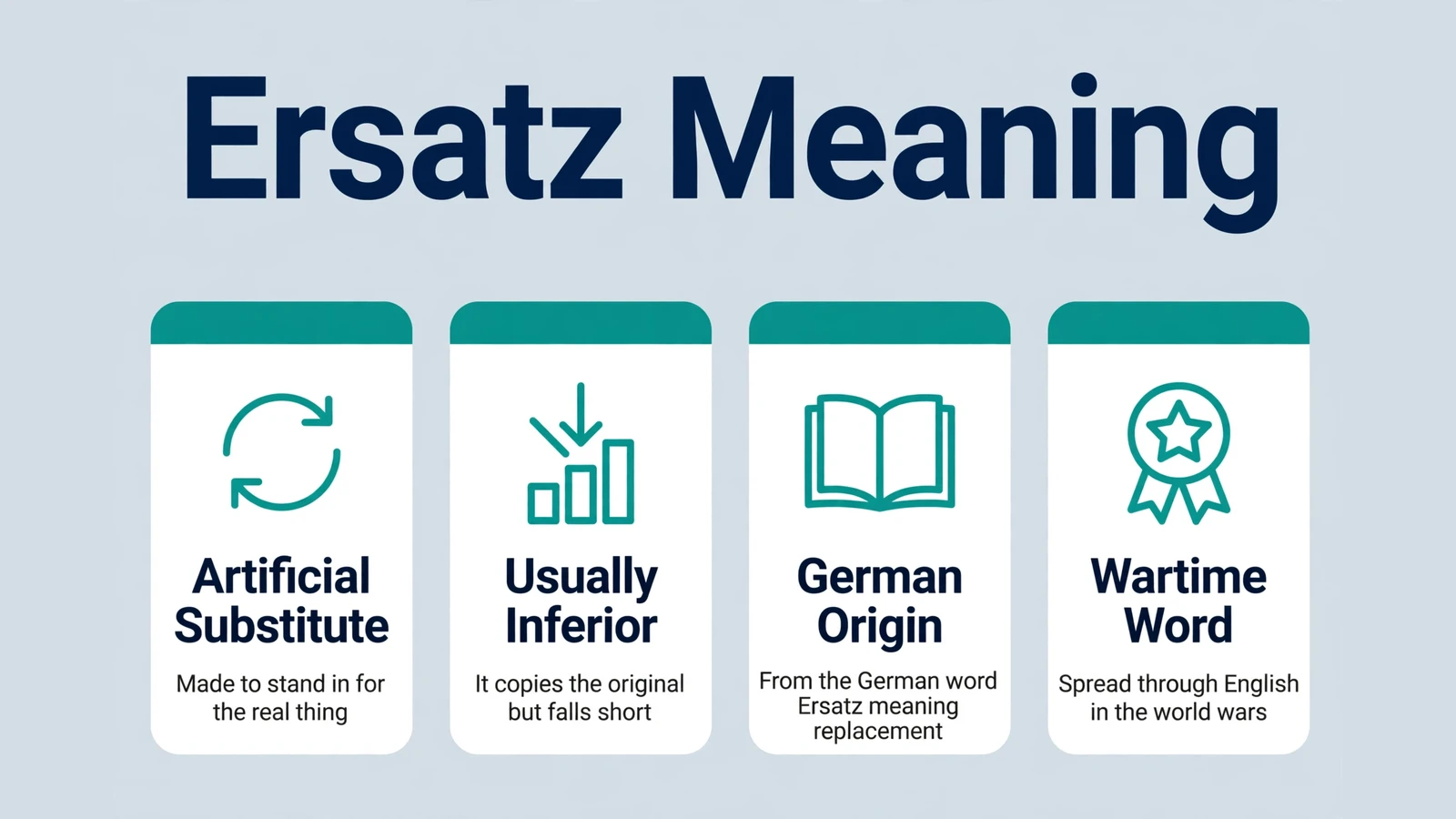
Order a coffee in a country cut off by war, and the cup in front of you might hold no coffee at all. Roasted acorns, chicory, or grain stood in for the real beans, and wartime drinkers had a word for it: ersatz. In plain terms, ersatz means made or used as a substitute for something genuine, and usually a worse one.
An ersatz product copies the real thing without matching it. Dictionaries define it as a usually artificial and inferior substitute or imitation. The word comes from German, and it spread through English during the two world wars.
Today, writers reach for it whenever a copy feels cheap, hollow, or not quite real. This guide covers the exact meaning, the pronunciation, the German origin, and the wartime history. It also shows how to use the word well in your own sentences.
What Does Ersatz Mean?
The Dictionary Definition
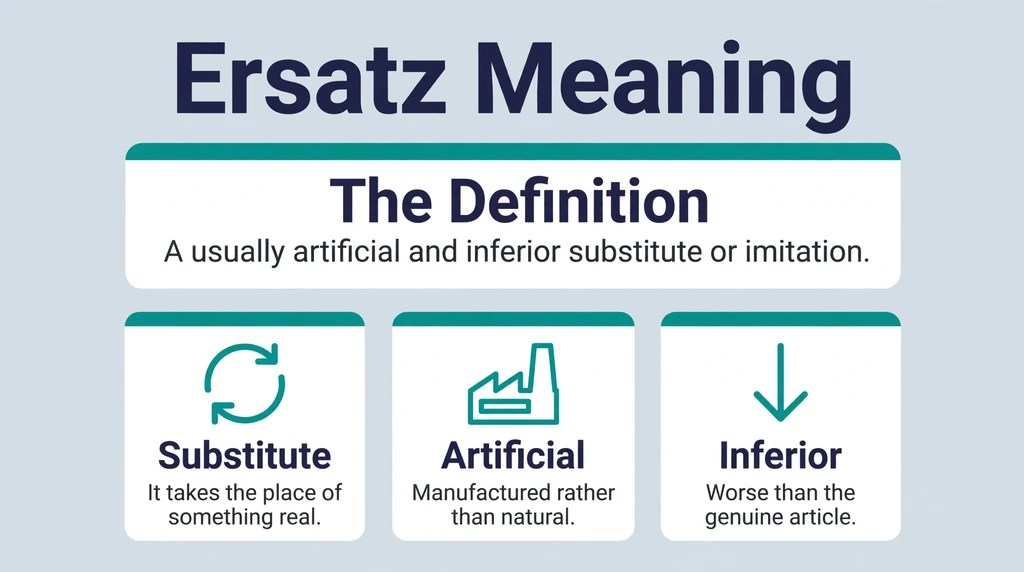
Merriam-Webster defines ersatz as “being a usually artificial and inferior substitute or imitation.” Read that definition slowly, because every word in it earns its place. A substitute takes the place of something else. An imitation copies the appearance or the role of the original. Artificial tells you the copy is manufactured rather than natural. Inferior adds the sting, since the replacement falls short of the genuine article. Other dictionaries agree closely. The American Heritage Dictionary uses nearly the same wording, and Collins describes ersatz as made in imitation of a natural or genuine product. So the core meaning stays stable across references. Ersatz names a stand-in that tries to pass as the real thing and quietly fails.
An Adjective First, a Noun Second
In English, ersatz works mainly as an adjective, and it usually sits right before a noun. You will see ersatz coffee, ersatz leather, and ersatz charm. The adjective labels the noun as a lesser copy of something real. Less often, ersatz appears as a noun in its own right. In that case it names the substitute itself, as in “the powder was an ersatz for real coffee.” The plural, ersatzes, exists but sounds clunky, so most writers avoid it. German treats the word differently, since Ersatz is a noun there and never an adjective. English flipped the roles when it borrowed the term. That flip explains why English speakers say “an ersatz version” so naturally. The borrowed noun became a handy label for anything that feels like a knockoff.
The Two Judgments Inside the Word
Every use of ersatz carries two judgments at once. The first judgment is practical: something real was missing, so a replacement filled the gap. The second judgment is about quality: the replacement does not measure up. A plain substitute carries only the first judgment. For example, a substitute teacher is simply a teacher who fills in, with no insult attached. An ersatz teacher, by contrast, would imply someone going through the motions of teaching. That built-in criticism is exactly why writers love the word. It lets them praise nothing and condemn something in a single breath. When you call a thing ersatz, you say it occupies the right slot but lacks the right substance. Keep both judgments in mind, and most dictionary examples will make instant sense.
Synonyms and Antonyms of Ersatz
The closest synonyms cluster around copying and faking. Merriam-Webster’s thesaurus leads with faux, and it also lists synthetic and unauthentic. Fake, imitation, artificial, mock, and sham all appear in dictionary synonym lists as well. Each synonym stresses a slightly different angle, though. Faux sounds fashionable, fake sounds dishonest, and synthetic sounds industrial. Ersatz stands apart because it adds disappointment to the copying. On the other side stand the antonyms: genuine, real, authentic, and natural. Those words describe the thing the ersatz copy wishes it were. Writers often set the pair side by side for contrast. A review might praise a genuine performance by mocking the ersatz one from last season. Knowing the family helps you pick the exact shade of praise or blame.
How to Pronounce Ersatz
The US and UK Versions
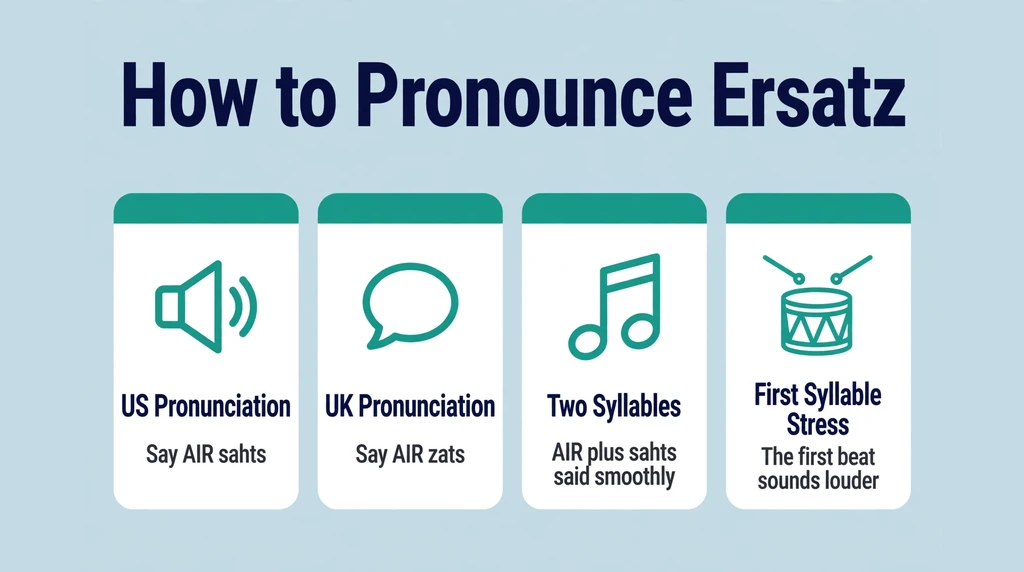
The most common American pronunciation is AIR-sahts, with the stress on the first syllable. Merriam-Webster prints that same pattern, and Cambridge gives the US form in phonetic symbols as /ˈer.zɑːts/. British speakers usually say AIR-zats instead. Cambridge lists the UK pronunciation as /ˈeə.zæts/, with a shorter, flatter second syllable. Some speakers also stress the second syllable and say er-ZAHTS, and dictionaries record that variant too. None of these versions is wrong, since the word is a loanword still settling into English mouths. If you pick the first-syllable stress, you will match the majority of educated speakers. Newsreaders and lecturers tend to use AIR-sahts in the United States.
A Simple Way to Say It
Break the word into two beats: AIR plus sahts. Start with the word “air,” the same sound you use for the air you breathe. Then add “sahts,” which rhymes with the end of “yachts” said quickly. Say the first beat a little louder and the second beat a little softer. Avoid reading it as “er-SATZ” with a hard final punch, because that ending sounds strained to most listeners. Also avoid splitting it into three syllables, since English keeps it at two. With a little practice, the word rolls out smoothly. Once you can say it, you can drop it into conversation without hesitation.
Mistakes Learners Often Make
Learners trip on the ending most of all. The final “tz” sound tempts them to add a third syllable, producing “er-sat-uhz.” English keeps the ending tight, so clip it short. Others stress the second syllable heavily because the German original stresses it. That version exists in dictionaries, yet the first-syllable stress sounds more natural in American speech. A third mistake is spelling: writers produce “erzats” or “ersatz” with a doubled s. Remember the German shape, er plus satz, and the spelling falls into place. Finally, do not soften the word with “very.” Ersatz already contains its judgment, and intensifiers only blunt it.
Where Does the Word Ersatz Come From?
A German Word for Replacement
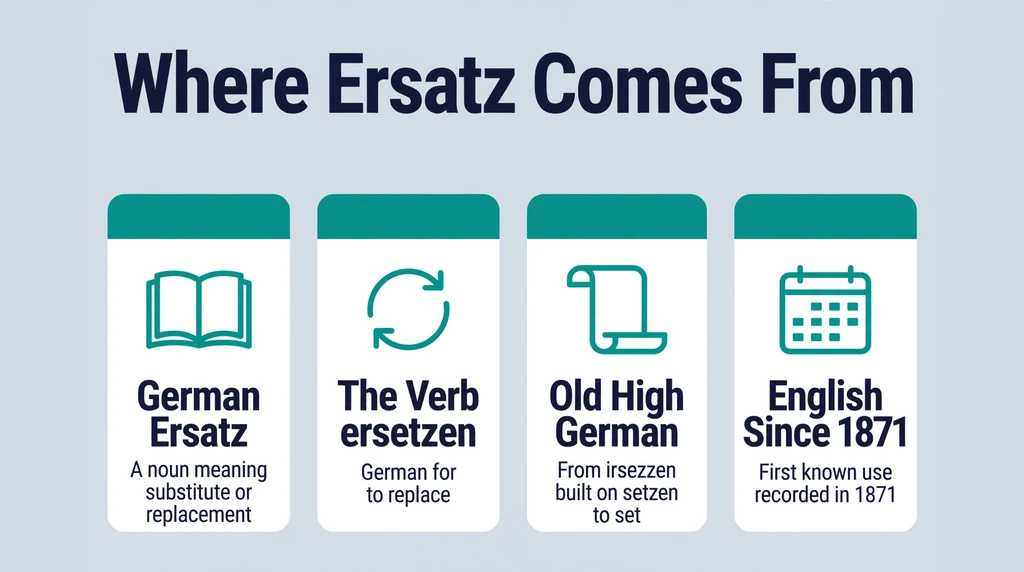
Ersatz comes straight from German, where Ersatz is a common noun meaning “substitute” or “replacement.” German capitalizes all nouns, so you will see it written with a capital E in German texts. English borrowed the word in the early 1870s. Merriam-Webster gives 1871 as the first known use of ersatz in English. Dictionary.com dates the borrowing to the same window, between 1870 and 1875. At first, English writers used it in a narrow, technical way. Then the world wars arrived, and everyday shortages gave the word a much bigger stage. Because the borrowing kept its German spelling, English readers still sense a foreign flavor in it. That foreign flavor suits the word well, since it often labels things that feel imported, improvised, or slightly off.
From ersetzen, “To Replace”
Behind the noun stands a German verb: ersetzen, which means “to replace.” The Online Etymology Dictionary traces ersetzen back to Old High German irsezzen. That older form joins a prefix, ir-, to setzen, the verb “to set.” Follow the chain further and you reach an ancient root meaning “to sit.” So the deep history runs from sitting, to setting something down, to setting something in place of another. Each step adds a layer of replacement. German builds many everyday words from Ersatz, because the language loves long compound nouns. Ersatzteile means “spare parts,” and Ersatzspieler means a substitute player on a team. Those neutral compounds show the word in its original, judgment-free home. English took the same word and gave it a sharper edge, as the next sections explain.
A Word That Kept Its German Spelling
Some loanwords change their clothes when they move. English usually drops foreign capitalization within a generation, and ersatz followed that rule, losing its capital E outside German compounds. The spelling, though, stayed untouched. English never respelled it as “airsats” or “erzats,” even while speakers argued about the pronunciation. That stability makes the word easy to spot in old texts. A reader can recognize it instantly in a memoir from 1918 or a novel from last year. The unchanged spelling also preserves the word’s biography. Every appearance quietly announces that English borrowed this judgment from somewhere else. Few six-letter words carry their passport so visibly.
How the Meaning Shifted in English
German speakers use Ersatz without any hint of criticism. A spare part is simply a spare part, and nobody feels insulted by it. English speakers, however, met the word during wartime. They heard it attached to bad coffee, thin bread, and shoddy goods. Because of that first impression, English ersatz absorbed a tone of complaint. Over time, the tone became part of the definition itself. Modern dictionaries now build “inferior” into the meaning, which German never did. This is a classic case of a borrowed word changing character in its new home. The word crossed a border, picked up the mood of the moment, and never gave it back. Writers today inherit that mood every time they choose ersatz over plainer words.
Ersatz in Wartime: How the Word Took Off
Blockade and Shortages in World War I
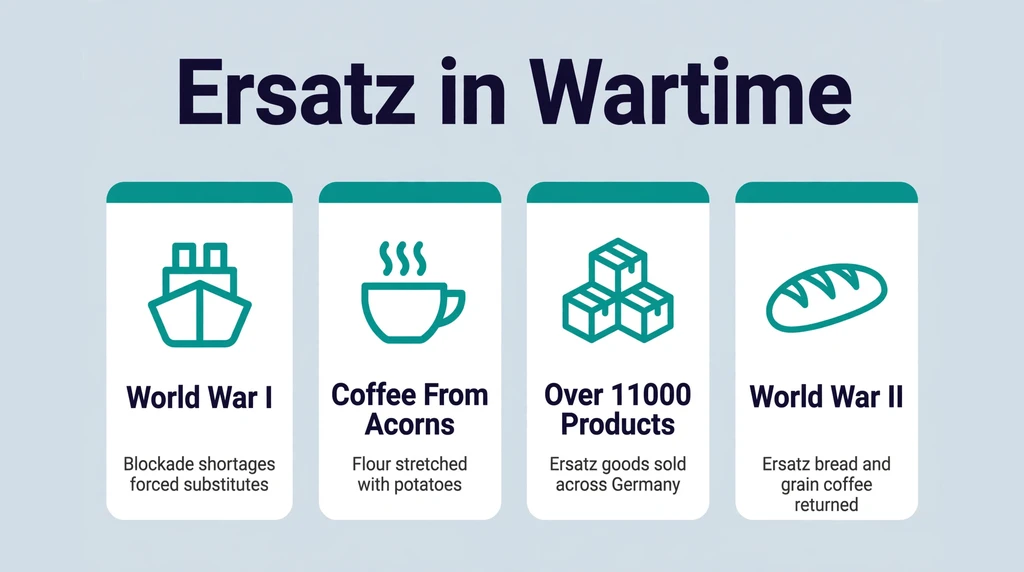
The First World War turned ersatz from a curiosity into a necessity. The Allied naval blockade limited trade with Germany, so factories and kitchens had to improvise. Coffee beans, rubber, cotton, and fats grew scarce or vanished entirely. In response, German industry produced substitutes on a huge scale. One wartime-era count put the number of ersatz products sold in Germany at more than 11,000. The list ran from synthetic rubber to paper textiles. Food suffered most of all, since cooks stretched wheat flour with potato flour and even powdered hay. Ersatz coffee, made from roasted acorns, became the symbol of the whole effort. Merriam-Webster notes that the word gained prominence in exactly this period. English newspapers reported on these strange substitutes, and the German word traveled with the stories.
Ersatz Corps and Ersatz Ships
The word also marched with the German army. In the opening months of the war, replacement troops came from the Ersatz Corps. These reserve units had less training than the soldiers they replaced, and they proved less effective in battle. The phrase carried the same pattern as the food: a stand-in that could not match the original. German shipyards used the word in a cooler, technical sense. A new warship built to replace an aging or lost vessel was called “Ersatz” plus the old ship’s name during construction. Secrecy rules hid real names until launch day, so the placeholder name stuck for months. One class of battlecruisers was even known as the Ersatz Yorck class. These military uses kept the word in official documents throughout the war. They also tied ersatz firmly to the idea of making do with second best.
World War II and the Second Wave
A generation later, the Second World War brought ersatz goods back. German soldiers received Ersatzbrot, a substitute bread made from potato starch. Recipes often stretched it further with extenders such as sawdust, and prisoners of war received the same loaves. Allied prisoners also drank Ersatzkaffee, an inferior grain coffee served by their captors. Thousands of English-speaking airmen and soldiers met the word this way, which popularized it in Britain. Meanwhile, besieged Leningrad handed out ersatz flour in place of wheat flour. Through such hard experiences, the word entered Russian and other Slavic languages as an insult. Merriam-Webster observes that by the end of this second war, ersatz was wholly entrenched in English. The word had completed its journey from German paperwork to everyday English vocabulary.
The Bread That Was Barely Bread
One exhibit shows how extreme the substitutions became. The Imperial War Museum in London displays a First World War ersatz loaf. Experts estimate that the loaf contains only about 20 percent actual bread. The rest is filler, added to stretch scarce flour across more mouths. Stand in front of that glass case and the definition stops being abstract. A loaf that is four-fifths substitute is ersatz made visible. It also explains the emotion inside the word. People did not resent the bakers, who worked with what they had. They resented the gap between the loaf they remembered and the loaf on the table.
After the Wars
Peace did not retire the word. Shortages in the Eastern Bloc kept ersatz goods on shelves for decades. In 1977, a coffee crisis in East Germany forced officials to introduce many coffee substitutes. The public generally rejected them, which confirmed the word’s gloomy reputation once again. Historians also applied the term backward in time. A well-known study of the American Civil War home front is titled Ersatz in the Confederacy. The title fits, since Southern households had improvised substitutes for coffee, cloth, and medicine generations earlier. By then, ersatz no longer belonged to any single war. It had become the standard English word for a substitute born of scarcity. Modern writers simply widened it further, as you will see next.
Why Ersatz Suggests Something Inferior
Substitute Is Neutral, Ersatz Is Not
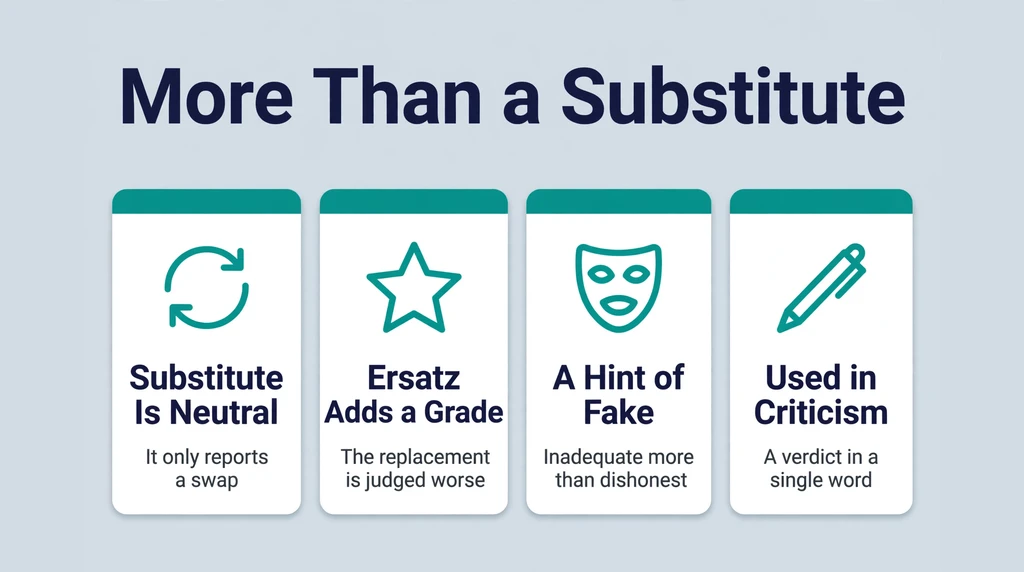
Substitute is a neutral word, and it simply reports a swap. A substitute ingredient might even improve a recipe, and a substitute player might win the match. Ersatz reports the swap and grades it at the same time. Calling something ersatz tells your reader the replacement is worse before you add another word. That is why the word appears so often in criticism, reviews, and opinion writing. A critic who calls a sequel an ersatz version of the original has finished the review in one adjective. The judgment rides inside the word itself, so the writer needs no extra explanation. Readers feel the downgrade instantly. If you want fairness, choose substitute. If you want a verdict, choose ersatz.
A Whisper of “Fake”
Ersatz also leans toward the territory of fake. A fake actively pretends to be the real thing, often to deceive a buyer. Ersatz usually makes a weaker claim, since everyone involved may know it is a copy. Wartime drinkers knew their acorn coffee contained no beans, yet they still called it ersatz. The word therefore suggests inadequacy more than dishonesty. Still, modern writers push it toward people and qualities, where it sounds sharper. An ersatz smile is not a real smile, and ersatz charm is charm performed rather than felt. In those phrases, the word questions authenticity itself. The copy lacks the inner substance of the original. That whisper of fakeness explains the word’s staying power in an age of knockoffs and imitations.
The Register: Slightly Literary, Always Pointed
Ersatz belongs to written English more than to casual speech. You will meet it in essays, reviews, history books, and quality journalism far more often than in conversation. That literary flavor is part of its effect. Dropping it into a chat can sound playful or mock-serious, and skilled speakers exploit that contrast for humor. In formal writing, though, it does serious work. It signals that the writer has judged the substitute and found it wanting. Because the word is pointed, one use per piece is usually enough. Repeat it in every paragraph and the criticism turns into a tic. Save it for the moment when disappointment peaks, and let it strike once, cleanly.
Ersatz Coffee: The Classic Example
What Went into Wartime Coffee
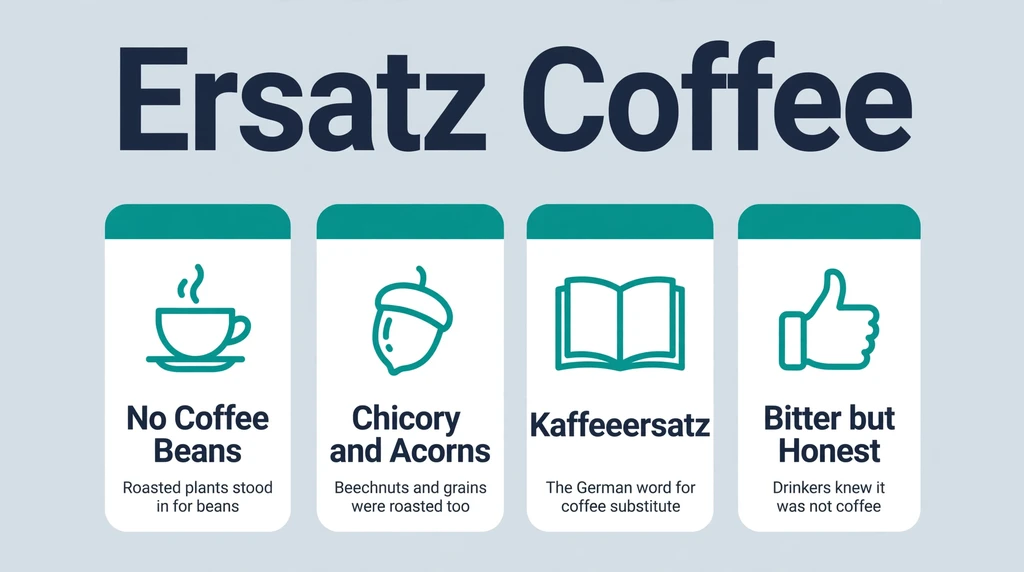
No example clings to the word like ersatz coffee. Real coffee beans reached Germany in tiny amounts during the blockade, so roasters turned to local plants. They roasted acorns, beechnuts, chicory, barley, and other grains, then ground the result into a dark powder. Dictionaries still use the drink to illustrate the word. The American Heritage Dictionary gives “ersatz coffee made of chicory” as its example. Random House offers “an ersatz coffee made from grain” instead. The German compound Kaffeeersatz names the whole category in one word. Some blends kept a little real coffee for flavor, while later wartime versions dropped the beans completely. Drinkers got a hot, bitter, coffee-colored cup. What they did not get was coffee.
Why Coffee Became the Symbol
Coffee suits the word for practical reasons. The drink has a strong flavor that substitutes can imitate in color but never in taste. Everyone who drank the substitute could measure the gap personally, cup after cup. Coffee was also a daily ritual, so its absence stung more than a missing luxury would. When prisoners described their grain coffee as ersatz, the complaint needed no translation. After the wars, the phrase ersatz coffee stayed in books and memoirs as shorthand for wartime deprivation. Even today, writers use it as the first example when they explain the word. If you remember one collocation, remember this one. It captures the scarcity, the imitation, and the disappointment in a single phrase.
Ersatz in Modern Life
From Rations to Reviews
The wars ended, but English kept the word and pointed it at new targets. Restaurant critics use it for whipped toppings, crab sticks, and truffle oil that never met a truffle. Film writers use it for sequels that copy a beloved original without its heart. Music journalists aim it at tribute acts and copycat bands. In each case, the pattern from the ration lines survives. A real thing exists, a cheaper stand-in takes its place, and the gap between them is the story. The word no longer needs a war to make sense. It only needs an audience that remembers the original and can taste the difference.
Why the Word Feels So Current
Modern life manufactures substitutes at industrial speed. Shoppers meet plant-based meats, lab-grown gems, virtual concerts, and machine-written text. Some of these replacements are excellent, and a few even beat the originals. Critics reach for ersatz precisely when a replacement feels hollow rather than helpful. The word gives their suspicion a name with a century of disappointment behind it. It also flatters the reader, who is assumed to know the real thing when they see it. That may be the secret of its survival. Every generation believes it lives among copies, and every generation needs a word that says so in one syllable of judgment. Ersatz, with its foreign snap and wartime echo, does the job beautifully.
Ersatz vs Substitute, Imitation, and Fake
Ersatz vs Substitute
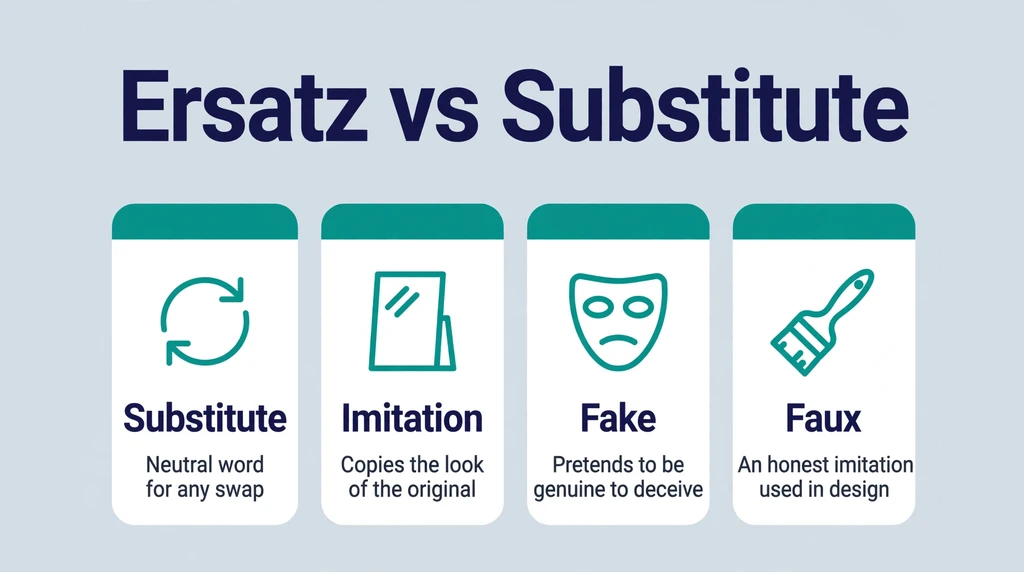
A substitute is any person or thing that takes another’s place. The word says nothing about quality, honesty, or materials. Margarine is a substitute for butter, and it can be a perfectly good one. Ersatz adds the missing verdict: the replacement imitates the original and falls short. All ersatz things are substitutes, but most substitutes are not ersatz. Choose substitute when you describe a fair exchange. Choose ersatz when the exchange shortchanges someone. The difference matters in careful writing, because readers catch the insult even when writers do not intend it. Calling a colleague’s stand-in “ersatz” would sound like an attack on their competence.
Ersatz vs Imitation
Imitation focuses on copying. An imitation diamond copies the sparkle of a real diamond, and skilled imitations can be excellent. The word imitation grades the resemblance, not the worth. Ersatz grades the worth first. An ersatz diamond would not just copy a diamond; it would copy it badly. Imitation also works as a neutral craft term, as in imitation leather used openly on labels. Writers pick imitation when the copy is the topic. They pick ersatz when the disappointment is the topic. Think of it this way: imitation describes the method, while ersatz describes the result. A product can be a fine imitation and still be called ersatz by a disappointed customer.
Ersatz vs Fake and Faux
Fake is the harshest word in this family. A fake watch pretends to be a luxury brand, and the pretense is the point. Fake implies an intent to deceive, which ersatz usually lacks. Faux, borrowed from French, sits at the gentle end. Faux fur and faux finishes are honest design choices, and nobody feels cheated by them. Ersatz lands between faux and fake, though closer to fake in tone. It lacks the cheerful honesty of faux and the criminal edge of fake. Instead, it carries weary disappointment: this is all we could get. Knowing these shades lets you grade your criticism precisely. Reach for faux for fashion, fake for fraud, and ersatz for the sad stand-in.
How to Use Ersatz in a Sentence
Ersatz with Things
Place ersatz directly before a noun when you describe a physical substitute. The classic pattern is ersatz plus a food, drink, or material. Here are natural examples in that pattern:
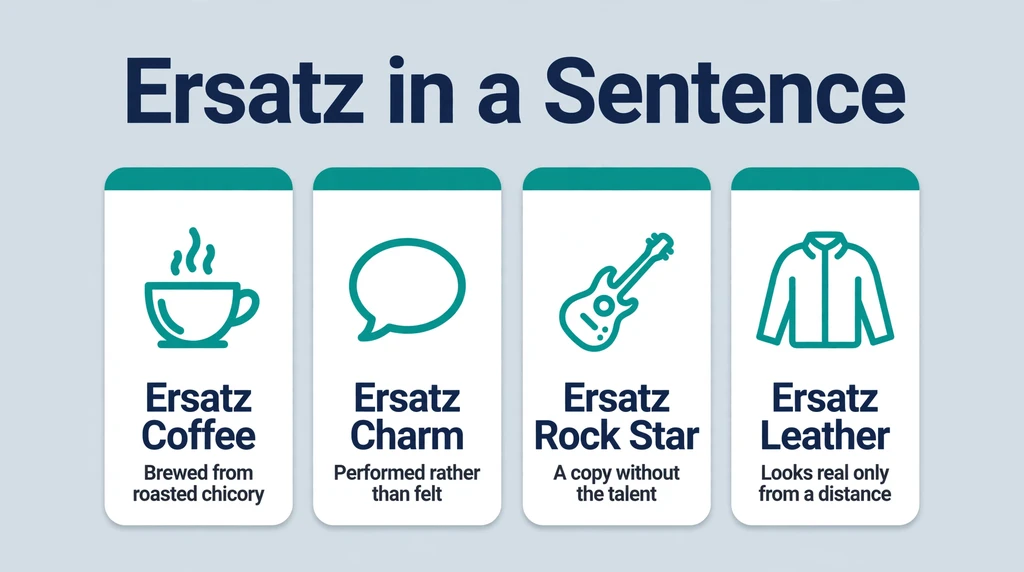
- The café served ersatz coffee brewed from roasted chicory, and nobody asked for a second cup.
- Her jacket looked like leather from a distance, but the stiff ersatz material gave it away.
- During the shortage, bakers sold an ersatz loaf that tasted faintly of potato and straw.
- The stage set featured ersatz marble columns painted on plywood.
- He sweetened his tea with an ersatz syrup that left a chemical taste behind.
Each sentence works because the replacement is easy to picture. The reader knows the real thing, sees the copy, and feels the drop in quality. Concrete nouns give the adjective something solid to judge.
Ersatz with People and Qualities
Writers also aim ersatz at people, performances, and feelings. In this pattern, the word attacks authenticity rather than ingredients. Consider these examples:
- The tribute act was an ersatz rock star, complete with wig, accent, and borrowed swagger.
- He offered an ersatz apology that mentioned everything except being sorry.
- Her ersatz charm fooled the new clients but tired everyone who knew her better.
- The speech delivered ersatz outrage, loud for the cameras and gone by lunch.
- Their ersatz friendship survived only while both of them needed something.
Notice how each example pairs the word with something that should be genuine. Charm, apologies, and friendship lose their value when they are performed. That clash between the real and the performed is the word’s favorite hunting ground. Use it there, and your sentence will land with a sting.
Ersatz as a Noun
Occasionally, ersatz steps out from before the noun and works as a noun itself. In that role it names the substitute directly. A memoirist might write that the prisoners’ coffee was a bitter ersatz, full stop. A historian might call the wartime loaf an ersatz that fooled no one. The construction “an ersatz for” also appears, as in “a sad ersatz for the real celebration.” These uses sound slightly formal, which suits history writing and literary prose. Everyday conversation prefers the adjective, so beginners should master that pattern first. Still, meeting the noun in older books will not confuse you now. It carries the same two judgments: something replaced, and something lost.
Ersatz in German: A Neutral Everyday Word
Everyday Compounds
Travel to Germany today and you will meet Ersatz everywhere, with no insult attached. Shops sell Ersatzteile, spare parts for cars, bikes, and washing machines. Football reports name the Ersatzspieler, the substitute player waiting on the bench. Rail announcements promise an Ersatzzug, a replacement train, when the scheduled one fails. Each compound uses Ersatz as a plain label for a replacement. German grammar builds these long words by gluing nouns together, and Ersatz glues easily. Nobody hears disappointment in them. A spare part that fits is simply a good part. The English sneer is entirely an English addition.
The Word Germans Use for “Inferior”
German does have a term for a lesser substitute: Surrogat. It is a cousin of the English word surrogate. A German speaker who wanted the English flavor of ersatz would reach for Surrogat instead. This contrast is the clearest proof that borrowings can drift. English speakers met Ersatz on wartime labels and in prisoners’ stories. They never met it in a hardware shop. So the war sense won, and the neutral sense stayed behind in Germany. When you read German texts, translate Ersatz as “replacement” and nothing more. When you read English texts, expect the raised eyebrow that English added.
Common Misconceptions About Ersatz
Misconception 1: Ersatz Just Means “Substitute”
Many learners file ersatz as a fancy synonym for substitute, and the filing is wrong. Substitute stays neutral about quality, while ersatz quietly condemns the replacement. Dictionaries build “inferior” into the definition for a reason. If you describe a helpful stand-in as ersatz, you have insulted them by accident. Treat the word as a judgment, not a label. That single correction will fix most misuse of the term.
Misconception 2: Ersatz Always Means Fake
The opposite error also appears: readers assume ersatz means counterfeit. A fake tries to pass as genuine and deceive someone. Most ersatz goods never hid what they were. Wartime shoppers knew the coffee held no beans and the bread held potato starch. The goods were honest about being substitutes; they were just poor ones. Ersatz describes the shortfall, not a fraud. Save fake for deception, and use ersatz for the openly inadequate copy.
Misconception 3: Only Food Can Be Ersatz
Beginners sometimes think the word belongs only to wartime food. The dictionary examples start with coffee and flour, which creates that impression. Modern usage, though, covers almost anything with a genuine version to fail against. Writers apply it to music, manners, emotions, expertise, and entire experiences. If a real version exists and a copy disappoints, ersatz fits. The wartime foods are the origin story, not the boundary.
Frequently Asked Questions
What does ersatz mean in simple words?
Ersatz means a substitute that imitates something real but is worse than it. If a product, performance, or quality feels like a cheap copy of the genuine article, English speakers call it ersatz. The word always carries a hint of disappointment.
How do you pronounce ersatz?
Say AIR-sahts, with the stress on the first syllable. British speakers often say AIR-zats. Both forms appear in major dictionaries, so either choice will sound natural in conversation.
Is ersatz a German word?
Yes. English borrowed it from German, where Ersatz is a noun meaning “substitute” or “replacement.” It comes from the verb ersetzen, “to replace,” and English has used it since the early 1870s.
Does ersatz always mean inferior?
In English, almost always. Dictionaries include “inferior” in the definition, and readers expect the criticism. In German, by contrast, Ersatz is neutral and simply means a replacement, with no judgment about quality.
What is ersatz coffee?
Ersatz coffee is a coffee substitute made without coffee beans, or with very few. Wartime versions used roasted acorns, chicory, beechnuts, or grains. It looked like coffee and tasted bitter, but drinkers never mistook it for the real thing.
What is the difference between ersatz and faux?
Faux describes an honest imitation used as a design choice, like faux fur. Nobody feels cheated by it. Ersatz describes a substitute that falls short of the original, so it sounds disappointed or critical rather than stylish.
Can ersatz describe a person?
Yes. Writers call someone an ersatz rock star or an ersatz expert when the person imitates a role without the talent or substance behind it. The word then attacks authenticity, not ingredients.
Is ersatz an insult?
Usually, yes, at least a mild one. Because English built “inferior” into the word, calling something ersatz criticizes it. The insult targets the copy rather than a person, unless you aim it at someone’s work, cooking, or performance.
Final Thoughts
Ersatz packs a whole story into six letters. It began as a plain German word for replacement, crossed into English in the 1870s, and found fame in the shortages of two world wars. Along the way it picked up the judgment that English dictionaries now print in the definition: artificial, imitative, and inferior. Use substitute when you mean a fair swap. Use faux when the imitation is honest and stylish, and fake when someone means to deceive. Save ersatz for the stand-in that occupies the right place with the wrong substance, from acorn coffee to a hollow apology. If you want to explore the word’s history further, Merriam-Webster’s Word of the Day essay on ersatz is a good next read.