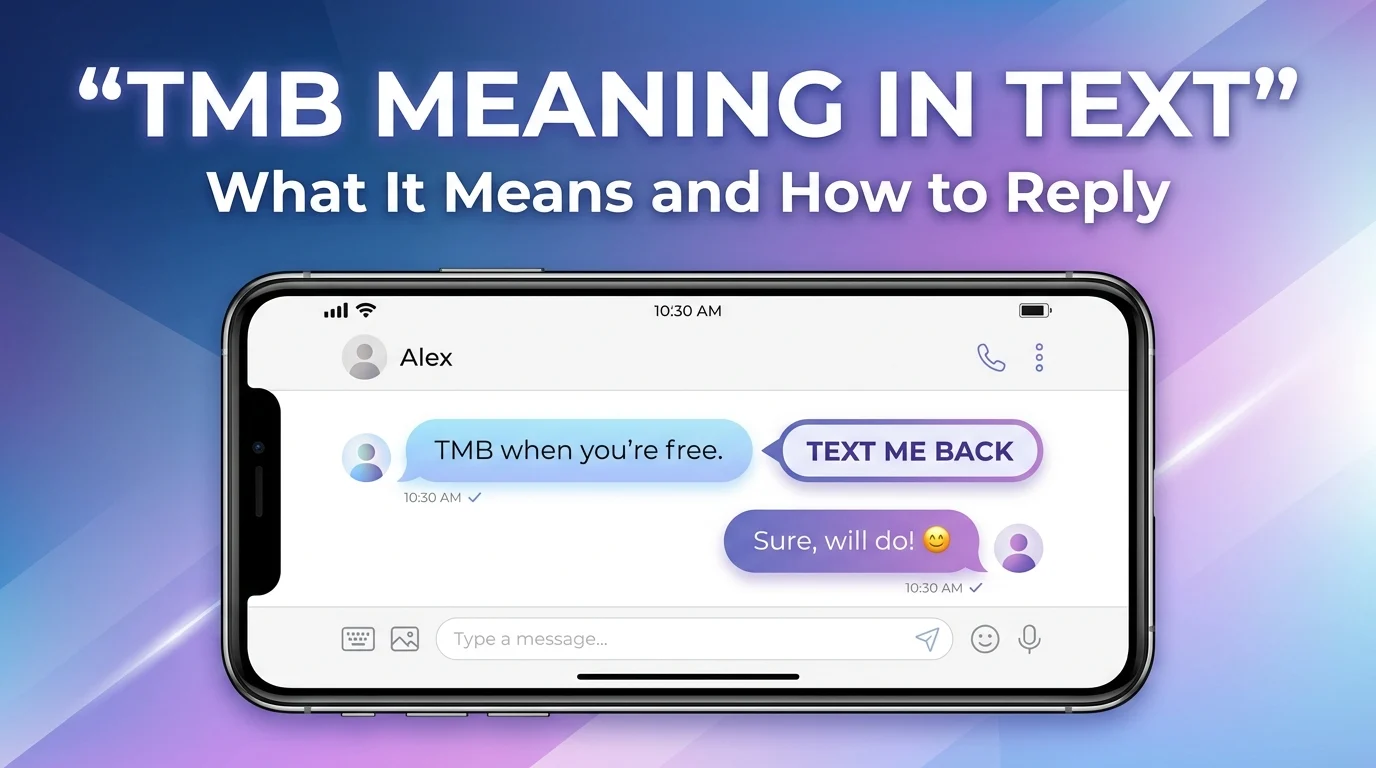
Have you ever received a message that simply says “TMB” and wondered what the sender wants? You’re not alone. Texting abbreviations can make everyday conversations confusing, especially when three little letters carry an entire message.
The TMB meaning in text is usually “Text Me Back.” Someone uses it to ask you to reply to a text message or continue a conversation. For example, a friend might write, “TMB when you get home,” meaning they want you to send them a message after you arrive.
However, TMB can have other meanings depending on the conversation. It may refer to “Tag Me Back” or “Tweet Me Back” in certain online interactions. In Spanish-language texting, lowercase tmb can also stand for también, meaning “also” or “too.”
The surrounding words usually reveal which interpretation makes sense.
In this guide, you’ll learn what TMB stands for, how people use it in text messages, what it means on social media, and how to respond naturally.
What Does TMB Mean in Text?
In everyday English texting, TMB most commonly means “Text Me Back.” It’s an informal abbreviation people use when they want someone to respond to a message.
Instead of typing an entire sentence, a person can simply write “TMB” to communicate the same basic request.
For example:
Alex: Hey, did you decide what time we’re meeting?
Jordan: Not yet. I’ll check and let you know.
Alex: Okay, TMB when you know.
Here, Alex wants Jordan to send another message once the decision becomes clear.
The abbreviation can communicate several closely related intentions:
- Requesting a reply: The sender expects you to respond to a question or message.
- Continuing a conversation: The sender wants to keep talking later.
- Getting an update: The sender wants you to share new information when you have it.
- Following up: The sender is reminding you to respond after you’ve had time to think.
TMB doesn’t automatically mean that a reply must be immediate. The sender’s wording and the situation determine how quickly they expect to hear from you.
For instance, “TMB ASAP” suggests urgency, while “TMB when you’re free” gives you more flexibility.
What Does TMB Stand for in Texting?
TMB stands for Text Me Back in its common English texting use. Each letter represents the first letter of one word.
| Letter | Word | Meaning |
|---|---|---|
| T | Text | Send a text message |
| M | Me | Contact the person who sent the message |
| B | Back | Respond or communicate again |
Put the words together and the meaning becomes straightforward: the sender wants you to text them in response.
TMB functions as an informal initialism because people read its letters individually rather than treating them as a conventional spoken word.
You’ll generally see it in casual text messages, private chats, and informal social media conversations. It isn’t a standard choice for formal business correspondence, although people may use it with coworkers they know well.
Is TMB Slang or an Acronym?
TMB is best described as a texting abbreviation or initialism when it means “Text Me Back.”
People sometimes call it an acronym in everyday conversation. Technically, however, an initialism differs from an acronym because you pronounce its individual letters rather than blending them into a word.
This distinction doesn’t change how people use it. In casual messaging, TMB serves as shorthand for a familiar request.
You can think of it alongside expressions such as:
- BRB: Be Right Back
- BTW: By the Way
- TBH: To Be Honest
- TTYL: Talk to You Later
These expressions save typing time and help people communicate quickly. TMB follows the same pattern, although it specifically asks the recipient to send another message.
Other Possible Meanings of TMB
Although “Text Me Back” is the clearest interpretation in ordinary English texting, it isn’t the only possible meaning. TMB can represent other expressions in particular settings.
The important thing is to distinguish established uses from creative interpretations that a friend group or online community may invent.
| Meaning | Likely context | What the sender means |
|---|---|---|
| Text Me Back | Everyday English texts and private messages | Send me a reply |
| Tag Me Back | Certain social media interactions | Tag me in return |
| Tweet Me Back | Older Twitter-related conversations | Respond to me on Twitter |
| También | Informal Spanish-language messages | Also or too |
| Take Me Back | Nostalgic posts or conversations | Return me to a past moment or experience |
These meanings aren’t equally interchangeable. The words surrounding TMB provide the strongest clue.
TMB Meaning as “Tag Me Back”
In some social media interactions, TMB can mean “Tag Me Back.” The sender wants you to mention or tag their account in a post, story, photo, or related interaction.
For example:
Mia: I posted our group photo.
Lena: TMB when you share the second one!
In this imagined conversation, Lena wants Mia to tag her when sharing the next photo.
This interpretation makes sense when the conversation involves social media mentions, usernames, or shared content. It makes less sense when someone asks you a direct question in a regular text message.
Because this expansion isn’t universally recognized, don’t assume that every social media use of TMB means “Tag Me Back.”
TMB Meaning as “Tweet Me Back”
TMB has also been used to mean “Tweet Me Back.” This interpretation belongs to Twitter’s older terminology, when people commonly described posts as tweets.
For example:
“I just mentioned you in my post. TMB!”
The sender wants the other person to respond to their post or mention.
Today, the interpretation is more historically specific because Twitter was renamed X in 2023. You may still encounter it in older conversations or among people familiar with that terminology.
In contemporary messages, “Text Me Back” is generally the more straightforward interpretation unless the conversation clearly concerns Twitter or X.
TMB Meaning as “También” in Spanish Texting
Language matters, too. In Spanish-language digital conversations, lowercase tmb is an informal abbreviation for también, which means “also” or “too.”
For example:
Lucía: Me gusta esa canción.
Carlos: A mí tmb.
The second person means, “I like that song too.”
Here, tmb doesn’t ask anyone to send a reply. It simply expresses agreement or adds another person to a statement.
You may encounter it in Spanish-language conversations on messaging apps and social networks. Other Spanish abbreviations can appear alongside it, so reading the entire message is often necessary.
For example:
- Yo tmb: Me too.
- A mí tmb: Me too, or I do too, depending on context.
- Yo tmb quiero ir: I also want to go.
The spelling and punctuation may vary in informal messages. If the conversation is in Spanish, consider the Spanish meaning before interpreting TMB as English texting slang.
TMB Meaning as “Take Me Back”
In nostalgic conversations, posts, or comments, TMB may stand for “Take Me Back.” Someone might use it when remembering a vacation, school year, celebration, or another enjoyable experience.
For example:
“Summer vacation 2022. TMB!”
The likely message is that the person wishes they could return to that time.
This use is context-dependent rather than a universal interpretation. A nostalgic photograph or a reference to the past makes it more plausible than an ordinary conversation about plans.
Compare these examples:
- “TMB when you reach home.” Here, “Text Me Back” makes sense.
- “TMB to our graduation day.” Here, “Take Me Back” may fit the nostalgic context.
When the abbreviation appears without enough information, don’t force a meaning. Ask the sender what they intended.
How to Use TMB in a Text Message
Using TMB is simple once you understand its purpose. Most of the time, you add it to a casual message when you want the other person to contact you again.
However, the surrounding words help communicate when you expect the reply and why you need it.
Asking Someone to Reply
Use TMB when you’re waiting for an answer and want the other person to message you back.
Example:
“Are we still meeting at 6? TMB.”
The sender wants a clear answer about the plan. The abbreviation keeps the message short, although a full sentence may sound more polite in a sensitive situation.
You can also write:
- “TMB when you get a minute.”
- “TMB so we can finalize the plans.”
- “Let me know what you think. TMB.”
These examples work best in informal conversations where both people understand the shorthand.
Requesting a Reply Later
Sometimes you don’t need an immediate response. You simply want the other person to get back to you when they have time.
Example:
“I’m heading into a meeting. TMB when you’re available.”
This example asks for a response later rather than demanding attention right away.
Adding a phrase such as “when you’re free” or “when you get a chance” helps communicate patience. It also makes the message sound warmer.
Following Up on an Important Question
TMB can remind someone to respond to a question that affects your plans.
Example:
“Can you confirm whether you’re coming tonight? TMB before 5 if possible.”
The time reference explains when the sender needs an answer.
This detail matters because TMB alone doesn’t communicate a deadline. If you need a reply by a specific time, state that expectation clearly rather than assuming the recipient will understand your urgency.
For a more polite version, write, “Please let me know by 5 if you can.”
Continuing a Casual Conversation
Friends may use TMB when they want to pick up a conversation later.
Example:
“I have to go help my family. TMB later!”
The sender is ending the conversation temporarily but expects to reconnect.
The abbreviation doesn’t necessarily mean the other person ignored a previous message. It can simply communicate an intention to talk again.
Using TMB With Friends and Family
TMB works naturally in many informal relationships, particularly when both people use texting shortcuts.
For instance:
Sam: Did you find the address?
Riley: Not yet. I’ll check.
Sam: Okay, TMB when you do.
The request is brief, understandable, and connected to the topic.
Still, don’t overuse the abbreviation in every message. If the recipient prefers complete sentences or doesn’t recognize texting slang, spell out what you mean.
TMB Meaning in Different Conversations
The core meaning of TMB usually stays the same in English texting, but the relationship between the sender and recipient can affect its tone.
A message between close friends may sound casual. The same abbreviation in a tense conversation may feel demanding.
TMB Between Friends
Friends often use TMB to keep plans moving or continue a conversation.
For example:
“Found a new restaurant for Saturday. TMB if you want to come!”
In this case, the sender wants the recipient to respond about the invitation.
The message is informal, and there’s no clear sign of frustration. The sender simply wants an answer.
TMB in Romantic or Flirty Conversations
Someone might use TMB while talking to a romantic partner, a person they’re dating, or someone they’re interested in.
For example:
“Had fun talking to you tonight. TMB tomorrow 😊”
The message suggests that the sender would like to talk again.
However, TMB doesn’t automatically mean someone is flirting or romantically interested. It communicates a desire for another message. The relationship, previous conversation, and other wording provide the missing context.
An affectionate emoji or a warm message may add a flirty tone, but the abbreviation itself doesn’t prove romantic interest.
TMB in Family Messages
Family members might use TMB to request an update about someone’s arrival, plans, or well-being.
For example:
“Text me when you get there. TMB!”
The sender wants the recipient to provide an update after arriving.
Depending on the situation, the request may reflect ordinary coordination or concern for someone’s safety. The abbreviation alone doesn’t tell you which one.
TMB in Group Chats
Group conversations often involve multiple people, so TMB can direct a request toward one particular person.
For example:
Taylor: Who’s picking up the tickets?
Morgan: I can do it.
Taylor: Great, TMB when you have them.
Here, Taylor wants Morgan to send an update once the tickets are ready.
In a group chat, make sure your message clearly identifies who should respond. Otherwise, several people might assume someone else will handle the request.
TMB Meaning on Social Media
TMB can appear on messaging platforms and social networks, including WhatsApp, Snapchat, Instagram, TikTok, and X. The platform alone doesn’t determine the meaning.
The main question is whether the conversation concerns ordinary messaging, public posts, or another activity.
TMB on WhatsApp
In an English-language WhatsApp conversation, TMB usually means “Text Me Back.”
For example:
“I sent you the location. TMB when you see it.”
The sender wants the recipient to acknowledge the message or respond after checking the location.
WhatsApp conversations can also include abbreviations from other languages. If someone writes in Spanish, tmb may mean también instead.
TMB on Snapchat
A person may use TMB in a Snapchat chat when they want a response to a message or want to continue talking.
Example:
“I’ll send you the details later. TMB when you get this.”
The likely meaning is “Text Me Back.”
Don’t assume TMB refers to a special Snapchat feature. Unless the conversation points to another interpretation, treat it as informal shorthand.
TMB on Instagram
On Instagram, the meaning depends partly on whether the message appears in a direct message, comment, or post caption.
In a direct message, “Text Me Back” is a reasonable default interpretation.
In a conversation about photos or account mentions, “Tag Me Back” may make more sense.
For example:
- Direct message: “Did you see my question? TMB.”
- Photo-sharing conversation: “TMB when you post the next picture.”
The first example requests a response. The second might request a reciprocal tag if that’s how the participants use the abbreviation.
TMB on TikTok
TMB may appear in TikTok comments, captions, or private conversations.
A comment beneath an old video or nostalgic memory might use it to express a desire to return to the past. In that context, “Take Me Back” may fit.
A private message asking someone to respond is more likely to use TMB as “Text Me Back.”
Don’t treat either reading as automatic. Check the video, caption, and conversation before deciding.
TMB on X (Twitter)
The meaning depends on the age and nature of the conversation.
Someone using older Twitter terminology might mean “Tweet Me Back.” In an ordinary direct message, however, the sender may simply mean “Text Me Back.”
Because TMB isn’t a universal platform-specific term, the safest interpretation comes from the message itself.
How to Reply When Someone Texts You TMB
When someone sends you TMB, you usually don’t need to decode anything complicated. They most likely want you to respond.
The best reply depends on whether you can answer immediately, need more time, or don’t want to continue the conversation.
If You Can Reply Right Away
When you already know the answer, respond directly.
Examples:
- “Sure! I’ll call you in a minute.”
- “Yes, Saturday works for me.”
- “I got your message. Thanks!”
- “I’m free tonight. What’s the plan?”
You don’t have to repeat TMB or acknowledge the abbreviation itself. Just respond to the original question or request.
If You’re Busy
If you can’t reply fully at the moment, send a short acknowledgment and explain when you’ll have time.
Examples:
- “I’m busy right now, but I’ll reply tonight.”
- “In class at the moment. I’ll text you when I’m out.”
- “I saw your message. Give me a little time.”
- “I’ll get back to you after work.”
These responses set expectations without leaving the sender wondering whether you received the message.
If You Need More Time to Decide
Some messages require thought rather than a quick yes or no.
For example, someone might ask you to attend an event, join a project, or make plans for the weekend.
You could reply:
- “Let me check my schedule first.”
- “I’m not sure yet, but I’ll let you know tomorrow.”
- “I need a little time to think about it.”
- “I’ll give you an answer once I know for sure.”
These responses are more helpful than promising a reply immediately when you don’t know when you’ll have an answer.
If You Don’t Want to Continue the Conversation
You aren’t required to continue every conversation simply because someone asks you to text back.
If a response is appropriate, you can communicate your decision clearly and respectfully.
For example:
- “Thanks for checking in, but I don’t want to continue this conversation.”
- “I appreciate your message, but I’m not interested.”
- “I don’t have anything else to add right now.”
You can also choose not to respond when the situation calls for it, particularly if further contact feels unwanted or uncomfortable.
The key is to choose a response that reflects your intentions rather than using a reply merely because the abbreviation creates pressure.
Does TMB Sound Rude, Impatient, or Flirty?
TMB isn’t inherently rude. It’s a request for a response, and the sender’s tone depends on the surrounding message.
Because the abbreviation is short, it may sound abrupt when it appears by itself. That doesn’t necessarily mean the sender is angry.
Consider these examples:
| Message | Likely tone | Why it sounds that way |
|---|---|---|
| “TMB when you’re free 😊” | Friendly | It gives the recipient time and uses a warm tone. |
| “Hey, TMB when you get home.” | Casual | It connects the reply to a specific event. |
| “I’ve asked three times. TMB now.” | Frustrated | The wording suggests that the sender has been waiting. |
| “TMB ASAP, please.” | Urgent | The sender clearly requests a quick response. |
| “Miss talking to you. TMB later ❤️” | Affectionate | The surrounding words express warmth. |
Capitalization alone doesn’t establish tone. Some people type abbreviations in uppercase by habit, while others prefer lowercase.
Punctuation can affect the impression, too. “TMB!” may express enthusiasm or urgency, depending on the conversation. It doesn’t always indicate anger.
If you’re unsure how the sender feels, look at the previous messages and the nature of the request. Don’t infer an entire emotional state from three letters.
Is TMB Appropriate for Professional Messages?
TMB generally works better in casual conversations than in formal workplace communication.
Although some coworkers use texting shortcuts with each other, the abbreviation may sound too abrupt in an email, client message, or discussion involving an important decision.
Instead of writing “TMB,” choose wording that clearly communicates what you need.
| Casual wording | Clearer professional alternative |
|---|---|
| TMB ASAP | Please reply as soon as possible. |
| TMB when free | Please respond when you have a chance. |
| TMB about the report | Please let me know your thoughts on the report. |
| TMB by 3 | Please send your response by 3 p.m. |
| TMB if you’re coming | Please confirm whether you’ll attend. |
These alternatives provide more information and help reduce misunderstandings.
For a quick message to a close colleague, informal language might be perfectly acceptable. For formal communication, complete sentences usually create a clearer and more professional impression.
TMB vs. Similar Texting Abbreviations
Several texting abbreviations resemble TMB in style, but they serve different purposes. Learning the difference can help you understand messages without guessing.
| Abbreviation | Full form | Main purpose |
|---|---|---|
| TMB | Text Me Back | Requests a reply |
| LMK | Let Me Know | Requests information or a decision |
| HMU | Hit Me Up | Invites someone to contact you |
| CMB | Call Me Back | Requests a return phone call |
| TTYL | Talk To You Later | Indicates that you’ll talk later |
| BRB | Be Right Back | Says you’ll return shortly |
| TBH | To Be Honest | Introduces an honest opinion or statement |
| IDK | I Don’t Know | Expresses uncertainty |
| OMW | On My Way | Says you’re traveling toward a destination |
| WYD | What You Doing? | Asks what someone is doing |
TMB vs. LMK
TMB and LMK both involve communication, but they focus on different things.
TMB asks someone to send a message back. LMK asks someone to share information, an opinion, or a decision.
For example:
- “TMB when you get home.” The sender wants a reply after you arrive.
- “LMK when you get home.” The sender wants you to inform them once you’ve arrived.
The difference is subtle. However, LMK emphasizes the information you should provide, while TMB emphasizes the act of replying.
TMB vs. HMU
HMU means “Hit Me Up,” an informal way to invite someone to contact you.
TMB is more specific because it usually requests a response to an existing message or conversation.
Compare these examples:
- “HMU when you’re free.” Contact me when you have time.
- “TMB when you’re free.” Reply to my message when you have time.
Both are casual, but the first doesn’t necessarily require an earlier unanswered message.
TMB vs. CMB
CMB means “Call Me Back.” It asks someone to return a phone call rather than send a text message.
For example:
“I tried calling you. CMB when you’re available.”
By contrast, “TMB when you’re available” asks for a text response.
This distinction matters when the sender needs to discuss something by phone or prefers written communication.
TMB vs. TTYL
TTYL means “Talk to You Later.” People often use it to end a conversation temporarily.
TMB, on the other hand, asks the recipient to contact the sender again.
For example:
- “I’ve got to go now. TTYL!” The sender is leaving the conversation.
- “I’ve got to go now. TMB tonight.” The sender expects the recipient to send another message later.
The expressions can appear in the same conversation, but their immediate purposes differ.
TMB Meaning in Text Examples
Examples make the abbreviation easier to recognize because they show how the same letters work in different situations.
Here are several realistic, illustrative conversations.
| Situation | Example message | Meaning |
|---|---|---|
| Making plans | “What time should we leave? TMB.” | Send an answer about the departure time. |
| Arriving home | “TMB when you reach home.” | Send a message after arriving. |
| Making a decision | “Check with your brother and TMB.” | Respond after getting the information. |
| Catching up | “It’s been ages! TMB when you’re free.” | Get in touch and continue talking. |
| Sharing an update | “Let me know when the package arrives. TMB.” | Send a message with the update. |
| Requesting urgency | “Please TMB before noon.” | Reply before the stated deadline. |
| Romantic conversation | “I liked our date. TMB tomorrow ❤️” | Send another message the next day. |
| Spanish conversation | “Yo tmb quiero ir.” | I want to go too. |
| Nostalgic post | “Those school days. TMB!” | A context-dependent expression of wanting to return to the past. |
Notice how the first seven examples involve some form of communication. The Spanish example works differently because tmb abbreviates también. The nostalgic example relies on the subject and surrounding content.
You can use a simple three-step method whenever you encounter an unfamiliar use:
- Read the whole message. Look for words that suggest a reply, a social media action, or another meaning.
- Check the conversation’s language. An English chat and a Spanish chat may use the same letters differently.
- Consider the situation. A direct question makes “Text Me Back” plausible, while a nostalgic photo may support another interpretation.
If the message still doesn’t make sense, asking the sender is better than relying on a guess.
Frequently Asked Questions
What does TMB mean in text?
TMB usually means “Text Me Back” in informal English texting. It’s a short request asking someone to reply to a message or contact the sender again.
What does TMB stand for in texting?
In its common texting use, TMB stands for Text Me Back. The initial letters represent the words text, me, and back.
What does TMB mean when someone texts you?
When someone sends TMB, they’re most likely asking you to respond. They may want an answer, an update, or a chance to continue the conversation later.
Check the surrounding message to understand whether they expect an immediate response or simply want you to reply when you’re available.
Does TMB have more than one meaning?
Yes. Besides Text Me Back, TMB may mean Tag Me Back or Tweet Me Back in certain online contexts. In Spanish-language texting, tmb can abbreviate también, meaning “also” or “too.” Take Me Back is another possible interpretation in nostalgic contexts.
These meanings are context-dependent and aren’t equally common in everyday English messaging.
What does TMB mean on Snapchat?
On Snapchat, TMB generally means Text Me Back when someone uses it in an ordinary chat. If the conversation concerns a different activity, consider the surrounding content before choosing an interpretation.
What does TMB mean on Instagram?
In an Instagram direct message, TMB can mean Text Me Back. In conversations about mentions or shared posts, it might mean Tag Me Back, depending on how the people involved use the abbreviation.
How should you respond to TMB?
Reply to the underlying message if you can. You could answer the question directly, acknowledge the message, or explain when you’ll respond.
For example, “I saw your message. I’ll get back to you tonight” works when you’re busy.
Is TMB a common texting abbreviation?
Text Me Back is a recognized informal texting meaning, but TMB isn’t universally understood by every person or online community. Some readers may recognize it immediately, while others may need context.
When clarity matters, writing out the full phrase is usually the safest choice.
Is TMB rude or demanding?
Not necessarily. TMB can sound friendly, neutral, urgent, or impatient depending on the wording and situation. A message such as “TMB when you’re free” sounds less demanding than “TMB right now.”
What’s the difference between TMB and LMK?
TMB asks someone to text back. LMK, which stands for Let Me Know, asks someone to provide information or share a decision. Their meanings overlap in some situations, but they aren’t interchangeable in every message.
Final Thoughts on TMB Meaning in Text
The TMB meaning in text is usually “Text Me Back.” People use it as a quick, informal way to ask for a reply, an update, or another chance to talk.
However, context matters. TMB can also refer to other expressions in certain social media interactions, and lowercase tmb has a separate meaning in Spanish texting.
When you receive the abbreviation, look at the full message, the relationship between the people involved, and the topic of the conversation. These clues will usually help you interpret it correctly.
And when you’re the one using TMB, remember that a little extra wording can prevent confusion. “TMB when you’re free” communicates your request more gently than a bare abbreviation.