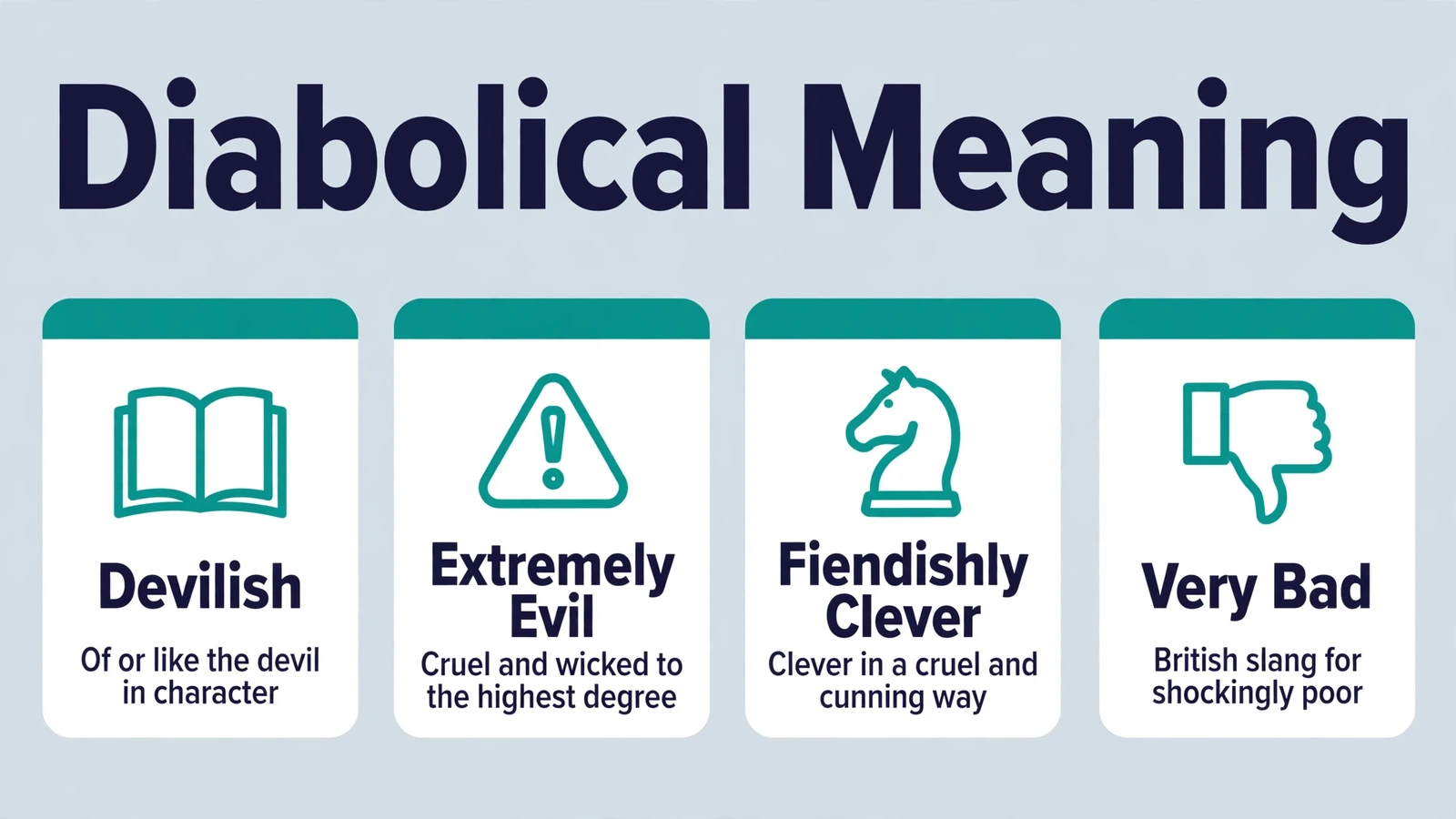
Few words work as hard as diabolical. A film critic can praise a villain’s diabolical plan, a puzzle fan can groan over a diabolical crossword, and a British commuter can call the morning traffic diabolical. In plain terms, diabolical means of or like the devil, and therefore extremely evil. Yet the same word can also mean fiendishly clever, fiendishly difficult, or, in informal British English, simply very bad.
This guide walks through every sense of the word. You will find the core definition, the pronunciation, the Greek and Latin roots, and the British slang use. You will also get synonyms, example sentences, and the traps that trip up learners. By the end, you will know exactly which shade of diabolical fits your sentence.
What Does Diabolical Mean?
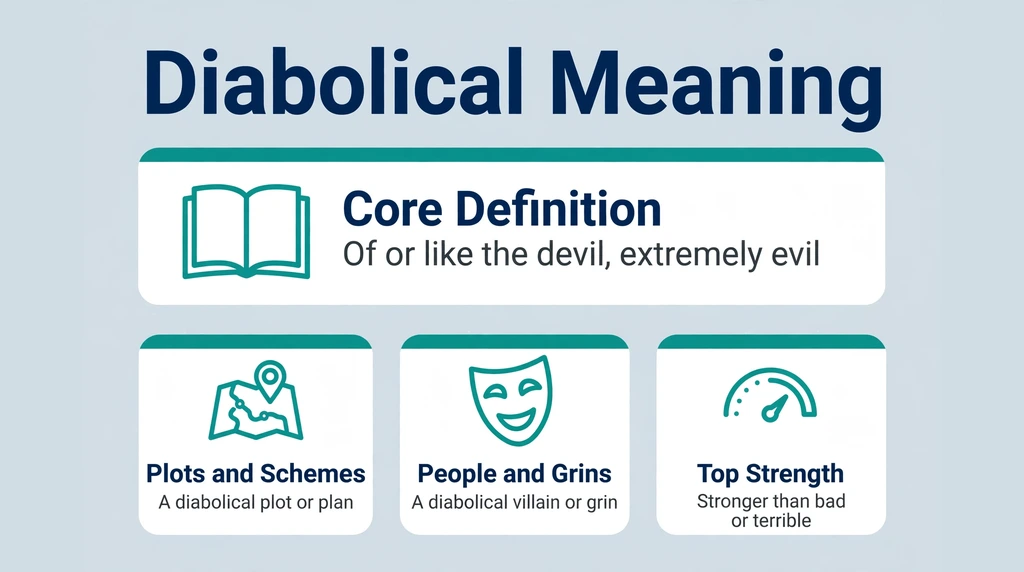
At its core, diabolical is an adjective that means characteristic of the devil. Because the devil stands for ultimate evil, the word describes anything that seems devilish in nature. A diabolical act is not just wrong. It is cruel, wicked, and extreme.
The Core Definition
Merriam-Webster defines the word as “of, relating to, or characteristic of the devil,” and adds a blunt summary: extremely evil. Other dictionaries agree closely. Dictionary.com describes diabolical things as having the qualities of a devil: devilish, fiendish, and outrageously wicked.
In short, the word judges something against the darkest standard available. Writers reach for it when ordinary words like bad, cruel, or evil feel too weak. That strength is the whole point of the word.
What the Word Can Describe
First, the word can describe the devil himself, as in an old phrase like “my diabolical visitor.” More often, though, it describes things connected with him in look, behaviour, or thought. Merriam-Webster lists examples such as diabolical lore, a diabolical grin, and a diabolical plot.
In practice, plots and schemes take the word most often. A diabolical plan is a plan built with wicked intent and cruel cleverness. People attract it as well, especially villains, tyrants, and smiling enemies. Objects take it less often, unless the object serves a dark purpose.
How Strong Is Diabolical?
Very strong. Vocabulary guides warn that diabolical is a heavy word, and it should be saved for real wickedness. A tough homework assignment may feel unfair, for example, but it is rarely diabolical. A scheme designed to ruin innocent lives, by contrast, earns the word easily.
Think of it as the top shelf of negative adjectives. Bad sits near the bottom of the scale. Terrible and dreadful climb higher. Diabolical looks down from above them all, because it drags the devil into the comparison. Use it when you want that extra weight, and avoid it when a milder word tells the truth better.
Diabolical, Evil, and Wicked: Sorting the Scale
Readers sometimes ask how diabolical differs from its plainer cousins. Evil is the broadest word of the three, covering everything from a lie to a massacre. Wicked narrows the field toward deliberate wrongdoing, often with a hint of pleasure in it. Diabolical narrows it further still.
A diabolical act combines wicked intent with design, scale, or cruelty that feels beyond ordinary human failing. That extra shade explains why the word suits plots better than impulses. A wicked remark takes a second to make. A diabolical scheme takes planning, patience, and a mind that enjoys the design. When your sentence involves a considered plan to harm, diabolical usually beats both rivals.
How to Pronounce Diabolical
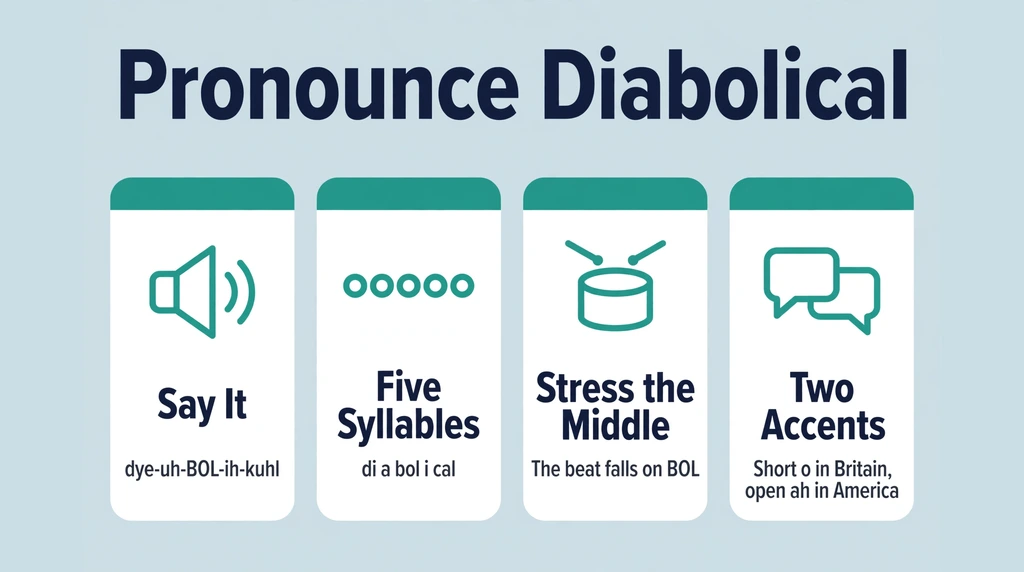
The word looks intimidating, but it breaks into friendly pieces. It has five syllables: di-a-bol-i-cal. The main stress falls in the middle, on the syllable bol. Said at full speed, it sounds like dye-uh-BOL-ih-kuhl.
The British and American Versions
British and American speakers differ mainly in the stressed vowel. In British English, the word sounds roughly like dye-uh-BOL-ih-kuhl, with a short o in the middle. In American English, the vowel opens up, so it sounds closer to dye-uh-BAH-lih-kuhl.
Both dictionaries record the same pattern of stress. Cambridge gives the British form with the short o and the American form with the open ah vowel. Oxford follows the same split. So whichever version you choose, keep the beat in the same place: di-a-BOL-i-cal.
A Quick Practice Tip
Start slowly and tap out the five beats on your fingers. Say di, then a, then BOL with extra force, then finish with ih-kuhl. Next, run the pieces together a little faster each time. After three or four rounds, the full word usually rolls out smoothly.
Mistakes Learners Make
Two errors appear again and again. The first puts the stress too early, producing something like DYE-uh-bol-ih-kuhl with a thump on the opening syllable. English ears hear that as a stumble, because the word’s music lives in the middle. The second error swallows the ending, so the word trails off as “diabolik” or stops at diabolic entirely.
Reading the word aloud in a full phrase fixes both problems quickly. Try “a diabolical plan” and “the diabolical villain” at conversation speed. The rhythm of the phrase carries the stress into place, and the final syllable gets the light finish it needs.
Where Diabolical Comes From
The history of diabolical reads like a journey through three languages. It begins in Greek, passes through Latin, and arrives in English in the late Middle Ages. Each stage left a mark on the word we use today.
A Greek Word for a Slanderer
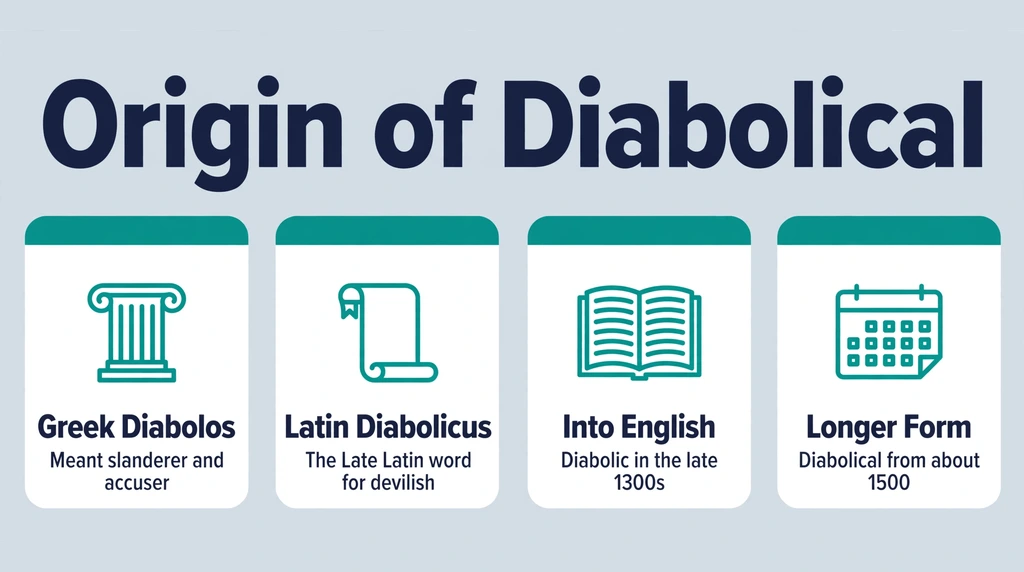
At the root sits the Greek word diabolos. Surprisingly, it did not first mean a horned monster. It meant a slanderer, an accuser, a backbiter: someone who attacks another person with words. Merriam-Webster points out that the word devil travels the same road. Like devil, diabolical traces back to Latin diabolus, which descends from Greek diabolos, a word that literally means “slanderer.”
Over time, diabolos became the name for the Devil himself, the great accuser. That shift matters, because it explains the word’s double flavour. Diabolical carries both verbal slyness and outright evil, and both traces survive in modern use.
Through Latin Into English
Greek diabolos became Latin diabolus, meaning the Devil. From there, Late Latin formed the adjective diabolicus, meaning devilish. French carried the word as diabolique, and Middle English borrowed it in the late 1300s as deabolik. The Online Etymology Dictionary dates that shorter form, diabolic, to the late fourteenth century and glosses it as “pertaining to the Devil; outrageously wicked, infernal.”
The Longer Form Arrives
English speakers then added the suffix -al to diabolic, which produced diabolical. This longer form appears around 1500 with the meaning “pertaining to the devil.” By the 1540s, it had settled into the sense “befitting the devil.” Dictionary.com gives the same first recording, 1500 to 1510, and shows the same recipe: Late Latin diabolicus plus the suffix -al.
The longer form eventually won the popularity contest. Today, diabolical is the everyday choice, while diabolic survives as a less frequent variant. Even so, dictionaries still treat the two as forms of one word.
How the Meaning Stretched
Originally, the word pointed straight at the Devil. Gradually, it widened to cover anything that resembled him: cruel plans, wicked grins, fiendish tricks. Much later, British speakers stretched it further, until it could describe anything shockingly bad at all. Each step kept the flavour of outrage while loosening the link to actual evil.
Cousins Across Languages
The same Greek root feeds several familiar words. English devil itself travelled this road, from diabolos through Latin diabolus into the old Germanic languages. That shared ancestry explains why devil and diabolical feel like family the moment you place them side by side.
Spanish keeps the connection even closer to the surface. There, diablo simply means devil, and Spanish speakers meet the root daily in a plain, living word. Italian diavolo follows the same pattern. For English learners from those languages, diabolical is a friendly false summit: the spelling helps, but the British slang sense still waits to surprise.
More Than Evil: Fiendishly Clever and Fiendishly Hard
Between the literal devil and the British slang sits a busy middle ground. Here, diabolical praises nothing and condemns cleverness instead. The word marks skill that feels wicked because it works against you.
The Clever Villain Shade
Storytellers love this shade. A diabolical plan is not merely evil; it is ingeniously evil, full of traps and false trails. The word credits the villain with brains while condemning his morals. Collins even records the adverb in this role, with the example of “a diabolically clever monster.”
Writers use the same shade outside fiction. A diabolical marketing trick, for instance, might be a scheme so cunning that customers feel cheated. The cleverness is real, but so is the sting. In short, this sense means clever in a way that feels cruel.
The Fiendishly Difficult Shade
Puzzles, exams, and video game levels attract the word for a different reason. Here, diabolical means fiendishly difficult or unpleasant. Collins lists “very difficult or unpleasant” among the senses of diabolic, and everyday use happily extends it to the longer form.
A diabolical crossword clue, for example, seems designed to defeat you personally. A diabolical exam question hides its answer behind three false leads. Nothing supernatural is involved. The word simply borrows the devil’s reputation for torment and applies it to a tormenting task.
Choosing Between the Shades
Context does the sorting for you. Put the word before plan, scheme, or plot, and readers hear evil cleverness. Put it before puzzle, level, or question, and readers hear painful difficulty. In both cases, the speaker feels outmatched, and the word captures that feeling perfectly.
Why Reviewers Reach for It
Open entertainment pages, and the word keeps appearing. Critics use it for villains who scheme in layers, for plots that twist against the hero, and for performances full of smiling menace. The word does double duty in a headline: it promises intelligence and warns of cruelty in a single breath.
That double promise explains its staying power in popular writing. Evil alone can sound flat, and clever alone can sound like praise. Diabolical fuses the two into a judgement readers grasp instantly. Whenever a reviewer needs menace with brains attached, this is the adjective waiting at the front of the drawer.
Diabolical in British English: The Very Bad Sense
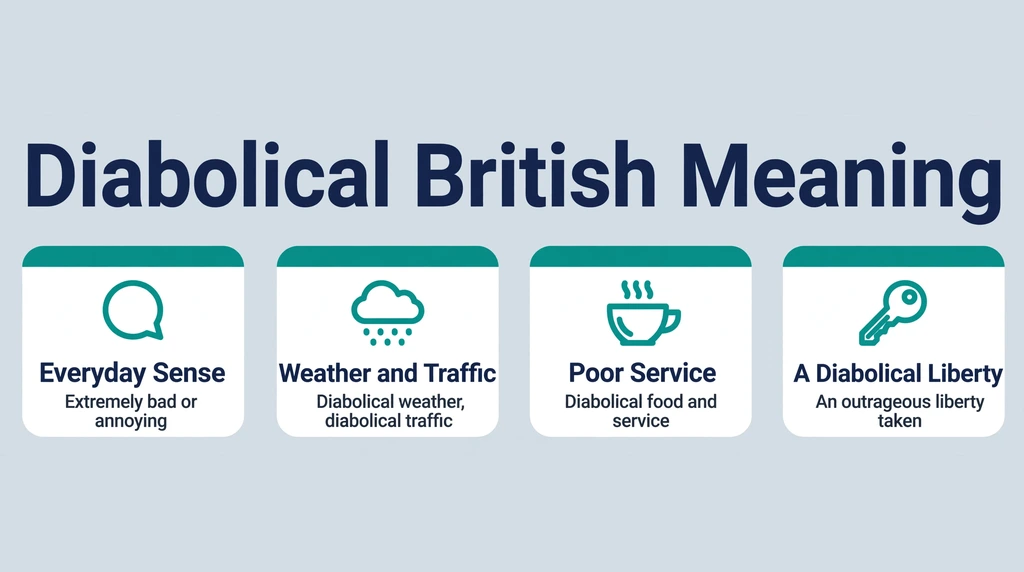
Travel to Britain, and the word sheds its horns. In informal British English, diabolical means extremely bad, shocking, or annoying. No evil is required. The word works there as a strong everyday complaint, closer to terrible or appalling than to anything supernatural.
Everyday British Examples
Cambridge Dictionary gives two classic examples: “Conditions in the prison were diabolical” and “His driving is diabolical!” Oxford offers another everyday scene: “The traffic was diabolical.” Merriam-Webster sums the slang up as “disgraceful” or “bad,” giving the example “the food was diabolical.”
Weather takes the word constantly. A week of cold rain becomes diabolical weather. Services take it too, so a delayed train or a rude help desk may earn a diabolical rating. In each case, the speaker means shockingly poor quality, delivered with feeling.
A Diabolical Liberty
British English also keeps a set phrase: a diabolical liberty. Someone who takes a diabolical liberty has done something outrageous, presumptuous, or unfair. Green’s Dictionary of Slang defines this slang use as “outrageous, disgraceful, disgracefully bad,” especially in that very phrase, and records it in print from the late 1950s.
Imagine a colleague who borrows your car without asking and returns it empty. A British friend might shake his head and say, “That’s a diabolical liberty.” Collins treats the word here as an intensifier, and the Concise Oxford Thesaurus glosses the phrase as extreme, excessive, and outrageous. The devil has left the scene entirely; outrage alone remains.
How It Sounds to American Ears
American English knows this slang sense, but uses it far less. To many American listeners, diabolical still sounds literary and evil first. A Briton complaining about diabolical weather may therefore sound oddly dramatic to an American friend.
Writers should weigh their audience. In British settings, the slang sense reads as natural and even humorous. In American settings, it may read as deliberate exaggeration. Neither reaction is wrong; the word simply carries different everyday weight on each side of the Atlantic.
From Outrage to Complaint
How did a word for the Devil end up rating café service? The path is a familiar one in language. Strong words weaken as speakers borrow them for everyday emphasis, a process linguists call bleaching. First the word kept its outrage but dropped its theology. Then the outrage itself shrank into strong annoyance.
Traces of each stage still coexist. A British speaker can call a war crime diabolical in the morning and a bus queue diabolical by lunch, and nobody confuses the two. The older sense never vanished; it simply learned to share the word with a lighter partner. That double life is exactly what makes the word so useful, and so worthy of a careful guide.
Diabolical vs Diabolic
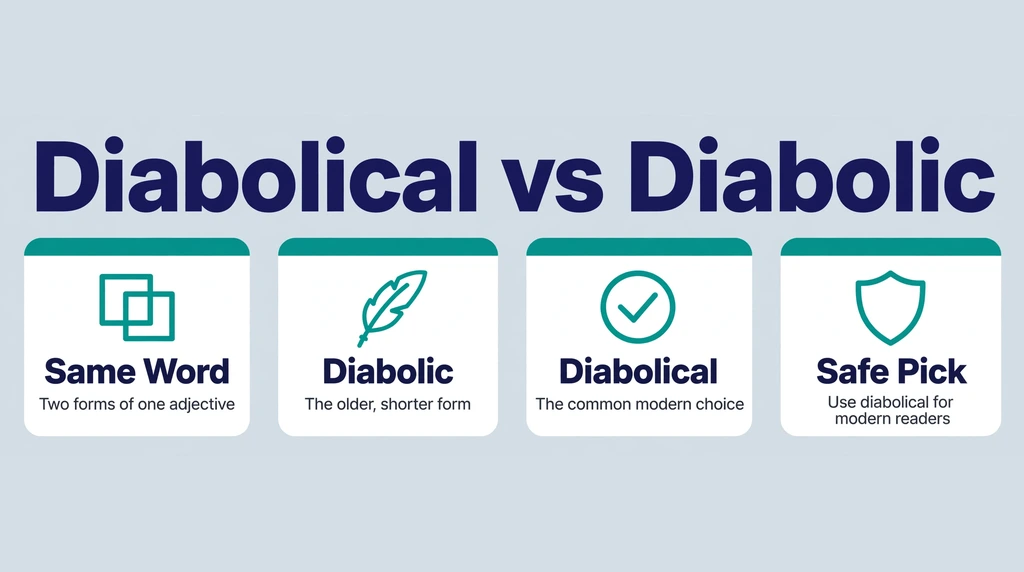
Learners often ask whether diabolic is a different word. It is not. Diabolic and diabolical are two forms of the same adjective, built from the same Latin root. Diabolic came first, and diabolical grew out of it by adding the suffix -al.
Which Form Should You Use?
Usage has settled the contest. Diabolical is the common modern form in both Britain and America. Oxford marks diabolic as “also, less frequent” for the evil sense, while Cambridge notes that American English also uses diabolic. In practice, you will meet diabolical far more often in news, novels, and conversation.
Still, diabolic survives in set corners of the language. Poetry and older prose sometimes prefer its shorter punch. Writers also choose it for rhythm, since it carries one syllable less. Choosing either form is correct; choosing diabolical is simply safer for modern readers.
Spelling Notes
Both forms start with dia, not die, so watch the opening letters. The middle carries a single l in diabolic and a double beat in diabolical, spelled d-i-a-b-o-l-i-c-a-l. A common slip is to drop the second a, producing the wrong “diabolical” without it. Sounding out the five syllables protects you, because each syllable gets its own vowel letter.
Hearing the Difference
Say both forms aloud, and the difference is rhythm, not meaning. Diabolic lands quickly, in four syllables, and suits a sharp, poetic line. Diabolical rolls out over five syllables, which gives it a statelier, more deliberate tread. Prose writers often prefer the longer roll for emphasis at the end of a sentence.
Editors, however, value consistency over music. If a document uses diabolical throughout, a sudden diabolic looks like a slip, even though it is correct. Pick the common form, keep it everywhere, and save the short form for poetry, titles, or deliberate echoes of older texts.
Synonyms and Antonyms of Diabolical
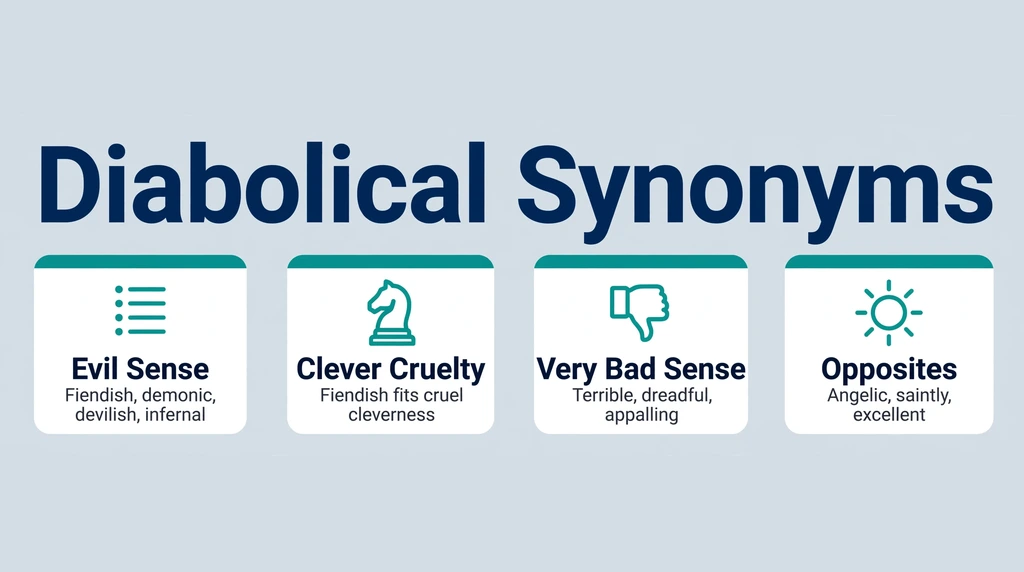
The right synonym depends on which sense you mean. Evil diabolical and slang diabolical live in different neighbourhoods of the vocabulary. Mixing their synonyms produces sentences that feel off, so keep the two lists apart.
Synonyms for the Evil Sense
Merriam-Webster’s thesaurus groups diabolical with demonic, sinister, malicious, satanic, fiendish, devilish, wicked, evil, vicious, and infernal. Other reference works add hellish and demoniac to the same family. Each word tilts the meaning slightly. Fiendish stresses cruel cleverness, so it suits plans and puzzles. Demonic stresses possession and fury, so it suits rage and energy. Sinister stresses a threat you sense rather than see, so it suits atmospheres and strangers.
Choose devilish with care. Devilish can describe playful mischief, especially in older or lighter writing, where diabolical cannot. A devilish grin might belong to a naughty child. A diabolical grin belongs to someone you should fear.
Synonyms for the Very Bad Sense
For the British informal sense, the synonyms turn plainer. Oxford gives terrible as the direct synonym. The thesaurus lists add dreadful, awful, disgraceful, shameful, appalling, atrocious, and abysmal. Informal options include dire, rotten, lousy, and pathetic.
These words trade places freely in casual speech. Diabolical service, dreadful service, and appalling service all deliver the same complaint. Diabolical simply sounds the most theatrical of the three. In formal reports, however, plainer words usually serve better.
Antonyms of Diabolical
For the evil sense, the natural opposites are angelic, saintly, godly, virtuous, and heavenly. An angelic smile answers a diabolical grin. A saintly patience answers diabolical cruelty. These pairs show how completely the word leans on the devil for its force.
For the very bad sense, the opposites flip to praise words: excellent, wonderful, superb, and first class. Diabolical weather one week can give way to wonderful weather the next. As always with this word, the sense decides the partner.
The Formal End of the Scale
A few synonyms sit at the formal, literary end of the family. Satanic names the Devil directly and sounds ceremonial, so it belongs in religious or gothic contexts. Luciferian, drawn from the name Lucifer, sounds even more bookish, and most writers meet it in older or scholarly texts.
Demoniac is rarer still, and it often works as a noun for a possessed person as well. Everyday writers can safely leave all three in the dictionary. Diabolical, fiendish, and demonic cover modern needs, and they do it without sending readers to a glossary.
The Word Family: Diabolically, Diabolism and More
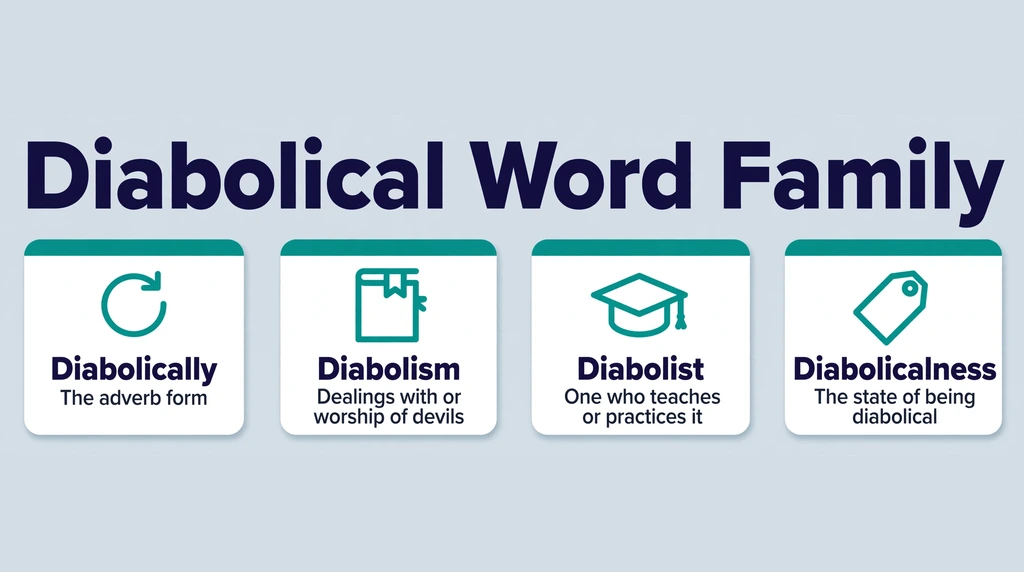
Diabolical anchors a small but lively word family. Knowing the relatives helps you read older texts and build stronger sentences. The three worth meeting are the adverb, the doctrine noun, and the quality noun.
Diabolically
The adverb diabolically means in a diabolical way. It modifies verbs and adjectives alike. A villain can laugh diabolically, plot diabolically, or scheme diabolically. Before adjectives, it works as an intensifier with a wicked flavour: a diabolically clever plan, a diabolically difficult puzzle, a diabolically simple trap.
The adverb keeps the same range as the adjective. In British informal use, it can even grade quality, so a singer might perform diabolically badly. Context, once again, tells the listener which world the word is working in.
Diabolism and Diabolist
Diabolism is the family’s serious noun. Merriam-Webster gives it three senses: dealings with or possession by the devil; belief in or worship of devils; and evil character or conduct. The word is recorded from 1614, and it appears mostly in religious, historical, and academic writing.
A diabolist is a person connected with diabolism, either a teacher of it or a practitioner. You will meet both words in studies of witchcraft trials, occult history, and gothic literature. Unlike diabolical, they never drifted into slang, so they always point at the real thing.
Diabolicalness
The quality noun is diabolicalness, meaning the state of being diabolical. Dictionaries list it as a standard derived form, alongside the adverb. In practice, writers rarely use it, because phrases like “the diabolical nature of the plan” flow better. Still, it exists, and it follows the regular pattern of English noun building.
One Family, Two Reputations
Step back, and the family splits neatly in two. Diabolical and diabolically live comfortably in daily speech, slang included. Diabolism and diabolist stayed behind in the library, serious and literal. The split happened because adjectives travel light, while doctrine nouns stay home.
For learners, the lesson is simple. Learn diabolical deeply, meet diabolically on the way, and recognise diabolism when old texts raise it. That order mirrors real English use, and it keeps your effort where the language actually lives.
Words That Travel With Diabolical
Some nouns attract diabolical so regularly that the pairs feel like units. Learning these collocations makes your English sound natural at once. It also helps you guess the intended sense before the sentence ends.
Partners for the Evil Sense
Plan, plot, and scheme lead the list. All three promise wicked design, and diabolical sharpens the threat. Act and deed follow closely, turning simple wrongdoing into diabolical cruelty. Grin, smile, and laughter form another cluster, because fiction loves a villain who enjoys his work.
Genius and mind appear in a colder cluster. A diabolical genius designs harm with brilliance, and readers both admire and dread him. Taken together, these partners show the word’s favourite habitat: deliberate, intelligent evil that someone planned in advance.
Partners for the British Sense
British collocations look far more domestic. Weather, traffic, driving, and service top the list, because daily life supplies daily complaints. Conditions and state join them in reports and reviews, as in “the room was in a diabolical state.”
One partner stands apart: liberty, in the set phrase already discussed. Unlike the others, it cannot swap freely. You can call the traffic dreadful instead, but a dreadful liberty sounds wrong. Set phrases guard their wording, and this one insists on diabolical.
Verbs That Set the Scene
Verbs gather around the adjective in predictable ways. Villains hatch, devise, and concoct diabolical plans, and each verb adds a flavour of secret preparation. Plans themselves unfold, unravel, or come to light, usually at the worst possible moment for the hero.
Judgement verbs follow a different pattern. Critics call a decision diabolical, describe a policy as diabolical, or dismiss a performance as simply diabolical. Learning these frames lets you build fresh sentences without guessing. Slot your own nouns into the frames, and the word will sit naturally every time.
How to Use Diabolical in a Sentence
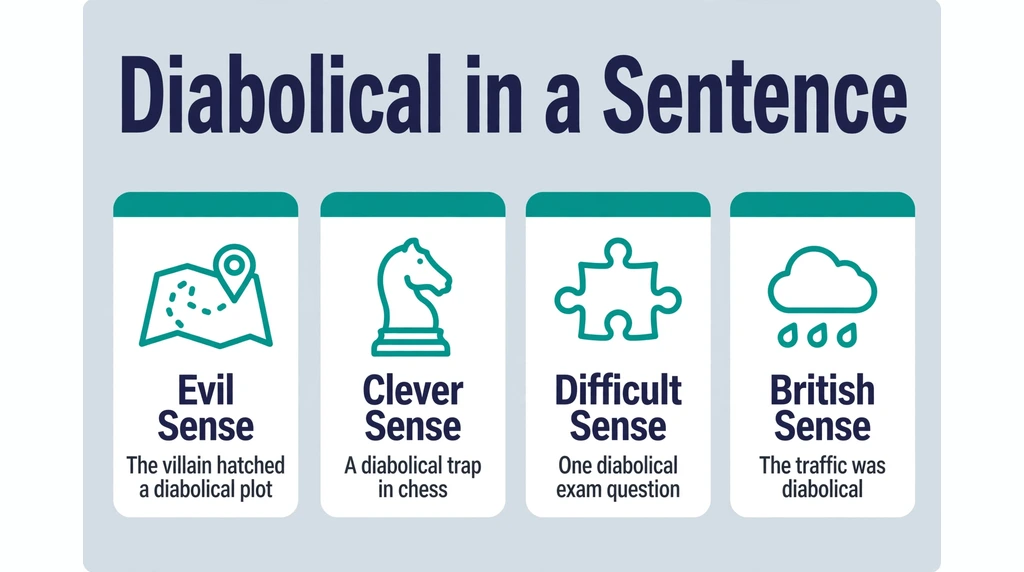
The safest way to learn the word is to watch it work. The examples below are grouped by sense, and every sentence is written for this guide. Notice how the nouns around diabolical steer its meaning each time.
Evil and Devilish Examples
The villain hatched a diabolical plot to flood the city. Here, plot signals wicked design, so the evil sense leads. A second example shifts to a person: with a diabolical grin, the traitor watched his plan unfold. The grin borrows the devil’s malice, and no reader misses it.
For an act rather than a person, try this pattern: the dictator’s diabolical cruelty shocked even his own generals. Finally, the word can stand after the verb be: the whole scheme was diabolical from start to finish. That predicative position suits judgements and summaries well.
Clever and Difficult Examples
Reviewers reach for the clever shade in sentences like this one: the chess champion set a diabolical trap, and her rival walked straight into it. The trap involves no evil at all, only cruel ingenuity. Difficulty works the same way: the final exam contained one diabolical question that nobody answered fully.
Games supply endless material for this shade. Players complain about diabolical levels, diabolical bosses, and diabolical puzzles with affectionate fury. The word flatters the designer while scolding him, which is exactly why gamers love it.
British Informal Examples
Now cross the Atlantic. A Londoner might report that the service in the café was diabolical, so she will not return. A driver might warn you that the traffic into town is diabolical on Fridays. Both sentences mean simply very bad, said with emphasis.
The set phrase deserves its own model: he helped himself to her lunch without asking, which was a diabolical liberty. Remember the pattern, because liberty in this complaint needs diabolical before it. Swap in terrible, and the idiom falls apart.
Three More Sentences to Study
Compare these three fresh models, one per sense. First, the evil sense: the prison governor’s diabolical regime punished hunger with darkness. Notice how regime and punished keep the sentence in the world of real cruelty, where the word belongs.
Next, the clever sense: the escape room ended with a diabolical lock that needed two keys turned together. Nothing evil happens here; the lock simply outsmarts the players with wicked elegance. Finally, the slang sense at full stretch: after three cancelled trains, she called the whole railway diabolical and walked home. British readers smile at the exaggeration, and that smile is the intended effect.
Common Mistakes With Diabolical
Three traps catch learners again and again. Each one is easy to escape once you see it clearly. A short tour of the traps will protect your writing.
Using It for Harmless Mischief
Diabolical is too strong for cute or harmless trouble. A toddler who hides your keys is mischievous, not diabolical. Calling him diabolical turns a family joke into a horror review, unless you exaggerate on purpose for comedy. For playful trouble, choose devilish, mischievous, or impish instead. Save diabolical for cruelty, wicked cleverness, or quality so bad that it shocks.
Expecting a Literal Devil Every Time
New readers sometimes hunt for a devil in every sentence. Most modern uses, however, involve no devil at all. The British commuter and the frustrated gamer are not making claims about hell. They are borrowing an old word for emphasis. Read the neighbours of the word first: weather, traffic, and puzzles signal slang or difficulty, while plots, curses, and rituals signal the literal family of meanings.
Confusing Strength Between Languages
Finally, handle translations with care. The Spanish word diablo simply means devil, as dictionaries note, and its adjective diabólico matches the evil sense closely. The British slang sense, though, does not travel with the word into every language. A learner who translates word for word may sound far more dramatic abroad than at home. When in doubt, translate the sense, not the spelling.
Spending the Word Too Freely
One last trap is inflation. A speaker who calls every delay, meal, and meeting diabolical soon has nothing left for genuine outrage. Strong words work like strong spices: they season a sentence precisely because they stay rare. British speakers survive this trap with tone, since a grin tells listeners how much weight to give the word.
Writers lack the grin, so they must ration the word deliberately. Keep it for the villain, the shocking failure, and the puzzle that truly torments. Your readers will feel each use land, and your judgements will keep their credit.
Frequently Asked Questions
What does diabolical mean in simple words?
In simple words, diabolical means extremely evil, like the devil. A diabolical person or plan is cruel and wicked on purpose. In informal British English, the word has a weaker everyday sense as well: it can mean extremely bad, as in diabolical weather.
Does diabolical always refer to the devil?
No. The oldest sense points at the devil, and the word still carries that history. Modern English, though, uses it for cruel plans, fiendish puzzles, and shockingly bad service. In those sentences, the devil survives only as a flavour of extreme judgement, not as a literal character.
What does diabolical mean in British slang?
In British slang, diabolical means extremely bad or annoying. People apply it to weather, traffic, driving, food, and service. Oxford labels this use “(especially British English, informal)” and gives terrible as its synonym, so treat it as a strong everyday complaint rather than a comment about evil.
What is a diabolical liberty?
A diabolical liberty is an outrageous, presumptuous act, such as taking something of yours without asking. The phrase is a fixed British expression, recorded in slang dictionaries from the late 1950s. It works as an intensifier of outrage, and it keeps diabolical even when other adjectives would fit the general idea.
What is the difference between diabolic and diabolical?
There is no difference in meaning. Diabolic is simply the shorter, older form, and diabolical adds the suffix -al. Dictionaries treat them as variants of one adjective. Diabolical is much more common today, while diabolic appears less often, mostly in older or more literary writing.
How do you pronounce diabolical?
Say dye-uh-BOL-ih-kuhl, with five syllables and the stress on bol. British speakers use a short o in the stressed syllable, while American speakers open it toward ah. Both Cambridge and Oxford record that pattern, so either version is correct for its side of the Atlantic.
What is a good synonym for diabolical?
For the evil sense, fiendish, demonic, devilish, sinister, and infernal all work well. Fiendish fits clever cruelty best. For the British slang sense, terrible, dreadful, appalling, and atrocious match the tone. Match the synonym to the sense, because a synonym from the wrong list changes the sentence’s meaning.
Is diabolical a strong word?
Yes, very strong. It compares a thing to the devil, the strongest image of evil in the language. That weight makes it perfect for villains and wicked schemes. For small faults, though, it sounds over the top, which is why guides advise saving it for cases that deserve the full force.
Final Thoughts
Diabolical rewards the reader who slows down. At heart, it means of the devil and therefore extremely evil, a sense anchored in the Greek word for a slanderer and carried through Latin into English around 1500. Around that core, English built fiendish cleverness, fiendish difficulty, and a very British way of calling things shockingly bad.
Keep the senses sorted by their neighbours, and the word will never confuse you again. When you want the full dictionary record with example sentences, the Merriam-Webster entry for diabolical is the natural next stop. Use the word boldly, but save it for things that earn it.