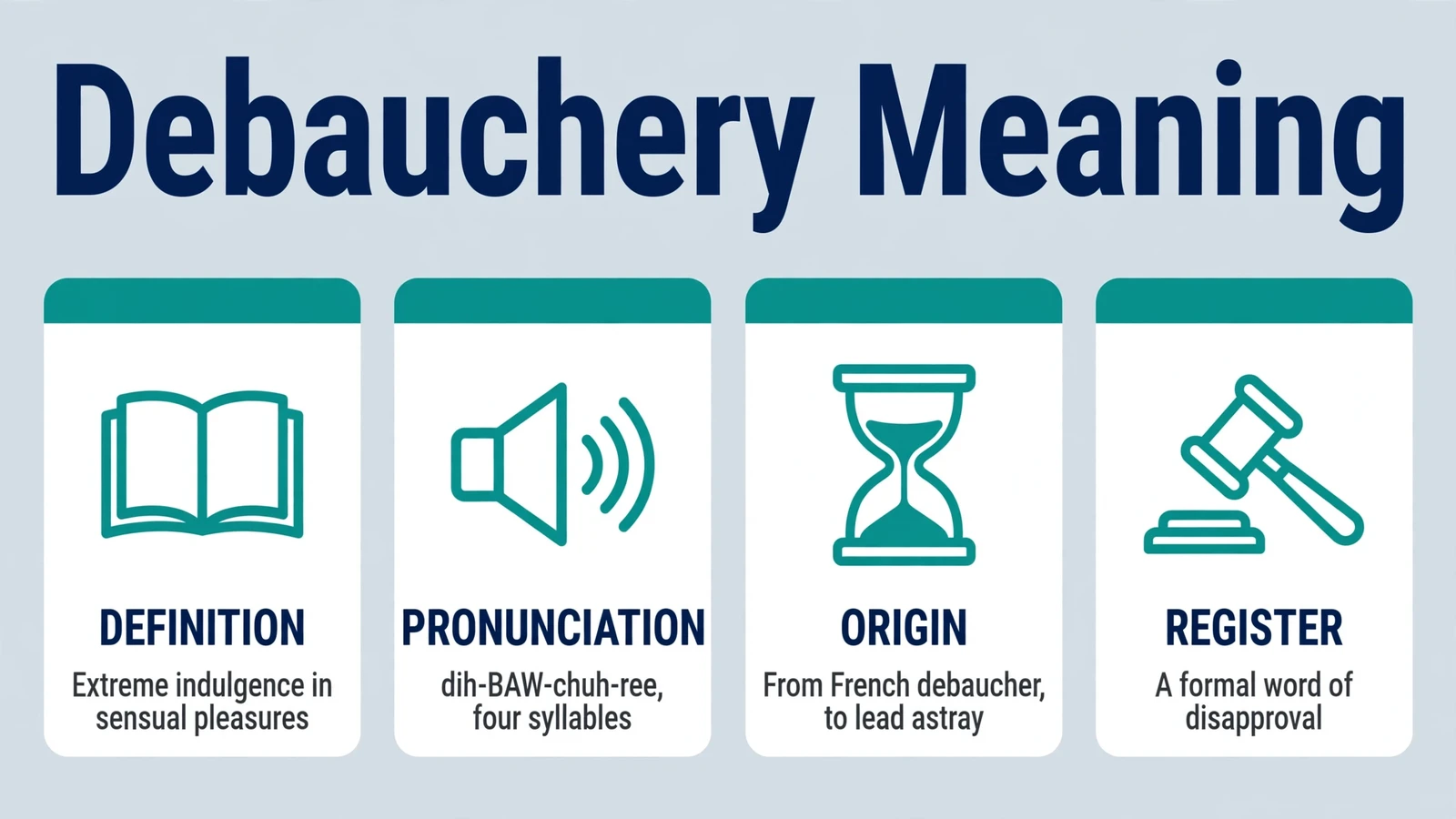
You have probably met this word in a novel, a film review, or a stern headline and felt its disapproval before you knew its meaning. Debauchery means extreme indulgence in sensual pleasures, especially drinking, drugs, and sex, carried far past the point of moderation and judged immoral by the person using the word. In short, it names pleasure with the brakes cut.
That built-in judgment is exactly what makes the word worth a closer look. Dictionaries, Bible translators, and artists like Hogarth have all used it, yet each one loads it slightly differently. This guide unpacks the definition, the pronunciation, and the surprising French origin. It also draws clear lines between debauchery and its near neighbours, hedonism, decadence, and licentiousness, so you can choose the right word every time.
What Does Debauchery Mean?
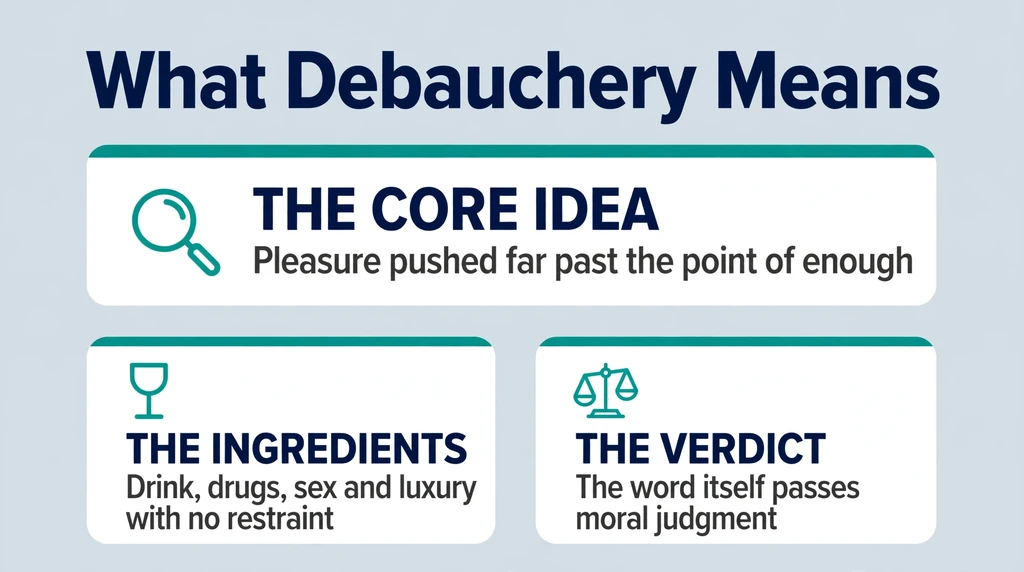
Merriam-Webster defines debauchery as extreme indulgence in bodily pleasures and especially sexual pleasures. The same entry describes behaviour involving sex, drugs, alcohol, and similar pleasures that is often considered immoral. Collins puts it more briefly: excessive indulgence in sensual pleasures, or intemperance.
Notice what both definitions share. First, the pleasure is sensual, meaning it belongs to the body and the senses. Second, the amount is extreme, not ordinary or moderate. Third, a moral shadow hangs over the whole picture. A large dinner is not debauchery. A weekend that dissolves into drunken excess, by contrast, earns the word easily.
Merriam-Webster’s own example sentence shows the everyday shape of the idea: fraternity brothers who “indulged in shameless debauchery all weekend.” The ingredients are time, company, appetite, and the total absence of a stopping point. Nothing in the sentence is illegal by itself. What makes it debauchery is the shameless scale of the indulgence, and that is true of nearly every real-world use.
One Word, Two Layers of Meaning
Most modern uses point at behaviour, yet older dictionaries preserve a second sense. In archaic use, debauchery could mean seduction from virtue or duty, the act of leading someone astray. That older layer survives inside words like debauched, which describes a person corrupted from an earlier, steadier character.
Both layers explain the word’s flavour. Debauchery is never neutral reporting. Instead, it always hints that someone crossed a line, or was pulled across it, and that pleasure did the pulling.
The older sense also unlocks older books. When a seventeenth-century writer complains about the debauchery of soldiers or servants, he often means their corruption and seduction away from loyalty, not their drinking. Modern readers who miss that layer misread whole passages. The behaviour sense won the long contest between the two meanings, but the loser never fully left the dictionary.
A Formal Word That Disapproves
Debauchery belongs to formal English, and learner dictionaries flag it as disapproving. Speakers reach for it when they want weight, not slang. A tabloid might shout about a celebrity’s wild weekend, but a historian writes about the debauchery of a corrupt court.
Grammar matters too. The noun is usually uncountable, like water or traffic, because it names a general condition. However, it does have a plural, debaucheries, which writers use for separate acts or occasions. So a memoir can describe one reckless year as a string of debaucheries.
The word also travels into abstract territory more easily than its rivals. Parliamentary records preserved by Hansard include talk of a “debauchery of public morals,” and debaters have even accused tax systems of debauchery. The word has become a heavy metaphor for corruption, proof of how completely its moral charge dominates its literal one.
How to Pronounce Debauchery
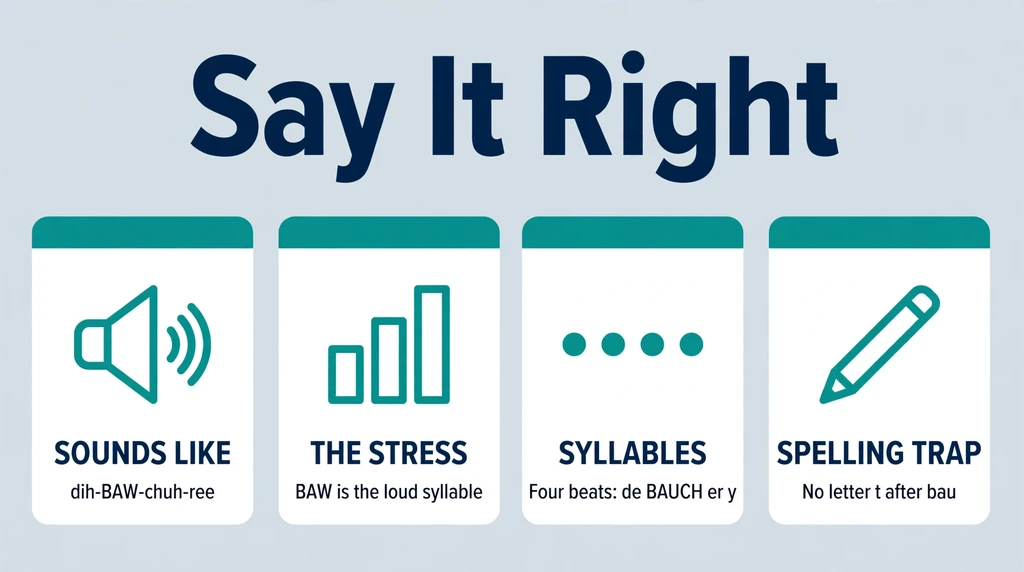
Debauchery is pronounced dih-BAW-chuh-ree, with the stress falling firmly on the second syllable: de-BAUCH-er-y. Merriam-Webster writes the pronunciation as di-ˈbȯ-chə-rē, and Collins gives the British form dɪˈbɔːtʃəri, which sounds nearly identical.
The middle of the word causes most of the trouble. The letters “bauch” rhyme with “watch” played through a yawn: BAW-ch. Meanwhile, the ending is light and quick, just “uh-ree.” Put together slowly, it runs de, BAUCH, er, y: four syllables, one strong beat.
A common mistake is stressing the first syllable, which produces DEB-uh-cherry. That version sounds like a fruit, not a vice. Keep the weight on BAW, and the word lands correctly every time. Also note the spelling: there is no “t” after the “bau,” even though the “ch” is pronounced like the “ch” in “church.”
The rest of the family follows the same beat. The verb debauch is dih-BAWCH, and the adjective debauched is dih-BAWCHT, with a hard final “t.” If you can say those two cleanly, the long noun holds no terrors. British and American speakers differ only in small vowel shades here, so one pronunciation serves both sides of the Atlantic.
Where the Word Debauchery Comes From
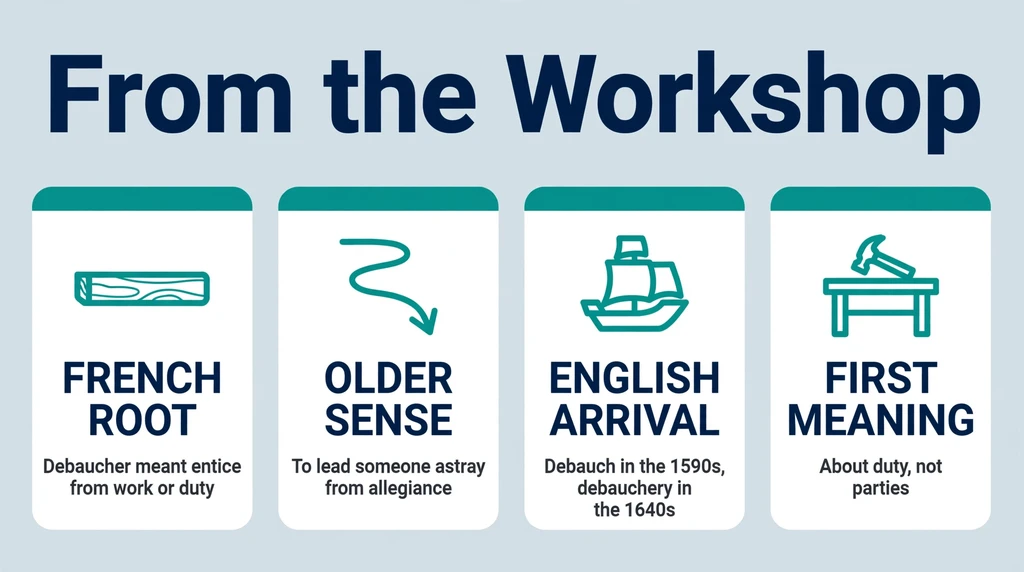
Debauchery was built in English from the verb debauch plus the suffix -ery, the ending also seen in trickery and drudgery. Etymonline dates the noun to the 1640s, while Collins gives the slightly wider window of 1635 to 1645. Early spellings wandered, with forms like debaush and debosh appearing before the modern spelling settled.
English even tried a rival formation first. The noun debauchment, meaning the same thing, is recorded from the 1620s, slightly earlier than debauchery itself. Debauchery won the contest so completely that its rival now looks like a misprint. Such contests are common in word history, and the winner usually owes its victory to nothing grander than habit and sound.
The real story, though, sits inside the verb. Debauch arrived in the 1590s, and its first job had nothing to do with parties at all.
From the Workshop: The Sense of Leading Astray from Work
Debauch came from the French verb débaucher, and débaucher meant to entice someone from work or duty. Behind the French stood the Old French desbaucher, simply “to lead astray.” So the earliest English uses of debauch describe pulling a person away from the side they belonged to. A soldier could be debauched from his allegiance. A servant could be debauched from a household. A son could be debauched from his family.
Merriam-Webster’s word history underlines the same point. As a verb, debauch initially meant “to lead astray,” especially leading someone away from a person to whom they owed allegiance or duty. Picture a recruiting agent luring apprentices out of a workshop, or a charming friend tempting a clerk from his desk for a week of idleness. That scene, not an orgy, is the word’s birthplace.
Only later did pleasure enter the picture. Around 1600, the verb picked up its darker, more specific sense: to seduce from virtue or morality, to corrupt someone’s principles. From there, the road to the modern meaning is short. Behaviour that leads people astray from duty and virtue became, in the noun, the wild behaviour itself.
Two Competing Theories About the Root
Where débaucher itself came from, nobody knows for certain, and honest etymologists say so. One theory follows the element bauch, meaning a beam of wood, from a Germanic word related to English balk. On that reading, the verb once meant trimming wood to shape a beam, and the sense drifted from there.
The rival theory gives bauch the meaning “workshop.” If that is right, débaucher began as luring a worker away from the bench, which fits the “entice from work” sense beautifully. Etymonline calls the sense development unclear, so treat both stories as informed guesses. What is certain is the French meaning the word carried into English: leading someone away from their proper work and duty.
This uncertainty is worth respecting because word origins attract confident fables. A tidy story about beams or benches makes the history feel solved, yet the documentary trail simply runs out in medieval French. Good dictionaries mark the gap honestly, and this article does the same.
How the Meaning of Debauchery Developed
Words travel, and this one travelled from the payroll to the party. Tracing its path explains why the modern word feels both moral and theatrical at once.
From Duty to Desire
In its first English century, debauch mostly named an act of seduction or corruption done to someone else. Interestingly, Merriam-Webster notes that the early noun debauch often referred to an instance of eating or drinking too much. The focus, in other words, sat on a single bout of excess rather than a whole character.
Over the following centuries, the centre of gravity shifted. By the time debauchery became a common noun, it described the excess itself: the drinking, the gambling, the sexual licence, the whole scene. The tempter faded out of the picture, and the behaviour took the blame alone. That is the sense dictionaries lead with today.
Food writing shows the same drift in miniature. Where the early noun could name one heavy bout of eating and drinking, modern menus and travel pieces borrow debauchery for feasts and dessert counters, always half in jest. The word scaled up from a single sitting to a lifestyle, then shrank back into a joke about a single sitting. Few words manage both directions.
From Deadly Serious to Half Joking
Register shifted alongside meaning. In religious writing, debauchery stayed deadly serious, a word for behaviour that endangers the soul. Preachers and translators used it with full weight, and many readers still meet it first in that solemn setting.
Modern everyday use is looser. Friends joke about a “night of debauchery” when they mean a big, silly evening with too much cake and karaoke. Travel writers describe resorts where adults can enjoy “mild debauchery” between beach activities. Merriam-Webster itself remarks that outside spiritual contexts, the word often carries this playful tone. The sting has softened, yet the wink only works because everyone still knows the serious meaning underneath.
Official language never quite joined the joke. Parliamentary debates preserved in the Hansard archive show members of parliament invoking “drunken debauchery” in earnest arguments about public order and morals. The same phrase that sells a beach holiday also serves, unchanged, in a legislature. Register, not wording, decides whether the word is a warning or a wink.
What Counts as Debauchery?
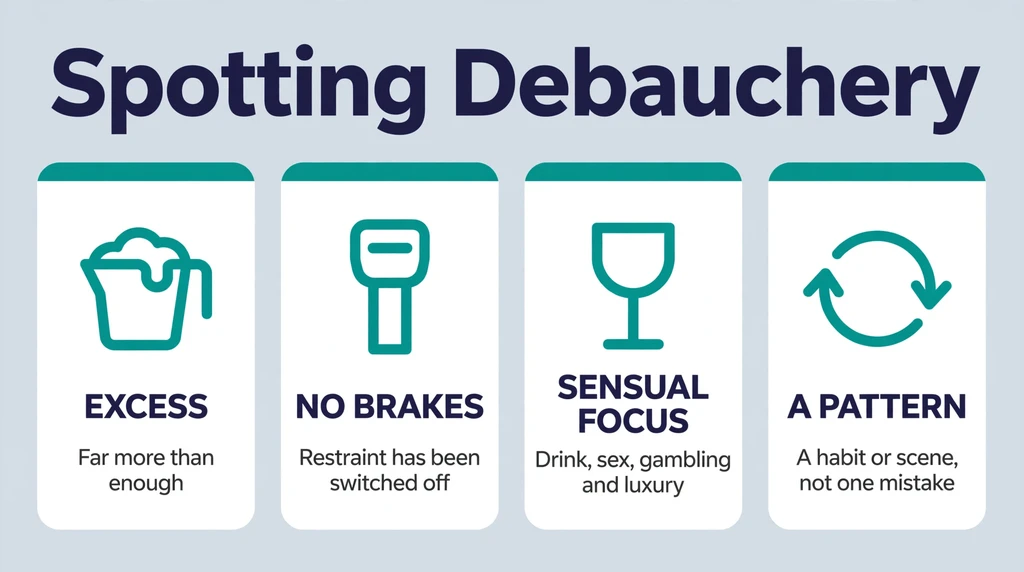
Not every pleasure qualifies, and not every mistake does either. Writers apply the word when several ingredients appear together.
First, there is excess. The indulgence runs far beyond need, comfort, or celebration. Second, restraint has failed. The person is not choosing a treat; the treat is choosing them. Third, the pleasures are sensual ones: food, drink, drugs, sex, luxury, and the thrill of the gaming table. Finally, an audience, real or implied, disapproves. Debauchery is a verdict as much as a description.
Consider the contrast. A couple opens one good bottle of wine on their anniversary: no one sensible calls that debauchery. A financier blows a fortune across a lost weekend of clubs, cards, and cocaine, then misses Monday entirely: the word fits at once. Scale and surrender make the difference.
Borderline cases test the recipe. A loud wedding with an open bar sits near the line; most guests file it under celebration, not vice. Add a pattern, though, and the label hardens. The same scenes repeated every weekend, with work, health, and promises collapsing around them, stop looking like parties. Debauchery is rarely about one glass too many. It is about a life, or at least a night, in which appetite has clearly taken the wheel.
One Night or a Whole Lifestyle?
The word works at both sizes, and context tells you which one is meant. As an uncountable noun, debauchery often names a lasting condition, as in “a life of debauchery” or “the debauchery of the regime.” Here it describes a settled pattern, a way of living with appetite in charge.
Countable uses shrink the lens. “A night of debauchery” shrinks it to one occasion, and the plural debaucheries can list several. This flexibility is handy. A reformer can condemn an era’s debauchery in one breath and forgive a friend’s single evening of it in the next.
Hotels and holiday companies exploit the small lens happily. One recent review quoted by Merriam-Webster praised a retreat where adults could “oscillate between wellness and mild debauchery,” a phrase that would horrify a Victorian preacher and delight a marketing team. The countable, one-evening sense is what makes that joke grammatical as well as funny.
Debauchery vs Hedonism, Decadence, and Licentiousness
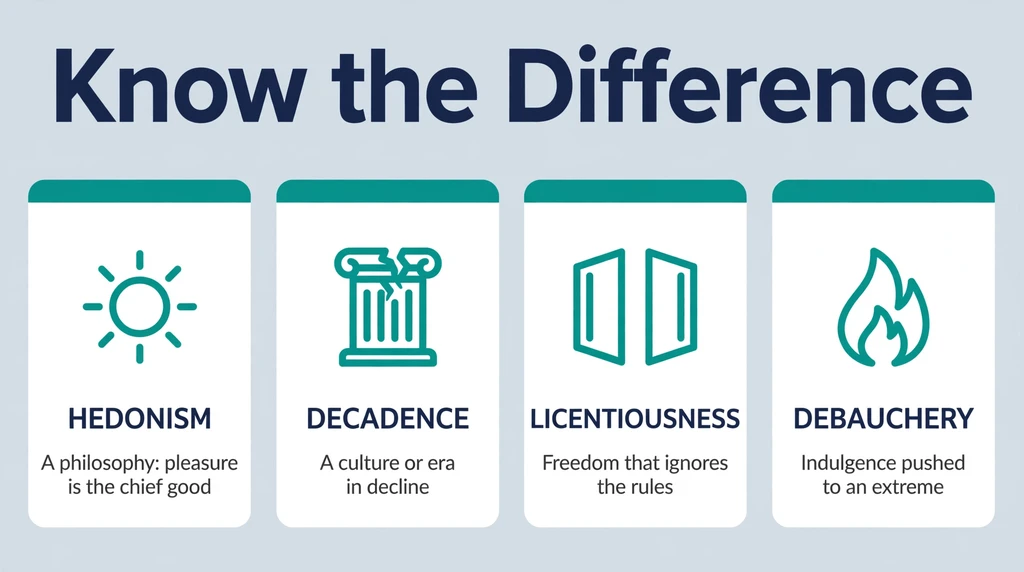
These four words share a neighbourhood, so writers confuse them constantly. Each one, however, points at a different thing: a behaviour, a philosophy, a decline, and a disregard for rules.
The confusion is understandable because the four often appear in the same stories. A declining empire (decadence) may host a court devoted to pleasure as life’s goal (hedonism), where rules of decency are openly flouted (licentiousness) at nightly orgies of spending and drink (debauchery). Same palace, four different diagnoses. Separating them is mostly a matter of asking what, exactly, the writer wants to blame.
Debauchery vs Hedonism
Hedonism began as a philosophy, not an insult. Merriam-Webster defines it as the doctrine that pleasure or happiness is the sole or chief good in life. The word comes from the Greek hēdonē, pleasure, and it entered English in the 1800s as a label for ancient Greek schools of thought.
Crucially, a philosophy of pleasure does not require excess. Epicurus, often claimed as hedonism’s patron, actually taught moderation, friendship, and freedom from pain as the surest route to lasting pleasure. Debauchery, by contrast, names behaviour only, and behaviour at an extreme. A quiet hedonist may savour long lunches and good company. A debauched evening, meanwhile, ends with the furniture broken. Hedonism answers the question “what is life for?” Debauchery answers “how badly did that go?”
The ancient schools behind hedonism disagreed with each other, too. Aristippus of Cyrene, usually named as the movement’s founder, prized present enjoyment. Epicurus, a generation later, ranked mental pleasures and peace of mind above bodily ones and treated self-restraint as a tool, not an enemy. So even inside philosophy, pleasure ranges from the impulsive to the carefully budgeted. Debauchery sits wholly outside that debate. It is not a position anyone defends; it is an accusation everyone understands.
Debauchery vs Decadence
Decadence comes from a Latin image of falling: Medieval Latin decadentia, a falling away. Dictionaries define it as moral degeneration or decline, and as gratuitous or excessive indulgence. Above all, decadence describes a process or a state, often belonging to a whole society, culture, or era.
Historians therefore speak of the decadence of a late empire, while they would use debauchery for the emperor’s parties. Decadence also has a softer modern life. A “decadent dessert” is not immoral; it is luxuriously, almost guiltily rich. Debauchery never gets that gentle. Use decadence for decline and luxury, and debauchery for conduct that has spun out of control.
The word also gave its name to an artistic movement. The Decadents were French and English writers of the late nineteenth century whose refined, artificial, deliberately provocative work Oxford’s dictionaries describe under the same headword. Their decadence was a style and a stance, adopted on purpose. Nobody adopts debauchery as a manifesto; people slide into it, or are accused of it. That difference in agency is the sharpest line between the two words.
Debauchery vs Licentiousness
Licentiousness is the closest cousin. Merriam-Webster defines licentious as lacking legal or moral restraints, especially disregarding sexual restraints. The word grows from the Latin licentia, meaning licence or freedom, and the family resemblance to the English word licence is no accident: licentious behaviour is freedom abused, permission pushed past its limit.
The overlap with debauchery is real, yet the focus differs. Licentiousness zeroes in on the rules being ignored, above all sexual rules. Debauchery spreads wider, covering the whole sensual spree: the drinking, the drugs, the gambling, the luxury, and yes, the sex. If the point is defiance of restraint, choose licentiousness. If the point is the scale of the indulgence, choose debauchery.
Older political writing stretched licentiousness even further from the bedroom. Webster’s dictionary illustrated it with a “licentious press,” meaning journalism that abused its freedom and ignored every standard of fairness. That usage survives whenever critics accuse media or speech of licence rather than liberty. Debauchery almost never stretches that way; it stays close to appetite. So the pair divide the territory neatly: licentiousness for abused freedom, debauchery for abused pleasure.
The Difference at a Glance
Think of it this way. Hedonism is a belief: pleasure is the point of life. Decadence is a direction: things are falling from a better state. Licentiousness is an attitude: rules do not bind me. Debauchery is an event or a habit: pleasure, taken to a shameless extreme. Keep those four pegs in mind, and the words stop blurring.
Test the pegs on one sentence each. “His hedonism was a considered philosophy of picnics and string quartets.” “The decadence of the old resort showed in peeling paint and empty ballrooms.” “Her licentiousness scandalised a town that prized respectability.” “The expedition ended, predictably, in debt and debauchery.” Each word sits where only it fits, and swapping any two would bend the meaning out of shape.
Debauchery in History, Art, and the Bible
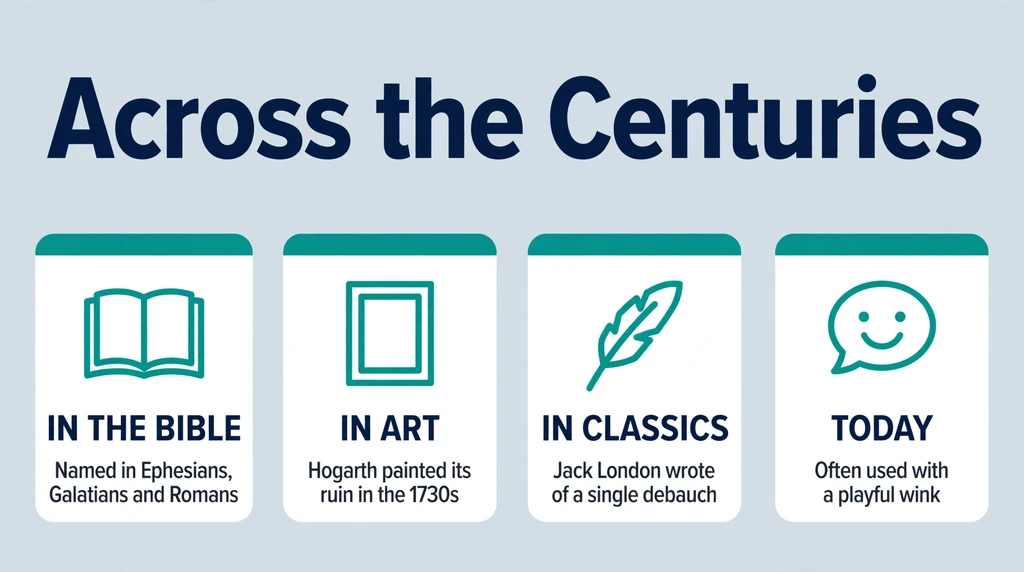
Few vocabulary words come with their own gallery and scripture attached. This one does, and those sources still shape how readers hear it.
Debauchery in the Bible
Many readers meet this word in a Bible translation rather than a novel. The New International Version uses debauchery in several well-known passages. Ephesians 5:18 warns, “Do not get drunk on wine, which leads to debauchery.” Galatians 5:19 lists debauchery among the “acts of the flesh,” and Romans 13:13 pairs it with drunkenness and sexual immorality. First Peter 4:3 looks back at a past life “living in debauchery.”
Older translations chose different English words for the same Greek terms. The King James Version renders the Ephesians phrase as “excess” and the Galatians term as “lasciviousness,” while the American Standard Version used “riot.” So when a modern reader asks what debauchery means in the Bible, the honest answer is unrestrained, self-indulgent living that the text condemns. The concept is stable even where the wording shifts.
Bible lexicons explain the variety. The Greek words behind these verses include asōtia, a term for wasteful, dissolute living, and aselgeia, a word for shameless sensuality. No single English noun covers both, which is why one generation reads “excess,” another reads “riot,” and modern readers meet “debauchery.” Merriam-Webster makes exactly this point in its history of the word: the Greek may be interpreted in many different ways, and translators keep choosing afresh.
Hogarth Painted the Debauched Life
In the 1730s, the English artist William Hogarth turned debauchery into a story you could hang on a wall. His series A Harlot’s Progress follows a young woman from the country who is drawn into London vice. Sir John Soane’s Museum, which owns the paintings, describes her as spiralling into moral debauchery before her early death.
The companion series, A Rake’s Progress, tells the male version across eight paintings, later published as engravings in 1735. It traces Tom Rakewell, who inherits a fortune and burns through it on fine clothes, gambling, taverns, and brothels. One famous scene shows a wild tavern party where his companions rob the drunken hero. Debtors’ prison follows, and madness after that: he ends in Bedlam, London’s notorious asylum. Hogarth needed no captions. The pictures preach the dictionary definition: appetite first, ruin close behind. Together, the two series fixed the visual meaning of debauchery for the English-speaking world.
The Word in Later Writing
Later authors kept reaching for the same word when a character’s appetites took command. The noun debauch could even stand alone for one bout of excess. Merriam-Webster quotes Jack London describing brimming drinks, each one “in itself a debauch,” a neat proof that the shorter noun once did the same work.
The pattern continues in modern reviewing and reporting. Critics use debauchery for films and novels about high society gone rotten, and historians use it for courts and regimes that collapsed into appetite. The word survives because no synonym carries quite the same mixture of relish and condemnation.
Recent citations gathered by Merriam-Webster show the range in a single glance. A film preview promises “one final night of fun and debauchery,” travel pages advertise resorts “great for après-beach debauchery,” and news reports use the word with a straight face for genuine scandal. Few nouns can sell a holiday and damn a regime in the same week. That double life is the modern meaning in action.
Debauch, Debauched, and Debauchery: The Word Family
A small family surrounds the headword, and knowing it prevents common errors.
The verb is debauch. To debauch someone is to corrupt them morally or lead them astray, and it is something done to a person, not a party you attend. The adjective debauched describes the result: a debauched official, a debauched era, manners that have been coarsened by indulgence. Someone who does the corrupting can be called a debaucher.
Watch the grammar of the noun itself. Debauchery is normally uncountable, so writers say “scenes of debauchery,” not “a debauchery,” in most contexts. The plural debaucheries appears when separate occasions are being counted. Meanwhile, do not confuse debauchery with debauch, the singular noun for a single bout, which now sounds old fashioned but still turns up in classic literature. Finally, there is no adjective “debaucherous” in standard dictionaries; the word you want is debauched.
One more relative deserves a footnote. The suffix -ery names behaviour or a practice, as in snobbery, tomfoolery, and quackery, which is why debauchery sounds like an ongoing activity rather than a single act. French speakers, meanwhile, still use the parent word débauche for a spree or a debauched lifestyle. The family resemblance across the Channel remains easy to spot.
Synonyms and Antonyms of Debauchery
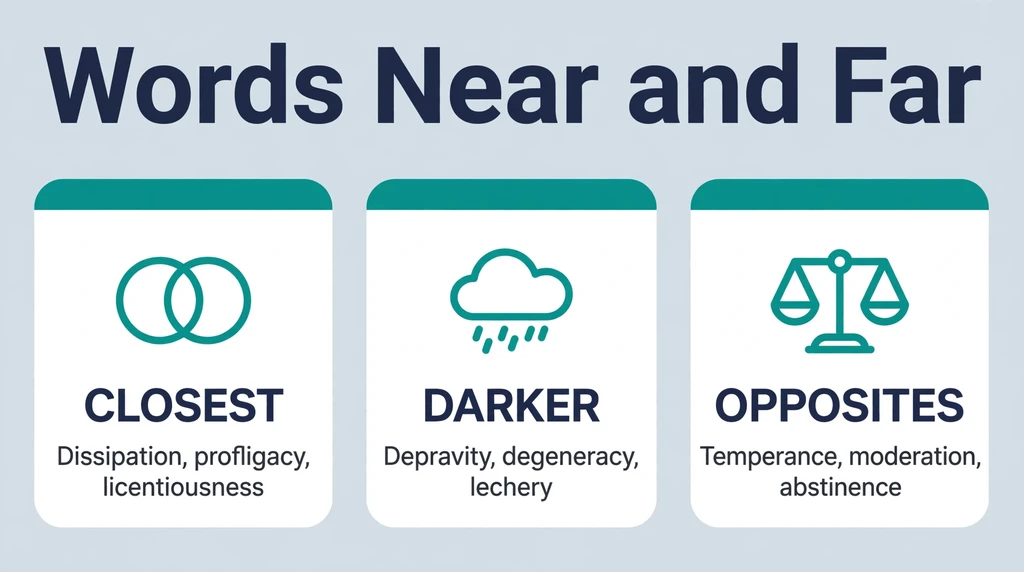
Because this word sits at the centre of a whole moral vocabulary, its synonyms come in shades. Some stress the wasted resources, some the sex, and some the sheer loss of discipline.
A thesaurus cannot choose for you, because each near synonym drags the sentence in a slightly different direction. The trick is to name the exact ingredient you mean: the money, the morals, the appetite, or the ruin. The groupings below follow the way Merriam-Webster’s thesaurus itself sorts the word’s meanings.
The Closest Synonyms
Merriam-Webster’s thesaurus sorts debauchery under three headings: corruption, degradation, and sensuality. Its closest matches include dissipation, a fine word for a life dissolving into pleasure, and profligacy, which adds reckless wastefulness, especially with money. Licentiousness and libertinism stress unrestrained, especially sexual, freedom. Dissoluteness and intemperance highlight the missing brakes, while wantonness suggests shameless, deliberate excess.
Stronger options exist when the tone must darken. Depravity and degeneracy accuse the behaviour of rotting something that was once sound. Lechery narrows the focus to sexual appetite, and sybaritism, named for the luxury-loving ancient city of Sybaris, narrows it to pampered luxury. Choose by ingredient: money wasted, dissipation or profligacy; rules ignored, licentiousness; appetite in charge, intemperance or wantonness.
Two quieter members of the family reward attention. Dissolution, an older favourite, pictures a character or a fortune slowly coming apart, while rakishness borrows the charm of the rake, the fashionable libertine of Restoration and Georgian storytelling. A rakish hero can still be likeable. A debauched one, in the full dictionary sense, is already past saving. Tone lives in those small choices.
Antonyms: The Language of Restraint
The opposite shore is well stocked too. Temperance is the classic antonym, meaning habitual moderation, and moderation itself serves in most sentences. Abstinence and sobriety answer the drinking side of the word directly. For the moral dimension, virtue, morality, and decency stand opposite, while asceticism names the extreme of self-denial, the mirror image of self-indulgence.
Self-restraint, though a plain compound rather than a glamorous word, may be the most precise opposite of all. Debauchery begins exactly where self-restraint ends, which is why sermons paired the two for centuries.
Thesaurus lists add a few more shades worth knowing. Chastity answers the sexual side of the word specifically, while decency covers the social verdict: behaviour neighbours can witness without complaint. Asceticism, the deliberate renunciation of pleasure, is the far shore from debauchery, further even than temperance. A temperate person still enjoys dinner. An ascetic has renounced the feast itself. Between those poles, most actual lives are negotiated.
Debauchery in a Sentence: Examples and Collocations
Seeing the word at work fixes its register faster than any definition. The sentences below are written in the word’s natural habitats: history, biography, reviewing, and friendly exaggeration.
Example Sentences
- The biography describes his student years as one long season of gambling, debt, and cheerful debauchery.
- After the scandal broke, the senator’s private life was exposed as a pattern of deceit and debauchery.
- The novel opens in a capital addicted to balls, duels, and late-night debauchery.
- She traded the debauchery of her touring days for early mornings and a quiet garden.
- The documentary treats the studio era as glamorous on screen and rotten with debauchery behind it.
- Their annual reunion is billed, only half in jest, as a weekend of mild debauchery.
- Reformers blamed the city’s decline on the debauchery of its ruling class.
- He wrote the memoir to confess the debauchery, not to celebrate it.
- The old admiral’s diaries record a youth of travel, study, and occasional debauchery in foreign ports.
- What began as a farewell dinner ended, by universal agreement, in cheerful debauchery.
Phrases That Keep Company with Debauchery
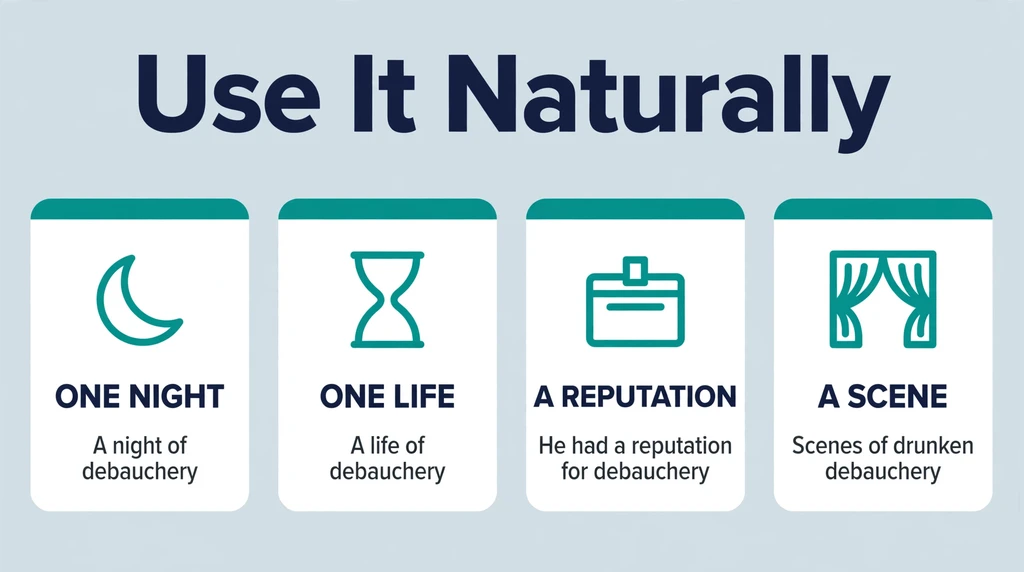
Certain frames recur so often that they function as ready-made units. “A night of debauchery” is the most famous, used seriously in older writing and playfully now. “A life of debauchery” stretches the same idea across a biography. Writers describe “scenes of debauchery” when a place, not just a person, is on trial, and “drunken debauchery” when alcohol is clearly the engine.
Cambridge’s example sentences offer real sightings: a young man who “had a reputation for debauchery,” and parliamentary debates about “drunken debauchery.” Learn those four frames and you can deploy the word, or spot its tone, almost anywhere.
Tone detection matters because the frames themselves stay neutral. “A reputation for debauchery” ruins a clergyman in a biography and burnishes a rock star in a review. The words around the frame, words like shameless, mild, cheerful, or notorious, carry the verdict. Read those adjectives first, and you will rarely misjudge whether the writer is condemning, confessing, or quietly advertising.
Frequently Asked Questions
What does debauchery mean in simple words?
In simple words, debauchery means enjoying bodily pleasures far too much and without any self-control. It covers wild behaviour involving drink, drugs, sex, and luxury, and the word itself disapproves of what it describes. If moderation is a dimmer switch, debauchery is the moment someone rips the switch off the wall.
What is an example of debauchery?
A classic example is a wealthy heir who spends his inheritance on gambling, taverns, and parties until debt and ruin catch up with him, exactly the story Hogarth painted in A Rake’s Progress. In everyday speech, people also use the word lightly for one very indulgent night. The scale differs, but the ingredients of excess and surrendered restraint stay the same.
Is debauchery the same as hedonism?
No. Hedonism is a philosophy that treats pleasure or happiness as the highest good in life, and a thoughtful hedonist may live quite moderately. Debauchery is not a belief system at all. It is behaviour, specifically indulgence pushed to an extreme that others judge immoral. Hedonism can be calm and reasoned; debauchery never is.
Why does the word debauchery appear in the Bible?
Modern translations such as the New International Version use debauchery to render Greek words for unrestrained, dissolute living. It appears in Ephesians 5:18, Galatians 5:19, Romans 13:13, and 1 Peter 4:3. Older versions chose rivals like excess, riot, or lasciviousness for the same Greek terms. Translators reach for debauchery because it packs drunkenness, sexual licence, and general excess into one strong word.
Can debauchery be used in a joking way?
Yes, and it often is. Because the word sounds so stern and old fashioned, speakers borrow it for comic exaggeration: a big birthday dinner becomes “an evening of pure debauchery.” Merriam-Webster notes that outside religious contexts the word frequently carries this playful tone. The joke works because listeners know the serious meaning and can measure the gap.
What is the adjective form of debauchery?
The adjective is debauched. It describes a person, period, or set of manners corrupted by indulgence, as in “a debauched court” or “his debauched youth.” The related verb is debauch, meaning to corrupt or lead someone astray. There is no standard adjective “debaucherous,” however tempting it looks.
What is the opposite of debauchery?
The classic opposites are temperance and moderation, the habits of keeping appetites within limits. Abstinence and sobriety oppose the drinking side of the word, while virtue and decency oppose its moral side. If one word must do the whole job, self-restraint is the safest choice.
Final Thoughts
Debauchery has travelled a long way from a French workshop, where it meant luring a man from his bench, to the nightclub and the history book. Through every century, though, its recipe has stayed stable: sensual pleasure, taken without restraint, in amounts that make onlookers shake their heads.
Choose it when excess and judgment both matter, and reach for hedonism, decadence, or licentiousness when only one ingredient is present. For the full paper trail of the word’s journey, the entry on debauchery at Etymonline (https://www.etymonline.com/word/debauchery) lays out the dates, spellings, and theories in one place. Handle the word with the very moderation its subjects never managed, and it will serve your writing well.
Debauchery survives because English still needs a word for the moment pleasure stops being a joy and starts being a master. Slang dates within a decade, but this old French traveller has condemned, amused, and warned readers for nearly four hundred years. Used precisely, it still does all three jobs at once.