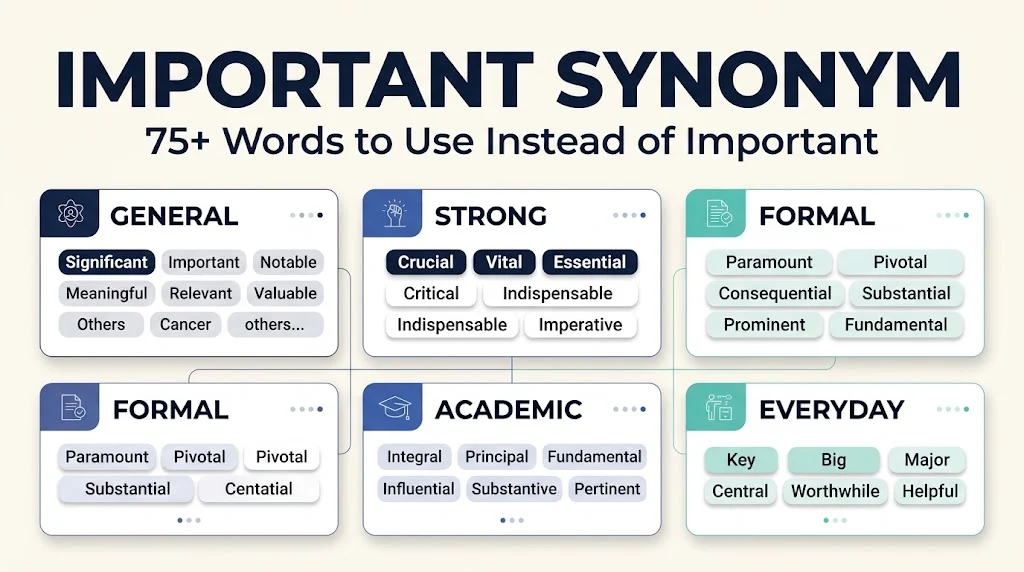
The word important works in almost every situation, but using it too often can make your writing sound repetitive. Whether you’re writing an essay, preparing a business report, updating your resume, or sending a professional email, the right synonym can make your message clearer and more precise.
The best synonym for important depends on what you want to express. Words such as significant, essential, crucial, vital, and paramount all describe importance, but they emphasize different things. Something significant has considerable meaning or impact, while something essential is necessary. A crucial decision can determine the outcome of an entire project.
This guide explores more than 75 alternatives to important, along with their meanings, practical examples, formal expressions, and common mistakes. You’ll learn how to choose the right word for academic writing, business communication, personal messages, and everyday conversations.
What Is Another Word for Important?
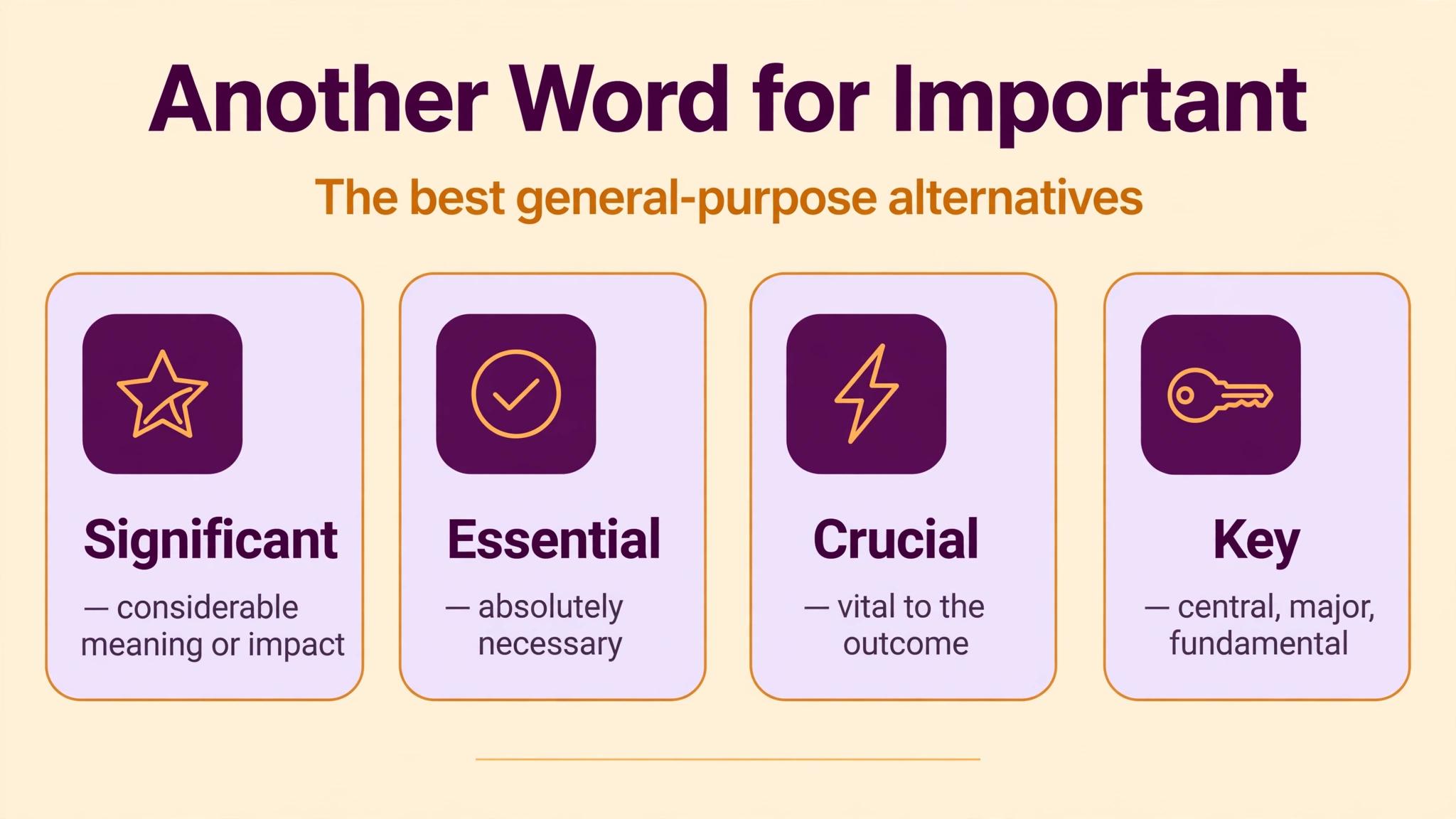
A useful synonym for important is significant. Other common alternatives include essential, crucial, vital, critical, key, major, and fundamental.
The word important describes something that has considerable value, meaning, influence, or relevance. It can also describe something that deserves attention or plays a major role in an outcome.
Here are the best general-purpose synonyms for important:
- Significant: Having considerable meaning, value, or impact.
- Essential: Absolutely necessary for a purpose or result.
- Crucial: Extremely important to the success or outcome of something.
- Vital: Necessary for life, success, or proper functioning.
- Critical: Extremely important, especially when the consequences are serious.
- Key: Central to understanding, achieving, or resolving something.
- Fundamental: Forming a basic foundation or principle.
- Meaningful: Having personal, emotional, or wider significance.
- Valuable: Worthwhile, useful, or beneficial.
- Major: Great in size, scope, importance, or effect.
- Relevant: Directly connected to a subject or situation.
- Pivotal: Having a decisive influence on what happens next.
- Consequential: Producing important effects or consequences.
- Indispensable: So necessary that it is difficult or impossible to do without.
- Paramount: More important than anything else in a particular situation.
Consider this example:
Original: Communication is important for a successful team.
Improved: Communication is essential for a successful team.
The second sentence makes a stronger claim. It tells readers that communication isn’t merely helpful. It’s necessary for the team’s success.
However, not every sentence needs a stronger word. Sometimes relevant, useful, or valuable expresses your meaning more accurately than crucial or vital.
Important Synonyms List With Meanings and Examples
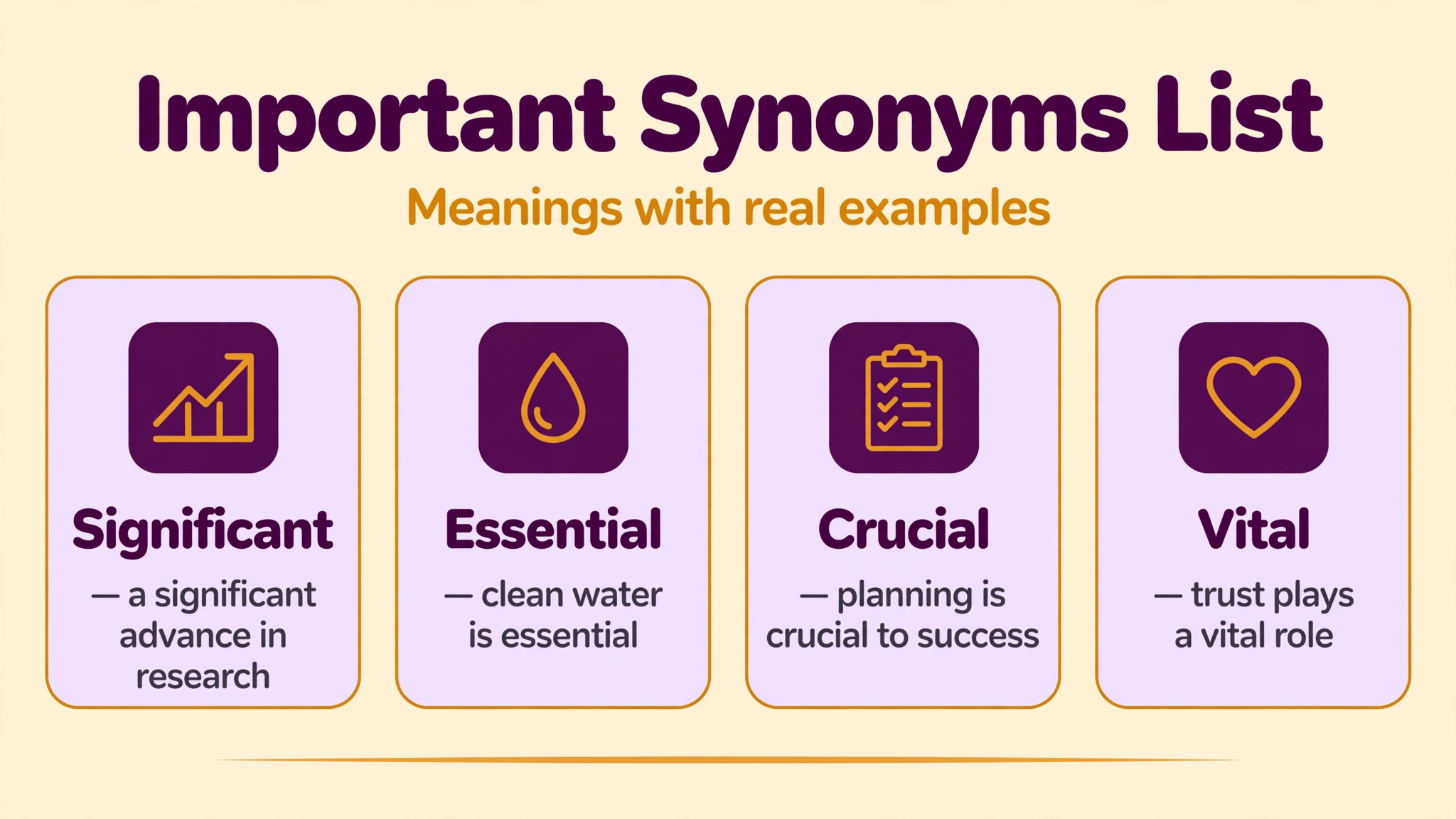
The following table brings together versatile synonyms for important. Each word includes a simple explanation and an example showing how it works in context.
| Synonym | Meaning | Example sentence |
|---|---|---|
| Significant | Having considerable meaning or impact | The discovery marked a significant advance in research. |
| Essential | Absolutely necessary | Clean water is essential for human health. |
| Crucial | Extremely important to an outcome | Planning is crucial to the project’s success. |
| Vital | Necessary for life or proper functioning | Trust plays a vital role in strong relationships. |
| Critical | Extremely important, often involving serious consequences | The engineers identified a critical safety issue. |
| Key | Central to an outcome or understanding | Consistency is a key factor in learning. |
| Fundamental | Forming a basic foundation | Grammar is fundamental to clear writing. |
| Meaningful | Having real significance or value | Their support made a meaningful difference. |
| Valuable | Worthwhile or beneficial | The meeting provided valuable feedback. |
| Relevant | Directly connected to the topic | Include only relevant details in your report. |
| Major | Considerable in scale or effect | The company announced a major policy change. |
| Consequential | Having significant effects | It was a consequential decision for the organization. |
| Substantial | Considerable in amount, degree, or scope | The proposal offers substantial benefits. |
| Pivotal | Decisive in influencing an outcome | Her research played a pivotal role in the project. |
| Indispensable | Extremely necessary | Accurate records are indispensable to the audit. |
| Integral | Forming an essential part of something | Feedback is an integral part of the learning process. |
| Noteworthy | Deserving attention | The report revealed a noteworthy improvement. |
| Salient | Most noticeable or relevant | The presentation highlighted the salient findings. |
| Material | Significant enough to affect a decision or outcome | The review found a material difference between the estimates. |
| Influential | Having the power to affect people or events | She became an influential voice in the industry. |
| Imperative | Absolutely necessary or demanded by circumstances | Immediate action is imperative in an emergency. |
| Paramount | More important than other considerations | Public safety remains paramount. |
| Principal | First in importance or main in a group | Cost was the principal concern during negotiations. |
| Primary | First in order, rank, or importance | Our primary objective is customer satisfaction. |
| Foremost | Most prominent or important | Safety should remain foremost in every decision. |
| Preeminent | Surpassing others in status or distinction | The institute is a preeminent center for research. |
| Momentous | Extremely important because of its lasting effects | The agreement marked a momentous change in policy. |
| Decisive | Settling an issue or determining an outcome | Her evidence proved decisive in resolving the dispute. |
| Worthwhile | Worth the time, effort, or expense | The training was worthwhile for the entire team. |
| Beneficial | Producing a helpful or favorable effect | Regular feedback is beneficial to employees. |
These words overlap, but they aren’t exact replacements in every sentence. For example, a momentous event changes something significantly, while a noteworthy event simply deserves attention. A material fact can affect a decision, especially in legal, financial, and business settings.
The most useful rule: Choose the word that describes why something matters, not merely how important it seems.
Synonyms for Important by Degree of Importance
Not every important matter deserves the same level of emphasis. A useful suggestion might be valuable, while a serious safety requirement might be critical. Choosing the right intensity helps readers understand the difference.
The groups below offer a practical guide rather than a strict ranking. A word’s strength always depends on context.
Mild or General Synonyms for Important
These words suggest usefulness, relevance, or moderate significance without making an extreme claim.
- Relevant
- Useful
- Worthwhile
- Notable
- Meaningful
- Valuable
- Appreciable
- Beneficial
Examples:
- Please include the most relevant information in your application.
- Your feedback was valuable during the planning stage.
- The course provides useful background for beginners.
- The team achieved a notable improvement in response times.
Use these words when you want to acknowledge something’s value without suggesting that it is essential or urgent.
For instance, a reference article might be relevant to your research without being necessary to complete it. Likewise, a meeting can be worthwhile without changing the project’s direction.
Moderate Synonyms for Important
These alternatives suggest considerable value, scope, meaning, or effect.
- Significant
- Substantial
- Major
- Consequential
- Noteworthy
- Considerable
- Integral
- Material
Examples:
- The study identified a significant change in consumer behavior.
- The company made a substantial investment in employee training.
- We found a major difference between the two proposals.
- The contract includes a material condition that affects payment.
These words are particularly useful in reports, essays, business communication, and analytical writing.
However, notice their differences. Substantial often relates to size or degree. Consequential emphasizes effects. Integral describes something that forms an essential part of a whole.
Strong Synonyms for Important
Use these terms when a matter directly affects success, safety, understanding, or the outcome of a decision.
- Crucial
- Critical
- Essential
- Vital
- Fundamental
- Pivotal
- Decisive
Examples:
- Accurate measurements are crucial to reliable results.
- Data protection is critical for the organization.
- Regular practice is essential for developing strong writing skills.
- The final negotiation proved pivotal to reaching an agreement.
These words carry more weight than general alternatives such as useful or noteworthy.
Still, they express different ideas. Essential means necessary, critical can signal serious consequences, and pivotal suggests a turning point that influences what happens next.
Synonyms for the Highest Level of Importance
When something takes precedence over other concerns, more emphatic words may fit.
- Paramount
- Indispensable
- Imperative
- Foremost
- Preeminent
- Of utmost importance
- Absolutely essential
- Mission-critical
Examples:
- Passenger safety is paramount in aviation.
- Reliable power is indispensable to certain medical systems.
- It is imperative that the team follows emergency procedures.
- Protecting confidential information is of utmost importance.
Use these expressions selectively. If you describe every routine task as paramount, readers may struggle to identify your genuine priorities.
Synonyms for Very Important
The phrase very important expresses strong significance, but several alternatives communicate the reason something matters more clearly.
| Alternative | Best use | Example |
|---|---|---|
| Crucial | An outcome depends on it | Preparation is crucial to success. |
| Critical | Serious consequences are possible | This is a critical security issue. |
| Vital | Something is necessary for functioning or success | Clean air is vital to public health. |
| Essential | Something is required | Identification is essential for registration. |
| Paramount | It outranks other considerations | Patient safety is paramount. |
| Indispensable | Something cannot readily be done without it | Reliable data is indispensable to the analysis. |
| Pivotal | Something decisively changes events | The ruling was pivotal in the dispute. |
| Imperative | Circumstances make action necessary | It is imperative to correct the error. |
| Of utmost importance | A formal, emphatic expression | Accuracy is of utmost importance in this report. |
| Mission-critical | Failure could seriously disrupt an essential operation | The update fixes a mission-critical system error. |
How to Use Stronger Alternatives
Use crucial when success depends on something.
Example: Choosing the right research method is crucial to obtaining reliable results.
Use essential when something is required.
Example: A valid signature is essential to completing the process.
Use paramount when one concern takes precedence over others.
Example: Protecting customer information is paramount.
Use pivotal when something changes the direction of events.
Example: The new evidence played a pivotal role in the investigation.
Use imperative when action is necessary because of circumstances.
Example: It is imperative that the team address the safety concern immediately.
One useful distinction deserves special attention: important doesn’t automatically mean urgent. A long-term business strategy can be important without requiring immediate action. Conversely, a minor administrative task might be urgent because its deadline is approaching.
Formal Synonyms for Important
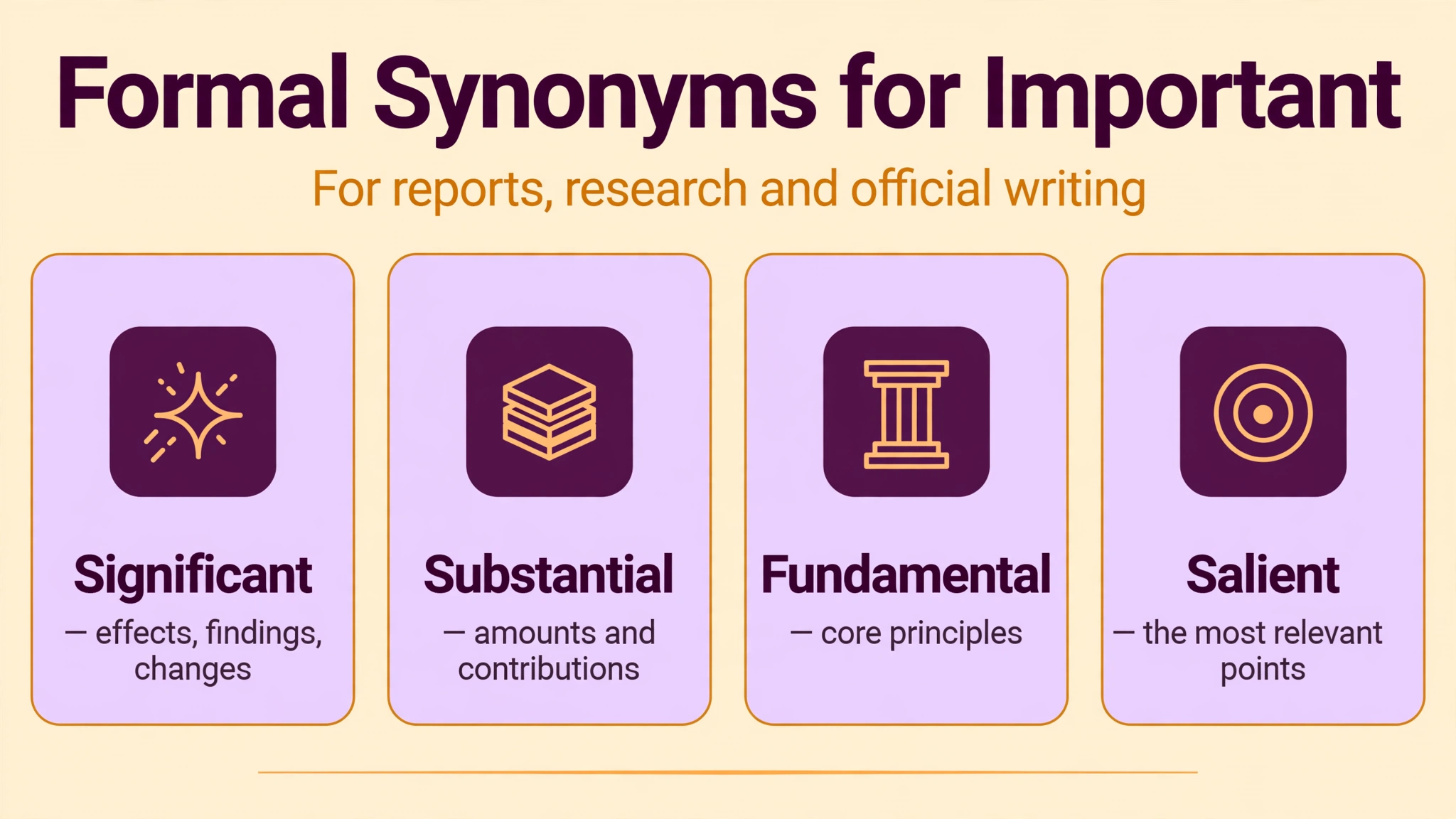
Formal writing often benefits from precise vocabulary, especially in reports, proposals, research papers, legal documents, and official correspondence.
The goal isn’t to replace every simple word with a complicated alternative. Instead, choose a term that communicates your intended meaning accurately.
Best Formal Alternatives
- Significant: Suitable for meaningful effects, findings, or changes.
- Substantial: Useful for considerable amounts, degrees, or contributions.
- Consequential: Appropriate for decisions that produce meaningful effects.
- Fundamental: Best for core principles, foundations, or underlying requirements.
- Salient: Useful for the most noticeable or relevant points.
- Material: Appropriate when something affects a decision or judgment.
- Integral: Describes something that forms an essential part of a whole.
- Pertinent: Means directly relevant to a particular subject or question.
- Paramount: Expresses the highest priority or level of importance.
- Noteworthy: Identifies something deserving particular attention.
Formal Synonyms in Sentences
Original: The report contains important information about the policy.
Improved: The report contains significant findings about the policy.
The revised sentence works when the information offers meaningful findings rather than routine details.
Original: Cost is an important factor in the decision.
Improved: Cost is a material factor in the decision.
This version fits when cost meaningfully affects the decision.
Original: Several important points require further discussion.
Improved: Several salient points require further discussion.
Use salient when those points stand out because of their relevance or prominence.
Original: Trust is important to effective governance.
Improved: Trust is fundamental to effective governance.
The replacement emphasizes trust as a basic foundation rather than a minor advantage.
Original: Accuracy is important in the final report.
Improved: Accuracy is paramount in the final report.
Choose this version when accuracy takes priority over other concerns. Otherwise, essential or critical may be more appropriate.
Professional and Business Synonyms for Important
In business writing, vague statements can hide the actual point. Saying that something is important doesn’t explain whether it affects revenue, deadlines, strategic decisions, legal obligations, or everyday operations.
Choose a more specific term whenever possible.
Synonyms for Important in Business Communication
| Business context | Recommended alternatives | Example |
|---|---|---|
| Strategy and planning | Strategic, central, pivotal | Customer retention is a strategic priority. |
| Reports and analysis | Significant, material, consequential | The review identified a material discrepancy. |
| Projects and deadlines | Critical, high-priority, time-sensitive | The team must resolve this high-priority issue. |
| Operations | Essential, integral, indispensable | Accurate records are essential to the process. |
| Performance | Key, significant, substantial | Response time is a key performance measure. |
| Leadership and influence | Influential, prominent, decisive | Her recommendation influenced the final decision. |
| Risk management | Critical, material, consequential | The assessment revealed a critical operational risk. |
| Business growth | Valuable, strategic, pivotal | The partnership became a valuable source of new customers. |
Examples for Business Writing
Instead of: Customer satisfaction is important to the company.
Write: Customer satisfaction is central to the company’s retention strategy.
This sentence identifies where customer satisfaction fits into the business plan.
Instead of: We have an important issue to resolve.
Write: We have a critical issue to resolve before launch.
This phrasing signals the issue’s serious consequences and ties it to a clear milestone.
Instead of: The report contains important financial information.
Write: The report identifies material financial risks.
Use material when the risks could influence a financial assessment or decision.
Instead of: This is an important project for our future.
Write: This is a strategic project that supports our long-term growth.
The alternative describes the project’s role in the organization’s broader direction.
When to Use High-Priority and Mission-Critical
High-priority indicates that something deserves attention before lower-priority tasks. It doesn’t necessarily mean the item is essential to the entire organization.
Mission-critical is stronger. It describes a system, process, or function whose failure could seriously interfere with an essential operation.
For example, fixing a spelling error in an internal memo might be worthwhile. Restoring a failed payment system during business hours could be mission-critical.
That distinction helps teams set priorities without labeling every task an emergency.
Academic Synonyms for Important
Academic writing requires careful word choice because different terms can make different claims.
A researcher might identify a significant finding, a fundamental principle, a salient factor, or a consequential result. Although these expressions overlap, each serves a different purpose.
Best Academic Alternatives
| Word | Meaning in academic writing | Example |
|---|---|---|
| Significant | Important because of its meaning, impact, or measured result | The study found a significant difference between the groups. |
| Fundamental | Basic to a theory, method, or field | Measurement is fundamental to the research design. |
| Salient | Particularly noticeable or relevant | The analysis identifies three salient themes. |
| Substantial | Considerable in amount, size, or degree | The intervention produced a substantial reduction in errors. |
| Consequential | Likely to affect later events or outcomes | The findings have consequential implications for policy. |
| Relevant | Directly connected to the research question | The review includes relevant studies. |
| Integral | Forming an essential part of a process or system | Participant consent is integral to the research process. |
| Pivotal | Decisive in influencing an outcome or development | The experiment marked a pivotal stage in the investigation. |
| Noteworthy | Deserving attention because of a notable feature | One noteworthy pattern appeared across the interviews. |
| Material | Significant enough to affect a judgment or result | The researchers identified a material limitation in the dataset. |
Important vs. Statistically Significant
The phrase statistically significant has a specific technical meaning in statistical analysis. It shouldn’t be used merely as a sophisticated substitute for important.
In hypothesis testing, statistical significance relates to whether the observed data meet a predefined criterion under a statistical model. A p-value is often compared with a significance threshold, such as 0.05, although the appropriate approach depends on the study.
A statistically significant result doesn’t automatically imply a large effect, practical value, or real-world importance.
For example, a study with a large sample may detect a very small difference that meets its statistical significance threshold. That difference might have little practical value.
By contrast, a meaningful effect may remain statistically uncertain in a small study.
Academic writers should therefore distinguish between:
- Statistical significance: Whether the result meets the chosen statistical criterion.
- Practical significance: Whether the result matters in real-world use.
- Scientific significance: Whether the finding advances knowledge or understanding.
- Clinical significance: Whether a result matters to patient health or clinical decisions.
Use significant in ordinary academic prose when you mean meaningful or notable. Use statistically significant only when that technical claim is justified.
Examples for Essays and Research Papers
Original: Education plays an important role in economic development.
Improved: Education plays a fundamental role in economic development.
This version emphasizes education as a basic foundation.
Original: The study identifies an important relationship between sleep and concentration.
Improved: The study identifies a significant relationship between sleep and concentration.
The revised wording works if the relationship has meaningful relevance to the research. If the authors mean statistical significance, the methods and findings must support that specific interpretation.
Original: One important factor affected the results.
Improved: One salient factor affected the results.
Use salient when the factor stands out as especially relevant to the analysis.
Positive Synonyms for Important
Sometimes, important describes something you value, appreciate, or consider meaningful. In these cases, an emotional or positive alternative can communicate more than a general statement.
Positive Alternatives
- Valuable
- Meaningful
- Beneficial
- Worthwhile
- Precious
- Cherished
- Invaluable
- Appreciated
- Influential
- Rewarding
- Significant
- Essential
Each word carries a slightly different tone.
Valuable emphasizes worth or usefulness.
Example: Her feedback was valuable during the development process.
Meaningful suggests personal significance or a deeper sense of purpose.
Example: Volunteering became a meaningful part of his life.
Beneficial emphasizes a favorable effect.
Example: Regular exercise can be beneficial to overall health.
Precious often expresses deep emotional value or exceptional scarcity.
Example: Those photographs preserve precious family memories.
Cherished describes something held dear.
Example: The award remains a cherished reminder of years of hard work.
Invaluable means extremely useful or valuable.
Example: Her experience proved invaluable during the transition.
A common mistake is assuming that invaluable means worthless because it begins with in-. In standard English, it expresses exceptionally high value.
Choose positive synonyms when you want to explain why something matters. A meaningful friendship, for instance, carries personal significance that the generic adjective important might not fully convey.
Synonyms for Important When Describing People, Roles, and Contributions
The word important can describe a person, a job, a contribution, or a position. However, different alternatives highlight different qualities.
A person may be influential because others listen to them. A role may be essential because the team cannot function without it. A contribution may be significant because it produces a measurable improvement.
Words for Important People
- Influential: Able to affect decisions, opinions, or events.
- Prominent: Widely recognized or noticeable within a field.
- Distinguished: Respected because of notable achievements.
- Eminent: Highly respected and recognized in a particular profession or area.
- Leading: Among the foremost people, organizations, or examples in a field.
- Respected: Regarded with admiration or esteem.
- Preeminent: Surpassing others in importance, status, or distinction.
Examples:
- She is an influential researcher in environmental science.
- The conference welcomed several prominent business leaders.
- He is a distinguished scholar with decades of research experience.
- The organization is a leading provider of technical services.
Be precise when describing people. Prominent doesn’t automatically mean admirable, and influential doesn’t necessarily mean successful. Each term expresses a different characteristic.
Words for Important Roles
- Essential
- Integral
- Central
- Key
- Pivotal
- Indispensable
- Fundamental
Examples:
- Training plays an integral role in employee development.
- The operations manager has a key role in coordinating daily work.
- Accurate testing is essential to quality control.
- Local partnerships played a pivotal role in the program’s expansion.
Words for Important Contributions
- Significant
- Substantial
- Valuable
- Meaningful
- Consequential
- Noteworthy
- Influential
Examples:
- The team made a significant contribution to the project.
- Her analysis provided valuable insight into customer behavior.
- The research made a substantial contribution to the field.
- Their work had a lasting impact on the community.
When possible, explain the actual contribution. A concrete result is usually more informative than a general label.
For example, “She played an important role in the launch” tells readers little about her work. “She coordinated the launch schedule and resolved supplier delays” provides specific evidence of her contribution.
Different Ways to Say Important in Everyday Writing
Formal vocabulary isn’t always the best choice. In casual conversation, a simple phrase can sound warmer and more natural than an elaborate synonym.
Here are alternatives for texts, messages, informal writing, and everyday conversations.
| Expression | Meaning or tone | Example |
|---|---|---|
| A big deal | Something that matters considerably | Getting the opportunity was a big deal for her. |
| Matters a lot | Has strong personal or practical value | Your support matters a lot to me. |
| Worth paying attention to | Deserves notice or consideration | This detail is worth paying attention to. |
| Of real value | Genuinely useful or meaningful | Your advice was of real value. |
| A key point | A central idea | That’s a key point in the discussion. |
| A major factor | Something that strongly affects an outcome | Cost was a major factor in our decision. |
| A priority | Something that deserves attention before other tasks | Finishing the assignment is my priority. |
| A turning point | An event that changes the direction of something | That conversation was a turning point for us. |
| Worth considering | Deserving careful thought | Your suggestion is worth considering. |
| Something that matters | An issue or thing with real significance | Focus on what matters most. |
Examples in Everyday Sentences
Original: Your opinion is important to me.
Natural alternative: Your opinion matters a lot to me.
Original: This is an important detail.
Natural alternative: This detail is worth paying attention to.
Original: Saving money is important right now.
Natural alternative: Saving money is a priority right now.
Original: That meeting was important for the company.
Natural alternative: That meeting was a turning point for the company.
Be careful with emotional meaning. “You matter a lot to me” communicates personal affection or appreciation, while “You are a significant person” can sound distant or overly formal.
The right expression depends on your relationship with the reader and the feeling you want to convey.
Important Synonyms in Example Sentences
Replacing important becomes easier when you examine the whole sentence instead of choosing a word from a list.
The examples below cover several common writing situations.
Health and Safety
Original: Regular exercise is important for health.
Better: Regular exercise is beneficial to overall health.
Use beneficial to emphasize a positive effect.
Original: Clean drinking water is important for survival.
Better: Clean drinking water is essential for survival.
Use essential because the sentence describes a basic necessity.
Original: Checking equipment is important before operating the machine.
Better: Checking equipment is critical before operating the machine.
Use critical when overlooking the check could create serious risks.
Education and Learning
Original: Practice is important for learning a new language.
Better: Practice is essential for developing language skills.
Original: Vocabulary is important for reading comprehension.
Better: Vocabulary is fundamental to reading comprehension.
Original: The teacher explained an important concept.
Better: The teacher explained a key concept.
These alternatives emphasize necessity, a foundation, and central relevance.
Decisions and Projects
Original: The team made an important decision.
Better: The team made a consequential decision.
Use this wording when the decision has meaningful effects.
Original: The final meeting was important to the project.
Better: The final meeting was pivotal to the project’s outcome.
This wording highlights a decisive influence.
Original: Meeting the deadline is important.
Better: Meeting the deadline is critical to completing the project on schedule.
The improved sentence explains why the deadline matters.
Personal Relationships
Original: Family is important to me.
Better: Family is invaluable to me.
Original: Her encouragement was important during a difficult time.
Better: Her encouragement made a meaningful difference during a difficult time.
Original: Trust is important in a healthy relationship.
Better: Trust is essential to a healthy relationship.
These examples show that the most suitable alternative depends on whether you mean emotional value, personal influence, or necessity.
History and Major Events
Original: The invention was an important moment in technological development.
Better: The invention marked a significant milestone in technological development.
Original: The agreement was an important event in the country’s history.
Better: The agreement was a momentous event in the country’s history.
Original: The ruling had an important effect on later decisions.
Better: The ruling had a lasting influence on later decisions.
Use momentous for events with exceptional historical or lasting significance. Reserve it for genuinely consequential developments.
Important Synonyms for Resumes and Cover Letters
Job seekers often write that they played an “important role,” handled “important tasks,” or completed “important projects.” These phrases aren’t necessarily wrong, but they rarely explain the value of the work.
A stronger resume uses specific language to describe responsibility, scope, and results.
Useful Resume Alternatives
- Key
- Strategic
- Critical
- Significant
- Valuable
- Substantial
- Integral
- High-priority
- Influential
- Essential
Choose an alternative based on the achievement rather than the desire to sound impressive.
| Generic resume statement | Improved version |
|---|---|
| Played an important role in customer service. | Played a key role in improving customer service response times. |
| Completed important projects. | Delivered high-priority projects within agreed deadlines. |
| Made an important contribution to sales. | Made a significant contribution to sales growth. |
| Handled important business operations. | Managed critical business operations across several teams. |
| Provided important insights. | Delivered valuable insights that informed planning decisions. |
| Worked on important company initiatives. | Supported strategic initiatives aligned with business objectives. |
The stronger examples become even more convincing when they include measurable outcomes.
For instance:
Coordinated a high-priority customer service project that reduced average response times by 20%.
Use that statement only if the result accurately reflects your experience. Never add a percentage or achievement simply to make a resume sound stronger.
Should You Use Sophisticated Words on a Resume?
Not necessarily. Hiring managers need to understand your experience quickly. A clear statement usually works better than an inflated one.
Compare these examples:
- Inflated: Played a preeminent role in consequential business undertakings.
- Clear: Led strategic projects that improved operational efficiency.
The second statement communicates action and purpose in familiar language.
Use strategic when the work supports a larger objective, key when you performed a central function, and significant when the contribution had a meaningful effect.
Important vs. Significant vs. Essential vs. Crucial
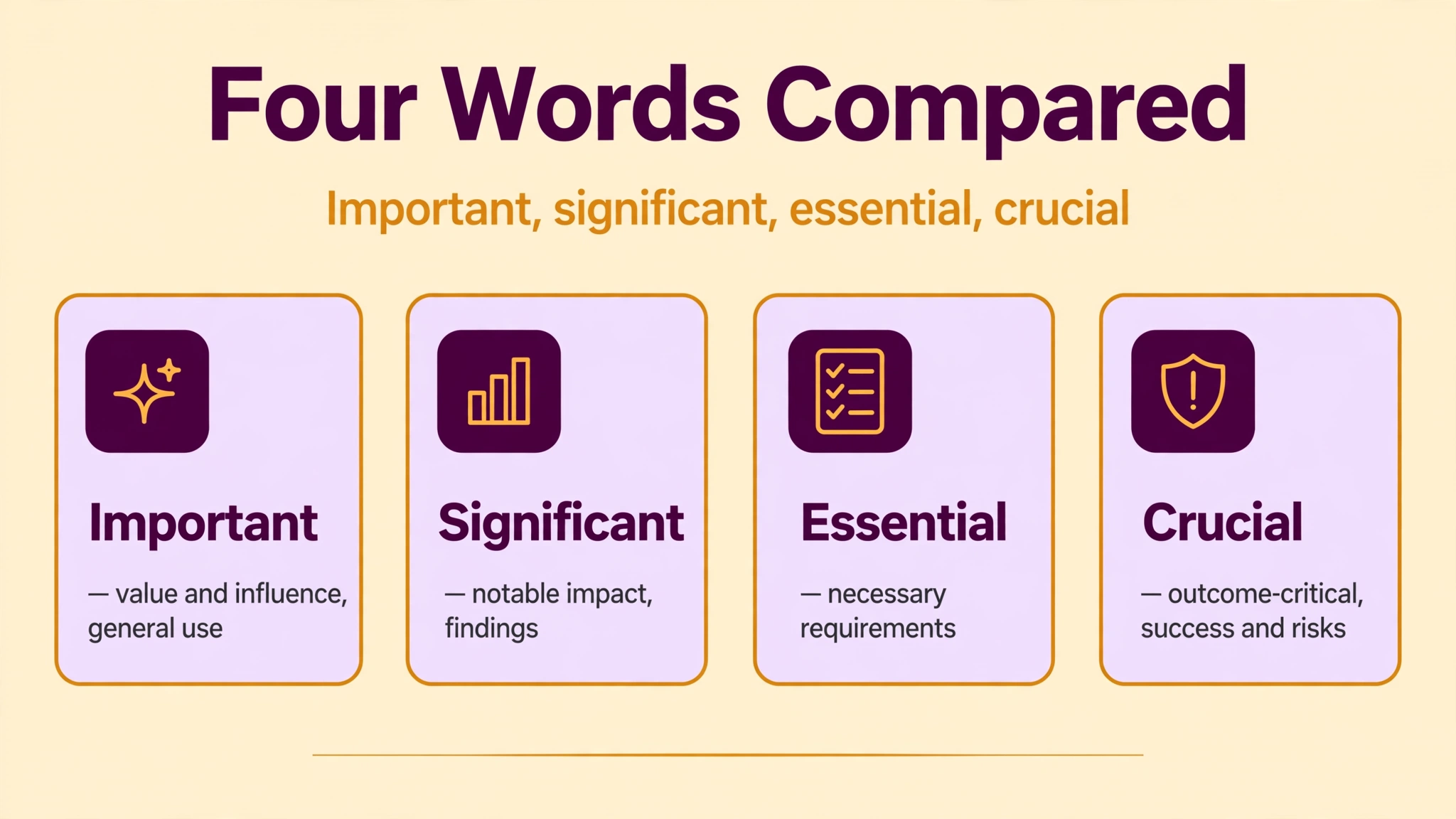
These four words are among the most useful alternatives to important. Learning their differences can improve both everyday and professional writing.
| Word | Core meaning | Best used for | Example |
|---|---|---|---|
| Important | Having value, meaning, or influence | General statements | Clear communication is important. |
| Significant | Having notable meaning, scale, or impact | Findings, changes, and results | The policy produced a significant change. |
| Essential | Necessary for a purpose or function | Requirements and foundations | Identification is essential for registration. |
| Crucial | Extremely important to an outcome | Success, decisions, and risks | Preparation is crucial to success. |
Important vs. Significant
Important is broad. It can describe a person, a decision, a responsibility, or a piece of information.
Significant emphasizes meaning, scale, or impact. It often suits research findings, changes, achievements, and events.
For example:
- General: This is an important issue.
- More specific: This issue has significant financial implications.
The second sentence explains the type of importance involved.
Important vs. Essential
Essential means necessary. Something can be important without being essential.
For example, a presentation’s opening slide may be important to the overall impression, but it isn’t always essential to the presentation itself.
By contrast, a required safety check may be essential because the process shouldn’t proceed without it.
Use essential when removing something would prevent a task, function, or purpose from being completed properly.
Important vs. Crucial
Crucial carries stronger emphasis than ordinary important. It usually indicates that an outcome depends heavily on a factor, decision, or action.
For example:
- General: Experience is important for this position.
- Stronger: Experience is crucial for this position because the employee must manage complex emergencies independently.
The second sentence explains why the experience matters.
Important vs. Vital
Vital often describes something necessary for survival, effective functioning, or success.
Examples include vital signs in healthcare, vital information in an emergency, and vital resources for a project.
Use vital when the thing described is central to continued functioning or an essential outcome.
Important vs. Paramount
Paramount means more important than other considerations in a particular context.
For example, a business may weigh cost, convenience, and delivery speed, but safety remains paramount.
The word establishes a clear hierarchy of importance. It is therefore stronger and more selective than the general adjective important.
Common Mistakes When Choosing a Synonym for Important
Synonyms help you vary your writing, but inaccurate substitutions can change the meaning of a sentence. Watch for these common problems.
Using Significant When You Mean Essential
These words express different ideas.
A report may contain significant information, but that doesn’t mean every detail is essential. Something can carry considerable meaning without being necessary to complete a task.
Use essential when the sentence requires necessity.
Using Urgent as a Direct Replacement
Urgent means that something requires prompt attention. It doesn’t simply mean that something matters.
A long-term investment strategy can be important without being urgent. A small technical problem can become urgent when it prevents a scheduled task.
Choose urgent only when the timing or need for immediate action matters.
Using Relevant When You Mean Crucial
Relevant information connects directly to a topic. It isn’t necessarily decisive or necessary.
For example, a historical detail may be relevant to an essay without being crucial to its argument.
Use crucial when the outcome depends heavily on the factor.
Using Influential to Mean Valuable
An influential person or factor can affect decisions, opinions, or events. That doesn’t automatically make the influence positive or useful.
For example, an influential marketing campaign may have a harmful effect.
Choose valuable when you want to emphasize worth or usefulness.
Using Paramount for Ordinary Tasks
Paramount signals the highest level of importance within a particular set of priorities.
Calling every meeting, email, and routine task paramount makes your writing less precise. Reserve it for situations where one concern genuinely takes precedence.
Overusing Complicated Words
A sophisticated synonym isn’t always an improvement.
Compare these sentences:
- Unclear: The aforementioned considerations are of paramount consequentiality.
- Clear: These considerations are extremely important.
The clear sentence gets straight to the point.
Good writing doesn’t require the most unusual word available. It requires the word that communicates the intended meaning with the least confusion.
Replacing Every Occurrence of Important
Sometimes, important is exactly the right word. Repeatedly replacing it can make an otherwise natural article sound forced.
Instead, consider whether the sentence needs a different adjective, a more specific noun, or a stronger verb.
For example:
- Original: The policy is important for employee safety.
- Better: The policy is essential for employee safety.
- More specific: The policy protects employees by setting clear safety requirements.
The last version explains why the policy matters rather than merely describing it.
Antonyms of Important
An antonym expresses the opposite or a contrasting meaning. Understanding antonyms helps clarify the boundaries between important matters and details that deserve less attention.
| Antonym | Meaning | Example |
|---|---|---|
| Unimportant | Having little importance | We can discuss the unimportant details later. |
| Insignificant | Too small or minor to have much impact | The difference was insignificant. |
| Trivial | Not serious or substantial | They spent too long debating a trivial issue. |
| Minor | Limited in size, degree, or importance | The report contains a minor error. |
| Irrelevant | Not connected to the matter at hand | That information is irrelevant to the decision. |
| Inconsequential | Having little or no meaningful effect | The mistake proved inconsequential. |
| Negligible | So small that it can reasonably be disregarded | The change produced a negligible cost increase. |
| Immaterial | Not significant to a particular decision or issue | The distinction was immaterial to the case. |
| Peripheral | Secondary rather than central | The discussion moved toward peripheral concerns. |
| Nonessential | Not strictly necessary | We removed several nonessential features. |
| Superficial | Concerned with appearances or surface features rather than depth | The review offered only a superficial analysis. |
| Insubstantial | Lacking substance or considerable weight | The proposal rested on insubstantial evidence. |
Irrelevant vs. Unimportant
These words are easy to confuse.
Something irrelevant has no direct connection to the question or task. Something unimportant has little significance.
For example, a person’s favorite color may be irrelevant when calculating a business tax. It could be important when choosing colors for a personalized gift.
The information itself hasn’t changed. Its relevance depends on the situation.
Insignificant vs. Negligible
Insignificant usually suggests that something lacks enough importance or impact to deserve much attention.
Negligible emphasizes that the amount, difference, or effect is so small that it can reasonably be ignored for a particular purpose.
For example, a negligible cost difference might not affect a purchasing decision. An insignificant detail might simply contribute little to the main argument.
Choose the antonym that matches the point you’re trying to make.
How to Choose the Best Synonym for Important
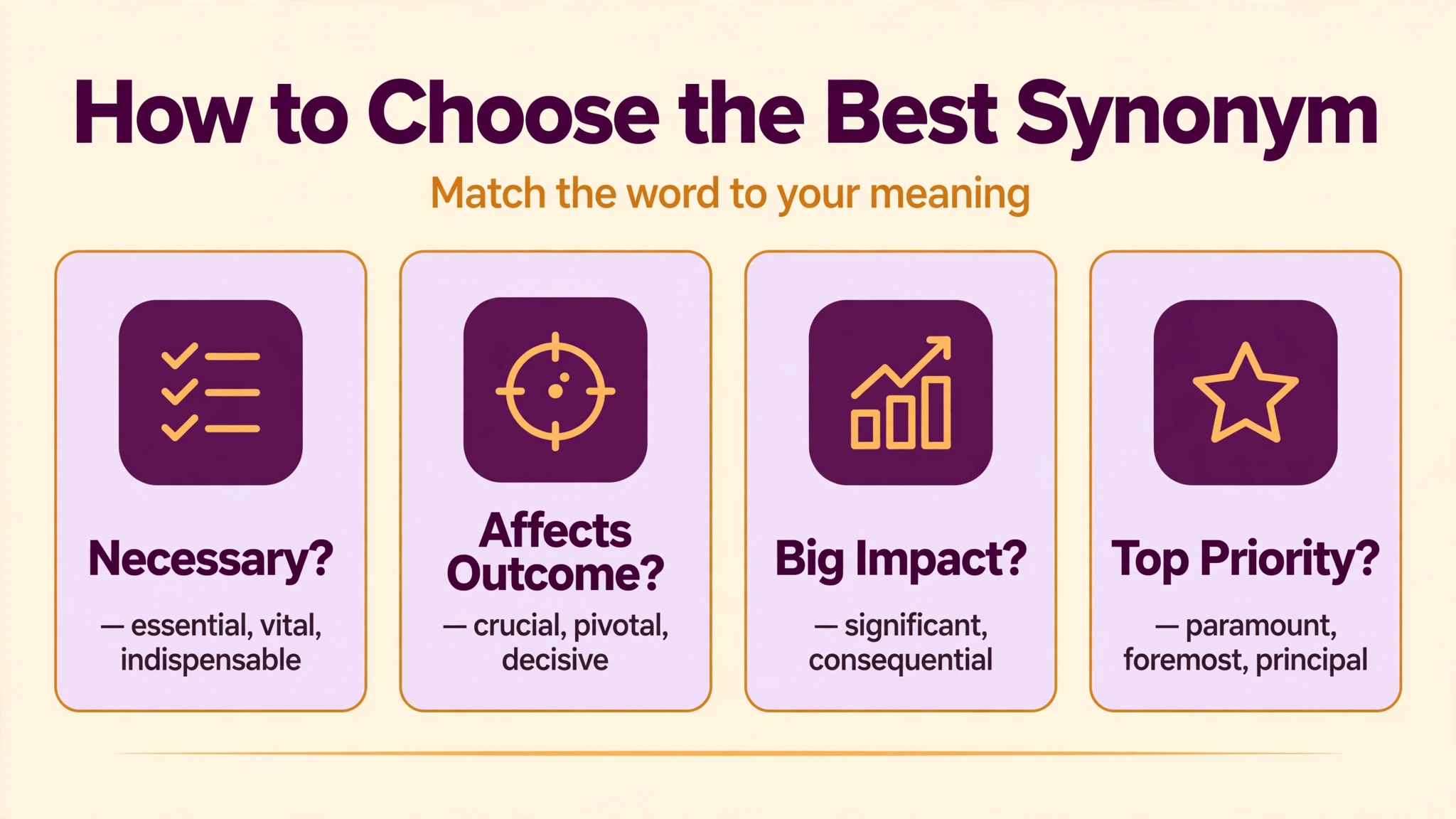
The fastest way to choose a synonym is to ask yourself what makes the subject important.
Does it matter because it’s necessary? Does it influence an outcome? Is it especially valuable to someone? Or does it deserve immediate attention?
Use the following guide to make a more accurate choice.
| If you mean… | Choose words such as… |
|---|---|
| Something is necessary | Essential, vital, indispensable |
| Something strongly affects an outcome | Crucial, pivotal, decisive |
| Something has considerable impact | Significant, consequential, substantial |
| Something deserves the highest priority | Paramount, foremost, principal |
| Something is relevant to a topic | Pertinent, relevant, salient |
| Something is valuable or helpful | Valuable, beneficial, worthwhile |
| Someone affects decisions or opinions | Influential, prominent, leading |
| Something requires immediate action | Urgent, pressing, time-sensitive |
| Something forms a basic foundation | Fundamental, integral, foundational |
| Something deserves special notice | Noteworthy, notable, remarkable |
| Something matters emotionally | Meaningful, precious, cherished |
| Something deserves priority at work | Key, strategic, high-priority |
Before choosing, read the entire sentence aloud. A synonym may fit the dictionary definition while sounding awkward in the actual context.
For example, “The report contains paramount statistics” sounds unnatural in most contexts. “The report contains significant statistics” may be more suitable, provided the findings support that description.
Likewise, “The deadline is valuable” doesn’t express the intended meaning. “The deadline is critical” or “Meeting the deadline is essential” is much clearer.
Precise word choice starts with precise thinking. Once you know why something matters, the right synonym becomes easier to identify.
Frequently Asked Questions About Important Synonyms
What Is the Best Synonym for Important?
The best general synonym for important is often significant, but the ideal choice depends on your sentence. Use essential when something is necessary, crucial when an outcome depends on it, and key when something plays a central role.
For everyday writing, significant, essential, crucial, vital, and key are versatile options.
What Is a Stronger Word Than Important?
Crucial, critical, vital, and paramount can express stronger importance than the general adjective important. However, each carries a different emphasis.
Use crucial when success depends on something, critical when the consequences are serious, vital when something is necessary for proper functioning, and paramount when it outranks other concerns.
What Is a Formal Word for Important?
Formal alternatives include significant, substantial, consequential, fundamental, salient, material, and integral.
Choose the word according to the context. For instance, material can describe a fact that affects a business or legal decision, while fundamental describes a basic principle or foundation.
Avoid choosing a complicated word merely to make your writing sound formal. Accuracy and clarity matter more than complexity.
What Is Another Word for Very Important?
Good alternatives to very important include crucial, essential, critical, vital, paramount, and indispensable.
You can also use phrases such as of utmost importance and absolutely essential.
For example, “Accurate reporting is crucial to the investigation” communicates more clearly than “Accurate reporting is very important to the investigation” when the investigation depends heavily on reliable records.
How Can I Avoid Repeating the Word Important in an Essay?
Start by identifying what you mean each time you use the word. Replace it with significant when discussing impact, essential when discussing necessity, fundamental when describing a foundation, or pivotal when explaining a decisive event.
You can also revise the sentence itself.
Instead of writing, “Education is important because it helps people develop skills,” try “Education helps people develop the skills they need for work and daily life.”
The revised sentence explains the value directly rather than relying on a general adjective.
Final Thoughts
The word important is useful because it fits so many situations. However, choosing a more specific alternative can make your writing clearer, stronger, and more engaging.
Use significant for meaning or impact, essential for necessity, crucial for outcomes, paramount for top priorities, and valuable for worth or usefulness. For professional writing, terms such as strategic, material, and high-priority can communicate more precise ideas.
Remember that the strongest synonym isn’t always the longest or most formal one. The best word expresses exactly why something matters.
When you choose words with care, readers spend less time interpreting your sentences and more time understanding your ideas.