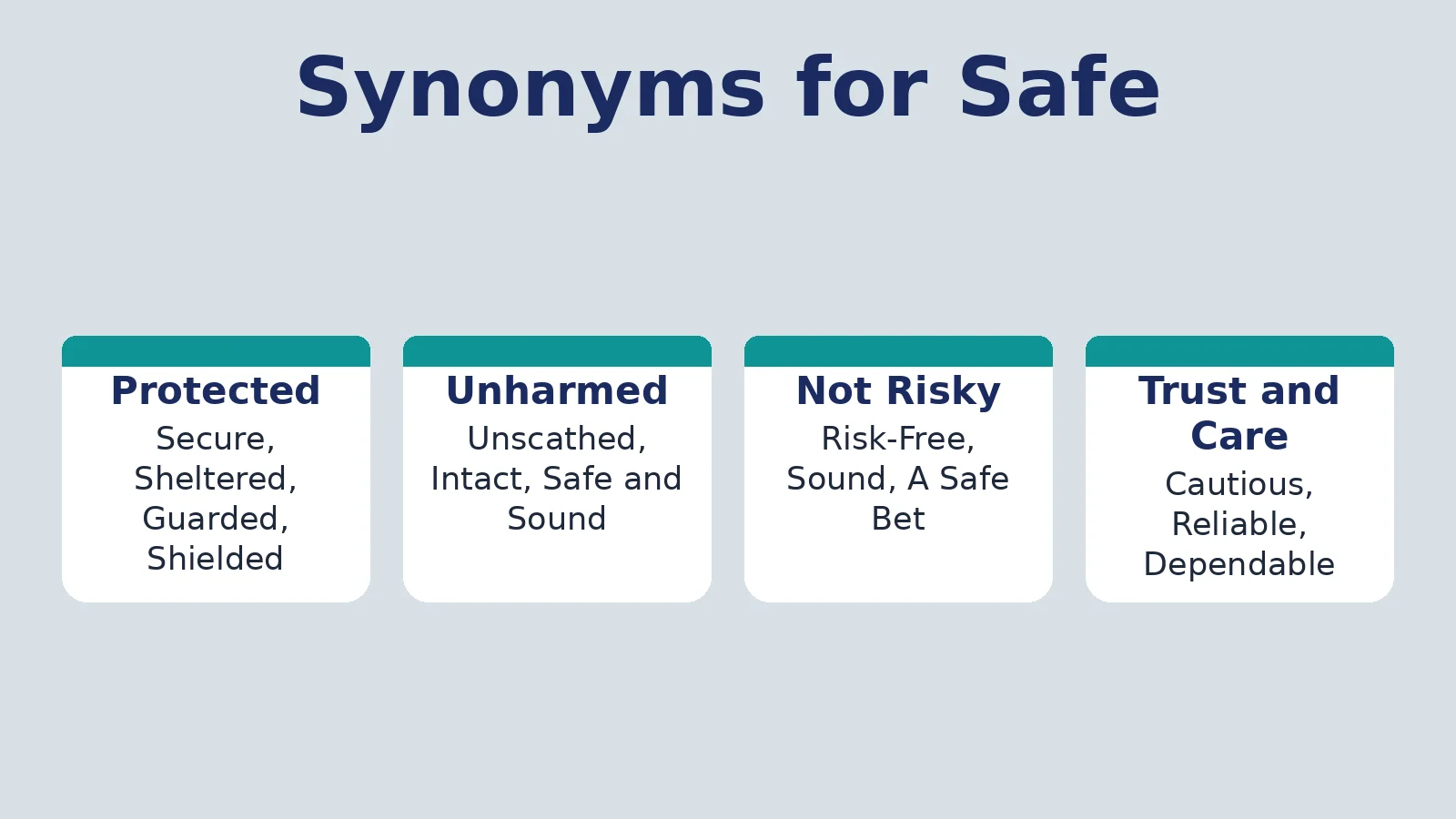
Safe looks like a simple word, yet it quietly covers five different jobs. It can describe a child protected from harm, a bridge that will not collapse, or a medicine that cannot hurt anyone. It also fits a cautious driver and a bet that is unlikely to fail. The most useful synonyms for safe include secure, protected, sheltered, unharmed, harmless, risk-free, cautious, and reliable. Each one matches only part of that range, though. Picking the wrong one can change your meaning completely.
This guide sorts more than 50 synonyms for safe by sense, so the differences stay clear. Every group comes with short meanings, and the key words include example sentences. As a result, you can choose the exact word your sentence needs. The guide also flags the traps near the end, including several words that look like synonyms but are not.
Top Synonyms for Safe: Quick Reference
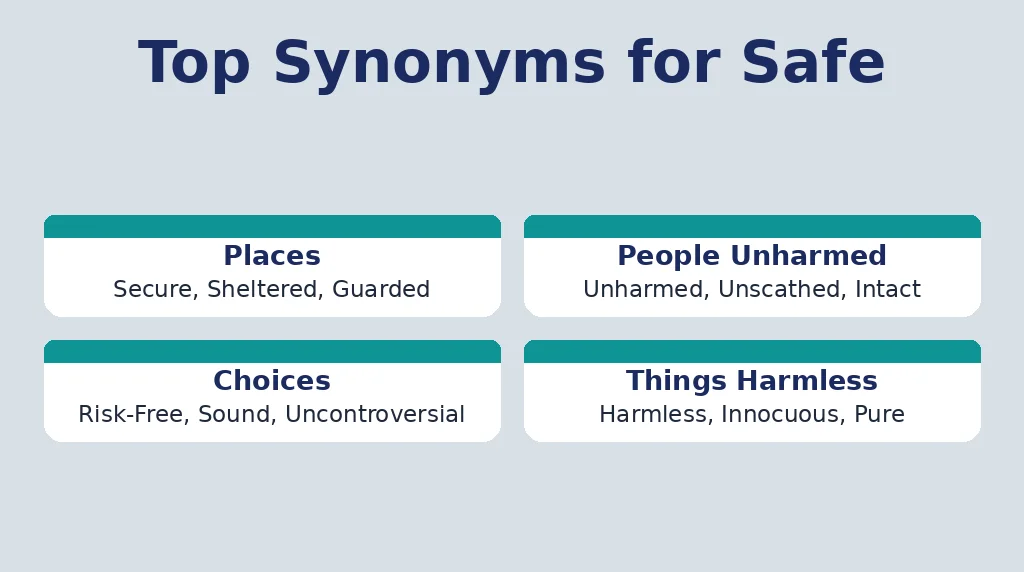
The table below covers the 28 synonyms readers reach for most often. Start here when you need one quick replacement. Later sections sort the full list into finer groups by meaning.
| Word | Meaning in one line | Best for |
|---|---|---|
| Secure | Protected against danger or loss | Places, accounts, feelings |
| Protected | Kept from harm by someone or something | People, data, wildlife |
| Sheltered | Shielded from weather or attack | Places, quiet locations |
| Guarded | Watched over by guards or care | Buildings, information |
| Shielded | Covered by a protective barrier | Eyes, equipment, people |
| Defended | Able to resist attack | Towns, positions, choices |
| Snug | Warm, sheltered and comfortable | Harbors, rooms, cabins |
| Impregnable | Too strong to be captured or entered | Fortresses, formal writing |
| Unassailable | Impossible to attack or defeat | Positions, arguments |
| Invulnerable | Impossible to harm or damage | Formal, dramatic tone |
| Unharmed | Not injured in any way | People after accidents |
| Unscathed | Completely uninjured, often surprisingly | Escapes, near misses |
| Unhurt | Not physically hurt | Everyday reports |
| Uninjured | Free from injury, formal tone | News, official reports |
| Intact | Whole and undamaged | Objects, cargo, plans |
| Safe and sound | Unharmed and back where one belongs | People returning home |
| Out of danger | No longer at risk | Patients, rescuers, news |
| Out of harm’s way | Moved away from anything dangerous | Children, valuables |
| Risk-free | Carrying no risk at all | Money, trials, offers |
| Sound | Solid, reliable and free from flaws | Investments, structures |
| Uncontroversial | Unlikely to offend or start an argument | Topics, comments, choices |
| Harmless | Unable to cause injury or damage | Animals, jokes, products |
| Innocuous | Harmless, with a formal tone | Remarks, substances |
| Cautious | Careful to avoid danger or trouble | Drivers, investors, speakers |
| Prudent | Sensible and careful about the future | Decisions, formal tone |
| Reliable | Worthy of trust, works as expected | Advice, people, equipment |
| Dependable | Can be counted on every time | Friends, cars, services |
| Vault | A strongly locked room or box for valuables | Banks, hotels, storage |
What Does Safe Mean?
At its core, safe means free from danger, harm, or loss. Merriam-Webster’s first sense puts it as “not exposed to the threat of loss or injury.” That single idea explains most uses of the word. A safe driver, a safe neighborhood, and a safe return all point back to it.
The catch is that safe works in two directions. Sometimes it describes the person or thing being protected, as in “the children are safe.” At other times it describes the thing doing the protecting, as in “a safe place to hide.” Merriam-Webster even gives that second use its own sense, summed up by the word “protecting.” Keeping the two directions apart prevents most choosing mistakes.
Safe also leads a second life as a noun. In that life it names the heavy locked box where hotels and banks keep valuables. The noun has its own small set of synonyms, covered in a later section. For the rest of this guide, safe means the adjective unless a heading says otherwise.
The subject of a sentence usually reveals which sense is at work. Safe water cannot hurt you, so harmless is the idea. A safe water supply is guarded against pollution, so protected is the idea. A safe swimmer takes no chances, so cautious is the idea. One word, three directions. Skilled writers decide the direction first and shop for synonyms second.
History explains the spread. Safe entered English from French centuries ago with the core meaning of unhurt and protected. The money and caution senses grew later, as trade, banking, and insurance gave English new kinds of risk to name. That is why the word still feels natural in a castle, a hospital, and a bank at the same time.
Synonyms for Safe: Protected and Sheltered
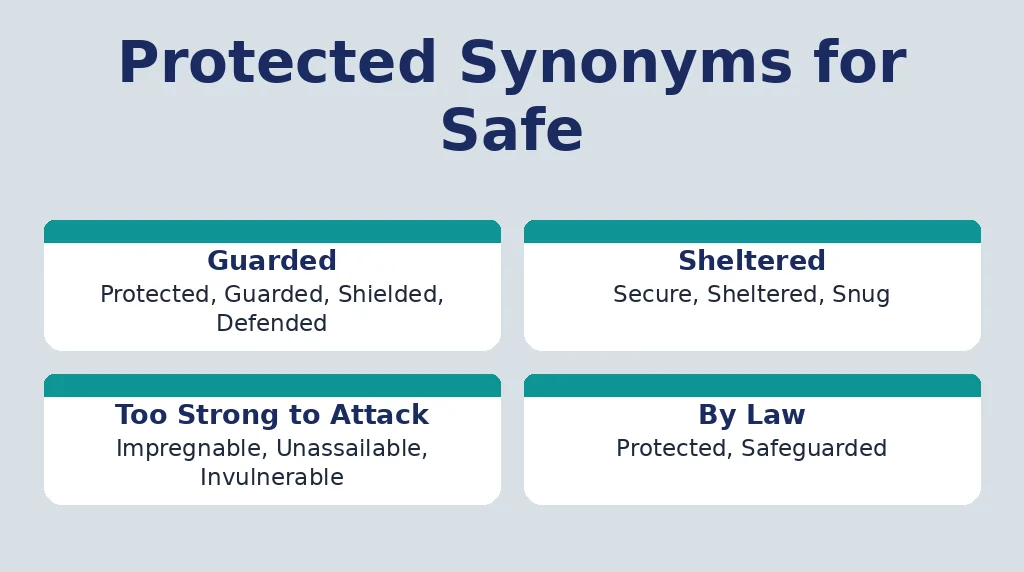
This group fits places, objects, and people that danger cannot easily reach. The words differ mainly in how the protection works. Some stress walls and barriers, while others stress guards, strength, or simple shelter.
Guarded and Watched Over
These words say that someone or something is actively keeping watch.
- Protected: kept safe from harm by a person, law, or barrier. Example: The bay is protected by a long line of rocks.
- Guarded: watched by guards, or kept under careful control. Example: The entrance stayed guarded through the night.
- Shielded: covered by something that blocks harm. Example: Her eyes were shielded from the glare.
- Defended: built or held so that attacks fail. Example: The old town was defended by thick walls.
- Safeguarded: protected by rules or measures, formal tone. Example: Your data is safeguarded by strong encryption.
Sheltered and Snug
Sometimes protection comes from position rather than guards. A place can simply sit out of danger’s path.
- Secure: firm, protected, and hard to threaten. Example: We found a secure spot for the tent.
- Sheltered: shielded from weather, attack, or trouble. Example: The harbor stays sheltered in every storm.
- Snug: warm and sheltered, with a cozy feel. Example: The cottage felt snug against the hillside.
- Preserved: kept in good condition and protected from loss. Example: The letters were preserved in a dry archive.
- Under lock and key: stored behind locks, for valuables. Example: The jewels sat under lock and key.
Too Strong to Attack
A few formal words say that attack is pointless because the defense cannot fail. Writers on the site also browse synonyms for strong for the adjectives that pair with these defenses.
- Impregnable: too strong to be captured or entered. Example: The fort looked impregnable from the valley.
- Unassailable: impossible to attack successfully or defeat. Example: Their lead became unassailable by noon.
- Invulnerable: impossible to harm or damage. Example: No password system is truly invulnerable.
- Inviolable: protected so deeply that it must not be broken or entered. Example: The treaty made the border inviolable.
- Impervious: not affected or penetrated by something. Example: The coating stays impervious to water.
Protected by Law and Rules
Some protection comes from documents rather than walls. Laws, policies, and contracts guard people, species, and data every day.
A protected species cannot be hunted legally. A protected witness receives a new identity and a guarded home. Protected data sits behind privacy rules as well as passwords. In each case, protected is the natural word, because an authority has promised the guarding. Safeguarded fits the same ground with a more official tone, which is why policies and annual reports prefer it.
Writers should keep this legal flavor in mind. Calling a garden fence “protected” sounds odd, because no rule or authority stands behind a fence. It is simply sturdy, secure, or well built instead.
Safe and Sound: Unharmed and Out of Danger
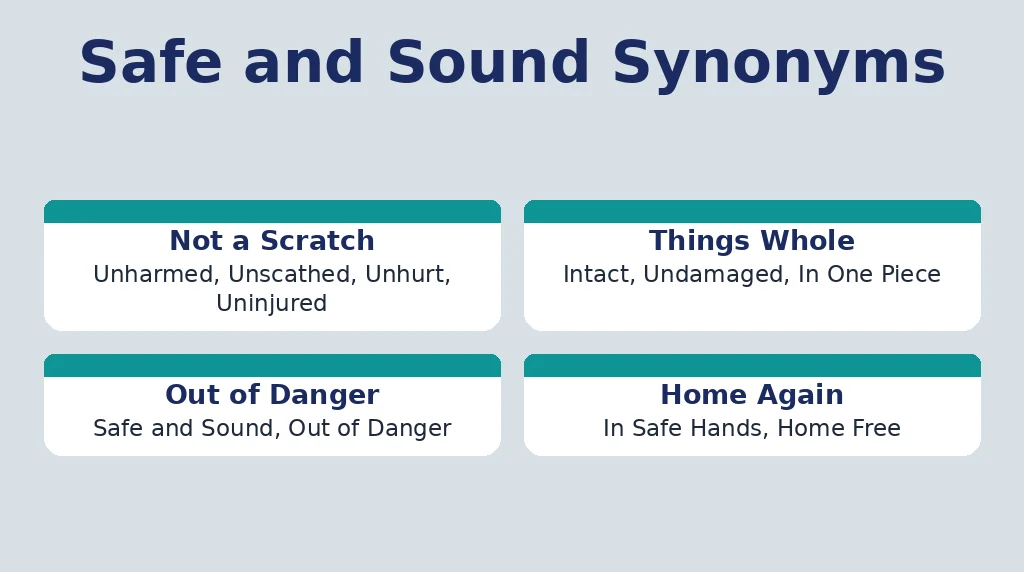
After an accident, a storm, or a long trip, safe usually means one thing: nobody got hurt. This group reports that happy result. A second set of phrases then describes the state of being clear of danger altogether.
Unharmed: Not a Scratch
These words describe people and things that came through an event without injury or damage.
- Unharmed: not injured or damaged at all. Example: Both drivers walked away unharmed.
- Unscathed: completely uninjured, often against the odds. Example: She emerged unscathed from the collapse.
- Unhurt: not hurt, plain everyday wording. Example: The driver escaped unhurt, luckily.
- Uninjured: free from injury, the word news reports prefer. Example: All passengers were uninjured.
- Intact: whole and undamaged, used for things and plans. Example: Most of the cargo was left intact.
- Undamaged: showing no harm after an event. Example: The painting reached the museum undamaged.
- In one piece: unharmed, informal and warm. Example: He got home in one piece.
- Without a scratch: completely unhurt, informal emphasis. Example: She fell two stories without a scratch.
- All right: fine and unhurt, usually about people. Example: The kids are all right after the scare.
- Okay: fine, the most informal option here. Example: Do not worry, he is okay.
- Fine: well and unhurt, calm reassurance. Example: She sounded fine on the phone.
- Well: in good health after danger, slightly formal. Example: The whole crew is safe and well.
Out of Danger: Clear of the Threat
When the danger itself has passed or been avoided, phrases do the work better than single words.
- Safe and sound: unharmed and back where one belongs, the classic pairing. Example: The hikers returned safe and sound.
- Out of danger: no longer at risk, common in hospital news. Example: Doctors say he is out of danger.
- Out of harm’s way: placed where nothing dangerous can reach. Example: Keep medicines out of harm’s way.
- In safety: living or kept in a state free from danger, formal phrasing. Example: Behind the walls, the town lived in safety.
- Free from harm: exposed to no injury at all. Example: The design keeps users free from harm.
- Free from danger: facing no threat, plain and general. Example: No road is fully free from danger.
- In safe hands: being cared for by someone capable. Example: Your dog is in safe hands with her.
- Out of the woods: past the worst of a difficulty, informal. Example: The patient is not out of the woods yet.
- Home free: certain to succeed now that the hard part is over, informal. Example: After the last exam, we were home free.
Why “Safe and Sound” Doubles Up
The phrase pairs two words that once carried slightly different jobs. Safe said the danger was gone or avoided. Sound said the person or thing stayed whole and healthy, the same sound found in “of sound mind.” Together, they promised both escape and good condition.
English keeps many such warm doublings, and this one survives because it sounds like relief itself. Newsreaders still use it for rescued climbers and returned travelers. In your own writing, keep the pair intact. Splitting it into “safe and healthy” loses the rhythm that made it famous.
Synonyms for Safe: Not Risky
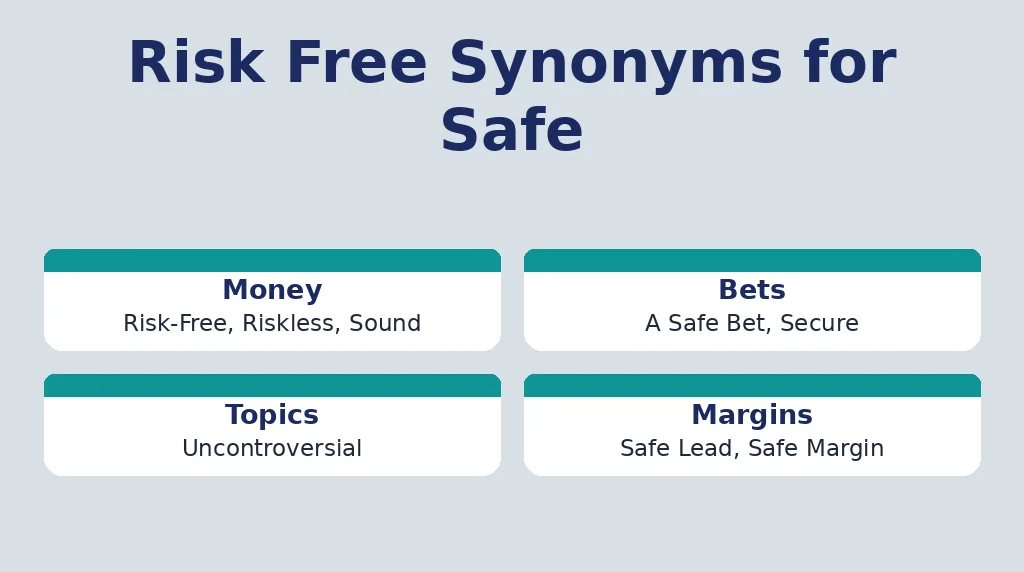
Safe also describes choices that are unlikely to fail or backfire. Money, bets, and career moves all use this sense. So do conversation topics that will not offend anyone.
Money and Bets
Investors reach for these words when loss feels unlikely, though never impossible.
- Risk-free: carrying no risk at all, the strongest claim in this group. Example: No investment is truly risk-free.
- Riskless: the same idea in a shorter, rarer word. Example: Traders hunted for riskless returns.
- Sound: solid and based on good judgment. Example: Property looked like a sound investment then.
- Secure: protected against loss, like a secure loan. Example: Her savings sit in a secure account.
- A safe bet: a choice very likely to succeed, informal. Example: Soup is a safe bet on a cold day.
A warning belongs here. A safe investment can still lose a little value. Safe means the risk is low, not missing. Writers who promise more than that mislead their readers. Readers comparing cautious wording with bolder claims can also check synonyms for brave, since brave choices sit at the opposite end of the risk scale.
Topics and Choices That Will Not Offend
Merriam-Webster gives this use its own sense. A safe topic is one unlikely to provoke controversy or offense.
- Uncontroversial: certain not to start an argument. Example: Weather is an uncontroversial opener.
Small talk survives on words like these. Weather, food, and travel plans stay safe because almost nobody fights about them.
Safe Leads and Safe Margins
Sport and engineering stretch the same sense in useful ways. A safe lead is a lead large enough that defeat looks unlikely, though commentators love tempting fate with the phrase. A safe margin, or margin of safety, is the extra room engineers and investors leave between a plan and failure.
Neither phrase adds a new synonym to this guide. Both show how deeply the not-risky sense is built into English. When a bridge carries a generous margin of safety, the word safe is doing quiet technical work. When a commentator calls a lead safe in the final minute, half the audience knocks on wood.
Synonyms for Safe: Harmless and Not Dangerous
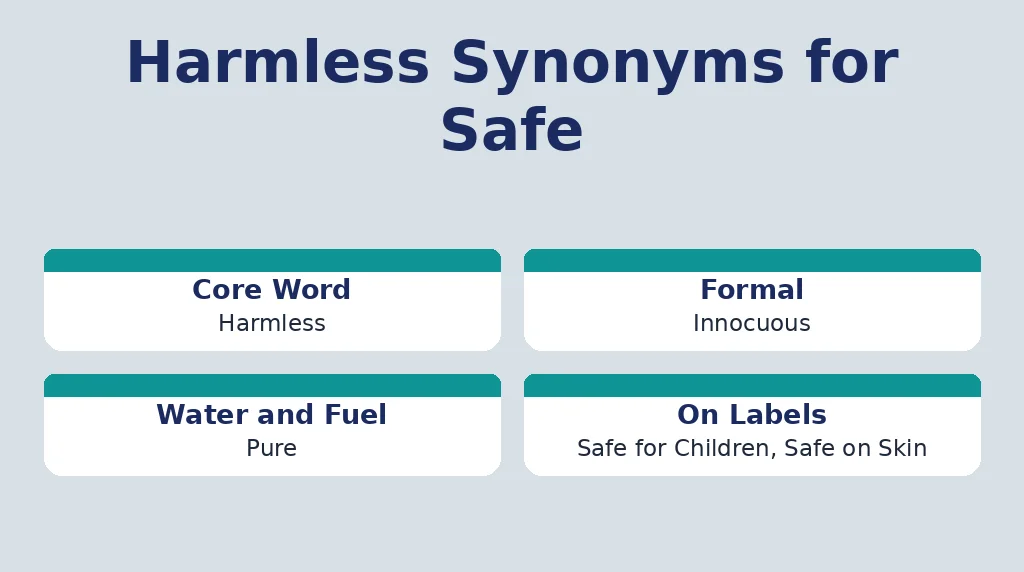
Now the direction flips. In this sense, safe describes something that cannot hurt anyone else. Medicines, animals, cleaning products, and jokes all use it this way.
- Harmless: unable to cause injury or damage, the headword for this whole sense. Example: Most house spiders are harmless.
- Innocuous: harmless, with a formal or scientific tone. Example: The gas is innocuous in small amounts.
- Pure: clean and free from harmful substances, used for water and fuel. Example: The spring gives pure, safe drinking water.
Collins illustrates this sense with “a clean, inexpensive and safe fuel.” Drivers reading about fuel and water quality often pair this group with synonyms for clean, because clean and safe overlap so often in product claims.
The direction matters more than the word itself. A harmless dog cannot bite you. A safe dog, oddly, sounds like a dog that feels protected. English speakers pick the first meaning for animals almost automatically, which is why harmless earns its own group here.
Safe on Labels: Food, Toys and Products
Shoppers meet this sense on packaging more than anywhere else. Labels promise that paint is safe for children, that a cleaner is safe on skin, or that a toy is safe from age three. In every case, safe means the product will not harm the user when used as directed.
Regulators take the claim seriously, so careful brands back it with testing language. Harmless appears less often on boxes, because it sounds absolute. Innocuous belongs to technical documents instead, such as safety data sheets. When you write product copy yourself, safe plus a condition (“safe when dry,” “safe for pets”) beats a bare harmless every time.
Synonyms for Safe in Everyday Contexts
The same handful of words keeps returning in daily life. What changes is the setting. This section tours the three settings where readers most often need the right choice.
At Home and While Traveling
Homes mix several senses at once. Locks and alarms make a house secure. A quiet street makes a neighborhood feel safe in the protected sense. Travelers returning late want to arrive safe and sound, and they leave spare keys in safe hands.
Word choice follows the worry. If the worry is burglary, write secure. If the worry is a child’s journey, write safe and sound. If the worry is a storm, sheltered and out of harm’s way do the work. Matching the word to the worry keeps travel and home writing precise.
At Work and in Safety Reports
Workplaces run on the not-dangerous and not-risky senses. A safe system of work protects staff, and a safe machine cannot injure its operator. Reports prefer secure, safeguarded, and risk-free because those words sound measured and auditable.
Tone matters here more than variety. Repeating safe procedures and safe equipment is normal in a report, and nobody complains. Swapping in colorful synonyms can actually create legal fog, since inspectors read every word literally. Save the elegant variation for essays and stories, and let reports stay plain.
Online and in Money Matters
Digital life gave safe two busy modern homes. A secure account resists hackers, and protected data resists leaks. Savers, meanwhile, ask whether money is safe in a bank, meaning protected from loss, and whether an investment is safe, meaning unlikely to fall.
The two questions look alike but use different senses. The first belongs to the protected group, the second to the not-risky group. Writers who keep them apart explain finance far more clearly. Readers feel the difference at once, even when they cannot name it.
Cautious Synonyms for Safe: Playing It Safe
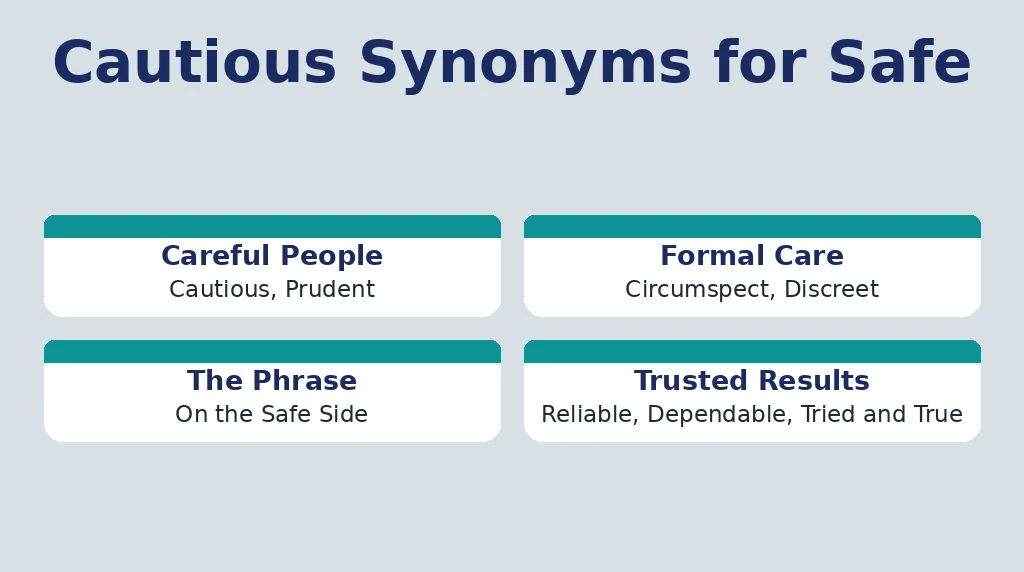
Sometimes safe describes a person’s behavior rather than a place or thing. Safe drivers, safe investors, and safe speakers all share one habit. They notice danger early and steer around it.
Careful People and Careful Habits
Merriam-Webster defines this sense as showing “a close attentiveness to avoiding danger or trouble.” Insurance companies reward safe drivers for exactly that habit.
- Cautious: careful to avoid danger or mistakes, the core word here. Example: Cautious drivers slow down early.
- Prudent: sensible and careful, especially about the future. Example: A prudent saver keeps an emergency fund.
- Circumspect: careful about consequences before speaking or acting, formal. Example: She stayed circumspect during the negotiation.
- Discreet: careful to avoid attention or embarrassment. Example: He followed at a discreet distance.
- On the safe side: choosing the careful option to avoid trouble, a phrase. Example: Take an umbrella, just to be on the safe side.
Notice what these words cannot do. They describe people and their choices, never places. A cautious bridge is nonsense, however sturdy the bridge may be. When the subject is a person making decisions, though, this group beats every other one in the guide.
Safe People You Can Rely On
A close cousin of caution is trustworthiness. Merriam-Webster gives safe a whole sense meaning “worthy of one’s trust,” illustrated by safe advice. These words fit advisers, equipment, and helping hands.
- Reliable: worthy of trust and steady in performance. Example: She always offers reliable, safe advice.
- Dependable: able to be counted on every single time. Example: He was a dependable companion on the trail.
- Tried and true: tested by experience and proven to work. Example: Take the tried and true route home.
- A safe pair of hands: a person who will handle a task without drama or error, informal. Example: With her in charge, the event was in a safe pair of hands.
The two groups often travel together. A cautious adviser gives reliable advice, and a dependable driver usually drives cautiously. Still, the emphasis differs. Cautious words praise the care taken, while reliable words praise the result you can expect.
The Noun Safe: Words for the Box Itself
Safe is also a noun, and then it stops describing safety in the abstract. It names a strong container with a secure lock, built to store money and valuables. Hotels advise guests to keep passports in one, and banks keep far bigger versions.
- Vault: a strongly built room or compartment in a bank, the grandest option. Example: The money was in storage in bank vaults.
- Coffer: a small chest for money or jewels, now mostly literary. Example: She crossed to her clothes coffer and lifted the lid.
- Repository: a place where things are stored for safekeeping, formal. Example: The archive became a repository for police files.
- Deposit box: a lockable box rented at a bank. Example: He kept the will in a deposit box.
- Safe-deposit box: the fuller name for the same bank box. Example: Her safe-deposit box held the original deeds.
Context makes the noun obvious. Nobody reads “keep it in the safe” and pictures an adjective. Still, writers should know the noun exists, because thesaurus lists mix both lives of the word without warning.
Size separates the synonyms in practice. A coffer sits in a home or a storybook. A deposit box sits inside a bank’s larger vault, rented by the year. A vault itself can fill a room and guard a whole branch’s cash. Repository is the odd one out, since it names any storage place, from a warehouse to a database, and only sometimes a secure one. Choose by scale, and the word will fit the scene.
How to Choose the Right Synonym for Safe
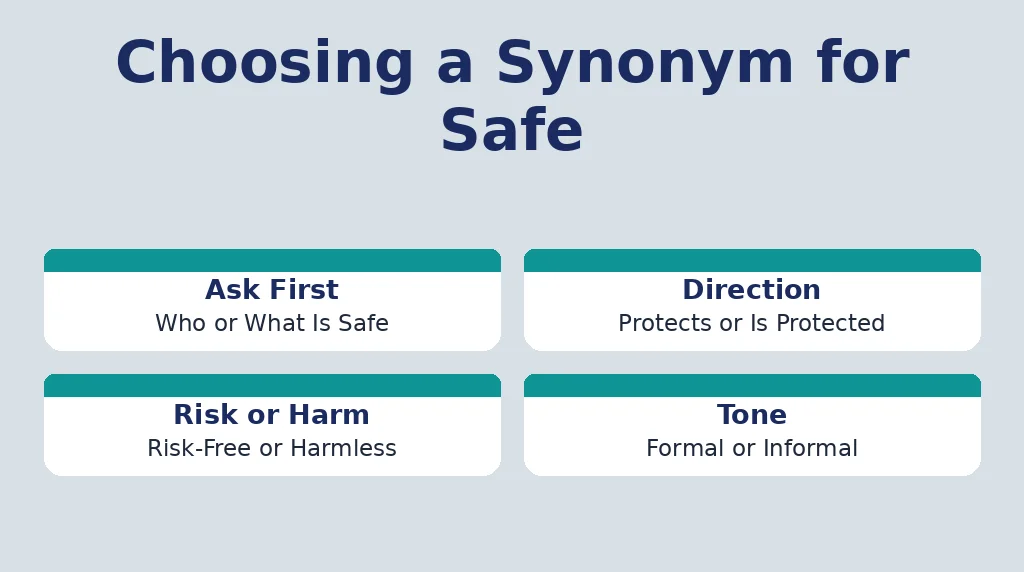
Choosing well starts with one question: what kind of safety does your sentence mean? Run through the checks below, and the right group usually picks itself.
First, ask who or what is safe. If danger has already happened and nobody was hurt, you need the unharmed group. Unharmed, unscathed, and intact report results. None of them describes a place before anything occurs.
Second, ask whether the word protects or is protected. A safe place shelters people, so protected and sheltered fit it. A safe medicine harms nobody, so harmless fits it. Swapping those two directions is the most common safe error in writing.
Third, check whether risk is the topic. Money and decisions use the not-risky group: risk-free, sound, and secure. Behavior uses the cautious group instead. A prudent investor is a person. A sound investment is a thing. The grammar alone often settles the choice.
Fourth, match the tone. Impregnable and inviolable sound grand and formal, fine for history or law. Okay, fine, and home free belong in relaxed speech and friendly writing. Snug adds warmth that secure never carries, so save it for homes, cabins, and harbors.
Finally, test the sentence by swapping in plain safe. If the meaning survives, your fancier word is probably right. If the sentence feels wider or narrower than before, try the neighboring group. The quick picker below matches common situations to strong first choices.
| Situation | Strong first choice |
|---|---|
| Child back from a trip | Safe and sound |
| Medicine for children | Harmless |
| Money you cannot afford to lose | Risk-free |
| Hotel room for valuables | Secure |
| Driver with a clean record | Cautious |
| Advice from a trusted mentor | Reliable |
| Topic for dinner with strangers | Uncontroversial |
| Fortress in a history essay | Impregnable |
One Scene, Five Words
Watch how one simple scene changes as the word changes. The facts stay fixed, yet each version tells a different story.
- The crew came back safe and sound. The trip is over, and relief is the point.
- The crew came back unscathed. The danger was real, and survival surprises us.
- The crew stayed sheltered all night. The place, not the crew, did the protecting.
- The crew felt secure behind the gate. Confidence and barriers share the credit.
- The crew was in safe hands. A trusted person looked after them.
Novelists exploit these shifts constantly. Report writers avoid them on purpose and repeat plain safe instead. Both habits are correct, because each genre rewards a different kind of precision.
Antonyms for Safe
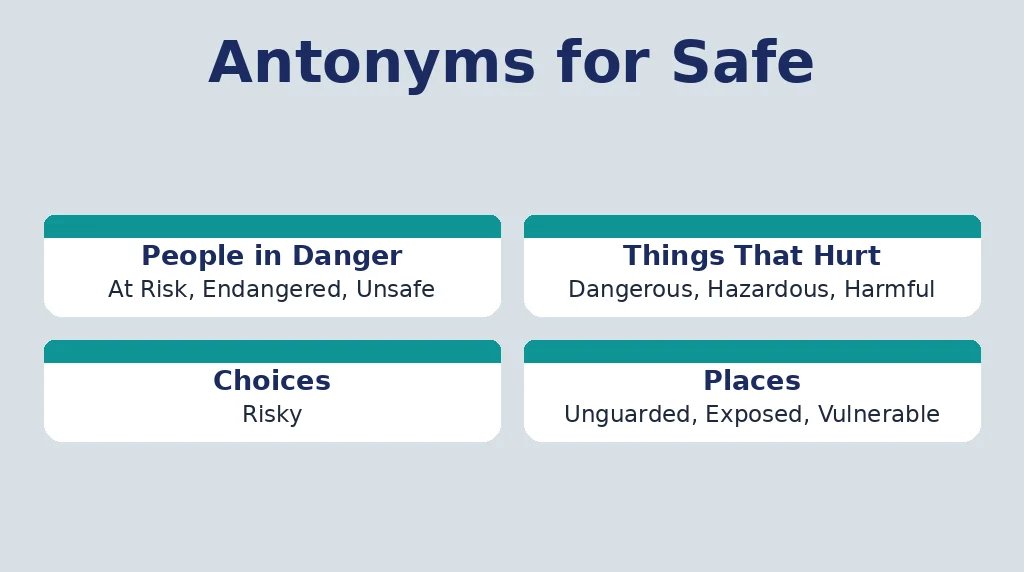
The clearest opposites of safe describe exposure to danger. Collins lists at risk, endangered, insecure, threatened, and imperiled for the protection sense. Each cancels safety in a slightly different way. At risk states the exposure plainly. Endangered suggests the threat is serious and close. Insecure stresses a lack of protection, and it also describes anxious feelings, so context has to guide the reader.
Another set of opposites answers the harmless sense. Dangerous, hazardous, and harmful describe things that can hurt people. A dangerous road threatens drivers, while a hazardous chemical threatens anyone nearby. Harmful is the plainest of the three and fits products, habits, and advice.
Risky and unsafe cover the remaining ground. Risky answers the not-risky sense, as in a risky investment. Unsafe is the direct negative of safe itself, blunt and general. Unguarded and exposed work for places: an unguarded border, an exposed hillside. Vulnerable, finally, is the natural opposite of invulnerable, and it fits people and systems alike.
A quick test helps in practice. If a word can finish the sentence “the children are no longer” in a worrying way, it is probably an antonym. Safe fails that test. At risk, endangered, and unsafe all pass it.
Common Mistakes: Words That Are Not True Synonyms for Safe
Accuracy matters in a synonym guide, so this section clears up the words that often sneak into safe lists wrongly.
Harmless is only half a synonym. It covers the “cannot hurt anyone” sense and nothing else. A harmless neighborhood sounds odd because neighborhoods need the protected sense instead. Match the direction before you swap the words.
Cautious cannot describe places. It belongs to people and their decisions. A cautious driver makes sense; a cautious staircase does not. For buildings and structures, secure and sound do the honest work.
Safety and safely are the wrong word class. Safety is a noun and safely is an adverb. Neither can replace the adjective safe in “a safe road.” Lists that include them are padding their counts.
Comfortable is about comfort, not danger. A comfortable hotel room might still sit in a risky area. Cozy and comfortable describe how a place feels, while safe describes what cannot happen there. Snug earns its place in this guide only because sources list it for sheltered harbors, where shelter is the point.
Lucky describes chance, not protection. A lucky driver escaped unharmed once. A safe driver avoids the crash entirely. Swapping lucky for safe quietly changes praise into chance.
Safe does not mean guaranteed. A safe bet can still lose, and a sound investment can still dip. The moment a writer needs certainty, words like certain and guaranteed take over, and safe should step aside.
One more trap hides in entertainment writing. Calling a film or an album “safe” can mean dull and unadventurous. Collins lists boring, tedious, and unexciting for exactly that use. Unless that criticism is your point, avoid safe where readers might hear it.
Frequently Asked Questions
What is the best synonym for safe?
There is no single best word, because safe covers several meanings. Secure is the most flexible choice for places and accounts. Unharmed fits people after an event, harmless fits things that cannot hurt anyone, and reliable fits advice and people you trust.
What is a formal synonym for safe?
Impregnable and unassailable are the formal choices for places that cannot be attacked. Circumspect is the formal word for a cautious person. For documents and reports, secure and safeguarded sound professional without sounding stiff.
What does safe and sound mean?
Safe and sound means unharmed and back where one belongs, usually after travel or danger. The pairing is centuries old and slightly redundant on purpose, since the doubling adds warmth and relief. People use it most for travelers, children, and rescued pets.
What is a synonym for safe place?
Shelter is the everyday noun, and haven is the warmer one. As adjectives for the place itself, secure, sheltered, and protected work best. A snug harbor and a guarded compound show how tone changes the choice.
What is the opposite of safe?
Unsafe is the direct opposite. More precise options depend on the sense: at risk and endangered for people in danger, dangerous and hazardous for things that can hurt, and risky for choices involving money or plans.
Is harmless the same as safe?
Only in one direction. A safe medicine means a harmless medicine, so the words overlap there. But a safe child means a protected child, and harmless cannot do that job. Harmless describes what something cannot do to others.
What is a safe bet?
A safe bet is a choice that is very likely to succeed or be correct. The phrase comes from gambling, where a safe bet risks little. People now use it for any dependable option, from menu choices to election predictions.
What does play it safe mean?
To play it safe means to choose the cautious option and avoid risk. A traveler who plays it safe books the earlier train. The phrase praises care in some contexts and hints at timidity in others, so tone decides how it lands.
Final Thoughts
Safe earns its keep by covering protection, health, money, behavior, and trust in a single short word. Once you sort its synonyms by sense, the right choice usually becomes obvious. Children come home safe and sound, medicines stay harmless, savings stay risk-free, and good advisers stay reliable.
For an even deeper list with related words and near-synonyms, the Merriam-Webster Thesaurus entry for safe is a reliable next step. Keep this guide bookmarked too, and your safety sentences will always say exactly what you mean. One last habit is worth building: whenever safe appears in your draft, ask which sense is doing the work. That single question fixes most weak choices before a reader ever sees them.