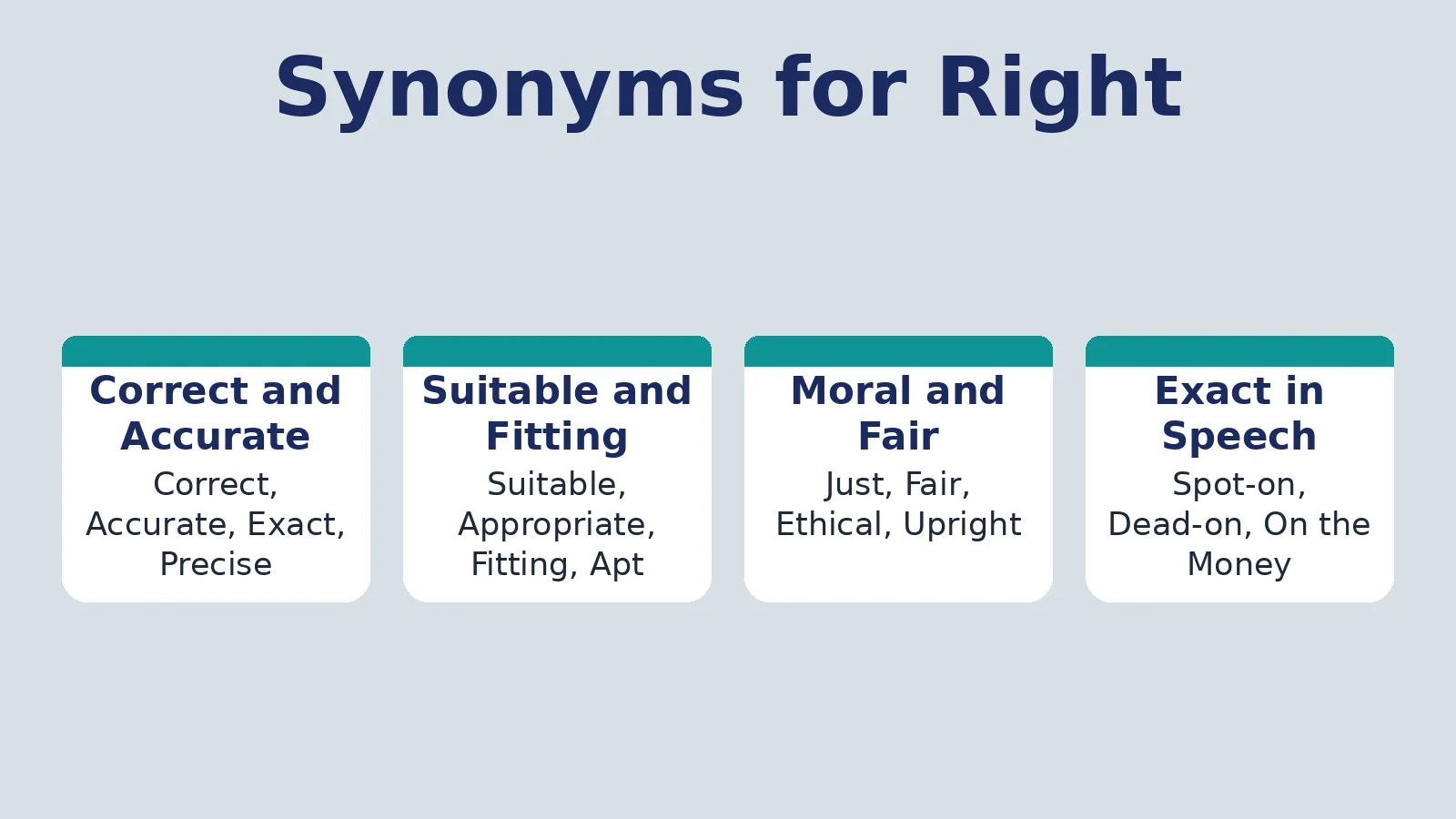
Right is one of the hardest-working words in English, and one of the vaguest. The most useful synonyms for right are correct, accurate, exact, precise, and true when you mean free from error; suitable, appropriate, and fitting when you mean the right choice for a job; and just, fair, and ethical when you mean morally good. Each group answers a different question, so the first step is knowing which right you mean.
This guide sorts more than 100 synonyms for right by sense, from exam answers to courtroom fairness. Every word carries a short meaning, and the key words include example sentences. By the end, you will know exactly which word fits your sentence, and which popular options quietly change the meaning.
Top Synonyms for Right: Quick Reference
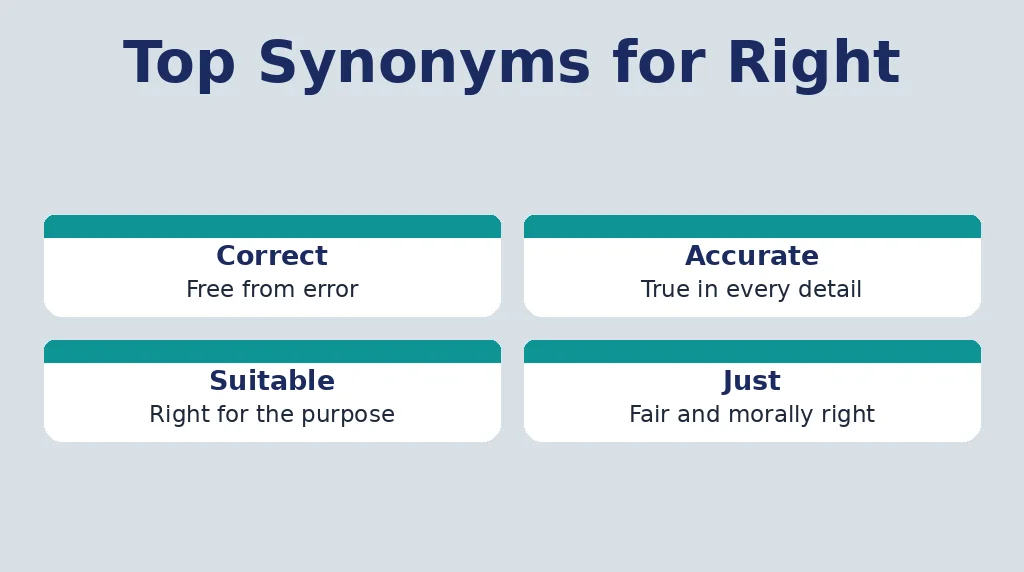
The table below covers the 28 synonyms readers reach for most often. Start here for one fast replacement, then use the later sections for finer shades of meaning.
| Word | Meaning in one line | Best for |
|---|---|---|
| Correct | Free from error | Answers, facts, standard choice |
| Accurate | True to the facts in every detail | Reports, measurements, records |
| Exact | Precise, with nothing left vague | Numbers, words, amounts |
| Precise | Sharply defined and careful | Science, instructions, timing |
| True | In agreement with the facts | Statements, claims, stories |
| Valid | Sound and officially acceptable | Arguments, documents, tickets |
| Factual | Based on real facts | Reports, accounts, writing |
| Authentic | Genuine, not a copy | Objects, documents, experiences |
| Genuine | Real and sincere | Feelings, antiques, people |
| Perfect | Exactly right for the purpose | Choices, matches, examples |
| Faithful | True to the original | Copies, accounts, translations |
| Spot-on | Exactly right, informal | Judgments, guesses, British speech |
| Dead-on | Perfectly accurate | Estimates, aim, predictions |
| Suitable | Right for a purpose or person | Jobs, clothes, candidates |
| Appropriate | Right for the situation | Behavior, language, formal writing |
| Proper | Correct in form or manners | Formal and British contexts |
| Fitting | Suitable in a satisfying way | Endings, tributes, rewards |
| Apt | Exactly suitable, often clever | Words, names, descriptions |
| Just | Fair and morally right | Laws, punishments, causes |
| Fair | Treating everyone equally | Decisions, deals, games |
| Ethical | Morally right by a code | Business, medicine, research |
| Upright | Honest and moral in character | People, reputations |
| Righteous | Morally right, sometimes smug | Formal or religious tone |
| Equitable | Fair in a formal, legal way | Systems, distribution, policy |
| Rectify | To put something right | Errors, situations, formal writing |
| Exactly | In every detail, no more and no less | Amounts, timing, emphasis |
| Properly | In the right way | Instructions, behavior |
| Directly | Without delay or detour | Movement, speech, timing |
What Does Right Mean?
Right packs at least five meanings into four letters. First, it means correct: “You got the right answer.” Second, it means morally good: “It was the right thing to do.” Third, it means suitable: “She is the right person for the job.” Fourth, it names a side, the opposite of left. Fifth, as a noun, it means something you are owed or allowed, as in “the right to vote.”
That spread explains why one synonym list cannot serve every sentence. A word like accurate shines in the first sense and fails in the second. Nobody calls a kind act “an accurate thing to do.” So this guide keeps the senses apart, the same way dictionaries do. Its natural opposite, wrong, splits into matching senses too, which is handy when you need the other side of the line.
Watch how the swap test exposes each sense. “The right answer” becomes “the correct answer” with no strain. “The right thing to do” becomes “the just thing to do,” and the facts vanish from the sentence. “The right shoes” becomes “the suitable shoes,” which judges comfort and dress codes, not truth. Three sentences, three different words hiding inside one small adjective. Once you see the split, the groups below will feel less like a list and more like a set of labeled drawers.
Synonyms for Right That Mean Correct and Accurate
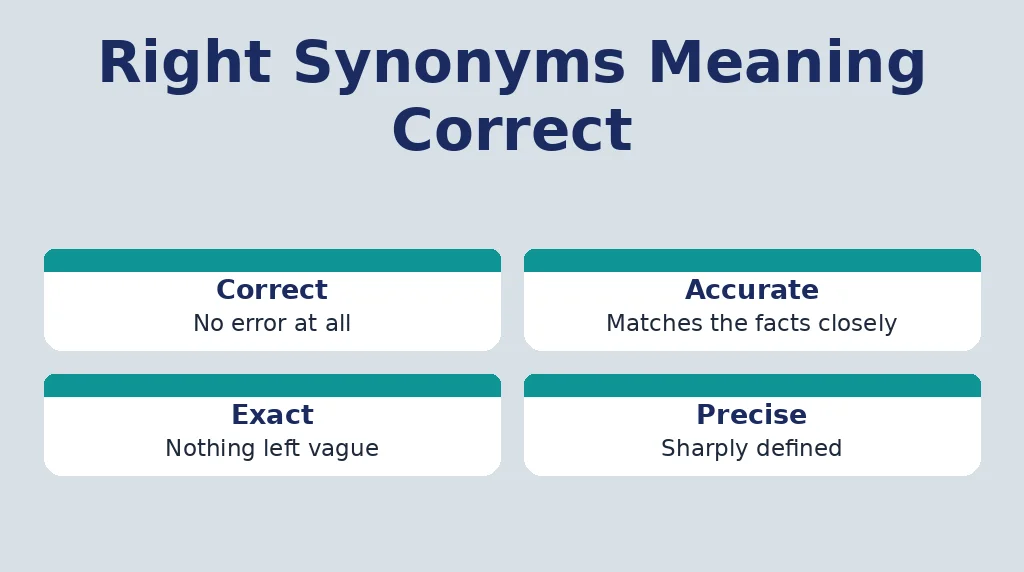
This is the sense most readers want. Something is right when it matches the facts, the standard, or the truth, with no error left in it. Merriam-Webster groups right with accurate, correct, exact, and precise here, and notes that right adds a stronger positive emphasis than plain correct. The words below all live in this sense, but they differ in care, detail, and tone.
The Everyday Core: Correct, Accurate and True
- Correct: free from error; the neutral standard for answers, spelling, and facts. Example: “Only one answer on the quiz was correct.”
- True: in agreement with the facts, used for statements, claims, and stories. Example: “It is true that the shop closes at nine.”
- Accurate: true to the facts in every detail, with care taken to avoid mistakes. Example: “The report gives an accurate picture of sales.”
- Valid: sound, logical, or officially acceptable. Example: “You need a valid passport for the trip.” Save valid for arguments, documents, and tickets.
- Factual: based on facts rather than opinion or invention. Example: “The essay stays factual and skips the rumors.”
- Authentic: genuine and not a copy, used for objects and documents. Example: “Experts confirmed the painting was authentic.”
- Genuine: real and sincere rather than fake or performed. Example: “Her concern for the team was genuine.”
- Authoritative: based on the best source, so it can be trusted as right. Example: “Use the authoritative guide for style questions.”
Precision Words: Exact, Precise and Perfect
Some sentences need more than “not wrong.” They need a word that promises sharp edges and no slack.
- Exact: precise in every detail, with nothing approximate. Example: “Tell me the exact amount you paid.”
- Precise: sharply defined and carefully measured. Example: “The recipe needs precise timing.”
- Perfect: exactly right for its purpose, with nothing to improve. Example: “It was the perfect day for a picnic.”
- Faithful: true to the original, word for word or detail for detail. Example: “The film stays faithful to the novel.”
- Nice: in older usage, fine and exact, as in “a nice distinction.” Modern readers hear pleasant instead, so treat nice as a historical extra, not a working synonym.
Informal Ways to Say Exactly Right
Speech and stories often want a livelier word than correct. These options praise a guess, a judgment, or an aim that landed perfectly.
- Spot-on: exactly right; British informal. Example: “Your guess about the price was spot-on.”
- Dead-on: perfectly accurate, for estimates and aim. Example: “His prediction was dead-on.”
- On the money: exactly right, informal, often about amounts or predictions. Example: “She said ten minutes, and she was on the money.”
- On the nose: exactly right, informal, often about exact amounts. Example: “The bill came to fifty dollars on the nose.”
Right for Records, Reports and Research
Written records attract their own corner of this group. A report earns trust when its facts are accurate and its sources are authoritative. A summary stays faithful when it keeps the original meaning intact. A claim reads as factual when every line can be checked. Researchers also lean on valid here, because a valid method produces results that other people can trust and repeat.
Habit does most of the sorting. Scales, maps, and records are accurate. Arguments and methods are valid. Encyclopedias and official guides are authoritative. Translations and summaries are faithful. When a writer says “the right figures,” readers usually picture accurate ones, checked twice against the source. Choosing the group’s specialist word tells readers exactly how the checking was done, and that small signal builds more trust than the plain word right ever could.
Synonyms for Right That Mean Suitable and Appropriate
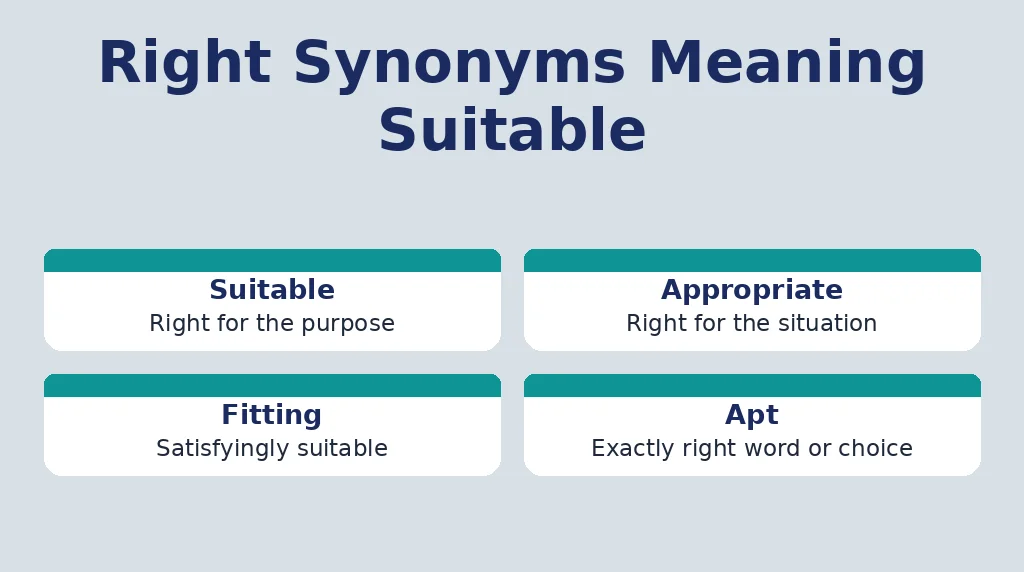
The second big sense is about fit. The right person, tool, or moment is the one that matches the need. Nothing here is about truth; a suitable coat is not a “correct” coat in the factual sense. These words judge choices instead of facts.
Think of a job interview. The panel wants the right candidate, and no one in the room means the factually correct candidate. They mean the suitable one: skilled enough, calm enough, and appropriate for the team. The same shift happens with tools, clothes, and words. “The right word” in a poem means the apt one, the word whose sound and weight match the line. Whenever right grades a choice instead of a claim, this group is doing the work.
The Right Fit for People, Places and Occasions
- Suitable: right for a person, purpose, or occasion. Example: “This film is not suitable for young children.”
- Appropriate: right for the situation, especially behavior and language. Example: “Wear appropriate clothes for the interview.”
- Proper: correct in form, manners, or social rules; formal or British in flavor. Example: “He wrote a proper thank-you letter.”
- Fitting: suitable in a way that feels satisfying or deserved. Example: “The award was a fitting end to her career.”
- Fit: suitable or ready for a purpose. Example: “The water is not fit to drink.”
- Apt: exactly suitable, often with a clever touch. Example: “Apt words can save a whole speech.”
- Becoming: suitable and attractive in behavior; formal and slightly old-fashioned. Example: “Such anger is not becoming in a leader.”
- Seemly: proper and suitable in appearance or behavior; formal. Example: “They kept a seemly silence.”
- In keeping with: matching the style or character of something. Example: “The new wing is in keeping with the old house.”
- Comme il faut: French for “as it should be”; very formal and rare. Example: “The ceremony was comme il faut in every detail.”
The Right Moment: Timing Words
Sometimes right describes not a thing but a moment. These four words cover luck, timing, and advantage.
- Opportune: happening at exactly the right time; formal. Example: “She arrived at an opportune moment.”
- Propitious: promising success, as if conditions favor you. Example: “It was a propitious day to launch the boat.”
- Advantageous: giving you a benefit or edge. Example: “The deal was advantageous for both sides.”
- Due: rightful, expected, or deserved at the proper time. Example: “Treat the letter with due care.”
Timing words reward a second look, because they praise luck as much as judgment. An opportune phone call arrives when you can still act on it. A propitious start suggests the whole project will go well. An advantageous moment gives you an edge over rivals. Due belongs to schedules and debts: rent is due, praise is due, and both arrive at the proper time or not at all. Pick the word that matches what the moment actually delivered.
Synonyms for Right That Mean Morally Good and Fair
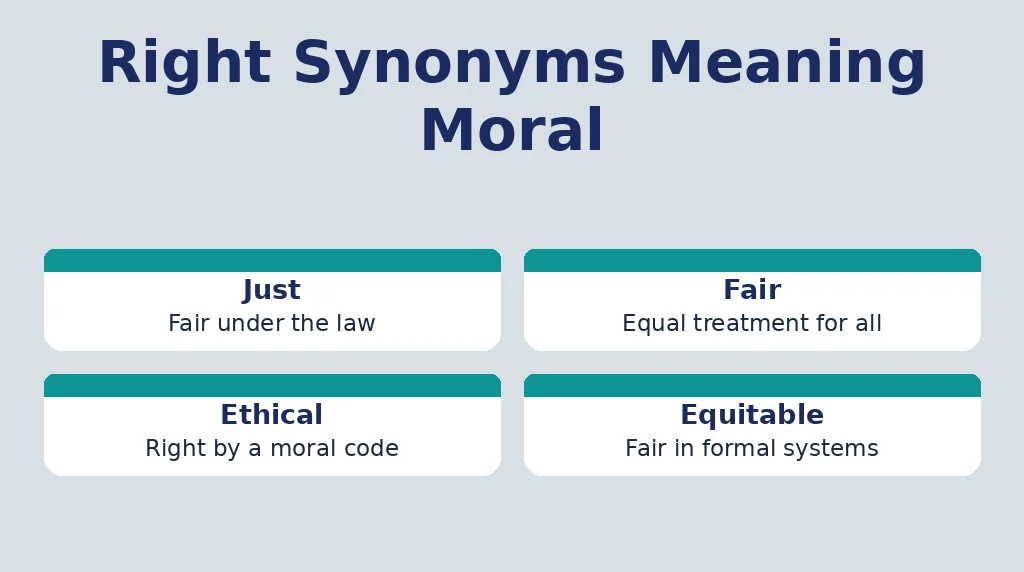
The third sense judges actions, laws, and people against a moral standard. “It is not right to cheat” says nothing about facts. It says the act fails a test of fairness or goodness. Cambridge groups this sense under treating everyone equally, and Collins lists it as “morally or legally acceptable.” The words below split into fairness words and character words.
Fair Treatment: Just, Fair and Even-Handed
- Just: fair and morally right, especially in laws and punishments. Example: “The judge gave a just sentence.”
- Fair: treating everyone the same, without favor or cheating. Example: “Everyone wanted a fair deal.”
- Good: morally right, the plainest word in this group. A guide to good shows how wide that word runs.
- Ethical: right according to a moral code or professional rules. Example: “It is not ethical to hide the results.”
- Moral: concerned with right and wrong behavior. Example: “She felt a moral duty to speak.”
- Even-handed: fair to all sides, without bias. Example: “The report gives even-handed coverage.”
- Balanced: fair because it weighs every side. Example: “The article offers a balanced view.”
- Equitable: fair in a formal or legal sense, especially in sharing things out. Example: “They demanded an equitable tax system.”
- Unbiased: free from favor toward any side. Example: “The magazine gives unbiased product tests.”
- Egalitarian: based on the belief that everyone is equal; formal. Example: “They built an egalitarian workplace.”
Character Words: Upright, Righteous and Virtuous
These words describe people whose whole character passes the moral test.
- Upright: honest and moral in everyday conduct. Example: “He was an upright, trusted neighbor.”
- Honest: truthful and fair in dealings with others. Example: “An honest answer can hurt and still help.”
- Righteous: morally right and virtuous, often with a religious tone. Example: “She fought for a righteous cause.” Handle with care: righteous can sound smug.
- Virtuous: living by high moral standards. Example: “The story praises a virtuous hero.”
Right in Law and Public Life
Courts, constitutions, and campaigns speak this sense daily. A just law treats similar cases alike. A fair trial gives both sides the same chance to be heard. An equitable policy shares costs and benefits without hidden favors. An egalitarian rule starts from the idea that every person counts the same. An unbiased judge, report, or test earns trust because no side can buy its outcome.
Notice how rarely these sentences want the word correct. A verdict can be legally correct and still strike the public as unjust. That gap is exactly why English keeps a separate moral vocabulary. When you write about public life, reach for this group first. The correctness words can sound cold here, as if a law were a math problem. The moral words admit that people, not numbers, carry the weight of the decision.
More Senses of Right: Mind, Body, Degree and Direction
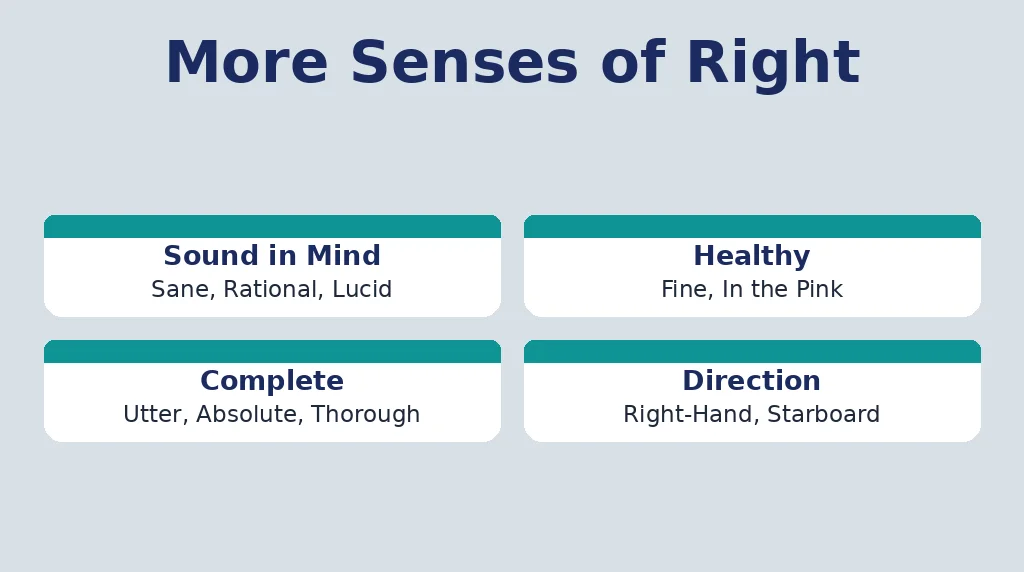
Right has smaller senses that still appear in daily speech. They rarely lead a search, yet each one has its own synonym set, and borrowing words from the big groups above will sound wrong here.
Sound in Mind and Body
When something feels off, English asks whether a person is “right.” These words describe a sound mind or a healthy body.
- Sane: sound in mind, able to think clearly. Example: “No sane person would swim there today.”
- Sound: healthy and in good working order. Example: “The horse was sound in wind and limb.”
- Normal: as expected, not strange or ill. Example: “Her temperature was normal again.”
- Rational: able to reason calmly and clearly. Example: “He grew rational as the shock faded.”
- Lucid: thinking and speaking clearly. Example: “She was lucid right after the surgery.”
- Compos mentis: Latin for “in control of one’s mind”; formal or humorous. Example: “After coffee, I am compos mentis again.”
- All there: mentally sharp; informal, usually in the negative. Example: “He is not all there since the accident.”
- Healthy: strong and well in body. Example: “The baby was born healthy.”
- Fine: well and in good shape. Example: “She said she felt fine.”
- In good health: the plain phrase behind several of these words. Example: “He left the hospital in good health.”
- In the pink: in perfect health; informal and cheerful. Example: “Grandpa is in the pink at ninety.”
- Up to par: as good as expected or required. Example: “Her work was not up to par this week.”
Complete and Utter: Right as an Intensifier
British speech and older writing use right to strengthen a noun, as in “a right mess.” These words do that job.
- Complete: total, with nothing missing. Example: “The surprise was complete.”
- Real: genuine and total in this use. Example: “He made a real fool of himself.”
- Pure: total and unmixed. Example: “It was pure luck.”
- Absolute: complete and without limits. Example: “She had absolute trust in the pilot.”
- Utter: total, used for strong feelings and failures. Example: “The plan was an utter failure.”
- Thorough: complete in every part. Example: “They gave the car a thorough check.”
The Right-Hand Side: Direction Words
The direction sense stays deliberately small, because English simply has few words here. Right-hand is the standard adjective: “the right-hand drawer.” Rightward describes movement toward that side: “a rightward turn.” Starboard is the right side of a ship or aircraft when you face forward. Everything else readers expect, like dexter, survives only in derived words such as dexterous, which means skillful, not right-sided.
A Right: The Noun in Brief
As a noun, a right is something you are entitled to. Its near synonyms are prerogative, privilege, claim, authority, title, license, permission, and power. “Free speech is a right” can become “a privilege” only with a meaning shift, so swap with care. The abstract noun points the other way, toward justice itself: justice, equity, fairness, virtue, integrity, morality, goodness, truth, honor, and uprightness all name what right stands for.
One verb hides in this family too. To right a wrong is to rectify, repair, or redress it, or in plain speech to fix it, sort out the mess, compensate for the loss, and put right what went bad. News writing loves these verbs, because they promise action: “The court righted a historic wrong.” Formal reports choose rectify and redress, while everyday speech stays with fix and put right. The thing being repaired decides the register, just as it does for the adjectives above.
Synonyms for Right at School, at Work and in Everyday Talk
Contexts pull different words out of the same groups. A quick tour of three common settings shows the pattern in action.
In School and Exams
School runs on the correctness sense. Teachers mark answers correct, praise accurate work, and ask for the exact value in math. A student who guesses and lands perfectly hears spot-on in the hallway, never in the grade book. Instructions for essays ask for appropriate language and proper citations. When a result feels deserved, students call it fair, and when a punishment feels too heavy, they call it unjust, sliding into the moral group without noticing.
At Work and in Business
Work mixes the senses hourly. A manager wants the right candidate, meaning the suitable one, and the right figures, meaning the accurate ones. Reports should be factual, sources authoritative, and methods valid. Meetings hunt for the opportune moment to raise a hard topic. Codes of conduct speak of ethical choices and fair treatment, because business borrows the moral group whenever trust is on the line.
In Stories and Everyday Talk
Fiction and conversation prefer color over precision. A hero does the right thing, and the moral weight lands harder than correct ever could. Friends say a guess was dead-on, a remark was apt, and a coincidence was pure luck. A grandmother is in the pink, a plan goes utterly wrong, and someone is not all there before coffee. These phrases carry warmth and voice, which is why novels keep them and reports drop them.
Formal and Informal Synonyms for Right
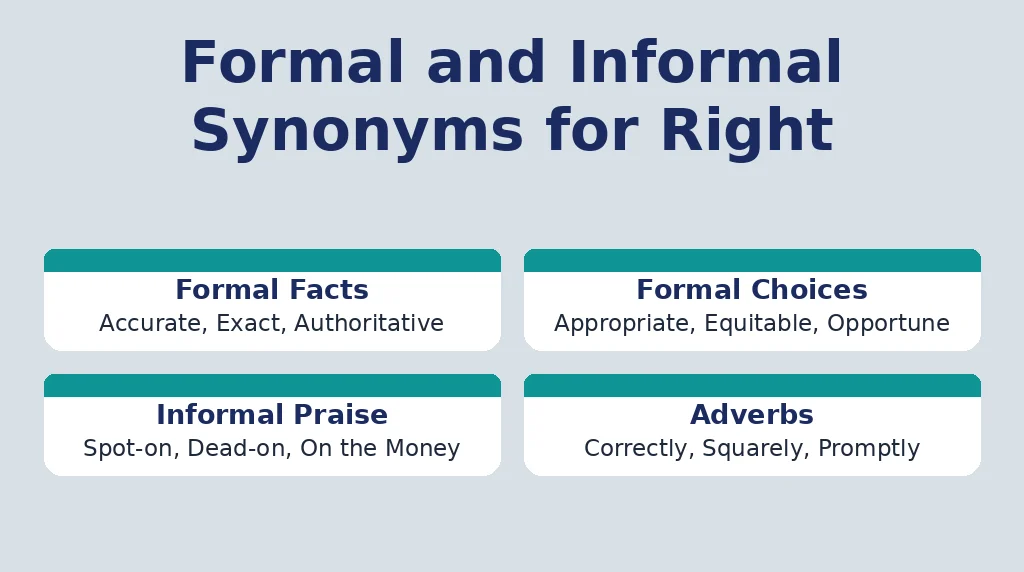
Register decides whether a synonym sounds at home in a report or in a kitchen conversation. The same idea, that an answer matches the facts, can wear a suit or a T-shirt. Pick the register first, and half the choosing is done.
Formal Choices for Essays and Reports
Formal writing prefers words with clear edges and no slang. From the groups above, reach for accurate, exact, precise, appropriate, equitable, opportune, and authoritative. Verbs turn formal too: to rectify an error sounds firmer than to fix it, and to redress a balance belongs in law and policy. Essays also lean on the moral group, where just and ethical carry more weight than plain right. For more on dressing a sentence up or down, compare how writers use plain verbs in formal drafts.
Informal Choices for Speech and Stories
Speech rewards color. Spot-on, dead-on, on the money, and on the nose all cheer a perfect guess. In the pink and not all there keep the health sense playful. Fiction writers borrow these for dialogue, because a character who says “your estimate was accurate” sounds like a report, while one who says “dead-on” sounds alive. Keep informal options out of contracts, exams, and official letters, where a playful word can look careless.
Right as an Adverb: Doing It Right
Right also works as an adverb, and its synonyms split by job. For manner, use correctly, properly, accurately, and suitably: “She pronounced the name correctly.” For exactness, use exactly, squarely, and precisely: “The ball hit him squarely on the shoulder.” For speed, directly, straight, promptly, and instantly cover “come right away.” For fairness, fairly, justly, and well fit: “Workers deserve to be treated fairly.” For degree, completely, totally, entirely, altogether, wholly, utterly, favorably, and quite strengthen the verb, as in “the candle burned right down.”
Adverbs reward the same sense test as adjectives. “He did it right” can mean he did it correctly, properly, or fairly, and each reading invites a different replacement. “The arrow flew right to the target” wants straight or directly, because path, not quality, is the point. When you revise, underline the adverb and ask what question it answers: how, when, how much, or in which direction. The answer points to the right shelf in the lists above.
How to Choose the Right Synonym for Right
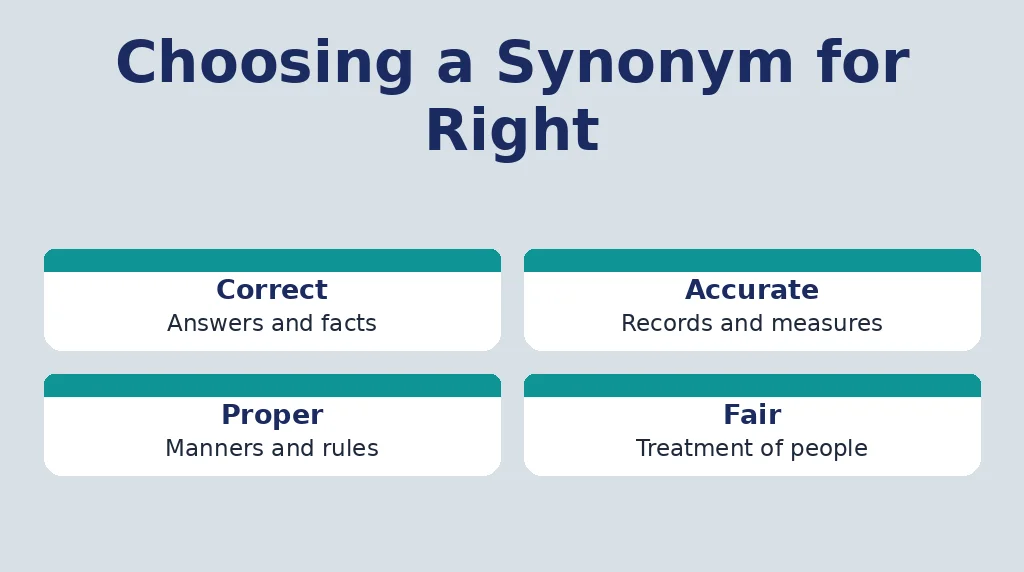
Choosing starts with one question: which sense does your sentence use? Answer that, and the field shrinks from a hundred words to about ten. Then weigh tone and habit. Some words own certain partners: answers are correct, measurements are accurate, moments are opportune, and causes are just.
Correct or Accurate?
Both judge facts, but they judge different things. Correct says an answer or statement has no error: “the correct answer.” Accurate says a record or measurement matches reality in fine detail: “an accurate scale.” A student gives correct answers; a scientist keeps accurate records. Swapping them rarely breaks a sentence, yet the natural partner always sounds better. Merriam-Webster adds that exact stresses strict agreement, while precise adds sharpness of definition, so “the exact time” and “precise instructions” beat their swaps.
Right or Proper?
Proper judges form, manners, and rules, not truth. “The proper way to address a judge” concerns custom. “The right answer to the riddle” concerns fact. British English stretches proper further, so “a proper meal” means a real, satisfying one. In American writing, proper can sound stiff or scolding, which is why appropriate wins most formal slots. When in doubt, ask whether a rule of behavior or a rule of fact is doing the judging.
Right or Fair?
Both words approve of something, but they approve from different seats. Right judges an act against a standard of conduct: “It was right to return the money.” Fair judges how people are treated compared with each other: “It was fair to split the money.” An act can be right without being fair, like keeping a promise that harms an innocent third party. It can also be fair without settling what is right, like a coin toss that treats both sides equally. Essays and arguments gain force when the writer picks the seat on purpose instead of drifting between the two words.
One last check: read the sentence aloud with the opposite swapped in. If “wrong” still fits as the natural opposite, you are in the correctness sense. If “unfair” fits better, you are in the moral sense, and if “left” fits, stay with plain right, because the direction sense has no real substitutes.
Antonyms for Right
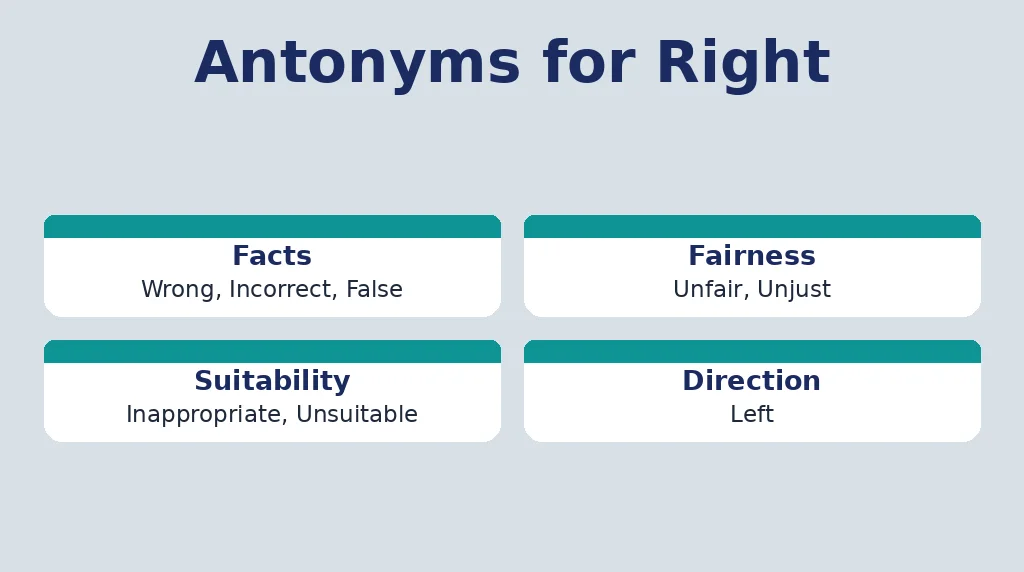
Antonyms only make sense inside one sense at a time, so here they are grouped the same way as the synonyms.
- Correctness: wrong, incorrect, false, inaccurate, erroneous, inexact, invalid, mistaken. “The date is wrong” needs wrong; “an inaccurate date” blames careless detail.
- Morality and fairness: unfair, unjust, immoral, unethical, dishonest. These judge acts and systems, not facts.
- Suitability: unsuitable, inappropriate, improper. A venue can be unsuitable without anyone behaving badly.
- Direction: left, the only true opposite. There is no second word for this job.
- Health and soundness: unwell, unsound, irrational. “Not right in the head” answers to unsound or irrational in formal prose.
One pattern is worth memorizing. English often builds these opposites with prefixes: correct becomes incorrect, just becomes unjust, fair becomes unfair, and appropriate becomes inappropriate. The prefix does not always work, though. There is no “unright” in standard English, and “improper” judges manners rather than facts. When you need the negative of a synonym, check which sense you are negating before you reach for a prefix. The wrong prefix can move the sentence into a different sense without warning.
Common Mistakes: Words That Are Not True Synonyms for Right
- Dexterous: it comes from the Latin word for right, yet it means skillful with the hands. “A dexterous pianist” praises skill, not direction. Never use it for the right-hand side.
- Righteous: a true synonym in the moral group, but a risky one. It often hints at self-righteous pride, so “a righteous decision” can sound like a boast rather than praise.
- Valid: valid judges logic and documents. “A valid point” works because points argue. “A valid answer” sounds like paperwork, unless an official rule decides which answers count.
- Proper: learners reach for proper everywhere. It cannot judge facts: “the proper answer” is only acceptable when a rule of form, not truth, decides.
- Nice: dictionaries record an old sense of exactness (“nice distinctions”), but modern readers hear pleasant. Using nice for correct confuses nearly everyone.
- Rightful: rightful means having a legal or moral claim, as in “the rightful owner.” It never describes answers or directions.
Frequently Asked Questions
What is the best synonym for right?
Correct is the safest all-purpose synonym for the factual sense. It fits answers, facts, spelling, and behavior without sounding stiff. Choose accurate for measurements and records, and just for moral questions.
What is a fancy or formal word for right?
For facts, try precise or authoritative. For choices, appropriate and opportune sound formal and exact. In legal or policy writing, equitable and rectify carry the most formal weight.
What is the opposite of right?
It depends on the sense. Facts take wrong or incorrect, fairness takes unfair or unjust, suitability takes inappropriate, and direction takes left. Right is several words in one, so its opposites are too.
Is correct the same as right?
Almost. Correct stresses freedom from error, while right adds a stronger positive emphasis on matching fact or truth. In daily speech they swap freely; in careful writing, correct suits answers and accurate suits records.
What is a slang or informal word for right?
Spot-on and dead-on praise a perfect answer or guess. On the money and on the nose fit exact amounts and predictions. All four belong in speech and informal writing, not in reports.
Can right mean a direction and a fact at the same time?
Writers play on this in jokes and headlines, but clear prose keeps the senses apart. If a sentence could be read both ways, reword it: “the correct turning” or “the turn to the right.”
What does “a right” mean as a noun?
A right is something a person is entitled to by law or morality, such as the right to vote. Near synonyms include privilege, claim, and prerogative, though each shifts the meaning slightly.
Final Thoughts
Right earns its keep by covering facts, fairness, fit, and one whole side of the body. The price of that range is vagueness, and synonyms are how you pay it off. Correct and accurate sharpen facts, suitable and appropriate sharpen choices, and just and fair sharpen moral claims. Match the sense first, then the tone, and the word will land exactly where it should.
Keep this page nearby the next time a draft leans on right five times in one paragraph. Swap two of them for the group’s specialist words, and leave the others alone. Strong writing rarely needs the fanciest option; it needs the exact one. For the dictionary’s own grouped lists and usage notes, the Merriam-Webster Thesaurus entry for right is the best single page to bookmark.