You have seen the letters at the end of company names everywhere, from law firms to coffee shops. But what do they actually mean?
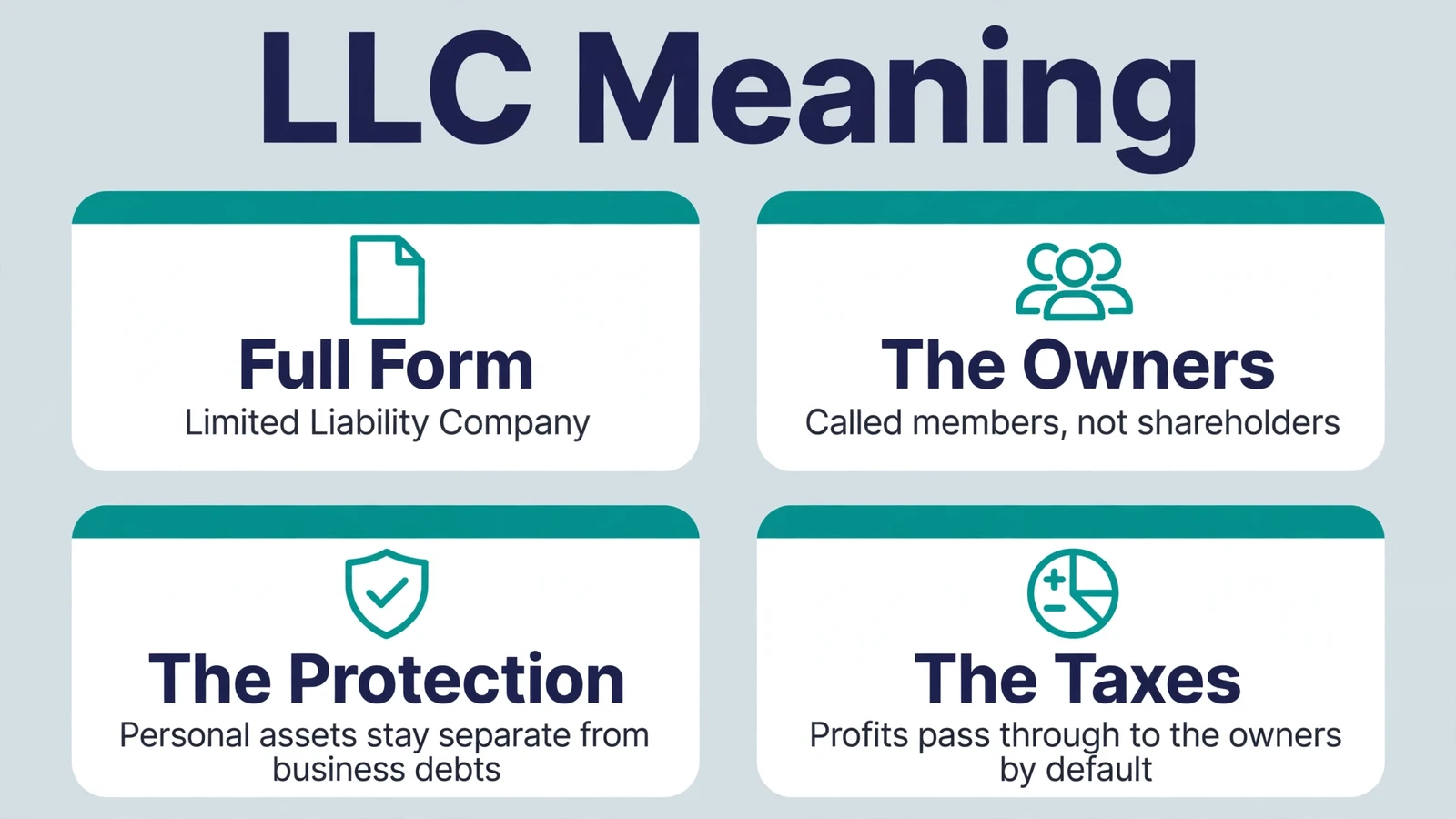
LLC stands for Limited Liability Company. It is a type of business structure in the United States that keeps a company legally separate from the people who own it. Because of that separation, the owners are usually not personally responsible for the debts and lawsuits of the business.
That one idea explains why so many owners choose this structure. An LLC mixes the liability protection of a corporation with the simpler, pass-through taxes of a partnership. Yet it stays flexible enough for a one-person freelance practice or a growing company with many owners.
In this guide, we break the term down in plain English. You will learn what an LLC is, where it came from, how it works, and how it is taxed. You will also see how it compares with a corporation and a sole proprietorship.
What Does LLC Mean?
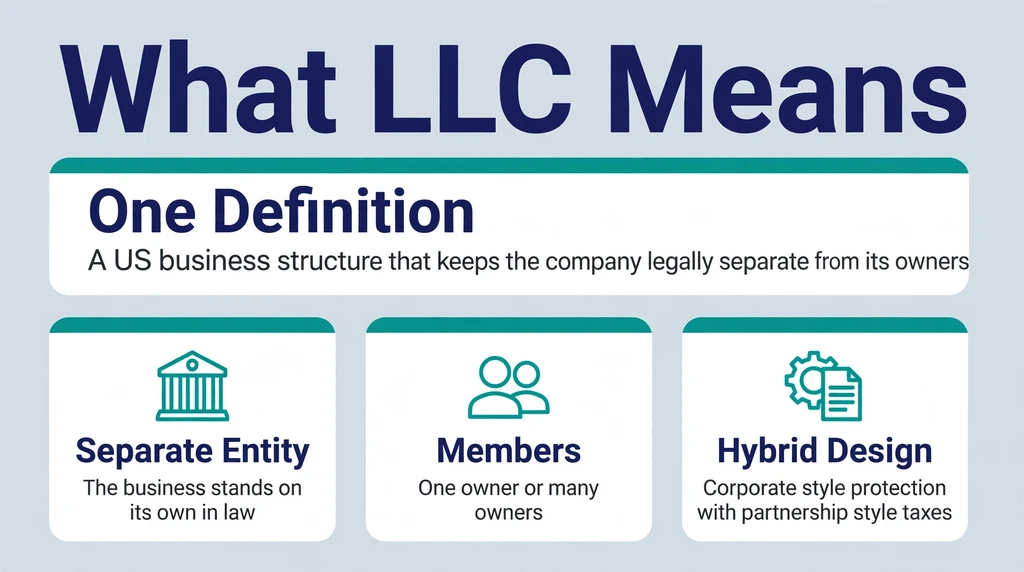
The full form tells you almost everything. Each word in “Limited Liability Company” carries a specific legal meaning, and together the three words describe how the business is built.
Limited: your risk has a cap
“Limited” refers to the risk of the owners. If the business owes money or loses a lawsuit, the owners normally risk only what they have put into the business. Their personal savings, home, and car sit outside the reach of business creditors in most cases.
Liability: the debts stay with the business
“Liability” is legal responsibility for debts and obligations. In an LLC, that responsibility belongs to the company itself. The company signs the contracts, takes the loans, and answers the lawsuits, rather than the owners doing so personally.
Company: a separate legal entity
“Company” signals that the business exists on its own in the eyes of the law. An LLC can open bank accounts, own property, hire employees, and sign contracts in its own name. It keeps existing even when an owner leaves or a new owner joins.
The owners are called members
People who own an LLC are called members, not shareholders. A member can be a single person, several people, another company, or even another LLC. According to the IRS, members may also include corporations and foreign entities, and there is no maximum number of members.
Most states also allow a single-member LLC with just one owner. However, a few kinds of businesses generally cannot be LLCs at all. The IRS notes that banks and insurance companies are the usual examples.
An LLC is created under state law, not federal law. Each state has its own LLC statute, so the exact rules differ a little from state to state. The structure itself, though, works the same basic way everywhere in the country.
How people actually use the term
In everyday speech, “LLC” often works as shorthand for the business itself. Owners say things like “my LLC signed the contract” or “I put the truck under my LLC.” Strictly, they mean the company took that action, with themselves acting on its behalf.
You will also hear the phrase “to LLC” used as a verb, as in “she LLC’d her design studio.” It is casual language, not a legal term, but everyone in the room understands it. The speaker means she reorganized her business as a limited liability company.
In formal documents, the full legal name appears instead of the abbreviation alone. Contracts, invoices, and bank records show the complete name with its designator. The short form dominates conversation, while the long form dominates paperwork.
Where the Term Comes From: A Short History of the LLC
The LLC is surprisingly young for such a common term. Before it existed, business owners faced an awkward trade-off. A corporation protected their personal assets, but its profits were taxed twice. A partnership avoided double tax, yet it left every partner personally exposed to business debts.
Wyoming writes the first LLC law in 1977
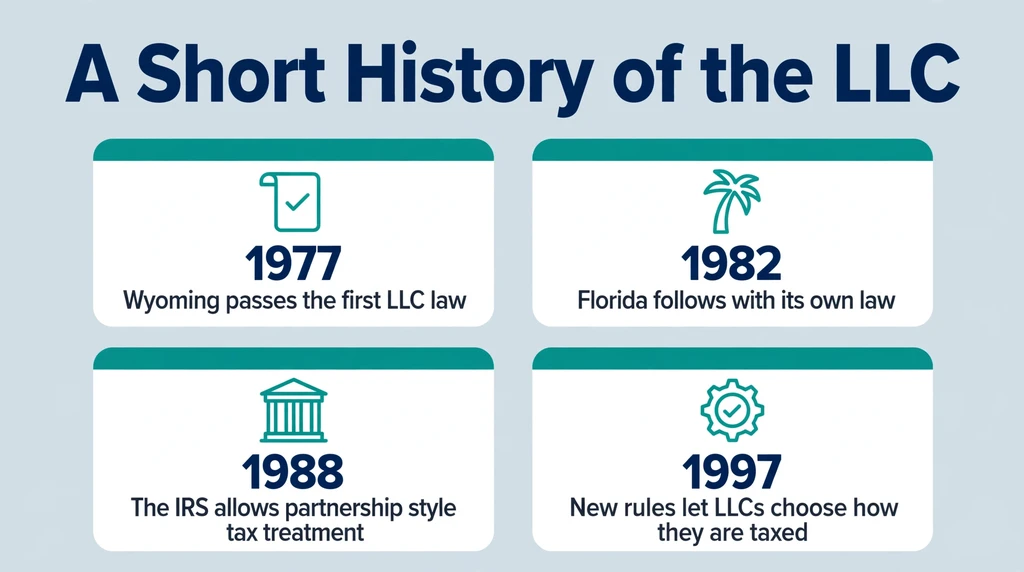
Wyoming became the first state to enact an LLC statute in 1977. The law was a project of the Hamilton Brothers Oil Company. The company wanted a structure with the liability and tax advantages it had enjoyed through a Panamanian entity, but built on American law instead.
Florida followed with its own LLC law in 1982. For years, though, few people used the new structure. Nobody knew for sure how the IRS would tax it, and that uncertainty scared owners away.
The 1988 ruling that changed everything
In 1988, the IRS ruled that a Wyoming LLC would be treated as a partnership for tax purposes. That single decision removed the biggest doubt. Owners could now get liability protection and pass-through taxation in the same structure.
After the ruling, states moved quickly. By 1996, every state in the country had its own LLC law on the books. Then, in 1997, federal check-the-box rules took effect. Those rules let an LLC choose how it would be taxed, which added even more flexibility.
Today the letters sit behind millions of business names. What began as one oil company’s workaround became the default structure for small businesses across the United States.
Why the idea spread so fast
The LLC filled a gap that owners had complained about for decades. It asked for far less paperwork than a corporation, yet it gave up none of the liability protection. For a two-person business, that combination was hard to resist.
States also had a reason to compete. Each state wanted the filing fees and business activity that new companies bring. Once a few states modernized their statutes, the rest followed quickly to stay attractive.
Timing helped as well. The structure matured just as freelancing, consulting, and online selling began to boom. A new generation of solo founders needed exactly what the LLC offered: a real legal wall, simple taxes, and a name that looked established.
How an LLC Works
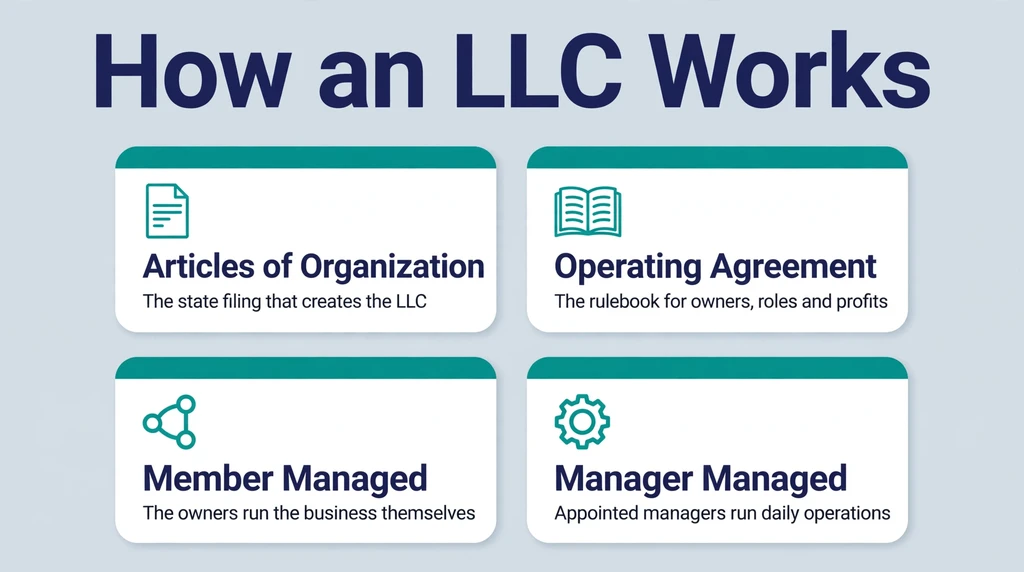
An LLC looks simple from the outside, but a few moving parts sit underneath. Three of them matter most: the state filing, the operating agreement, and the management style.
It starts with a state filing
You form an LLC by filing a document with the state, usually with the Secretary of State. That document is called the articles of organization. Lawyers say an LLC is “organized” rather than “incorporated,” because it never becomes a corporation.
The filing is short. It typically lists the name of the business, its address, and its registered agent. A registered agent is the person or company that receives legal papers on behalf of the business.
Many states also ask for an annual report to keep the registration active. The exact requirements and fees vary by state, so owners check their own state’s rules.
The basic formation steps
Although the details vary by state, the formation path looks similar almost everywhere:
1. Choose a state. Most owners form the LLC in the state where the business actually operates.
2. Pick a legal name. The name usually must include “Limited Liability Company” or an abbreviation like LLC, and it must differ from names already registered.
3. Appoint a registered agent. The agent receives legal documents and official mail for the business.
4. File the articles of organization. This filing with the state is the moment the LLC legally begins. 5. Write an operating agreement. The members record ownership shares, roles, and profit splits while relationships are friendly. 6. Get an EIN and open accounts. A federal tax ID and a dedicated bank account keep business money separate from day one. 7. Handle licences and permits. Local rules may require extra licences depending on the industry and city.
Each step is simple on its own. Together, they create the legal separation that makes the whole structure work.
The operating agreement runs the inside
While the articles create the LLC, the operating agreement runs it. This internal document sets out who owns what percentage, how profits are split, and how decisions get made. It also covers what happens if a member wants to leave or sell a share.
Not every state legally requires an operating agreement. Even so, experienced owners write one anyway. Without it, the state’s default rules decide those questions, and the defaults may not match what the owners actually want.
Instead of shares of stock, owners hold a membership interest. That interest is measured in units or percentages, and a membership certificate can document it.
Member-managed or manager-managed
An LLC also chooses how it will be run day to day. In a member-managed LLC, the owners handle operations themselves. This is the common choice for small businesses where every owner works in the business.
In a manager-managed LLC, the members appoint one or more managers to run things. Some members can then stay passive and simply invest. Larger or investor-backed LLCs often prefer this setup.
Most LLCs also get an EIN, a federal tax ID number, from the IRS. The business uses it for tax filings, payroll, and opening a business bank account.
Keeping an LLC in good standing
Formation is not the last step. The state expects the LLC to stay current, and owners treat a few habits as routine maintenance.
Many states require an annual report with updated addresses and agent details. Missing the deadline can lead to penalties or even administrative dissolution in some states. Owners also file state taxes on time, because falling out of good standing can quietly weaken the liability shield.
Inside the business, the habits matter just as much. Members hold the occasional meeting, record big decisions, and keep the operating agreement updated when ownership changes. None of this matches corporate formality, but it proves the LLC is a real, separate operation.
What Limited Liability Actually Protects
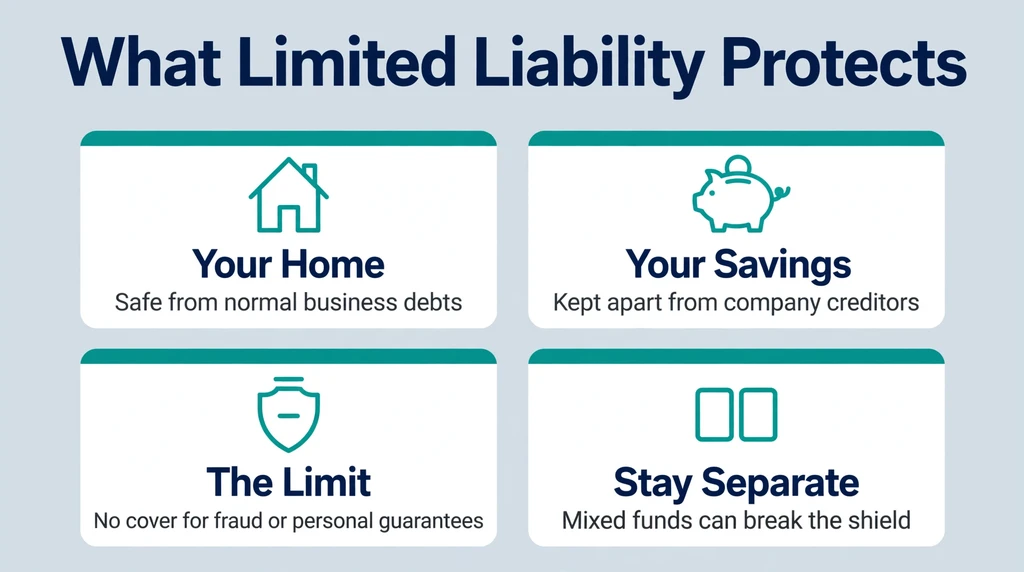
Limited liability is the main reason owners form an LLC, so it is worth understanding precisely. The protection is strong, but it has clear edges.
What the shield covers
Imagine your LLC signs a lease, borrows money, and buys equipment. If sales dry up and the business cannot pay, the creditors can go after the assets of the business. In general, they cannot come after your house, your personal savings, or your car.
The same logic applies to most lawsuits. If a customer sues the business over a contract or an accident, the claim normally targets the LLC. Your personal wealth stays out of it, as long as you keep the business properly separate.
Where the shield stops
First, the shield does not cover loans you personally guarantee. Banks often ask small business owners to sign a personal guarantee. If you sign one, you are personally on the hook for that loan, LLC or not.
Second, it does not protect you from your own wrongdoing. If you personally injure someone, commit fraud, or break the law while working, you can be personally liable for your own actions.
Third, courts can set the shield aside when owners treat the business as a personal wallet. Mixing personal and business money is the classic mistake. Lawyers call this piercing the veil, and it can reopen the door to personal liability.
For that reason, owners keep separate bank accounts and clean records. The formality is light compared with a corporation, but it is not optional if you want the protection to hold.
A quick real-world picture
Picture a small bakery organized as an LLC. The bakery signs a flour contract, leases an oven, and hires two bakers. If the bakery falls behind on the flour bill, the supplier’s claim stops at the bakery’s own assets and accounts.
Now picture the same bakery run as a sole proprietorship. The contract sits in the owner’s personal name, so the supplier can pursue the owner’s personal savings. Same debt, same bakery, completely different personal exposure.
One more detail matters here. If the owner personally crashes the delivery van into another car, the LLC does not erase that personal fault. The shield protects owners from the business’s obligations, not from the consequences of their own actions.
Insurance still matters
Smart owners treat the LLC and insurance as partners, not substitutes. The structure handles debts and contract claims well. Insurance handles accidents, injuries, and property damage, which can arrive with legal bills long before any judgement.
A general liability policy is the usual starting point for a small LLC. Landlords, consultants, and trades often add professional or property cover on top. The LLC limits what a claim can reach; the policy pays the claim itself.
How an LLC Is Taxed
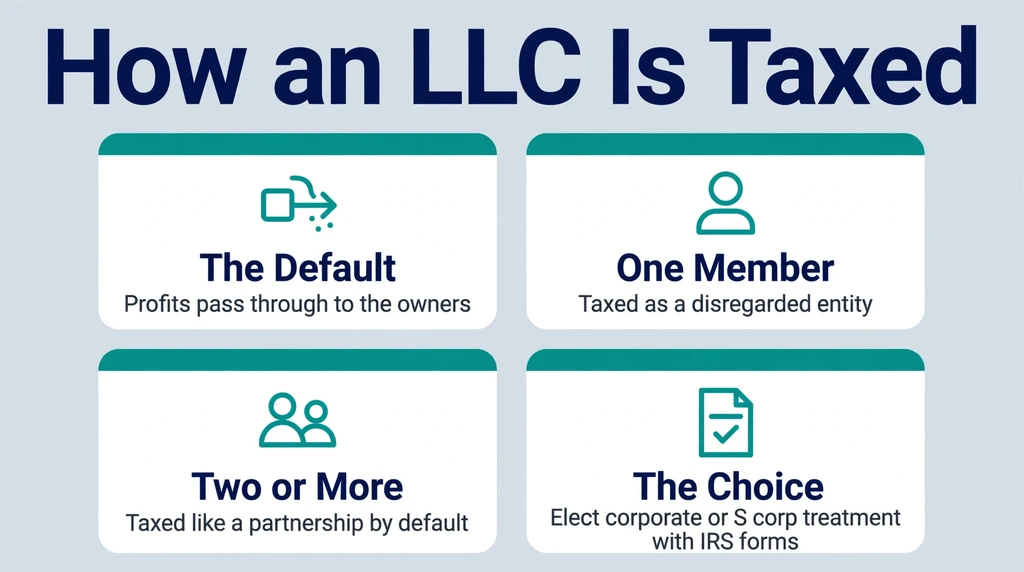
Here is the part that surprises many people. The IRS does not have a separate tax category called “LLC.” Instead, the agency taxes an LLC as something else, and the LLC can even choose which treatment it wants.
The default: pass-through taxation
By default, the IRS does not tax the LLC itself as a separate business. Instead, profits and losses pass through the business to the members. Each member then reports a share on a personal tax return and pays tax at a personal rate.
If the LLC has only one member, the IRS treats it as a disregarded entity. In plain terms, the tax system ignores the LLC and treats the owner like a sole proprietor. The owner reports business income on a personal return, usually on Schedule C.
If the LLC has two or more members, the IRS treats it as a partnership by default. The LLC files an information return, and each member receives a Schedule K-1 showing a share of the profit or loss.
When the LLC has employees
Hiring adds a second tax layer. An LLC with staff must withhold payroll taxes from wages and pay employer taxes, just like any other employer. The pass-through rule only governs the income tax on profits, not the payroll system.
Even a single-member LLC counts here. The IRS treats it as disregarded for income tax, yet it still counts as a separate entity for employment tax purposes. So the same business can be invisible on one form and fully visible on another.
What pass-through looks like in practice
A simple walk-through makes the system concrete. Suppose two friends run an LLC that finishes the year with a profit. The LLC itself writes no cheque to the IRS for income tax on that profit.
Instead, the business files its information return and issues each member a Schedule K-1. Each friend then adds a share of the profit to a personal tax return. The money is taxed once, at each owner’s personal rate, whether or not the cash actually left the business bank account.
That last point catches new owners off guard. Members can owe tax on profits that stayed in the business to fund growth. For this reason, many LLC members make estimated tax payments during the year rather than settling everything in April.
The self-employment tax point
There is a catch to the default setup. The SBA notes that LLC members are generally considered self-employed by the tax authorities. As a result, their share of the profit is usually subject to self-employment taxes, which fund Social Security and Medicare.
This is one reason owners review their tax setup as profits grow. The structure that suits a small side business may not suit a company earning serious money.
Choosing to be taxed as a corporation
An LLC can change its tax treatment by filing Form 8832 with the IRS. With that election, the agency taxes it as a corporation instead. The LLC itself then files a corporate return and pays corporate tax.
Alternatively, an eligible LLC can elect S corporation treatment by filing Form 2553. S corp taxation is also pass-through, so profits still land on personal returns. However, it comes with stricter ownership rules than a plain LLC.
Owners weigh these choices with an accountant, because each one changes payroll, paperwork, and the final tax bill. The right answer depends on profit levels, salaries, and long-term plans.
State taxes vary
Finally, states add their own layer. Some states charge LLCs an annual fee or a franchise tax, while others keep it minimal. Because the rules differ so widely, this article avoids quoting amounts. Your state’s tax authority is the reliable source for current figures.
LLC vs Other Business Structures
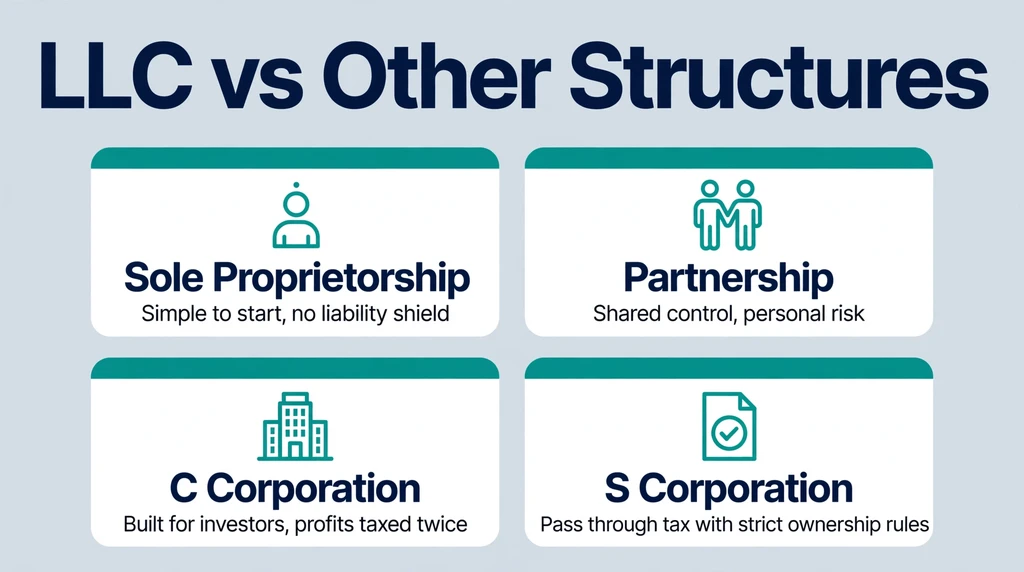
Most confusion about the term comes from comparisons. An LLC borrows features from its neighbours, so a side-by-side look clears things up fast.
LLC vs sole proprietorship
A sole proprietorship is the simplest way to run a business. You start working, and the business is legally you. There is no filing to create it and no separation between you and the company.
That simplicity has a price. As the SBA explains, a sole proprietor is personally responsible for all business debts and obligations. An LLC costs a little more effort to form, but it builds the legal wall that a sole proprietorship lacks.
LLC vs partnership
A general partnership forms when two or more people run a business together. Like a sole proprietorship, it usually needs no state filing to exist. The partners share profits, control, and, crucially, personal liability for business debts.
An LLC gives co-owners the same teamwork with a key upgrade. Each member gets liability protection, and the operating agreement can divide profits in flexible ways that do not have to match ownership percentages.
LLC vs C corporation
A C corporation is a fully independent legal entity owned by shareholders. It can sell stock, raise money from investors, and exist forever. Big companies choose it for exactly those reasons.
The trade-off is tax. A corporation pays tax on its profits, and shareholders pay tax again on dividends. This double taxation is the classic drawback. Corporations also carry heavier formalities, such as boards, annual meetings, and detailed records, which the SBA flags as costly and complex.
LLC vs S corporation
An S corporation is not really a structure. It is a tax status that a corporation or an LLC can elect. Its big benefit is pass-through taxation without double tax.
However, the S corp rules are strict. Ownership is limited, only certain people and entities can hold shares, and only one class of stock is allowed. An LLC taxed by default has none of those ownership limits, which is why many owners keep the standard LLC setup.
Here is the comparison in one view:
| Feature | LLC | Sole Proprietorship | Partnership | C Corporation |
|---|---|---|---|---|
| Personal liability protection | Yes | No | No | Yes |
| Default taxation | Pass-through | Pass-through | Pass-through | Taxed twice |
| Owners are called | Members | Owner | Partners | Shareholders |
| State filing to form | Yes | No | No | Yes |
| Ongoing formalities | Light | None | Light | Heavy |
A quick way to decide
If you are choosing between these structures, four questions usually settle it. How much personal risk does the business carry? A client-facing or product business usually argues for the LLC wall.
Do you have co-owners? Partners without protection argue for an LLC, while a solo hobby seller may not need one yet. Do you plan to raise money from investors or sell shares one day? That path points toward a corporation instead.
Finally, how much paperwork will you actually maintain? An LLC rewards light discipline: separate accounts, simple records, one internal agreement. If even that feels heavy today, start simple and convert later, because many owners do exactly that.
Who Uses an LLC and Why
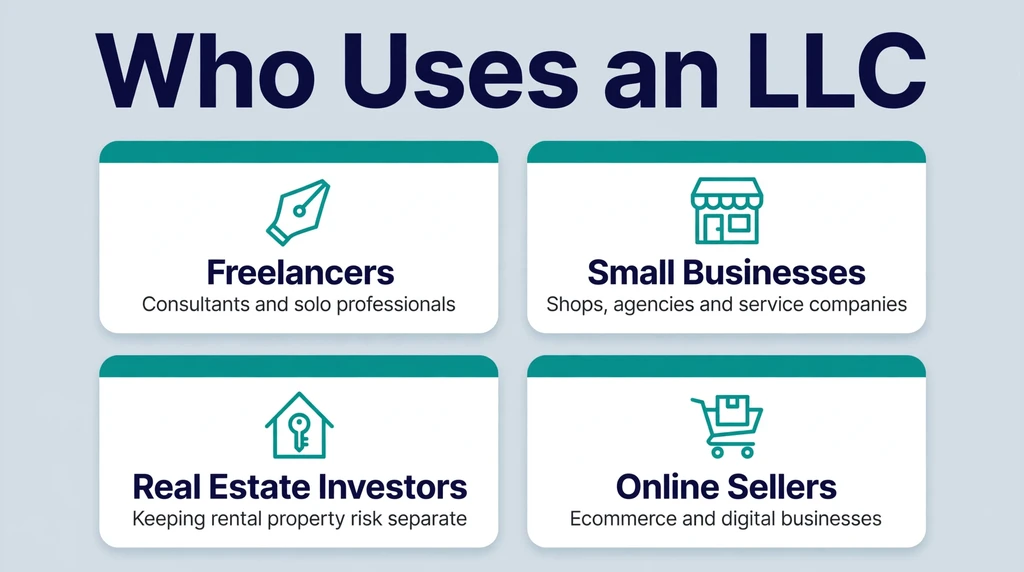
Once you know the definition, the pattern of users makes sense. The structure suits anyone who wants a legal wall without corporate paperwork.
The typical users
Freelancers and consultants often form single-member LLCs once their income grows. It also looks more established to clients, and it separates business money from personal money.
Small shops, agencies, and service companies are heavy users too. So are real estate investors, who frequently place rental properties inside LLCs to keep property risks away from their personal assets. Online sellers, tradespeople, and family businesses round out the list.
Some professionals face an extra rule. In many states, licensed professionals such as lawyers, doctors, and accountants must use a professional LLC, or PLLC, instead. The idea is the same, with licensing rules added on top.
Two variations worth knowing
A minority of states also allow a series LLC. This design places several sub-units, called series, under one parent LLC. Each series can hold its own assets and debts, which suits landlords with several properties.
Real estate investors like the pattern because a problem at one property stays inside its own series. However, the concept is newer and less tested in court than the standard LLC. Many owners stick with separate ordinary LLCs instead.
You may also meet the low-profit LLC, or L3C, in social enterprise circles. Only a few states offer it, and it remains a niche form. For almost every reader, the plain LLC is the version that matters.
Why “LLC” appears in company names
You see the letters everywhere because state law generally requires them. The legal name of the business must include a designator such as “Limited Liability Company” or the abbreviation “LLC” or “L.L.C.”
That designator does real work. It warns customers, suppliers, and lenders that they are dealing with a limited liability entity. As a result, nobody can later claim they thought they were contracting with a person.
Some companies still market themselves under a shorter brand name. In that case, the brand operates as a trade name, while the LLC remains the legal business behind it.
When an LLC is not the right fit
The structure has limits, and honest guides should name them. Startups chasing venture capital usually form C corporations instead. Investors prefer stock, familiar corporate law, and an easy path to a public offering, none of which an LLC provides well.
Nonprofits follow a completely different route, because they seek tax-exempt status rather than owner profit. Regulated industries face their own rules as well. As the IRS notes, banks and insurance companies generally cannot be LLCs at all.
Finally, the LLC is an American invention. Other countries have their own equivalents, but the exact structure does not transfer across borders. A business operating internationally usually needs local advice in each country.
Advantages and Disadvantages of an LLC
A clear definition is only half the picture. Owners pick this structure for practical reasons, and they accept real trade-offs in return.
The advantages
- Personal asset protection. The core benefit. Business debts and most business lawsuits stop at the company, not at your home or savings.
- Pass-through taxes by default. Profits are taxed once, on the members’ personal returns, with no separate corporate layer.
- Tax choice. Few structures let you change your mind. An LLC can elect corporate or S corp taxation later if the numbers start to favour it.
- Flexible ownership and profits. Almost anyone can be a member, and the operating agreement can split profits in ways that do not mirror ownership percentages.
- Light formalities. No board of directors, no mandatory annual shareholder meetings, and far less record keeping than a corporation.
- Credibility. The designator in the name signals a registered, serious business to clients, banks, and suppliers.
The disadvantages
- Self-employment taxes. Under the default setup, members usually pay self-employment tax on their full share of profits. At higher incomes, that can cost more than the alternatives.
- State costs and upkeep. Formation filings, annual reports, and in some states a franchise tax or annual fee add recurring costs. The amounts vary widely by state.
- Harder fundraising. An LLC cannot issue stock. Investors who want shares, options, and a familiar exit path usually push the business toward a corporation.
- More paperwork than doing nothing. A sole proprietor can start today with no filing at all. An LLC always demands at least the state filing and basic maintenance.
- Rules vary by state. Moving the business or operating across state lines can mean extra registrations, because every state writes its own version of the law.
For most small businesses, the advantages win easily. The disadvantages mostly bite at the extremes: very high profits, outside investors, or multi-state operations.
Common Myths and Misunderstandings About LLCs
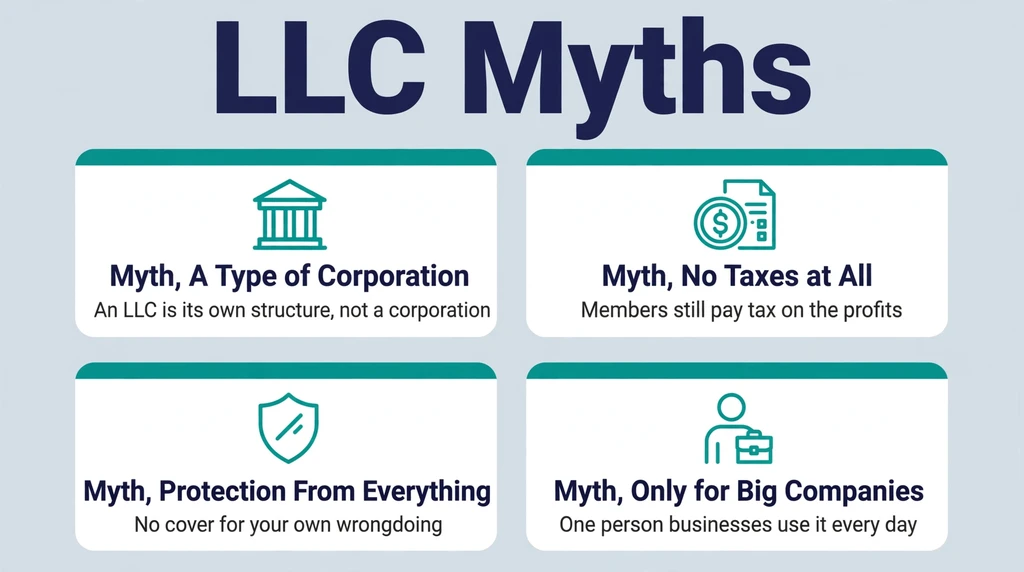
The term attracts a few stubborn myths. Clearing them up will save you from bad assumptions.
Myth 1: An LLC is a type of corporation
It is not. An LLC is its own kind of entity, created by its own state statutes. It is organized, not incorporated, and its owners are members rather than shareholders. The confusion comes from the shared liability protection, but the two structures follow different rules.
Myth 2: An LLC pays no taxes
An LLC is not a tax escape hatch. By default, the tax bill simply lands on the members instead of the business. The IRS collects the same income tax either way. It only changes who writes the cheque and which form gets filed.
Myth 3: An LLC protects you from everything
The shield covers business debts and most business lawsuits. It does not cover your own negligence, fraud, or personally guaranteed loans. It also does not replace insurance. Most established LLCs carry liability insurance alongside the structure.
Myth 4: Only big companies need an LLC
In practice, the opposite is often true. A solo freelancer with one big client contract may carry more personal risk than a large company with reserves. That is why so many one-person businesses choose the single-member route.
Myth 5: LLC is a federal registration
There is no federal LLC registry and no national LLC certificate. Every LLC is born in one state, under that state’s law. Federal agencies only enter the picture later, mainly through taxes and an EIN.
FAQs About LLC Meaning
What does LLC stand for?
LLC stands for Limited Liability Company. The name describes a business whose owners have limited personal liability for its debts. It is a legal structure created under the law of a US state.
Is an LLC a corporation?
No. An LLC is a separate type of entity with its own statutes. It shares a corporation’s liability protection, but it has different owners, documents, and rules. Its owners are called members, and it is organized rather than incorporated.
Can one person own an LLC?
Yes. Most states allow a single-member LLC with exactly one owner. For federal income tax, the IRS treats that LLC as a disregarded entity by default. The owner reports the business results on a personal tax return.
Does an LLC pay its own taxes?
Usually not by default. Most LLCs use pass-through taxation, so the members pay tax on the profits personally. An LLC can elect corporate taxation instead by filing the right IRS forms.
Why do companies put LLC in their name?
State law generally requires the designator in the legal name. It tells everyone that the business is a limited liability entity. The letters also help distinguish the legal company from any shorter brand name it trades under.
What is the difference between an LLC and an S corp?
Strictly, an S corp is a tax election, not a structure. An LLC can elect S corp taxation, but it keeps its LLC legal form. The election adds ownership restrictions while keeping pass-through taxation.
Who can own an LLC?
Almost anyone. Members can be individuals, corporations, other LLCs, and foreign entities, and there is no maximum number. A few industries, such as banking and insurance, generally cannot operate as LLCs.
How do you start an LLC?
You file articles of organization with your state, usually through the Secretary of State. Most owners also write an operating agreement, get an EIN, and open a business bank account. The steps are simple, but state rules and fees differ.
This article explains the term in general terms. It is educational information, not legal or tax advice, so speak to a qualified professional about your own situation.
Final Thoughts
LLC meaning comes down to three words: limited, liability, company. The structure gives a business its own legal identity, caps the personal risk of its owners, and still taxes profits in a simple pass-through way by default.
That balance is exactly why the term spread from one Wyoming oil company in 1977 to millions of shop signs and invoices today. For the official word on how the tax side works, the IRS guide to limited liability companies is the best next stop. Once you understand the letters, you will start noticing them everywhere.
You will also read company names differently. The design firm, the landlord, the coffee roaster, and the app studio all chose those letters on purpose. Each one wanted the same simple promise: a business that stands on its own, owners whose personal lives stay protected, and taxes that stay as simple as the work allows. That is the whole meaning of LLC, and it is why the abbreviation is not going anywhere.