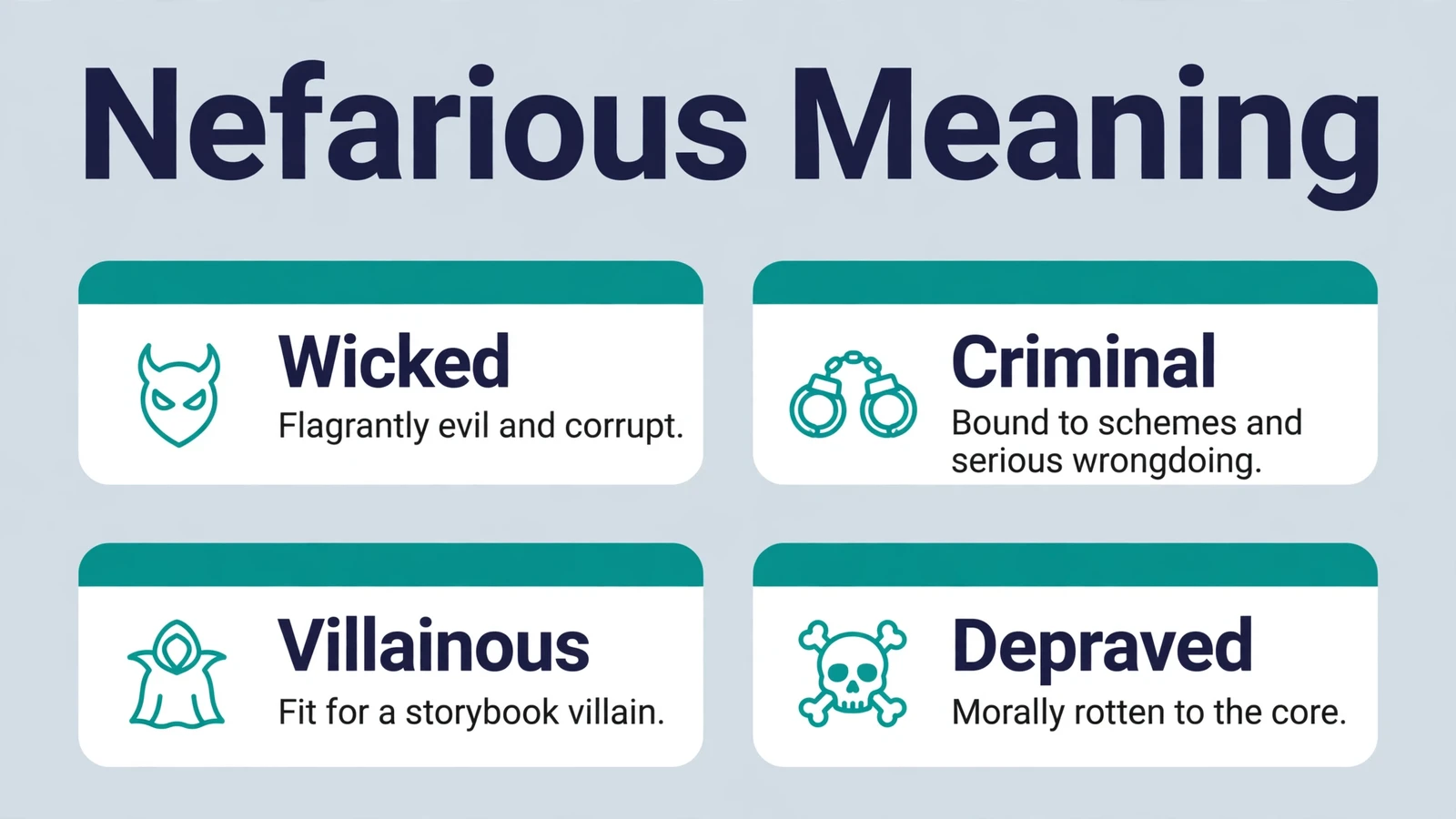
Some words accuse quietly, and some words accuse loudly. Nefarious belongs firmly in the second group. It is the word reporters reach for when a scheme looks truly rotten, and the word storytellers save for villains with grand, wicked plans. In plain English, nefarious means flagrantly wicked or corrupt, evil in a deliberate and extreme way. Merriam-Webster puts it exactly like that, and Dictionary.com sharpens the picture with “extremely wicked or villainous.” So when a headline calls a plot nefarious, nobody is talking about a small mistake or a minor fib. This guide unpacks the word fully, from its pronunciation and its Latin roots to its closest synonyms, its favourite phrases, and its second life in film and games.
What Does Nefarious Mean?
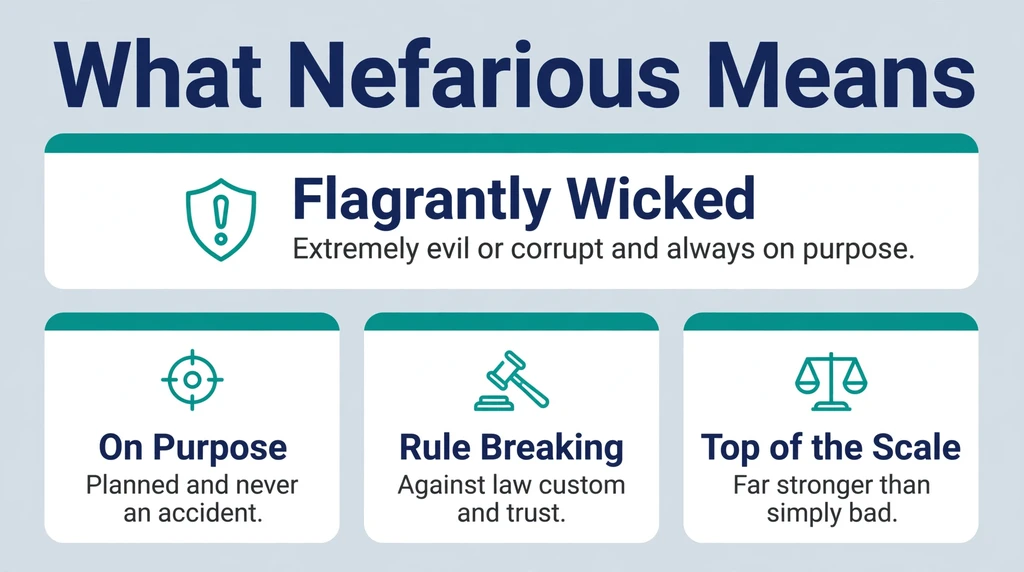
Nefarious is an adjective, and it describes people, actions, plans, and dealings that are wicked to an extreme degree. A nefarious act is not just wrong. It is wrong in a way that is open, deliberate, and morally rotten. Cambridge Dictionary captures the everyday sense neatly, defining nefarious as “morally bad,” especially when it describes an action or an activity. That little word “especially” matters, because the word clings most naturally to things people do and plan.
Think of the difference this way. A careless driver makes a bad mistake, yet nobody calls the mistake nefarious. A fraudster who spends months building a fake charity to steal donations, though, is doing something nefarious. The word demands intent. It demands a plan, a pattern, or at least a clear choice to do wrong. Random accidents and honest errors never earn it.
The Core Definition in Plain English
Strip away the dictionary language and the core meaning is simple. Nefarious means as wicked as it gets. It sits at the very top of the scale of bad words, far above “bad” and well above “wrong.” If “bad” is a slap on the wrist, nefarious is a full courtroom accusation. It tells the listener that the behaviour broke serious rules, harmed real people, and did so on purpose.
This strength explains the word’s tone. Nefarious sounds formal, even slightly old-fashioned, and that formality gives it weight. People rarely waste it on trivia. Instead, they save it for corruption, crime, betrayal, and elaborate schemes. When you hear it in a news report, you can safely assume the story involves genuine harm.
Why the Word Feels Stronger Than “Bad”
Part of the punch comes from what the word implies, not just what it states. Nefarious suggests scheming. It hints that the wrongdoing was plotted in advance, hidden from view, and carried out against laws or customs that everyone respects. Merriam-Webster’s usage notes make this precise. The dictionary says nefarious suggests a “flagrant breaching of time-honored laws and traditions of conduct.” In other words, the word points at rule-breaking as much as at cruelty.
That is also why nefarious pairs so well with words like scheme, plot, and activities. A single angry outburst is rarely nefarious. A long-running operation, quietly organised and deliberately concealed, almost defines it. So the word carries a little movie scene inside it: dim rooms, whispered plans, and someone up to no good.
What Nefarious Can Describe
The word is flexible about its targets, as long as real wickedness is involved. It most often describes activities, schemes, plots, purposes, deeds, and dealings. It can also describe the people behind them, so English happily allows a nefarious character, a nefarious villain, or a nefarious organisation. Even places and businesses can take it when they are known for corrupt behaviour.
However, the word does have limits. It does not describe ordinary rudeness, bad luck, or harmless mischief. A child sneaking an extra biscuit is cheeky, not nefarious. A storm that ruins a picnic is unfortunate, not nefarious. Keep those limits in mind, because using the word for small things drains its power and can sound unintentionally comic.
Does Nefarious Always Involve a Crime?
Not always, although crime is its home territory. Many nefarious schemes are plainly criminal: fraud, smuggling, blackmail, and corruption all qualify instantly. Yet the word stretches a little wider than the law. A corporation that secretly designs a product to deceive its own customers may break no single statute and still behave nefariously. The moral verdict matters more than the legal one.
That flexibility comes straight from the word’s history. Its Latin root condemned acts against divine law, a far broader category than any criminal code. So modern English keeps both layers alive. If an act is illegal and wicked, nefarious fits perfectly. If it is merely wicked, corrupt, and deliberate, the word still fits well.
What never fits is innocence or accident. The moment planning and bad intent disappear, the word loses its footing. Always check for those two ingredients before you use it.
How to Pronounce Nefarious
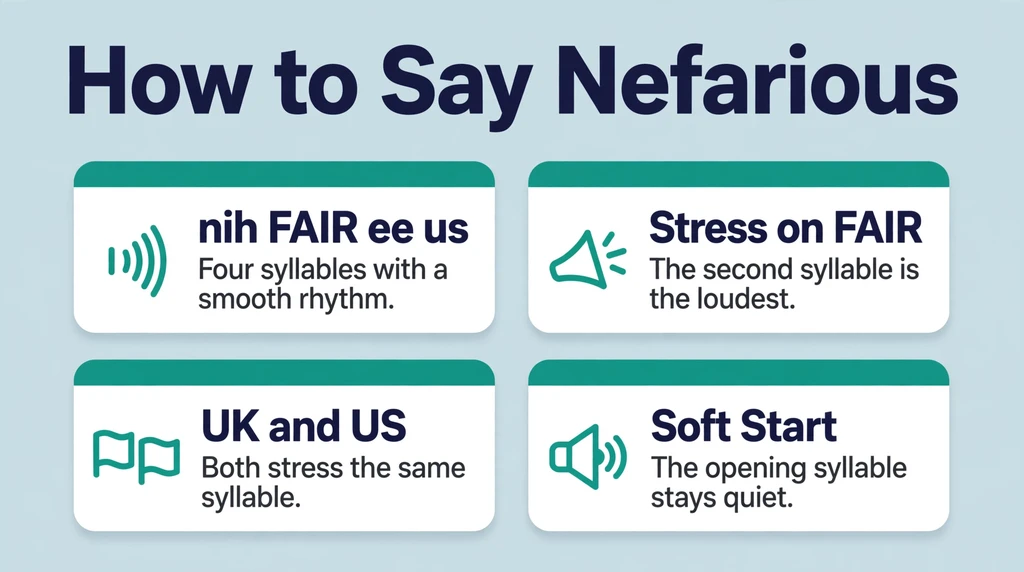
Pronunciation scares many learners away from this word, yet it is friendlier than it looks. Merriam-Webster gives the spoken form as nih-FAIR-ee-us. Cambridge lists the American pronunciation as /nəˈfer.i.əs/ and the British as /nəˈfeə.ri.əs/. The difference between the two accents is tiny, and both stress the same syllable. Once you hear the rhythm once, the word becomes easy to say with confidence.
Syllables and Stress
The word has four syllables: ne-far-i-ous. The stress falls on the second syllable, the “FAIR” part, which you should say a little louder and longer than the rest. Meanwhile, the opening syllable shrinks to a soft “nih” or “nuh.” The ending, “ee-us,” flows quickly and lightly. Put together, it sounds like a small drumbeat: da-DUM-da-da.
A useful trick is to anchor the word to “fair.” Most learners already say “fair” without effort. Start with a soft “nih,” land firmly on “FAIR,” then glide out through “ee-us.” Practise the full word slowly three times, then speed up. Most people find it sticks quickly after that.
Related Forms You Will Meet
English builds two close relatives from the same stem. The adverb is nefariously, as in “the funds were nefariously diverted,” and Cambridge marks that form as formal. The noun is nefariousness, which means the quality of being nefarious, as in “the nefariousness of the scheme shocked investigators.” Both forms appear mostly in writing, not conversation.
There is also a comparison scale for the adjective itself. Writers can say “more nefarious” and “most nefarious” when they rank wrongdoing. That flexibility helps in essays and arguments, where one scandal can be judged more nefarious than another. Still, most writers treat the word as already extreme, so they use comparisons sparingly.
The Origin of Nefarious: A Latin Story
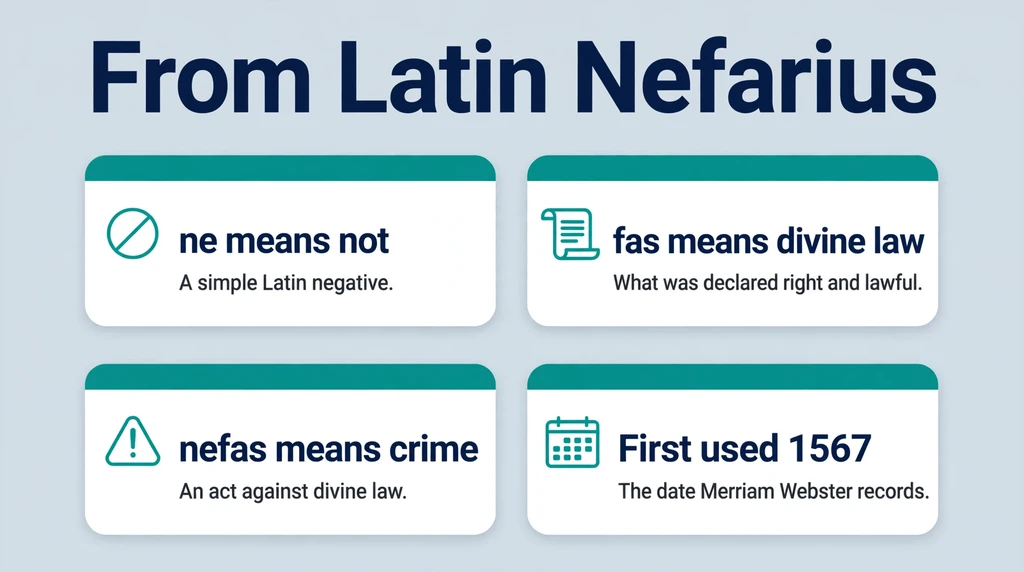
Every strong word hides a story, and this one leads back to ancient Rome. Nefarious comes from the Latin adjective *nefarius*, which meant wicked, abominable, or impious. Behind *nefarius* stands the Latin noun *nefas*, a heavy word for a crime, a wrong, or an act of impiety. The word is not just about breaking human law. It is about violating something sacred.
Ne, Fas, and Divine Law
Latin speakers built *nefas* from two small parts. The first part, *ne-*, simply means “not.” The second part, *fas*, meant right, law, or divine law. So *nefas* described something that stood against divine law itself, an act the gods had not sanctioned. Etymonline adds a beautiful detail here: *fas* is related to the Latin verb *fari*, “to speak.” In that picture, *fas* was what had been divinely spoken, and *nefas* was its forbidden opposite.
That origin explains the word’s flavour in English today. Nefarious still carries a faint whiff of the sacred. Calling something nefarious hints that it breaks more than a rule. It offends the deep order of how people should behave. Few modern speakers think about Roman religion when they use the word, yet the old weight survives inside it.
Interestingly, English kept very few words from this root. Merriam-Webster notes that nefarious is one of only a handful, joined by nefariousness and by *nefast*, a thoroughly obscure word that also means wicked. So the little Latin root *fas* survives in modern English mostly through this one famous villain of a word.
When the Word Entered English
Merriam-Webster records the first known use of nefarious in 1567. Other references place the word’s arrival at roughly the same moment. Etymonline dates it to about 1600, and Dictionary.com gives a first recording of 1595 to 1605. Whichever reference you follow, the word is a child of the late sixteenth century.
By the standards of English, that makes nefarious a relative latecomer. Merriam-Webster points out that cousins like *vicious* and *villainous* had already been in the language for about two hundred years before nefarious showed up. English speakers managed without it for centuries. Then scholars, steeped in Latin, imported a word that sounded learned, heavy, and damning all at once.
The strategy worked. The word never became everyday slang, and it never faded away either. Instead, it settled into the formal layer of English, where it still waits for moments that deserve real condemnation.
Nefarious vs Notorious
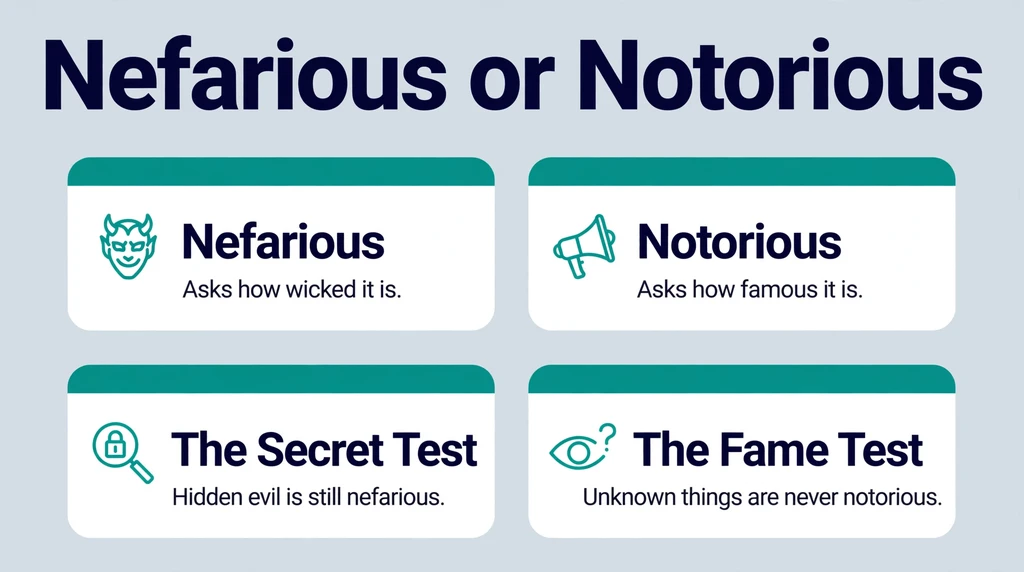
Here is the mix-up that catches more learners than any other. Nefarious and notorious sound alike, they both describe dark things, and even confident writers swap them by accident. Yet the two words answer different questions. Nefarious answers the question “how wicked is it?” Notorious answers the question “how famous is it for something bad?”
What Notorious Actually Means
Merriam-Webster defines notorious as “generally known and talked of,” and especially “widely and unfavorably known.” Its own example is a notorious gangster, a criminal everyone has heard of. The word comes from the Latin verb *noscere*, “to come to know,” and that origin gives the game away. Notorious is about knowledge and reputation. It says nothing directly about how evil something is, only that the bad reputation is public and widespread.
The word picked up its negative colour early. Merriam-Webster notes that one of the first printed uses of the unfavourable sense appears in the 1549 Book of Common Prayer, which speaks of “notorious synners.” From the very beginning, then, notorious attached itself to people whose bad behaviour was common knowledge.
The Fame Test That Separates Them
A simple test keeps the two words apart forever. Ask yourself: could this thing be completely secret? A hidden plot in a locked basement can absolutely be nefarious, because wickedness does not need an audience. But it cannot be notorious, because notoriety needs fame, talk, and reputation. Secrecy kills notorious and leaves nefarious untouched.
The reverse also holds. A tiny village bakery might be notorious locally for its rude owner and dreadful queues. Everyone talks about it, so notorious fits. Nothing about the bakery, though, is deeply wicked, so nefarious would be a wild exaggeration. Fame and wickedness overlap often, especially with famous criminals, but they are not the same idea.
When Both Words Fit at Once
Of course, some subjects earn both labels honestly. A crime boss whose schemes fill newspapers for years is notorious, because the whole country knows his name. He is also nefarious, because his schemes are genuinely wicked. Headline writers love this overlap, and they often stack the words near each other for extra punch.
Still, precision is a gift to your readers. If the point is reputation, choose notorious. If the point is moral rottenness, choose nefarious. Picking the exact word makes your writing sharper and your meaning impossible to miss.
Nefarious and Its Near Synonyms
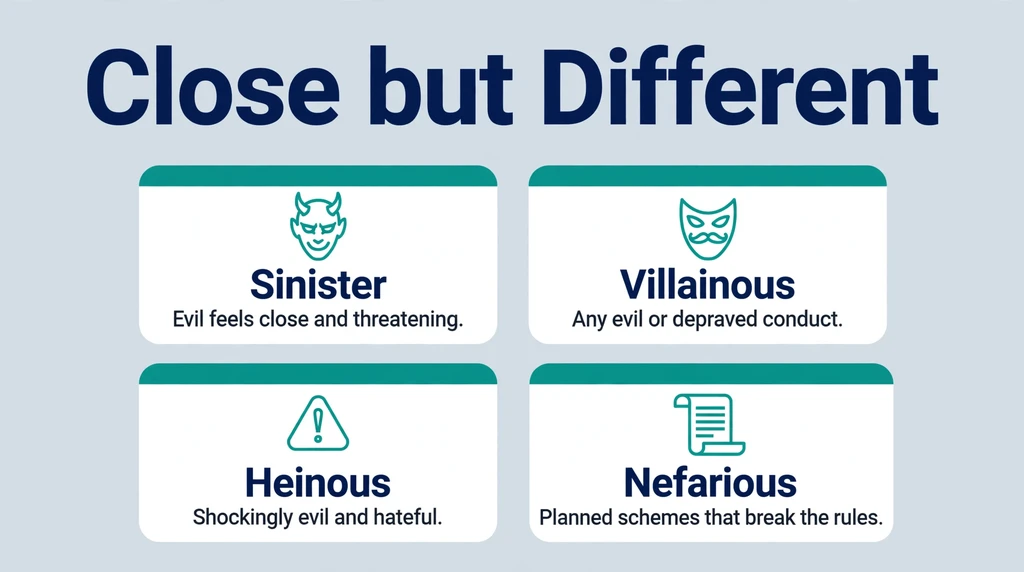
English owns a whole shelf of words for evil, and each one shades the idea differently. Nefarious shares that shelf with sinister, villainous, heinous, and several others. Knowing the shades helps you pick the word that matches your scene, instead of grabbing whichever dark adjective floats past first.
Nefarious vs Sinister
Sinister is the word of atmosphere and threat. Something sinister feels like harm is quietly approaching, even before anything bad has actually happened. A sinister figure in a doorway, a sinister silence before an announcement, a sinister pattern in the data: each one creates dread about what comes next. The evil in sinister is often suspected rather than proven.
Nefarious works differently. It usually points at wrongdoing that is already real, planned, or uncovered. A sinister stranger might turn out to be harmless. A nefarious scheme, once exposed, is guilty as charged. So choose sinister for suspicion and shadow, and choose nefarious for schemes and deeds you are ready to condemn outright.
Nefarious vs Villainous
Villainous is the closest cousin in the family. Merriam-Webster notes that while nefarious suggests flagrantly breaking long-honoured laws and traditions, villainous applies to any evil, depraved, or vile conduct or characteristic. That makes villainous the broader, looser word. It also carries a theatrical flavour, borrowed from the villains of plays and stories.
Because of that flavour, villainous often sounds slightly playful or dramatic. A villainous laugh, a villainous moustache, a villainous plan in a cartoon: the word winks at fiction. Nefarious sounds colder and more official. Court reports, investigations, and serious journalism lean toward nefarious, while storytelling and humour lean toward villainous.
Nefarious vs Heinous
Heinous is the word of shock and horror. Merriam-Webster defines it as “hatefully or shockingly evil” and gives the example “a heinous crime.” Its history explains its emotional charge, because it comes from the Anglo-French word *haine*, meaning hate. Heinous acts provoke outrage and revulsion. They are the crimes that make whole communities recoil.
The difference from nefarious lies in what each word emphasises. Heinous emphasises the horror of the act itself and the disgust it triggers. Nefarious emphasises deliberate, organised wickedness, often with scheming involved. A single shocking assault is heinous. A network that plans fraud for years is nefarious. The worst real cases, sadly, can be both at once.
Quick Shade Guide
A compact summary helps fix the differences in memory:
- Nefarious: deliberate, organised wickedness; schemes and corrupt dealings.
- Sinister: a threatening atmosphere; evil seems to be approaching.
- Villainous: evil in the manner of a storybook villain; broad and dramatic.
- Heinous: shockingly, hatefully evil; used for atrocious acts and crimes.
- Infamous: famous for something bad; the fame is the point.
- Iniquitous: grossly unfair and sinful; formal and moral in tone.
Notice how each word aims at a different target. Mastering those targets turns a vague insult into a precise judgement. It also makes your descriptions far more vivid for readers.
Words Nefarious Keeps Company With
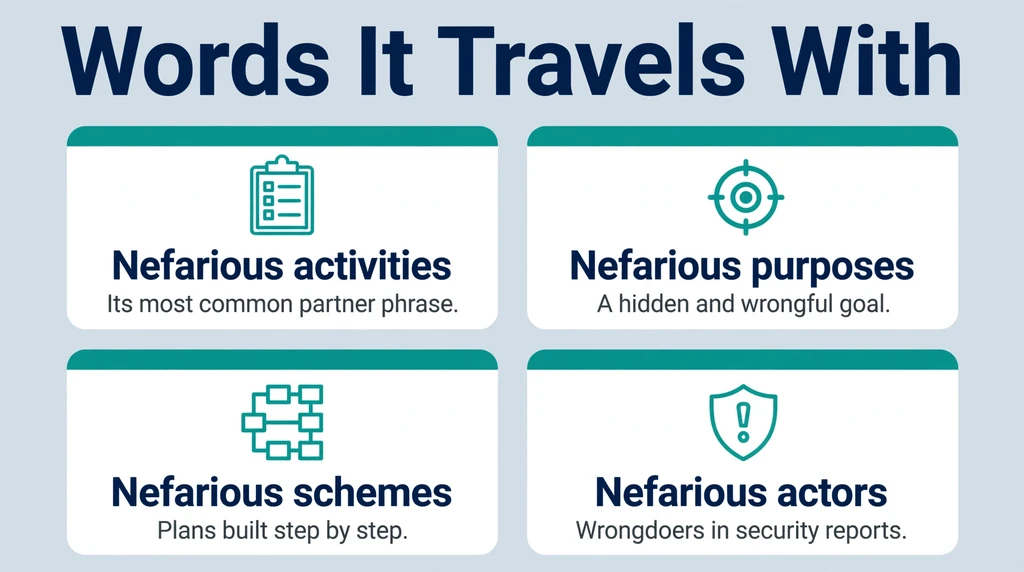
Words develop habits, and nefarious has very clear ones. It appears again and again beside the same small set of nouns, and those pairings are called collocations. Learning them makes your English sound natural instantly, because native speakers recognise the pairs on sight. Cambridge Dictionary even treats “nefarious activities” as a named collocation, with example after example drawn from parliamentary debate.
Nefarious Activities and Nefarious Purposes
“Activities” is the word’s favourite partner by a wide margin. Officials say it when they suspect wrongdoing but want a broad, serious label: “the group was investigated for nefarious activities.” The phrase covers a wide range of misconduct without naming any single crime. That breadth is exactly why politicians and police statements love it.
“Purposes” runs a close second. People say a tool, a fund, or a technology was used “for nefarious purposes.” The phrase implies a hidden, wrongful goal behind an innocent-looking action. A perfectly legal purchase becomes suspicious when its purpose is nefarious. So the pairing quietly accuses the intention, not the object.
Nefarious Schemes, Plots, and Deeds
When writers want drama, they reach for schemes and plots. “A nefarious scheme” is Merriam-Webster’s own example sentence, which shows how central the pairing is. Schemes and plots both imply planning over time, with steps, helpers, and a target. That planning element matches the word’s core meaning perfectly.
“Deeds” gives the same idea an older, more literary flavour. Heroes in novels uncover nefarious deeds; reports in newspapers expose nefarious dealings, a business-flavoured cousin. Dealings suggests transactions, contracts, and quiet agreements, so it suits corruption stories especially well. Each partner noun steers the same adjective into a slightly different world.
Nefarious Characters and Actors
The word also attaches to people. A nefarious character is someone whose whole reputation smells of wrongdoing, whether or not one specific act is named. In security and technology reporting, the phrase “nefarious actors” has become standard shorthand for hackers, fraudsters, and hostile groups operating online. There, the word does efficient work: it labels the people as deliberate wrongdoers without pausing to prove each individual act.
Together, these habits explain the word’s modern life. It lives in official statements, investigative reporting, and security briefings. Whenever professionals need one adjective that says “deliberately, seriously up to no good,” nefarious is waiting for the call.
Nefarious Intentions and Influence
Two quieter partners deserve a mention as well. “Nefarious intentions” accuses the motive before any act takes place, which makes it popular in warnings and accusations. “Nefarious influence” describes a corrupting effect one person or group exerts over others. Parents, teachers, and reformers reach for that pairing when they fear young people are being led astray.
Both pairings confirm the same lesson. Nefarious rarely travels alone. It arrives holding hands with nouns about plans, motives, and effects, because the word itself is really about the machinery of wrongdoing. Learn its favourite partners, and you will rarely place it wrong.
How to Use Nefarious in a Sentence
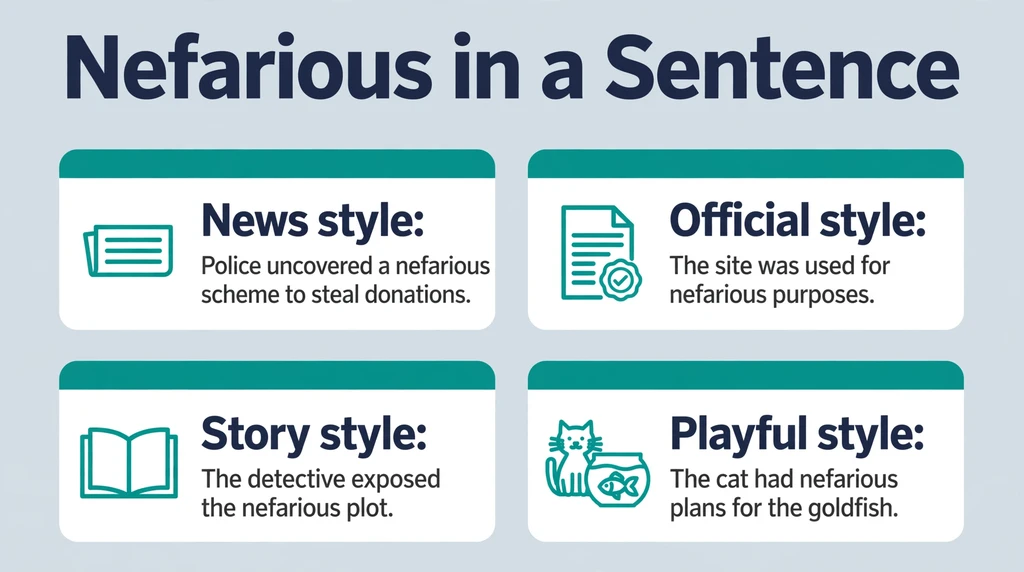
Seeing a word in action teaches faster than any definition. The sentences below show nefarious at work across news, fiction, work, and everyday speech. Notice how every example involves deliberate wrongdoing, never an accident or a trivial annoyance. That pattern is the whole secret of using the word well.
Example Sentences From Serious Contexts
1. The charity’s director was arrested after investigators uncovered his nefarious scheme to pocket donations.
2. Police believe the warehouse was being used for nefarious purposes, including storing stolen goods.
3. The leaked files revealed years of nefarious dealings between the company and corrupt officials.
4. Despite his respectable public image, the mayor was engaged in nefarious activities behind the scenes. 5. The software was designed for research, but criminals soon found ways to use it nefariously. 6. Historians still debate the nefarious role the minister played in the treaty negotiations.
Each of these sentences would collapse if you swapped in a weaker word like “bad.” The fraud, the hidden storage, the corruption, and the secret misuse all deserve the strongest everyday accusation English offers. That is precisely the job nefarious was built to do.
Example Sentences From Stories and Everyday Speech
1. In the final chapter, the detective exposes the count’s nefarious plot to seize the throne.
2. My little brother insists the cat has some nefarious plan for the goldfish, and honestly, he may be right.
3. The movie’s hero spends two hours foiling the nefarious schemes of a very theatrical villain.
4. She raised an eyebrow and asked what nefarious business the two of them were plotting in the kitchen.
Stories welcome the word because it sounds dramatic and slightly playful at the same time. Even the everyday examples above use it with a smile. The cat sentence works as a joke only because everyone knows the word normally belongs to serious crime. That tension between weight and play is part of the word’s charm.
Small Usage Tips That Make a Big Difference
First, keep the register in mind. Nefarious is a formal, written word, so it shines in essays, reports, speeches, and fiction. In casual chat it can sound mock-serious, which is fine when that is the joke you intend. Second, use it for people and their doings, not for weather, objects, or luck. A nefarious storm is a mistake; a nefarious smuggler is a perfect fit.
Finally, let the word stand alone. Because nefarious already sits at the top of the badness scale, piling on intensifiers weakens it. “Very nefarious” and “extremely nefarious” sound padded. A clean, confident “nefarious” accuses far more powerfully.
Nefarious in Film and Games
Words this dramatic rarely stay locked inside dictionaries. Nefarious has escaped into popular culture, where creators use it as a shortcut for stylish evil. The pattern is consistent across media. Wherever the word appears in a title or a script, audiences know instantly that a villain is about to take centre stage.
The Word’s Life in Stories
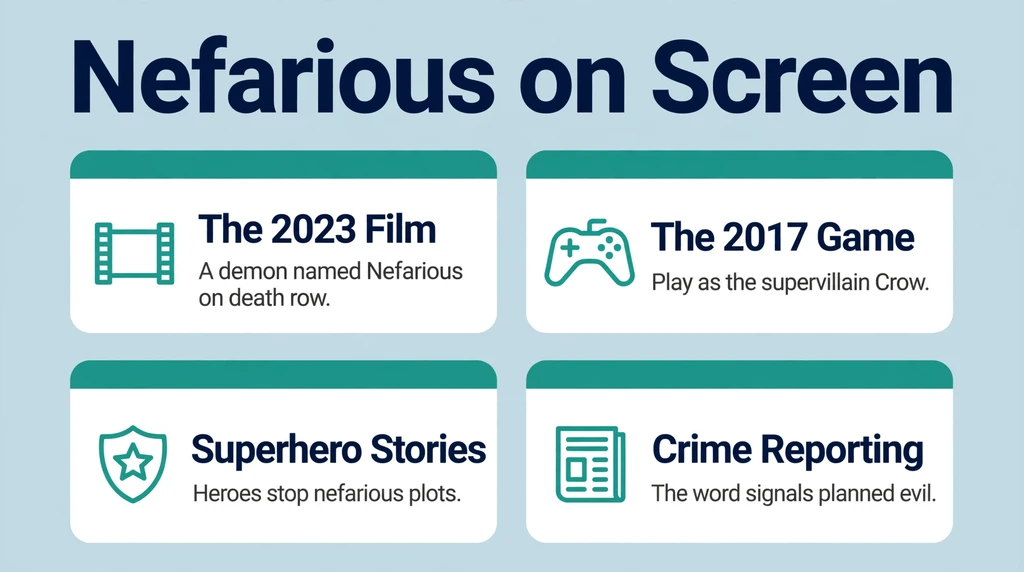
Fiction writers reach for nefarious when they describe plots hatched by villains. The word suits castles, boardrooms, and secret lairs equally well. Dictionary.com captures the association in its own usage note, observing that Batman and Superman are always busy stopping the nefarious plots of evildoers. Superhero stories, spy novels, and fantasy sagas all lean on that same energy.
News writing borrows the flavour too. Crime reporters know that “nefarious” lifts a story above the ordinary run of offences. It signals to readers that the case involves planning, networks, and intent, not a moment of madness. So the word shuttles between fiction and fact, and it keeps its theatrical spark in both worlds.
A Film That Took the Name
In 2023 the word became a character outright. *Nefarious*, an American independent horror-thriller written and directed by Cary Solomon and Chuck Konzelman, is based on Steve Deace’s 2016 novel *A Nefarious Plot*. In the film, Sean Patrick Flanery plays a convicted killer on death row who claims that a demon possesses him. Jordan Belfi plays the psychiatrist sent to judge whether that claim is real. The demon itself goes by the name Nefarious, which tells you everything about how the word sounds to modern ears: ancient, intelligent, and evil.
A Game That Lets You Be the Villain
Gamers met the word from the other side of the controller. *Nefarious*, a 2017 action platform game developed by StarBlade, casts the player as Crow, a supervillain who kidnaps princesses to power his doomsday device. The game flips the usual script by letting players act as the boss in fights against heroes. Choosing “nefarious” as the title was a promise: this time, you get to be the bad guy.
Together, the film and the game show the word’s modern range. It can name a literal demon in a deadly serious thriller. It can also headline a playful cartoon about a cheerful supervillain. Few adjectives cover that much ground while keeping one clear meaning.
Synonyms and Antonyms of Nefarious
A rich vocabulary lets you fine-tune any accusation. The lists below gather the closest matches for nefarious and its clearest opposites. Short glosses follow the main entries, so you can feel the differences instead of treating the words as interchangeable.
Closest Synonyms
Merriam-Webster’s own list for nefarious includes evil, wicked, sinful, immoral, unlawful, vicious, vile, and villainous. Each one leans in a slightly different direction:
- Wicked: the general, all-purpose word for morally bad behaviour.
- Villainous: evil in the manner of a villain; see the comparison above.
- Iniquitous: grossly unfair, sinful, and morally corrupt; very formal.
- Vicious: given to vice and cruelty; also used for brutal attacks.
- Vile: disgustingly low and worthless; strong disgust built in.
- Depraved: morally corrupted, often describing character itself.
- Diabolical: devilish, or fiendishly clever, in its evil.
- Malevolent: actively wishing harm on others; intent-focused.
Reach for nefarious itself when planning and scheming are part of the picture. Reach for the others when horror, disgust, or general wickedness matters more.
Clear Antonyms
The opposite shelf is just as useful. WordNet gives virtuous as the direct antonym of nefarious. Standard thesaurus lists add honorable, righteous, moral, upright, honest, innocent, just, and lawful. These words describe people and actions that respect rules and deserve trust.
The contrast is instructive. Nefarious behaviour breaks divine and human law in secret pursuit of gain. Virtuous behaviour honours those same standards openly. Placing the two families side by side gives essay writers a clean moral axis: on one side, the nefarious scheme; on the other, the virtuous response that exposes it.
Common Mistakes and Confusions
Even advanced speakers trip over this word in predictable ways. The good news is that each trap is easy to escape once you can see it. The four mistakes below cover nearly every error teachers and editors report with nefarious.
Mistake 1: Swapping It With Notorious
This is the champion error, covered in detail in the comparison section above. Remember the fame test. Secret wrongdoing can be nefarious but never notorious. Widely discussed behaviour is notorious, whether or not it is deeply evil. When in doubt, ask whether you are talking about reputation or about rottenness, then pick the matching word.
Mistake 2: Using It for Mild Annoyances
Inflation ruins strong words. A delayed train, a dripping tap, or a colleague who microwaves fish at lunch may be annoying, inconsiderate, or unfair. None of them is nefarious. Save the word for deliberate, serious wrongdoing, and it will keep its thunder. Spend it on trivia, and readers will stop taking your accusations seriously.
Mistake 3: Thinking It Means “Secret”
Because nefarious plots often unfold in secret, learners sometimes treat secrecy as part of the definition. It is not. Secrecy is a common companion of nefarious behaviour, not its meaning. A dictator’s openly announced campaign of persecution can be nefarious in broad daylight. The definition is about wickedness, not concealment.
Mistake 4: Mispronouncing or Misspelling It
Two small slips are everywhere. In speech, people sometimes rush the middle and say “nef-uh-REE-us,” misplacing the stress. The stress belongs on the second syllable: nih-FAIR-ee-us. In writing, the common slip is dropping a letter, producing “nefarous.” The correct spelling keeps the full Latin shape: n-e-f-a-r-i-o-u-s. Slow down on both fronts and the word behaves.
Frequently Asked Questions
What does nefarious mean in simple words?
In simple words, nefarious means extremely wicked or evil. It describes actions, plans, or people that are deliberately and seriously wrong, often criminal. If something is nefarious, it is not just bad. It is bad on purpose, and usually planned.
How do you pronounce nefarious?
Say it as nih-FAIR-ee-us, with the stress on the second syllable. The word has four syllables: ne-far-i-ous. American speakers say /nəˈfer.i.əs/, and British speakers say /nəˈfeə.ri.əs/, but the rhythm is identical in both accents.
Is nefarious the same as notorious?
No. Nefarious describes how wicked something is, while notorious describes how famous something is for a bad reason. A secret plot can be nefarious without being notorious. A much-discussed scandal is notorious, whether or not it reaches the deepest level of evil.
Can a person be nefarious, or only actions?
Both work. The word attaches most naturally to actions and plans, such as nefarious activities or a nefarious scheme. However, English also allows a nefarious person, character, or organisation, meaning someone whose behaviour and reputation are thoroughly wicked. Dictionaries support both uses.
Where does the word nefarious come from?
It comes from the Latin word *nefarius*, meaning wicked or impious. That word grew from *nefas*, a crime or offence against divine law, built from *ne-*, meaning “not,” and *fas*, meaning right or divine law. Merriam-Webster records its first known use in English in 1567.
Is nefarious a formal word?
Yes. Nefarious belongs to formal and written English. It appears most often in journalism, official statements, legal writing, and fiction. In casual conversation it usually sounds playful or mock-serious, which speakers sometimes use deliberately for comic effect.
What is the opposite of nefarious?
The direct opposite is virtuous. Other clear antonyms include honorable, righteous, moral, upright, honest, innocent, and lawful. These words describe people and actions that respect moral rules and deserve trust, the exact reverse of everything nefarious stands for.
Does nefarious appear in movies or games?
Yes, and the examples suit the word perfectly. The 2023 horror-thriller *Nefarious* gives the name to a demon possessing a death-row inmate. The 2017 video game *Nefarious* lets players control a supervillain named Crow. In both titles, the word promises an encounter with deliberate evil.
Final Thoughts
Nefarious earns its place in English by doing a job no shorter word can do. It condemns deliberate, organised wickedness, and it carries the echo of ancient law inside it. A nefarious act is not a slip, a lapse, or a misunderstanding. It is a choice to break the rules that hold communities together, usually in secret and usually for gain.
So use the word with the respect its weight deserves. Aim it at schemes, corruption, and genuine villainy, and keep it away from life’s small irritations. Pronounce it nih-FAIR-ee-us, pair it with activities, purposes, and plots, and never confuse it with its famous cousin notorious. If you want to explore the word further, the Merriam-Webster entry for nefarious offers more examples and a fuller word history. Master this one adjective, and your judgements, in essays and in conversation, will land with real precision.