You are telling a story at dinner. Halfway through, someone stops you to correct one small word you used. The story dies, and the table suddenly goes quiet. That correction, and the urge behind it, is exactly what the word pedantic describes.
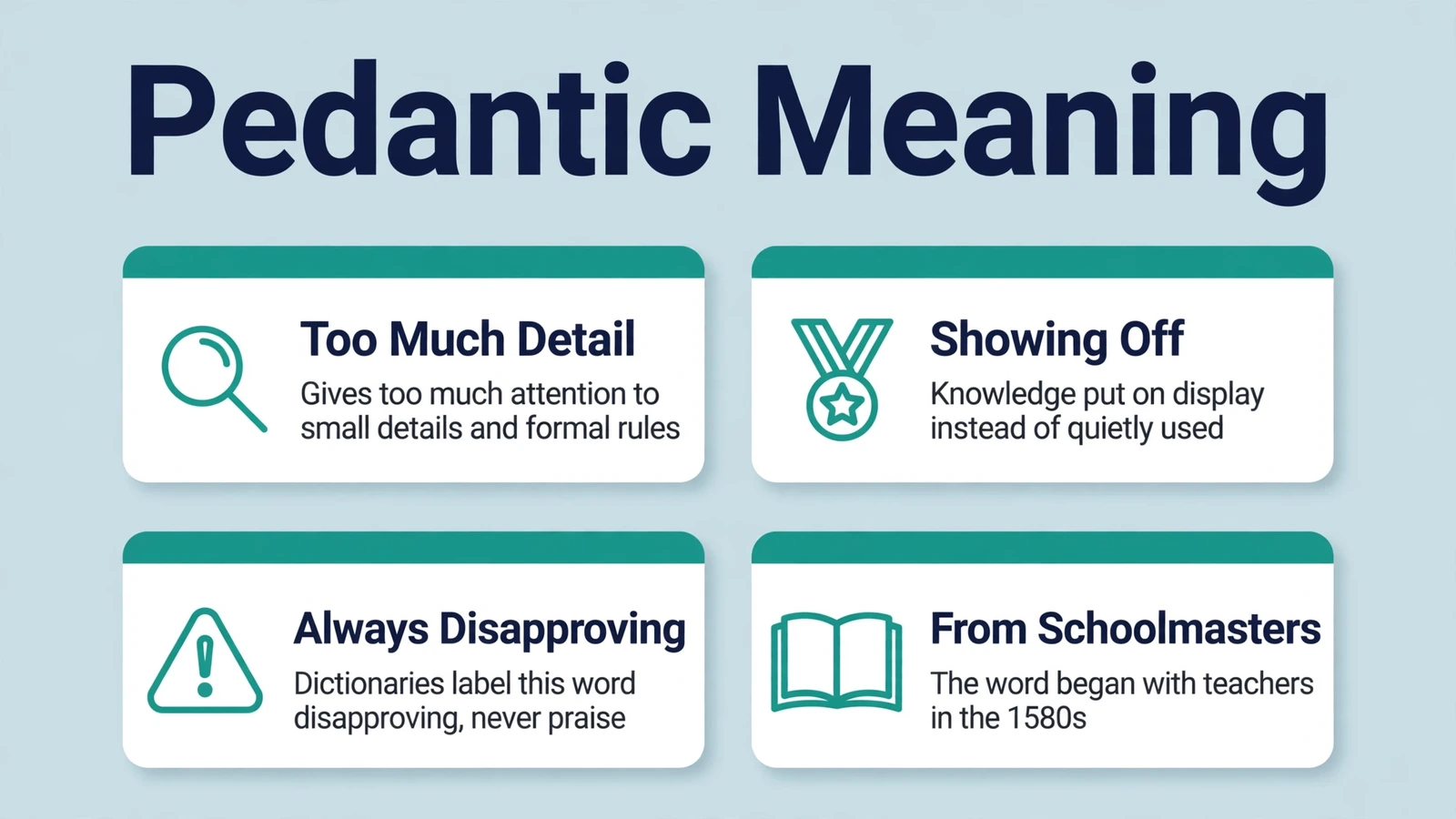
Pedantic is an adjective for giving too much attention to formal rules and small details, often while showing off how much you know. A pedantic person corrects tiny errors, insists on exact wording, and cares more about being precisely right than about the bigger point. Dictionaries mark the word as disapproving, so calling someone pedantic is a criticism, not a compliment.
This guide explains the pedantic meaning in plain English, step by step. You will find the origin of the word, its word family, clear examples, and close synonyms. You will also learn when the label is fair, when it is unfair, and how people use the word today in reviews, group chats and online debates.
What Does Pedantic Mean?
The dictionary definition
Cambridge defines pedantic as giving too much attention to formal rules or small details. Merriam-Webster adds a second layer to that idea. In its second sense, the word means narrowly, stodgily, and often ostentatiously scholarly. In other words, the learning is not just narrow; it is also put on display.
Merriam-Webster also lists a third sense: unimaginative and dull. So a pedantic lecture is not merely strict about facts. It is strict in a way that drains the life out of the subject. Oxford dictionaries give a similar core meaning: excessively concerned with minor details or rules.
The meaning in plain English
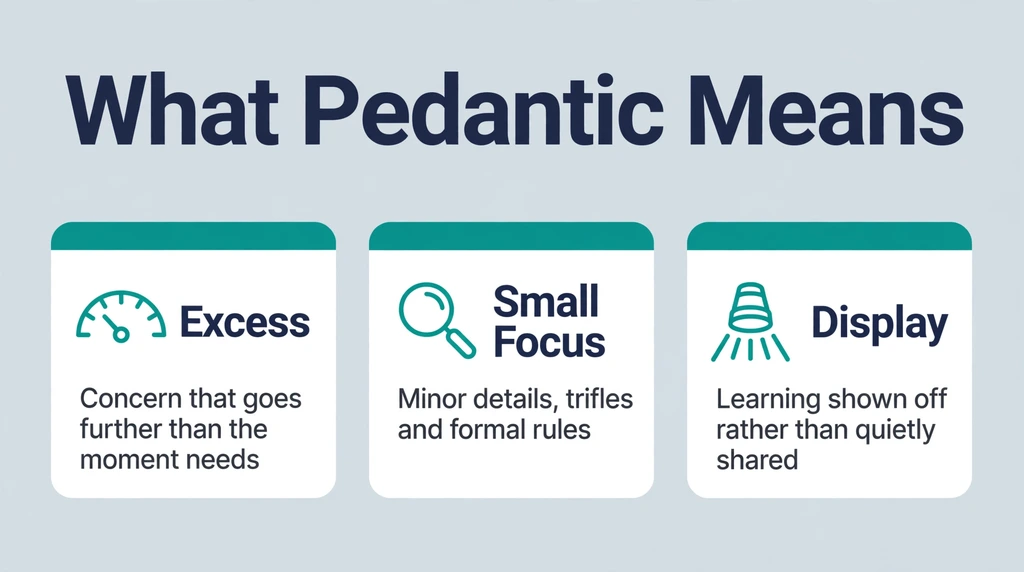
Three ingredients appear in almost every definition. First, there is excess, because the concern goes further than the situation needs. Second, the focus is small, landing on minor details, trifles, and formal rules. Third, there is display, since the knowledge is shown off rather than quietly used.
Remove any one ingredient and the word stops fitting. A surgeon who checks every small detail is careful, not pedantic, because the details truly matter. A teacher who shares a fascinating fact is generous, not pedantic, because nothing is being forced. Pedantic begins where the detail matters less than the correction itself.
What the word can describe
People use pedantic for more than people. It can describe a remark, a comment, a rule, or a whole style of writing. A pedantic footnote corrects something nobody questioned. A pedantic dress code argues about shades of color instead of the event itself.
The word is pronounced puh-DAN-tik, with the stress on the middle syllable. It works as an adjective, so it sits before a noun or after a verb like “sounds” or “seems”. For example, a review might call a textbook pedantic, while a friend might say a comment sounded pedantic.
The three senses, side by side
It helps to see the dictionary senses as three flavors of one complaint. The first flavor targets behavior: correcting, fussing, and insisting on minor points. Next comes scholarship: learning that is narrow, stodgy, and proudly on show. The third targets effect: writing or teaching so dry that it becomes dull.
Real uses usually blend all three flavors at once. A pedantic comment corrects a detail, shows off knowledge, and bores the room in a single move. That blend is why the word feels so complete as an insult. It judges the act, the motive, and the result together.
The most common scene: grammar
If one scene defines the word today, it is the grammar correction. Somebody writes “me and him went” in a message, and a pedantic reply fixes the word order instead of answering. The same reflex appears under posts about split infinitives, double negatives, or using “literally” for emphasis. Each topic has a long, settled history of debate among linguists.
Notice what makes the correction pedantic in these scenes. The message was clear, the setting was casual, and the fix changed nothing. The corrector treated a chat like an exam paper. Swap the setting to a contract, a thesis, or a published book, and the same sharp eye becomes simple professionalism.
Where Pedantic Comes From
A word that began with schoolmasters
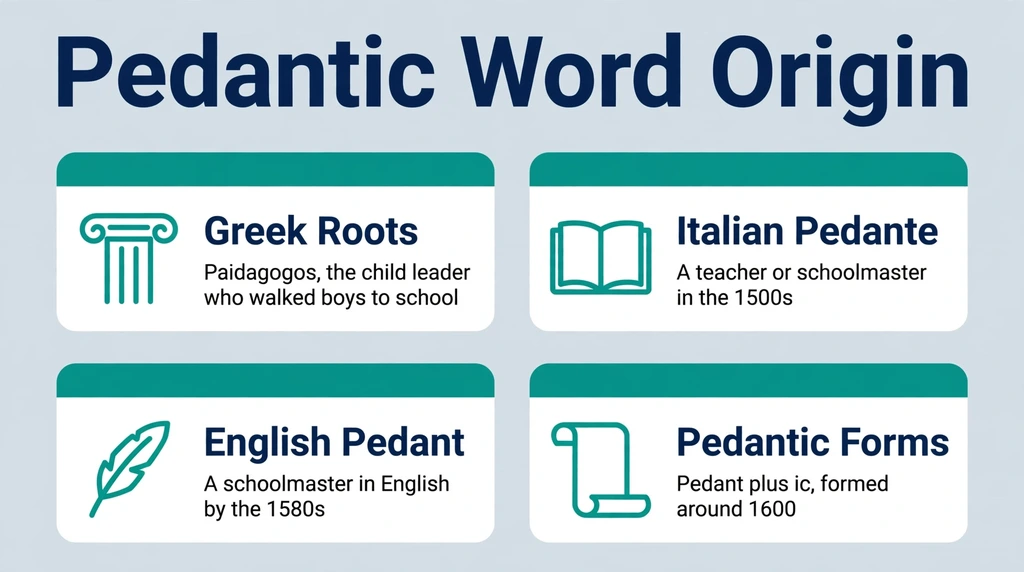
The story starts with the noun pedant. It entered English in the 1580s, and at first it simply meant a schoolmaster. The word came from French pédant or directly from Italian pedante, which literally meant a teacher or schoolmaster. Behind those words sits a Latin form, paedagogantem, linked to the verb paedagogare, to teach.
That Latin line leads back to Greek. A paidagogos was originally a slave who walked boys to school and supervised them. The Greek word joins pais, meaning child, with agogos, meaning leader. Over time, paidagogos came to mean a teacher or trainer. Nothing in this early history is insulting.
How the meaning slid downhill
The slide began quickly. By the 1590s, pedant had picked up a sharper sense. It now described a person who trumpets minor points of learning. Such a person overrates book knowledge and stresses exact details over large matters and general principles. The schoolmaster had become a stock figure of fun.
Pedantic was formed in English from pedant plus the suffix -ic, around the year 1600. Collins dates the formation to between 1590 and 1600, while Merriam-Webster gives 1628 as the first known use. The adjective kept the new, critical flavor of the noun. It described an undue or inappropriate display of learning.
Etymologists think the word may appear early in John Donne’s poem “The Sun Rising”. The speaker scolds the sun as a “sawcy pedantique wretch” and sends it off to chide late schoolboys instead. The attribution is marked as uncertain, yet the scene fits the word perfectly: a busybody authority, scolding people over small things.
A false trail to avoid
One claim online says pedantic comes from a Latin word about feet. That story is false, and no major dictionary supports it. The real path runs through teachers, not toes. It goes from Greek child-leaders to Latin teaching, then to Italian and French schoolmasters, and finally into English.
Merriam-Webster sums up the whole journey neatly. Pedant once denoted simply a tutor, but now it tends to mean one who makes a show of knowledge. Pedantic once related to teaching, but now it more often means unimaginative or dull. The classroom stayed in the word; the respect did not.
Spelling causes a second confusion. Pedant sounds close to pendant, the hanging jewel, and the two words are sometimes mixed up in writing. They are not related at all. Watch the middle letters: pedant has an “a” after “ped”, and pedantic keeps that “a” in every form.
The cousins that stayed at home
The family never really left Europe’s classrooms. French still uses pédant for a schoolmasterly know-it-all, and French also has the adjective pédantesque. Italian keeps pedante, and Spanish has the matching pedante. In each language, the word carries the same raised eyebrow.
English speakers borrowed the word and sharpened it further. Where the older languages kept a link to teaching, English pushed pedantic toward pure criticism. Today, an English speaker can call a sentence pedantic without picturing a teacher at all. The schoolroom survives only as a faint smell of chalk.
Pedant, Pedantic and Pedantry: The Word Family
Pedant: the person
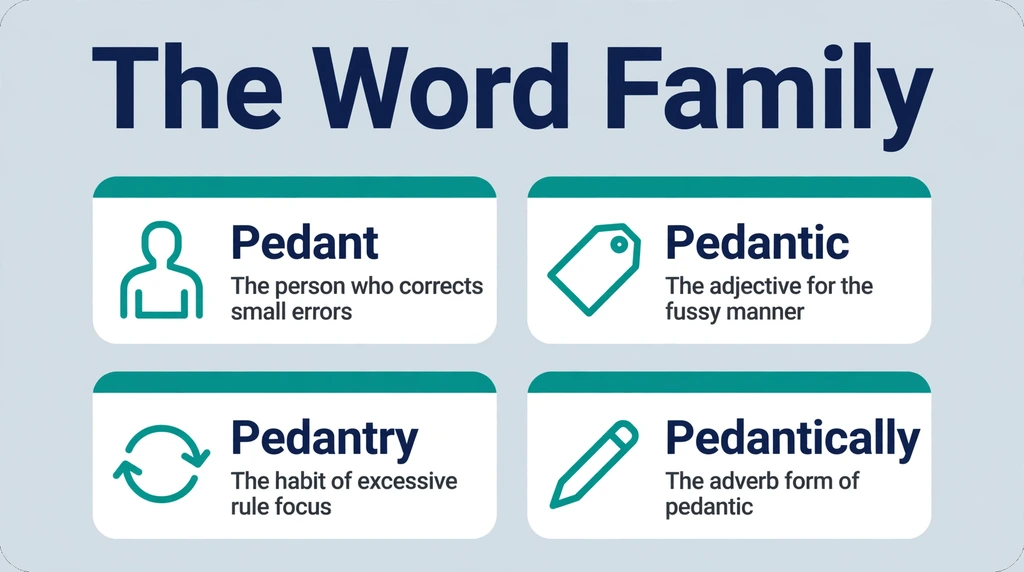
Pedant is the noun, and it names the person. Cambridge defines a pedant as someone too interested in formal rules and small unimportant details. Merriam-Webster’s thesaurus is blunter: a pedant annoys other people by correcting small errors. Its example describes a professor more concerned with punctuation than with the craft of writing.
You call the person a pedant and the behavior pedantic. So the noun pins the label on someone’s character. The adjective, by contrast, can target a single moment. That difference matters, because “that was a pedantic comment” is softer than “you are a pedant”.
Pedantry: the habit or act
Pedantry is the noun for the behavior itself. It means an excessive concern with formalism, minor details, and rules that are not important. A single act of pedantry might be one needless correction. A habit of pedantry is the pattern behind many such corrections.
Writers often use pedantry when they judge a style rather than a person. A report can be full of pedantry even if its author is pleasant in person. The word lets you criticize the performance without attacking the performer. That makes it useful in reviews and feedback.
Pedantically and the older cousins
Pedantically is the adverb, as in “he pedantically corrected every date in the draft”. An older adjective, pedantical, was once common but is now obsolete. Collins lists it only as a historical form. Modern English has settled firmly on pedantic.
The family also includes a cousin, pedagogue. A pedagogue is a teacher, especially a strict or old-fashioned one. It comes from the same Greek paidagogos. Dictionaries note that pedagogue can be neutral, yet it usually hints at a dull or pedantic teacher. The whole family tree, it seems, leans toward the schoolroom and its sternest habits.
How the forms work in a sentence
Each form has its favorite patterns. Pedant follows words like “a”, “such a”, or “a bit of a”: “He is a bit of a pedant about wine labels.” Pedantic loves the phrase “pedantic about”, as in “She is pedantic about margins and fonts”. It also pairs with “attention”: a pedantic attention to detail.
Pedantry often appears after “full of”, “a touch of”, or “mere”: “The review dismissed the book as mere pedantry.” Pedantically, the adverb, usually sits before a verb: “He pedantically listed every exception.” Learning these patterns makes the whole family easy to use without forcing it.
What a Pedantic Person Actually Does
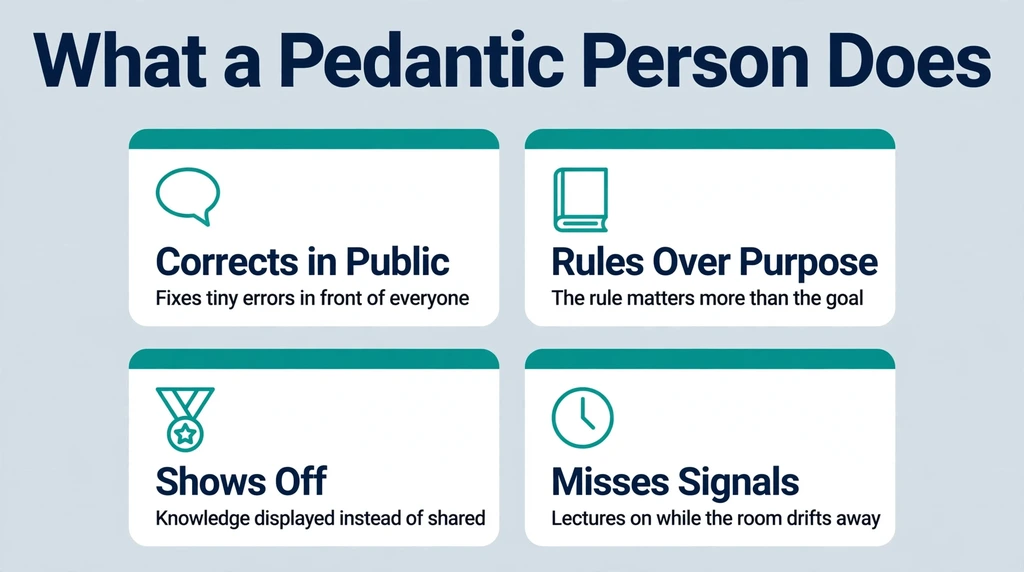
They correct small errors in public
The classic pedantic move is the public correction of something tiny. A colleague says “less people” in a meeting, and the pedant stops the discussion to explain “fewer”. The grammar point may even be right. However, the timing turns a small fix into a small humiliation.
Online, this habit has no off switch. A pedantic reply answers a heartfelt post by fixing one apostrophe. The correction is accurate, and yet it misses everything the post was about. Accuracy was never the real problem; proportion was.
They put rules above purpose
Rules exist to serve a purpose, and most people bend them when the purpose demands it. A pedantic person reverses that order. The rule becomes the purpose. So a form gets rejected because a box was filled in blue ink instead of black, although the information is perfectly clear.
In writing, this shows up as worship of guidelines over readers. A pedantic editor enforces every style rule but never asks whether the paragraph makes sense. The document ends up flawless and unreadable. Meanwhile, the actual goal, communication, quietly fails in the background.
They display knowledge instead of sharing it
Helpful experts answer the question you asked. Pedantic experts answer three questions you did not ask, then add a footnote. The goal is not your understanding. The goal is the visible display of their learning. Merriam-Webster calls this side of the word ostentatious, and it is the side people resent most.
You can hear the difference in tone. A helpful correction sounds light and quick, almost an aside. A pedantic one arrives with ceremony, complete with Latin names and a brief history of the rule. The extra ceremony is the tell. It exists for the audience, not for you.
They miss the social signal
Conversations run on signals: a glance, a yawn, a polite “anyway”. Most people read those signals and wrap up. A pedantic speaker often does not. They continue the lecture while the room mentally leaves. This is why the word pairs so often with dull in dictionary definitions.
Importantly, the issue is not intelligence. Many pedantic people are genuinely knowledgeable, and their facts are usually sound. The problem is calibration. They bring a microscope to a situation that called for a map, and they cannot see why nobody thanks them.
Why people slip into pedantry
Habits explain much of it. Professions train people to hunt errors, and the hunting continues after hours. An editor corrects menus; a lawyer argues with game rules. The skill is real, but the setting is wrong, so the skill reads as pedantry.
Love of a subject plays a part too. Deep knowledge itches to be shared, and sharing can outrun the listener’s interest. Status adds the final ingredient. Correcting someone is a quick way to feel clever in public. When knowledge, habit, and status combine, pedantic behavior follows almost automatically.
The pedantic email, the pedantic reply
Modern pedantry often arrives in writing, where tone is easy to misjudge. The pedantic email quotes your own sentence back at you, corrects one term, and answers nothing else. The pedantic reply in a thread does the same in public, where the audience doubles the sting. Both feel colder than the spoken version, because the correction sits on the screen, permanent and screenshot-ready.
Written pedantry also loves formatting. Numbered objections, quoted fragments, and a closing line of Latin all signal ceremony over content. If a reply needs that much staging, its real subject is usually the writer. The point itself could have fit in one friendly line.
Pedantic Synonyms and Words Often Confused With It
Close synonyms with a critical edge
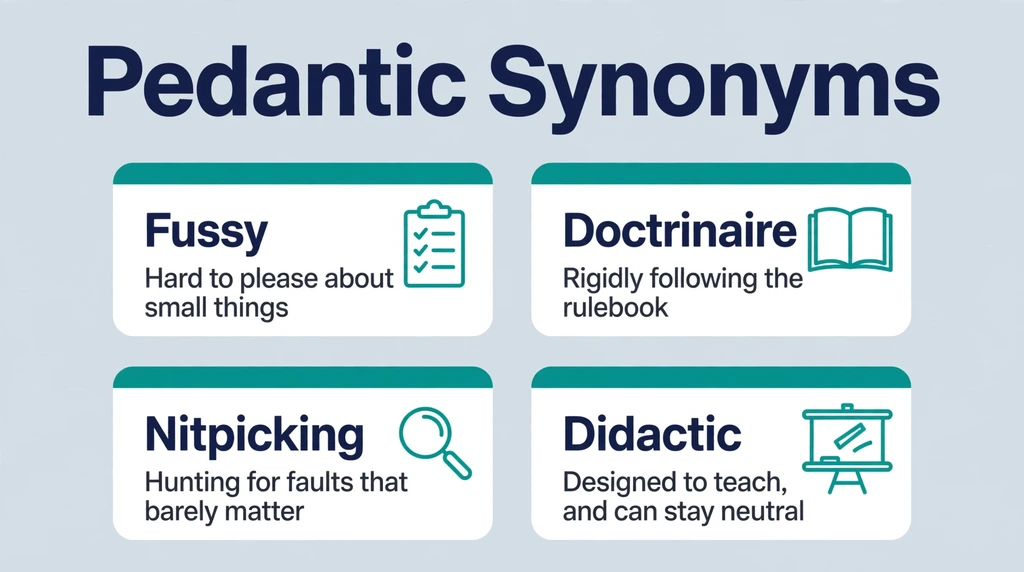
Several synonyms carry the same disapproving flavor. Fussy describes someone hard to please about small things, and it fits pedantic behavior in everyday settings. Nitpicking names the act of finding tiny faults, while a nit-picky person hunts for errors that barely matter. Both words feel informal and slightly mocking.
Doctrinaire is a heavier synonym. Collins lists it beside didactic for pedantic’s scholarly sense. A doctrinaire person follows a doctrine or rulebook rigidly, refusing to bend for real life. Schoolmasterly and stilted also appear in Collins’ synonym list. Schoolmasterly suggests a lecturing manner, and stilted describes language that sounds stiff and unnatural.
Hairsplitting belongs to the same family of complaints. A hairsplitter draws distinctions too fine to be useful, especially in arguments. Pompous, another Collins synonym, adds arrogance to the picture. A pompous speaker does not just correct you; they clearly enjoy ranking above you.
Purist and perfectionist: relatives, not twins
Merriam-Webster’s thesaurus lists purist among the synonyms of pedant. A purist insists that something stay true to its original form or rules. Language purists fight new slang, and food purists reject fusion recipes. The overlap with pedant is real, because both guard the rules. Still, a purist guards a standard, while a pedant often guards the spotlight.
Perfectionist is another near relative, and the difference is direction. Perfectionism usually aims inward, at your own work and your own results. Pedantry usually aims outward, at other people’s errors. A perfectionist rewrites their own sentence ten times. A pedant rewrites yours, in public, with commentary.
Stickler: the everyday cousin
Stickler is the word people reach for in daily life. A stickler for punctuality, spelling, or table manners insists on one standard and enforces it firmly. The tone can be fond or annoyed, depending on the speaker. Unlike pedant, stickler often stays inside one narrow territory.
The contrast is instructive. A stickler guards a single gate; a pedant patrols the whole city. A stickler’s rule is usually clear and consistent, while pedantic corrections wander wherever a mistake appears. If someone is strict about exactly one thing, stickler is probably the fairer word. Save pedantic for the full performance: the roaming corrections, the ceremony, and the display.
Words often confused with pedantic
Didactic causes the most confusion. Merriam-Webster explains that didactic generally means designed to teach. It can be neutral, although it sometimes sounds preachy. Pedantic, in contrast, is almost always an insult. A didactic poster teaches you something. A pedantic one teaches you something and makes you feel small.
Meticulous and precise also sit nearby, but they are compliments. A meticulous accountant and a precise engineer protect people from real harm. Nothing in those words implies showing off. If you swap pedantic into their place, you accuse the person of caring about the wrong details. That swap changes praise into criticism, so choose carefully.
Academic appears in synonym lists too, yet context decides its tone. In a job title, academic is neutral and respectful. In a complaint like “that is just academic”, it means detached from real life. Pedantic never enjoys that neutral safe zone. Wherever it lands, it lands as a judgment.
At the opposite end of the scale
Words at the opposite pole help fix the meaning by contrast. Easygoing, flexible, and broad-minded describe people who let small things pass. Big-picture thinkers forgive minor errors because their eyes stay on the outcome. None of these words praises sloppiness; they praise proportion.
Careless and sloppy sit at the far extreme, and they are insults too. English thus criticizes both directions: too little care and too much display of it. Pedantic occupies one ditch beside the road. The road itself is called judgment, and the word exists to keep us on it.
Pedantic in Sentences: Examples From Real Life
About people and remarks
Reading examples is the fastest way to feel the word’s tone. Notice how each sentence below criticizes a manner, not a fact. The facts inside them could all be true.
- “Do not be pedantic about it; everyone understood what she meant.”
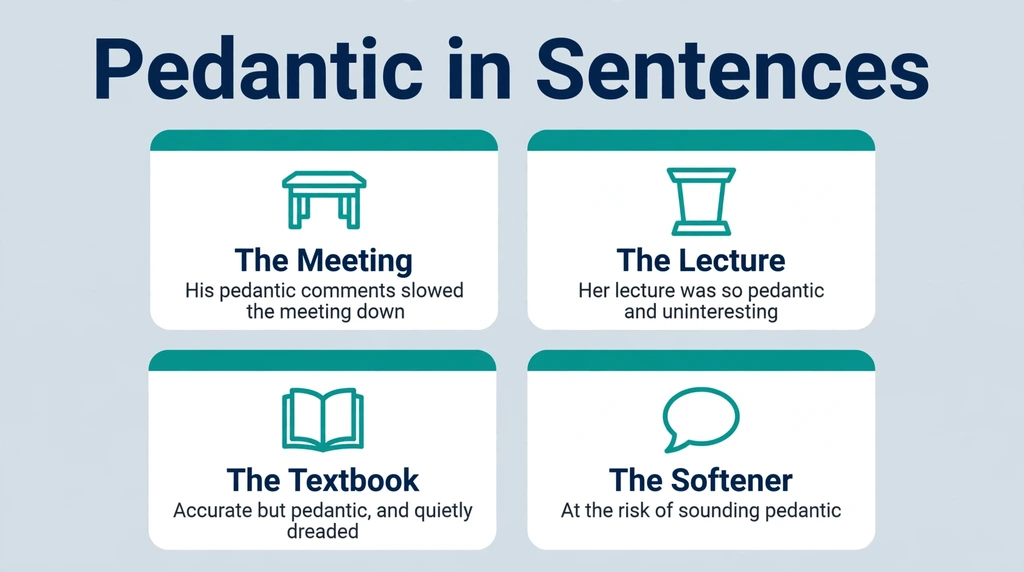
- “His pedantic comments slowed the meeting to a crawl.”
- “She rolled her eyes at his pedantic correction of her pronunciation.”
- “It felt pedantic to argue about a comma while the deadline burned.”
- “The new manager is brilliant but hopelessly pedantic about file names.”
Each example turns on proportion. The correction, rule, or detail is smaller than the moment it interrupts. That imbalance is the engine of the word.
About writing, teaching and work
The word appears often in judgments of style. Reviewers use it when learning gets in the way of reading. Teachers hear it when accuracy crowds out curiosity.
- “The textbook is accurate but pedantic, and students quietly dread it.”
- “Her lecture was so pedantic and uninteresting that half the hall drifted out.”
- “The report reads like a pedantic rulebook instead of practical advice.”
- “He writes in a pedantic style, heavy with jargon and light on meaning.”
- “The training video turned a simple task into a pedantic ceremony.”
Collins uses a very similar lecture example in its own entry. The pattern is stable across dictionaries: pedantic teaching buries the student in detail. Good teaching, by contrast, selects the few details that illuminate the rest.
Light, playful and self-aware uses
Not every use is a knife. Friends tease each other with the word when the stakes are tiny. Someone who insists the movie quote was “slightly” different might get a laughing “okay, pedant”. The insult softens into a badge inside the joke.
People also aim the word at themselves. “At the risk of sounding pedantic” is a common softener before a small correction. It signals awareness: the speaker knows the detail is minor but believes it matters here. Used this way, the word works as a tiny apology in advance. It can rescue a useful correction from sounding like a lecture.
The pattern behind the examples
Read the examples again and one pattern keeps surfacing. Somebody interrupts, corrects, or insists, and the thing at stake is tiny. The audience in each scene understands the message perfectly well without the fix. That is why the word stings: it says the correction served the corrector, not the conversation.
Notice, too, how rarely the examples argue about facts. Nobody in them says the correction was wrong. Pedantic almost never means mistaken. It means right in the wrong way, at the wrong moment, for the wrong reason. Keep that pattern in mind, and you will spot the word’s natural home everywhere.
How Pedantic Is Used Today
In reviews of books, films and courses
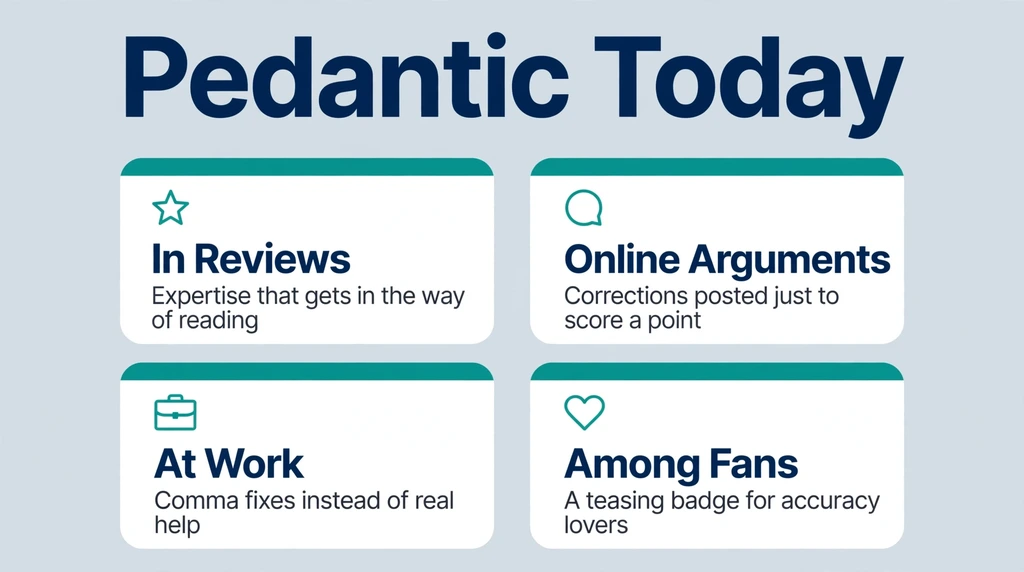
Modern reviewers reach for pedantic when expertise becomes a burden. A history book can be praised as thorough or damned as pedantic, sometimes by the same reviewer. The difference lies in selection. Thorough work chooses details that build the story. Pedantic work includes details because the author knows them.
Film and television criticism uses the word the same way. A drama that stops to explain its own world too carefully earns the label. So does a documentary that lectures instead of showing. In course reviews, students use pedantic for instructors who grade the format harder than the ideas. The complaint is never “too correct”. It is always “correct about the wrong things”.
Star ratings tell the same story in miniature. A three-star review often praises a book’s accuracy, then faults its pedantic tone. Readers are not rejecting the facts; they are rejecting the delivery. Authors who survive this filter share one habit. They treat detail as a servant of the story, never as the story itself.
In online arguments
The internet has given pedantry a stadium. Under every viral post sits a correction about a date, a spelling, or a technical term. Sometimes the correction genuinely matters, and the crowd applauds it. Often, though, it exists only to score a point. Readers sense the motive instantly, and pedantic is the word they fire back.
The word also works as a shield. When an argument goes badly, calling the other side pedantic can end the debate without answering it. That move is common and a little dishonest. It reframes precision itself as bad manners. Wise readers check the detail first: if the correction changes the conclusion, it was not pedantry at all.
At work and in group chats
In offices, pedantic usually surfaces around documents and process. It describes the reviewer who returns a proposal covered in comma fixes but silent on the budget. It also describes meetings where wording debates eat the hour meant for decisions. Teams rarely object to accuracy. They object to accuracy that arrives instead of help.
Group chats have their own version. One member always corrects the joke, the meme, or the casual exaggeration. Everyone else learns to post less. Nothing about the corrections is false, yet the chat gets quieter and colder. That social cost is precisely what the word pedantic has measured for four centuries.
The affectionate turn
Lately, the word has picked up a warmer side in fan and hobby cultures. Magazines now address their most exacting readers with a wink. WIRED, for instance, opened a technical note with “for the pedants out there (WIRED salutes you)”. The pedants, in that line, are the beloved guardians of accuracy.
Communities built on lore, language, or collectibles often feel the same affection. Inside the group, precision is a love language, not a lecture. The label still teases, but it also thanks. Context, once again, decides whether pedantic lands as an insult, a joke, or a small medal.
Pedantic or Just Detail-Oriented?
The big misconception
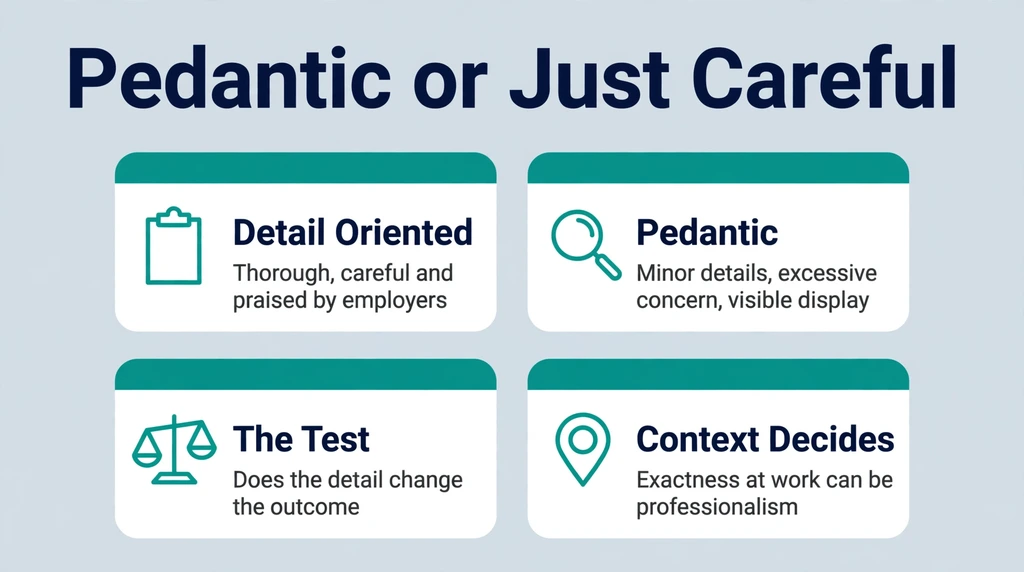
The most common misconception is that pedantic simply means detail-oriented. It does not. Detail-oriented is a compliment about thoroughness, and employers ask for it in job adverts. Pedantic adds three extra charges: the details are minor, the concern is excessive, and the display matters more than the result.
Think of it as a recipe. Carefulness is the base ingredient in both dishes. Pedantry adds a spoonful of showing off and a pinch of bad timing. Without those extras, you only have a careful person. Calling that person pedantic is not precision; it is an unfair label.
Three questions that reveal the difference
When you are unsure, ask three quick questions. First, does the detail change the outcome? A wrong dosage on a label matters; a wrong apostrophe in a chat does not. Second, who benefits from the correction? If the answer is mainly the corrector’s image, pedantry is near.
Third, how was it delivered? A quiet word respects the listener, while a public performance does not. If a correction fails all three tests, the pedantic label probably fits. If it passes even one clearly, think twice before using the word. Fairness matters, because the label itself can become a lazy insult.
When correcting is the right call
Some settings run on exactness. Contracts, safety checks, medical notes, and code all punish small errors. In those places, insisting on details is professionalism, not pedantry. The same habit changes meaning with context. A copyeditor who flags a comma at work is doing a job; doing it to a friend’s birthday card is doing a performance.
Context also explains why the word stings. It tells the listener that their knowledge, however real, was used badly. That is a social verdict, not an intellectual one. Understanding this keeps the word sharp and fair. Use it for manner, not for intelligence, and it will keep its meaning.
If someone calls you pedantic
Treat the label as feedback about delivery, not about your brain. Run the three questions from earlier: did the detail matter, who benefited, and how did you say it? If the honest answers embarrass you, the fix is simple. Save corrections for moments when they change something.
You can also soften the habit without dulling your standards. Ask before correcting: “Want the nerdy detail?” Offer the fix once, briefly, and let it go. People forgive almost any correction delivered with lightness. What they remember, and resent, is the lecture that would not end.
Frequently Asked Questions
What does pedantic mean in simple words?
It means caring far too much about small details and formal rules. A pedantic person corrects tiny mistakes and shows off their knowledge. The word is a criticism, not a compliment. If a friend says “less people” and you stop the chat to lecture on “fewer”, that moment is pedantic.
Is pedantic an insult?
Yes, almost always. Merriam-Webster calls it an insulting word for someone who annoys others by correcting small errors. It can be playful between friends, but its dictionary label is disapproving.
What is a pedant?
A pedant is the person: someone too interested in formal rules and small, unimportant details. Pedantic is the adjective, pedantry is the behavior, and pedant is the person who does it.
What does pedantry mean?
Pedantry is the behavior itself: an excessive concern with formalism, minor details, and rules that are not important. One needless correction is an act of pedantry. A steady habit of such corrections is pedantry as a character trait.
What is the difference between pedantic and didactic?
Didactic means designed to teach, and it can be neutral. Pedantic means teaching in a showy, fussy, narrow way. Merriam-Webster notes that pedantic is almost always negative, while didactic is not.
What is another word for pedantic?
Close words include fussy, nitpicking, doctrinaire, schoolmasterly, and stilted. Purist and perfectionist are relatives with different shades of meaning. Each synonym removes or adds a small charge, so match the word to the behavior. For pure fault-finding, nitpicking is the sharpest fit.
How do you pronounce pedantic?
Say puh-DAN-tik, with the stress on the middle syllable. It has three syllables and rhymes with “frantic” said slowly. The related noun pedant is pronounced PED-ant.
Can pedantic ever be a good thing?
Dictionaries do not give it a positive sense. Still, the habits beneath it, accuracy and rule knowledge, are valuable in the right setting. The word itself, though, always carries disapproval, even when people use it jokingly about themselves. So enjoy being exact, and just watch how the exactness lands on other people.
Final Thoughts
Pedantic describes a manner, not a mind. It means giving too much attention to formal rules and small details, usually with a touch of showing off. Its history runs from Greek child-leaders to Italian schoolmasters, and its tone slid from respect to ridicule within a few decades. Used fairly, it is a precise little warning: the detail has eaten the point. If you want the dictionary’s own wording and example sentences, the Merriam-Webster entry for pedantic is the place to check. Keep your own knowledge generous, your corrections rare, and your timing kind. And the next time someone stops your story to fix one small word, you will have exactly the right word for them.