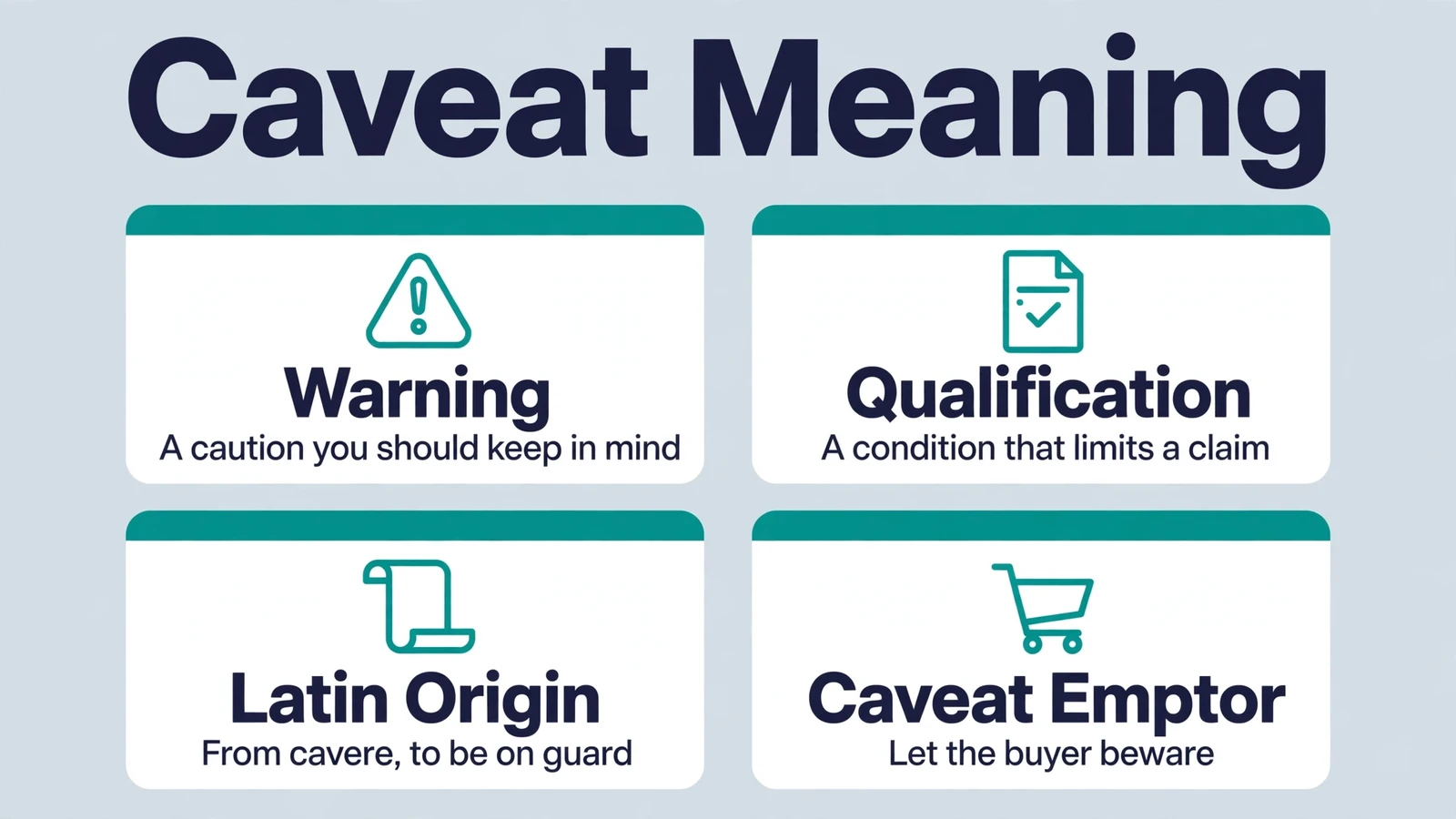
Someone agrees with your plan, then adds four small words: “with one caveat.” The mood changes at once. Something good just came with a condition attached.
A caveat is a warning or qualification added to a statement, an offer, or a claim. It tells you the part you should not ignore. The deal still stands, but only within limits.
The word looks formal, yet people use it every day. You will hear it in business meetings, news reports, science stories, and legal documents. It also hides inside the famous Latin phrase caveat emptor.
This guide explains the caveat meaning in plain English. You will learn how to pronounce it, where it came from, and how lawyers use it. You will also see natural examples, so you can use the word with confidence. By the end, that small warning word will feel simple. It may even change how carefully you read every single claim.
What Does Caveat Mean?
The plain English definition
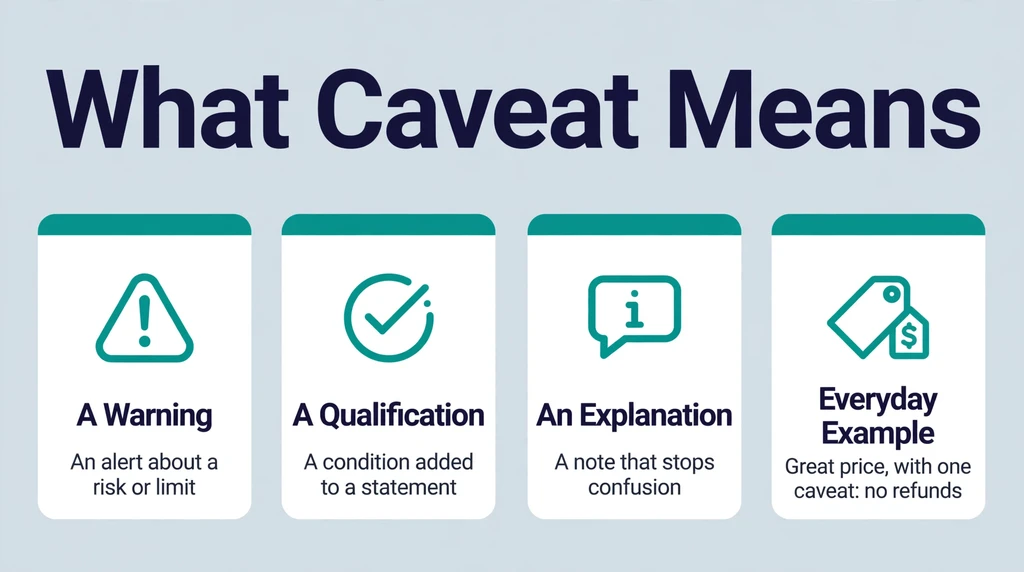
A caveat is a warning or a qualification that comes with something. Merriam-Webster describes it as an explanation or warning that should be remembered. You keep it in mind while you judge, read, or act on something.
Think of it as a note attached to a bigger statement. The main message stays the same, but the caveat adds a limit. For example, a review may praise a phone and then add a caveat about its weak battery.
In short, the statement is true, but not in every case. The caveat marks the edge of that truth. That is why people add one before others rely on their words.
A caveat as a warning
Sometimes a caveat works as a direct warning. It tells people not to rush into an action. A doctor, for instance, may support a new treatment with a caveat about side effects.
Dictionaries also list this stronger sense. A caveat can warn against certain acts or practices. In research, a caveat against taking data at face value is a classic example.
So the warning sense is about risk. Something could go wrong, so slow down and think first. The word sounds polite, but the message can be serious.
A caveat as a qualification
Other times, a caveat simply limits a claim. A report might say sales rose, with the caveat that one large order drove the growth. Nothing dangerous is involved there.
Instead, the caveat prevents a misunderstanding. It stops readers from drawing a wider conclusion than the facts allow. Writers and scientists use this sense very often.
In fact, many caveats are small acts of honesty. The speaker knows a limit and states it openly. That habit builds trust rather than weakening the point.
Caveats in research and news
Science writing runs on caveats. Every study has limits in size, method, or scope. Good researchers state those limits before others repeat the findings.
News reports quote caveats for the same reason. A headline may sound dramatic, yet the caveat tells the careful story. Polls, for example, carry a caveat about the margin of error.
As a reader, train yourself to find it. The caveat often sits in one quiet sentence near the end. That sentence may be the most honest line in the piece.
One line summary: yes, but
If you need one memory hook, use this. A caveat turns a plain “yes” into a careful “yes, but.” The agreement remains, yet the boundary is now visible.
That tiny shift prevents big misunderstandings later. Deals, plans, and claims all stay safer. No wonder the word appears wherever accuracy matters.
Singular and plural forms
The singular form is caveat, and the plural is caveats. You will see the plural far more often in reports. Lists of limits naturally come in groups.
Usage is simple. One condition takes “a caveat” or “the caveat.” Several conditions take “caveats” or “some caveats.”
A related older form, caveator, names the legal filer. Everyday English rarely uses it, though. Outside legal writing, stick with caveat and caveats.
Is a caveat good or bad news?
A caveat itself is neutral. It simply marks a limit or a risk. The news around it may be good, bad, or mixed.
In fact, a clear caveat often signals good news about the speaker. It shows the person checked the edges of the claim. Careful speakers earn more trust than absolute ones.
Problems start only when caveats hide. A claim with no stated limits may conceal real ones. So welcome the caveat; it tells you where you stand.
How to Pronounce Caveat
The most common pronunciation
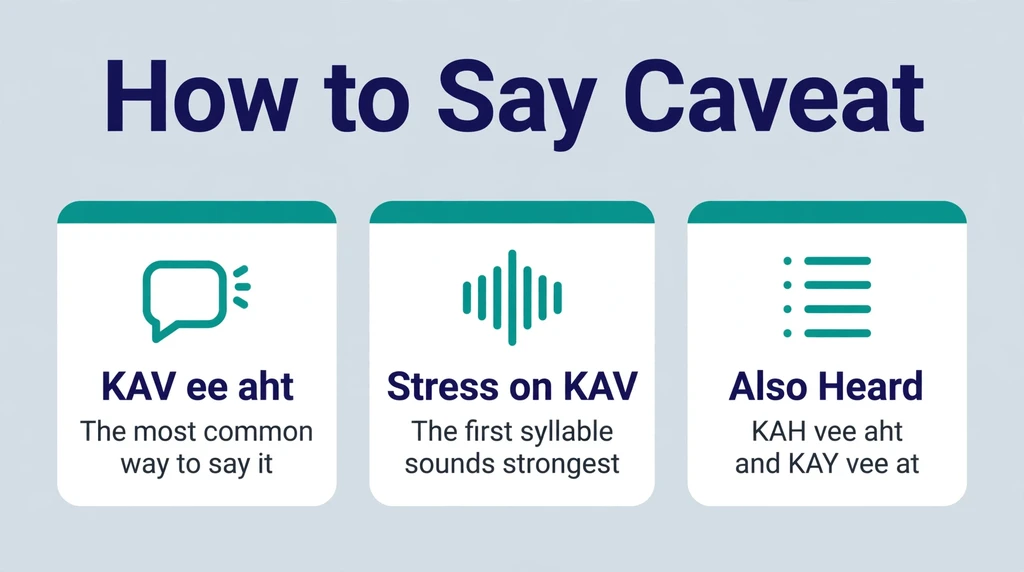
Most speakers say KAV-ee-aht. The word has three syllables: kav, ee, and aht. The stress falls on the first syllable, so the KAV part sounds strongest.
Dictionaries list KAV-ee-aht first among the options. If you use this version, you will sound natural almost everywhere. It is the safest choice for learners.
Say it a few times in a full sentence. For example, say, “There is one caveat.” The rhythm soon feels easy.
Other pronunciations you may hear
You may also hear KAH-vee-aht or KAY-vee-at. Dictionaries record these variants too, so none of them is wrong. Regional accent explains much of the difference.
British speakers sometimes use a shorter final sound. American speakers vary as well, even within one workplace. Listeners understand every common version without trouble.
For that reason, do not worry about picking the perfect one. Clear speech matters more than the exact vowel. Choose KAV-ee-aht and move on.
A quick memory trick
The first syllable sounds like the start of “cavern.” Both words share a hard KAV opening sound. Linking the two words makes the pronunciation stick.
Also remember that the final t is pronounced. Some learners drop it and say “KAV-ee-ah.” That version sounds unfinished to most listeners.
In short, end the word cleanly. A small clear t makes a real difference.
Common pronunciation mistakes
One common error adds an extra syllable. Some learners say “KAV-ee-uh-tay,” which stretches the word too far. The word has three syllables, never four.
Another error stresses the second syllable. “Kuh-VEE-aht” sounds off to native ears. Remember, the stress always lands on the first syllable.
A third slip swaps the word with “caviar.” The two words look similar on the page. They mean very different things, though, so slow down when reading aloud.
Saying caveat emptor aloud
The full phrase follows the same first word. Most speakers say KAV-ee-aht EM-tor. The second word, emptor, has two clear syllables.
Stress lands on caveat, not on emptor. The phrase then flows like a small warning bell. Practice it once in a quiet moment and it stays with you.
Hearing it in films and lectures helps too. The phrase usually arrives with a knowing tone. That tone signals old wisdom about careful buying.
Where the Word Caveat Comes From
The Latin root
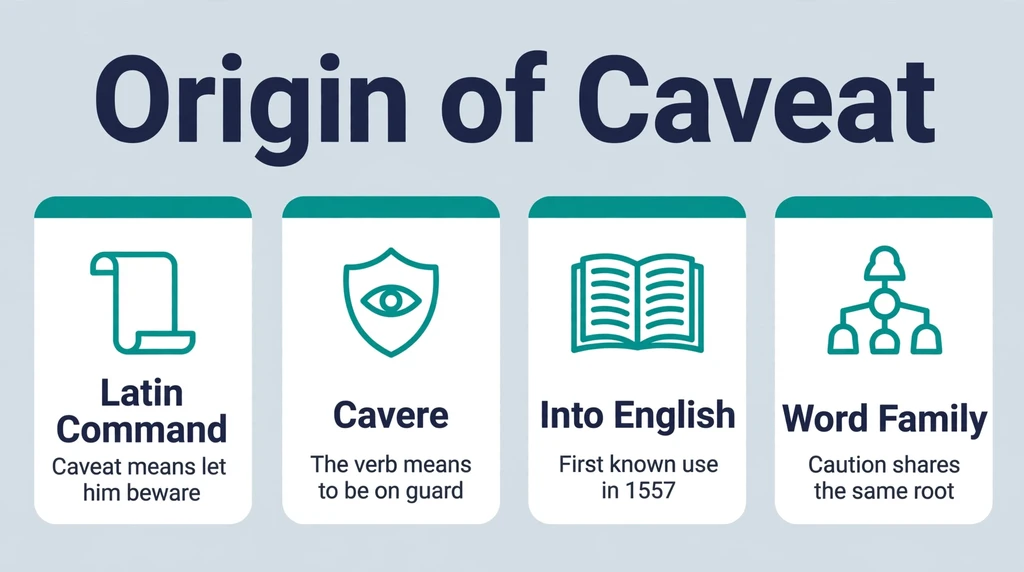
Caveat is a Latin word that English borrowed whole. In Latin, it means “let him beware.” It is a form of the verb cavere, which means to be on guard or to take care.
So the word began life as a command. Someone was told to watch out. That urgent little order still echoes in the modern meaning.
Every time you add a caveat today, you repeat that old warning. The form changed over centuries, but the purpose did not. It still tells people to pay attention.
A command, not a name
Grammarians call caveat a subjunctive form. It expresses a wish or command about someone else. “Let him beware” speaks about a third person, not the listener.
That detail explains the word’s slightly distant tone. The warning sounds official, as if read from a record. Modern speakers keep that flavour without knowing the grammar.
English froze the Latin form exactly as it stood. No translation replaced it in legal use. The frozen form became a noun over time.
Into English in the 1500s
English writers adopted the word in the 1500s. Merriam-Webster dates its first known use to 1557. At first, the word belonged mainly to legal writing.
Lawyers used it for a formal notice in court. Only later did the broader warning sense spread into everyday English. The general meaning grew out of that legal soil.
Meanwhile, the Latin form stayed unchanged. English never reshaped it into a native looking word. That is why caveat still feels slightly formal today.
Relatives of caveat
The word caution comes from the same Latin root. Cavere sits behind both words. So caveat and caution are distant cousins in meaning and origin.
Latin also gave us the phrase caveat lector. It means “let the reader beware.” Readers use it as a playful warning to read with a grain of salt.
These relatives show one clear pattern. The whole family deals with guarding yourself against error. A caveat is simply the guard in written form.
Why Latin survived in English law
English law kept many Latin phrases for centuries. Courts valued fixed wording that everyone cited the same way. Latin terms acted like labels that never changed spelling.
Caveat benefited from that habit. Judges and clerks used the same short word in record after record. Over time, educated readers met it again and again.
Eventually, the word escaped the courtroom. Journalists and scholars borrowed its precise flavour. Modern English kept both the legal sense and the everyday one.
Caveat Emptor: Let the Buyer Beware
What the phrase means
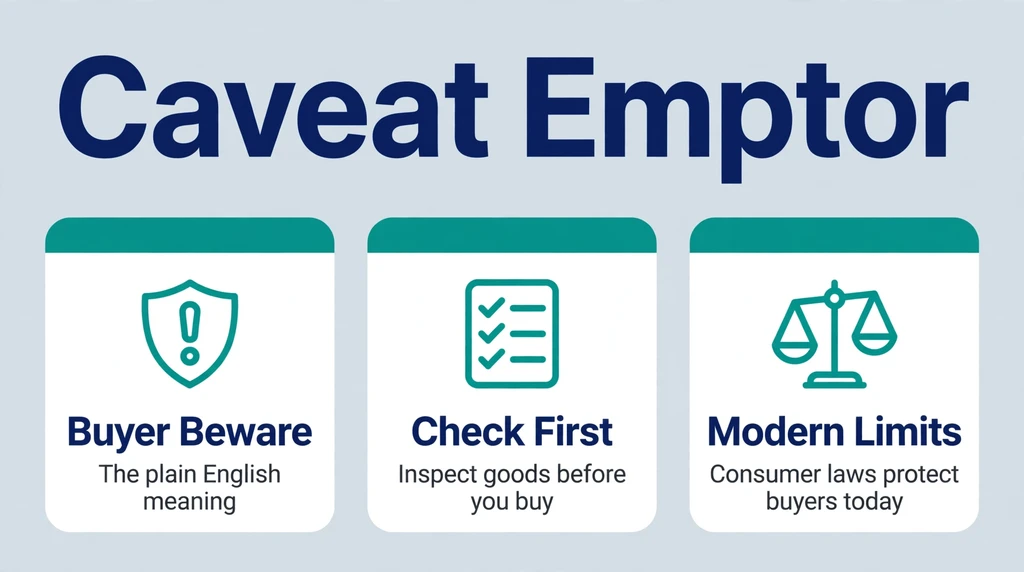
Caveat emptor is Latin for “let the buyer beware.” Emptor means buyer, and caveat keeps its usual sense of beware. The phrase is much older in print, with a known use from 1523.
The idea is simple. Before you buy something, inspect it yourself. If you fail to check, the loss may be yours.
People still quote the phrase today. It appears in business courses, property sales, and consumer advice. It survives because the situation it describes never disappears.
How the doctrine worked
In law, caveat emptor became a common law doctrine. Cornell Law explains that it placed a duty on buyers. Buyers had to examine property reasonably before a purchase.
If a defect was easy to spot, the buyer carried the blame. The buyer could not recover money for a fault that an inspection would have revealed. Sellers, in contrast, had few duties under the old rule.
The doctrine assumed both sides could judge the goods. In simple markets, that assumption often held true. A buyer handled the cloth, tested the tool, and paid with open eyes.
In the 16th century, this rule protected sellers. A buyer examined a horse before paying, for example. After the sale, the seller could not be blamed for its flaws.
The limits and exceptions today
Modern law has softened the doctrine a lot. Consumer protection laws now guard buyers against deceptive practices. Warranties and disclosure rules share the burden with sellers.
Exceptions existed even under the old doctrine. For instance, concealment was never protected. A seller who hid a known defect could not hide behind caveat emptor.
As a result, the phrase now works mostly as advice. It reminds buyers to check first and ask questions. Courts apply it with far more balance than before.
Caveat venditor, the modern flip side
You may also meet the phrase caveat venditor. It means “let the seller beware.” Writers use it for the modern shift toward seller accountability.
The contrast is useful. Caveat emptor describes the old buyer beware world. Caveat venditor describes today’s world of refunds, guarantees, and regulation.
Neither phrase covers every sale, of course. Real cases depend on the law of each place. Still, the pair neatly frames a long legal story.
Caveat emptor in property sales
The phrase appears most often in real estate. Used homes are usually sold after the buyer’s own inspection. Sellers describe condition, yet buyers still hire inspectors.
That routine grew straight from the doctrine. Check first, then sign. A buyer who skips the inspection accepts real risk.
Even so, disclosure laws now help buyers. In many places, sellers must reveal known defects. The old rule survives, but inside a fairer frame.
Caveat emptor in online shopping
Online buying revives the phrase in a new setting. Photos can flatter a product, and reviews can mislead. Buyers cannot touch the item before paying.
So the old advice applies with fresh force. Read the return policy before you order. Check sizes, materials, and seller ratings with care.
Modern platforms add protections of their own. Refund guarantees and buyer cover soften the risk. Still, a careful buyer loses less often than a careless one.
Everyday examples of the idea
A used car sold “as is” shows the doctrine at work. The buyer accepts the car in its current state. Hidden faults become the buyer’s problem after the sale.
Auction sales work in a similar way. Bidders inspect items during preview hours. Once the hammer falls, complaints rarely succeed.
Even a market stall follows the pattern. You squeeze the fruit and check the fabric yourself. The phrase may be Latin, but the habit is universal.
Caveat in Law: The Formal Notice
The legal definition
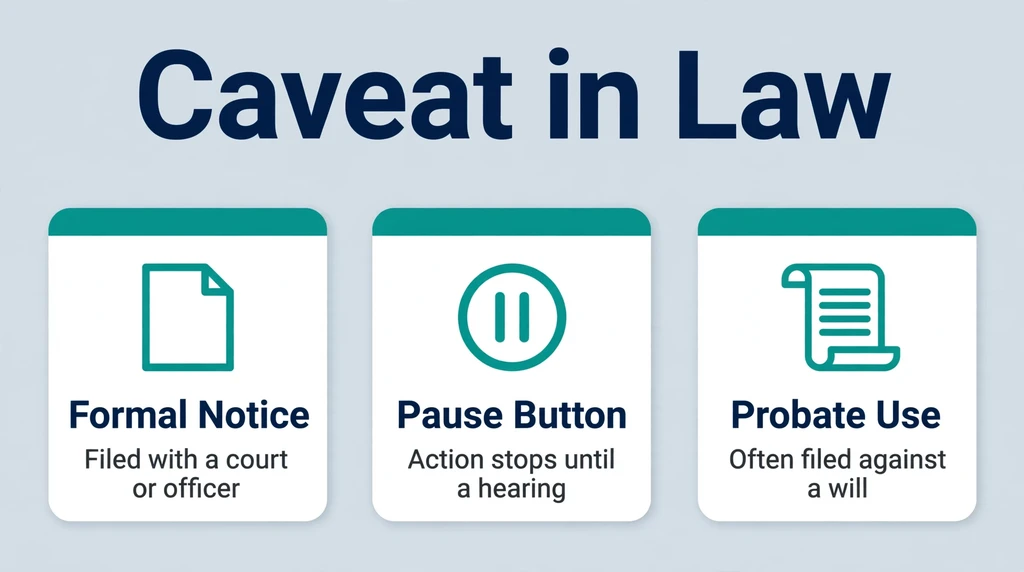
In law, a caveat is a formal notice to a court or a public officer. It asks the officer to suspend a proceeding. Nothing moves forward until the person who filed it gets a hearing.
Dictionaries define this sense almost word for word. Merriam-Webster and Collins both describe it the same way. It is the oldest surviving technical use of the term.
So the legal caveat is not a casual warning. It is an official step with real effects. Filing one pauses a process by design.
The probate caveat
The classic example involves a will. A person who doubts a will can enter a caveat in probate court. That filing stops the proving of the will.
The court then hears the objection first. Perhaps the filer questions the will’s validity or the executor’s role. Only after that hearing can probate continue.
This protects people with a real interest in an estate. It gives them a voice before assets move. Without it, a disputed will might take effect too quickly.
Who files one, and what happens next
The person who files a caveat is called the caveator. After the filing, officials notify the other side. A hearing follows, where both sides present their case.
The court then decides whether the process resumes. In other words, a caveat buys time for a fair check. It does not win the argument by itself.
Rules differ between countries and states, however. Deadlines, fees, and forms all vary by jurisdiction. Anyone facing a real case should ask a local lawyer.
Caveats beyond probate
Probate is the famous case, not the only one. The dictionary wording covers any court or public officer. A caveat can pause different kinds of official action.
The shared idea is notice. The filer says, in effect, “do not proceed without hearing me.” That pause prevents silent, one-sided decisions.
Because the step is formal, it goes on record. Opposing parties learn that an objection exists. The process then continues in the open, with both sides heard.
How long does a legal caveat last?
There is no single answer to that question. Each jurisdiction sets its own time limits. Some caveats lapse unless the filer renews or acts on them.
Others stay in place until a court lifts them. The details depend on the type of proceeding involved. Probate, land, and court registries all run their own rules.
For that reason, treat any real filing as time sensitive. Missing a renewal deadline can end the protection. A local lawyer can confirm the exact period that applies.
How to Use Caveat in a Sentence
The most common sentence patterns
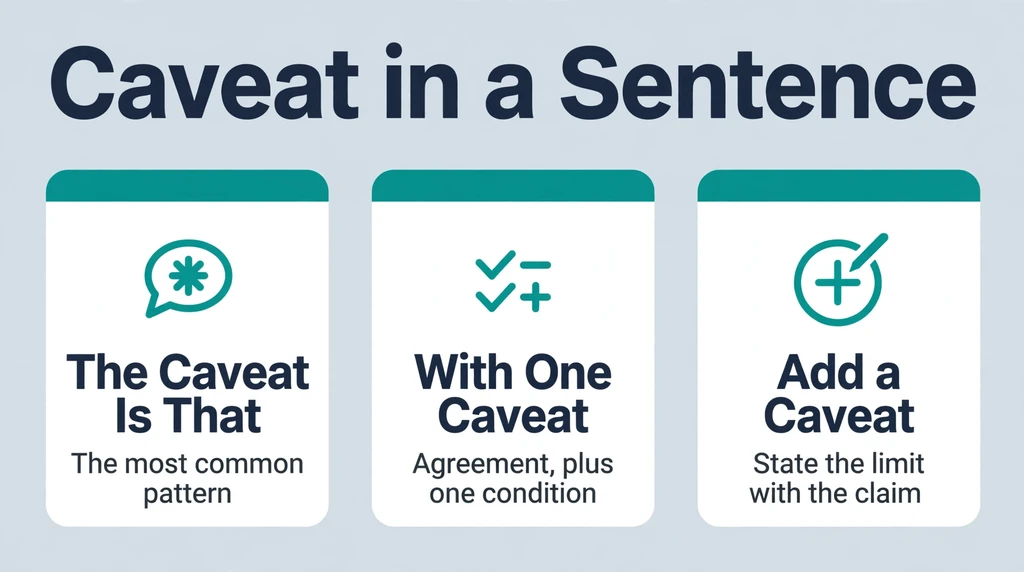
Most everyday caveats follow a few easy patterns. The first is “the caveat is that.” For example, “The plan is cheap; the caveat is that it takes longer.”
The second pattern is “with one caveat.” A sentence might read, “I agree with the plan, with one caveat.” The condition then follows in the next sentence.
A third pattern uses “add a caveat.” Writers add a caveat before a claim, not just after it. Each pattern sounds natural in speech and writing.
Examples at work and in business
In offices, caveats keep promises realistic. A manager might say, “We can launch in June, with the caveat that testing goes well.” The team hears both the goal and the condition.
Finance uses the word constantly. An adviser may note strong returns, with the caveat that past results guarantee nothing. That single phrase protects clients from false hope.
Reports also rely on caveats. Survey results often carry a caveat about a small sample size. Readers then judge the numbers with proper care.
Examples in everyday life
Outside work, the word appears in friendly warnings. “You can borrow the car, with one caveat: fill the tank.” The condition is clear, and nobody feels misled.
Home buying brings caveats too. “The house is a bargain, but the caveat is the roof.” One short clause changes the whole picture.
Even weather talk uses it. “Saturday looks sunny, with the caveat that storms may form late.” In each case, the caveat marks the limit of good news.
Can caveat be a verb?
Modern dictionaries also record caveat as a verb. It means to add a warning to information you present. A paper might caveat its findings with a call for more research.
This verb use is newer and less formal. Some careful writers still avoid it in polished prose. They prefer “add a caveat” or “note a limit” instead.
In casual writing, though, the verb is now common. Style guides may grumble, but usage keeps growing. Knowing both options helps you choose well.
Caveats in academic and science writing
Researchers attach caveats to almost every claim. A study may show a link, with the caveat that correlation is not causation. That one clause keeps conclusions honest.
Peer review rewards this habit. Papers that admit limits often earn more trust. Readers know exactly where the evidence ends.
Students can copy the pattern safely. State your point, then state its limit. Your writing will sound careful rather than weak.
Where to place the caveat
Position changes the feel of a sentence. A caveat at the start sounds cautious: “With one caveat, the plan works.” A caveat at the end sounds like a footnote.
Most writers place the claim first. The reader gets the main point, then the limit. That order keeps the sentence confident and clear.
Avoid burying the caveat, though. If the limit is serious, give it its own sentence. Honesty should never hide in a subordinate clause.
Caveats in headlines and reviews
Headlines love a short caveat. “Markets rally, with a caveat” promises a twist below. Readers click because the limit sounds interesting.
Reviewers use the same hook. A five star review may still carry one caveat about price or size. That balance makes the praise believable.
Product pages do it too. “Free delivery, with one caveat: orders over fifty dollars.” The condition is honest, visible, and easy to check.
Caveat in spoken English
People speak caveats as often as they write them. A friend might say, “Dinner is on me, with one caveat: you pick the place.” The pause before the condition adds a playful beat.
In meetings, speakers use it to stay precise. “We support the idea, with a caveat about cost.” Nobody hears total rejection or blind agreement.
Tone does much of the work here. Said lightly, a caveat feels helpful. Said slowly, it can warn of a serious problem ahead.
Common Caveat Phrases You Will Hear
“The only caveat”
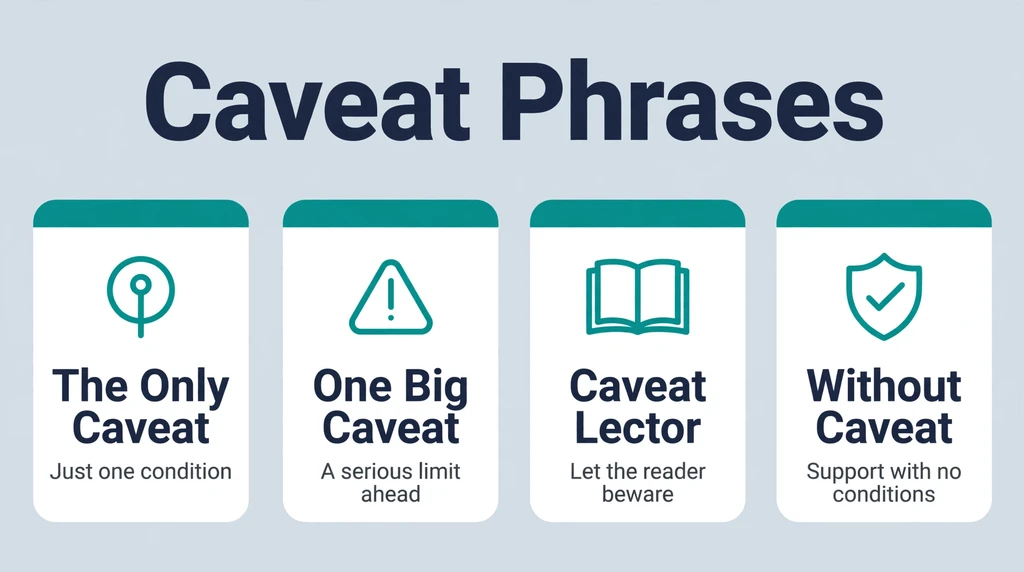
People often narrow everything to one condition. They say, “The only caveat is the price.” That phrase tells listeners the rest is fine.
It works because it sets a clear boundary. One problem exists, and here it is. Nothing else hides behind the statement.
You can use it in reviews and recommendations. “I recommend this laptop; the only caveat is its weight.” The advice stays honest and useful.
“One big caveat”
The opposite move highlights a serious limit. “There is one big caveat” signals real weight. The condition ahead could change a decision.
Writers use this phrase before key warnings. It prepares the reader for an important catch. As a result, the warning lands with more force.
Choose this version when the limit truly matters. For small print details, a plain caveat is enough. Matching the phrase to the stakes keeps your tone honest.
“Caveats and conditions”
News stories often pair the two words. A deal is announced “with caveats and conditions.” The phrase suggests fine print that deserves a closer look.
Politicians and companies use such pairings often. The headline sounds positive, yet the details carry limits. Careful readers always check what follows the announcement.
This habit protects you as a reader. Whenever a claim sounds perfect, look for its caveats. They usually reveal the real story.
“Without caveat”
Less often, someone removes all conditions. Support given “without caveat” is total and unqualified. That phrase carries unusual strength for that reason.
It appears in endorsements and official statements. “We support the plan without caveat” leaves no room for doubt. Speakers choose it when they want full commitment on record.
Knowing this phrase completes the picture. Caveat language can add limits or remove them entirely. Context always decides which way it points.
“A caveat against” something
You will also see the word with “against.” A report may issue “a caveat against reading too much into the data.” Here the caveat works as a warning, not a condition.
This pattern suits advice and analysis. It tells people which error to avoid. The mistake is named, so readers can dodge it.
Try it in your own writing. “One caveat against the new method: it fails on old files.” The sentence warns clearly without sounding harsh.
“Minor caveats” and small print
Writers often soften limits with size words. “A few minor caveats” tells readers not to worry much. The limits exist, but they change little.
Contracts take the opposite approach. There, every caveat can matter, however small it looks. Fine print has a way of growing teeth later.
So judge the phrase by its setting. In a friendly review, minor means minor. In a legal document, read every line as if it counts.
Caveat vs Similar Words
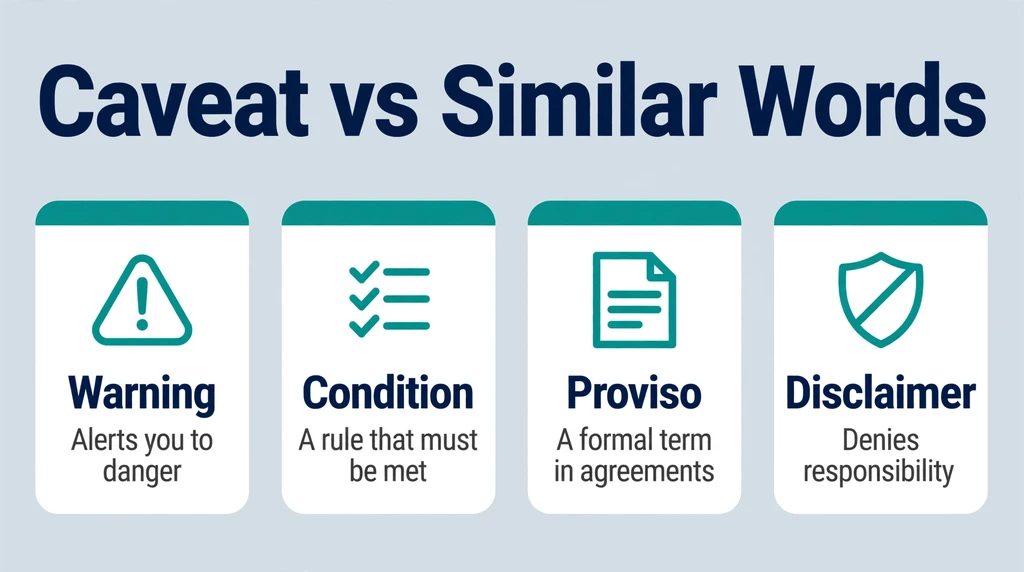
Caveat vs warning
A warning alerts you to danger or risk. A caveat can do that, but it often does something softer. It qualifies a statement rather than predicting harm.
For example, “Warning: wet floor” prevents an accident. In contrast, a caveat about a survey prevents a wrong conclusion. One guards your body, the other guards your judgment.
The two words overlap in the caution zone. Still, caveat belongs more to statements and agreements. Warning belongs more to safety and threats.
Caveat vs condition
A condition is a rule that must be met. If the condition fails, the deal often fails too. It has practical, sometimes legal, force behind it.
A caveat is lighter in most settings. It informs rather than enforces. “With the caveat that results may vary” does not cancel the claim.
However, the two can blend in contracts. A carefully written caveat may restate a real condition. Drafters choose words with the effect in mind.
Caveat vs proviso and disclaimer
A proviso is a formal condition in an agreement. Lawyers use it inside clauses and statutes. It sounds heavier and more technical than caveat.
A disclaimer, meanwhile, denies responsibility. A company disclaimer says, in effect, “this is not our fault.” A caveat does not shift blame in that way.
So each word has its own job. Use caveat for an honest limit on a claim. Use disclaimer when liability is the real topic.
Caveat vs catch
Everyday speech offers a shorter rival: “the catch.” “The catch is that the battery dies fast” means the same as a caveat. Both flag the hidden downside.
The difference is tone. Catch sounds casual and slightly sneaky. Caveat sounds neutral and professional.
Choose catch for friendly conversation. Choose caveat for reports, reviews, and advice. The meaning survives either way; the register changes.
Which word should you choose?
Ask what job the sentence must do. To limit a claim honestly, choose caveat. To demand a term in a contract, choose condition or proviso.
To warn about harm, choose warning. To deny blame, choose disclaimer. Each swap changes the effect on the reader.
When in doubt, caveat is the safe middle ground. It sounds careful without sounding legal. That balance explains its lasting popularity.
Caveat vs reservation
A reservation is a feeling of doubt about something. “I support the plan, with some reservations” reports an attitude. The doubt may never become a clear condition.
A caveat is more specific than that. It names the exact limit or risk involved. Readers can point to it and discuss it.
Use reservation for a mood of hesitation. Use caveat for a stated, checkable point. Precise words make disagreements easier to solve.
Frequently Asked Questions
What is the simple meaning of caveat?
A caveat is a warning or condition attached to a statement. It points out a limit you should remember. For example, good news may come with the caveat that it applies only this year.
How do you pronounce caveat?
Say KAV-ee-aht, with the stress on the first syllable. Some speakers say KAH-vee-aht or KAY-vee-at instead. Dictionaries list all of these, so each one is acceptable.
What does caveat emptor mean?
Caveat emptor is Latin for “let the buyer beware.” It means buyers should inspect goods before a purchase. In law, it once placed most of that burden on the buyer.
Is caveat a formal word?
Yes, dictionaries mark caveat as a fairly formal word. Even so, people use it in normal speech every day. It sounds professional rather than stiff, especially in work settings.
Can caveat be used as a verb?
Yes, modern dictionaries record a verb use. To caveat a finding means to add a warning to it. The verb is informal, so formal writing often uses “add a caveat” instead.
What is a caveat in law?
In law, a caveat is a formal notice filed with a court or officer. It pauses a proceeding until the filer is heard. People often file one against the probate of a disputed will. The filer is known as the caveator.
What is the difference between a caveat and a disclaimer?
A caveat limits or qualifies a claim. A disclaimer denies responsibility for something. In short, a caveat adds honest detail, while a disclaimer steps back from blame.
What is a synonym for caveat?
Close synonyms include warning, caution, qualification, and proviso. Condition also fits in many sentences. The best choice depends on whether you mean danger, a limit, or a formal rule. Catch works as an informal option in everyday speech.
Final Thoughts
Caveat is a small word with a clear job. It warns you, limits a claim, or pauses a legal process. Once you see that job, the word stops feeling mysterious at all.
Keep the Latin picture in mind. To say caveat is to say “beware,” politely and precisely. That is why the word fits both fine print and friendly advice.
Use it when your statement needs an honest edge. Add the limit, name the risk, and let readers judge fairly. And when someone offers you a claim with no caveat at all, ask what the limits are.
The word has served readers for nearly five centuries now. It began as a Latin command in legal records. It survives because honest limits never go out of style. For the legal side in more depth, Cornell Law’s Wex entry on caveat emptor explains the buyer beware doctrine and its exceptions.