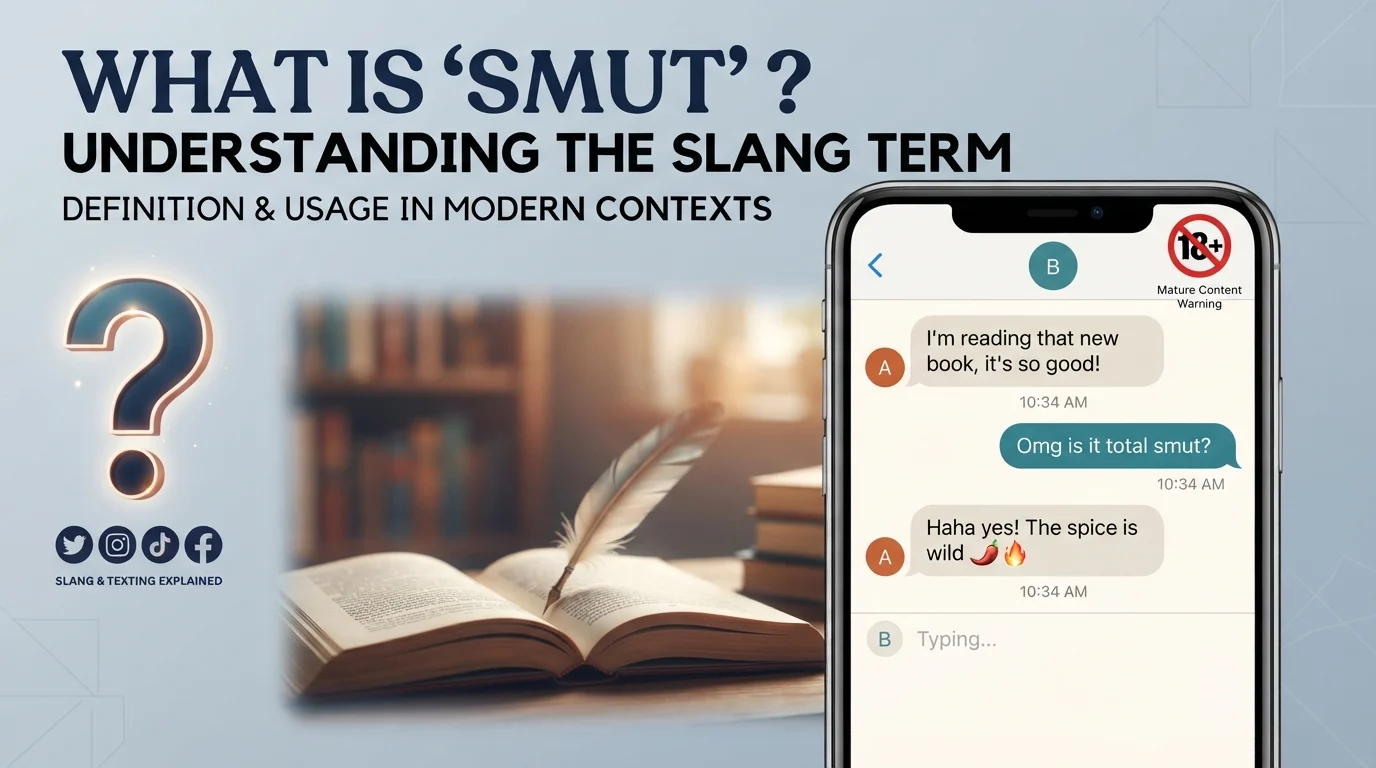
You’re reading a message, comment, or book description and suddenly see the word “smut.” The meaning can seem unclear because it has both an ordinary dictionary meaning and a common online meaning. In most modern text and internet conversations, smut refers to sexually explicit or sexually suggestive material, especially writing, stories, pictures, movies, or similar content.
However, context matters. Someone discussing fanfiction may use “smut” as a casual label for sexually explicit fiction, while an older or general English sentence could use it to mean a dirty mark or a plant disease. Here’s how to tell which meaning someone intends.
What Does Smut Mean?
In text, chat, and online communities, smut usually means sexually explicit content, particularly writing, fiction, or other material centered heavily on sexual content. The term can sound blunt, informal, disapproving, humorous, or simply descriptive, depending on who uses it and why.
| Detail | Explanation |
|---|---|
| Most Common Online Meaning | Sexually explicit or obscene material |
| Full Form | None; “smut” is a word, not an acronym |
| Tone | Informal and sometimes negative or joking |
| Common Contexts | Texts, fanfiction, social media, forums, online communities |
| Formal or Informal | Mostly informal |
For example:
“That book is basically smut.”
Here, the speaker is saying the book contains a large amount of sexual content. The statement may be criticism, teasing, or a casual description rather than a formal classification.
What Is the Main Smut Meaning in Text?
When someone searches for smut meaning in text, they usually want to know whether it refers to sexual content. In most online conversations, that is the intended meaning.
People may call a story, scene, image, joke, or video “smut” when they consider its sexual content particularly explicit or central to the material. The word is closely associated with terms such as porn, pornography, erotica, and explicit content, although these words are not always exact substitutes.
For example:
Person A: “Did you finish that novel?”
Person B: “Yep, but there’s a lot of smut in it.”
The second person means the novel contains substantial sexual content. Depending on their relationship, the comment could be neutral, humorous, or judgmental.
Is Smut a Full Form?
No. Smut does not have a standard full form like an acronym such as LOL or FYI. It is a regular English word with several established dictionary meanings.
Online communities sometimes use it as a short label for sexually explicit fanfiction or similar material, but that does not make it an acronym or abbreviation. Fanfiction communities specifically use “smut” for fanworks containing a strong amount of explicit sexual content.
Other Meanings of Smut
The sexual meaning is common online, but smut is not exclusively an internet slang term. It has other established meanings that can appear in traditional English.
| Meaning | Context | Tone | Example |
|---|---|---|---|
| Sexual or obscene material | Books, media, online discussions | Often informal or disapproving | “The magazine was criticized as smut.” |
| Dirt or soot | General English | Neutral | “His hands were covered in smut.” |
| Plant disease | Agriculture and botany | Technical | “The wheat crop was affected by smut.” |
Dictionaries list “smut” as a term for soot or dirty matter and also as a fungal disease affecting plants, especially grasses and cereal crops.
That means the surrounding sentence matters enormously. A farmer talking about wheat probably isn’t discussing online content.
How Context Changes the Smut Meaning
You can usually identify the intended meaning by looking at the words around “smut.”
Example 1:
“I found some smut on the old chimney.”
Here, “smut” means soot or dirty material.
Example 2:
“The forum removes posts containing smut.”
Here, the word almost certainly refers to sexual or obscene material.
Example 3:
“This fanfic has a lot of smut.”
Here, the context points specifically toward explicit sexual fiction.
Example 4:
“Smut destroyed part of the wheat crop.”
This is the agricultural meaning, referring to a plant disease.
The platform can help, too. In a fanfiction discussion, “smut” often functions as a genre or content label. In a general conversation, it may carry a more negative meaning.
Smut Meaning on Different Platforms
The basic online meaning usually stays the same across platforms, but the purpose of the word can change.
Text Messages
In texting, “smut” normally refers to sexual or obscene material.
“Why are you sending me smut?”
The wording may sound disapproving, playful, or teasing depending on the relationship.
TikTok and Instagram
On social platforms, people may use “smut” while discussing books, fictional characters, jokes, or content that they consider sexually explicit. The word can also appear when users criticize or describe mature material.
“People keep calling this book smut.”
Here, the speaker is labeling the book’s sexual content.
Reddit and Online Forums
Forum communities may use “smut” as a casual content label, particularly when talking about fiction or mature media. The term can be descriptive rather than insulting within a community.
Fanfiction Communities
This is one of the clearest online contexts for the term. In fandom spaces, smut can refer to fanfiction or fanworks where explicit sexual scenes make up much of the content. Fanlore documents this specific fandom usage and notes that some fans use the term affectionately rather than as a judgment.
Real Conversation Examples
Friends Discussing a Book
Person A: “What kind of book is it?”
Person B: “Romance, but apparently there’s a lot of smut.”
Meaning: The book contains substantial sexually explicit material.
Group Chat
Person A: “Why is everyone calling this story smut?”
Person B: “Because the romantic scenes get pretty explicit.”
Meaning: The group is using “smut” to describe explicit sexual content in the story.
Online Community
Person A: “Is this chapter mostly plot?”
Person B: “Not really. It’s mostly smut.”
Meaning: The second person is saying sexual content dominates that chapter.
Is Smut Rude?
Smut can sound rude or judgmental, but it is not automatically an insult. The tone depends on the speaker, audience, and context.
For example, saying:
“That book is disgusting smut.”
is clearly negative.
But saying:
“I’m looking for a romance novel with some smut.”
is more like a casual content preference.
The word itself traditionally carries a disapproving sense when referring to sexual material, but online communities can use it more casually.
Is Smut Offensive?
It can be, particularly when someone uses it to shame another person’s reading choices, writing, interests, or media preferences.
Calling someone’s work “smut” may therefore sound insulting even when the underlying meaning is simply “sexually explicit.” In neutral writing, terms such as sexually explicit content or adult content can be clearer and less judgmental.
How to Reply to Smut
Your response should match what the person means and the relationship you have with them.
Polite Replies
- “Do you mean sexually explicit content?”
- “What part are you referring to?”
- “I’m not sure what you mean by smut here.”
- “Are you talking about the book’s mature scenes?”
Funny Replies
- “Well, that escalated quickly.”
- “That’s one way to describe the book.”
- “I think ‘romance’ might be doing some heavy lifting here.”
- “Okay, I definitely need more context.”
Replies When You Are Confused
- “Wait, which meaning of smut do you mean?”
- “Do you mean the story is sexually explicit?”
A clarification reply works especially well when the word could have more than one interpretation.
When to Use the Term
“Smut” fits best in casual conversations where everyone understands the context. It may appear in chats with friends, book discussions, fandom communities, forums, or conversations about mature fiction.
Consider the audience before using it. If you’re discussing a book with people who regularly use the term, it may sound completely normal. With unfamiliar people, however, the word can be interpreted as crude or judgmental.
When to Avoid the Term
Clearer wording is usually better in professional emails, academic writing, client communication, formal announcements, and sensitive discussions.
For example, rather than writing:
“The report contains smut.”
a formal description could say:
“The material contains sexually explicit content.”
That wording removes ambiguity and makes the intended meaning immediately clear.
Common Mistakes
| Common Mistake | Correct Understanding |
|---|---|
| Assuming “smut” is always sexual | It can also mean soot, dirt, or a plant disease. |
| Treating it like an acronym | “Smut” is a regular word, not a standard initialism. |
| Assuming it is always insulting | It can be negative, neutral, humorous, or community-specific. |
| Assuming every online use means pornography | Context may specifically refer to explicit fiction or fanfiction. |
Smut vs. Similar Terms
| Term | Meaning | Main Difference |
|---|---|---|
| Porn | Informal term for pornography | Usually more directly associated with sexually explicit media |
| Erotica | Sexually themed artistic or literary material | Often carries a less judgmental or more literary tone |
| Explicit Content | Material containing clearly sexual or mature material | More neutral and descriptive |
| Fanfiction | Stories written by fans about existing characters or worlds | Not necessarily sexual; “smut” can describe a sexual subset |
| Smutty | Adjective meaning sexually explicit or obscene | Describes something rather than naming the material itself |
“Erotica” and “pornography” overlap with “smut,” but the terms can carry different connotations. “Smut” is often more informal, while “explicit content” is more neutral.
Origin and Popularity
The word smut is much older than internet slang. Traditional dictionaries record senses connected with obscene material as well as soot, dirty marks, and plant disease. The online fandom use developed as communities began using the word to label explicit fictional works, including fanfiction.
There is no need to treat “smut” as a newly invented texting abbreviation. It is an established English word whose meaning changes according to context.
Quick Recap
- Smut meaning in text usually refers to sexually explicit or obscene material.
- It is not an acronym and has no standard full form.
- In fanfiction communities, “smut” can specifically describe fiction dominated by explicit sexual scenes.
- The word can sound negative, humorous, neutral, or casually descriptive depending on context.
- Outside online conversations, “smut” can also mean soot, dirt, or a plant disease.
- When the meaning is unclear, asking for clarification is the safest response.
Frequently Asked Questions
What does smut mean in text?
Smut usually means sexually explicit or obscene content, especially writing, fiction, images, or other mature material.
Is smut rude?
Smut can sound rude or judgmental when used negatively, but some online communities use it casually or descriptively.
What does smut mean on TikTok?
On TikTok, smut generally refers to sexually explicit content or discussions of explicit books, fiction, or mature media.
How should you reply to smut?
Ask what the person means when unclear, or respond casually when the sexual-content context is already obvious.
Can smut have different meanings?
Yes, smut can also mean soot or a fungal plant disease, although sexual content is common online.
Final Thoughts
The main smut meaning in texting and online conversations is sexually explicit or obscene material. However, the word is not limited to internet slang. It can describe explicit fiction, especially in fandom communities, while traditional English also uses it for soot, dirty marks, and certain plant diseases.
Context does the heavy lifting. Look at the surrounding words, platform, relationship, and overall tone before deciding what someone means. When the audience may misunderstand the term, clearer wording such as “sexually explicit content” is usually the better choice.
1 thought on “Smut Meaning | What This Popular Word Really Means in Text, Books & Online 2026”