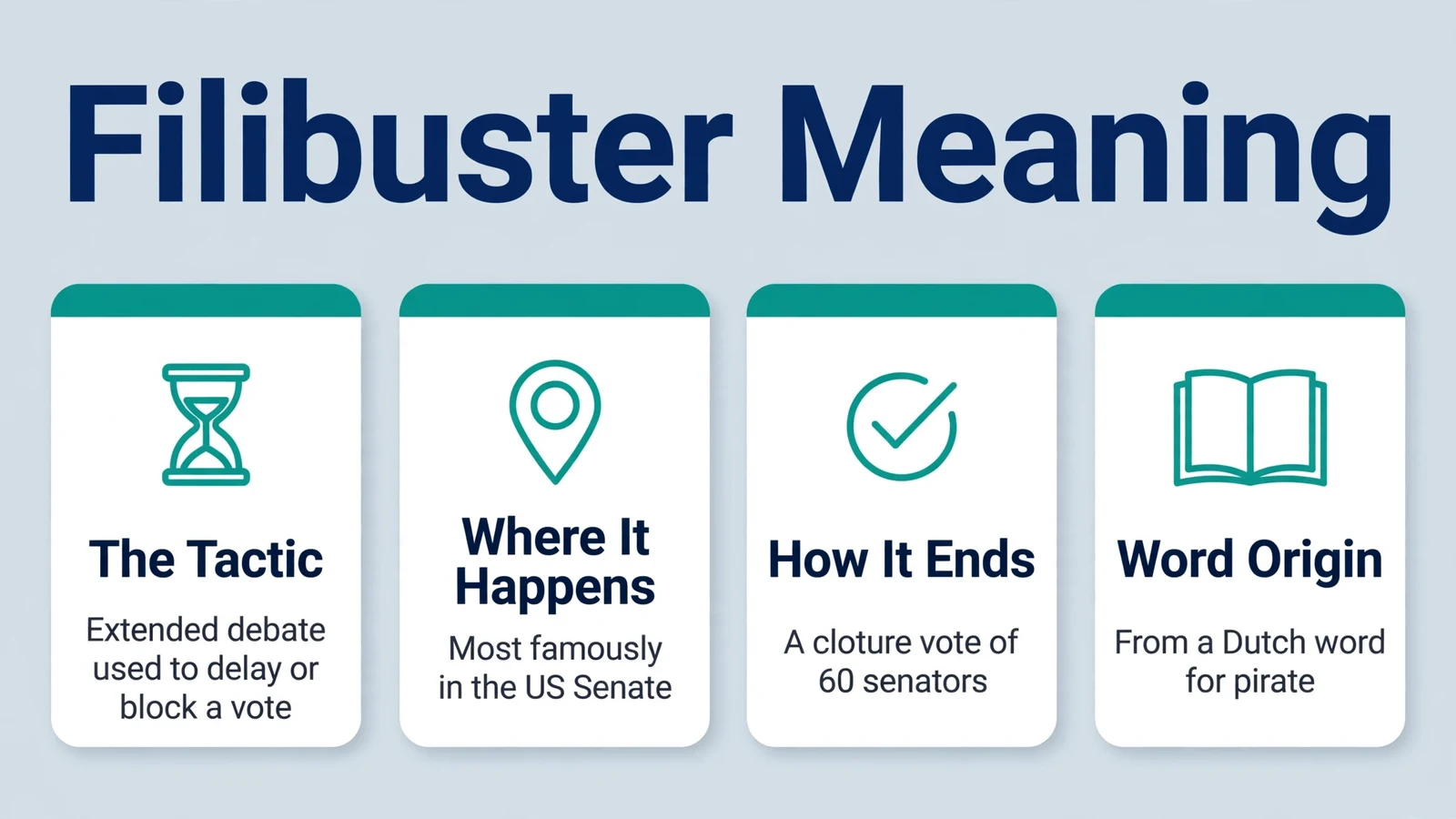
Imagine one person talking for an entire day and night, while a hundred elected officials wait, unable to vote. That is the strange power behind one of the most searched words in American politics.
A filibuster is a tactic used to delay or block a vote in a legislature, usually by speaking for a very long time or by threatening to do so. It happens most famously in the United States Senate, where debate has traditionally had no time limit. Supporters describe the practice as a shield for the minority. Critics describe it as a brake on majority rule.
Either way, the word carries a curious history. It started with pirates, crossed two languages, and now shapes how laws pass or fail. This guide explains the meaning, the origin, the rules, and the record-breaking speeches.
What Does Filibuster Mean?
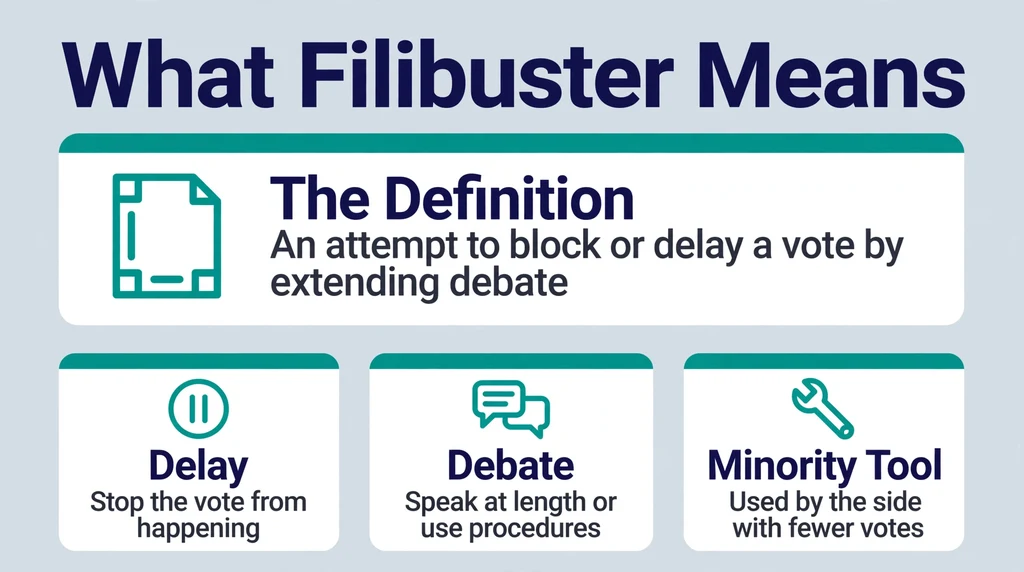
The United States Senate keeps its own glossary, and its wording is helpfully plain. In that glossary, a filibuster is an informal term for any attempt to block or delay Senate action on a bill or other matter. The blocking can happen by debating a measure at length. It can also happen through numerous procedural motions or other delaying actions. In short, the goal is to stop a vote from taking place.
The dictionary definition
Encyclopaedia Britannica gives a similar picture in slightly sharper language. It calls the filibuster a parliamentary tactic used in the United States Senate by a minority of senators, sometimes even a single senator. The minority talks for so long that the majority either grants concessions or withdraws the bill. So the definition has three parts. First, someone extends debate on purpose. Second, the aim is delay or defeat, not persuasion alone. Third, the tactic works because the chamber cannot easily force an end to debate.
Cramming the definition into one line
If you need the meaning in a single sentence, use this one. A filibuster is extended debate, or the threat of it, used to delay or prevent a vote on a proposal. The Congressional Research Service describes the same idea as dilatory tactics that stop a measure from coming to a vote. Textbooks often add one more element: the tactic belongs mainly to the minority side of a chamber. A majority that wants a vote has no reason to stall its own agenda. So filibusters are almost always weapons of the outnumbered, which is exactly why the word sparks such strong arguments.
Filibuster as a noun and a verb
The word works in two directions, and both appear in everyday news writing. As a noun, a filibuster is the event itself, as in “the filibuster lasted all night.” It can also describe the person doing it in older usage, though that sense is now rare. As a verb, to filibuster means to carry out the tactic. A senator can filibuster a bill, and a bill can be filibustered. Related forms include filibustering and filibusterer. News reports use the verb forms most often, especially when a measure stalls before any speech begins.
Pronunciation and quick facts
Filibuster is pronounced FIL-uh-bus-ter, with the stress on the first syllable. It is spelled the same in the singular for both the tactic and, historically, the adventurer. A close everyday cousin is the phrase “talking a bill to death,” which Senate historians use for the same idea. Another useful point is what the word is not. It is not a vote, a veto, or a formal motion written into the Constitution. Instead, it is a practice that grows out of the Senate’s own rules and traditions.
Where the Word Filibuster Comes From
Few political terms have a past as colorful as this one. The word began on the sea, among raiders and private adventurers. Then it moved onto land, attached itself to freelance soldiers, and finally entered the vocabulary of Congress. Each step kept the same core image: someone acting outside the usual rules, on their own terms.
Pirates and freebooters
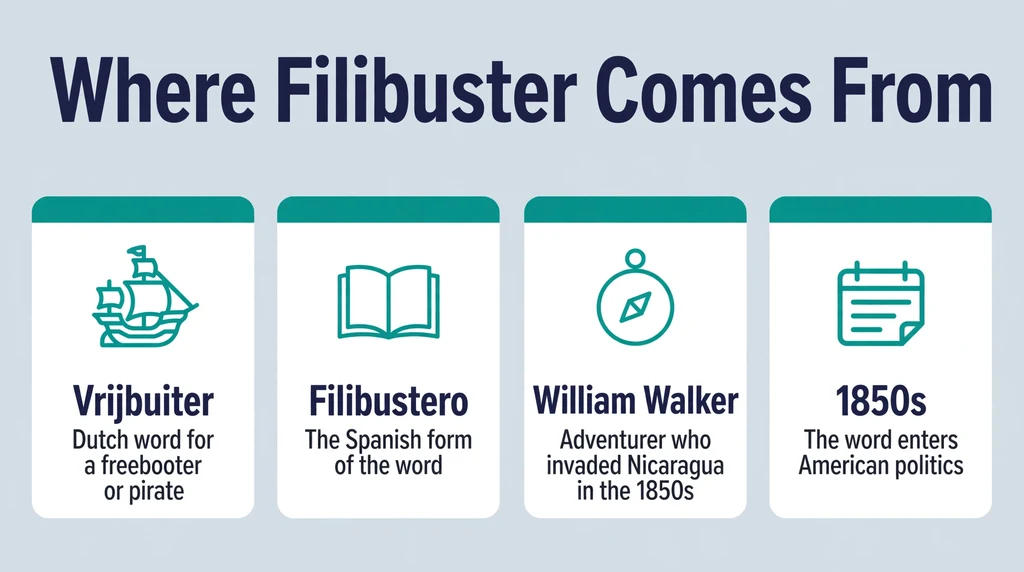
The trail starts with the Dutch word vrijbuiter, which meant a freebooter or pirate. English borrowed the same Dutch word directly and turned it into “freebooter.” Spanish speakers reshaped it into filibustero, and French produced flibustier along the way. Merriam-Webster traces the English word filibuster to the Spanish filibustero, which literally meant freebooter. In the 1500s and 1600s, such words described the privateers and raiders who preyed on ships and colonies around the Caribbean. So before it ever described a speech, the word carried the smell of salt water and plunder.
The pirate word was old before politics
The adventure sense was actually the word’s second career. Forms of the word had floated around English since the late 1500s. Etymology references record spellings like flibutor in the 1580s, meaning a pirate or West Indian buccaneer. The Dutch original, vrijbuiter, built the word from parts meaning “free” and “booty,” the plunder a raider carried off. English speakers knew the same figure as the freebooter of storybooks. So the raw material of the word, a lawless plunderer who followed his own rules, waited in the language for centuries before politics claimed it.
Adventurers in Central America
By the middle of the 1800s, the Spanish word had picked up a new target. It now described American adventurers who launched unauthorized military expeditions into Central America and the Caribbean. These men were not official soldiers. They were private fortune seekers who tried to stir up revolutions or seize territory. The most famous was William Walker, who intervened in Nicaragua in the 1850s. English-speaking journalists picked up the Spanish label and printed it as filibuster. Merriam-Webster records the first known use of the noun in English in 1851, in exactly this adventurer sense.
The jump into legislative language
The Senate’s own historical overview explains what happened next. During the 1850s, the term began appearing in American legislative debates. Lawmakers aimed the comparison as a pointed and slightly insulting jab. A lawmaker who seized the floor and refused to give it back was acting like a freebooter. He was waging a kind of private war against the chamber’s business. The insult stuck because it was vivid. Within a few years, filibuster had become the standard label for talking a bill to death, and it has kept that job ever since.
How a Filibuster Works in the US Senate
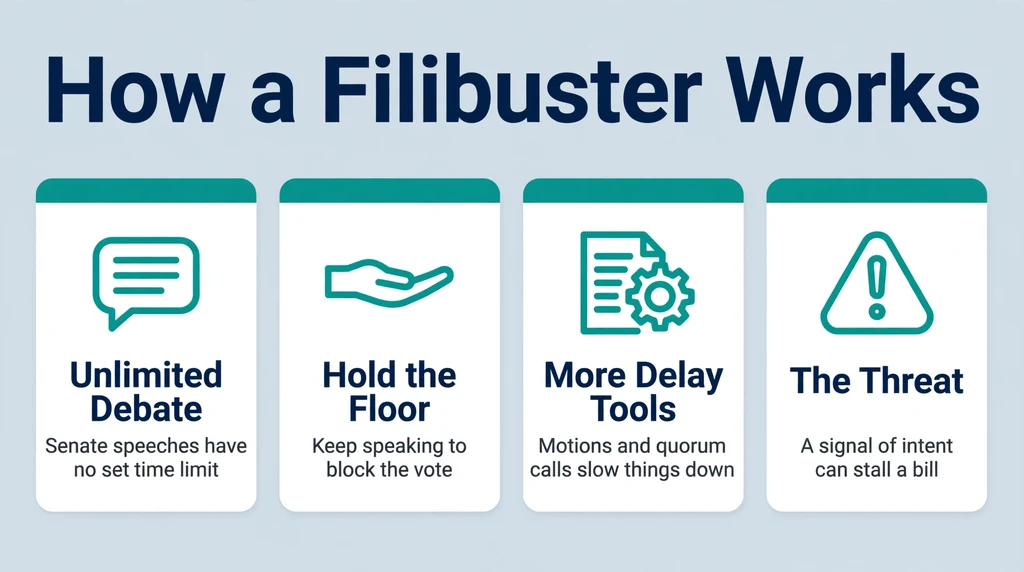
The filibuster is possible because of one unusual feature of the Senate. In this chamber, debate on most measures has no built-in time limit. A senator who is recognized by the presiding officer may keep speaking. Until that senator sits down, or the rules are used against the speech, the final vote cannot happen.
Unlimited debate is the starting point
The Senate’s tradition of open-ended debate is old. Senate historians note that delaying speeches appeared in the chamber’s very first session. In September 1789, Senator William Maclay wrote in his diary that some members planned to talk away the time so a bill could not pass. The early Senate had few tools to stop such tactics. For most of the 1800s, there was simply no formal process that let a majority end debate and force a vote. That gap is the space in which the filibuster grew.
Holding the floor
In its classic form, the tactic is physical. A senator gains recognition and then keeps the floor by speaking continuously. The senator cannot sit down or leave, and colleagues can only take over if the speaker yields. Determined groups sometimes rotated speakers, passing the floor between allies to stretch the effort for days. The speech itself does not always stay on topic under Senate custom. Famous filibustering senators read documents, lists, and long texts aloud to fill the hours. The content matters less than the clock, because every minute of speech is a minute without a vote.
Delay goes beyond speeches
Talking is only the best-known tool. The Senate glossary points to other methods, such as offering numerous procedural motions. Senators can also demand repeated quorum calls, propose long chains of amendments, or object to the routine agreements that normally speed business along. Each step forces the chamber to spend time. Modern filibusters often combine several of these tools at once. As a result, the word covers a family of delaying tactics, not one single performance.
Fighting back with round-the-clock sessions
A majority is not entirely helpless while a speech runs. One traditional countermeasure is to keep the Senate in session around the clock. The idea is simple attrition. If the filibustering side must stay on the floor at all hours, exhaustion may do what arguments cannot. Britannica lists round-the-clock sessions among the classic measures used to defeat a filibuster. The tactic strains everyone, though, including the majority’s own members, who must stay nearby for quorum calls. That shared burden is one reason such sessions are rare today.
Why the threat alone can work
Here is the part that surprises many readers. A modern filibuster often requires no speech at all. If enough senators signal that they will block a measure, the majority leader may simply move on to other business. The leader knows the votes to end debate are not there. So the threat performs the same work as the marathon speech. This quiet version explains why news reports say a bill “was filibustered” on days when nobody spoke for long. The blocking power lies in the arithmetic of the cloture rule, which the next section explains.
Cloture: The Vote That Ends a Filibuster
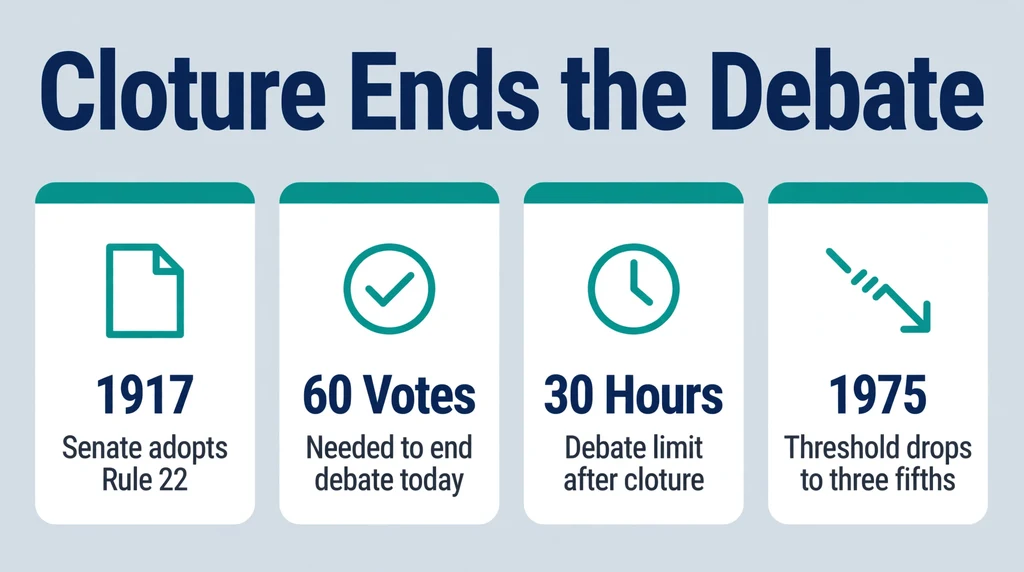
Every durable filibuster raises the same question. How does the majority ever fight back? The Senate’s answer is a procedure called cloture. Cloture is the formal vote to place a time limit on debate, and it is the only regular route around a determined filibuster.
How cloture works step by step
First, a group of senators files a cloture motion on the pending measure. Then the Senate takes up the motion after a short waiting period built into the rule. If the motion wins the required support, cloture is invoked and debate is capped. Under Rule XXII, further consideration of the measure is limited to thirty additional hours. After that time runs out, the Senate can finally hold its vote. If the motion falls short, though, debate may continue, and the filibuster survives.
The number that matters: sixty votes
Today, ending debate on most legislation requires three-fifths of all senators duly chosen and sworn. With a full Senate of one hundred members, that number is sixty votes. This is why forty-one senators can sustain a filibuster against a bill. They only need to keep the majority below sixty on the cloture vote. The final vote on the bill itself usually needs only a simple majority. So the real contest happens earlier, at the cloture stage. Many measures die there quietly, without any dramatic speech at all.
One bill can face two cloture fights
There is a second layer of delay that civics coverage often highlights. A major bill may need cloture more than once. Senators can filibuster the motion to begin debating a bill, before the bill itself is even discussed. Later, they can filibuster the bill again at the final stage. The National Constitution Center’s explainers describe these as two separate cloture votes, one to take up the measure and one on the measure itself. If either vote falls short of sixty, the measure sits in limbo. This doubling helps explain why Senate leaders count votes so carefully before scheduling anything controversial.
1917: the rule that changed everything
For more than a century, no cloture rule existed at all. The turning point came during the First World War. In 1917, a small group of senators filibustered a bill to arm American merchant ships. President Woodrow Wilson reacted with famous anger. He condemned “a little group of willful men” who had rendered the government helpless. At Wilson’s urging, the Senate adopted Rule XXII that year. The new rule allowed cloture with a two-thirds majority vote. It was first used successfully in 1919, to end a filibuster against the Treaty of Versailles.
1975: the threshold drops to sixty
The two-thirds bar proved hard to clear. Senate historians record that cloture succeeded only five times in the four decades after 1917. In 1975, the Senate lowered the requirement to the modern three-fifths standard, the sixty votes used today. One special case kept the higher bar. Changes to the Senate’s own rules still require two-thirds support to end debate. Otherwise, the sixty-vote line has defined the filibuster fight ever since.
Exceptions to the filibuster
Not everything in the Senate can be filibustered in the same way. In the 2010s, the Senate set new precedents for nominations. A 2013 precedent lowered the cloture threshold for executive and most judicial nominations to a simple majority. A 2017 precedent extended that approach to Supreme Court nominations. Budget reconciliation is another exception. That special process for budget-related bills cannot be filibustered, so such measures can pass with a simple majority. These exceptions explain why some major actions move quickly while ordinary bills stall.
Talking Filibuster vs Silent Filibuster
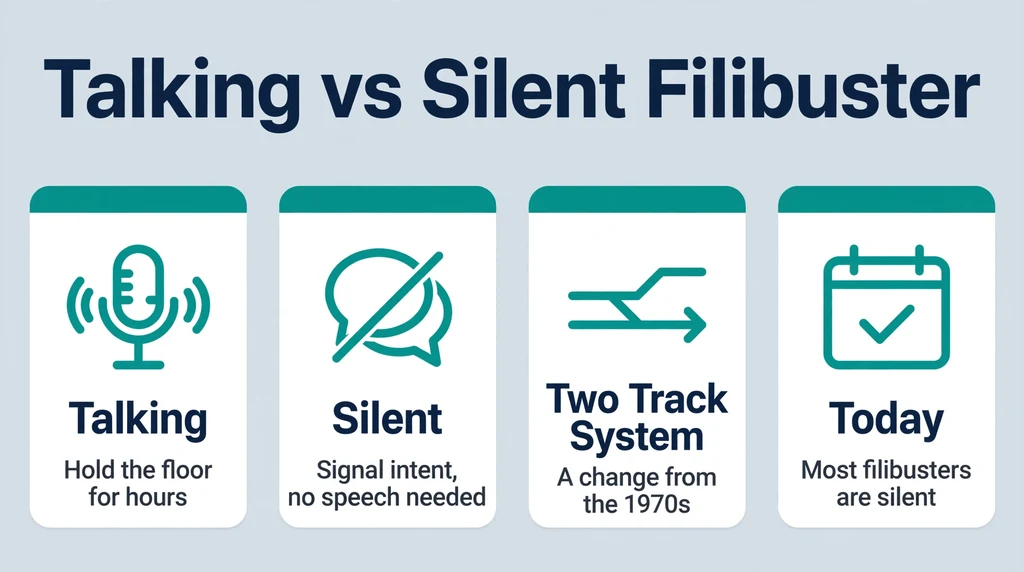
People often picture a filibuster as a lone senator reading names from a phone book at 3 a.m. That image is real, but it belongs mostly to an earlier era. The modern version usually happens in silence, and the difference between the two forms explains much about today’s Senate.
The classic talking filibuster
In the talking form, the obstruction is visible and exhausting. A senator must hold the floor, speak for hours, and endure the physical strain. All other business slows or stops while the speech continues. This format carried real costs for the filibustering side. It also drew public attention, which was sometimes the point. Senators such as Huey Long in the 1930s used long speeches partly as public theater. The talking filibuster demanded commitment, so it stayed relatively rare.
The two-track system and the silent era
The change came in the 1970s with an arrangement called the two-track system. Under this approach, the Senate could set a filibustered bill aside temporarily and handle other business on a second track. Life became easier for everyone, including the blockers. A senator no longer had to speak for hours to sustain an objection. Merely signaling an intent to filibuster could be enough. Scholars describe the result as the silent filibuster. Because the cost dropped, the tactic became far more common, and the sixty-vote threshold quietly became the normal price of passing major legislation.
Famous Filibusters in History
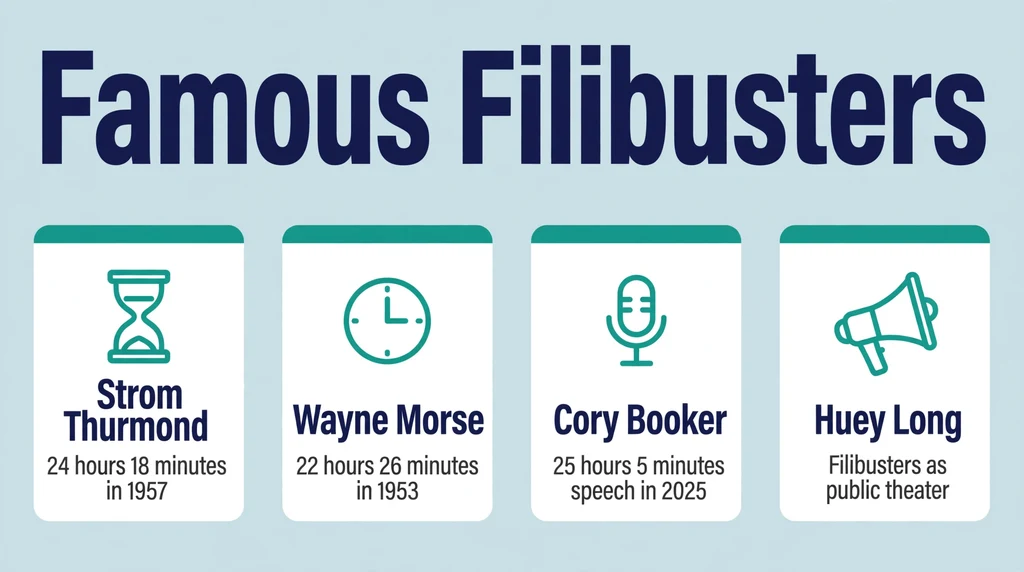
Records give the definition a human shape. The Senate’s own history pages celebrate some of these marathons, and journalists still rank them today. Each record below is documented by Senate historians or by multiple reputable accounts.
Early record holders
In 1908, Wisconsin senator Robert La Follette spoke for more than eighteen hours, an endurance mark for his era. Oregon senator Wayne Morse broke new ground in 1953. Protesting legislation about offshore oil lands, Morse held the floor for twenty-two hours and twenty-six minutes. His record stood for only four years. These early marathons showed how completely one determined member could dominate the chamber. They also built the public image of the filibuster as a test of stamina.
Huey Long and the filibuster as theater
Louisiana senator Huey Long turned the tactic into a public spectacle in the 1930s. Senate historians note that Long used the filibuster against bills he believed favored the rich over the poor. His long speeches mixed policy attacks with humor, stories, and readings. Crowds followed them in newspapers and on the radio, which was part of the strategy. Long showed that a filibuster could aim at the public as much as at the Senate. That lesson, that the speech itself can be the message, still shapes how senators use the floor today.
Strom Thurmond and the 1957 record
The most famous individual filibuster belongs to South Carolina senator Strom Thurmond. In August 1957, Thurmond spoke against the Civil Rights Act of 1957 for twenty-four hours and eighteen minutes. He read election laws, court material, and other documents to fill the time. The speech still holds the record for the longest individual filibuster. Yet the story ends with an important lesson. The bill passed anyway, shortly after he finished. A filibuster can delay a determined majority, but delay alone does not always defeat it.
The 1964 civil rights filibuster
Some filibusters are team efforts measured in weeks, not hours. In 1964, a group of southern senators filibustered the Civil Rights Act for more than two months of debate. The standoff became a landmark test of the cloture rule. That June, the Senate finally gathered enough votes to invoke cloture. Senate historians note that 1964 marked the first time the Senate overcame a filibuster to pass a major civil rights bill. The episode showed both sides of the tactic. It could stall landmark legislation for months, yet a broad enough coalition could still break it.
The longest Senate speech: Cory Booker
In April 2025, New Jersey senator Cory Booker spoke for twenty-five hours and five minutes. That performance set the record for the longest individual speech in Senate history. However, careful explainers add a footnote. Because Booker was not delaying a specific pending measure, his speech is generally not classed as a true filibuster. The distinction matters for quizzes and history lists. Thurmond still holds the filibuster record. Booker holds the broader speech record.
Mr. Smith and the movie version
For many people, the first filibuster they ever saw happened in a cinema. Frank Capra’s 1939 film Mr. Smith Goes to Washington ends with a fictional senator collapsing after a day-long filibuster. Senate historians themselves point to the film when explaining the tactic’s popular image. The movie fixed the talking version in the public mind. Real senators have been measured against that dramatic template ever since, even though the modern tactic usually involves no speech at all.
Which form do we have today
Today’s Senate runs almost entirely on the silent version. Leaders negotiate around the sixty-vote line before debate even begins. Long speeches still occur, but usually as protests or messaging events rather than true blocking moves. When a senator does hold the floor for many hours now, it often ends by prior agreement. The contrast with the Texas rules in the next section is sharp. Knowing which form a report describes is the key to understanding what actually happened.
Filibusters Outside the US Senate
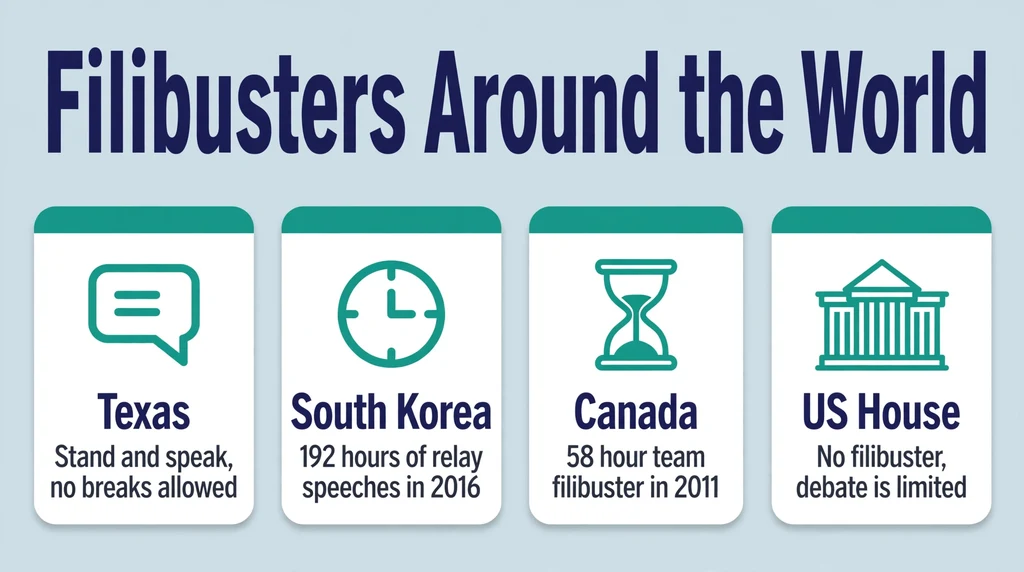
The filibuster is strongly tied to the United States Senate, but it is not confined to that one room. Other chambers in America and abroad have their own versions. Comparing them shows how much the details depend on local rules.
Why the House has no filibuster
The United States House of Representatives cannot be filibustered in the Senate style. House rules limit how long members may speak, and the House can vote to close debate. The chamber is much larger, with 435 members, so open-ended debate would grind it to a halt. Because speaking time is capped, no single House member can hold business hostage by talking. This contrast is a favorite civics point. The filibuster exists in the Senate not because of the Constitution, but because Senate rules and traditions left debate open.
Texas and its strict standing rules
The Texas Senate keeps the old-fashioned talking version, with harsh conditions. A filibustering senator must stand the entire time, without leaning on a desk or chair. The speech must stay on the topic of the bill. There are no breaks for food, drink, or the restroom, and three sustained points of order can end the speech. In June 2013, state senator Wendy Davis spoke for nearly eleven hours under those rules to block a bill in a special session. The effort succeeded for that session. Even so, the measure returned and passed a few weeks later in a new session.
South Korea’s world record relay
The longest team filibuster on record unfolded in South Korea in 2016. From February 23 to March 2, opposition lawmakers in the National Assembly spoke in relay against an anti-terrorism bill. In total, thirty-eight or thirty-nine lawmakers kept the speeches going for 192 hours and 25 minutes across nine days. News agencies reported the effort as a world record for a filibuster. The final speaker, Lee Jong-kul, set a Korean individual record of twelve hours and thirty-one minutes. The lawmakers ended the protest voluntarily, and the bill then passed.
Canada and other relay efforts
Before South Korea, the team record belonged to Canada. In 2011, members of the New Democratic Party sustained a filibuster of roughly fifty-eight hours in the House of Commons. Other parliaments have seen similar relay tactics, because the basic idea travels well. Wherever rules allow long speeches and weak closure, a minority can trade stamina for time. The details differ by country. The strategy, however, is recognizably the same one that grew up in the United States Senate.
Arguments For and Against the Filibuster
Any honest explainer must note that Americans argue about this practice constantly. The Senate’s own history page frames the two classic positions in a single sentence. The filibuster is described by admirers as a protector of political minorities from the tyranny of the majority. It is attacked by detractors as a tool of obstruction. Supporters add that the sixty-vote threshold forces broader agreement before major laws pass. In their view, that requirement slows rash decisions and gives the minority a real voice. Critics answer that the modern silent version blocks action without any public debate at all. They also note that measures with majority support can fail without ever receiving a final vote. This article takes no side in that debate. For the meaning of the word, what matters is that both arguments start from the same definition: extended debate used to delay or prevent a vote.
Because the stakes are high, reform proposals surface regularly in Washington debate. Some proposals, discussed by members of both parties at different times, would restore the talking filibuster and make blockers hold the floor again. Others would lower the cloture threshold gradually, or exempt certain categories of business. Each idea has attracted support and opposition in turn, sometimes from the same senators in different years, depending on whether their party held the majority. The arguments, notably, tend to swap sides with the election results.
Filibuster in Sentences
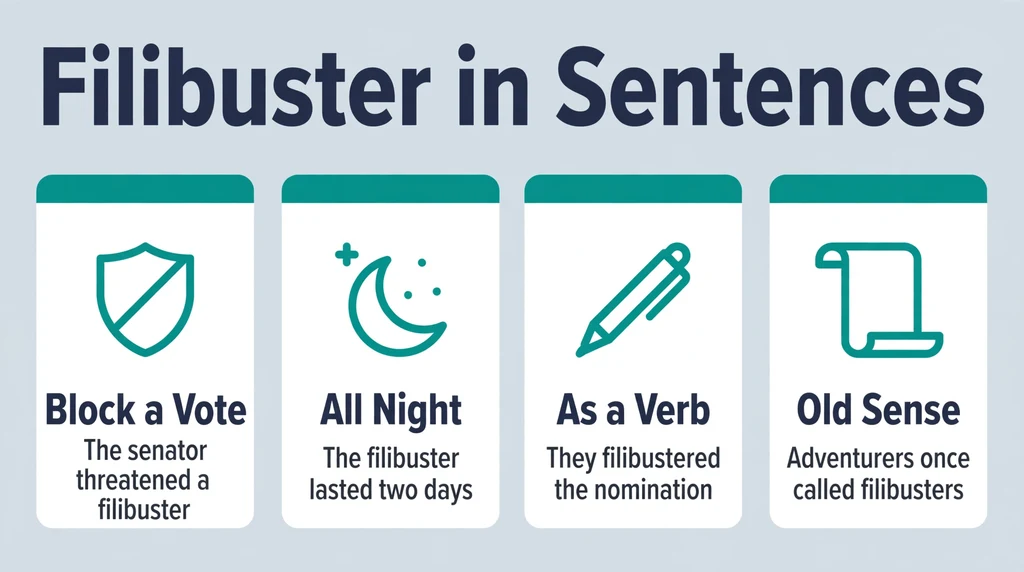
Seeing the word in action helps fix its meaning. The examples below use original, everyday sentences for each common sense of the word.
- The senator threatened a filibuster unless the committee agreed to hear more witnesses.
- After a two-day filibuster, the exhausted lawmakers finally voted on the bill.
- The minority filibustered the nomination until the leadership offered a compromise.
- Texas rules make a filibuster a genuine test of endurance, not just of patience.
- Historians still call Thurmond’s 1957 filibuster the longest individual effort on record.
- In the 1850s, newspapers used filibuster for adventurers who invaded foreign lands.
- She joked that her uncle could filibuster any family dinner by telling war stories.
Common Misconceptions About the Filibuster
Myths cling to this word because it sits at the center of so many arguments. A few corrections make the real picture clearer.
Misconception one: the Constitution created it
The Constitution never mentions the filibuster. No statute creates it either. The practice exists because Senate rules allow long debate and, for over a century, offered no way to cut it off. It is a product of procedure and tradition, not of the founding text.
Misconception two: a filibuster means nonstop talking
That was once mostly true. Today, the signal of intent usually does the work, thanks to the two-track system and the cloture arithmetic. Many measures described as filibustered never faced a single long speech. The talking image survives because it is dramatic, not because it is typical.
Misconception three: only one senator can filibuster
A filibuster can be a solo stand, a rotating team, or a whole party bloc. The 1964 civil rights filibuster was a group effort lasting weeks. South Korea’s record effort used dozens of speakers in relay. The word describes the delay, however many people produce it.
Misconception four: a filibuster always kills the bill
Delay is not the same as defeat. Thurmond spoke for more than a day, and his target bill passed soon after. The Davis filibuster in Texas blocked a bill for one session only. A filibuster buys time and bargaining power. Sometimes that is enough to win changes, and sometimes it is not.
Misconception five: filibusters only block bills
Legislation is the most famous target, but it is not the only one. Filibusters have also been aimed at nominations, treaties, and procedural motions. The cloture fights over presidential nominees grew so intense that the Senate carved out exceptions for them in 2013 and 2017. The word applies to the delay itself, whatever the pending business happens to be.
Frequently Asked Questions
What is a filibuster in simple terms?
A filibuster is a way for lawmakers to delay or block a vote by extending debate. In the United States Senate, that usually means speaking for a very long time or credibly threatening to. The goal is to stop the chamber from reaching a final decision on a bill or nomination.
How do you pronounce filibuster?
Say it as FIL-uh-bus-ter, with the stress on the first syllable. The word has four syllables and a soft ending that sounds like “buster.” It is spelled the same as the verb, so context tells you whether someone means the tactic or the action.
How many votes does it take to end a filibuster?
For most legislation, ending debate requires a cloture vote of three-fifths of the Senate. In a full Senate, that is sixty of one hundred senators. Nominations are an exception, since Senate precedents from 2013 and 2017 allow cloture by a simple majority.
What is the difference between a filibuster and cloture?
A filibuster is the delaying tactic itself. Cloture is the procedure the majority uses to end debate and force a vote. One extends time, and the other limits it. The two words form a pair, because modern filibuster fights are usually decided by whether a cloture motion reaches sixty votes.
What was the longest filibuster ever?
The longest individual filibuster was Strom Thurmond’s speech of twenty-four hours and eighteen minutes in 1957. For a team effort, the record belongs to South Korea, whose lawmakers relayed speeches for 192 hours in 2016. Cory Booker holds the broader record for a single Senate speech, at twenty-five hours and five minutes in 2025, although it is not classed as a filibuster.
Why can senators filibuster but House members cannot?
Senate traditions allow unlimited debate on most measures, and its rules long lacked a way to cut debate short. The House, by contrast, limits speaking time and can vote to end debate. That is why the tactic lives in the Senate and not in the House.
Does a filibuster require constant talking?
Not anymore. The classic version did, and some state senates still demand it. In the modern United States Senate, senators can usually sustain a filibuster by signaling their intent. The majority then needs sixty votes for cloture, whether or not anyone is speaking.
Where did the word filibuster come from?
It comes from the Dutch word vrijbuiter, meaning a freebooter or pirate, by way of the Spanish filibustero. The label moved from Caribbean pirates to nineteenth-century American adventurers, and then to lawmakers who waged private procedural wars in the 1850s Senate.
Final Thoughts
Filibuster is one of those rare words whose meaning, history, and controversy all fit in a single story. It means a deliberate attempt to delay or block a vote by extending debate. Its name recalls pirates and freelance adventurers who answered to no one. Its rules, shaped in 1917 and 1975, decide how much agreement American lawmaking requires. For the Senate’s own account of the practice and its history, the United States Senate’s overview of filibusters and cloture is the natural next stop. Once you know the word, the headlines read differently. Behind every report of a bill “stalled in the Senate,” there is usually this old tactic, still doing the job its pirate name suggests.