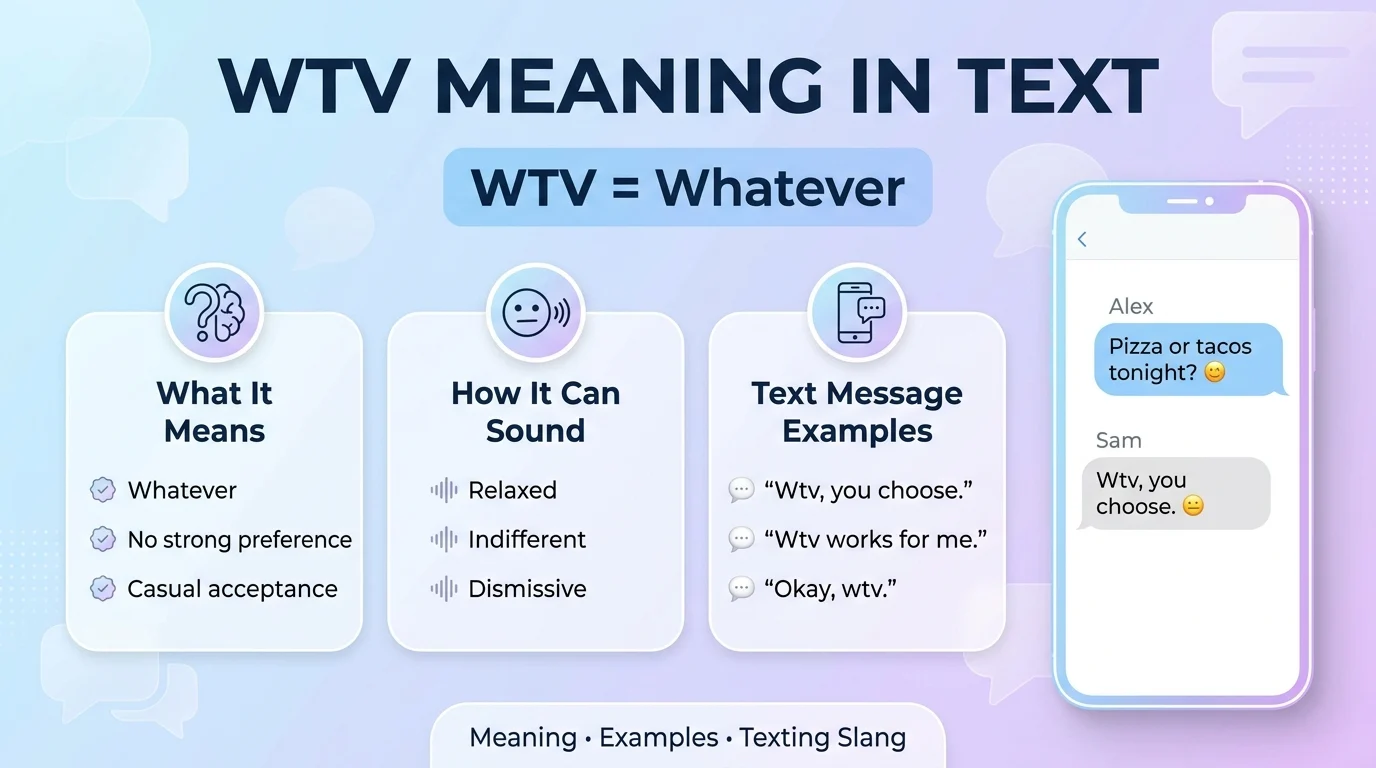
Have you ever received a text that simply says “wtv” and wondered what the other person meant? This three-letter abbreviation appears in casual text messages, social media conversations, and online chats. Depending on the situation, it can sound relaxed, uninterested, or even a little rude.
WTV means “whatever” in texting and online communication. People use it when they don’t have a strong preference, want someone else to make a decision, or feel ready to move on from a conversation.
For example, imagine asking your friend, “Do you want pizza or burgers?” If they reply, “Wtv, you choose,” they’re probably letting you decide. However, if someone texts “Okay, wtv” during an argument, they might be expressing frustration or dismissing the discussion.
The meaning stays roughly the same, but the tone can change considerably. Understanding the conversation around the abbreviation helps you figure out what the sender actually intends.
In this guide, you’ll learn the WTV meaning in text, how people use it, whether it sounds rude, what it means on social media, and how to respond naturally.
What Does WTV Mean in Texting?
WTV is an informal abbreviation for “whatever.” People use it in text messages and online conversations because it’s shorter and quicker to type than the complete word.
The abbreviation usually communicates one of three ideas:
- Indifference: The person doesn’t have a strong opinion or preference.
- Acceptance: The person is comfortable with whatever option someone chooses.
- Dismissal: The person wants to stop discussing a topic or doesn’t want to engage further.
The surrounding conversation helps distinguish these meanings. A friend who replies “wtv” when choosing a restaurant might genuinely be flexible. Someone who sends the same message after a disagreement might feel annoyed.
WTV Definition at a Glance
| Detail | Meaning |
|---|---|
| Abbreviation | WTV |
| Full form | Whatever |
| Common lowercase form | wtv |
| Type | Informal texting abbreviation |
| Main use | Expressing indifference, acceptance, or dismissal |
| Common platforms | Text messages, Snapchat, Instagram, TikTok, and WhatsApp |
| Tone | Neutral, casual, uninterested, or dismissive, depending on context |
| Formality | Very informal |
Example:
Person A: “Where should we go after school?”
Person B: “Wtv, I’m good with anything.”
Here, the sender doesn’t have a specific preference. They’re happy to let the other person decide.
What Does WTV Stand For?
WTV commonly stands for “whatever.” It’s a shortened written form rather than a separate word with an entirely different meaning.
People often use lowercase wtv in casual conversations. Others write WTV or Wtv. These capitalization differences generally don’t change the intended meaning.
You’ll also see WTV used at the beginning, middle, or end of a message.
For example:
- “Wtv, let’s just watch a movie.”
- “You can wear wtv you want.”
- “I’m fine with that or wtv works for you.”
- “Get whatever snacks you want, chips or wtv.”
In each example, the abbreviation relates to the idea of “whatever.” However, replacing the complete word works best when the sentence remains natural and easy to understand.
Is WTV an Acronym or an Abbreviation?
WTV is best described as an informal abbreviation used in digital communication. People generally understand it as a shortened form of “whatever,” rather than as a conventional acronym they pronounce as a word.
In everyday texting, this technical distinction isn’t especially important. If someone asks what WTV stands for, the useful answer is simply “whatever.”
What Does WTV Mean in Different Contexts?
Although WTV usually means “whatever,” it doesn’t always communicate the same feeling. The sender’s word choice, the topic, and the messages around it can change how the abbreviation comes across.
Here are the most common interpretations.
WTV Can Mean “I Don’t Have a Preference”
Sometimes, WTV is a straightforward way to say that any available option is fine.
People often use it when making everyday decisions. Choosing a restaurant, picking a movie, or deciding what to do over the weekend rarely requires a long discussion.
Example:
You: “Should I order Chinese food or make pasta?”
Friend: “Wtv, both sound good.”
Your friend isn’t necessarily uninterested in the conversation. They simply don’t care which meal you choose because either option works for them.
In this situation, WTV communicates flexibility. A more formal version would be “Either option is fine with me.”
WTV Can Express Casual Acceptance
Another common use is to let someone else make a decision.
The sender might have no strong preference, trust the other person’s judgment, or want to keep the conversation moving.
Example:
Person A: “We’re watching a comedy tonight. Is that okay?”
Person B: “Wtv you want to watch is fine.”
The reply indicates that the sender is willing to go along with the other person’s choice.
However, don’t assume every use of WTV signals enthusiastic agreement. Someone can accept a decision without feeling particularly excited about it.
WTV Can Sound Dismissive
WTV may also suggest that the sender doesn’t care about the discussion or doesn’t want to continue it.
This interpretation becomes more likely when the conversation already includes frustration, disagreement, or repeated explanations.
Example:
Person A: “You never listen when I explain what happened.”
Person B: “Okay, wtv.”
In this exchange, WTV sounds dismissive because it appears during a disagreement. The sender may feel frustrated or unwilling to continue the conversation.
Still, one message doesn’t reveal everything about someone’s intentions. Look at the broader conversation before deciding that the person is angry.
WTV Can Mean “I Don’t Want to Choose”
Sometimes, people use WTV when they’d rather avoid making a small decision.
Example:
You: “Which shirt should I wear?”
Friend: “Wtv looks good on you.”
The friend leaves the choice to you rather than selecting a specific shirt.
This meaning overlaps with casual acceptance, but there’s a slight difference: the sender isn’t necessarily agreeing to a decision already made. They’re letting someone else choose in the first place.
WTV Can Signal That Someone Wants to Move On
A conversation doesn’t always end with an explicit goodbye. Sometimes, a brief reply signals that the sender has lost interest in the current topic.
Example:
Person A: “We’ve been arguing about this for an hour.”
Person B: “Wtv. Let’s talk about something else.”
Here, the sender wants to stop discussing the issue.
That doesn’t automatically mean the relationship is in trouble. They might simply be tired of repeating the same points. If the subject is important, however, ending the conversation with WTV may leave the other person feeling dismissed.
How Is WTV Used in Text Messages?
People use WTV in different types of casual conversations, from everyday planning to conversations with close friends. Its meaning depends partly on what the sender wants to communicate.
WTV in Everyday Conversations
Everyday conversations often involve small decisions. WTV offers a quick response when someone doesn’t care which option wins.
Examples include:
- “Wtv, let’s get coffee.”
- “You can pick wtv movie you want.”
- “I’m free whenever, so wtv works.”
- “Wear wtv makes you comfortable.”
These messages generally communicate flexibility or a lack of preference.
For clearer writing, you can also use the full word “whatever.” For example, “Wear whatever makes you comfortable” sounds natural and reads more smoothly than forcing the abbreviation into every sentence.
WTV Between Friends
Friends often develop their own texting habits. If two people regularly use abbreviations, a short WTV reply may feel perfectly ordinary rather than cold or unfriendly.
Example:
Friend A: “I found three places we could eat tonight.”
Friend B: “Wtv, I’m hungry 😂”
Friend A: “Haha okay, let’s go to the closest one.”
The laughing emoji and friendly exchange make the reply sound lighthearted. The sender cares more about eating together than choosing a particular restaurant.
However, familiarity doesn’t guarantee a positive meaning. If a friend usually gives thoughtful responses but suddenly replies “wtv” after a serious message, the change in tone may be worth noticing.
WTV During an Argument
Arguments can make short abbreviations feel sharper than intended. WTV may act as a quick way to express frustration or stop a conversation.
Example:
Person A: “I told you I’d be late. Why are you upset?”
Person B: “Wtv, forget it.”
This reply can suggest that Person B feels frustrated or doesn’t want to explain their feelings further.
The important detail is the context. WTV isn’t automatically hostile, but it can sound dismissive when the other person expects a thoughtful response.
WTV in Group Chats
Group chats often move quickly. Several people may suggest restaurants, movies, meeting times, or weekend activities at once.
WTV lets someone express flexibility without weighing in on every suggestion.
Example:
Mia: “Are we meeting at 6 or 7?”
Noah: “Wtv works for everyone else.”
Mia: “Let’s make it 7.”
Noah leaves the decision to the group. In this case, WTV helps keep a low-stakes conversation moving.
Common WTV Text Examples and Their Meanings
The same abbreviation can communicate different attitudes depending on the sentence.
| Text message | Likely interpretation |
|---|---|
| “Wtv, you pick.” | The sender leaves the choice to you. |
| “Wtv works for me.” | The sender accepts the available option. |
| “Okay, wtv.” | The sender may sound uninterested or annoyed. |
| “Wear wtv you like.” | The sender gives you freedom to choose. |
| “Wtv, let’s move on.” | The sender wants to change the subject. |
| “I’ll watch wtv you’re watching.” | The sender is flexible about the choice. |
| “Fine, wtv.” | The sender may be frustrated or reluctantly accepting. |
These are examples of informal usage, not fixed definitions. The tone can shift with the relationship, the situation, and the sender’s usual communication style.
Is WTV Rude or Disrespectful in Texting?
WTV isn’t inherently rude, but it can sound dismissive. The word “whatever” has several possible tones in everyday English, and the abbreviation carries those same possibilities into text messages.
Because text lacks the vocal tone and facial expressions you get in person, readers sometimes have to infer the sender’s intention.
When WTV Sounds Rude
WTV may come across as disrespectful in situations such as these:
- During an argument: A one-word reply can make the other person feel that their concerns don’t matter.
- After a serious question: If someone shares something personal and receives “wtv,” the response may feel uncaring.
- When ending a discussion abruptly: WTV can suggest that the sender no longer wants to listen.
- When paired with dismissive wording: Phrases such as “fine, wtv” may communicate frustration rather than agreement.
For instance, imagine telling a friend that something they did hurt your feelings. If they reply “WTV,” the response may feel dismissive because it doesn’t acknowledge your concern.
When WTV Isn’t Rude
On the other hand, WTV can be completely harmless in a relaxed conversation.
Consider this exchange:
You: “Do you want to sit inside or outside?”
Friend: “Wtv, either is fine.”
Your friend is simply saying that both options work. There’s no clear sign of disrespect.
Similarly, when a group is choosing a movie, a message such as “Wtv, you guys decide” can communicate flexibility rather than apathy toward the people involved.
How to Tell What Someone Means by WTV
Before interpreting a WTV message negatively, consider a few clues.
Look at the previous messages. If you were discussing something trivial, the reply may be neutral. If you were arguing, it may carry more frustration.
Consider the person’s usual style. Someone who regularly sends short messages may not intend to sound rude. A sudden change from their normal behavior may deserve more attention.
Notice the wording around WTV. “Wtv works for me” sounds more accommodating than “Fine, wtv.”
Look at what happens next. Someone who continues chatting normally may have meant nothing serious. Someone who repeatedly shuts down important conversations may be expressing a broader reluctance to engage.
Ask for clarification when necessary. A simple question can resolve uncertainty more effectively than guessing what three letters mean.
What Does WTV Mean From a Girl or a Guy?
People sometimes search for the WTV meaning from a girl or a guy because they want to understand the emotions behind a message.
The basic definition doesn’t change with the sender’s gender. WTV generally means “whatever,” but its tone depends on the particular conversation and the person sending it.
What Does WTV Mean From a Girl?
If a girl texts you WTV, she may be expressing any of the following:
- She doesn’t have a preference about a decision.
- She’s happy to let you choose.
- She’s feeling annoyed or disappointed.
- She wants to move on from the current discussion.
- She’s simply using her normal casual texting style.
For example:
You: “Should we go out Friday or Saturday?”
Her: “Wtv, whichever works for you.”
This reply likely indicates flexibility.
Now consider a different exchange:
You: “Why didn’t you tell me you changed the plan?”
Her: “Okay, wtv.”
The second reply might sound frustrated because of the disagreement that came before it.
Neither message proves a particular emotion on its own. Read the entire exchange rather than assuming that WTV has a special meaning when a girl uses it.
What Does WTV Mean From a Guy?
A guy may use WTV to communicate indifference, casual acceptance, or frustration, just as anyone else might.
For instance:
You: “Which game do you want to play?”
Him: “Wtv, you choose.”
He may simply have no preference.
But if a discussion becomes tense and he replies, “Wtv, forget it,” he may be tired of arguing or unwilling to continue the conversation.
The most useful clues are his wording, his usual communication style, and the subject being discussed. WTV alone doesn’t prove that someone is angry, losing interest, or trying to send a hidden romantic signal.
What Does WTV Mean in a Relationship?
In a relationship, WTV can feel more significant because partners often expect each other to communicate openly.
A partner might use it when they genuinely don’t mind which restaurant you choose. Alternatively, they may send it after a disagreement because they’re frustrated or need space.
The context makes a difference.
| Situation | Possible meaning | Helpful response |
|---|---|---|
| Choosing a date-night activity | Either option is fine. | “Great, I’ll pick a place.” |
| Discussing weekend plans | No strong preference. | “Would you rather do something outdoors or stay in?” |
| After a disagreement | Possible frustration or withdrawal. | “I want to understand what you’re feeling. Can we talk?” |
| During a routine conversation | Casual shorthand. | Continue the conversation naturally. |
Don’t treat a single WTV message as proof that your partner doesn’t care about you. If the reply feels unusual or a pattern of dismissive communication develops, a direct conversation offers more reliable insight.
What Does WTV Mean on Snapchat, Instagram, TikTok, and WhatsApp?
WTV usually retains its meaning of “whatever” across social media platforms. The platform may change how people communicate, but it doesn’t automatically give the abbreviation a different definition.
WTV Meaning on Snapchat
On Snapchat, WTV may appear in direct messages, snap replies, or conversations between friends.
Example:
You: “Are we keeping our streak going today?”
Friend: “Yeah, send wtv 😂”
In this example, the sender uses WTV to mean “whatever” or “anything,” depending on the intended wording. They may be suggesting that the particular snap doesn’t matter much.
A single “wtv” reply can also sound dismissive if it follows a disagreement. Consider the message history before deciding which tone applies.
WTV Meaning on Instagram
On Instagram, people may use WTV in direct messages, comments, or casual exchanges about posts and plans.
Example:
You: “Which picture should I post?”
Friend: “Wtv one you like best.”
The friend is leaving the choice to you rather than choosing a particular image.
In a comment thread, WTV may sound more dismissive if someone uses it to reject another person’s opinion without explaining why. However, the abbreviation itself doesn’t automatically indicate hostility.
WTV Meaning on TikTok
TikTok users may write WTV in comments, captions, and direct messages.
Example:
User A: “Which trend should we try next?”
User B: “Wtv is easiest 😂”
Here, the sender doesn’t have a strong preference about the trend. They simply suggest choosing the easiest option.
As with other platforms, WTV generally means “whatever.” Don’t assume that the abbreviation represents a separate TikTok-specific slang term without evidence from the conversation.
WTV Meaning on WhatsApp
WhatsApp messages and group chats often include informal abbreviations that help people respond quickly.
Example:
Person A: “Should I bring soda or juice?”
Person B: “Wtv you have is fine.”
The sender is saying that either option works.
If WTV appears during a serious conversation on WhatsApp, interpret it as you would in a regular text message. The surrounding discussion matters more than the app itself.
How Do You Respond to WTV in a Text?
The best response depends on what the person seems to mean. You don’t need to turn every short reply into a serious conversation. Match your answer to the situation.
When WTV Sounds Casual
If someone uses WTV while choosing food, making plans, or discussing another low-stakes decision, you can respond naturally.
Examples include:
- “Okay, I’ll choose!”
- “Cool, let’s go with pizza.”
- “Sounds good to me.”
- “Perfect, I’ll make the plan.”
- “Great, either works for me too.”
These replies keep the conversation moving without overthinking a harmless abbreviation.
When Someone Seems Annoyed
If WTV appears after a disagreement, avoid immediately accusing the person of being rude. Ask a calm question instead.
You could say:
- “Are you upset about something?”
- “I’m not sure how to read that. Are we okay?”
- “I feel like something’s bothering you. Want to talk?”
- “I don’t want to argue. Let’s work this out.”
Your goal should be to understand the problem, not to win an argument about a short message.
When You’re Unsure What WTV Means
Sometimes, the context isn’t clear enough to reveal the sender’s intention. A brief clarification can prevent misunderstandings.
Try these responses:
- “Do you mean you don’t mind?”
- “Are you leaving the choice up to me?”
- “Just checking—are you okay with the plan?”
- “Would you rather pick something yourself?”
These questions are useful because they address the practical issue without assuming that the person meant something negative.
When Someone Uses WTV to End an Argument
If the conversation has become tense, you may need to give the other person some space.
For example, you could reply:
“Okay, let’s take a break and talk when we’re both ready.”
This acknowledges the situation without escalating it.
If the subject matters, return to it when both people can communicate more calmly. A dismissive exchange rarely becomes more productive when either person keeps pushing for an immediate answer.
WTV vs. Other Texting Abbreviations
WTV belongs to a broad group of informal expressions that people use to communicate quickly. Some have similar tones, while others express entirely different ideas.
Understanding these distinctions can help you interpret a message more accurately.
| Abbreviation | Full meaning | How it differs from WTV |
|---|---|---|
| WTV | Whatever | Expresses indifference, flexibility, or dismissal. |
| IDC | I don’t care | More directly states a lack of concern or interest. |
| IDK | I don’t know | Expresses uncertainty or a lack of knowledge. |
| NVM | Never mind | Withdraws a previous question or tells someone to disregard something. |
| WTH | What the heck | Expresses surprise, confusion, or frustration. |
| WYM | What do you mean? | Asks for clarification. |
| TBH | To be honest | Introduces a candid opinion or statement. |
| IDGAF | I don’t give a f*** | Expresses strong indifference using profanity. |
| IMO | In my opinion | Signals a personal viewpoint. |
| OFC | Of course | Communicates agreement or confirmation. |
| NGL | Not gonna lie | Introduces a candid or potentially blunt statement. |
| LMK | Let me know | Asks someone to provide information or an update. |
WTV vs. IDC
WTV and IDC can both communicate indifference, but they aren’t interchangeable in every situation.
Means “whatever.” Depending on the sentence, it can indicate that the sender has no preference or doesn’t want to continue a topic.
IDC means “I don’t care.” It makes the lack of concern more explicit.
For example:
Question: “Should we order pizza?”
Reply A: “WTV, you choose.”
Reply B: “IDC.”
The first reply leaves the decision open. The second more directly states that the sender doesn’t care about the choice. Neither response necessarily indicates anger, though either could sound dismissive in the wrong context.
WTV vs. IDK
These abbreviations express different ideas.
WTV usually communicates “whatever,” while IDK means “I don’t know.”
For example:
You: “Which movie do you want to watch?”
Friend A: “WTV, they’re all fine.”
Friend B: “IDK. I haven’t seen any of them.”
Friend A doesn’t have a preference. Friend B is uncertain because they lack the information needed to decide.
WTV vs. NVM
NVM stands for “never mind.” People use it to withdraw a question, dismiss a previous point, or indicate that something no longer needs attention.
For example:
You: “Can you help me with something?”
Friend: “Sure, what is it?”
You: “Nvm, I figured it out.”
WTV would communicate a different idea. If you said “WTV, you decide,” you’d be leaving a choice to the other person rather than withdrawing your request.
WTV vs. WTH
WTH commonly means “what the heck” and expresses surprise, confusion, disbelief, or frustration.
For example:
You: “The meeting got canceled five minutes before it started.”
Friend: “WTH? Seriously?”
The friend is reacting with surprise. WTV wouldn’t communicate that same reaction because its usual meaning centers on “whatever.”
WTV vs. Whatever
The difference between WTV and “whatever” is mainly one of form.
WTV is a shortened written form of “whatever.” The full word is clearer for readers who aren’t familiar with texting slang, while the abbreviation fits casual digital conversations.
Both can sound neutral or dismissive depending on how someone uses them. Writing the full word doesn’t automatically make a message friendlier.
When Should You Use WTV in a Text Message?
WTV works best in casual situations where both people understand informal texting. It’s convenient when a short response communicates everything the conversation requires.
Situations Where WTV Works Well
Consider using WTV when:
- You’re chatting with friends who regularly use texting abbreviations.
- You genuinely don’t have a preference about a small decision.
- Someone asks you to choose between several acceptable options.
- You’re participating in a relaxed group conversation.
- You want to communicate informally rather than write a full sentence.
For example, “Wtv, let’s meet at 7” may work perfectly well in a casual group chat.
Situations Where You Should Avoid WTV
Although the abbreviation is convenient, it doesn’t suit every conversation.
Avoid using it when:
- You’re replying to a serious or emotionally sensitive message.
- Someone needs a clear decision or detailed answer.
- You’re communicating with a customer, manager, teacher, or professional contact.
- The other person might interpret a brief response as disrespectful.
- You need to explain a disagreement or resolve a misunderstanding.
In a workplace conversation, for example, “WTV works” may sound careless. A clearer reply such as “Either option works for me” communicates the same basic idea without the casual tone.
Clearer Alternatives to WTV
If you want to avoid sounding dismissive, use a phrase that communicates your actual intention.
| Instead of WTV | Try this | Why it helps |
|---|---|---|
| “Wtv, you pick.” | “You can choose.” | Makes your intention clear. |
| “Wtv works.” | “Either option works for me.” | Sounds more considerate. |
| “Fine, wtv.” | “I’m okay with it. Let’s move on.” | Reduces the chance of sounding dismissive. |
| “Wtv you want.” | “I’m happy with whichever you prefer.” | Communicates flexibility politely. |
| “Wtv.” | “I need a little time to think.” | Explains when you’re not ready to respond. |
The best option is the one that matches your real feelings. Clear communication often saves time and prevents unnecessary misunderstandings.
Frequently Asked Questions About WTV Meaning in Text
What Does WTV Mean in Texting?
WTV commonly means “whatever.” People use it in text messages and online chats to express indifference, acceptance, or dismissal. The surrounding conversation helps you identify the intended tone.
Is WTV Short for Whatever?
Yes. In casual texting, WTV is a shortened form of “whatever.” People often write it in lowercase as wtv.
Does WTV Mean Someone Doesn’t Care?
Not necessarily. It may mean that the sender doesn’t have a preference, is comfortable with your choice, or doesn’t want to continue discussing a topic. The context helps distinguish these meanings.
Is WTV Rude in Texting?
WTV can sound rude when someone uses it to dismiss a concern or end an argument. However, it can also be a neutral way to say that either choice is fine.
What Does WTV Mean From a Girl?
When a girl texts WTV, she generally means “whatever.” She might be expressing flexibility, indifference, or frustration. Her gender alone doesn’t reveal which interpretation is correct.
What Does WTV Mean From a Guy?
A guy may use WTV to let you make a choice, show that he has no preference, or dismiss a discussion. Read the surrounding messages before drawing conclusions about his feelings.
What Does WTV Mean on Snapchat?
WTV usually means “whatever” on Snapchat. People use it in direct messages and casual exchanges to communicate indifference, flexibility, or dismissal.
What Does WTV Mean on Instagram and TikTok?
On Instagram and TikTok, WTV generally retains the meaning “whatever.” It may appear in direct messages, comments, and captions, depending on the conversation.
How Do You Respond to WTV?
If the sender seems relaxed, you can choose an option and continue the conversation. If the message seems dismissive, ask a calm question such as “Are you upset about something?” rather than assuming the worst.
Can You Use WTV in Professional Messages?
It’s usually better to avoid WTV in professional communication because it can sound too casual or dismissive. Phrases such as “Either option works for me” communicate flexibility more clearly.
What Is the Difference Between WTV and Whatever?
WTV is the shortened written form of “whatever.” They generally communicate the same basic meaning, although WTV may feel more casual because people often use it in quick text replies.
What Are Some Alternatives to WTV?
Common alternatives include “I don’t mind,” “either is fine,” “you decide,” “whatever you prefer,” and “I’m good with either option.” Choose the phrase that best communicates your intention.
Final Thoughts on WTV Meaning in Text
The WTV meaning in text is usually straightforward: it stands for “whatever.” The tricky part is understanding the tone behind it.
In a casual conversation, WTV can mean that someone doesn’t have a preference and is happy to let you choose. During an argument, the same abbreviation may sound dismissive or indicate that the sender wants to end the discussion.
Pay attention to the surrounding messages, the relationship between you and the sender, and their usual texting habits. If you’re unsure, asking a simple question is often the easiest way to clear things up.
Ultimately, WTV is useful shorthand for casual conversations, but it isn’t the clearest choice for every situation. When tone matters, a few extra words can make all the difference.