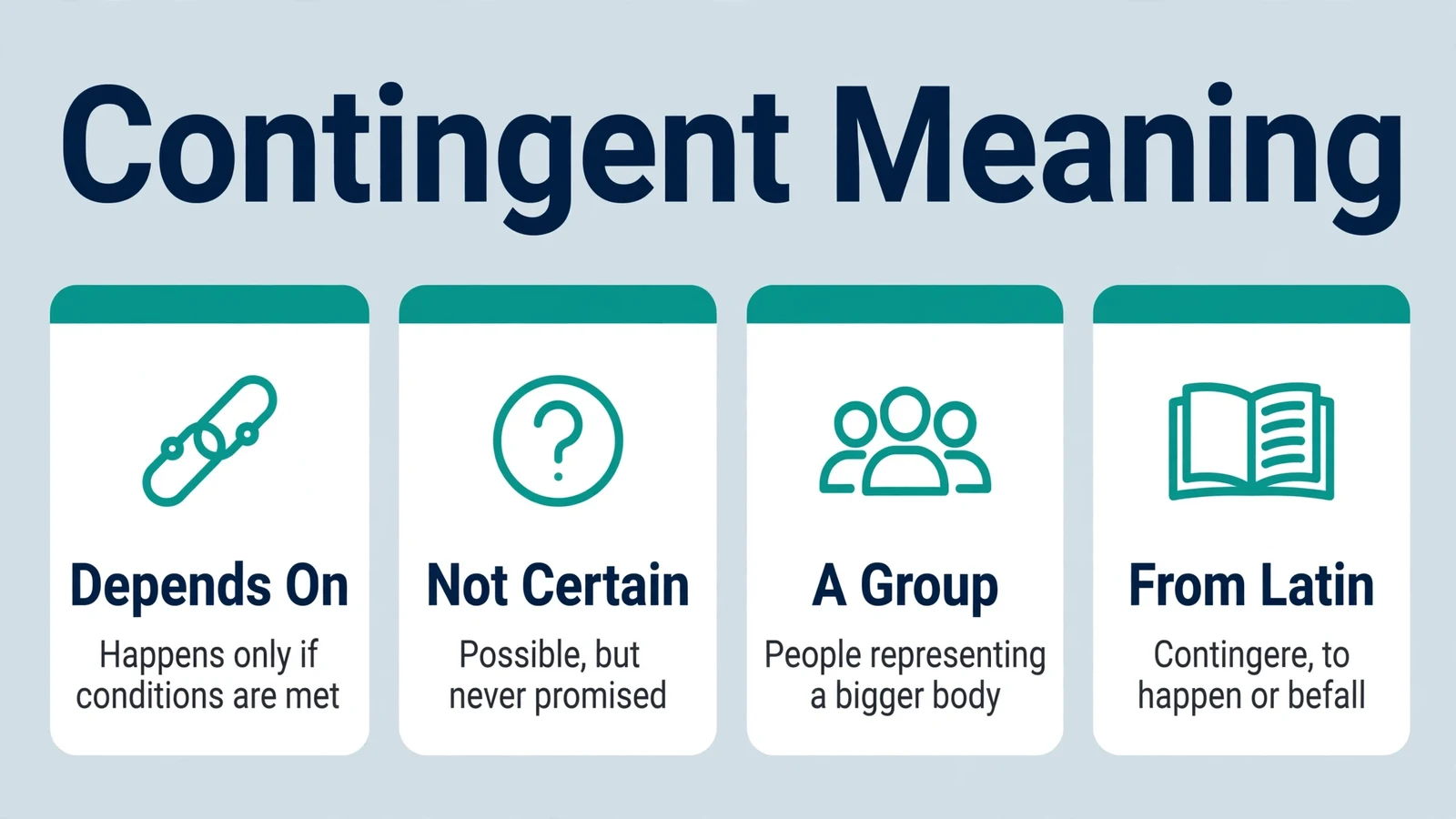
You see the word on a house listing, in a job advert, and in the news, and every time it seems to point in a slightly different direction. That confusion is normal. Contingent is one of those tidy formal words that quietly does several jobs at once.
At its core, contingent means dependent on something else. If one thing is contingent on another, the first thing happens only if the second thing happens first. As an adjective, it describes plans, offers, and payments that hang on a condition.
As a noun, it names a group of people who represent a bigger group. This guide walks through both halves of the word, using the same senses the major dictionaries record. By the end, you will read a contingent offer, a contingent worker, and a visiting contingent with equal confidence.
What Does Contingent Mean?
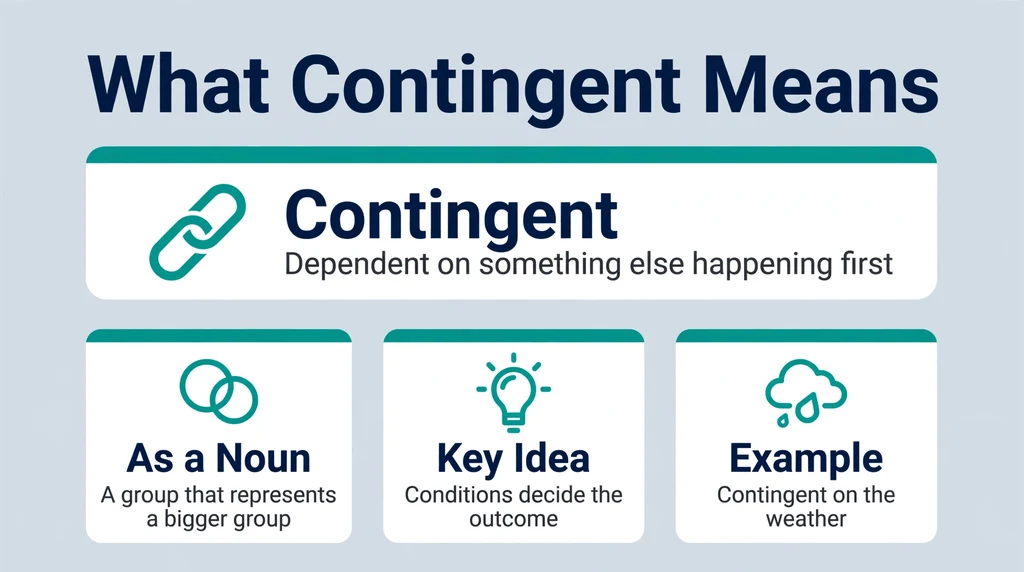
Dictionaries give contingent two main jobs. The first is an adjective meaning dependent on something else that may or may not happen. The second is a noun meaning a group of people who represent a larger group, country, or organisation.
The adjective in one line
When something is contingent, it is conditional. It exists, starts, or goes ahead only when a stated condition is met. A bonus can be contingent on hitting a sales target. A picnic can be contingent on dry weather. In both cases, the word tells you the outcome is not guaranteed yet.
The noun in one line
When contingent is a noun, it counts people. A contingent is a body of representatives sent by a larger group. News reports talk about a national contingent at the Olympics or a contingent of troops in a peacekeeping force. The shared idea is representation: the smaller group stands for the whole.
A quick test for readers
When you meet the word in the wild, one question sorts it out. Ask: is this sentence about people, or about conditions? If it counts people who represent a larger body, you have the noun. If it describes something waiting on a condition, you have the adjective.
The test works because the two parts of speech rarely overlap in practice. Articles about delegations use the noun again and again. Contracts and listings stick to the adjective. Once you know which world the sentence lives in, the meaning stops wobbling.
The thread that ties the senses together
Both halves of the word grew from the same root idea of something falling out by chance. The adjective stresses that an outcome depends on events. The noun once meant a share that fell to someone in a division, and it later settled into the group sense. So the word has always lived close to luck, shares, and conditions.
Contingent as an Adjective: Hanging on Something Else
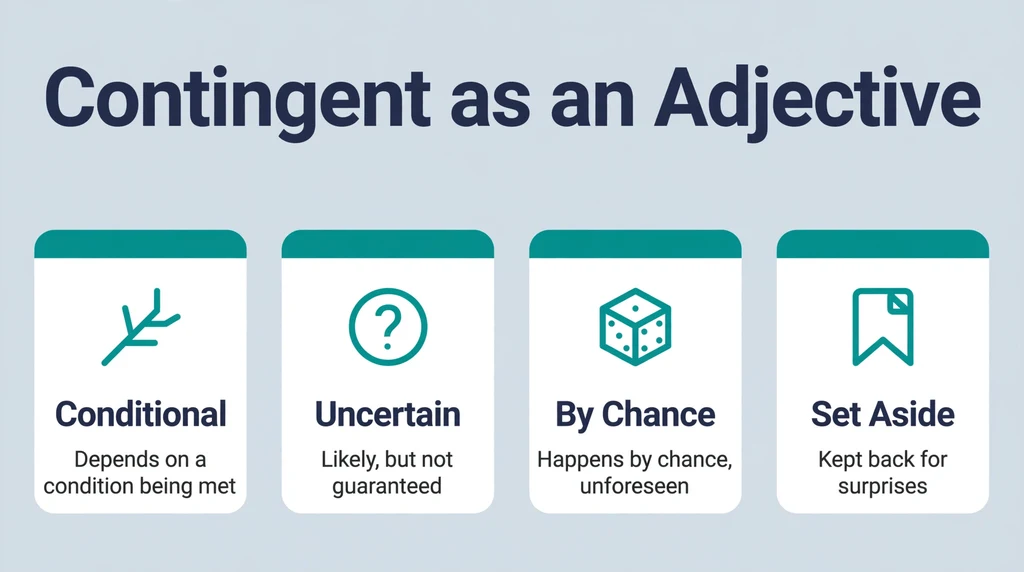
Most searches for this word are really about the adjective. It appears in contracts, news reports, and careful everyday speech. The adjective carries three closely related shades of meaning, and context tells you which one is active.
Dependent on a condition
The strongest and most common sense is dependence. Merriam-Webster puts it first: contingent means dependent on or conditioned by something else. The dictionary illustrates it with a contingent offer and with plans that are contingent upon the weather.
Notice the grammar that comes with this sense. Contingent almost always travels with the word on or upon. Writers say contingent on approval, contingent upon funding, or contingent on the results. That little preposition names the condition, so the phrase answers its own question: depends on what? On that.
Possible, but not certain
A second shade softens the dependence into simple uncertainty. In this sense, contingent means likely but not certain to happen. A contingent benefit might arrive, and it might not. Nobody has promised it, and nobody can schedule it.
This is why the word suits careful writers. It lets them flag a real possibility without overstating it. A report might say that further growth is contingent, meaning conditions look promising but the outcome stays open.
Happening by chance
The third shade points at pure luck. Something contingent can be something that happens by chance or through unforeseen causes. Dictionaries record this sense from the early 1600s, and it survives in phrases about the contingent events of a life or a war.
Writers reach for this shade when no single condition controls the outcome. Instead, many small accidents stack up. The word then means unpredictable rather than conditional, although the two ideas sit close together.
Set aside for the unforeseen
One smaller sense deserves a mention. Contingent can describe money or resources held back for circumstances nobody fully foresaw. Governments and companies keep contingent funds for exactly this reason. The money waits, unused, until an unexpected need appears.
The partner words: on and upon
Grammar gives this adjective a reliable habit. In its dependence sense, contingent pairs with on or upon, and the two forms mean the same thing. Upon sounds a touch more formal, so contracts and official letters often prefer it. Everyday writing usually picks on.
The condition that follows can be almost anything. It can be a noun, such as approval, funding, or the weather. It can also be an action, as in “payment is contingent on the goods arriving safely.” Either way, the pattern stays fixed: claim first, condition second.
Contingent as a Noun: A Group That Stands for a Bigger Group
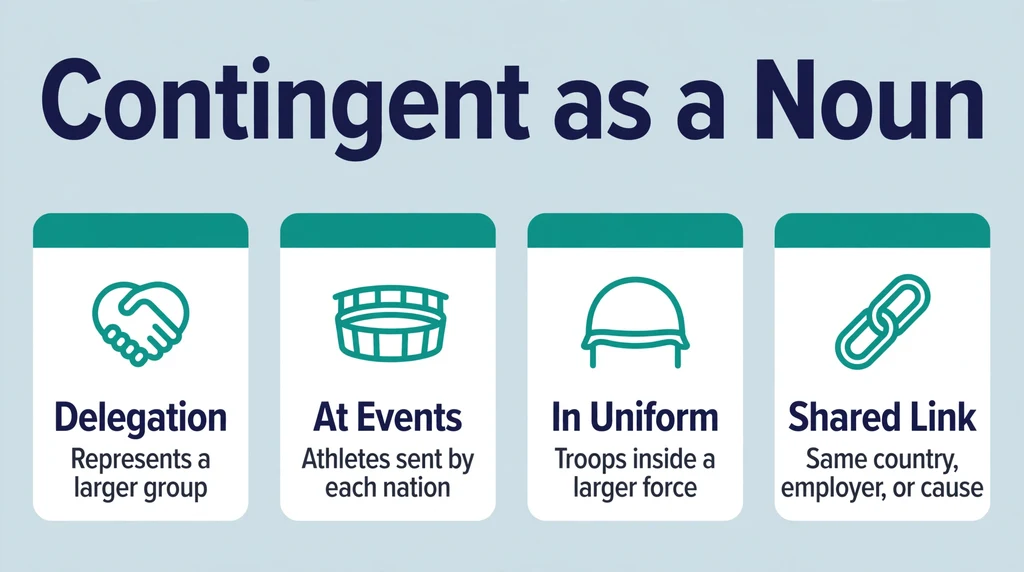
Flip the word into a noun and the meaning changes completely. A contingent is now a group of people. Dictionaries define it as a representative group, a delegation, or a detachment.
Contingents at events
You meet this sense most often in news and sports writing. Each nation sends a contingent of athletes to the Olympic Games. A conference hosts contingents from universities, companies, and charities. The word tells you the group did not wander in by accident. Someone chose them to represent a larger body.
The people in a contingent share something that the rest of the crowd does not. Usually that link is a home country, an employer, or a cause. Oxford’s learner dictionary captures this neatly: a contingent is a group at an event who have something in common that others there do not share.
Contingents in uniform
The noun also has a long military life. A contingent can be the portion of troops that one country contributes to a larger combined force. Reports describe the French contingent in a peacekeeping mission or a national contingent serving under shared command.
This usage explains the formal tone of the noun. It sounds organised, counted, and official. Writers rarely use contingent for a casual group of friends meeting for lunch. The word belongs to delegations, teams, and organised bodies with a purpose.
The older noun sense
Older dictionaries also list contingent as a noun for something that might happen. Officials in that older style tried to prepare for every contingent, however unlikely. Today, contingency has taken over that job almost completely. You will still meet the older noun in classic books and formal reports, so it is worth recognising.
How writers describe a contingent
Because the noun is countable, contingents come in sizes. Learner dictionaries list the adjectives that cluster around it: large, strong, and substantial are the faithful companions. A report might praise a large contingent of supporters or note a strong contingent from one region.
Verbs follow a similar pattern. Groups send, lead, and provide contingents. That word choice keeps the representation idea visible. A contingent never just shows up in careful writing; someone dispatches it, and it arrives with a purpose.
Where the Word Contingent Comes From
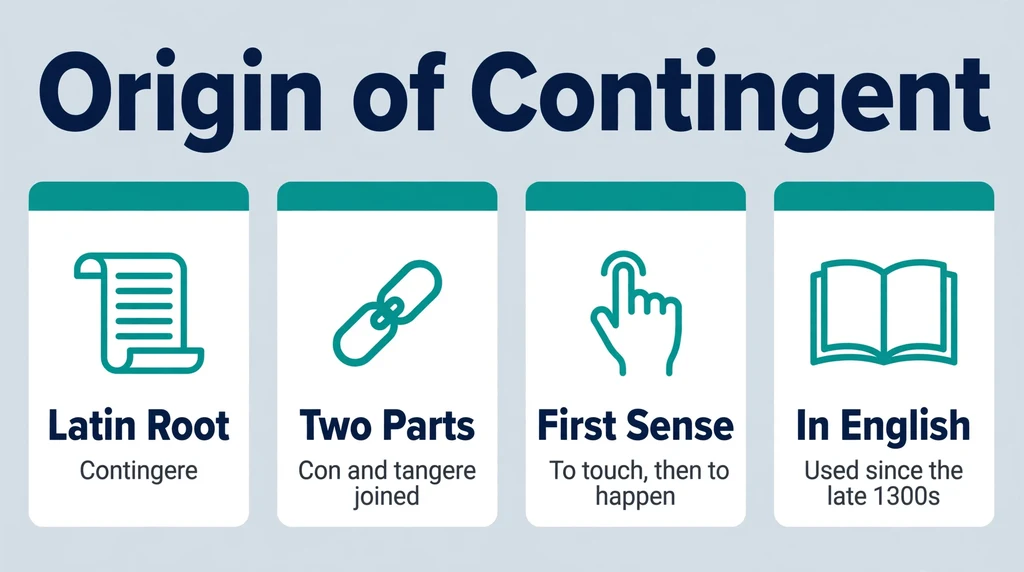
Contingent comes from the Latin verb contingere. That verb packed two ideas into one word. At its base, it meant to touch or to be in contact with something. From that physical starting point, it stretched to mean to happen, to befall, or to fall to someone’s lot.
A verb built from touch
Latin speakers built contingere from two parts: con-, meaning with or together, and tangere, meaning to touch. English still owns several relatives from the same root, including contact, tangible, and tangent. Each one keeps a faint trace of that original touching.
The jump from touching to happening makes sense once you picture it. When events touch your life, they befall you. Latin used the verb both ways, and English inherited the happening side of the family.
Arriving in English
The adjective reached English in the late 1300s, carrying the sense of depending on circumstances and not being predictable with certainty. Merriam-Webster dates the adjective’s first known use to the 1400s and the noun’s to 1548. At first, the noun meant a thing that happens by chance.
Later, the noun picked up the idea of a share or quota, the portion that falls to someone when a whole is divided up. Armies then borrowed that share idea for the troops each ally supplied. From there, the modern group sense settled in during the early 1700s.
How to Pronounce Contingent and Its Word Family
Contingent has three syllables: kun-TIN-junt. The stress falls in the middle, on TIN. Dictionaries write it as /kənˈtɪndʒənt/, and the noun and adjective sound exactly the same.
The forms you will meet
The word family is small and tidy. Contingently is the adverb, as in “the payment was contingently approved.” Contingents is the simple plural of the noun, used for two or more groups. Contingence is an older, rarer noun that most modern writers skip.
The relative everyone actually uses
The family member you will meet most often is contingency. It grew out of contingent in the 1560s by adding the noun ending -cy. At first it named the quality of being contingent. Within a few decades it also meant a chance occurrence, an event that may or may not happen. The next sections separate the pair properly, because everyday English keeps them busy in different places.
Contingent in Real Estate: The Meaning Behind the Listing
If you found this word on a property website, you are in good company. Real estate is where most people meet contingent today. A listing marked contingent holds a very specific message about the sale.
What a contingent offer means
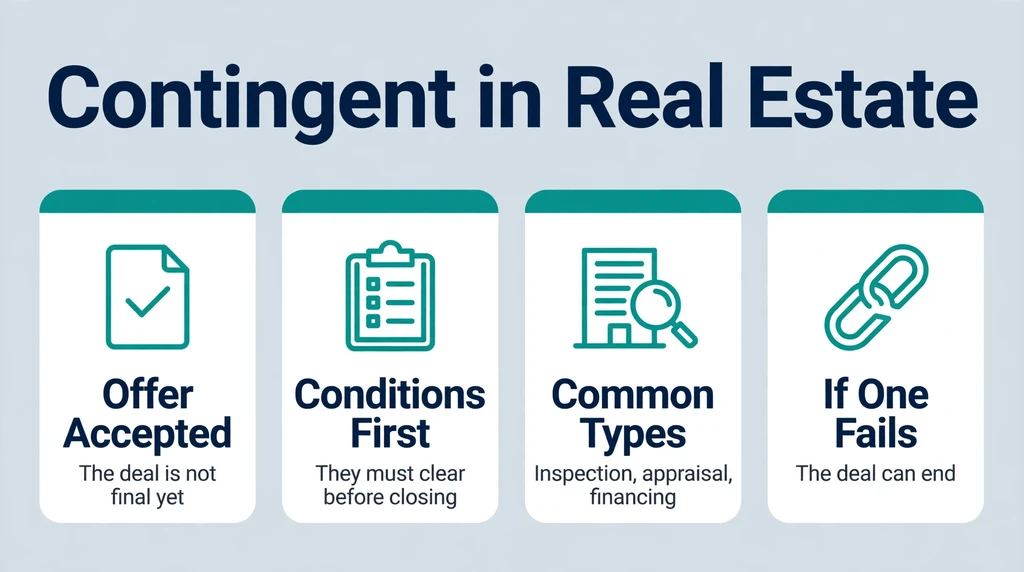
A contingent status means the seller has accepted an offer. However, the sale will only go through if certain conditions are met first. Until those conditions clear, the deal is real but not final.
Think of it as a deal with a checklist attached. Both sides have agreed on the big points, such as price. Yet the contract pauses while the listed conditions get checked. If a condition fails, the deal can end, and the home can return to the market.
The conditions you will see most
A handful of contingencies appear again and again in home sales. An inspection contingency lets the buyer hire a professional to examine the home’s condition first. An appraisal contingency requires the home to be valued at or above the agreed price. A financing contingency makes the sale depend on the buyer actually securing a mortgage.
The fourth common type is the home sale contingency. Here, the purchase depends on the buyer selling their current home by an agreed date. Some contracts also require clear title, so no legal claims hang over the property. In practice, the contingency period often runs about 30 to 60 days, depending on the type of condition involved.
Can a contingent home still receive offers?
Often, yes, although the details sit in the contract. Because a contingent deal can still collapse, some sellers keep marketing the home and may accept backup offers. Real estate guides note that a seller can accept another buyer’s offer during the contingency period in some arrangements.
For house hunters, that means a contingent label is not always a closed door. It is better read as “under contract, with conditions outstanding.” If every condition clears on time, the first deal proceeds. If one fails, the seller may turn to the next offer instead.
What happens as conditions clear or fail
A contingent contract moves in steps. Each listed condition gets checked in turn: the inspection happens, the appraisal lands, the lender decides. As a condition is satisfied, it drops off the list, and the deal edges closer to certain.
When a condition fails, the contract itself decides what happens next. Depending on its terms, the sides might renegotiate the price, extend a deadline, or end the agreement. That is the whole point of writing contingencies down: nobody has to argue later about what was promised.
Contingent vs pending
Buyers often confuse contingent with pending, but the two statuses mark different stages. Pending means the offer is accepted and the contingencies have been met or waived. The sale is further along and usually close to completion.
Contingent, by contrast, means the conditions are still open. The deal could close smoothly, or it could fall through. That openness is exactly why some sellers keep accepting backup interest during a contingent period, although contract terms vary by place and agreement. This article offers general information only, not legal advice for any specific purchase.
Contingent vs Contingency: Sorting Out the Pair
These two words cause more mix-ups than the rest of the family combined. The good news is that the split between them is simple once you see it. One word describes; the other word names.
What contingency means
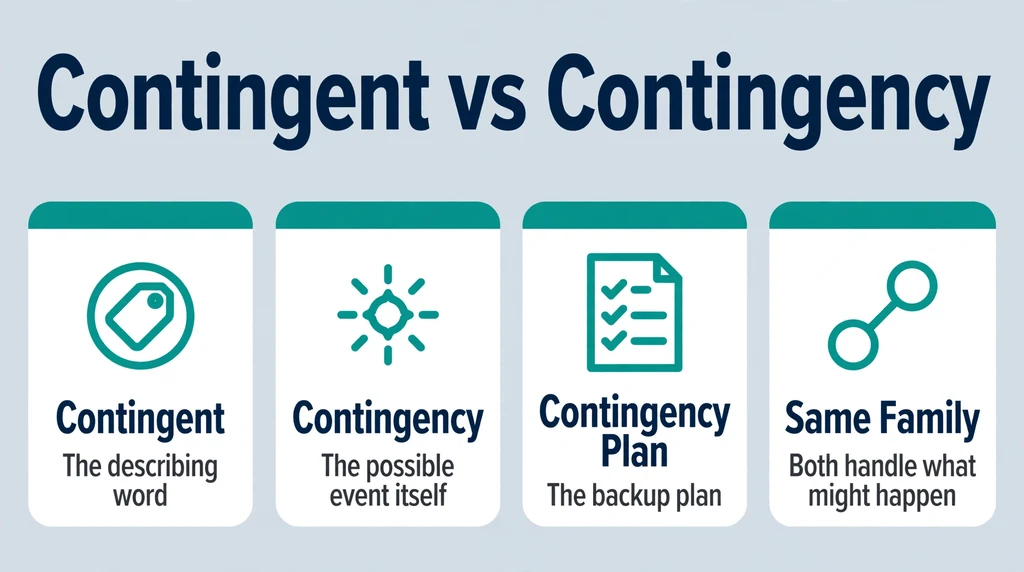
Contingency is a noun, and it names the uncertain thing itself. Merriam-Webster calls it a contingent event or condition: an event, such as an emergency, that may happen but is not certain to occur. So a flood, a job loss, or a sudden repair bill can each be a contingency.
You can hear the difference in a sentence pair. “The payment is contingent on delivery” uses the adjective to describe the payment. “We planned for every contingency” uses the noun to name the possible events. Same family, different job.
The contingency plan
The pair meets most famously in the phrase contingency plan. A contingency plan is a backup plan, designed for an outcome other than the one you expect. Collins puts it crisply: a contingency plan or measure is intended to be used if a possible situation actually occurs.
Schools, airlines, and hospitals all keep contingency plans. The plan might cover severe weather, a power failure, or a key system going down. Crucially, a contingency plan is not pessimism. It is simply the plan you hope stays in the drawer.
Fees and funds with strings attached
The adjective also shows up wherever money waits on a result. A fee can be contingent on an outcome, which means it is paid only if that outcome happens. Businesses likewise budget a contingency amount inside a project, extra money reserved in case costs shift. In each case the pattern is identical: nothing moves until the stated condition is met.
Contingency in projects and planning
Project managers live inside this word family. A project plan names its risks, then sets aside time and money for the ones that might land. That reserve exists because experienced planners treat surprises as a category, not a shock.
The vocabulary stays consistent across the field. A risk that might occur is a contingency. The money held back is a contingency reserve. The fallback course of action is a contingency plan. Once you learn the trio, business reports and tender documents become much easier to read.
Contingent Workers and the Contingent Workforce
Business writing gives contingent a second modern career. A contingent worker is someone whose job is not expected to last. The phrase covers a large and growing corner of the labour market, and official statistics give it a precise meaning.
The official definition
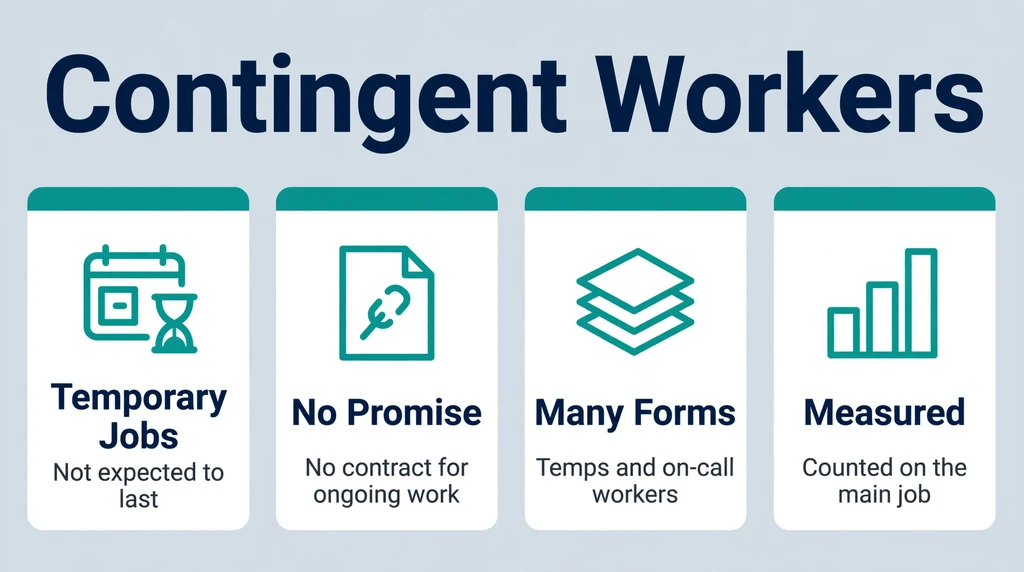
The US Bureau of Labor Statistics defines contingent workers plainly. They are people who do not expect their jobs to last, or who report that their jobs are temporary. They hold no implicit or explicit contract for ongoing employment.
That definition focuses on expectation rather than job title. A worker counts as contingent because the job has an end built into it. Someone leaving a job for personal reasons, such as retiring or returning to school, does not count as contingent under this definition.
How many contingent workers are there?
The same bureau measures the group through national surveys. In July 2023, it reported that 4.3 percent of workers, about 6.9 million people, held contingent jobs on their sole or main job. Back in May 2017, the survey had found 3.8 percent, or about 5.9 million workers.
Treat those numbers as a snapshot, not a ranking. The bureau asks about a person’s main job, and it keeps contingent work separate from related categories. Those categories, called alternative arrangements, include independent contractors, on-call workers, temporary help agency workers, and workers supplied by contract firms.
Why employers use the term
Companies lean on the phrase contingent workforce for flexibility. Seasonal staff, project specialists, and cover for absent employees all fit the pattern. The work is real, but the attachment is temporary by design. For workers, the trade is equally clear: contingent roles can offer freedom and variety, yet they rarely promise the security of a permanent post.
Contingent, temporary, and gig: close cousins
Everyday speech blurs three nearby labels. Temporary describes how long a job lasts, while contingent describes what the worker can expect: no ongoing future in the role. The bureau’s definition follows expectation, so the two labels overlap heavily without being identical.
Gig work is looser still. The Bureau of Labor Statistics points out that it keeps no official definition of the gig economy, because researchers use the phrase in many different ways. When precision matters, contingent worker is the safer term, since it has a published definition behind it.
Contingent in Philosophy: True, but It Could Have Been Otherwise
Philosophy kept one precise sense of the word, and it is simpler than it sounds. In logic, a contingent statement is one that is neither necessarily true nor necessarily false. Its truth depends on how the world actually is.
Take the sentence “the library closes at nine tonight.” That claim happens to be true or false based on the facts. It could easily have been otherwise, because the library might have chosen a different hour. Logicians call such a statement contingent, since experience alone can settle it.
Contrast that with a necessary truth, such as “it is either raining or it is not raining.” No weather report can overturn that one. Statements of arithmetic behave the same way. Two plus two equals four in every situation you can describe, so it stands as necessary rather than contingent.
Merriam-Webster records this usage as a formal logic sense: contingent means not true by definition alone, and provable as true or false only by experience. So when a philosophy text calls something a contingent truth, it simply means a truth that did not have to be true.
Future contingents: the ancient puzzle
Philosophers have argued about this word for a very long time. Their oldest puzzle concerns statements about the future. If a sea battle will happen tomorrow, is the sentence “there will be a sea battle tomorrow” already true or false today?
Thinkers since Aristotle have debated such future contingents. The events have not happened, so their truth seems unsettled. Yet logic prefers every statement to be true or false. That tension keeps the topic alive in philosophy courses, and it is why the word contingent appears so often in them.
Contingent in Everyday Life
Away from contracts and listings, the word quietly organises daily plans. Anytime people build a plan A that leans on a condition, the idea of contingency is doing the work, even when nobody says the word aloud.
Plans that lean on the weather
Outdoor life runs on conditions. A school schedules its sports day but holds an indoor timetable in reserve. A festival sells tickets while watching the forecast. Families plan a barbecue and quietly agree on a backup date.
Each of those is a contingent arrangement. The main plan proceeds if the condition behaves. The reserve plan waits in case it does not. Naming the condition early is what separates a contingent plan from a hopeful guess.
Travel, events, and work
Travel plans work the same way. A traveller books a refundable ticket because the trip is contingent on leave being approved. An organiser confirms a speaker but prepares a substitute, since attendance depends on flights and health.
At work, the pattern repeats at a smaller scale. A team sets a launch date that depends on testing finishing cleanly. A shop hires extra hands for a sale that depends on foot traffic. In every case, contingent thinking simply means planning honestly around an outcome nobody controls.
Using Contingent Well: Register and Alternatives
Contingent is a slightly formal word, and that is part of its value. In contracts, reports, and careful journalism, it signals precision. In casual conversation, though, it can sound heavier than the moment needs.
When the word earns its place
Reach for contingent when the dependence itself matters. Job offers, grants, listings, and official plans all involve real conditions with real consequences. There, the word tells the reader exactly where the uncertainty sits. It also sounds measured, which suits negotiations and public statements.
When a plainer phrase works better
In everyday speech, dependent on, if, and as long as often do the same job with less ceremony. “Dinner depends on when the train gets in” feels warmer than “dinner is contingent on the train’s arrival.” Neither is wrong. The choice is about tone, not correctness, and good writers switch between them as the setting changes.
Contingent Synonyms and Antonyms
The adjective’s closest synonyms are conditional and dependent. Both keep the idea of hanging on something else. Possible works when you want the softer uncertainty shade, while accidental, casual, and fortuitous fit the happening-by-chance shade.
Dictionaries draw one useful line between these words. Contingent suggests a possibility, but it stresses uncertainty and dependence on future events. Accidental and fortuitous, by comparison, lean harder on pure luck and drop the dependence idea.
For the noun, the natural synonyms are delegation and detachment. Team, squad, and mission can also serve in looser writing. Antonyms for the adjective depend on the shade you mean: certain, definite, and unconditional oppose the conditional sense, while necessary opposes the logic sense. For the noun, a rough opposite is the whole body itself, the organisation the contingent merely represents.
How to Use Contingent in a Sentence
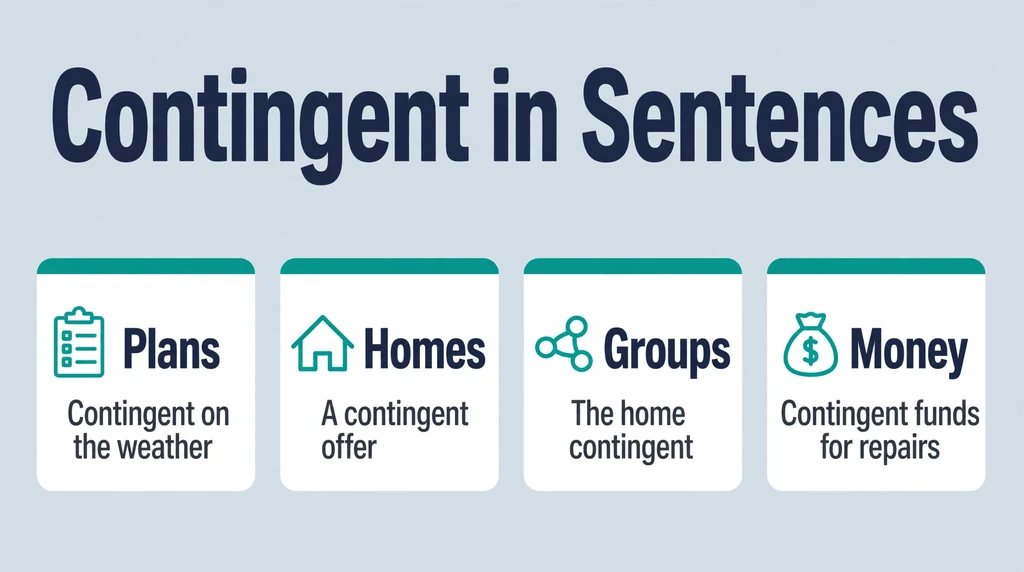
Examples fix the senses faster than definitions do. Each sentence below uses the word in one of its standard ways, so you can borrow the pattern with confidence.
Adjective examples
- Our outdoor wedding is contingent on the weather holding.
- The grant is contingent upon the committee’s final approval.
- Her promotion was contingent on the new branch hitting its targets.
- The museum set aside contingent funds for emergency repairs.
- Rainfall that year was a contingent event, driven by a shifting ocean pattern.
Noun examples
- The home contingent cheered loudest at the opening ceremony.
- A small contingent of residents attended the council meeting.
- The peacekeeping force included a contingent of engineers.
- Each club sent a contingent to the national tournament.
Read those again and notice the split. The adjective sentences all name a condition, stated or implied. The noun sentences all count people who stand for a larger group. If your sentence does one of those two things, you are using the word the standard way.
Common Mistakes and Misconceptions
A few errors follow this word around. Clearing them up takes only a moment, and it sharpens every sentence you write afterwards.
Thinking contingent means certain
The most common slip flips the meaning entirely. Contingent never means guaranteed. It means the opposite: dependent, open, and still undecided. If a result is sure, words like certain, confirmed, or final do the job instead.
Mixing up the two spellings of the family
Writers sometimes reach for contingent when they need contingency. Remember the jobs: contingent describes, contingency names. “Our plan is contingent” sounds right, while “we planned for any contingent” sounds off in modern English. In that second slot, contingency is the word you want.
Confusing contingent with contiguous
The two words look alike because both descend from Latin words about touching. Contiguous, however, kept the physical meaning: it describes things that share a border or sit next to each other. Contingent moved on to conditions and chance. A contingent border is a doubtful idea; a contiguous border is a real line on a map.
Reading a contingent listing as a closed deal
One practical misconception deserves repeating. A contingent home listing is not a finished sale. Conditions remain open, deadlines apply, and deals do fall through. Buyers and sellers who treat contingent as final often plan around money and moving dates that are not yet secure.
Frequently Asked Questions
What is the simple meaning of contingent?
In simple terms, contingent means depending on something else. If event A is contingent on event B, then A happens only if B happens. As a noun, a contingent is a group of people representing a larger group.
What does contingent on mean?
Contingent on is the standard phrase for the adjective. It means dependent on a named condition, as in “the trip is contingent on good weather.” Writers also use contingent upon, which means exactly the same thing and sounds slightly more formal.
What does contingent mean in real estate?
In real estate, contingent means an offer has been accepted but the sale is not final. Conditions called contingencies, such as an inspection, an appraisal, financing, or the sale of the buyer’s current home, must be satisfied first. If a condition fails, the deal can be cancelled under the contract’s terms.
What is the difference between contingent and pending?
Contingent means conditions are still open and being worked through. Pending means those conditions have been met or waived, and the sale is close to completion. A contingent deal can still fall through; a pending deal is much further along.
What is a contingent worker?
A contingent worker holds a job that is not expected to last. The US Bureau of Labor Statistics uses the term for people who report that their jobs are temporary and who have no contract, spoken or implied, for ongoing employment. Temps, seasonal staff, and many project-based roles fit this pattern.
What is the difference between contingent and contingency?
Contingent is mainly an adjective that describes something dependent on a condition. Contingency is a noun that names the possible event or condition itself. You make a contingent offer, and you keep a plan for every contingency.
Is contingent a positive or negative word?
Neither. The word is neutral and slightly formal. It simply signals dependence and uncertainty. A contingent offer is not a bad offer, and a contingency plan is not a gloomy plan. Both are routine, practical tools for handling an open future.
How do you pronounce contingent?
Say kun-TIN-junt, with the stress on the middle syllable. It has three syllables, and the noun and adjective are pronounced identically.
Final Thoughts
Contingent rewards a second look. As an adjective, it marks anything that depends on a condition, from a family picnic to a house purchase to a fee that pays out only on results. As a noun, it gathers people into a representative group, from travelling fans to troops under a shared flag. Both senses trace back to a Latin verb about things touching and befalling us, which is a fitting origin for a word about how events lean on each other.
If you remember one test, make it this: ask “depends on what?” If the sentence answers that question, the adjective fits. If the sentence instead counts a group standing in for a bigger whole, you have the noun. For the dictionary entry behind these senses, see Merriam-Webster’s page on contingent.