You have likely heard someone praised as easygoing, then heard nearly the same behavior criticized as submissive. The word sits on a fine line, which is exactly why so many people look it up.
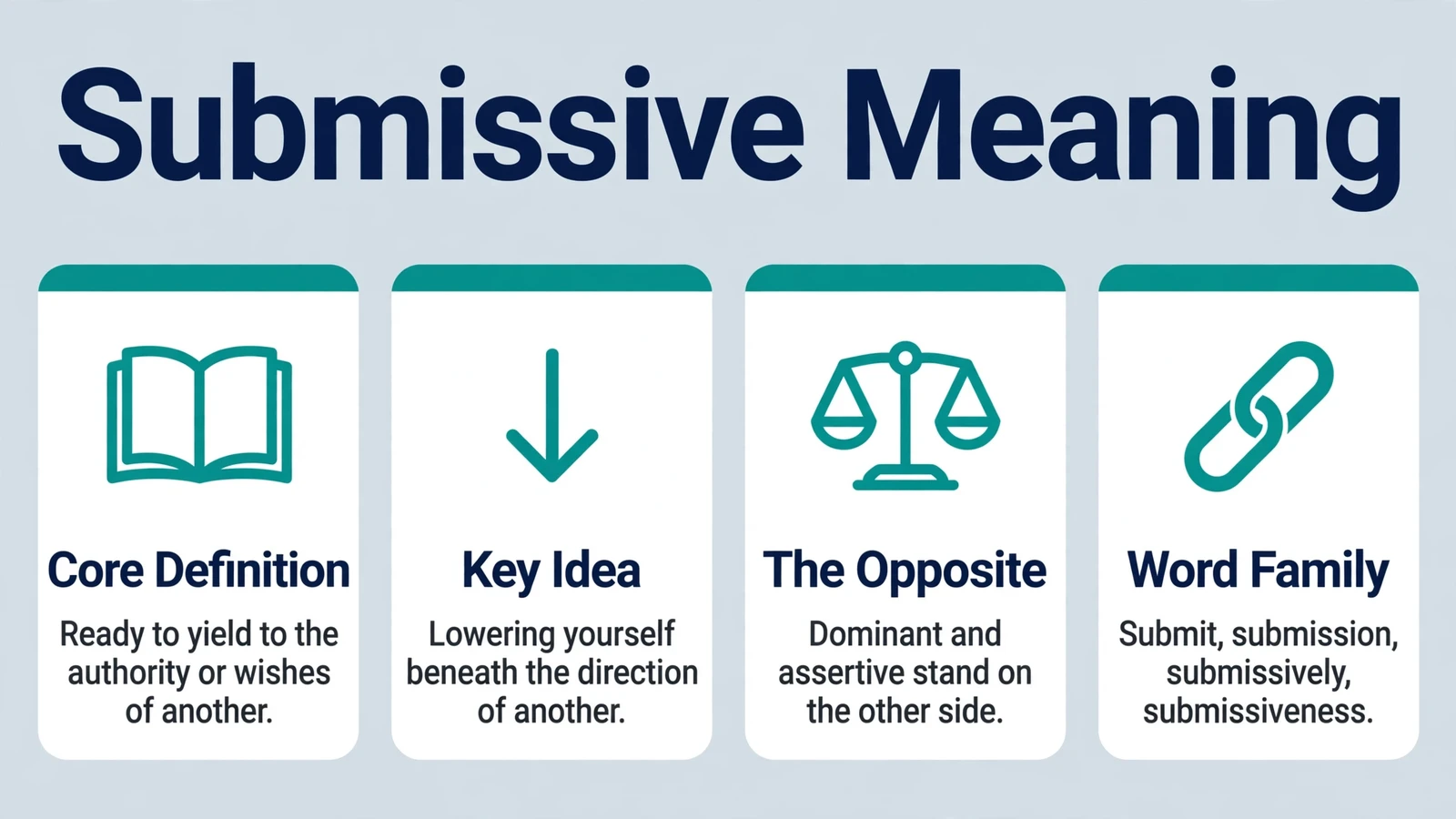
In plain terms, submissive means inclined to yield to the authority, control, or wishes of another person. A submissive person lets someone else lead, decide, or take charge, usually without argument. Dictionaries describe it as being ready to submit and humbly obedient.
Still, the word covers more than personality. It also describes body language, animal behavior, and a few specialized uses. This guide walks through the definition, the origin, the closest synonyms, and clear examples, so you can use the word with confidence.
By the end, you will also know when submissive is the wrong choice. Near neighbors like docile, passive, and compliant look similar on the surface, yet each one changes the sentence in a different way.
What Does Submissive Mean?
Dictionaries agree closely on this word, so the core definition is easy to pin down. Submissive is an adjective, and it points to a readiness to give way to someone else’s authority or wishes.
The dictionary definition
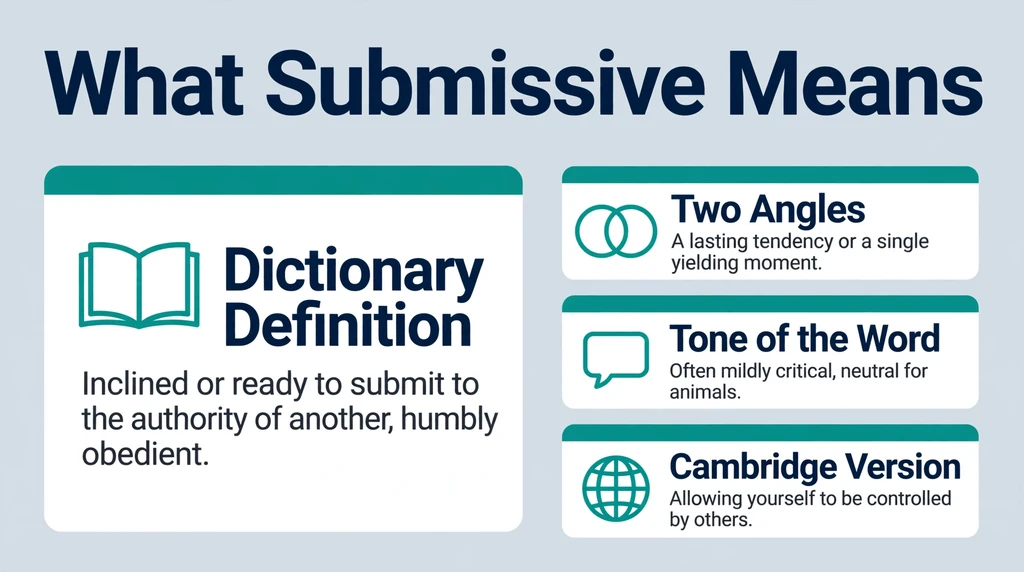
Merriam-Webster describes a submissive person as inclined or willing to submit to the orders or wishes of another. Dictionary.com puts it slightly more strongly: inclined or ready to submit, unresistingly or humbly obedient.
Cambridge, meanwhile, gives the learner-friendly version. It defines submissive as allowing yourself to be controlled by other people or animals. Notice that Cambridge includes animals, because the word works for both species.
Oxford adds an important hint about tone. Its learner’s dictionary says submissive means too willing to accept somebody else’s authority, obeying without questioning anything. That little word “too” tells you how the adjective usually sounds in everyday speech.
One word, two angles
In practice, the adjective works from two angles. First, it can describe a person’s general tendency. Someone with a submissive nature habitually defers, avoids confrontation, and lets others decide.
Second, it can describe a single act or signal. A submissive gesture, reply, or posture shows yielding in one moment, even if the person is normally confident. A short, quiet “whatever you think is best” can be a submissive reply from someone who is usually assertive.
Because of this, context matters a lot. The same word can sound neutral in a report about animal behavior, yet sharply critical in an office conversation.
Using the word in grammar
Submissive behaves like a regular descriptive adjective. It can sit before a noun, as in “a submissive employee,” or after a linking verb, as in “the employee was submissive.” Both positions keep the same meaning.
It also pairs naturally with a short list of nouns. Writers lean on set phrases such as submissive behavior, submissive posture, submissive gesture, submissive attitude, and submissive role. These collocations appear constantly in news reports, novels, and research summaries.
Prepositions matter too. A person is usually submissive to someone: submissive to authority, submissive to her husband, submissive to the committee’s wishes. That small word “to” quietly names the power on the other side of the relationship.
Core Meaning of Submissive
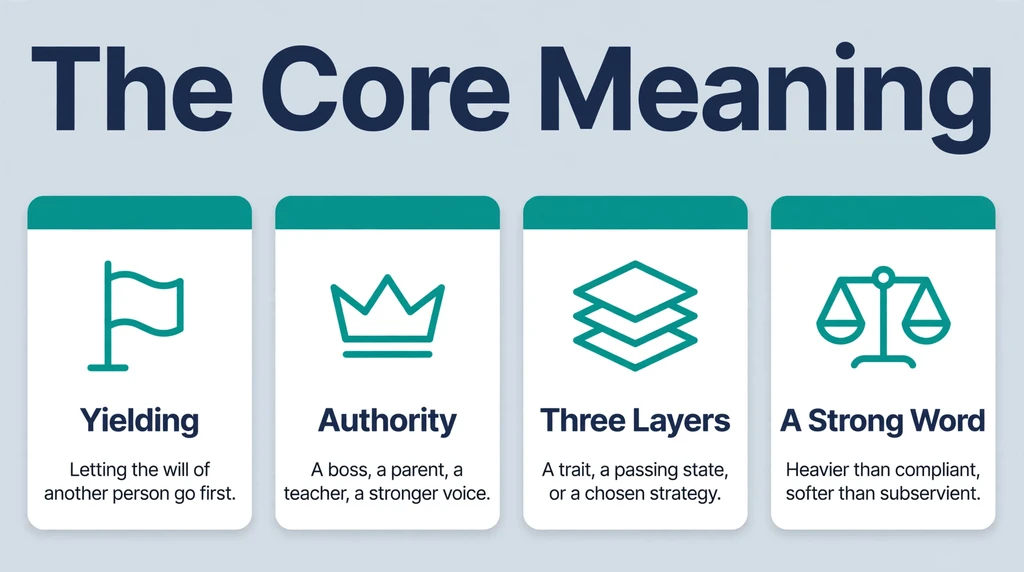
Underneath every use sits one simple picture: one side lowers itself while the other side takes the higher position. Yielding is the heart of the word.
Yielding to authority
Submissive behavior always involves an authority of some kind. That authority might be a boss, a parent, an older sibling, a teacher, or simply the loudest voice in the room. In animal groups, it might be a stronger or higher-ranking member.
The yielding itself can take many forms. It may mean following instructions without debate. It may mean dropping your own preference so another person gets their way. Or it may mean softening your body language so you look smaller and less threatening.
Crucially, submission here is about outward behavior. A submissive person might privately disagree with every word. However, they still comply, stay quiet, or step back in the moment.
How strong is the word?
English speakers treat submissive as a fairly strong label. Calling someone compliant sounds mild and even professional. Calling them submissive suggests a deeper pattern of giving in, and it often carries disapproval.
The word also grades easily. Someone can be slightly submissive in meetings, very submissive at home, or too submissive for their own good. Writers reach for it when simple obedience is not the whole story.
In short, obedient describes following a rule. Submissive describes a posture toward power itself.
Trait, state, and strategy
Psychologists and careful writers separate three layers here, even in ordinary language. A trait is a lasting tendency: some people generally prefer harmony and let others steer. A state is temporary: anyone can feel submissive in front of a judge, a surgeon, or an angry customs officer.
Strategy is different again, because it is chosen on purpose. A negotiator may act submissive early in talks to gather information and goodwill. A junior lawyer may stay submissive before a senior partner whose support she needs. In both cases, yielding is a tool, not a confession of weakness.
This distinction explains many confusing sentences. When a profile calls an athlete submissive in interviews, it usually means the state or the strategy. The same athlete may be fiercely dominant on the field, an hour later.
Submissive Pronunciation and Word Forms
This word looks longer than it sounds. Once you hear the stress pattern, it becomes easy to say and spell.
How to pronounce submissive
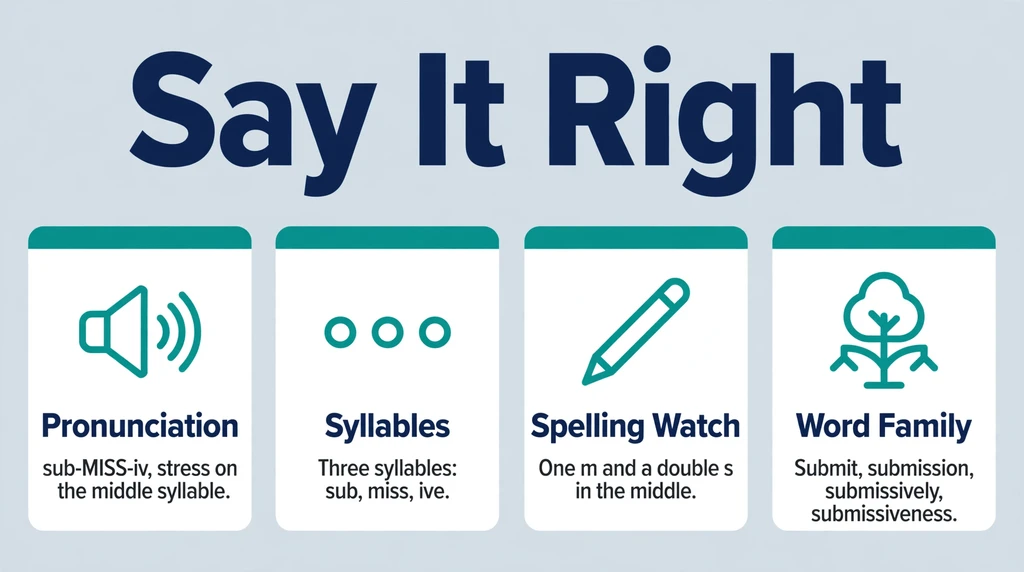
Say it as sub-MISS-iv. The word has three syllables, and the stress falls firmly on the second one. Dictionaries write it as /səbˈmɪs.ɪv/ in both American and British English.
A helpful trick is to build it from the verb submit. You already stress the second syllable there, sub-MIT. Submissive simply swaps the ending while keeping that same strong middle beat.
For spelling, watch the double s in the middle. The word runs sub, then miss, then ive: s-u-b-m-i-s-s-i-v-e. There is only one m, despite what your fingers may want to type.
The word family
Submissive belongs to a large, hardworking family. The verb is submit, and the noun for the act is submission. From the adjective, English adds submissively as the adverb and submissiveness as the noun for the quality.
Each form does a slightly different job. A manager submits a report. An employee shows submission to a policy. A submissive trainee follows instructions quietly. She nodded submissively, and his submissiveness surprised everyone.
Interestingly, submit carries two branches of meaning. You can submit a form, which means handing it in for a decision. You can also submit to an authority, which means yielding to it. Both branches grow from the same root idea of placing something under someone else’s judgment.
Related words you will meet
A few cousins deserve a quick mention. Submittal is a technical noun used in construction for documents handed over for approval. It belongs to the hand-in branch, not the yielding branch.
Sport borrowed the noun in a vivid way. In mixed martial arts and professional wrestling, a submission is a hold that forces an opponent to yield, and fighters win by submission. The loser quite literally submits, which makes the old meaning easy to remember.
Religious writing uses the family heavily as well. Submission there often means willing obedience offered out of faith or respect. The tone in that setting is usually positive, which shows again how context steers the word.
Forms that sometimes trip writers
The adjective compares in the regular way: more submissive and most submissive, never “submissiver.” A trainee can grow more submissive over a brutal winter, and the most submissive recruit in the unit draws notice.
Because it is an adjective, submissive has no ordinary plural. Only the specialized noun takes one: submissives, meaning people in the yielding role. If your sentence needs a plural for everyday writing, you almost certainly want the adjective plus a noun, such as submissive employees.
Writers also confuse submissive with submittable, a rare technical word meaning able to be submitted, as in a submittable file format. Context separates them easily: files are submittable, people are submissive.
Where the Word Submissive Comes From
The origin of submissive is unusually vivid. Hidden inside the word is a physical image of lowering something down.
A Latin picture of lowering
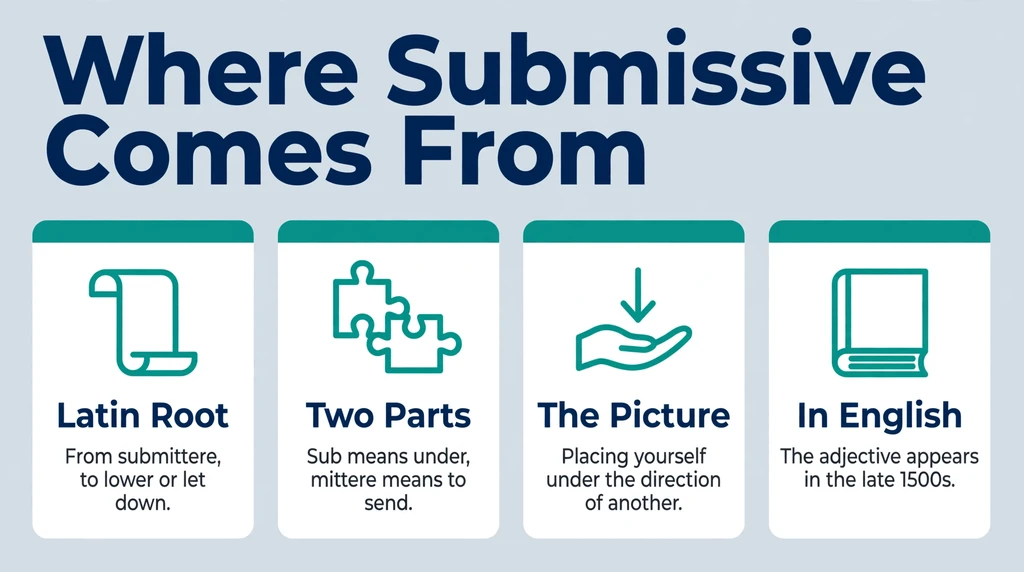
Submissive comes from the Latin verb submittere. That verb meant to let down, to put down, to lower, or to yield. Latin speakers built it from two parts: sub, meaning under, and mittere, meaning to send or let go.
So the literal picture is sending something under. A person who submits places himself under another’s direction, almost like lowering a flag or setting an object down at someone’s feet.
English formed the adjective from submiss-, the past-participle stem of that Latin verb, and added the suffix -ive. Oxford notes that submissive was shaped from submission, on the pattern of older pairs such as remission and remissive.
When it entered English
The rest of the family arrived earlier. Submit and submission were already in English in the 1300s, borrowed through French and Latin channels. Submission first meant referring a matter to a third party for judgment, and its humble obedience sense appeared by the mid-1400s.
The adjective itself turned up later. Merriam-Webster dates the first known use of submissive to 1572, while Dictionary.com and the Online Etymology Dictionary place it in the 1580s. Either way, by the late 1500s the word was ready for the role it still plays today.
How the meaning settled
Early uses leaned on humility. In religious and household writing, a submissive person lowered himself before God, a ruler, or the head of a family, and writers often meant that as praise. Yielding showed discipline, patience, and respect for order.
Modern usage is cooler. Editors today reach for submissive when they want to question the yielding, not admire it. That shift explains Oxford’s definition, which calls the person “too willing” to obey.
The animal sense kept the older neutrality. Zoologists never moralized about a submissive wolf. For them, the word simply names a rank signal, and that scientific calm still protects the term in nature writing.
What Submissive Behavior Looks Like
Because submission is about posture toward power, much of it shows up in the body before it shows up in words. Writers, managers, and researchers all describe a recognizable cluster of signals.
Signals in people
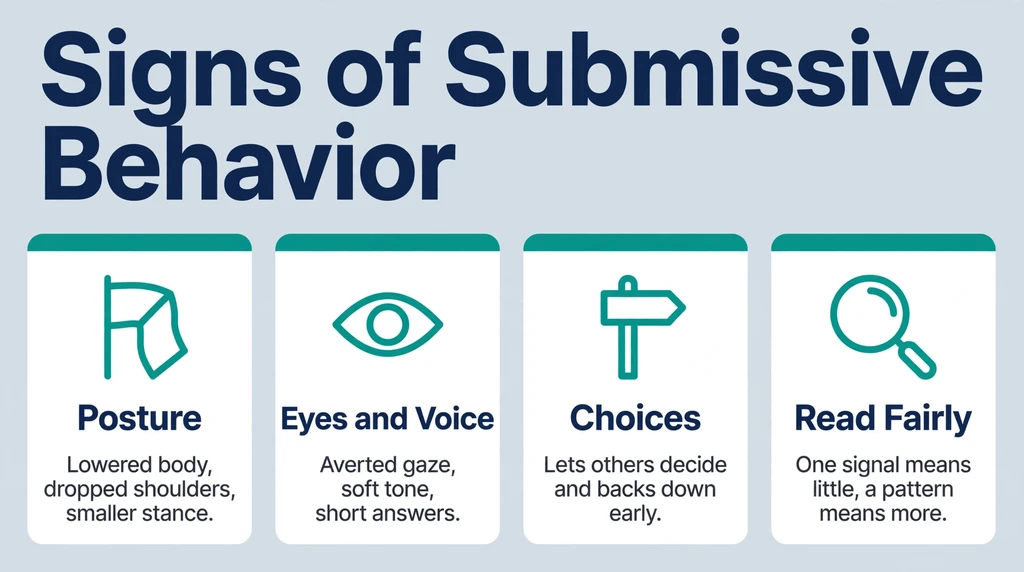
A submissive posture usually makes a person appear smaller. Shoulders drop, the head lowers, and eye contact fades. Cambridge’s research corpus even notes that discomfort can be relieved by submissive gestures such as averting the gaze.
Speech follows a similar pattern. Submissive speakers use a soft tone, short answers, and plenty of agreement. They apologize often, qualify their opinions, and rarely hold the floor for long.
Choices tell the same story. A submissive colleague lets others pick the plan, the deadline, and the restaurant. In an argument, they back down early, even when the facts are on their side.
None of these signals proves a submissive personality on its own. Fatigue, politeness, culture, and simple caution can produce the same behavior. The adjective fits best when the pattern repeats whenever authority appears.
At work and at home
Context decides whether the behavior reads as a strength or a problem. In a hospital team or a cockpit crew, quick deference to the expert in charge can keep everyone safe. In such settings, a submissive moment is really professional discipline.
At home, the balance matters more. A partner who always yields may keep the peace for years. Over time, though, one-sided yielding often breeds resentment on both sides.
That is why careful writers describe behavior, not worth. Saying “she took a submissive role in the meeting” observes a fact. Calling her “a submissive person” turns a moment into an identity.
A quick self-check for readers
If you are wondering whether a description fits, ask three questions. First, who holds the power in this scene? Without a stronger side, submissive is probably the wrong word, and shy or quiet may fit better.
Second, does the person yield repeatedly? One polite concession is manners. A steady pattern of giving way, apologizing, and deferring earns the adjective.
Third, what does the yielding cost? When nothing is at stake, the behavior may be simple agreeableness. When someone surrenders their own interests every time, writers and readers both sense the weight that submissive carries.
The signals at a glance
For quick reference, the classic cluster looks like this in adults: lowered posture, dropped shoulders, limited eye contact, a soft and quiet voice, brief answers, frequent agreement, ready apologies, and reluctance to take space, time, or credit.
No single item on that list proves anything. Together, repeated in the presence of the same authority, they form the pattern the adjective was built to name.
Inside teams and groups
Groups quietly sort themselves with these signals. When one member always yields, others start expecting the yielding, and the pattern hardens into a role. Meeting chairs then talk past that member, even when the member holds the key fact.
Healthy teams, by contrast, rotate the yielding on purpose. A good leader invites the quiet analyst to finish a thought and asks the loudest voice to hold back. Notice that the goal is not to banish submission, but to keep it situational rather than personal.
This is also why the adjective stings in performance reviews. It suggests the role has trapped the person. Managers who write it usually mean: this employee must learn to hold ground when it counts.
Submissive Behavior in Animals
Long before the word described office politics, it described the animal world. Ethologists, the scientists who study animal behavior, use submissive for any display that signals peaceful intent toward a stronger or higher-ranking animal.
Why animals show submission
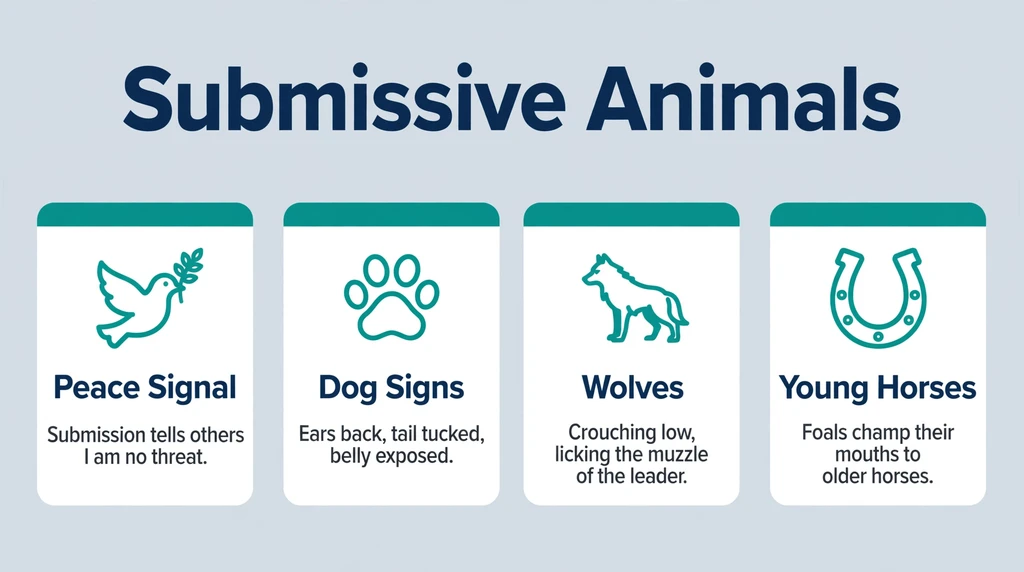
Submission is a peace signal. It tells the other animal: I am not a threat, and I accept your higher rank. Cambridge’s corpus offers a stark example: a fight generally ends quickly once one combatant adopts a submissive posture and backs away.
Among social animals, these displays keep the group stable. A younger or lower-ranking member defers to an older one over food, space, or mates. The group avoids constant fighting, and everyone saves energy.
Biologists point out a neat economy here. A real fight risks injury to both sides, including the likely winner. A clear submissive display settles the ranking question at almost no cost, which is why evolution kept the habit in so many species.
You can see the same pattern across species. Younger eagles act submissive around older birds. Wolves, horses, and primates all have their own versions of the display.
Submission across species
Wolves offer the textbook picture. A lower-ranking wolf approaches with its body lowered, ears back, and tail down, sometimes licking the muzzle of the higher-ranking animal. The message is rank, not affection: you lead, I follow.
Horses use quieter signals. A submissive young horse may make chewing motions with an empty mouth around an older horse. Primates, meanwhile, rely heavily on gaze and posture, presenting, crouching, or moving aside.
Cats complicate the picture. A relaxed cat rolling over is often inviting play, not submitting at all, which shows how easily humans misread these displays. Context decides, just as it does with the word itself.
Submissive dogs and submissive urination
Dogs give the clearest everyday example. Humane-society guidance lists the classic signs of a submissive dog: ears flattened back, eyes averted, head and neck lowered, body crouched or cowering, tail tucked, and sometimes rolling onto the back to expose the belly.
One special case even has its own name: submissive urination. Some dogs, especially puppies and shy or anxious dogs, urinate while showing these postures during greetings, when someone approaches, or when they are scolded.
Importantly, experts stress that this is not disobedience or a house-training failure. The dog feels threatened and answers with the strongest peace signal it knows. The response follows the dog’s perception of danger, not the owner’s intention.
For that reason, punishment makes the behavior worse, and patient handling works better. Guidance from humane societies recommends low-key greetings, avoiding direct stares and looming postures, and rewarding confident behavior instead. Most puppies grow out of submissive urination as their confidence builds.
Submissive vs Dominant
Submissive rarely travels alone. Its natural partner and opposite is dominant, and the two words frame a single scale of power.
Two ends of one scale
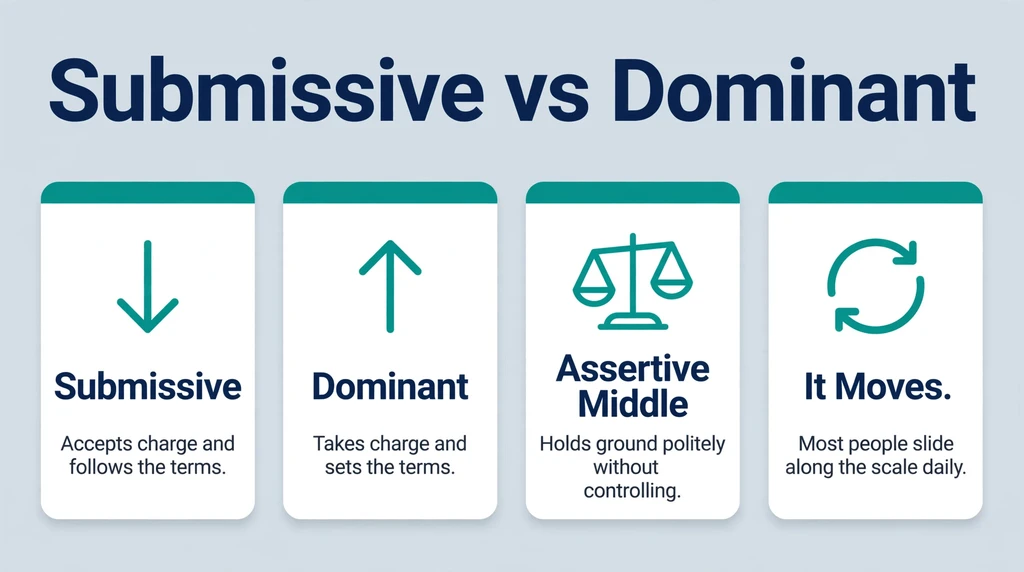
A dominant person takes charge, sets the terms, and expects others to follow. A submissive person accepts charge, follows the terms, and lets the dominant side lead. Neither word describes intelligence or worth; both describe a position in an interaction.
The scale appears everywhere. Two dogs meet, and one stands tall while the other lowers itself. Two executives negotiate, and one drives the agenda while the other keeps conceding points.
Most people slide along the scale during a single day. The same person may be dominant with junior staff, neutral with friends, and quietly submissive in front of a feared parent. Context, not character alone, sets the position.
Closely related opposites
English offers several near-opposites, each with a different flavor. Dictionaries list domineering as a direct antonym of submissive, and it adds a flavor of bullying control. Oxford, by contrast, gives assertive as the direct opposite in its learner’s entry.
The difference matters. Assertive sits in the healthy middle: firm about your own needs without trampling anyone. Dominant and domineering push further toward control. If submissive means giving up too much ground, assertive means holding your ground politely.
Reading the pair in sentences
Watch how the two words share work in real sentences. “The committee needs a chair who is firm without being domineering, and members who are cooperative without being submissive.” Each half balances the other.
Animal writing uses the pair even more mechanically. A report might say the dominant hen eats first while submissive hens wait at the edge. No judgment hides in those lines; rank is simply being recorded.
Business writing sits between the two poles. Calling a negotiator dominant can be praise for control of the room. Calling the other side submissive hints they conceded too cheaply. The pairing, once again, tells you which side the writer favors.
The middle ground in everyday life
Real relationships rarely sit at either pole for long. Friendships, marriages, and good working pairs trade the lead constantly. One person chooses the holiday; the other chooses the house. Power moves back and forth without ceremony.
Problems begin when the trade stops. If one side is always dominant and the other always submissive, the arrangement stops being teamwork. Writers sense this instantly, which is why the pair of words appears so often in advice columns about balance.
In other words, the healthiest reading of the scale is movement. Submissive moments are normal and often kind. A submissive life, imposed rather than chosen, is what the word warns against.
Submissive Compared With Similar Words
English has a whole shelf of yielding words, and they are not interchangeable. Choosing the wrong one can quietly change your meaning.
Submissive vs obedient
Obedient is narrower and more concrete. It describes following a specific instruction, rule, or law. A soldier, a child, or a dog can be obedient about one command without being submissive in general.
Submissive reaches deeper. It describes the overall posture behind the obedience, a standing readiness to yield. Collins lists obedient as the closest synonym, yet even Collins treats submissive as the broader, weightier word.
Submissive vs docile and meek
Docile emphasizes teachability. A docile student or animal is easy to manage and quick to learn, and the word usually sounds approving. Nobody insults a horse by calling it docile.
Meek, meanwhile, emphasizes gentleness and patience. It describes someone quiet and unresisting, often without any authority figure in the picture at all. Submissive almost always implies someone above you; meek does not need that second person.
Submissive vs passive and compliant
Passive describes inaction rather than yielding. A passive bystander does nothing, but not necessarily because anyone ordered it. A submissive person, in contrast, is actively responding to another’s will, even if the response is quiet.
Compliant is the professional cousin. It means following rules, standards, or requests, and it sounds neutral in reports and audits. A compliant company meets regulations. A submissive company, however, sounds like it surrendered.
Where subservient crosses the line
Subservient goes further than all of these. It suggests excessive eagerness to serve, and dictionaries group its cousins servile and slavish as disapproving words. If submissive already sounds critical, subservient sounds like an accusation of groveling.
As a rule of thumb, use compliant for rules, docile for temperament, passive for inaction, and submissive for yielding to a person or power.
Submissive vs shy or timid
One last neighbor causes frequent mix-ups. Shy and timid describe discomfort around people, especially strangers or new situations. They say nothing about authority at all.
A shy person may still refuse an order flatly once cornered. A submissive person may be perfectly relaxed socially, then yield the moment a superior gives an instruction. The first pair measures nerves; the second measures response to power.
Writers blur these in character descriptions all the time. If your sentence involves a boss, a ranking, or an order, reach for submissive. If it involves blushing at a party, shy is the honest word.
Submissive vs deferential
Deferential is the respectful member of this family. It describes polite yielding that honors someone’s rank, age, or expertise. A deferential junior doctor listens carefully to the senior surgeon, and nobody thinks less of her.
The behavior can look identical from outside. Tone separates the two words. Deferential assumes the yielding is appropriate, perhaps even gracious. Submissive hints that the person yielded more than the situation required, and that hint is where the criticism lives.
A Quick Note on the Noun Use
Dictionaries also record a specialized noun use. In relationship slang, a submissive is a person who prefers the yielding role alongside a dominant partner, by mutual agreement. The adjective keeps its ordinary sense there: the partner who follows rather than leads.
You may spot this noun in film reviews, dating profiles, and discussions of fictional couples. Outside that context, though, the word in this article, the everyday adjective about yielding to authority, is the meaning people almost always intend.
How to Use Submissive in a Sentence
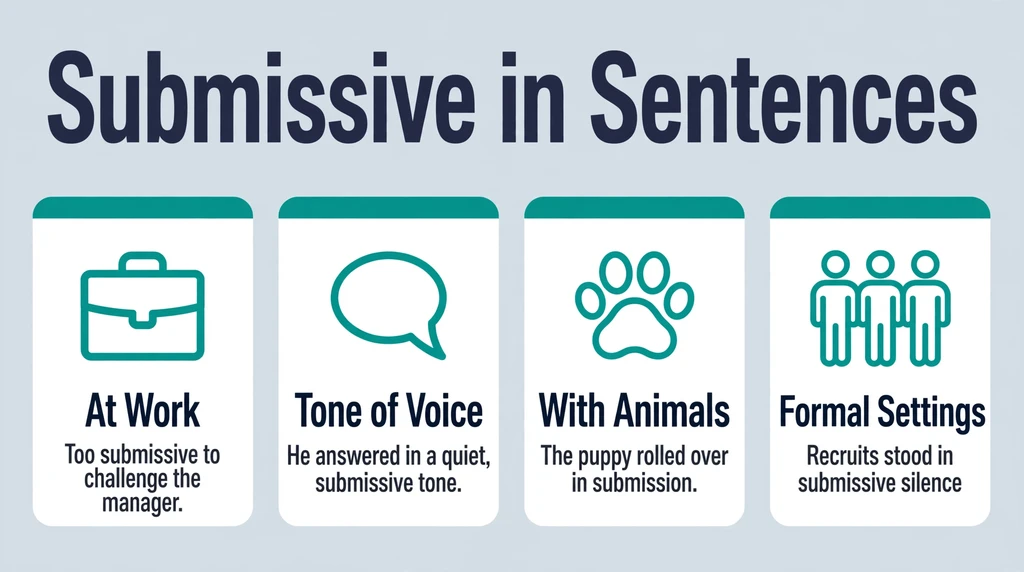
Examples fix a word in memory better than any definition. Notice how each sentence below leans on authority, posture, or yielding.
People and everyday life
- The new assistant was bright and capable, but far too submissive to challenge the manager’s mistakes.
- He answered the inspector in a quiet, submissive tone and kept his eyes on the floor.
- Rather than argue, she gave a submissive shrug and let her brother choose the movie.
- Years of submissive silence had taught her colleagues to talk over her in meetings.
Animals and behavior
- When the older dog approached, the puppy rolled over in a classic submissive posture.
- A submissive gesture, like looking away, can calm an aggressive animal quickly.
- The trainer explained that the rescue dog’s submissive urination should fade as she settled in.
- In the presence of the lead mare, the younger horses stayed submissive and kept their distance.
School, duty, and formal settings
- The recruits stood in submissive silence while the sergeant inspected the line.
- Despite her private doubts, the junior clerk remained submissive to the committee’s ruling.
- The old novel describes wives as meek and submissive, an ideal few modern readers accept.
- His submissive nod told the board he would accept the budget, however reluctantly.
Common Misconceptions About Submissive
A few stubborn misunderstandings follow this word around. Clearing them up will sharpen both your reading and your writing.
Misconception one: submissive means weak
Yielding is a behavior, not a measure of strength or worth. Soldiers, nurses, martial artists, and diplomats all yield strategically every day. Choosing not to fight a battle is sometimes the strongest move available.
The word also misleads when it becomes a permanent label. A person may act submissive with one authority figure and perfectly assertive everywhere else. Describe the behavior in its setting before you describe the person.
Misconception two: submissive just means polite
Politeness is mutual courtesy between equals. Submission involves a power gap. Holding a door for a stranger is polite; silently accepting every order from a bullying boss is submissive. The two can overlap, but they answer different questions.
Misconception three: the word is always an insult
In animal behavior, submissive is a plain technical term with no sting at all. Even for people, it can be neutral description in the right setting. The insult appears when a writer uses it to mock someone for lacking a spine.
Misconception four: a submissive dog is a badly trained dog
Owners often read a puppy’s rolled-over greeting as misbehavior or failed house training. Humane-society experts say the opposite: the puppy is communicating carefully in the only language it has.
Punishing submissive urination deepens the fear behind it, so the accidents multiply. Calm greetings and confidence-building work far better. The misconception matters because the label you choose decides the treatment you reach for.
Frequently Asked Questions
What does submissive mean in simple words?
It means ready to let another person be in charge. A submissive person obeys, yields, or steps back instead of arguing or taking control themselves.
Think of it as the opposite of taking charge. Where a dominant person says “follow me,” a submissive person is the one content to follow.
What is the opposite of submissive?
The main opposites are dominant and assertive. Dominant describes the one who takes control, while assertive describes the balanced middle: standing your ground without controlling anyone else.
Is submissive a negative word?
Usually it carries a critical edge for people, since Oxford defines it with the phrase “too willing” to obey. For animals, however, it is a neutral scientific term, and in formal settings it can be plain description.
What is the difference between submissive and passive?
Passive means inactive: someone does nothing and responds to nobody. Submissive means yielding to a specific person’s authority or wishes. A passive person ignores the situation; a submissive person answers it by giving way.
How do you pronounce submissive?
Say sub-MISS-iv, with the stress on the middle syllable. It has three syllables, and dictionaries write the pronunciation as /səbˈmɪs.ɪv/.
What does submissive mean when describing a dog?
It describes peace signals a dog shows toward people or other dogs: lowered body, tucked tail, averted eyes, and sometimes rolling over. Submissive urination is the related greeting behavior seen mostly in puppies and nervous dogs.
Is submissive an adjective or a noun?
It is mainly an adjective, as in “a submissive reply.” A specialized noun use exists in relationship slang for a person in the yielding role, but the adjective covers nearly all everyday writing.
Can someone be submissive in one place and not another?
Yes, and this is very common. Many people yield automatically at work yet decide everything at home, or the reverse. The word describes behavior inside a relationship or setting, not a fixed label for a whole life.
Final Thoughts
Submissive is a compact word with a long shadow. At its core, it simply means ready to yield to another’s authority, whether that shows in a lowered gaze, a quiet reply, or a puppy rolling onto its back.
Use it with care and it becomes precise. Distinguish it from polite, passive, and obedient, and remember its opposite scale, from assertive in the middle to dominant at the far end. For the full dictionary entry behind this guide, see Merriam-Webster’s entry for submissive.
Above all, remember the picture inside the word: something lowered, willingly or not, beneath something else. Keep that picture in mind, and you will rarely misuse submissive or mistake it for its milder neighbors again.