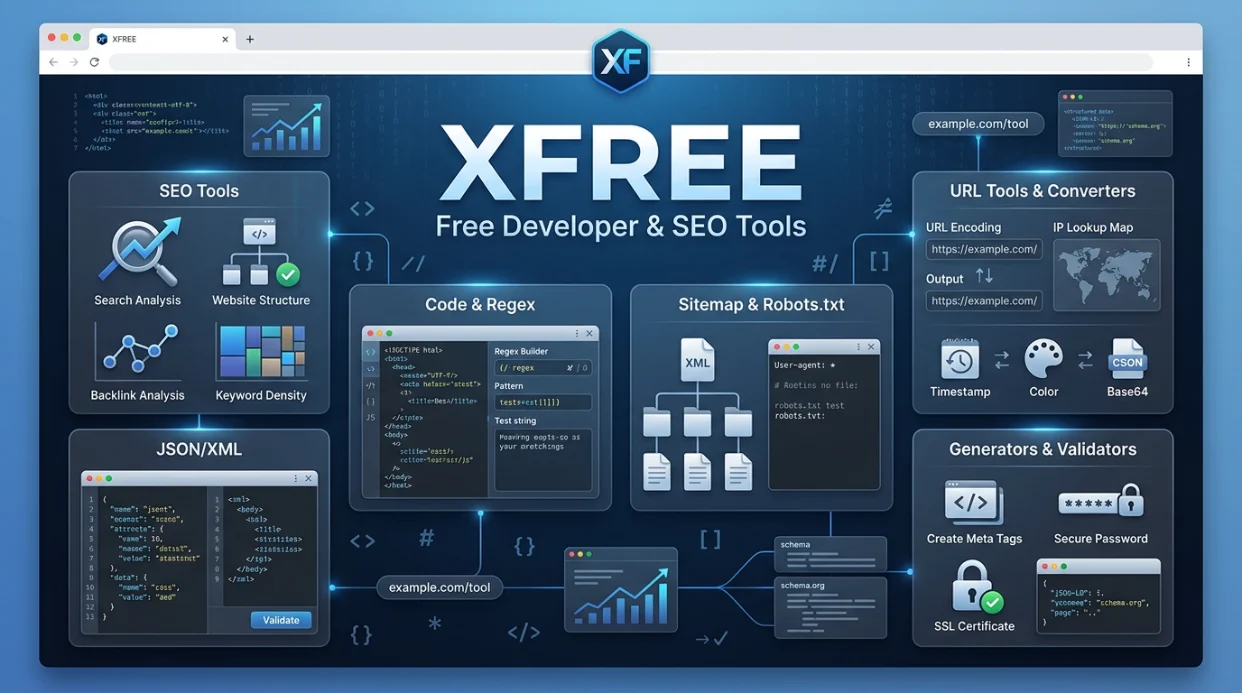
What if you could format JSON, test regex, create an XML sitemap, generate meta tags, decode JWTs, and handle other everyday web tasks without installing software or creating an account? That is the idea behind XFree.
XFree is a browser-based platform offering free tools for developers, SEO professionals, and everyday online tasks. Its official platform currently lists 58+ tools covering areas such as JSON, regex, URLs, SEO, security, coding, text, and data conversion.
One of XFree’s main features is its local-first approach. According to the platform, its tools process data directly in the browser wherever the operation allows it, so users do not need to upload their input to a remote server. The platform also states that its tools require no signup and are open source under the MIT License.
This guide explains what XFREE means, whether XFREE has a full form, how it works, and what you can use its free tools for.
XFREE Definition & Meaning
XFree is the name of a free online platform that provides browser-based micro-tools for developers, SEO professionals, and other users.
In simple terms, XFree means a collection of small, focused online tools that let you complete technical and SEO tasks directly in your browser. Examples include a JSON Formatter, Regex Tester, XML Sitemap Generator, robots.txt Generator, Meta Tag Generator, URL tools, hash generators, and various converters.
The name XFree should generally be treated as a brand name, rather than a standard technical abbreviation with a universally recognized expanded form.
XFREE Full Form and Meaning
XFREE does not have an officially stated full form or acronym expansion on the XFree website. It is presented as the brand name XFree for its free, browser-based developer, SEO, and online tool platform.
So, if you are searching for “XFREE full form,” the most accurate answer is:
XFREE Full Form: No official full form has been publicly specified.
Meaning: XFree is a free online tools platform focused on simple, browser-based utilities for developers, SEO users, and general web tasks
What Is XFREE?
XFREE is a browser-based developer and technical SEO tool platform that brings many small, focused utilities together in one website.
Instead of searching for a separate website every time you need to format JSON, test a regular expression, generate an XML sitemap, create meta tags, inspect a JWT, or convert structured data, XFREE provides these types of utilities in a single workspace.
The platform currently lists 61 published tools. Its website also displays a 25,000-concept public roadmap, but these roadmap concepts should not be confused with live tools. XFREE explicitly separates published implementations from planned concepts.
The platform is mainly useful for:
- Developers
- Technical SEO professionals
- Website owners
- Content creators
- Data-processing users
- Digital marketers
- People who need quick browser-based utilities
How Does XFREE Work?
XFREE follows a relatively simple workflow.
You select a published tool, provide the required input, run the utility, and then review or export the result when the particular tool supports those actions.
The general process is:
- Open the XFREE website.
- Browse the published tools.
- Choose a utility for your task.
- Add your text, code, URL, or supported data.
- Run the tool.
- Review the generated result.
- Copy, download, or continue the workflow when available.
XFREE says that its public tools do not require account registration.
For supported Local Mode utilities, processing takes place within the browser. The platform separately identifies optional cloud features when network transmission is involved.
What Can You Use XFREE For?
XFREE is designed around practical digital workflows.
For example, a developer might use it to format JSON or test a regular expression. An SEO professional might use it to generate a sitemap, prepare robots.txt directives, create metadata, or generate Schema.org JSON-LD.
A content or data user might use its text utilities to clean, compare, normalize, or transform information.
Common use cases include:
- Formatting and validating JSON
- Working with XML
- Testing regular expressions
- Extracting URLs
- Creating XML sitemaps
- Creating robots.txt files
- Generating meta tags
- Preparing Open Graph information
- Creating structured data
- Encoding and decoding Base64
- Inspecting JWT information
- Generating URL slugs
- Building UTM campaign URLs
- Generating Cron expressions
- Converting JSON to CSV
- Cleaning and processing text
The official tool directory currently organizes published utilities into several practical categories.
XFREE Developer Tools
The XFREE developer tools are intended for everyday programming, debugging, formatting, validation, and data-processing tasks.
Examples include:
- JSON Formatter and Validator
- XML formatting and validation tools
- Regex Tester
- Cron Expression Generator
- Base64 tools
- JWT inspection
- Data-format utilities
For example, if you receive a minified JSON response from an API, a JSON formatter can make its structure easier to inspect. Similarly, a Regex Tester can help you test a regular expression against sample text before using the pattern in an application.
The advantage of focused tools is that you can perform a specific task without setting up a complete development environment.
XFREE SEO Tools
XFREE also provides tools aimed at technical SEO and website management.
Its published SEO-related utilities include tools for:
- XML sitemaps
- Robots.txt
- Meta tags
- Open Graph
- Schema markup
- URL extraction
- SEO-friendly URL slugs
- UTM campaign parameters
These tools can be useful during website launches, technical SEO audits, content publishing, and routine website maintenance.
For example, the Meta Tag Generator can help prepare title and description markup, while the Schema Markup Generator can produce Schema.org JSON-LD for supported types.
XFREE Text and Data Tools
Not every online task involves programming or SEO.
XFREE also provides tools for text manipulation, comparison, cleanup, normalization, and data conversion.
These types of utilities can be helpful when working with:
- Large lists
- Text files
- Structured data
- Copy-and-paste datasets
- CSV files
- JSON
- Encoded content
- URL lists
For example, converting JSON to CSV can make structured information easier to open and inspect in spreadsheet software.
The platform’s text and converter categories are intended to handle these smaller but frequently repeated digital tasks.
XFREE Generators and Validators
Generators and validators solve two different problems.
A generator creates a useful output from defined inputs. Examples include Cron expressions, URL slugs, UTM parameters, hashes, or structured data.
A validator checks whether information follows a particular format or set of rules.
This distinction is useful because generating something and checking whether it is valid are often separate steps in a real workflow.
For example, you might generate a robots.txt file and then use a validator or tester to check whether its rules behave as expected.
XFREE Tools: Examples and Use Cases
The best way to understand XFREE is to look at practical tasks.
| XFREE Tool | What It Does | Useful For |
|---|---|---|
| JSON Formatter & Validator | Formats and validates JSON | Developers, API work |
| Regex Tester | Tests regular expressions | Developers |
| Bulk URL Extractor | Extracts URLs from text or HTML | SEO and data cleanup |
| XML Sitemap Generator | Creates XML sitemaps | Technical SEO |
| Robots.txt Generator | Creates crawler directives | Website owners |
| Meta Tag Generator | Creates metadata | SEO |
| Schema Markup Generator | Creates JSON-LD structured data | SEO |
| Base64 & JWT Decoder | Encodes/decodes and inspects supported data | Developers |
| URL Slug Generator | Creates cleaner URL slugs | SEO and content |
| UTM Builder | Builds campaign URLs | Marketing |
| JSON to CSV Converter | Converts JSON into CSV | Data processing |
These examples come from the platform’s currently published tool directory.
How to Use XFREE
Using XFREE generally does not require complicated setup.
Step 1: Open the Website
Go to the official XFREE website and browse the published tool directory.
Step 2: Identify Your Task
Think about what you actually need to accomplish.
For example:
- Need readable JSON? Choose the JSON Formatter.
- Need to test a regex? Choose Regex Tester.
- Need an XML sitemap? Choose the Sitemap Generator.
- Need metadata? Choose the Meta Tag Generator.
- Need structured data? Choose the Schema Markup Generator.
Step 3: Enter Your Input
Paste or enter the information required by the selected tool.
Step 4: Process the Input
Run the tool and examine its output.
Step 5: Review the Result
Do not automatically assume generated output is production-ready. Check the result against your actual website, application, or workflow requirements.
Step 6: Copy or Export
Where supported, copy or download the result or pass it into another step of your workflow.
Does XFREE Require an Account?
No account is required for XFREE’s published public tools.
The official website specifically states that published utilities can be opened without creating an XFREE account or profile.
This is one of the platform’s more convenient characteristics because users can access a tool directly instead of first completing a registration process.
It also means that searches such as XFREE account, XFREE profile, XFREE registration, and XFREE login can be misleading if interpreted as requirements for using the public tools.
XFREE Login and Registration
For the published public utilities, users do not need a traditional XFREE login or registration process.
The normal workflow is simply:
Website → Tool → Input → Processing → Result
Rather than:
Registration → Email verification → Login → Dashboard → Tool
This no-signup approach makes XFREE particularly convenient for one-time tasks.
Users should nevertheless make sure they are using the legitimate XFREE website before entering any information, particularly if they encounter an unfamiliar page claiming to be an XFREE login or registration page.
XFREE Dashboard and Profile
A traditional account dashboard or personal profile is not necessary for accessing XFREE’s public tools.
Instead, the website provides a tool directory, while XFREE Studio provides a more advanced workspace for supported workflows.
This distinction is important because it explains why searches for an XFREE dashboard or XFREE profile may not correspond to the normal experience of using the public tool directory.
XFREE Studio
XFREE Studio is designed for more structured workflows.
The platform describes Studio as a command surface that can route requests across approved local engines and visible workflow steps. Users can therefore move beyond simply opening one tool at a time and work with supported tool chains.
This can be useful when a task naturally involves multiple stages.
For example, a workflow could conceptually involve:
Input → Clean → Transform → Validate → Export
Rather than manually moving between unrelated websites, supported Studio workflows can connect approved steps within the XFREE environment.
XFREE Local Mode
One of the most important concepts to understand about XFREE is Local Mode.
XFREE states that published Local Mode tools process working input in the browser rather than submitting that input to an XFREE processing endpoint.
This matters for privacy-conscious users because processing behavior is not hidden behind a generic statement such as “your data is secure.”
Instead, XFREE describes the processing mode of its tools and distinguishes local processing from optional cloud functionality.
Users should still check the specific tool’s disclosure before entering confidential information.
XFREE Security
The security question should be considered at the individual-tool level.
XFREE’s Local Mode is designed to process working input inside the browser. Optional cloud features are identified before content is transmitted.
That provides useful transparency, but users should still follow normal online-security practices.
For example:
- Do not share passwords unnecessarily.
- Avoid entering confidential information into tools unless you understand how it is processed.
- Check whether the selected tool operates locally or through a cloud service.
- Use the official XFREE domain.
- Review documentation when handling sensitive data.
The fact that a tool runs locally does not automatically mean every feature surrounding it is offline or local, so understanding the specific processing mode remains important.
XFREE Privacy
Privacy is closely connected to XFREE’s Local Mode architecture.
For published Local Mode tools, XFREE says the working input is processed within the browser rather than being submitted to an XFREE processing endpoint. Optional cloud functionality is separately labeled before transmission.
This can be particularly relevant when using developer tools with source snippets, JSON, URLs, or other working data.
However, users should always verify the processing behavior of the individual tool before submitting information that must remain confidential.
Does XFREE Work Offline?
XFREE should not be described as a completely offline platform.
The platform provides an installable Progressive Web App (PWA) shell for Studio, and supported same-origin assets and workflows can work from cache after they have been loaded. However, cloud AI functionality and uncached remote resources still require a network connection.
In simple terms:
- Some supported workflows can work from cached resources.
- Local browser processing can occur without sending input to an XFREE processing endpoint.
- Cloud features require network access.
- Uncached remote resources may require an internet connection.
Therefore, “local processing” and “completely offline” are not the same thing.
Is XFREE Free?
Yes. XFREE presents itself as a free browser-tool platform, and its published tools are available without account signup.
However, users should distinguish between the free published tools and optional cloud or third-party functionality.
If a particular feature involves another service or cloud processing, its specific requirements should be checked before use.
XFREE Support and Documentation
XFREE provides documentation intended to explain how its tools work.
Its current resources include:
- Documentation Hub
- Reviewed Guides
- FAQ and Guidance
- Workflow Recipes
The platform states that its documentation covers areas such as inputs, outputs, examples, limitations, privacy behavior, and references.
This is useful because a tool directory alone does not always explain how a utility should be used in a real production workflow.
XFREE Review: Pros and Cons
A balanced XFREE review should consider both its strengths and limitations.
Pros
- Free access to published tools
- No signup required for public utilities
- Browser-based workflow
- Developer-focused utilities
- Technical SEO tools
- Text and data-processing utilities
- Local Mode for supported tools
- Studio workflow functionality
- Documentation and guides
- Multiple focused utilities in one platform
Cons
- The number of live tools is much smaller than the 25,000 roadmap figure.
- Not every planned concept is currently available.
- Offline functionality is not universal.
- Cloud features can have different processing requirements.
- Users still need to evaluate individual tools for production use.
- A focused utility may not replace a full professional development or SEO application.
The distinction between 61 published tools and 25,000 roadmap concepts is especially important when evaluating XFREE. The roadmap represents planned concepts rather than currently available utilities.
XFREE Alternatives
Someone searching for XFREE alternatives should first identify which XFREE capability they want to replace.
For example, the requirements could be:
- JSON formatting
- Regex testing
- Sitemap generation
- Meta tag generation
- Schema markup
- URL extraction
- Text processing
- Data conversion
There is no single “best XFREE alternative” for every use case.
A specialized developer tool may be better for advanced programming workflows, while a dedicated SEO platform may provide more comprehensive website auditing than a collection of individual utilities.
For quick, focused browser tasks, however, a multi-tool platform such as XFREE can be convenient because several related utilities are available from one place.
XFREE vs. Other Online Tool Websites
The main distinction between XFREE and many generic tool websites is its emphasis on focused utilities, explicit processing modes, and technical workflows.
Instead of simply presenting a large collection of calculators or miscellaneous generators, XFREE focuses heavily on:
- Developer workflows
- Technical SEO
- Text processing
- Data conversion
- Validation
- Structured-data utilities
- Browser-based processing
Its Local Mode disclosures also make processing behavior part of the product’s presentation.
For users who regularly switch between small technical tasks, this focused approach can be more useful than maintaining bookmarks for many unrelated websites.
XFREE for Developers
Developers can use XFREE for many small tasks that occur during development.
For example, when working with an API, a developer may need to:
- Inspect JSON.
- Format the response.
- Validate the structure.
- Encode or decode a value.
- Test a regular expression.
- Convert data into another format.
Instead of installing a separate utility for every task, browser-based tools can provide a faster way to perform these small operations.
The important limitation is that online utilities should complement—not necessarily replace—proper development environments, automated tests, and production validation.
XFREE for SEO Professionals
SEO professionals can use XFREE for several technical SEO tasks.
Examples include:
- Generating XML sitemaps
- Creating robots.txt directives
- Preparing meta tags
- Reviewing Open Graph information
- Generating Schema.org JSON-LD
- Extracting URLs
- Creating SEO-friendly slugs
- Building UTM campaign URLs
These utilities can be particularly useful during website development and technical SEO maintenance.
However, an individual generator should not be treated as a substitute for a complete SEO audit. Generated output should still be reviewed against the site’s architecture and search-engine requirements.
XFREE for Website Owners
Website owners who do not work with code every day can also benefit from focused utilities.
For example, a website owner may need to create:
- A sitemap
- Robots.txt rules
- Meta tags
- Schema markup
- UTM URLs
Instead of learning an entire development framework, a focused utility can make these individual tasks more approachable.
The important point is to understand what the generated output does before publishing it.
XFREE: Who Should Use It?
XFREE is most suitable for people who frequently need quick technical or website-related utilities.
Developers
Useful for formatting, validation, encoding, testing, and data transformation.
SEO Professionals
Useful for technical SEO tasks such as sitemaps, robots.txt, metadata, URLs, and structured data.
Website Owners
Useful for handling individual website configuration and optimization tasks.
Content and Data Users
Useful for text cleanup, transformation, comparison, and format conversion.
Beginners
The no-signup browser workflow can make individual utilities easier to try without setting up software.
Frequently Asked Questions About XFREE
What is XFREE?
XFREE is a free browser-based platform providing developer utilities, technical SEO tools, text tools, converters, generators, validators, and workflow functionality.
Is XFREE free?
Yes. XFREE describes itself as a free browser-tool platform, and its published utilities can be accessed without creating an account.
Does XFREE require registration?
No. Published XFREE utilities do not require users to create an account or profile.
Do I need an XFREE login?
A login is not required for the public published tools. Users can open those utilities directly.
How many XFREE tools are available?
XFREE currently lists 61 published tools. Its separate 25,000 figure refers to roadmap concepts rather than 25,000 live tools.
What are XFREE tools used for?
They can be used for developer tasks, technical SEO, text processing, data conversion, validation, generation, encoding, URL handling, and related workflows.
What is XFREE Local Mode?
Local Mode means supported tools process working input in the browser rather than submitting it to an XFREE processing endpoint.
Does XFREE work offline?
Some supported Studio workflows can work from cached resources, but XFREE is not completely offline. Cloud functionality and uncached remote resources can require an internet connection.
Is XFREE safe for sensitive information?
Users should check the processing mode of the specific tool before submitting sensitive information. Local Mode processes working input in the browser, while optional cloud features are separately disclosed.
Final Verdict
XFREE is a useful free browser-based collection of developer, technical SEO, text, conversion, generation, and validation tools. Its strongest advantages are its no-signup access, focused utilities, Local Mode processing for supported tools, and Studio workflow capabilities.
The most important thing to understand is the difference between published tools and roadmap concepts. XFREE currently lists 61 published tools, while its 25,000-concept figure represents future or planned concepts rather than currently available utilities.
For developers and SEO professionals who regularly need small, specific utilities, XFREE can reduce the need to search for a different website for every task. At the same time, users should verify generated outputs, understand each tool’s processing mode, and avoid treating individual utilities as replacements for comprehensive development or SEO platforms.
Overall, XFREE is best viewed as a focused browser-tool workspace for practical technical and web tasks, rather than a replacement for a full development environment or enterprise SEO suite.