You have almost certainly read the word rheo without noticing it. It hides at the front of rheology, rheostat and rheometer, quietly doing the same job in each one. Type it into a search engine alone, though, and the results scatter across science, medicine and brand names.
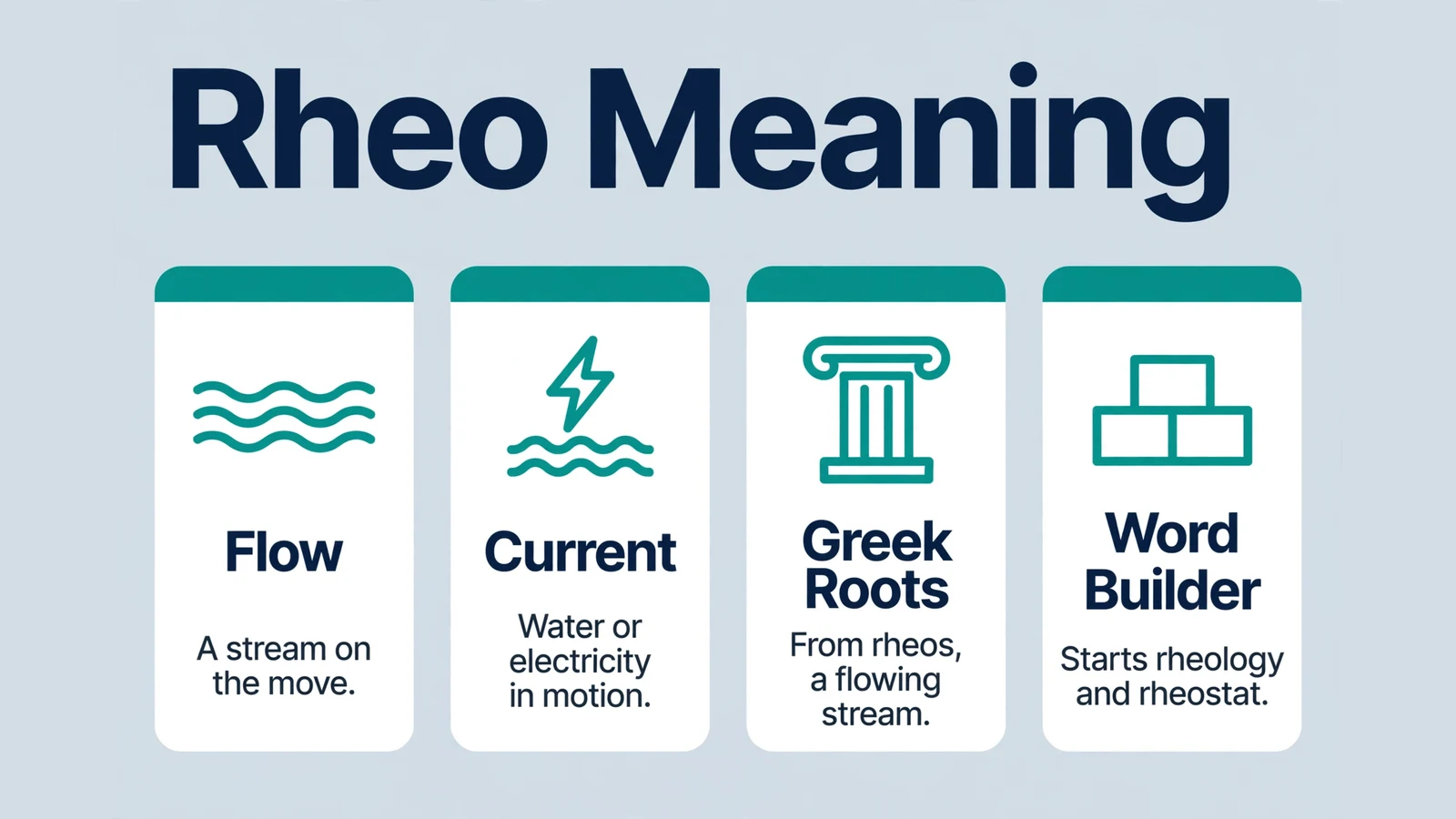
So what is the rheo meaning? Rheo- is a combining form from Greek, and it means flow or current. Sometimes that current is water moving in a stream. Sometimes it is electricity moving through a wire.
Either way, rheo- always points to something on the move. Most prefixes earn a living inside everyday words. This one chose science instead. This guide unpacks the prefix properly. You will learn where it comes from, how to say it, and how it builds a small family of science words.
By the end, words that once looked like jargon will read like plain English.
What Does Rheo Mean?
The Dictionary Answer
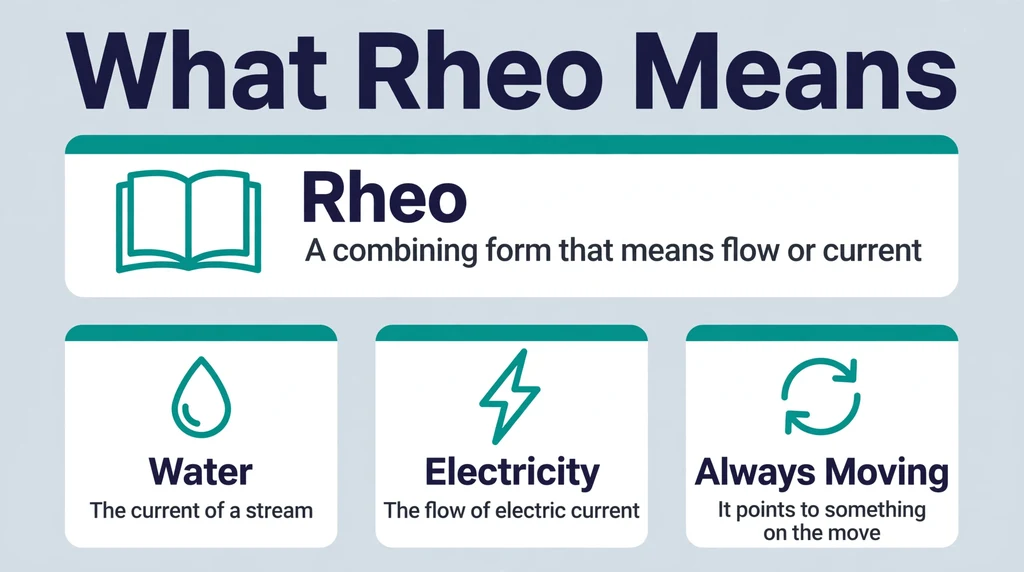
Merriam-Webster defines rheo- as a combining form meaning “flow : current,” and it gives rheostat as the example word. That entry is only three words long, yet it covers a lot of ground. Flow is the wide idea, and it covers rivers, blood, paint and lava. Current is the narrower idea, and it points to a directed stream of water or of electricity. Together, the two words explain every technical term the prefix has ever built. Whenever you meet rheo- at the start of a word, something in that word moves, streams or flows. That single clue unlocks most of the family on sight.
A Combining Form, Not a Standalone Word
Here is the part many short definitions skip. Rheo is not a normal standalone word, so you will never use it alone in an ordinary sentence. Instead, it is a combining form, a word-building block that joins other pieces to make complete words. Dictionaries signal this by printing it with a trailing hyphen, as rheo-. English owns many such blocks, mostly borrowed from Greek and Latin. Hydro-, for example, means water, and it builds words like hydroelectric. Rheo- works the same way, except that it names the movement rather than the material. It always needs a partner, such as -logy, -meter or -stat, before it can stand as a full word.
Two Currents, One Idea
The prefix began its life beside water. Its earliest sense was the current of a stream, the moving body of a river. Then, in the late nineteenth century, scientists began using it for a second kind of current. Electricity was the new frontier, and researchers needed fresh words for controlling its flow. The Online Etymology Dictionary notes that from that period, rheo- typically referred to the flow or adjustment of electric current. The jump makes sense once you picture it. Early scientists often described electricity as a fluid that streamed through wires. Ordinary English made the same leap, which is why one word, current, serves both a river and a circuit. Rheo- simply follows the path that current had already taken. One Greek stream word ended up serving both the river and the circuit.
The Greek Roots of Rheo
Rheos and Rhein, a Flowing and a Stream
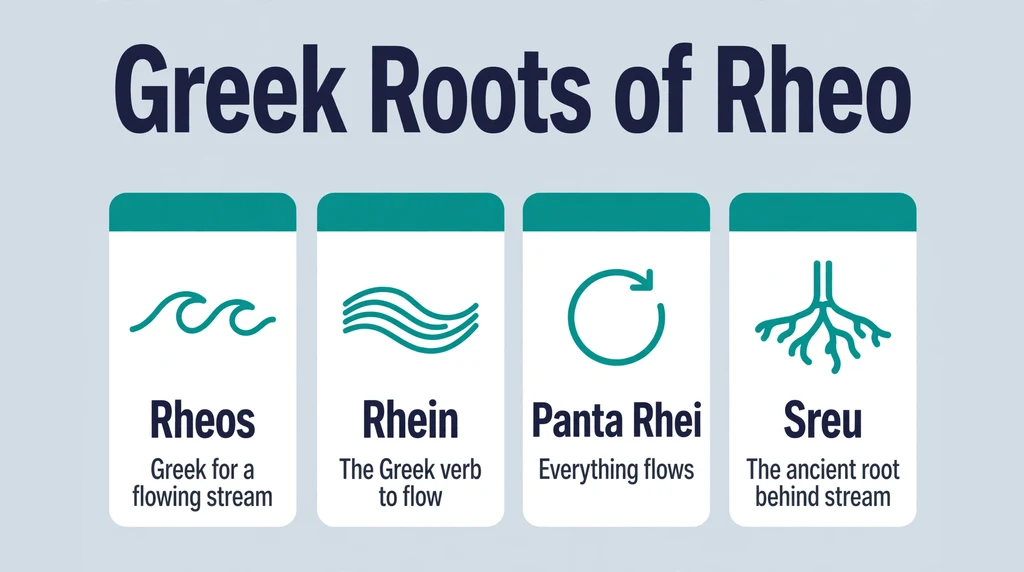
The trail starts with the Greek noun rheos, which meant a flowing, a stream or a current. Behind that noun stands the verb rhein, meaning to flow. Merriam-Webster gives exactly this line of descent in its word history for rheo-. Greek also had the everyday verb rheo, which meant to flow or to run, as water runs. Writers used it for rivers, tears and anything else that streamed. So the family was never abstract. From the beginning, these words described visible movement, the kind you could watch in a mountain stream. English borrowed the noun’s shape, rheo-, and put it to work.
Panta Rhei, Everything Flows
Ancient philosophy gave the root its most famous slogan. The phrase panta rhei means “everything flows,” and tradition links it to Heraclitus of Ephesus. Heraclitus is also the thinker tied to the saying that you cannot step into the same river twice. His point was that the world never sits still, just as river water never repeats itself. The slogan proved so fitting that it was later adopted as the motto of the Society of Rheology. That detail, recorded in histories of the field, shows how proudly flow scientists claim this Greek heritage. A two-thousand-year-old remark still introduces a modern science.
One Root, Many Relatives
Push further back and rheo- joins a much bigger clan. Etymonline traces rheos to a Proto-Indo-European root usually written *sreu-, meaning to flow. Sanskrit, a distant cousin language, has sravati for “flows” and srotah for “stream.” Inside English, the same root quietly produced the word stream itself. It also produced rhythm, through the Greek word rhythmos, a relative of rhein. The medical family belongs here too. Rheumatism and rheumatoid descend from rheuma, a Greek word for a flow or discharge. Meanwhile, the -rrhea ending in diarrhea and catarrh comes from the same flowing idea. One ancient root for moving water now runs through music, medicine and physics alike.
From Greek Streams to English Rivers
The root’s journey did not stop at Greek. Etymonline traces even the plain English word stream back to *sreu-, which makes stream a home-grown cousin of rheo-. Sanskrit took the same root and produced sravati, “flows,” and srotah, “stream.” Avestan and Old Persian, two more cousin languages, formed their own words for river from it. So one prehistoric word for flowing water split into streams across Europe and Asia. Greek kept its branch in the laboratory, while English kept its branch in everyday speech. When you say stream and rheology in one sentence, you are using the same ancient root twice.
Rheo in Greek Writing
The verb behind the prefix had a long literary life of its own. Greek writers used rheo for anything that flowed, from rivers to crowds to words. Lexicons note that the verb appears in Greek literature from Homer onward. One later line became especially famous: “streams of living water will flow from within.” Bible lexicons catalogue that single use carefully, along with the verb’s cousins across languages. They even line it up beside Sanskrit sru and Latin fluo, the verb behind English words like fluent and fluid. The pattern is consistent across two thousand years. Wherever something streams, this root turns up.
How to Pronounce Rheo

The prefix is pronounced REE-oh, with the stress on the first syllable. That soft opening is typical of words English took from Greek. The spelling can mislead new readers, because the h is silent and the pair rh simply marks the Greek origin. Rhythm, a cousin of rheo-, keeps the same rh spelling habit. Once you know the trick, the whole family becomes easy to say aloud.
The relatives follow the same pattern, each with its own stress:
- Rheo-: REE-oh
- Rheology: ree-OL-uh-jee
- Rheostat: REE-uh-stat
- Rheometer: ree-AH-muh-ter
- Rheophile: REE-uh-file
- Rheotaxis: ree-uh-TAK-sis
Notice how the first syllable stays stable across the list. Only the ending changes as the second half of each word changes. So, if you can say REE-oh confidently, you can attempt any rheo- word in public. Reading science writing aloud becomes far less risky with that one anchor in place.
One spelling detail explains the shape of the prefix itself. Greek combining forms usually end in the joining vowel -o-, which links them smoothly to the next part. That is why the block appears as rheo- rather than rhe-. The same joining vowel appears in hydro-, thermo- and electro-. It carries no meaning of its own, yet it makes long compounds pronounceable. Think of it as the mortar between two bricks of meaning.
How Rheo Builds Words

The Second Half Tells You the Job
A combining form is only half a word, so the ending decides the final meaning. Luckily, rheo- keeps predictable company. The ending -logy means the study of something, so rheology is the study of flow. The ending -meter means a measuring device, so a rheometer measures flow. Next, -stat names a regulating device, and a rheostat regulates an electric current. The ending -phile means a lover of something, which makes a rheophile a creature that loves flowing water. Finally, -taxis concerns response and arrangement, and rheotaxis is a living response to a current. Learn five endings, and the whole family starts translating itself.
How to Decode a Rheo Word You Have Never Seen
This pattern gives you a reliable reading method. First, split the word where rheo- ends. Next, translate rheo- as flow or current. Then translate the ending in plain words. Finally, join the two halves and test the result against the sentence around it. Suppose you meet the phrase “rheophilic fish” in a nature article. Flow plus loving gives you fish that love flowing water, which is exactly what biologists mean. The method works because these words were designed, not evolved by accident. Nineteenth and twentieth century scientists built them from Greek parts on purpose, like labelled machine components.
Rheo- Among Its Peers
Rheo- belongs to a large toolkit of Greek building blocks that science keeps reusing. Hydro- names water itself, and it appears in hydroelectric and hydrofoil. Thermo- names heat, and -meter names measurement, which is why a thermometer measures heat. The -stat ending in rheostat belongs to the same toolkit, since it marks a device that holds something steady. Once you see the system, technical English becomes far less mysterious. Most long science words are simply two or three labelled parts clicked together. Rheo- is one of the most honest parts in the box, because it always announces movement.
Rheology: The Science of Flow
Two Centuries of Flow Without a Name
Long before anyone coined rheology, great scientists were already circling its questions. Physics Today notes that contributors stretch back to the days of Newton and Hooke. Newton explored how fluids resist motion, while Hooke studied how solids spring back under force. Geologists, engineers and doctors each examined flowing materials inside their own fields. However, the fields barely spoke to one another, and progress stayed scattered. Each discipline kept its own vocabulary for what was often the same behaviour. The subject needed a shared language before it could become a shared science. That missing language is exactly what the twentieth century supplied.
A Word Invented on Purpose
Most science words grow slowly, but rheology was coined in a single decade. In the 1920s, Professor Eugene C. Bingham of Lafayette College in Pennsylvania needed a name for the study of how matter deforms and flows. A colleague who taught classics helped him build one from Greek, and the result was rheology. When the American Society of Rheology was founded in 1929, its members adopted Bingham’s definition: the science of the deformation and flow of matter. The very first meeting heard papers on asphalt, lubricants, paints, plastics and rubber. From day one, this was a science of sticky, stretchy, real-world materials.
What Rheologists Actually Study
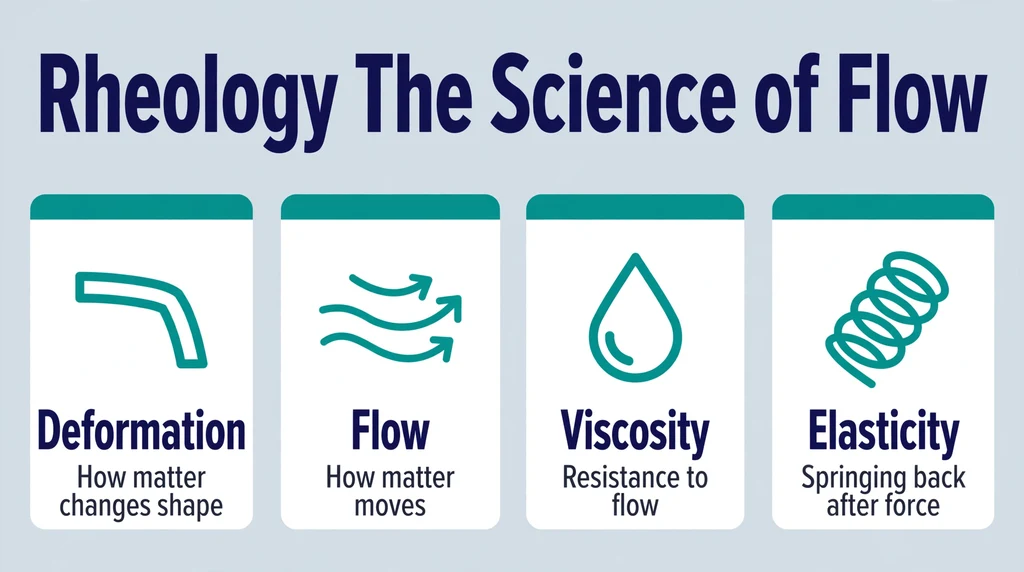
Britannica sums the field up through three partner ideas. The first is elasticity, the ability of a material to spring back after a force is removed. The second is viscosity, the resistance of a fluid to flow. Honey has high viscosity, so it pours slowly, while water has low viscosity and pours fast. The third idea is plasticity, the ability to change shape permanently once enough force is applied. Real materials mix all three behaviours in different proportions. Because of that, rheologists ask one guiding question about any substance. How does this material respond when a force pushes, pulls or twists it?
Newtonian and Non-Newtonian Flow
Some fluids keep life simple. Water, for instance, flows the same way whether you stir it gently or hard. Fluids with this constant viscosity are called Newtonian, after Isaac Newton, an early giant in the study of moving matter. Many everyday materials refuse to behave so politely, though. Ketchup sits thick in the bottle, then thins and pours once you shake or squeeze it. Materials like toothpaste go further and act almost solid until a firm push arrives. Rheologists call such yield-point materials Bingham bodies, a nod to Bingham himself. These odd behaviours are exactly why the field needed its own name.
The Deborah Number, Where Even Mountains Flow
One founder-era idea shows how playful this science can be. Markus Reiner, a colleague of Bingham, named a key concept the Deborah number. He borrowed the name from the prophetess Deborah, whose song says that the mountains flowed before the Lord. The idea behind it is serious, though. Given enough time, almost any material flows at least a little, while over short timescales even water can behave almost like a solid. So the Deborah number compares the timescale of the material with the timescale of your experiment. It reminds every rheologist that solid and liquid are partly matters of patience.
Why Thickness Changes: Shear and Temperature
Two everyday forces explain most changes in thickness. The first is shear, which simply means pushing layers of a material past one another. Stirring, squeezing, shaking and brushing all apply shear. Some materials thin under shear, which is why paint slides off the brush yet stays put on the wall. Others thicken instead, and a few change slowly even after the pushing stops. Temperature is the second force. Warm honey pours easily, while the same honey creeps after a night in the fridge. Rheologists measure these responses rather than guessing them, because a product must behave the same in the factory, the shop and your kitchen.
Measuring Flow: Rheometry in Practice
Rheology is a hands-on science, and measurement is half of its identity. Workers in the field call the measuring side rheometry. A typical test traps a small sample between two surfaces inside a rheometer. One surface then twists, slides or oscillates while sensors record how hard the sample pushes back. From that resistance, software builds a profile of the material across many speeds of pushing. A shampoo, for example, must pour slowly in the shower yet cling long enough to clean. Its profile proves whether the recipe hits that balance. Numbers, not impressions, decide whether a batch ships.
Rheology in Everyday Life
You meet rheology every morning, whether you know the word or not. Paint is engineered to spread smoothly under a brush, then cling to the wall without dripping. Cosmetics firms test creams so they squeeze out easily yet sit calmly on skin. Doctors, meanwhile, study the rheology of blood, because flow inside vessels matters to health. Researchers have even put Oreo creme and baseball mud into rheometers to measure how they flow. In 2017, Smithsonian reported on physicist Marc-Antoine Fardin, who used rheology to ask whether a cat can behave like both a solid and a liquid. Flow science clearly reaches far beyond the factory.
Rheology at Work in Industry
Industry runs on controlled flow, so rheologists are quietly everywhere. Road builders test asphalt, because a surface must spread during laying yet resist rutting under traffic for years. Printers care about ink, which must flow through the press and then stay exactly where it lands. Concrete crews face the same puzzle in reverse, since wet concrete must pour like a liquid and then set like a stone. Geologists use flow models when they study mudslides, glaciers and lava. Even the first Society of Rheology meeting in 1929 mixed asphalt, lubricants, paints, plastics and rubber on one programme. The science was industrial from birth.
Rheo in Medicine and the Body
The Rheology of Blood
Your body is full of moving fluids, so medicine claims a share of the prefix too. Medical dictionaries single out blood flow as an area where rheology has become important. Blood is not a simple liquid, because it carries cells that change how it streams through vessels. Its flow behaviour shifts between wide arteries and narrow capillaries. Researchers therefore measure blood the way engineers measure paint, with rheometers and flow models. The journal Eye devoted attention to the same theme, reporting a Cambridge symposium titled “Go with the flow.” Its subject was rheology, fluid flow and the eye. Even eye specialists, it turns out, need flow science.
The -Rrhea Family, Flow Written on the Body
Greek medicine built its own branch of the family with the ending -rrhea, which means a flow or discharge. You can decode its most famous member with the skills from earlier. Diarrhea joins dia-, meaning through, with the flow root, giving a flowing through. Catarrh, an old word for inflamed mucus flow, belongs to the same group. Etymonline also lists gonorrhea, amenorrhea and rhinorrhea among the relatives of the *sreu- root. These are not cheerful words, but they prove a serious point. When doctors needed precise names for things flowing where they should not, they reached for rheo’s family.
The Rheostat: Rheo Meets Electricity
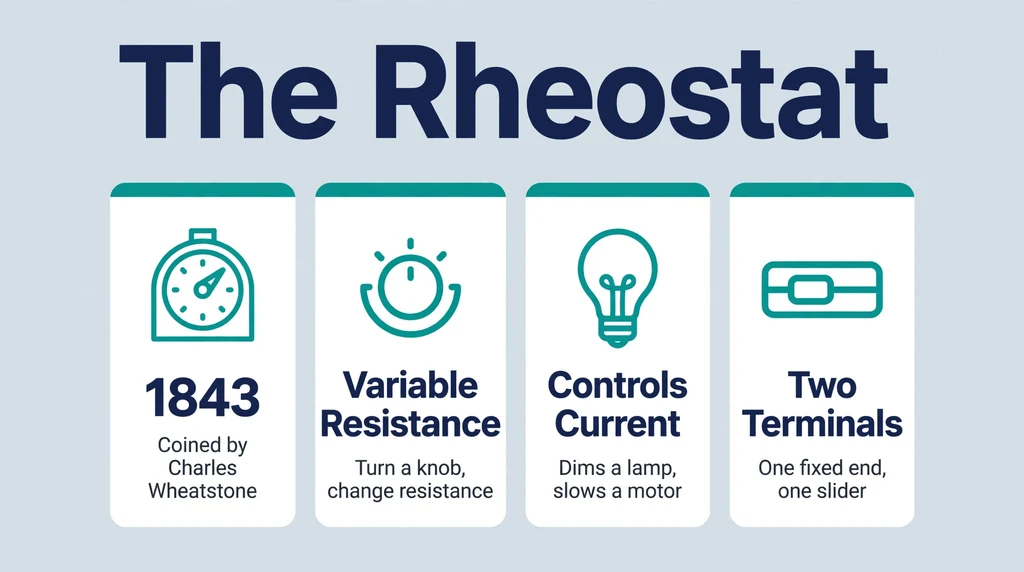
Coined by Charles Wheatstone in 1843
The oldest famous rheo- word belongs to electricity, not water. In 1843, the English physicist and inventor Charles Wheatstone presented new instruments for studying electric circuits. One device adjusted the resistance in a circuit, which in turn adjusted the current. Wheatstone announced its name in his lecture: “I have called it a Rheostat.” He built the word from rheos, the Greek stream or current, plus the ending -stat, meaning a regulating device. Thermostat uses that same ending, and it regulates temperature instead. Wheatstone’s coinage worked so well that Merriam-Webster still records 1843 as the word’s first known use.
What a Rheostat Does
A rheostat is a resistor whose resistance you can vary by turning a knob or sliding a contact. More resistance means less current gets through, and less resistance means more current flows. That simple control made rheostats the dimmer switches of their era. Turning one down lowered the brightness of a lamp, a use electronics teachers still cite today. Rheostats also controlled the speed of electric motors before modern electronics took over.
Because they are built to carry strong currents, workshop rheostats were often large, wire-wound devices rather than tiny components. Their weakness was waste, since a resistor turns the blocked electrical energy into heat. That is why modern dimmers mostly use electronic switching instead. The rheostat survives in laboratories, classrooms and heavy equipment, where simple and rugged beats clever. The name fits the job perfectly. Inside the device, a human hand is quite literally standing in the electric stream, guiding how much of it may pass.
Rheostat vs Potentiometer
These two names cause steady confusion, so here is the clean split. A rheostat uses two terminals, one fixed end and one sliding contact, and its job is to vary current. A potentiometer uses three terminals and works as a voltage divider, so its job is to vary voltage. That is why volume knobs on amplifiers are usually potentiometers. The two devices are close relatives, though, and the same hardware can often serve both roles. Wire a potentiometer using only two of its terminals, and it behaves as a rheostat. In short, the name follows the wiring and the job, not the object alone.
More English Words Built on Rheo
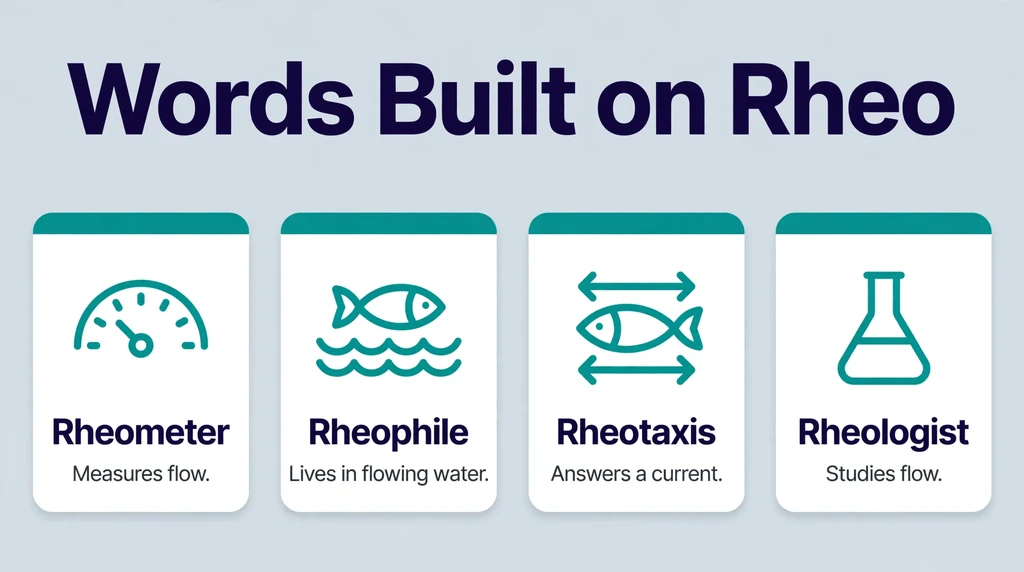
Rheometer, the Flow Measurer
A rheometer is an instrument for measuring flow, especially the flow of thick or viscous substances. Merriam-Webster records its first known use in 1847, just four years after the rheostat. Modern rheometers often twist a sample between plates or spin it inside a chamber. By measuring how the sample resists that motion, they reveal its viscosity and stiffness. Paint makers, food scientists and geologists all rely on such readings. Whenever a factory needs a sauce, cream or slurry to flow exactly as designed, a rheometer probably checked it first.
Rheophile, Life That Loves a Current
Biology borrowed the prefix for creatures of fast water. Merriam-Webster defines rheophilic, the adjective form, as preferring or living in flowing water. The noun form, rheophile, is pronounced REE-uh-file. Stream insects, algae and many river fish count as rheophilic, because their whole lives unfold inside a current. Some grip rocks, some swim constantly, and some filter food straight from the passing water. The word is built exactly as the decoding method predicts. Rheo- supplies the flowing water, and -phile, the lover, supplies the preference.
Rheotaxis, Answering the Current
Rheotaxis names a subtler behaviour. Merriam-Webster’s medical dictionary defines it as a taxis in which the push of a moving fluid, such as water, directs the organism’s response. In plain terms, the current tells the creature how to orient itself. Many fish show rheotaxis when they turn to face upstream. Facing the flow lets them hold position without being swept away, and it brings food and oxygen toward them. Tiny organisms in streams and in the body show similar responses. Once again, the Greek stream sits at the centre of the idea.
The Wider Family at a Glance
Step back, and the family forms a tidy toolkit around one idea. Rheology names the science, and a rheologist is the scientist who practises it. A rheometer is the instrument that measures flow, and rheometry is the measuring work itself. A rheostat leaves water behind and regulates the electric branch of the family. Biology takes two members, rheophile for the creature and rheotaxis for its behaviour. The adjective rheological can describe any of it, from the rheological profile of blood to the rheological testing of paint. Six or seven words cover the whole territory. Each one becomes transparent the moment you hear flow inside it.
Rheo as a Company and Product Name
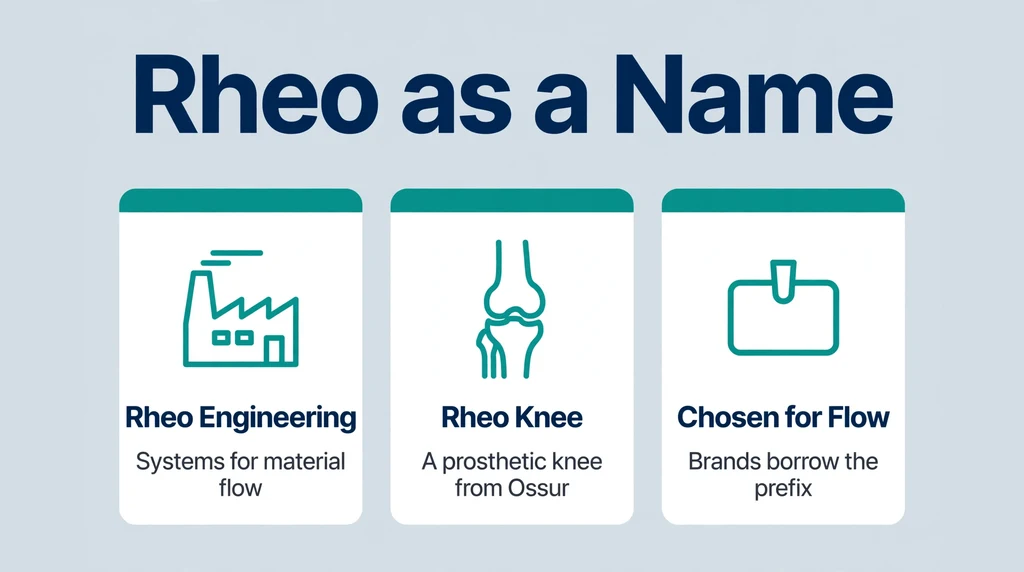
Because the prefix promises smooth flow, businesses borrow it as a name. In April 2020, an American firm called EHS Solutions renamed itself Rheo Engineering. The company explained the choice on its own history page: “Rheo, a Greek prefix meaning ‘flow’.” The name suits its work, since the firm designs large systems that move powders and materials around pharmaceutical plants. Its own site adds that its solutions also serve the specialty chemical, food and beverage, nutraceutical and cosmetic industries. Every one of those industries lives or dies by how materials flow. Product names borrow the prefix too. The Rheo Knee, a microprocessor-controlled prosthetic knee from the maker Össur, reached the market in 2005. Its fourth generation, the Rheo Knee 4, followed in 2019. In each case, the borrower is trading on the same ancient image. Something here moves, streams or flows.
Common Mix-Ups Around Rheo
Rheology Is Not Theology
Newcomers often meet rheology through an embarrassing typo. One medical journal article on the field jokes that spell-checking tools constantly try to change rheology into theology. The two words share most of their letters, yet their worlds could not differ more. Theology studies religious belief, while rheology studies flowing matter. The confusion is a handy reminder of how young and specialised the flow word still is. Most dictionaries of everyday English built their spell-check lists long after 1929. So, if your software keeps sending you to church, your document is probably about toothpaste, paint or blood.
Rheo- Is Not Rheum
A second look-alike causes quieter confusion. Rheum is a complete English word, not a combining form, and it names a thin, watery discharge, especially from the eyes or nose. Rheumy eyes in old novels are simply watery eyes. The two words are distant cousins rather than strangers, since Etymonline places rheum in the same *sreu- family. A separate Greek branch, rheuma, meaning a flow, also produced rheumatism and rheumatoid. Still, the jobs differ completely. Rheo- builds science terms about flow in general, while rheum names one specific bodily fluid. Keeping the hyphen in mind keeps them apart.
A Rheostat Is Not a Thermostat
The shared ending tricks many readers here. Both words finish with -stat, the regulating-device ending, so both devices hold something steady. The difference lies in what each one guards. A rheostat regulates an electric current by changing resistance in a circuit. A thermostat regulates temperature by switching heating or cooling on and off. Their first halves announce the difference, since rheo- means flow and thermo- means heat. Once again, the Greek parts translate the whole word for you. Reading the pieces beats memorising the names every time.
Rheo Words in Sentences
Seeing the family inside real sentences fixes the meanings in memory. Each example below uses a word exactly as scientists and writers use it.
- The paint chemist used rheology to explain why the new coating levelled smoothly but never sagged.
- A heavy brass rheostat on the wall once controlled the theatre lights, long before digital dimmers arrived.
- Before the sauce could be bottled, the lab ran it through a rheometer to check its thickness.
- Rheophilic insects cling to stones in the fastest part of the stream, where the current delivers their food.
- The young trout showed strong rheotaxis, turning upstream the moment the flow increased.
- To forecast the lava, the volcanologist treated the molten rock as a rheology problem, not a mystery.
- Her thesis measured the rheology of blood samples, comparing how they flowed at different temperatures.
- Stage crews once dimmed the house lights with a row of rheostats, each one warm from the current it tamed.
Frequently Asked Questions
What does rheo mean in one line?
Rheo- means flow or current. It is a Greek combining form that sits at the front of science words, pointing to the flow of a liquid, the flow of matter in general, or the flow of electric current.
Is rheo a word by itself?
Not in standard English. Dictionaries list rheo- as a combining form, which means it only works as part of a larger word, such as rheology or rheostat. Companies sometimes use Rheo alone as a brand name, but that is a naming choice, not a dictionary sense.
How do you pronounce rheo?
Say REE-oh. The h is silent, and the stress falls on the first syllable. The same opening sound runs through the family: rheology is ree-OL-uh-jee, and rheostat is REE-uh-stat.
What is the difference between rheo- and hydro-?
Hydro- names the substance, water, while rheo- names the movement, flowing. A hydroelectric dam uses water, which is the hydro- part of the story. The rheology of the river below it studies how that water and sediment actually flow.
What does rheo mean in rheology?
In rheology, rheo- contributes the idea of flow. Joined with -logy, the study of something, it gives the science of the deformation and flow of matter. The word was coined in the 1920s by Eugene C. Bingham, and the Society of Rheology was founded in 1929.
Why does the word rheostat contain rheo-?
Because the device controls an electric current, and current was the second great sense of rheo-. Charles Wheatstone coined rheostat in 1843, joining rheos, a stream or current, with -stat, a regulating device.
Is rheo related to the word rhythm?
Yes, they are cousins. Etymonline traces both to the same Greek neighbourhood: rheos comes from rhein, to flow, and rhythmos, the source of rhythm, is a relative of that same verb. Measured flow sits inside both words.
What is a rheophile?
A rheophile is a plant or animal that prefers, or lives in, flowing water. The word joins rheo-, flow, with -phile, a lover of something. Stream insects and many river fish are everyday examples.
Final Thoughts
Rheo is a small prefix with an unusually vivid picture inside it: a stream on the move. That single image explains a science of flowing matter, a nineteenth century current controller, instruments that measure thickness, and creatures that live facing the current. Between Wheatstone naming the rheostat in 1843 and Bingham naming rheology in the 1920s, the prefix quietly colonised two different sciences. Few building blocks of English can claim both a river and a wire as home territory. Learn to spot rheo- at the start of a word, and technical vocabulary stops looking like a wall of jargon. It becomes a set of labelled parts that you can translate on the spot. For the dictionary entry itself, see Merriam-Webster’s page for rheo-, the shortest definition this whole family grows from.