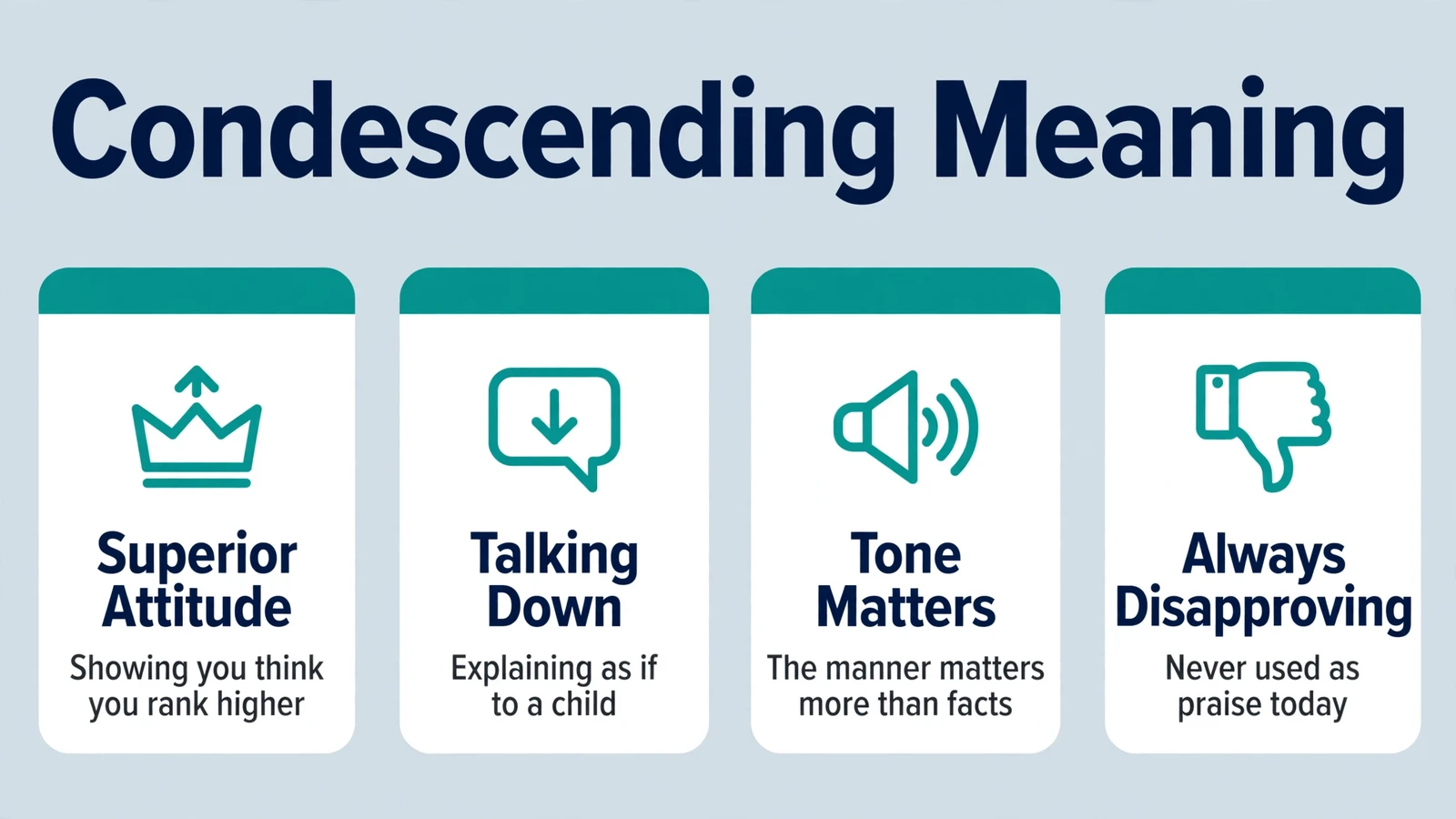
Someone explains a simple thing to you very slowly, with a patient little smile. You already knew it. Still, they keep going, syllable by syllable, as if your understanding were fragile. That uneasy feeling has a name. A person is being condescending when they treat you as less intelligent or less important than they are, while showing a superior attitude about it. Put simply, the condescending meaning is talking down to someone from a height you have claimed for yourself. People rarely forget that tone, because it stings in a quiet way. This guide explains where the word comes from, how to spot it, and how it differs from close cousins like patronizing and arrogant. By the end, you will also know how to use it well yourself.
What Does Condescending Mean?
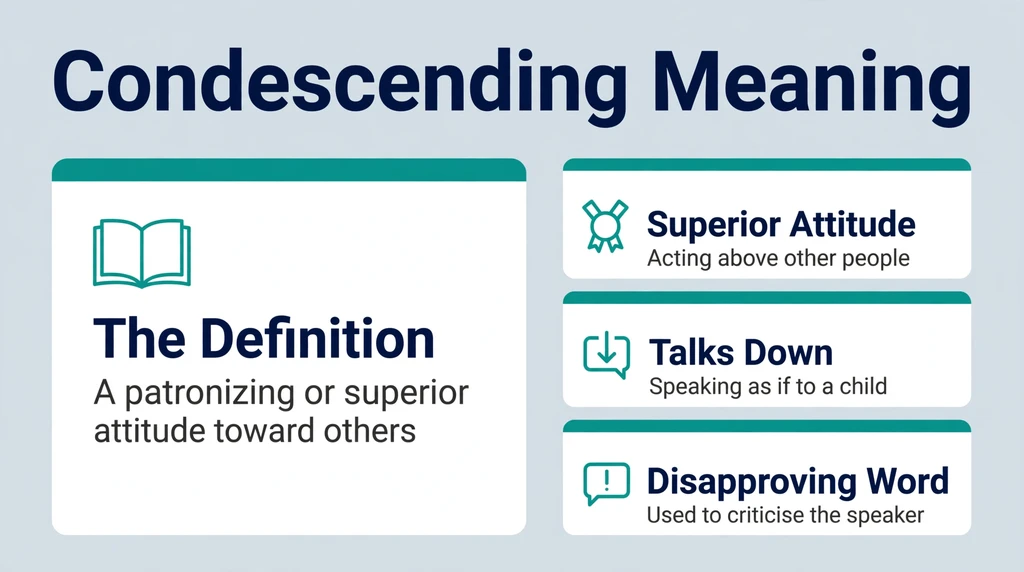
Merriam-Webster defines condescending as “showing or characterized by a patronizing or superior attitude toward others.” Cambridge Dictionary puts it in plainer words: treating someone as if you are more important or more intelligent than them. Both definitions point at the same behavior.
The dictionary definition in plain words
Strip away the labels and the idea is simple. A condescending person acts as if they stand on a higher step than you. Then they perform a small favor: they come down to your level, briefly, and explain your own world to you. The help itself may even be accurate. However, the attitude wrapped around it says you could not have managed alone.
A word people use to complain, not to praise
Cambridge marks condescending as “disapproving,” and real usage agrees completely. Nobody thanks a friend for a condescending explanation. Instead, the word appears when someone feels talked down to at work, at home or online. Merriam-Webster even lists the classic combinations: a condescending tone, a condescending attitude, a condescending remark. Notice that all three target the manner, not the facts. A statement can be true and still land as condescending.
What condescending looks and sounds like
Most condescension travels through tone rather than vocabulary. The voice slows down. Simple words get spelled out. A smile arrives half a second too late, and praise comes with a tiny hook inside it. Typing can carry it too, through phrases like “as I already explained” or “let me make this simple for you.” In short, the message underneath says: I am above this conversation, and above you.
A condescending moment vs a condescending person
Writers use the word at two sizes. At the small size, it labels one act: a condescending remark, a condescending email, one badly judged explanation. Almost anyone can produce one of those on a tired afternoon. At the large size, it labels a habit, and the phrase becomes “a condescending person.” The habit matters far more than the slip. When you use the word, decide which size you mean. The single act can be apologized for and repaired. The reputation, once attached, follows its owner into every new room.
Core Meaning of Condescending
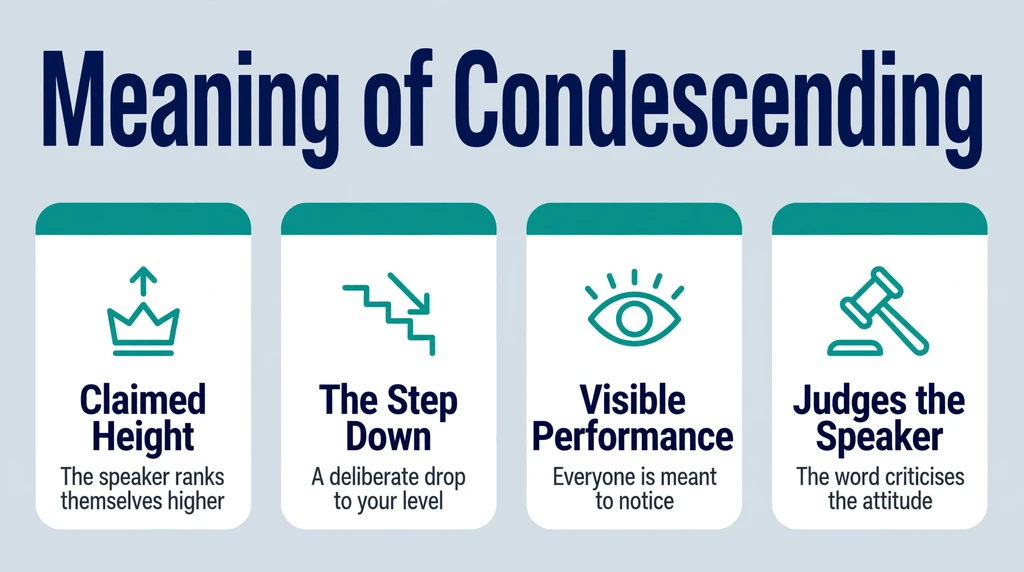
Beneath the dictionary line sits a small drama with three parts. First, the speaker claims a higher position. Second, the speaker steps down in a visible, deliberate way. Finally, everyone nearby is expected to notice the step. That visibility is the core of the word.
Superiority is the engine
Every condescending moment starts with a ranking. One person quietly decides they are smarter, richer, older, more experienced or simply more important. The ranking may be real on paper, such as a manager speaking to a new hire. Even so, ranking alone does not create condescension. The problem begins when the higher person enjoys displaying the gap instead of quietly doing the job.
The deliberate step down
Condescension also needs a performance. The speaker lowers their language, slows their pace and simplifies ideas the listener already understands. Then the speaker waits for gratitude. This is why over-explaining feels so insulting to adults. Nobody objects to a clear explanation. People object to being treated like a child who needs one.
Why the word always criticizes the speaker
Calling behavior condescending judges the speaker, never the listener. It says the speaker’s attitude was superior and unnecessary. Interestingly, the target of condescension often understands more than the speaker assumes. That mismatch is exactly what makes the moment memorable. The speaker performs generosity, yet the listener hears a ranking instead.
Why good intentions do not settle the question
Speakers often protest that they meant no harm. Sometimes that is even true. Nevertheless, the word describes the effect of the performance, not the private intention behind it. A manager may genuinely want to teach. Still, if the teaching arrives wrapped in sighs and needless simplification, listeners will hear the ranking first. That is why apologies for condescension usually fail when they only defend the motive. Repair works better: acknowledge the tone, skip the verdict on the listener, and continue at an even level.
Condescending Pronunciation and Word Forms
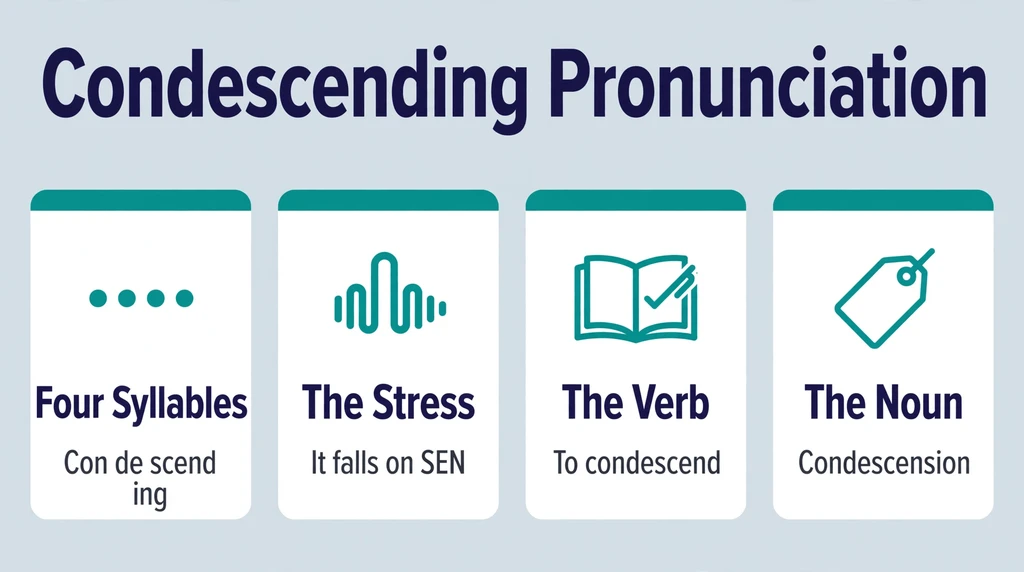
Condescending has four syllables: con-de-scend-ing. Cambridge gives the British pronunciation as /ˌkɒn.dɪˈsen.dɪŋ/ and the American as /ˌkɑːn.dəˈsen.dɪŋ/. In both versions, the stress lands on the third syllable, the “scend” part. Say it as kon-duh-SEN-ding and you will sound natural almost anywhere.
The word family
The adjective grows from the verb condescend, which means to assume an air of superiority, or more mildly, to unbend and waive the privileges of rank. Its noun is condescension, the behavior itself. The adverb is condescendingly, as in “she smiled condescendingly at the new intern.” Dictionary.com also records the rare nouns condescender and condescendent for the person doing it. In everyday writing, though, the adjective and the noun do nearly all the work.
Forms you will meet most often
Because the adjective describes tone, it pairs with a small set of nouns again and again. Writers describe condescending remarks, condescending attitudes, condescending smiles and condescending answers. Editors, reviewers and bosses attract the label most often in print. Meanwhile, the verb usually appears with “to,” as in “he would not condescend to reply.” That construction carries its own little sneer, which is part of why people enjoy using it.
Where Condescending Comes From
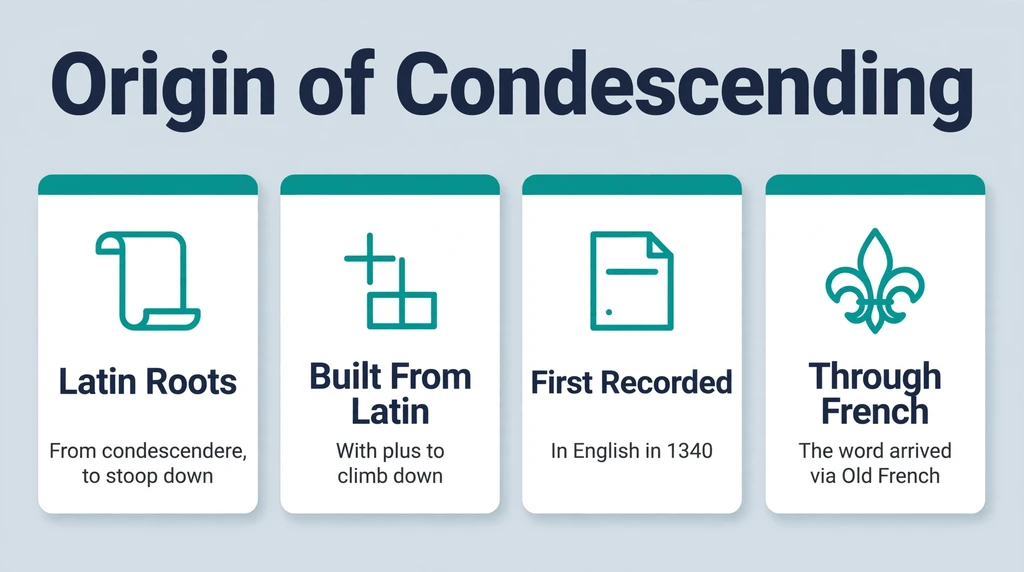
The word is built from Latin parts that literally describe stepping down. Late Latin had the verb *condescendere*, meaning to let oneself down or stoop. English took the verb in through Old French in the fourteenth century. Its pieces still show today: *com-*, meaning “with,” joined to *descendere*, “to descend.”
The Latin roots
Inside *descendere* sits another small machine. The prefix *de-* means “down,” and *scandere* means “to climb.” So the ancestor of condescend describes climbing down together with someone. That picture survived for centuries. A condescending person was someone who climbed down from a high seat to meet ordinary people where they stood. The modern insult keeps the staircase and simply drops the kindness.
First appearances in English
The verb condescend was first recorded in English in 1340, in religious and formal writing. At that stage it mostly meant yielding gracefully or making an allowance. Condescension as a noun followed much later, with a first known use in 1647. The adjective condescending arrived last of all. Merriam-Webster dates its first known use to 1881, which is telling. English needed the adjective only once the behavior itself had become a recognizable fault.
When Condescending Was a Compliment
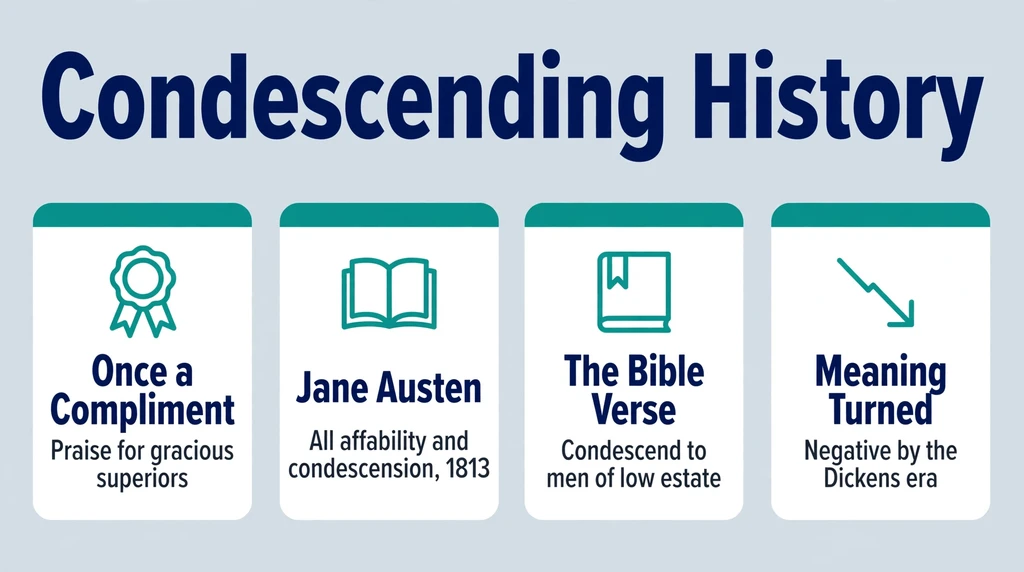
Here is the surprise inside this word’s history. For several centuries, condescension was praise. A great lord, a queen or even God could be admired for it. The higher the person, the more gracious the step down appeared.
A virtue in a world of ranks
In Middle English, condescend was generally a positive word, according to etymology references. Society ran on visible rank, so a superior who set rank aside seemed generous. Merriam-Webster still keeps this older sense on record: “voluntary descent from one’s rank or dignity in relations with an inferior.” The King James Bible uses the verb the same way in Romans 12:16, urging believers to “condescend to men of low estate.” Nobody in that sentence is being insulted.
Jane Austen and Lady Catherine
Jane Austen gives us the famous example. In *Pride and Prejudice*, published in 1813, the clergyman Mr. Collins praises his patroness, Lady Catherine de Bourgh. He tells Elizabeth, “She is all affability and condescension.” Collins means it as the highest compliment. He believes Lady Catherine kindly lowers herself to speak with people beneath her. Modern readers, though, often hear the line as a joke at Collins’s expense, because the modern meaning has crept in underneath.
How the word turned sour
During the nineteenth century, the compliment curdled. Charles Dickens, in *Dombey and Son*, describes a character as “a little condescending, but extremely kind.” That “but” is the giveaway. Kindness and condescension had become opposites that needed excusing. As ranked society faded, the performance of stepping down started to look like self-promotion. Merriam-Webster’s unabridged dictionary now glosses the modern noun as “disdain veiled by obvious indulgence or patience.” The staircase stayed. The generosity left.
Signs of a Condescending Tone
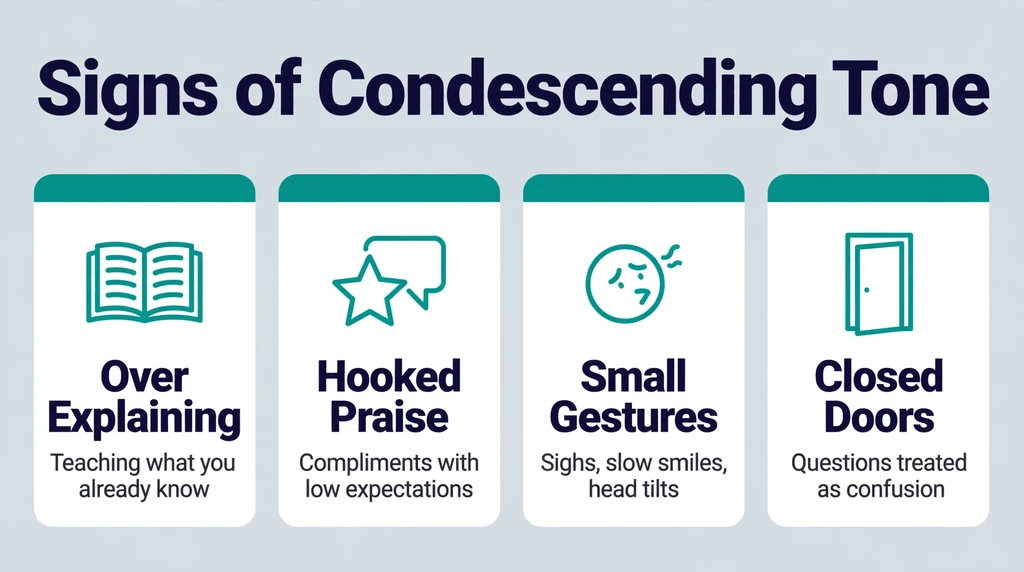
Condescension rarely announces itself with an insult. Instead, it leaks out through a handful of repeatable habits. If several of these show up together, the tone is probably condescending, whatever the words claim.
Over-explaining what you already know
The clearest sign is an explanation nobody requested, pitched far below your level. A colleague walks you through a tool you have used for years. A relative explains your own job to you at dinner. The content may be correct, yet the assumption underneath does the damage. It presumes ignorance first and checks later, if it checks at all.
Praise with a hook inside
Condescending praise sounds sweet and lands sour. “That’s actually quite good, for a first attempt.” “You speak very well for someone from your background.” Each compliment quietly installs a low expectation, then applauds you for reaching it. Genuine praise names the work itself. Condescending praise names your category first, and that ordering gives the game away.
Small gestures that carry the message
Words are only half the channel. A slow head tilt, a patient sigh or a smile held a moment too long can all deliver the ranking. So can being patted on the arm mid-sentence, or hearing your name used like a warning label: “Well, Alex, what you need to understand is…” None of these moves proves anything alone. Together, they build the unmistakable feeling of being handled rather than heard.
Dismissing questions instead of answering them
Finally, watch what happens when you push back. A condescending speaker treats questions as confusion, not curiosity. “Let’s not overcomplicate this.” “Trust me, it’s beyond the scope here.” The door closes politely, and your competence closes with it. A respectful expert answers the question or admits its limits. A condescending one protects the staircase.
Condescending vs Patronizing
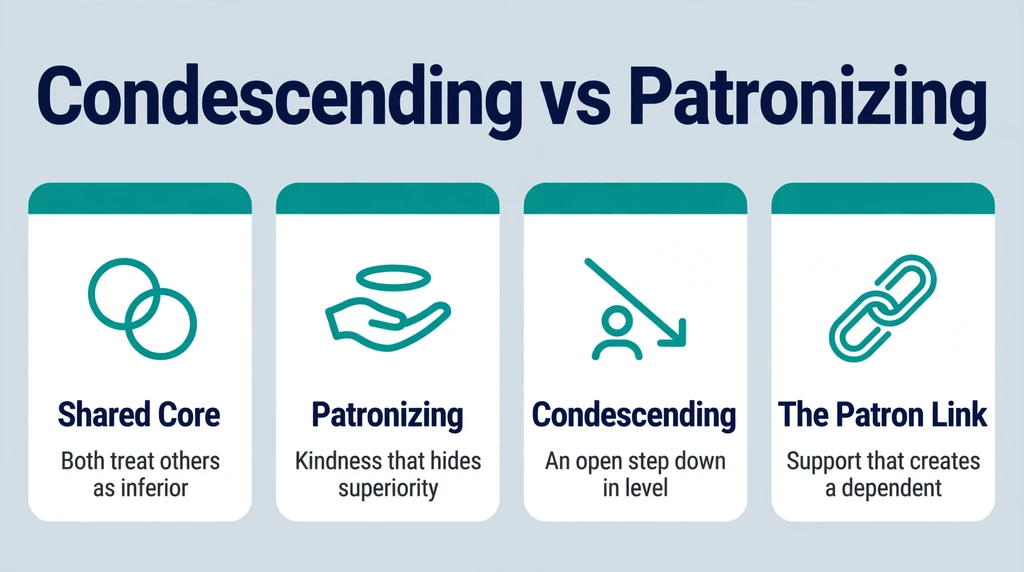
These two words shadow each other so closely that dictionaries define each with the other. Merriam-Webster calls this out directly in its usage notes. Still, a real shade of difference survives, and knowing it helps you pick the sharper word.
Where the two words overlap
Both describe treating someone as an inferior while sounding superior. Both offend. Both appear in complaints about teachers, doctors, officials and reviewers. If you swapped one for the other in most sentences, nobody would object. Their shared center is the attitude: I know better, and I want you to feel it.
The kindness coating on patronizing
Patronizing usually wears a helpful face. Oxford’s definition captures it neatly: apparent kindness that betrays a feeling of superiority. The word also keeps friendlier senses, since people patronize shops and patronize the arts. Merriam-Webster traces the superior sense to the figure of the patron, the wealthy supporter whose help creates a dependent. Patronizing help, then, always arrives with the giver standing tall.
The open step down in condescending
Condescending skips the kindness coating more often. Its picture is the deliberate climb down: I will lower myself to your level, briefly, and we will both notice. The speaker may not even pretend to help. A flat “nice try” from a rival can be purely condescending, with no support offered at all. In practice, choose patronizing for fake-friendly superiority and condescending for superiority performed openly.
Condescending vs Arrogant
Arrogant and condescending travel together, yet they describe different things. Arrogance is a trait a person carries everywhere. Condescension is an act aimed at a target in a specific moment. The distinction matters when you describe behavior fairly.
Arrogance is self-focused
An arrogant person overrates their own importance and shows it generally. They boast, dismiss rivals and expect admiration from the whole room. The behavior needs no particular victim. Arrogance is a posture toward the world, running on its own schedule. Cambridge groups arrogant, pompous and self-important beside condescending, but the grouping is about flavor, not identity.
Condescension needs a target below
Condescension, by contrast, is relational. It exists only between the speaker and the person being lowered. The same manager who brags arrogantly all morning becomes condescending at one specific moment: when she slowly explains the obvious to one employee. So a quiet, unboastful person can still be condescending in a single conversation. The word judges the interaction, not the whole personality.
Can someone be both at once?
Frequently, yes. The arrogant colleague who also slows his voice down for you is stacking the trait and the act together. However, separating them keeps criticism accurate. Call the bragging arrogance, and call the directed performance condescension. Precision sounds fairer, and fair criticism is harder to dismiss. It also tells the person exactly which behavior to change, instead of handing them a verdict on their whole character to argue with.
Condescending or Just Confident?
A common worry hides behind this search: was that expert actually condescending, or merely confident? The two can look similar from the listener’s chair. Both involve someone who clearly knows more about the topic than you do right now. The difference sits in how the knowledge travels.
Confidence shares the floor
A confident expert explains at the level the room sets. They answer the question that was asked, then stop. Questions from listeners are treated as part of the work, not interruptions of it. Crucially, confident people leave your standing untouched. You walk away knowing more, and you do not walk away smaller. The knowledge transfer happens across a flat floor, even when the knowledge itself is unevenly shared.
Condescension charges a toll
Condescension adds a toll to the same transfer. You receive the information, but you pay with a small public demotion. The explainer makes sure everyone notices who climbed down to deliver it. So the listener test is practical rather than scientific: after the explanation, do you mainly feel informed, or mainly feel placed? One unclear case proves little, since moods and bad days interfere. A repeated feeling after the same person’s explanations, though, is the pattern this word was built to name.
Condescend vs Deign
One more relative deserves a quick look. Dictionary.com notes that deign is a close synonym of condescend in its dignity sense. To deign is to do something you consider beneath your dignity, usually with reluctance on full display. Kings in old stories deign to reply. Modern executives, in the joke version, deign to attend meetings.
Where deign and condescend split
The two verbs share the staircase, but they face different directions. Deign focuses on the single act: the great person bothers to do the low thing at all. Condescend focuses on the manner of dealing with people during the act. You can deign to answer a letter in one line and be done. Condescension, instead, colors the whole exchange, from the first slow sentence to the final patient smile. Writers therefore reach for deign when they want irony about a task, and for condescend when they want to judge a tone.
Why deign now sounds old fashioned
Deign belongs mostly to historical fiction, formal writing and deliberate jokes today. Its world assumed fixed ranks, much like the old positive sense of condescend did. Condescending survived the journey into everyday speech because the behavior survived too. Offices and group chats simply gave the old staircase new carpet. When a modern speaker says someone “deigned to show up,” the archaism is the point. The sentence borrows a crown and places it, mockingly, on the latecomer’s head.
Condescending in Everyday Settings
The word follows people through ordinary life, because rank can be claimed almost anywhere. Money, age, job title, education and even taste can all serve as the staircase. Three settings produce the label most often.
Condescending at work
Workplaces build visible ladders, so they host the word constantly. It appears when a senior colleague explains a junior person’s own project back to them. It appears when feedback praises effort while quietly doubting ability. Notably, the complaint often targets the manner of real expertise, not fake expertise. A genuinely skilled person can still deliver knowledge like a verdict. Keeping explanations at the level the room requests is what separates mentoring from condescension at work.
Condescending in families and friendships
At home, the claimed height is usually experience. Older relatives explain adult life to adults. Friends explain money, health or relationships as if the listener had never met any of them. Because love is present, the sting confuses people. The listener knows the speaker cares, yet still feels ranked. In these cases the word often arrives gently, as feedback rather than attack: “I know you mean well, but that sounded condescending.” Tone, once named, can usually be repaired between people who trust each other.
Condescending online and in writing
Text strips away voice, yet condescension survives the trip. It lives in the overly basic reply to a detailed question. It lives in corrections offered with theatrical patience. Quotation marks around ordinary words do heavy work online, quietly suggesting the term is naive. Even praise posts can carry it, when the writer marvels that some group produced something good. Readers cannot hear the smile, but they recognize the staircase anyway, because the word choices rebuild it.
Condescending Synonyms and Antonyms
Because condescending names an attitude, its synonyms form a family of superior-sounding words. Each one leans in a slightly different direction, though. The antonyms point the opposite way, toward humility and respect.
Close synonyms and their shades
Patronizing is the nearest match, with its fake-kind surface. Supercilious suggests a raised eyebrow and quiet scorn, superiority worn like a facial expression. Disdainful goes colder: the speaker barely hides contempt. Haughty stresses proud distance, while pompous adds self-importance and inflated language. Cambridge’s thesaurus also lists superior itself, used as an adjective, plus the everyday phrasal verb talk down to, which says in five plain words what condescending says in one long one.
Antonyms worth knowing
The opposites describe people who meet others levelly. Humble and modest speakers do not rank the room before joining it. Respectful and courteous behavior treats the listener’s competence as the default. Unpretentious and down to earth describe the relaxed manner that replaces the staircase altogether. If a sentence says someone explained a hard idea without a trace of condescension, one of these words is usually waiting nearby.
How to Use Condescending in a Sentence
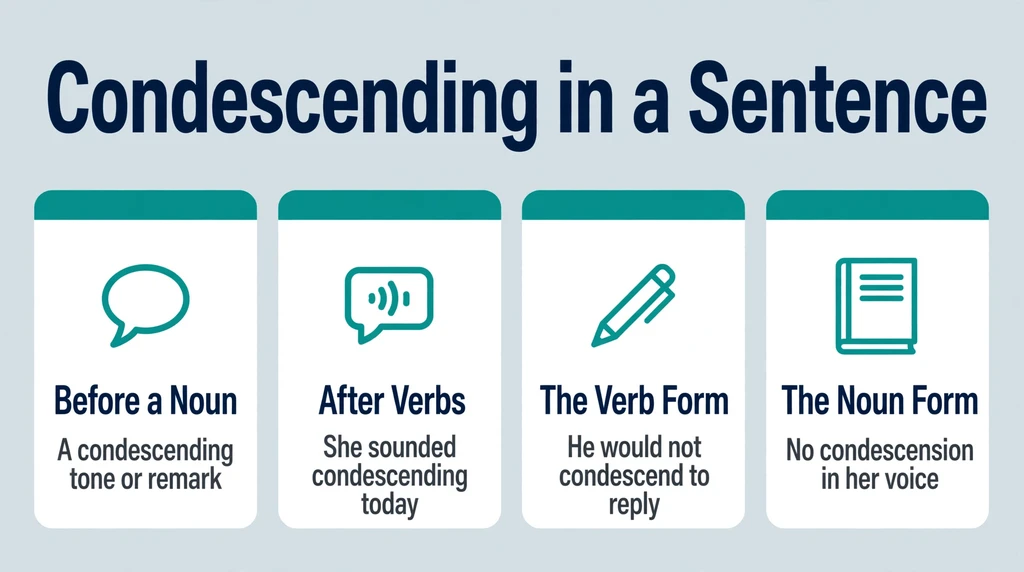
The adjective usually sits before a noun like tone, remark or attitude, or follows verbs such as sound, seem and be. Here are natural examples in the patterns real writers use.
Everyday examples
- Her condescending tone annoyed the whole team during the budget meeting.
- He gave me a condescending smile and explained my own report to me.
- The review was less critical than condescending, which stung even more.
- Please do not be condescending; I have run this machine for six years.
- She answered every question without sounding condescending, and the class loved her for it.
Using the verb and noun forms
The verb form often appears in refusals: “He would not condescend to answer the letter.” That structure implies the task sits beneath the person’s dignity. The noun names the behavior as a thing: “There was no condescension in her voice, only patience.” Austen’s older pattern also survives in historical writing, where condescension can still mean graciousness. Context decides which century you are reading.
Condescending in reviews and commentary
Writers about books, films and public figures reach for this adjective often. It criticizes an attitude without questioning competence, which makes it precise. Merriam-Webster’s collected examples include Jesse Sheidlower’s line: “Though a condescending snob, he was genuinely concerned with the poor.” The sentence grants the man’s sincerity and faults his manner in the same breath. Critics also aim the word at works themselves, calling a novel or a sequel condescending when it underestimates its audience. In that pattern the target is not a listener in the room. The target is everyone the work presumed to teach down to.
How to Avoid Sounding Condescending
Most people who sound condescending do not plan to. The tone sneaks in through helpful habits, especially when you know a topic well. A few small checks remove most of the risk.
Check what the listener already knows
First, ask before you explain. One short question, “Have you used this before?”, prevents the entire problem. If the answer is yes, your explanation can start at the right floor. If the answer is no, your help arrives as a gift rather than a verdict. Either way, you have treated the listener as the expert on their own knowledge.
Praise the work, not the person category
Next, keep praise specific and clean. Say the chart is clear, the argument is tight or the fix was clever. Leave out surprise, which almost always smuggles in a low expectation. “You did a great job” warms people. “You did a great job, considering” quietly ranks them first. Small wording, large difference.
Retire the risky little adverbs
Also, watch the small words that smuggle rank into neutral sentences. “Actually” before a correction implies the other person should have known better. “Obviously” and “clearly” announce that disagreement would be foolish. “Simply” and “just” shrink the listener’s problem before solving it, as in “just restart it.” None of these words is forbidden. Used constantly, though, they season everything you say with the same flavor. Swapping them for plain statements removes the seasoning without changing the recipe.
Let questions stay questions
Finally, answer challenges at face value. When someone questions your claim, treat the question as a real one, even if the answer feels obvious to you. Obviousness is private; nobody else can see inside your experience. The moment you sigh at a question, the staircase appears. Answering evenly keeps everyone on the same floor.
How to Respond to a Condescending Remark
Being talked down to creates a small decision under pressure. You can absorb it, flare up, or answer the ranking directly. The third option usually works best, because it names the manner without attacking the person.
Pause and check what you heard
First, give yourself one breath. Tone is real evidence, but a single sentence can also mislead, especially in text. Ask what the remark assumed about you. If the assumption was simply wrong, a calm correction often ends the matter: “I have used this system for years, so let us start from the error message.” Facts reset the floor without any argument about attitudes.
Name the tone, briefly and calmly
If the pattern continues, describe it once, in plain words. “That sounded a bit condescending” is enough. Avoid diagnosing motives, since motives start fights that facts cannot finish. Then return to the subject immediately. The quick return matters: it shows the conversation, not the ranking, is your business. Most people adjust at once, because few speakers actually want the reputation this word describes.
When the pattern keeps repeating
Occasionally the tone is a habit with an audience, especially in meetings. In that case, respond to content in the moment and raise the pattern later, privately. Private feedback protects the other person’s dignity, which is exactly what their tone failed to do for you. That contrast is not weakness. It is a demonstration of the even level you are asking for, and it makes the request hard to refuse.
Common Misconceptions About Condescending
A few myths cling to this word. Clearing them up makes the definition sharper and fairer.
Misconception one: simplifying is always condescending
Plain language is not the problem. Teachers, doctors and good writers simplify hard ideas all day, kindly and well. Simplification becomes condescension only when it assumes the listener is lesser and performs that assumption. The test is simple: would you explain it this way to a respected colleague? If yes, you are probably fine.
Misconception two: the word was always an insult
As the history section showed, condescension began as praise for gracious rank setting. The insult is the younger meaning, not the original one. That is why older novels confuse modern readers. Collins praising Lady Catherine is not being sarcastic. He is using the vocabulary of his century correctly, and the joke sits elsewhere.
Misconception three: only powerful people can be condescending
Rank helps, but it is not required. A junior employee can be condescending about software to a senior one. A teenager can be condescending about music to a parent. The word only needs a claimed height, not a real one. In fact, the gap between claimed and actual status is often what makes the moment sting.
Misconception four: being an expert protects you
Expertise causes as many cases as it prevents. The more obvious a subject feels to you, the easier it is to forget it ever looked hard. Experts also get asked the same beginner questions for years, and impatience accumulates quietly. The result is a fluent, accurate, genuinely helpful explanation delivered with a sigh. Knowledge earns respect most reliably when it arrives without the staircase attached.
Frequently Asked Questions
What does condescending mean in simple words?
It means treating someone as if they are less intelligent or less important than you. The attitude shows in tone, gestures and over explaining. Dictionaries define it as a patronizing or superior attitude toward others.
Is condescending always an insult?
In modern English, yes, the word is always negative and disapproving. It once worked as praise for gracious behavior by high ranking people. That positive sense survives only in older books and historical writing.
What is the difference between condescending and patronizing?
They overlap heavily. Patronizing adds a surface of kindness or help that hides superiority. Condescending more openly performs the step down to someone’s level. Dictionaries define each word using the other.
How do you pronounce condescending?
Say kon-duh-SEN-ding, with the stress on the third syllable. Cambridge lists the British pronunciation as /ˌkɒn.dɪˈsen.dɪŋ/ and the American as /ˌkɑːn.dəˈsen.dɪŋ/. The word has four syllables in total.
What is a condescending tone?
A condescending tone is the slow, patient, overly simple way of speaking that assumes the listener knows very little. It often includes forced smiles, sighs and phrases like “let me explain this simply.” The words may be polite while the ranking stays unmistakable.
What are synonyms for condescending?
The closest synonyms are patronizing, supercilious, disdainful, haughty and pompous. The plain phrasal verb “talk down to” carries the same meaning. Antonyms include humble, modest, respectful and unpretentious.
Can you be condescending without meaning to?
Yes. Most accidental condescension comes from explaining before checking what the listener knows. Praise that carries surprise can also sound condescending. Asking first and praising the work itself prevents most cases.
Where does the word condescending come from?
It comes from the Latin verb condescendere, meaning to let oneself down or stoop. English borrowed it through Old French in the fourteenth century. The built-in picture is someone climbing down from a higher level.
Final Thoughts
Condescending is a small word carrying a whole staircase. It describes the moment someone claims a higher step, climbs down on purpose and lets you watch. Dictionaries agree on the modern verdict: a superior, patronizing attitude, always disapproving, never a compliment. The word’s history adds the twist, since Austen’s readers once praised the very behavior we now criticize. For the full usage notes and audio pronunciations, the Merriam-Webster entry on condescending is the best single reference. Meanwhile, the practical lesson is short. Explain things evenly, praise work cleanly, and the word will describe other people’s tone, not yours.