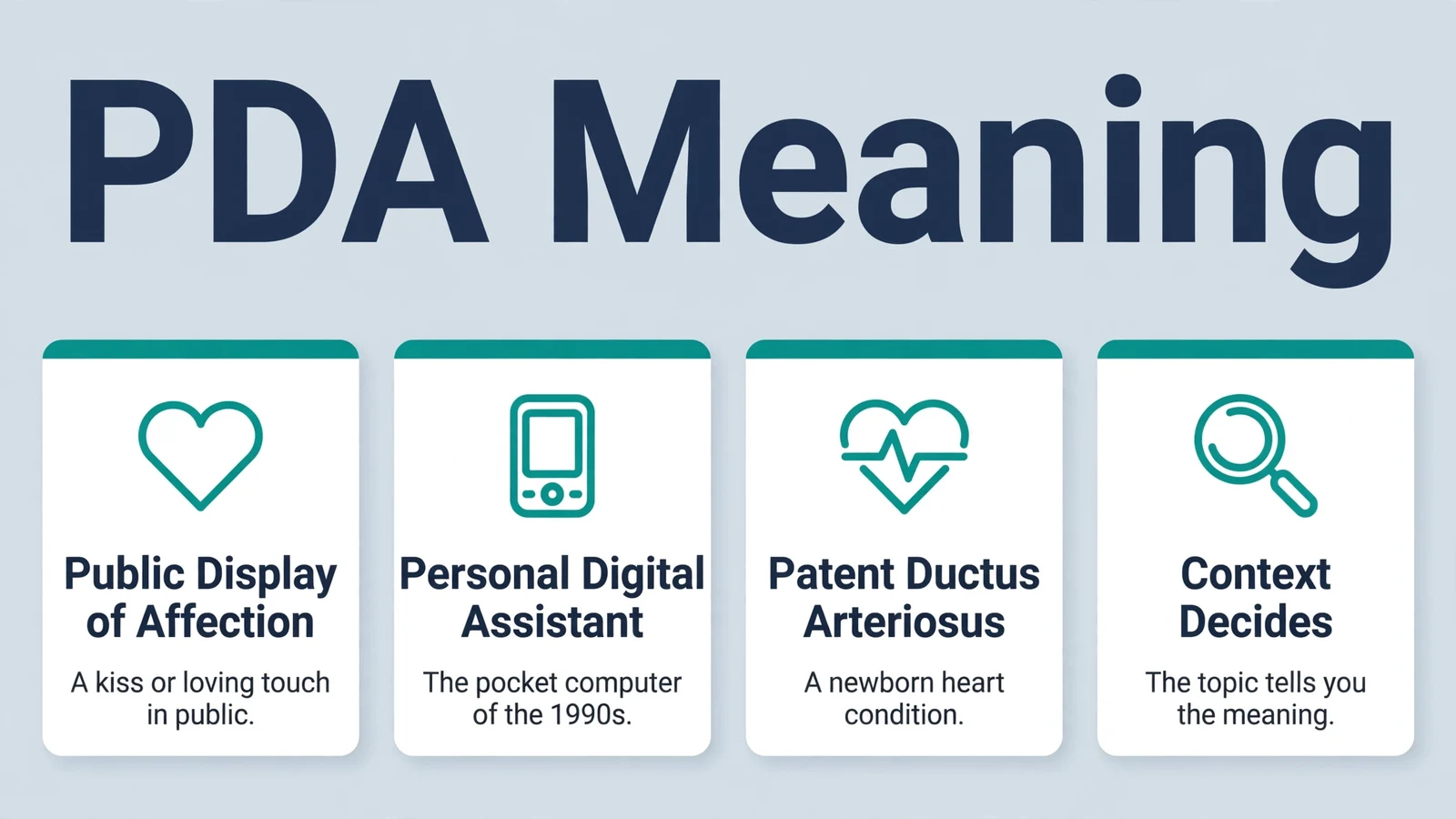
You are scrolling through the comments under a couple’s photo when someone writes, too much PDA in one place. Or maybe a teacher announces that there is a strict no PDA rule at the school dance. Either way, those three little letters carry a lot of meaning, and the topic around them decides which one applies.
In everyday language and texting, PDA stands for public display of affection. It means a kiss, a hug or any loving touch that happens where other people can see it. This guide also covers the two dictionary meanings you may meet elsewhere. In technology, a PDA was a small handheld computer. In medicine, it is a heart condition found in newborn babies.
Every sense below is checked against major dictionaries and trusted medical references, so you can match the letters to the right meaning with confidence.
What Does PDA Mean?
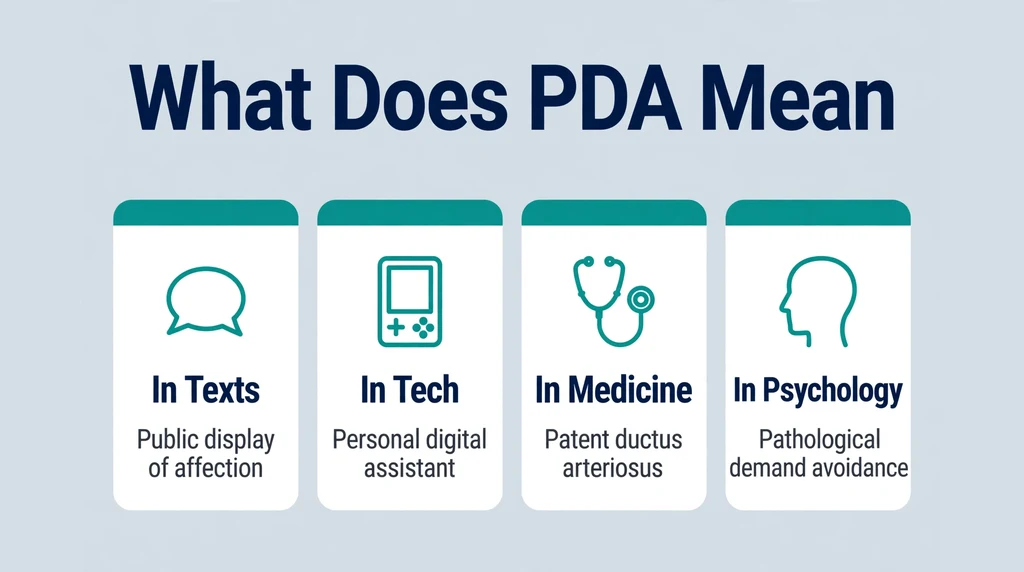
PDA is an initialism, which means each letter starts a word in a longer phrase. The tricky part is that several phrases share the same three letters. Your job as a reader is simply to pick the phrase that matches the situation.
Here is the short tour. In chats and social posts, PDA almost always means a public display of affection. An article about old gadgets uses the same letters for a personal digital assistant, a pocket computer from the 1990s and 2000s. In a hospital or parenting context, it usually means patent ductus arteriosus, a heart condition in newborns.
Two rarer senses appear in specialist reading. In psychology writing, PDA can mean pathological demand avoidance, a profile linked to autism. In computer science, it can mean a pushdown automaton, a simple model of a computer. This article gives the affection sense the most space, because that is what most searchers want. Still, every meaning gets a clear explanation, so you can recognize all of them.
How to Say and Write PDA
PDA is pronounced by saying the three letters one by one: pee dee ay. The plural is PDAs, and writers use it for every sense. You might read about PDAs at a school dance, PDAs in a technology museum or PDAs in a hospital report.
One spelling detail helps as well. Writers keep all three letters capitalized, because lowercase letters would look like an ordinary word. That capital form is your first clue that an abbreviation is doing the work. In speech, context does the same job as capital letters, since listeners hear the topic rather than the spelling.
PDA Meaning in Texting and Social Media
In texts, group chats and social media, PDA means public display of affection. People use it as a quick label for couples who kiss, hug or cuddle where everyone can see. Dictionaries tag this sense as informal, and Cambridge Dictionary even marks it as humorous. That playful tone matters, because the word usually appears in jokes rather than serious complaints.
Most of the time, the writer is teasing. A friend might drop the comment under a holiday photo of a couple holding hands at sunset. The message is affectionate, not angry. However, context can sharpen the word. The same three letters can carry real annoyance when a display feels over the top.
How People Use PDA in Texts
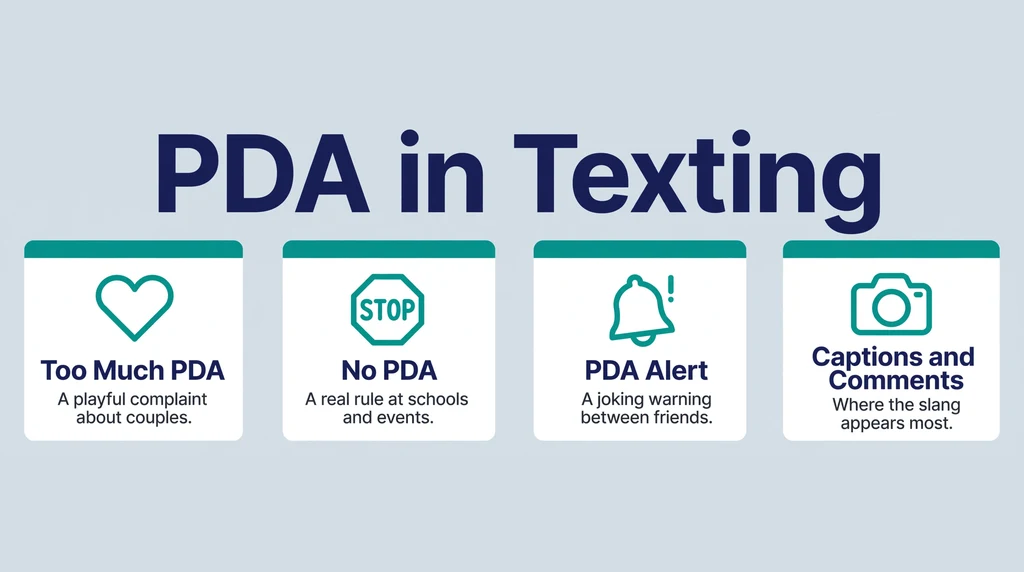
Certain short phrases appear again and again. The phrase “too much PDA” is the classic playful complaint about a couple who will not stop kissing in public. A “PDA alert” or “PDA warning” works as a joking heads up before friends walk into a lovey scene.
Meanwhile, “no PDA” is the serious version, and it usually signals a rule rather than a joke. Schools, camps and event venues post it in handbooks and dress codes. Cambridge Dictionary gives a typical spoken example: “I would hug you but I’m not into PDAs.” Notice how casual that sounds. People rarely spell out the full phrase in conversation, because the short form is faster and everyone nearby already knows it.
PDA in Captions, Comments and Memes
Social platforms are where the slang lives now. Under a romantic photo, a comment like “the PDA is strong here” teases the couple with love. Reaction images and short videos use the term the same way, as a caption for exaggerated romance.
In addition, the hashtag version groups thousands of couple photos together. Some users add it proudly, while others add it as a gentle warning to followers. Either way, the affection meaning is the default online. If a post shows people rather than gadgets or hospitals, you can safely read PDA as public display of affection.
Why This Slang Spread So Fast
The affection sense fits texting culture perfectly. It is short, it is a little bit funny, and it lets people comment on romance without writing an essay. A single word under a photo can praise a couple, tease them or scold them, depending on the friendship.
The slang also works as social shorthand. Instead of describing a scene, a writer labels it, and every reader pictures the same thing. Schools helped spread it too, since generations of students memorized the phrase from rule books. Sitcom jokes and pop culture lines then carried the term to wider audiences. Put together, brevity, humor and school rules explain why these three letters outlived the gadget that made them famous.
What Counts as PDA?
A public display of affection is any romantic or loving physical gesture that happens in front of other people. The gesture itself is usually ordinary. The public setting is what turns it into PDA. A kiss at home is private life, while the same kiss on a busy train platform is a display.
People picture a whole scale of behavior when they hear the term. Light gestures sit at one end, and intense ones sit at the other. Most disagreement about PDA is really disagreement about where the middle of that scale ends.
Everyday Examples of PDA
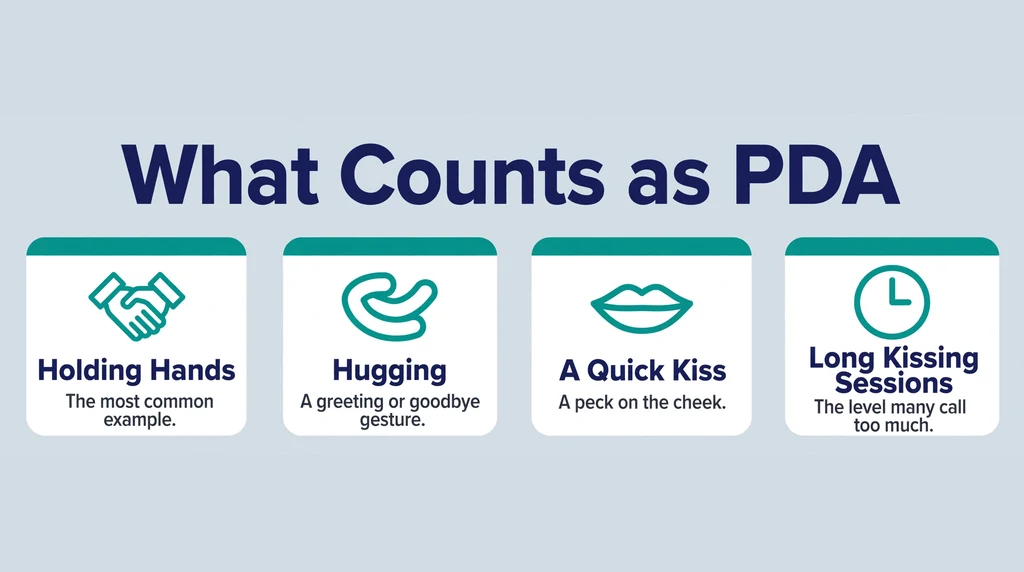
Holding hands is the most common example of all. Couples hold hands on streets, in parks and in shopping centers everywhere. A hug also counts, especially a long greeting or goodbye hug at an airport or station.
Similarly, a quick kiss belongs on the list. A peck on the cheek and a brief kiss goodbye are classic examples. Sitting close with an arm around a partner counts as mild PDA too. So does feeding each other a bite of dessert in a restaurant, at least in the eyes of many onlookers. None of these gestures shocks most people today. They are simply the visible, everyday signs of a relationship.
When a Display Crosses the Line
Problems start when a display stops being brief. Long, intense kissing sessions in shared spaces make many bystanders uncomfortable. Behavior that belongs in private draws the strongest reactions of all.
For example, a couple making out on a crowded bus will hear about it quickly. Fellow passengers cannot easily look away, and the setting offers no escape. That trapped feeling explains much of the pushback. People object less to affection itself and more to being made an audience. In short, duration and intensity matter as much as the gesture.
Culture and Context Change the Rules
What counts as acceptable PDA differs sharply around the world. In much of Europe and the Americas, holding hands and a quick kiss are unremarkable. In other regions, social or religious norms treat even hand holding between couples as improper in public.
Setting matters just as much as geography. A kiss at a wedding is expected and celebrated. The same kiss during a business meeting would be startling. Age plays a role too. Teenagers often face stricter limits than adults, because schools and parents set the rules for them. Because of all this, there is no single global standard. The wise approach is to read the room before you show affection in it.
PDA at Goodbyes, Weddings and Photo Moments
Some settings practically invite public affection. Airport goodbyes are the classic example, and nobody blinks at a long hug beside the departures board. Weddings build the whole day around one public kiss, complete with applause.
Photo moments work the same way. Couples kiss for the camera at landmarks, parties and reunions, and friends fully expect it. Greeting rituals matter too. In many cultures, a kiss on the cheek is standard politeness between friends, not romance at all.
Context decides whether observers read a gesture as custom, celebration or display. That is why arguments about PDA so often end with the same conclusion. The gesture is only half the story, and the occasion writes the other half.
PDA at School and Work
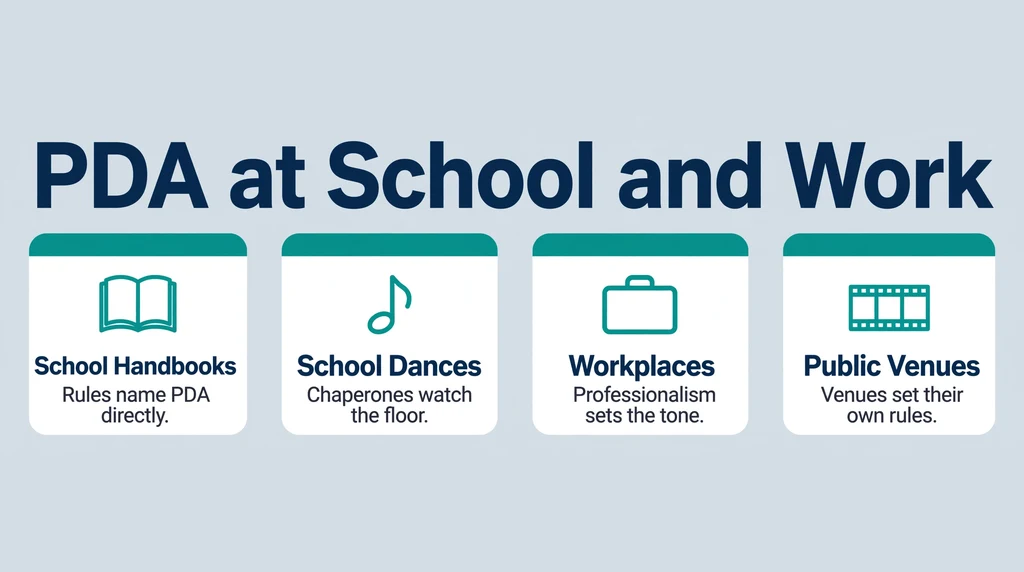
Schools are the place where most young people first meet the term PDA. Many school handbooks list public displays of affection by name. The rules usually ban kissing, prolonged hugging and similar couple behavior in hallways and classrooms.
Schools give practical reasons for these rules. Hallway affection can block crowded corridors between classes. It can also make other students uncomfortable, especially younger ones. School dances often repeat the message, with chaperones watching for behavior that goes too far. Students usually hear the rule as “no PDA,” and the short form sticks in their vocabulary for life. That is one big reason the slang stays familiar to each new generation.
Workplaces handle the same idea in a quieter way. Few offices print the letters PDA in a policy document. Instead, they rely on general professionalism standards. A quick hug between colleagues at a retirement party is normal and welcome. Romantic displays between partners at work, though, read as unprofessional in most settings. Public venues set their own versions too. Cinemas, pools and family restaurants may ask couples to tone things down. The details differ, but the principle stays the same. Shared spaces run on shared comfort. Interestingly, many adults first hear the rule version as children and keep using the phrase for decades afterward.
What Happens When Someone Breaks the Rules
Consequences are usually mild and practical. At school, a teacher separates the couple and reminds them of the handbook. Repeated problems can bring a note home or a talk with parents.
At work, a manager might have a quiet word about professionalism. Venues simply ask guests to stop, and staff rarely enjoy that conversation. Nobody sensible treats ordinary affection as a serious offense. Rules exist to keep shared spaces relaxed, not to police feelings. A quick, respectful adjustment ends almost every PDA dispute before it grows.
PDA in Technology: The Personal Digital Assistant
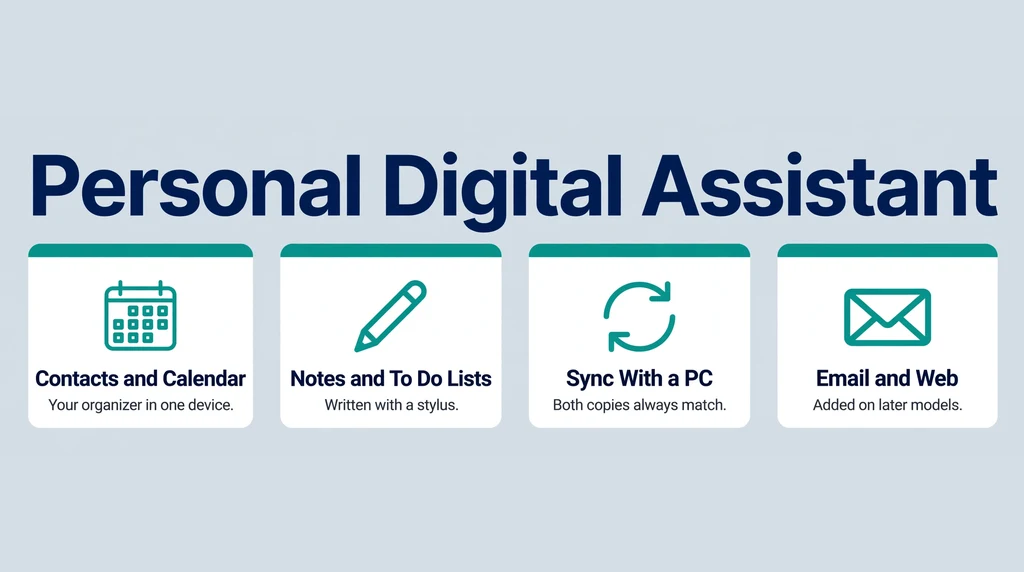
Long before the slang took over, PDA had a serious career in technology. A personal digital assistant was a small handheld computer that worked as an electronic organizer. Britannica describes it as a pocket sized device with a microprocessor, built to store and organize personal information.
People carried a PDA the way we now carry a phone. It held their address book, their calendar and their notes in one place. For busy professionals in the 1990s, that felt revolutionary. Paper diaries could not beep, search or back themselves up.
What a Personal Digital Assistant Actually Did
The core jobs were simple and useful. A PDA managed your contacts, with names, phone numbers and addresses. It ran your calendar and reminded you about appointments. It also kept to do lists and short memos.
Over time, the job list grew longer. Later models handled documents and spreadsheets. Many could send and receive email. Some played music, showed photos or opened simple web pages. Simple games existed too, and many owners killed time with them between meetings. A few even worked as phones, although calling was never the main event. The whole category existed to keep one person’s information organized and portable.
Stylus, Syncing and Small Screens
Most PDAs had a touch screen that you operated with a small pen called a stylus. You wrote on the screen, and the device tried to turn your handwriting into typed text. Early attempts at this were famously unreliable, which gave comedians easy material.
Syncing was the other defining habit. You connected the PDA to your computer with a cable or a cradle. One press copied your calendar and contacts in both directions. That way, the pocket device and the desktop always matched. Wireless connections arrived near the end of the era, adding Wi-Fi and Bluetooth. By then, though, a stronger rival was already taking shape in the phone market.
Why Owners Loved Their PDAs
Owners remember these devices with real warmth, and the reasons are easy to understand. A PDA switched on instantly, with no waiting for a computer to wake up. Many models ran for weeks on simple batteries, a luxury no modern phone offers.
The devices were also focused. A PDA did a handful of jobs and did them calmly, without notifications competing for attention. For doctors, salespeople and field workers, it replaced a heavy bag of paper files. That mix of simplicity, stamina and focus explains the nostalgia collectors feel today.
The History of the Personal Digital Assistant
The PDA story is short but surprisingly dramatic. A new category appeared, boomed and vanished within about twenty years. Its ideas did not die, though. They moved into the smartphone you probably used this morning.
The Newton Gives the PDA Its Name
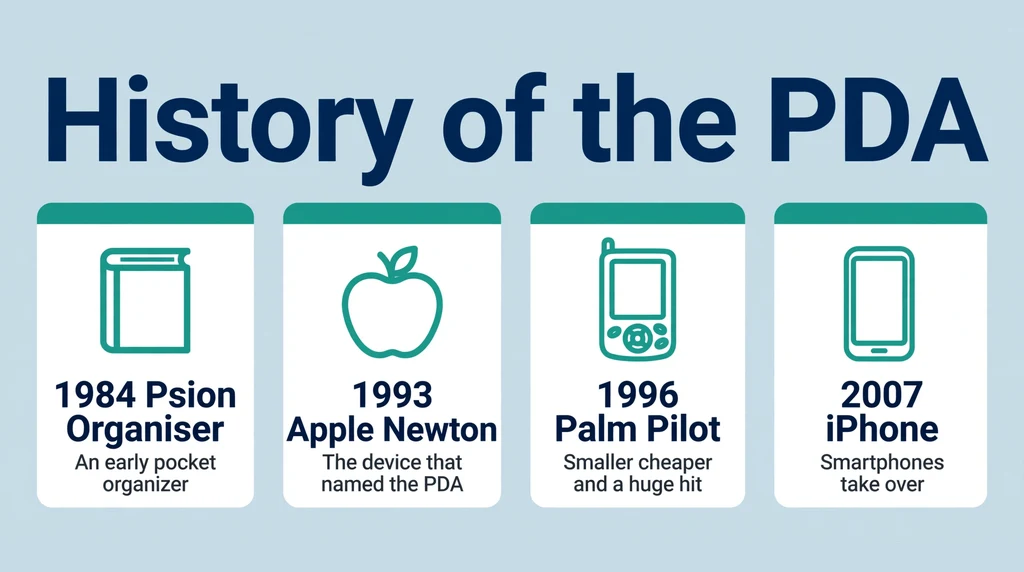
Apple CEO John Sculley coined the term personal digital assistant in the early 1990s. He used it for Apple’s Newton, a new kind of handheld computer. The first Newton MessagePad began shipping in 1993, at a price of about 699 dollars.
The Newton promised to read your handwriting and organize your life. In practice, its handwriting recognition often guessed words hilariously wrong. Critics mocked it, and its high price slowed sales. Still, the Newton proved that a real computer could fit in a coat pocket. An earlier British device, the Psion Organiser of 1984, had already hinted at the idea with a pocket organizer design.
PalmPilot Makes the PDA Mainstream
Palm changed the story in 1996 with the Palm Pilot. It was smaller, cheaper and simpler than the Newton. Instead of full handwriting, it used a simplified writing system called Graffiti, built from quick strokes for each letter.
The formula worked beautifully. Britannica notes that the Palm Pilot became the popular model of the category. It offered a calendar, an address list, a memo pad and expense tracking, plus easy syncing with a PC. Millions of people bought one. Its success proved the category had a mass market, and rival makers soon rushed in with designs of their own. Soon “Palm Pilot” became a casual nickname for almost any PDA, whatever the brand.
Smartphones Absorb the PDA
During the 2000s, phones learned to do PDA jobs. First they added calendars and contacts. Then the iPhone arrived in 2007 and put a full organizer, email and the web into one touch screen device.
As a result, the separate PDA lost its reason to exist. Britannica records that growing smartphone sales matched a steady decline in PDA sales. By the early 2010s, smartphones had fully supplanted the category. The letters survived, though. They simply found a new job in slang, which is where most people meet them today.
The PDA Legacy You Still Use
Look closely at your phone and the PDA is still there. The calendar app, the contacts list and the notes app all began life as PDA software. Stylus input survives in drawing tablets and note taking phones. Even the word “sync” entered everyday speech through cradles and cables.
Historians of technology treat the PDA as the smartphone’s clear ancestor. It proved that people wanted a computer in their pocket years before networks could support one. The gadgets failed, the idea won, and the letters drifted into slang.
PDA in Medicine: Patent Ductus Arteriosus
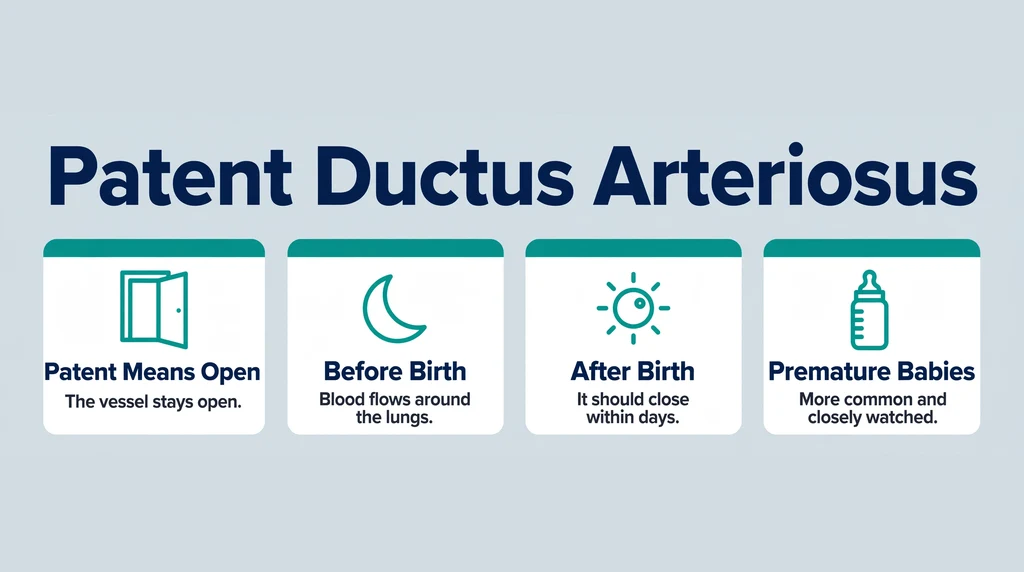
The third main meaning belongs to medicine, and it sounds serious because it is. Patent ductus arteriosus is a heart condition that doctors check for in newborn babies. MedlinePlus, the medical reference of the US National Library of Medicine, explains it in plain terms.
Here, the word “patent” is a medical term that means open. It is pronounced PAY tent, not like a patent for an invention. The condition’s name therefore means an open ductus arteriosus. Understanding it takes one small piece of baby biology. You will meet this sense on health websites, in pregnancy forums and in news stories about neonatal care. Parents rarely go looking for it in advance. They usually hear the letters for the first time from a doctor, which is why clear explanations matter.
The Blood Vessel Every Baby Has Before Birth
Every baby has a ductus arteriosus before birth. It is a small blood vessel that lets blood flow around the baby’s lungs. Inside the womb, the lungs are not yet breathing air, so most blood does not need to visit them.
Birth changes everything in minutes. The lungs fill with air and start their real work. The vessel is suddenly unnecessary, so it normally closes within a couple of days. In healthy full term babies, the closure finishes completely within a few weeks. If the vessel stays open instead, doctors call the condition patent ductus arteriosus, or PDA. The open vessel lets blood flow abnormally between the aorta and the pulmonary artery, the two great vessels leaving the heart.
Signs That Make Doctors Check
A small PDA may cause no symptoms at all. Some cases are found only because a doctor hears a heart murmur through a stethoscope. MedlinePlus lists the signs that can appear, especially with a larger opening. These include fast breathing and shortness of breath. Poor feeding, sweating while feeding and tiring very easily are also on the list. Poor growth can follow over time.
The condition is more common in premature infants, whose vessels have had less time to mature. It also affects girls more often than boys. Doctors confirm the diagnosis with an echocardiogram, an ultrasound scan of the heart. This section is general information only, not medical advice for any individual baby.
Why Premature Babies Get Extra Attention
Premature babies deserve their own mention here. Their ductus arteriosus has had less time to develop before birth, so it often stays open longer. MedlinePlus notes that a heart murmur may not be heard in premature infants, which makes careful monitoring important.
Hospital teams therefore watch breathing, feeding and growth closely in the first days and weeks. An echocardiogram gives them a clear picture when questions arise. Many small openings in premature babies close with time and support. Each case is individual, and neonatal teams judge the timing of any treatment baby by baby.
How Doctors Close a PDA, in General Terms
When treatment is needed, the goal is to close the vessel. Sometimes a PDA closes on its own, especially in premature babies during their first years. MedlinePlus notes that medicines such as indomethacin or ibuprofen are often the first choice in newborns.
If medicine is not suitable, doctors can use a catheter procedure. A thin tube carries a small coil or blocking device to the vessel and seals it from inside. Surgery remains an option when other approaches cannot be used. Outcomes and choices depend on each baby’s size, health and other conditions. Parents facing this diagnosis should always follow their own medical team, who know the full picture.
Other Meanings of PDA
Two more senses deserve a short mention, because you may meet them in specialist reading. Neither comes close to the top three in everyday use. Still, each dominates its own small corner of the internet.
Pathological Demand Avoidance
In psychology and autism writing, PDA means pathological demand avoidance. The PDA Society explains that Professor Elizabeth Newson introduced the term in the 1980s. She used it for children who avoided the ordinary demands of everyday life to an extreme degree.
Today, writers describe it as a profile of autism. The avoidance is understood as driven by anxiety and a strong need for control, not by simple defiance. Some people prefer a gentler name, a pervasive drive for autonomy. Note that PDA is not a standalone diagnosis in the main diagnostic manuals. If you land on parenting or autism pages, this is almost certainly the meaning in play.
Support for this profile looks different from standard advice. The PDA Society describes approaches built on trust, collaboration and lower pressure. Families often offer choices instead of direct instructions. Reducing the sense of demand can reduce the anxiety that drives the avoidance. Research on the profile is still developing, and specialists debate the details. The core picture, though, stays consistent across sources.
Pushdown Automaton
Computer science students meet a very different PDA. A pushdown automaton is a theoretical model of a simple computer. It reads input symbols and works with a stack, a pile of items it can add to or remove from the top.
That stack gives it more power than the simplest computing models. Pushdown automata can recognize patterns called context free languages, which matter in programming language design. Balanced brackets in code are the classroom’s favorite example, because opening and closing pairs behave like items pushed onto a pile and popped off again. You will only see this meaning in textbooks, lectures and exam papers. Outside the classroom, it barely exists.
How to Tell Which PDA Meaning Fits
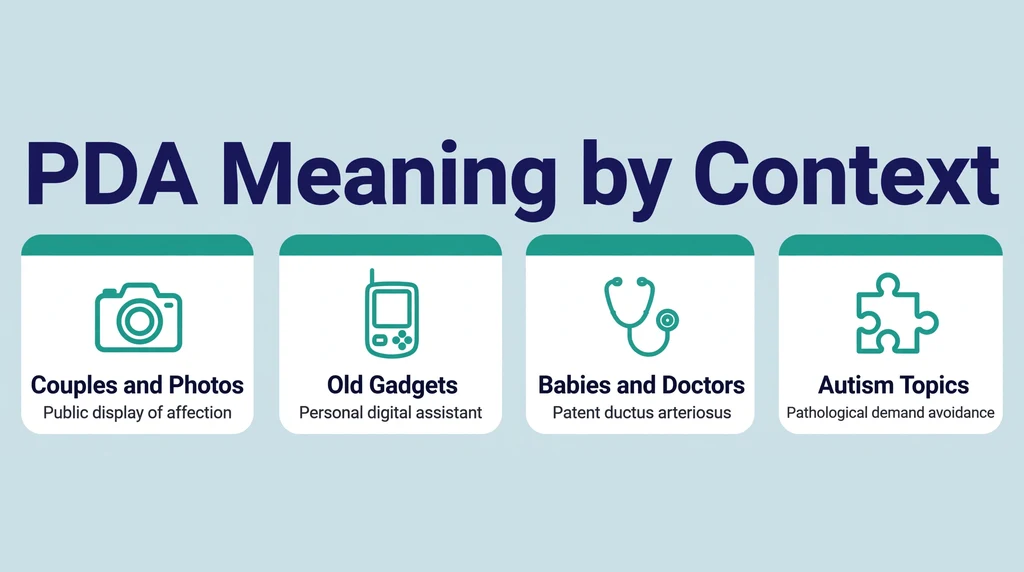
Luckily, you rarely need to guess. The words around PDA almost always give the meaning away. A few quick checks will settle nearly every case you meet.
First, look at the topic of the page or conversation. Photos of couples, dating talk and school rules point to public display of affection. Gadgets, old computers and the 1990s point to the personal digital assistant. Babies, hospitals and heart scans point to patent ductus arteriosus.
Next, look at who is speaking. A friend texting you uses the slang. Technology writers use the device sense. A doctor, nurse or medical website uses the heart sense. Parenting and autism communities use the demand avoidance sense. A post’s hashtags work the same way, since tags about gadgets, newborns or couple goals openly label the topic.
Finally, check the grammar. People count displays of affection, so you will see “a PDA,” “too much PDA” and “PDAs everywhere.” The device sense also takes plurals, as in “PDAs were everywhere in 2002.” The medical sense usually appears with words like diagnosed, treatment or newborn. Match those clues and the letters unlock themselves.
A Worked Example
A worked example pulls the clues together. Suppose a headline reads, “Hospital Launches New PDA Screening Program.” The word hospital rules out slang and gadgets at once, and screening confirms a medical topic.
Now flip the setting. A yearbook caption saying “Less PDA in the Hallways, Please” clearly uses the school slang sense. Two sentences carry two different expansions. In each case, the topic made the call before you finished reading.
PDA in Sentences: Examples for Each Meaning
Seeing each sense inside a real sentence makes the differences stick. Here are natural examples for all five meanings.
For the affection sense, imagine a caption that reads, “Forgive the PDA, but we just got engaged.” A rule based example would be, “The camp has a strict no PDA policy after dark.” A joking example sounds like this: “There was so much PDA at the reunion that grandma covered her eyes.”
For the technology sense, a history fan might say, “My first PDA was a Palm Pilot, and I synced it every night.” A collector could write, “The Newton was a PDA ahead of its time.”
For the medical sense, a health article might state, “The scan showed a small PDA, and the doctors chose to monitor it.” For demand avoidance, a teacher might note, “His PDA profile means written demands work better than spoken ones.” For computer science, a lecturer would say, “A pushdown automaton uses a stack, so this PDA can match balanced brackets.”
Notice how each sentence plants its own clues. Words like engaged, policy, synced, scan and stack quietly announce which world the letters belong to. When you write about PDA yourself, adding one such clue word saves your reader a guess.
Common Misconceptions About PDA
A few wrong ideas follow these letters around. Clearing them up makes every future encounter easier.
The first misconception says PDA only ever means the affection slang. That is understandable, since slang dominates social media. Yet dictionaries list the device sense first in many entries, and hospitals use the medical sense daily. The letters genuinely serve several masters.
The second misconception claims that all PDA is rude. In reality, most displays are mild and widely accepted, like holding hands. Objections target intense behavior in trapped settings, not affection itself. The third misconception merges the PDA device with the mobile phone. Early PDAs had no phone function at all. They were organizers first, and calling features arrived late and clumsily.
The fourth misconception treats the medical PDA as a hole in the heart. It is actually a blood vessel that stayed open beside the heart’s main arteries. That detail matters, because it explains both the murmur doctors hear and the way treatments close it.
Frequently Asked Questions
What does PDA mean in texting?
In texting, PDA means public display of affection. People use it for kissing, hugging or cuddling that happens where others can see. The tone is usually playful, as in “too much PDA,” although “no PDA” can signal a real rule at a school or event.
What does PDA stand for in full?
It depends on the context. The main full forms are public display of affection, personal digital assistant and patent ductus arteriosus. Rarer forms include pathological demand avoidance and pushdown automaton. The surrounding topic tells you which expansion the writer intends.
Is PDA a good thing or a bad thing?
Neither, by itself. Mild displays like holding hands or a quick kiss are normal and accepted in many places. Problems arise when displays are intense, long or badly matched to the setting. Culture, place and audience decide how any single display is judged.
What was a PDA device used for?
A personal digital assistant stored contacts, calendars, notes and to do lists in your pocket. Later models added email, documents and simple web access. People synced them with a computer so both copies of their information matched. Smartphones eventually absorbed all of these jobs.
What does PDA mean for a baby’s heart?
In medicine, PDA means patent ductus arteriosus. A small vessel that should close after birth stays open, letting blood flow the wrong way between two major arteries. It is more common in premature babies. Doctors confirm it with an echocardiogram and decide whether it needs treatment.
Why do schools ban PDA?
Schools usually ban it to keep hallways moving and shared spaces comfortable for everyone. Rules typically cover kissing and prolonged hugging during the school day and at school events. The exact limits vary by school, and students can find them in the student handbook.
Is holding hands considered PDA?
Yes, holding hands is the mildest and most widely accepted form of PDA. Most people count it because it happens in public and quietly signals a relationship. Very few settings object to it, although a small number of schools and stricter venues still discourage it.
How can I tell which PDA meaning someone intends?
Check the topic, the speaker and the nearby words. Couples and photos mean affection. Old gadgets mean the device. Babies and doctors mean the heart condition. Autism discussions mean demand avoidance, and computing classes mean the pushdown automaton.
Final Thoughts
Three small letters, several very different worlds. In daily life, PDA means a public display of affection, and that is the sense behind almost every text, caption and school rule you will meet. Keep the other meanings in your back pocket, though. The device sense explains a whole era of technology, and the medical sense matters deeply to the families who hear it in a hospital. You also now know why the same abbreviation can headline a school rule, a gadget history and a medical report without any of them being wrong.
The Cambridge Dictionary entry for PDA is a handy bookmark if you ever want the two best known senses side by side. From now on, context will do the decoding for you. Once you know the possible meanings, you will never misread these letters again.