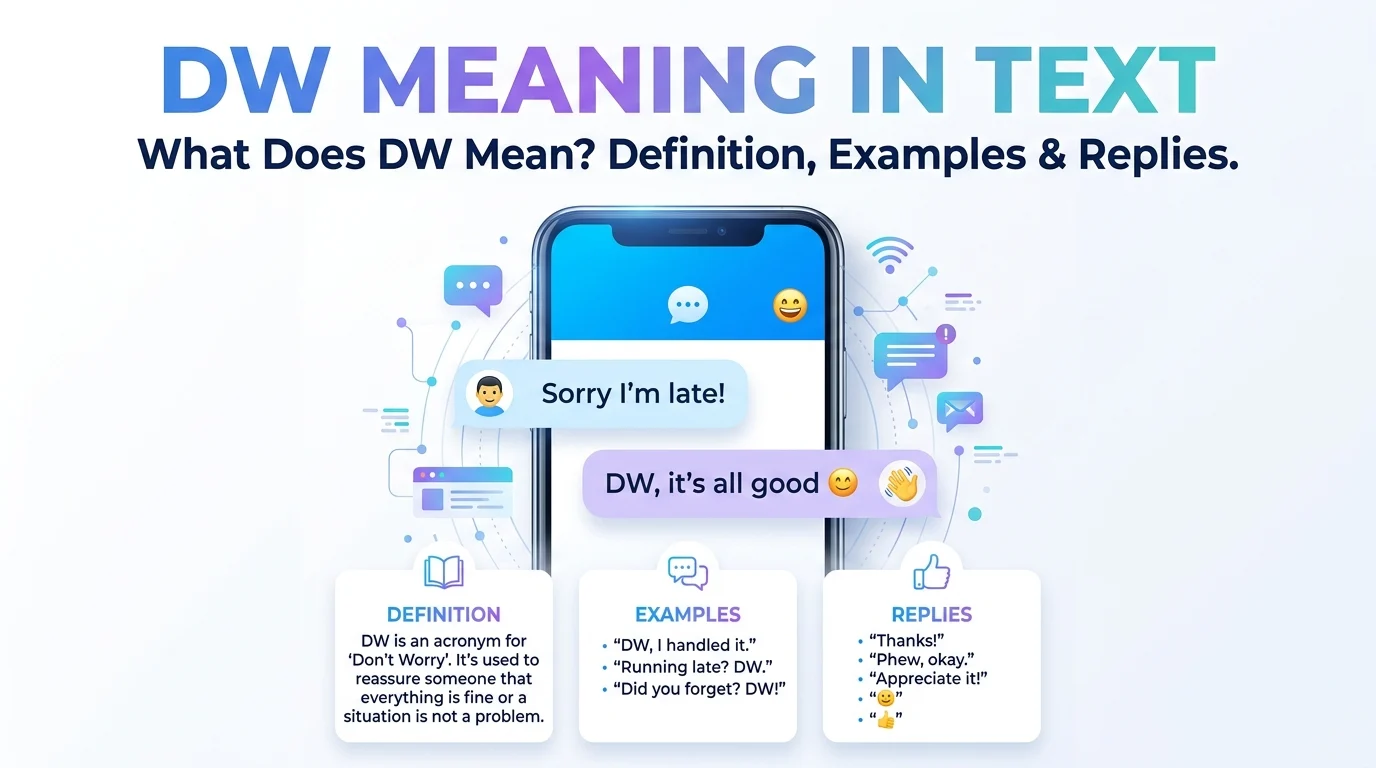
Have you ever received a message that simply says “DW” and wondered what the sender meant? This short abbreviation appears in text messages, social media conversations, and online chats. Although it might look confusing at first, its meaning is usually straightforward.
DW means “Don’t Worry” in text messages and most casual online conversations. People use it to reassure someone, respond to an apology, or explain that a small mistake isn’t a big deal.
For example:
- Person A: “Sorry I forgot to send you the pictures.”
- Person B: “DW, you can send them later!”
In this conversation, DW tells the other person there’s no need to feel bad about forgetting the pictures.
You may encounter DW on Snapchat, Instagram, TikTok, WhatsApp, or in an ordinary text message. Its meaning generally stays the same across these platforms. However, context matters because DW can also stand for other expressions in specific situations.
This guide explains the DW meaning in text, shows you how to use it naturally, and explores the best ways to respond when someone sends it to you.
What Does DW Stand for in Texting?
DW stands for “Don’t Worry.” It’s an informal texting abbreviation that helps people communicate reassurance without typing the entire phrase.
Instead of writing “Don’t worry about it,” someone might type “DW about it.” Both versions communicate a similar idea, although the full phrase can sound warmer or more deliberate.
People often use DW when they want to:
- Reassure someone who feels nervous or concerned.
- Accept an apology without making a big deal out of the situation.
- Tell someone that a minor mistake is understandable.
- Explain that they’ll take care of a problem.
- Keep a casual conversation short and friendly.
Consider this example:
Friend: “I’m really sorry I couldn’t make it today.”
You: “DW, we can meet another time.”
Here, DW communicates understanding and removes some of the pressure the other person might feel.
You may see the abbreviation written as DW or dw. Capitalization usually doesn’t change its meaning in a casual conversation.
Technically, DW is an initialism because you pronounce its letters individually rather than as a single word. In everyday language, however, people commonly call it a texting abbreviation or acronym.
What Does DW Mean in a Text Message?
When someone sends you DW, start by considering the message that came before it. The abbreviation usually reassures you that something isn’t a problem, but the exact implication depends on the conversation.
DW After an Apology
One of the most common uses of DW is responding to an apology. It tells the other person that they don’t need to keep apologizing for a minor mistake.
Example:
Alex: “Sorry I replied so late. I was busy with work.”
Jordan: “DW! I figured you were busy.”
Jordan uses DW to show understanding rather than frustration. The response helps the conversation move forward without dwelling on a delayed reply.
You can use DW in similar situations when someone forgets something, arrives a little late, or makes an innocent mistake.
DW When Someone Feels Worried
DW can also reassure someone who’s nervous about a situation.
Example:
Mia: “I’m worried that I’ll mess up my presentation tomorrow.”
Sam: “DW, you’ve practiced a lot. You’ll be fine.”
In this example, DW introduces a reassuring message. Sam isn’t simply dismissing Mia’s concern; the rest of the reply offers encouragement.
Remember that a short DW message doesn’t always provide the emotional support someone needs. If a friend is genuinely distressed, a thoughtful response may be more helpful than two letters alone.
DW When There’s No Serious Problem
Sometimes people use DW to explain that a mistake doesn’t matter much.
Example:
Chris: “I accidentally spilled some water on the table.”
Taylor: “DW, I’ll wipe it up.”
Here, the abbreviation tells Chris not to feel overly concerned. Taylor also offers a practical solution.
This use is especially natural when the problem is small and easy to fix.
DW When Someone Offers Help
DW can also appear when one person reassures another that a task is under control.
Example:
Jamie: “Do you need me to help finish the assignment?”
Riley: “DW, I’ve almost finished it!”
Depending on the context, this response may mean that the sender doesn’t need help or doesn’t want the other person to worry.
It’s worth noting that DW doesn’t always mean a problem has disappeared. Sometimes it simply means the sender believes the situation is manageable.
What Does DW Mean in a Relationship?
In a relationship, DW usually means “Don’t Worry,” just as it does in other everyday conversations. Partners may use it to reassure each other, accept apologies, or reduce unnecessary tension.
For example:
Partner A: “Sorry, I couldn’t call you earlier.”
Partner B: “DW, I know you had a busy day.”
The response communicates understanding. It suggests that the delayed call isn’t a major issue in that moment.
Couples might also use DW when discussing plans, misunderstandings, or small mistakes.
Example:
“DW, we’ll figure it out together.”
This message combines reassurance with a sense of teamwork. The sender is telling their partner not to panic because they can work through the situation together.
However, the abbreviation doesn’t automatically signal love, forgiveness, attraction, or emotional closeness. Those interpretations depend on the relationship and the surrounding conversation.
If your partner sends only “DW,” don’t assume that they’re upset or completely unbothered. Look at what happened before the message and how they usually communicate.
What Does DW Mean From a Girl?
When a girl texts DW, she generally means “Don’t Worry.” She might be reassuring you after an apology, explaining that a mistake isn’t serious, or telling you not to stress about something.
For example:
You: “Sorry if my joke offended you.”
Her: “DW, it’s okay!”
In this situation, she’s reassuring you that the joke wasn’t a problem, at least according to her response.
She might also use DW to discuss plans:
“DW, I’ll let you know when I’m free.”
That simply means you don’t need to worry because she’ll update you later.
The sender’s gender doesn’t change the standard definition. If you’re trying to understand whether she likes you, feels annoyed, or wants to continue the conversation, consider her overall communication rather than relying on DW alone.
What Does DW Mean From a Guy?
When a guy sends DW, the abbreviation usually means “Don’t Worry” as well.
For instance:
You: “Sorry I couldn’t join the game last night.”
Him: “DW bro, we’ll play again tonight.”
His reply reassures you that missing the game wasn’t a serious issue.
A guy might also use DW when discussing a personal concern:
“DW, I’ll help you sort it out.”
This message suggests that he wants to reassure you or offer assistance. Still, the abbreviation itself doesn’t prove romantic interest, friendship, or any particular emotional intention.
The key takeaway: DW generally has the same meaning regardless of who sends it. Context tells you more than gender does.
What Does DW Mean on Snapchat, Instagram, TikTok, and WhatsApp?
DW isn’t exclusive to any particular social media platform. Its usual meaning remains “Don’t Worry” across common messaging apps.
The following examples show how it may appear in different digital conversations.
DW Meaning on Snapchat
On Snapchat, DW can appear in private chats, replies to Snaps, or conversations about plans and everyday situations.
Example:
“DW about the streak. We can snap tomorrow.”
The sender is telling the other person not to worry about maintaining the Snapchat streak.
Another example:
“DW, your photo looks great!”
Here, the sender uses DW to reassure someone who may feel uncertain about a picture.
The abbreviation doesn’t have a separate official meaning on Snapchat. It’s simply casual shorthand that people use within the app.
DW Meaning on Instagram
On Instagram, DW commonly appears in direct messages (DMs) and casual conversations between friends, followers, or acquaintances.
Example:
“DW, I’ll send you the photos later.”
This means the sender will share the photos later and doesn’t want the recipient to worry.
You might also see:
“DW, your comment didn’t bother me.”
In this case, the abbreviation softens the message and reassures the recipient.
The context of the conversation still matters. Instagram users may discuss anything from social plans to personal concerns, but DW generally retains its familiar texting definition.
DW Meaning on TikTok
On TikTok, people may use DW in direct messages, comment sections, and conversations about videos or trends.
Example:
“DW, your first video doesn’t have to be perfect.”
The message reassures someone who feels nervous about posting content.
Another example:
“DW, you’ll get better with practice!”
Here, DW introduces encouragement rather than a technical explanation.
Although TikTok has its own collection of internet slang, DW isn’t limited to the platform. Its meaning usually carries over from ordinary texting.
DW Meaning on WhatsApp
On WhatsApp, DW works naturally in private conversations and group chats.
Example:
“DW, I’ll share the location when I arrive.”
The sender reassures the recipient that they’ll provide the location later.
In a group conversation, someone might write:
“DW everyone, we still have enough time to finish the project.”
This message addresses the whole group and helps ease concern about the deadline.
DW can also appear in family chats, discussions about appointments, and messages between coworkers who communicate informally.
Across these platforms, the abbreviation is a convenient way to offer quick reassurance without writing a complete sentence.
How To Use DW in a Text Message
DW works best when you want to reassure someone in a casual conversation. You don’t need to follow complicated rules, but you should consider the situation and the tone you want to convey.
Here are several practical ways to use it.
Use DW When Someone Apologizes
When a friend apologizes for something minor, DW can help them understand that you aren’t holding it against them.
Examples:
- “DW, it’s all good!”
- “DW about being late.”
- “DW, we can reschedule.”
- “DW, these things happen.”
For example, if your friend says, “Sorry I forgot to bring your book,” you could reply, “DW, just bring it next time.”
This response acknowledges the mistake without making it seem more serious than it is.
Use DW To Reassure Someone
You can use DW when someone is worried about an upcoming event or a small uncertainty.
Examples:
- “DW, you’ll do great.”
- “DW, everything is under control.”
- “DW, there’s still plenty of time.”
- “DW, we’ll work it out.”
Imagine that your friend is nervous before an interview. You could write, “DW, you’ve prepared well. Just do your best.”
Adding a supportive sentence makes the response more personal and useful.
Use DW When Offering Help
DW can accompany a promise to take care of something.
Examples:
- “DW, I’ll handle the booking.”
- “DW, I’ll explain it to the teacher.”
- “DW, I’ll send the document tonight.”
- “DW, I’ll take care of everything.”
Be careful not to promise more than you can deliver. In this context, your words reassure the recipient that you’ve taken responsibility for the task.
Use DW in Casual Conversations
Sometimes you simply want to keep the conversation moving.
Examples:
- “DW, it’s not a big deal.”
- “DW, no need to apologize.”
- “DW, we can try again tomorrow.”
- “DW, I understand.”
These messages work well between people who already know each other and understand their usual texting style.
When Should You Avoid DW?
DW isn’t suitable for every situation. Because it’s informal and brief, it may sound dismissive when someone needs serious emotional support.
For example, if someone tells you they’re experiencing a major personal crisis, responding with only “DW” may make them feel that you’re brushing aside their concerns.
A more thoughtful message could be:
“I’m sorry you’re dealing with this. I’m here for you if you want to talk.”
The lesson is simple: match your response to the seriousness of the situation. Use DW for casual reassurance, but choose fuller language when the conversation calls for empathy or care.
DW Meaning in Text: Examples of Realistic Conversations
Understanding DW becomes easier when you see how the abbreviation fits into everyday messages.
The following examples illustrate common situations and the meaning DW conveys in each one.
| Situation | Example conversation | What DW communicates |
|---|---|---|
| Late reply | “Sorry for the late reply.” — “DW, I was busy too.” | There’s no problem with the delay. |
| Forgotten item | “I forgot your notebook!” — “DW, bring it tomorrow.” | The mistake is manageable. |
| Missed plans | “I can’t come today. Sorry!” — “DW, we’ll meet another day.” | The cancellation is understandable. |
| Personal worry | “I’m scared about the exam.” — “DW, you’ve studied hard.” | The sender offers encouragement. |
| Minor mistake | “I sent the wrong picture.” — “DW, send the right one.” | The mistake isn’t a big issue. |
| Work task | “I haven’t finished the document.” — “DW, send it when it’s ready.” | There’s some flexibility with timing. |
| Relationship concern | “I hope you’re not mad at me.” — “DW, we’re okay.” | The sender offers reassurance. |
| Group planning | “We might be late to the event.” — “DW, I’ll let everyone know.” | The sender is addressing the concern. |
| Social media | “I look awkward in that video.” — “DW, you look great!” | The sender offers reassurance and praise. |
| Asking for help | “Sorry to bother you again.” — “DW, I’m happy to help.” | The sender doesn’t mind helping. |
Notice that DW doesn’t carry exactly the same emotional weight in every example. Sometimes it dismisses a small issue. At other times, it introduces encouragement or an offer of help.
The words that follow DW often reveal more about the sender’s intended tone than the abbreviation alone.
How To Reply When Someone Texts DW
The best response to DW depends on the message that came before it. In many cases, a simple acknowledgment is enough. You don’t need to create a long conversation when the other person has already reassured you.
Short and Casual Replies
Use these replies when someone tells you not to worry about a small issue.
- “Thanks!”
- “Okay, got it.”
- “Appreciate it.”
- “Good to know.”
- “Thanks for understanding.”
Example:
You: “Sorry I forgot to call.”
Friend: “DW!”
You: “Thanks, I appreciate it.”
This exchange feels natural because your response acknowledges the reassurance without dragging out the conversation.
Friendly Replies
If you want to sound warm and appreciative, try a slightly more personal response.
- “You’re the best!”
- “Thanks for being understanding.”
- “That’s really kind of you.”
- “Glad we’re good.”
- “Thanks for being so chill about it.”
These replies are useful when someone goes out of their way to make you feel comfortable.
Replies in a Romantic Relationship
When your partner sends DW, you can respond in a way that fits the conversation.
For example:
Partner: “DW, I know you didn’t mean it.”
You: “Thanks for understanding. I appreciate that.”
Or:
Partner: “DW, we’ll figure everything out.”
You: “I’m glad we’re handling this together.”
These responses acknowledge the reassurance without assuming that the abbreviation carries a hidden romantic message.
What If You Don’t Know What DW Means?
If someone sends DW and the context isn’t clear, there’s nothing wrong with asking.
You could say:
- “Thanks! Just checking, what does DW mean?”
- “Do you mean don’t worry?”
- “Got it. I wasn’t familiar with that abbreviation.”
Most people will understand that not everyone knows every texting abbreviation. Asking for clarification is better than guessing incorrectly.
Do You Always Need To Reply to DW?
No. DW sometimes acts as a natural closing to a conversation.
For example:
You: “Sorry I kept you waiting.”
Friend: “DW, it’s fine.”
You could reply with “Thanks!” or leave the conversation there if it feels complete.
However, if the other person adds a question or introduces a new topic, respond to that part of the message instead.
Is DW Rude or Friendly?
DW is generally neutral or reassuring, but its tone depends on the situation, the sender, and the surrounding words.
In many conversations, the abbreviation is friendly because it helps someone feel less concerned.
For example:
“DW, everyone makes mistakes.”
This message sounds supportive. The sender normalizes the mistake rather than blaming the person who made it.
Compare that with:
“DW. It’s not that serious.”
The second message could sound impatient or dismissive, especially if the recipient is discussing something important to them.
Even so, a short message doesn’t automatically mean the sender is annoyed. Some people naturally text in brief phrases, while others prefer detailed replies.
Before interpreting DW as rude, consider these questions:
- Was the original problem minor or serious?
- Did the sender add reassuring or dismissive words?
- Does the sender usually communicate in short messages?
- Does the reply fit the tone of the rest of the conversation?
If you’re still unsure, ask a direct but relaxed question. It’s usually more useful than reading too much into two letters.
DW vs. Don’t Worry vs. Don’t Worry About It
DW, “Don’t Worry,” and “Don’t Worry About It” express similar ideas, but they aren’t always interchangeable.
The main difference is how explicit and conversational each expression sounds.
| Expression | Meaning | Typical use |
|---|---|---|
| DW | Don’t Worry | Quick reassurance in casual texts |
| Don’t worry | The full phrase | General reassurance in casual or more deliberate conversation |
| Don’t worry about it | Reassurance that a particular issue isn’t a problem | Apologies, mistakes, and favors |
| NP | No Problem | Often used after thanks or an apology |
| NBD | No Big Deal | Suggests that something isn’t particularly important |
Consider a simple example.
Person A: “Thanks for helping me with my homework.”
Person B: “NP!”
Here, NP means “No Problem.” It acknowledges the thanks and suggests that helping wasn’t an issue.
Now compare this exchange:
Person A: “I’m worried that I asked too many questions.”
Person B: “DW, I’m happy to explain.”
DW fits naturally because the message directly addresses someone’s concern.
In everyday conversation, these abbreviations sometimes overlap. The important difference is their emphasis: DW addresses worry, NP emphasizes that something is not a problem, and NBD downplays the importance of an issue.
Other Meanings of DW
Although “Don’t Worry” is the usual DW meaning in text messages, the same letters can represent other expressions in different settings.
The surrounding words and the topic help you identify the intended meaning.
| Meaning of DW | Where you might encounter it | Example |
|---|---|---|
| Don’t Worry | Text messages and online chats | “DW, everything is okay.” |
| Dear Wife | Personal messages and some online communities | “My DW planned the whole trip.” |
| Darling Wife | Informal references to a spouse | “I’m taking my DW out for dinner.” |
| Data Warehouse | Data engineering, business intelligence, and analytics | “The sales records are stored in the DW.” |
| Doctor Who | Discussions about the television series | “I’m watching DW tonight.” |
| Disney World | Informal discussions about travel to Walt Disney World | “We’re planning a DW trip next summer.” |
These meanings aren’t equally common in everyday texting. For a casual message such as “DW, it’s fine,” “Don’t Worry” is the natural interpretation.
However, a sentence such as “Our DW contains customer records” belongs to a technical discussion. In that setting, DW can refer to a data warehouse rather than a reassurance.
Similarly, when someone writes “My DW is coming with me,” they may be referring to their wife, especially in a conversation about family or travel.
You shouldn’t assume that every occurrence of DW uses internet slang. Read the complete sentence and consider the topic before settling on a definition.
Is DW Formal or Informal?
DW is an informal abbreviation. It works naturally in casual conversations, but spelling out the complete phrase is usually a better choice in formal or professional communication.
For example, you might text a friend:
“DW, I’ll send it tonight.”
However, a professional message could say:
“Don’t worry. I’ll send the document this evening.”
The second version looks more polished and communicates the same basic reassurance.
When DW Is Appropriate
You can generally use DW when messaging:
- Friends and family members.
- People who regularly use texting shorthand.
- Teammates in casual group chats.
- Acquaintances in relaxed online conversations.
- People who already understand your communication style.
When To Spell Out Don’t Worry
Consider writing the full phrase when:
- Sending a formal email.
- Communicating with a client or unfamiliar recipient.
- Discussing a serious problem.
- Writing an academic paper or professional document.
- You want to avoid any chance of misunderstanding.
Workplace culture also matters. A relaxed team may use abbreviations in internal chat messages, while an official customer communication may require more formal language.
The goal isn’t to avoid all abbreviations. It’s to choose language that suits your audience and purpose.
Related Texting Abbreviations You Should Know
DW is one of many abbreviations people use to make digital communication faster. Learning a few related expressions can help you understand messages without interrupting the conversation to look up every unfamiliar term.
| Abbreviation | Full form | Meaning or purpose |
|---|---|---|
| NP | No Problem | Indicates that something isn’t a problem. |
| NBD | No Big Deal | Downplays the importance of something. |
| NVM | Never Mind | Withdraws a question or indicates that something no longer matters. |
| IDK | I Don’t Know | Expresses uncertainty or a lack of information. |
| BTW | By The Way | Introduces an additional point. |
| TBH | To Be Honest | Introduces an honest opinion or statement. |
| LMK | Let Me Know | Requests an update or answer. |
| WYM | What You Mean | Usually asks someone to explain what they mean. |
| BRB | Be Right Back | Indicates a brief absence. |
| TTYL | Talk To You Later | Signals that the conversation will continue later. |
These abbreviations serve different purposes. Some answer questions, others introduce new information, and a few help people reassure each other.
For example, DW and NP sometimes appear in the same conversation:
Friend: “Sorry I forgot to send the link.”
You: “DW, send it whenever you can.”
Friend: “Thanks!”
You: “NP!”
Here, DW reassures the friend, while NP responds to their thanks.
Learning how these expressions fit into natural conversations is more useful than memorizing their full forms alone.
Frequently Asked Questions About DW Meaning in Text
What does DW mean in a text message?
DW usually means “Don’t Worry.” People use it to reassure someone, respond to an apology, or explain that a small issue isn’t a problem.
For example, “DW, it’s okay” tells the recipient that they don’t need to feel concerned about the situation.
What does DW stand for in texting?
DW stands for “Don’t Worry.” It’s a common informal abbreviation used in private messages, group chats, and other casual digital conversations.
Does DW always mean Don’t Worry?
No. Although “Don’t Worry” is the usual meaning in everyday texting, DW can also refer to expressions such as “Dear Wife” or “Darling Wife.” In technical discussions, it may stand for “Data Warehouse.”
The topic and surrounding sentence usually make the intended meaning clear.
What does DW mean on Snapchat?
On Snapchat, DW generally means “Don’t Worry.” Someone might use it in a private chat or reply to a Snap to reassure you about a mistake, a delayed response, or another minor concern.
What does DW mean on Instagram?
On Instagram, DW usually stands for “Don’t Worry” in direct messages and casual conversations. It can reassure someone that a problem isn’t serious or that the sender understands a situation.
What does DW mean from a girl or a guy?
The usual meaning remains “Don’t Worry,” regardless of the sender’s gender. A girl or a guy might use the abbreviation to accept an apology, offer encouragement, or tell someone not to stress about something.
The abbreviation alone doesn’t reveal whether someone is romantically interested, upset, or simply being polite.
How do you respond when someone says DW?
Your response depends on the situation. Common replies include:
- “Thanks!”
- “I appreciate it.”
- “Glad we’re good.”
- “Thanks for understanding.”
- “Okay, good to know.”
You can also leave the conversation there if the other person has naturally ended it.
Is DW rude or friendly?
DW is usually friendly or neutral, but its tone depends on the context. “DW, everything is okay” sounds reassuring, while “DW, it’s not that serious” may feel dismissive if the concern matters to the recipient.
Consider the complete message before interpreting its tone.
Is DW the same as NP?
No. DW means “Don’t Worry,” while NP means “No Problem.” Their meanings overlap when someone apologizes, but DW more directly addresses worry and NP often acknowledges thanks or indicates that something wasn’t inconvenient.
Is DW formal or informal?
DW is informal and works best in casual texts, social media chats, and relaxed conversations. In professional emails, formal documents, or serious discussions, writing out “Don’t worry” usually sounds clearer and more appropriate.
Can you use DW in a sentence?
Yes. You can use DW at the beginning or within a casual message when reassuring someone.
Examples include:
- “DW, I’ll help you tomorrow.”
- “DW about the mistake.”
- “DW, everything is under control.”
- “You can DW about that for now.”
The final example is less natural in standard English because DW usually replaces the phrase “Don’t worry,” rather than functioning as an ordinary verb. A better version would be: “You don’t need to worry about that for now.”
Why do people use DW in text messages?
People use DW because it’s short, familiar, and convenient. It lets them communicate reassurance without typing the complete phrase.
However, brevity isn’t always the best choice. When someone needs careful support or a detailed explanation, a complete response may communicate more than DW alone.
Final Thoughts on DW Meaning in Text
The DW meaning in text is usually simple: DW stands for “Don’t Worry.” It’s an informal abbreviation people use to reassure others, respond to apologies, and make everyday conversations feel easier.
You may see it on Snapchat, Instagram, TikTok, WhatsApp, or in ordinary text messages. Its basic meaning generally stays the same across these platforms, although the surrounding conversation determines the intended tone.
When someone sends DW, a simple “Thanks!” or “I appreciate it” is often enough. If the conversation involves a serious concern, consider responding with more empathy instead of relying on shorthand.
Finally, remember that abbreviations can have different meanings in different settings. “Don’t Worry” is the most relevant interpretation in casual texting, but expressions such as “Dear Wife” and technical terms such as “Data Warehouse” may make sense in other contexts.
Once you understand the situation, interpreting DW becomes much easier. Use it when casual reassurance fits the moment, and spell out the full phrase whenever clarity or a more thoughtful tone matters.