You have probably seen it in the word façade. A small hook hangs beneath the c, easy to overlook and surprisingly hard to name. That little hook is the cedilla, one of the hardest working marks in the alphabet.
In short, a cedilla is a diacritical mark placed under a letter to change the way that letter sounds. Under a c, it tells you to use a soft s sound where you would normally expect a hard k sound. French, Portuguese, and Catalan rely on it every single day, and Turkish gives it a completely different job.
This guide pulls together what major dictionaries and language references agree on. You will learn what the cedilla does, where its strange name comes from, and which languages cannot write properly without it. You will also find the exact keys for typing it on any device. By the end, that tiny hook will stop looking like a typo. It will start looking like what it really is, a small but essential piece of spelling.
What Does Cedilla Mean?
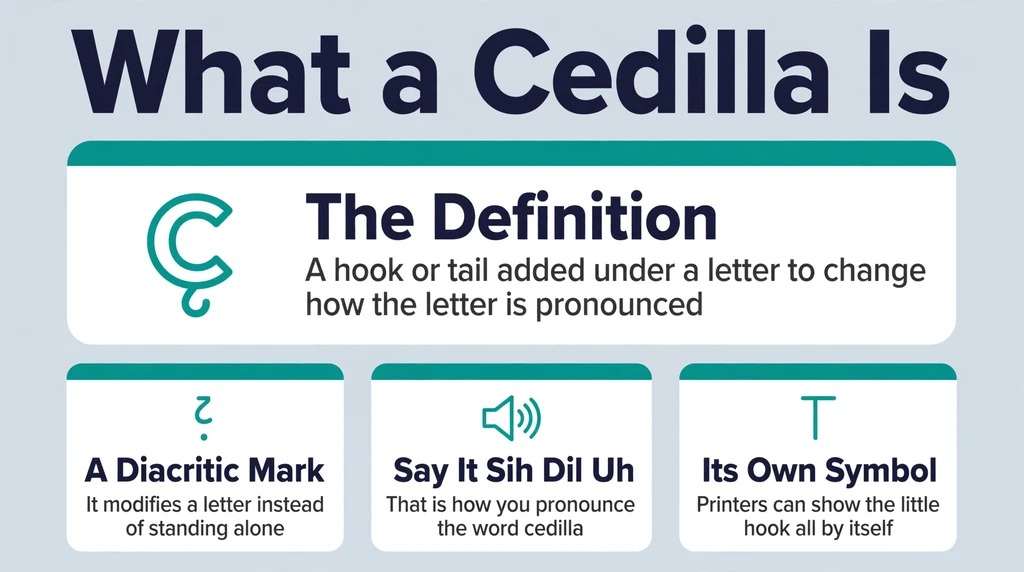
Dictionaries define the cedilla as a hook or tail added under certain letters as a diacritical mark. Its purpose is to show that the pronunciation of the letter is modified. The mark itself looks like a small curved hook, a little like a comma with a tail, and it hangs from the bottom of its host letter.
The word is pronounced sih-DIL-uh. Most people meet the cedilla through one letter, the c. When the hook sits under a c, the two parts together form the letter ç, which linguists call c-cedilla. In fact, the cedilla is so strongly tied to this one letter that many people use the word cedilla for the whole letter ç. Strictly speaking, though, the word names only the little hook itself.
A mark, not a letter
A cedilla on its own is not a letter. Instead, it belongs to the family of diacritical marks, the small signs that attach to letters and adjust their sound. Accents such as the acute in café belong to the same family, although they sit above the letter rather than below it.
Because it is a modifier, a cedilla never appears alone in normal writing. It always travels with a host letter, and it changes the value of that letter. However, some languages treat the finished combination as a letter in its own right. Turkish, for example, counts ç and ş as separate letters of its alphabet, with their own places in alphabetical order.
The cedilla by itself
Typographers also give the lonely mark its own symbol, written ¸. This spacing version of the cedilla exists so that the mark can be discussed, printed in dictionaries, and shown in type specimens. Unicode lists it at code point U+00B8, under the plain name CEDILLA.
Alongside that symbol, Unicode provides a combining version at U+0327, called COMBINING CEDILLA. Software uses this invisible building block to attach the hook to letters that have no ready made version. You will see later how that matters for languages such as Marshallese, which needs cedillas under letters that no keyboard offers.
How the mark is drawn today
The cedilla you see on screen depends heavily on the font. Traditional serif typefaces draw it as a flowing tail that grows out of the letter, echoing its handwritten past. That calligraphic shape, however, sat awkwardly beside the clean geometry of modern sans-serif letters.
When typeface modernism arrived, some designers quietly replaced the tail with a comma design. The comma version could be drawn bolder, and it matched the simpler mood of fonts such as Helvetica. As a result, the same letter can wear a graceful hook in one font and a neat comma in another, and both shapes count as the same mark.
How the Cedilla Changes Pronunciation
The cedilla exists because the letter c is unreliable. In English and in the Romance languages, a c changes its sound depending on the vowel that follows it. Understanding that split is the key to understanding the whole mark.
The problem with the letter c
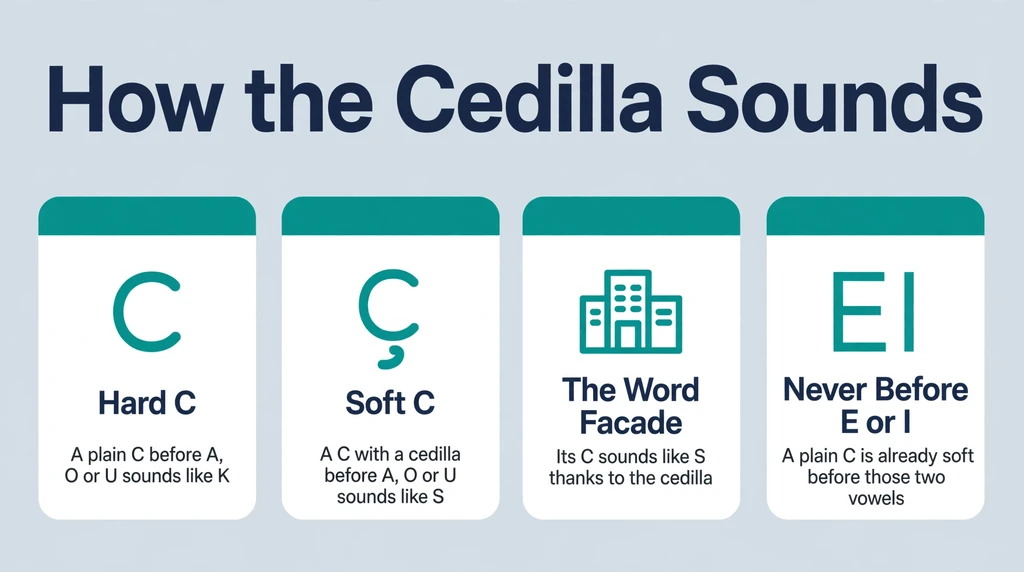
Before the vowels e and i, a c usually sounds soft, like an s. Think of the English words cent, city, and cinema. Before a, o, and u, though, the same letter turns hard and sounds like a k. Cat, cold, and custom all show that harder value.
That pattern works until a language needs the soft sound in front of a, o, or u. French faced exactly this problem. Several common French words needed an s sound before those very vowels, and scribes had no tidy way to write it. The cedilla solved the problem neatly.
What the hook does to a c
When you add a cedilla to a c, you order the reader to use the soft sound anyway. So the French word ça, meaning “that,” is pronounced sah, not kah. Likewise, garçon, the French word for boy or waiter, begins its second syllable with an s sound, not a k.
The rule is simple to state. A plain c before a, o, or u sounds like k. A c with a cedilla before the same vowels sounds like s. Portuguese and Catalan follow the same rule, which is why the mark appears in thousands of everyday words across those languages.
Why you never see it before e or i
You will not find a cedilla under a c that stands before e or i in French, Portuguese, or Catalan. The reason is practical. Before those two vowels, a plain c already sounds soft, so the hook would add nothing.
Medieval scribes occasionally wrote it anyway, producing forms such as çinco for “five.” Later grammarians treated that habit as hypercorrection, an overdone attempt at correctness, and it disappeared. Modern spelling keeps the cedilla only where it changes something.
Where the Word Cedilla Comes From
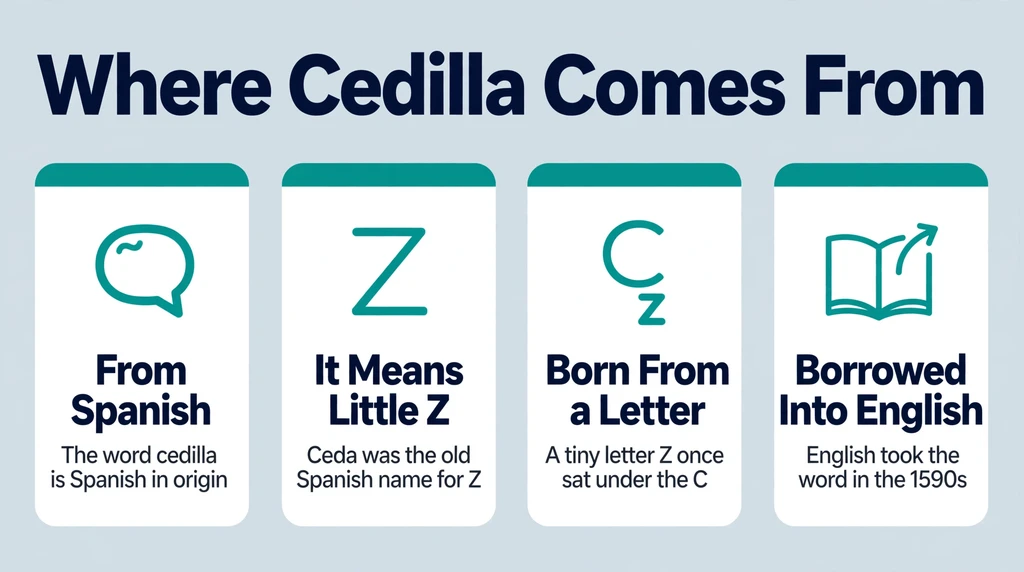
Oddly enough, the name of this mark has nothing to do with the letter c. The word cedilla comes from Spanish, and it means “little z.” That surprising meaning is your first clue to the mark’s real history.
Little z, from ceda to cedilla
In Old Spanish, the letter z was called ceda, a name descended from the Late Latin zeta and the Greek zêta. Spanish speakers formed a diminutive from that name, and the result was cedilla, literally a small ceda, or little z. English borrowed the word in the 1590s, and the Oxford English Dictionary cites a Spanish-English dictionary of 1599 among its earliest uses.
The name describes the mark’s birth. Early scribes signaled the soft sound by writing a small z after or under the c. Over time, that little z shrank, slipped below the line, and turned into the hook we know. The word kept the memory of the z long after the shape changed.
The same mark, other names
Each language that adopted the cedilla gave it a local name. French calls it a cédille, and the letter itself is a c cédille. Portuguese calls the mark a cedilha, and the finished letter is a c cedilhado, often shortened to c cedilha.
Catalan took a different path. There, the mark is a trenc, and the letter is the c trencada. That translates as “broken c,” a name that describes the look of the letter rather than its ancestry. Still, all three names point to the same small hook doing the same job.
A famous mix up about the name
Not everyone read the name correctly. The French scholar Dumarsais, writing in the Encyclopédie, explained cedilla as “little c,” probably because the hook hangs under a c. Later scholars corrected him. The name truly comes from the z, and the mark’s shape still betrays that origin if you look closely.
A Short History of the Cedilla
The cedilla began as a full letter, not a mark. Its story starts in medieval Spain, moves through the earliest French writing, and then spreads across Europe through the printing press.
Born from a Visigothic z
In Visigothic script, the letter z had a distinctive shape with two loops. Scribes in Spain used a form of that z to write a sound much like ts, a sound that Latin spelling handled badly. Gradually, the upper loop of the little z grew and came to be read as a c, while the lower loop shrank into a tail beneath it.
The result was a single character, ç, that packed two letters into one shape. Early French literature shows the experiment in progress. The Sequence of Saint Eulalia, dated to 881, is counted as the first literary manuscript in French. It contains the spelling czo, where a c and a z work together to guide the reader. Once the z slid fully under the c and shrank, the cedilla had arrived.
A look alike in old Latin books
Medieval books contain a second tailed letter that often confuses readers. Scribes wrote an e with a small tail, called the e caudata, or tailed e, in place of the Latin letter combination ae. The mark appears in manuscripts as early as the 6th century and survived in handwriting long after printing arrived.
Despite the similar shape, scholars consider the tailed e unrelated to the cedilla. It probably grew from a small a written beneath the e, not from any z. Palaeographers, the specialists who date old handwriting, even use its presence to help place a manuscript in the 11th to 13th centuries. The resemblance is a warning that similar hooks can have entirely separate family trees.
Into print with Geoffroy Tory
Manuscripts used the mark for centuries, but printing made it standard. Spanish and Portuguese printers cut type for the cedilla first, and the French printer Geoffroy Tory championed it for French. In his 1529 treatise Champ fleury, Tory argued that French needed the mark. It would show readers when a c should sound soft before a, o, or u.
Tory used the cedilla in print from 1530, and his 1533 edition of L’Adolescence clémentine carried it to a wide audience. From that point, printers across France adopted it. The rules of use settled into roughly the shape they keep today, and French spelling has leaned on the cedilla ever since.
Spain gives up its own invention
The strangest twist in the story belongs to Spain. Modern Spanish does not use the cedilla at all, even though Spanish scribes created it and Spanish speakers named it. During an orthographic reform in the 18th century, Spanish replaced ç with z in its spelling.
So the mark emigrated and never came home. It thrives today in French, Portuguese, Catalan, and Occitan, the languages that borrowed it from Spain. Meanwhile, its name in English, cedilla, still preserves the Spanish word that Spanish itself no longer needs.
Cedilla in French
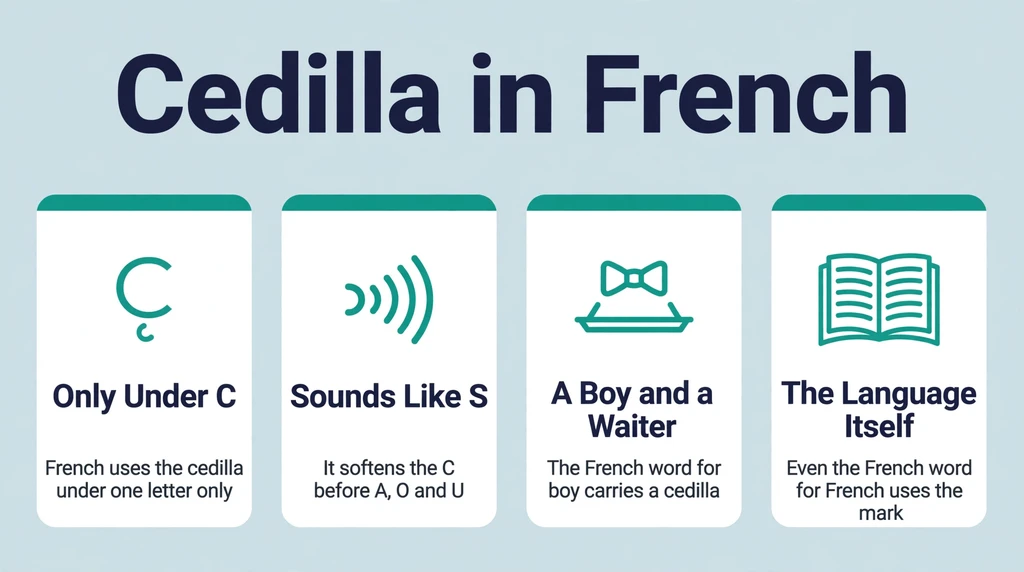
French is the language most English speakers associate with the cedilla. The name of the language itself contains one, since français is spelled with a ç. French uses the mark under c only, in both lowercase ç and capital Ç.
The basic French rule
In French, a c before a, o, or u normally sounds like k, as in cave or école. Adding a cedilla flips that value to s. The cedilla therefore appears only before those three vowels, because before e and i the c is soft already.
French also uses the cedilla at the start of words. The little word ça, meaning “that” or “it,” is one of the most common words in the language. Without its hook, the spelling would suggest the wrong sound entirely, and readers would stumble over an everyday word.
French words you may already know
Several French words with cedillas have entered English or appear on menus and signs everywhere. Garçon, meaning boy, became familiar through its use for a waiter. Leçon means a lesson, and English borrowed the word directly from Old French.
Reçu is a receipt, aperçu is a quick glimpse or insight, and façon means a way or manner of doing something. In verb forms, the cedilla keeps the sound steady, as in nous commençons, “we begin.” The hook preserves the soft sound before the o of the ending.
The capital letter Ç
The cedilla works on the capital letter too, giving Ç. French uses it at the start of sentences and in names, and you will see it in uppercase headings on French signs and book covers.
Interestingly, French writers sometimes forget the cedilla on capitals, because old typewriters and some keyboards made it hard to produce. Style guides still insist on it, since a missing hook can change how a name should be read aloud.
Cedilla in Portuguese, Catalan, and Occitan
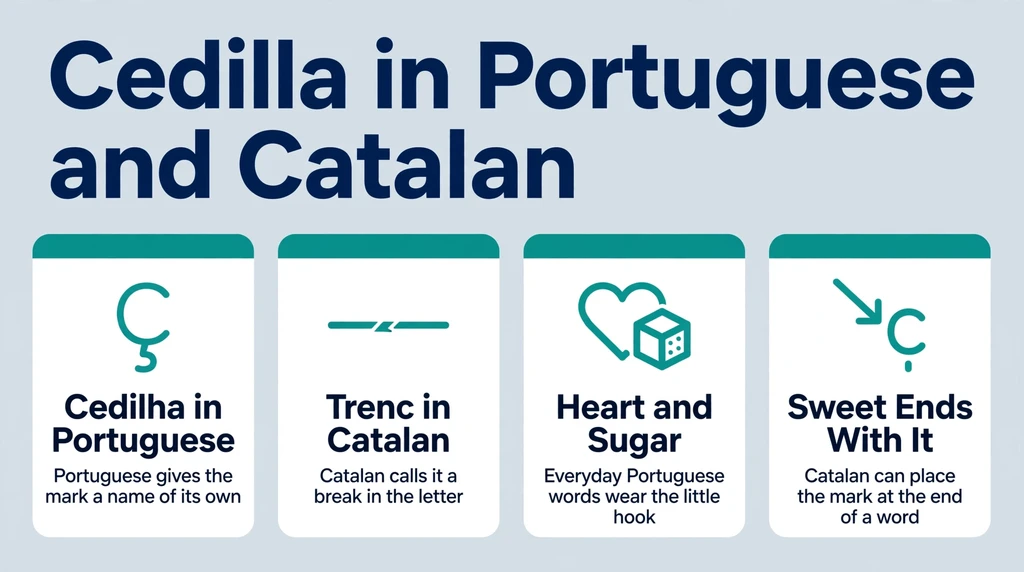
Portuguese is the second great home of the cedilla. There the mark is called a cedilha. The letter ç follows the same sound rule as in French, standing for s before a, o, and u.
Portuguese words with ç
Everyday Portuguese is full of the letter. Coração means heart, praça means a public square, and ação means action. Açúcar, the word for sugar, shows the letter at the start of a word, a position French rarely uses for it.
Brazilian and European Portuguese both use the cedilla heavily, in names, places, and ordinary vocabulary. Because Portuguese keyboards include a dedicated ç key, Portuguese speakers treat the letter as an ordinary part of writing, not a special character.
Catalan and the broken c
Catalan calls the letter the c trencada, the broken c, and the mark itself is a trenc. It follows the familiar rule before a, o, and u, giving words such as plaça, a square, and força, meaning strength.
The language also does something French does not. It places ç at the end of words to mark a final s sound, as in dolç, meaning sweet, and braç, meaning arm. A name like Barça, famous worldwide through football, carries the cedilla in the middle and is pronounced with an s sound.
Occitan and Friulian
Occitan, a Romance language of southern France and nearby valleys, also uses the cedilla, especially in its classical orthography. Word final ç appears there as well, following the Catalan pattern.
Further east, Friulian in northeastern Italy uses a cedilled c for a different sound, the ch sound heard in church. That difference is a useful reminder. The cedilla signals that a letter’s sound has changed, but each language decides what the new sound will be.
Cedilla Beyond the Letter C
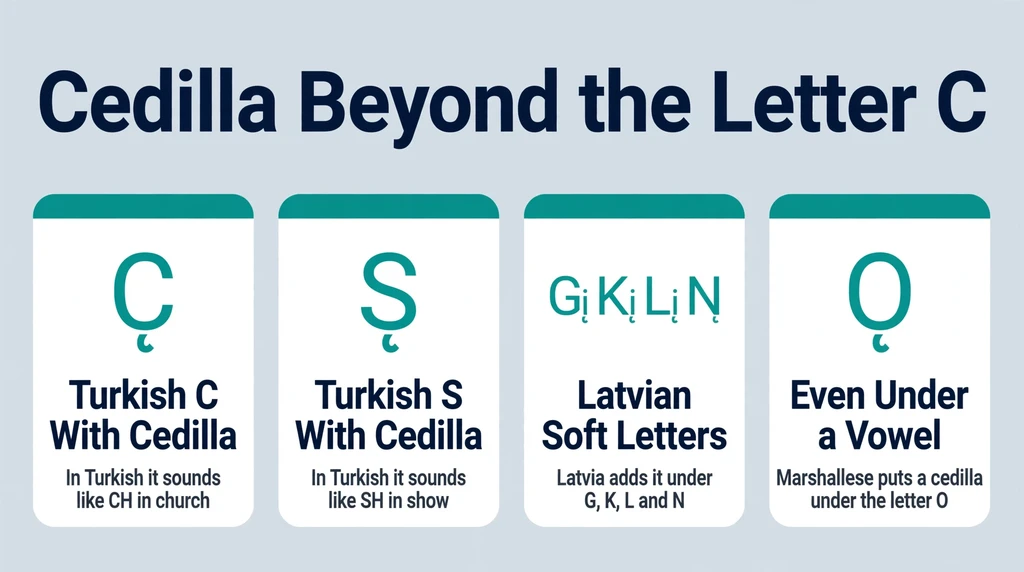
Once printers and linguists saw how useful the hook could be, they attached it to other letters too. The cedilla now works under s, t, and several other letters, and in some alphabets it even sits under vowels.
Turkish s and c with cedillas
Turkish uses two cedilla letters, and neither sounds like the French ones. In Turkish, ç stands for the ch sound in church, as in çay, the word for tea. The letter ş stands for the sh sound in show, as in şiir, meaning poetry.
Both letters arrived with Turkey’s adoption of a Latin based alphabet on 1 November 1928. Turkish treats them as full letters, not decorated versions of c and s. They take their own places in the alphabet, ç after c and ş after s.
The same letters across the region
Turkish did not keep the pair to itself. Azerbaijani uses the same two letters with the same sounds, in common words such as içmək, to drink, and danışmaq, to consult or speak. Turkmen and Tatar use them too, as do Crimean Tatar and Gagauz.
Albanian also writes ç for the ch sound, a usage fixed by its 1908 orthography congress at Monastir. Kurdish uses both ç and ş as well. Across this whole region, then, the little hook signals ch and sh sounds, a job it never does in French or Portuguese.
Latvian and the comma shaped cedilla
Latvian takes the mark in yet another direction. Latvian attaches a cedilla, drawn like a small comma, under g, k, l, and n to show softened, palatalized sounds. The letters are ģ, ķ, ļ, and ņ, and an older letter ŗ fell out of official use during the Soviet period.
The Latvian mark behaves curiously with the letter g. On a capital Ģ, the hook sits below the letter as usual. On the lowercase ģ, however, printers place the mark above the letter. A hook underneath would collide with the descender of the g and hurt legibility.
Cedillas under vowels and other letters
Marshallese, spoken in the Marshall Islands, may be the most surprising user of all. Its alphabet puts cedillas under l, m, n, and even the vowel o, producing ļ, m̧, ņ, and o̧. Two of those letters do not exist as ready made characters, so software builds them with the combining cedilla.
In parts of Africa, the cedilla does something else entirely. Several languages of Cameroon, including Vute, place it under vowels to mark nasalization, meaning the vowel is spoken partly through the nose. One small hook, in other words, can change a consonant, soften a letter, or nasalize a vowel, depending on where it lands.
Cedilla in English Words
English never adopted the cedilla as part of its own spelling system. Even so, a handful of borrowed words keep the mark, and you have almost certainly read some of them without noticing.
Façade and friends
The most famous example is façade, borrowed from French, where it means the front of a building. English speakers kept the cedilla in careful spelling, and they kept the pronunciation it commands, saying fuh-SAHD with a soft c. Without the hook, the written word would suggest a hard k, which is why the cedilla earns its place.
Other borrowings include cachaça, the Brazilian sugarcane spirit, and limaçon, a snail. Limaçon also names a spiral shaped curve in mathematics, and both words come from Portuguese and French sources. Provençal, the name of a language and region of southern France, also keeps its ç in English texts.
Personal names carry the mark into English print as well. English newspapers write François when they mention French public figures, and Portuguese footballers bring names such as Gonçalo to match reports. In names, dropping the cedilla is usually treated as a spelling error, because a name belongs to its owner in a way a common noun does not.
Why English often drops it
In practice, English frequently drops the cedilla. Newspapers and websites often print facade, cachaca, and limacon, and dictionaries list the plain spellings as accepted variants. The reason is simple. English keyboards have no ç key, and English readers pronounce these words from memory rather than from spelling rules.
So the cedilla in English is a courtesy to the word’s origin, not a working part of English spelling. Keeping it looks precise, and language lovers defend it. Dropping it, however, breaks no English rule, because English never made one for it.
Cedilla vs Comma Below
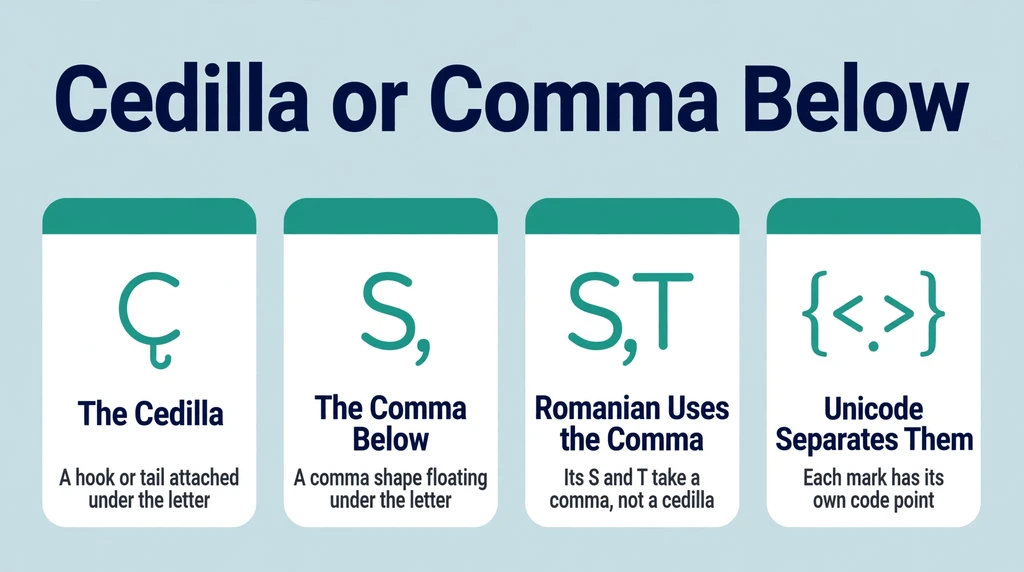
Look closely at Romanian writing and you will see marks under s and t that look exactly like cedillas. They are not cedillas at all. They are commas below, a separate mark with its own history, and the difference once caused real trouble in computing.
Two marks that look like twins
A true cedilla is a small hook or tail, usually attached to the bottom of its letter. It often curves like a tiny 5 without its top stroke. A comma below, by contrast, is a detached comma shape that floats just under the letter without touching it.
In many fonts the two look nearly identical, and some type designers even draw the cedilla as a comma for a cleaner look. That visual overlap hides a real distinction. The marks have different names, different code points, and, for the languages involved, different identities.
The Romanian story
Romanian writes two letters with marks beneath them, s with a mark for the sh sound and t with a mark for the ts sound. For years, printers and early computer standards treated that mark as a cedilla. Romanian text was therefore full of ş and ţ, letters borrowed from the Turkish set.
In 2003, the Romanian Academy confirmed that the correct mark is a comma placed below the letter, not a cedilla. Unicode now encodes the Romanian letters separately, at U+0218 through U+021B, and careful Romanian typography uses those comma below characters. Latvia’s cedilla shaped marks add one more twist, since the Unicode names for its letters say cedilla while the drawn mark is really a comma.
Do not confuse it with the ogonek
One more look alike deserves a mention. The ogonek is a hook under a letter that curves the opposite way, like a mirror image of the cedilla. Polish, Lithuanian, and Navajo use it to mark nasal vowels.
If the hook opens toward the left and hooks backward, it is an ogonek. If it hangs like a small tail in the middle, it is a cedilla or a comma below. The difference is subtle in print, but the languages that use these marks treat them as completely different tools.
How to Type a Cedilla on Any Device
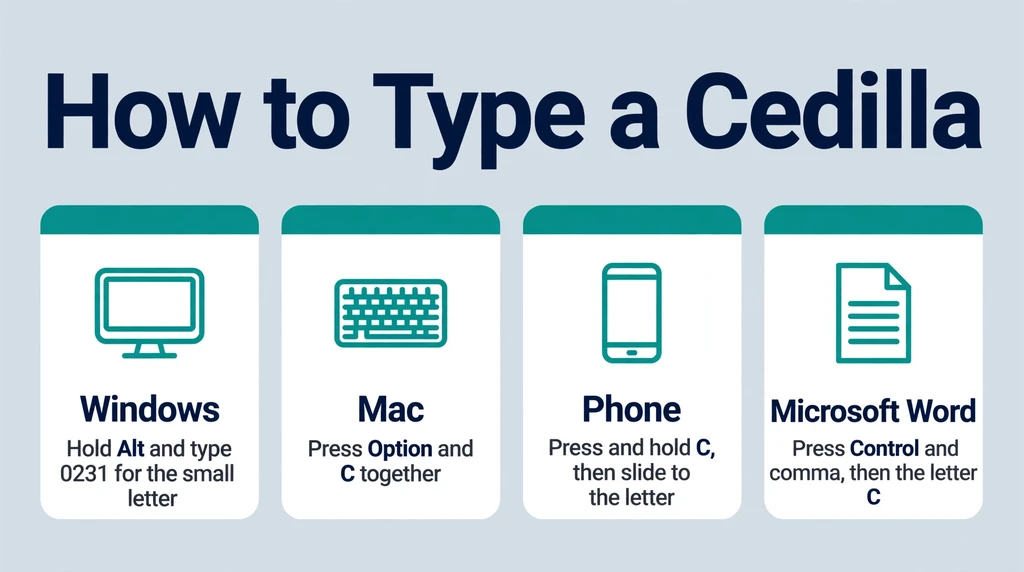
Because English keyboards omit the ç key, most people meet this letter as a typing problem. Luckily, every major system offers a quick route to it. Here are the methods that typing references consistently recommend.
On Windows
If your keyboard has a numeric keypad, Alt codes are fastest. Hold Alt and type 0231 for the lowercase ç, then release. For the capital Ç, hold Alt and type 0199 instead. Num Lock needs to be on, and the codes only work with the keypad, not the number row.
Without a keypad, open the Character Map app, search for cedilla, and copy the letter from there. Alternatively, add a French or Portuguese keyboard layout in Settings if you type the letter often, and it becomes a single keystroke.
On a Mac
Mac users get a dedicated shortcut. Press Option+C and the lowercase ç appears at once. For the capital, press Option+Shift+C.
You can also press and hold the c key. A small menu of accented versions pops up, and you pick ç from the list. The Character Viewer, opened with Control+Command+Space, offers the same letter through a search for cedilla.
On phones and tablets
Phones make the job easiest of all. On both iPhone and Android keyboards, press and hold the c key. A row of variants appears above your finger, and you simply slide to ç and let go.
The same gesture works for the capital letter. Hold the shift key first, or long press the capital C, and choose Ç. No settings need changing, because the letter is built into the standard keyboard.
In Word, Docs, and on the web
Microsoft Word has its own shortcut. Press Ctrl and the comma key together, release, and then press c, and Word inserts ç. You can also type the code 00E7 and press Alt+X to convert it into the letter.
Google Docs users can open Insert, then Special characters, and search for cedilla. Finally, if you write for the web, the letter has the HTML entity ç and the Unicode code point U+00E7, while its capital uses U+00C7. The combining cedilla, U+0327, lets developers attach the hook to almost any letter.
Why older computers struggled with it
Older readers may remember an era when the letter simply went missing. Basic ASCII, the character set behind early computing, contains no accented letters at all. Faced with that gap, some users faked the mark by typing a comma after the letter.
National variants of the ISO 646 standard patched the problem locally. The French version, for instance, assigned the lowercase ç to a slot that American ASCII used for a punctuation character. Each country solved the puzzle differently, though, so files crossed borders badly, and cedillas often arrived as strange symbols. Modern Unicode ended that chaos by giving every letter, cedilla included, one permanent address.
Common Mistakes and Misconceptions
The cedilla is small, and so are the misunderstandings around it. Here are the claims that dictionaries and language references most often have to correct.
“Cedilla means little c”
This is the oldest error of all, printed by Dumarsais in the Encyclopédie in the 18th century. The name does not come from the letter c at all. It comes from ceda, the Old Spanish name for z. So cedilla means little z, and the mark’s history as a shrunken z proves the point.
“The cedilla is an accent”
People often call the cedilla an accent, but accents in the strict sense mark stress or vowel quality, like the marks in café or résumé. The cedilla instead changes a consonant’s basic sound. It is a diacritic, which is the wider family, but its job is closer to changing the letter than to decorating it.
“Dropping it changes nothing”
In English, dropping the cedilla is harmless, since the words are read from memory. In French or Portuguese, dropping it can change the sound and even the meaning. The French word ca does not exist as a normal word, while ça means “that.” Likewise, a Portuguese reader expects coração with its hook, and the bare spelling looks broken.
“Spanish uses the cedilla”
Given the name and the origin, many people assume Spain still uses its invention. It does not. Spanish dropped the cedilla in an 18th century spelling reform and writes z or c where its ancestors wrote ç. The mark survives in the languages that borrowed it, not in the one that created it.
“Ç is pronounced the same everywhere”
Finally, the letter does not carry one universal sound. In French, Portuguese, and Catalan it sounds like s. In Turkish, Azerbaijani, and Albanian it sounds like the ch in church. Friulian also gives it the ch value. Always let the language, not the letter, tell you the sound.
Frequently Asked Questions
What is a cedilla in simple words?
A cedilla is a tiny hook placed under a letter to change its sound. It appears most often under the letter c, creating ç. In French and Portuguese, that hook tells you to pronounce the c as a soft s instead of a hard k.
How do you pronounce the word cedilla?
Say sih-DIL-uh, with the stress on the middle syllable. The word comes from Spanish, where it means “little z,” because the mark began life as a small z written under a c.
What sound does ç make?
That depends on the language. In French, Portuguese, and Catalan, ç sounds like s, as in façade. Turkish, Azerbaijani, and Albanian give the same letter the ch sound of church, as in the Turkish word çay, meaning tea.
Is ç a separate letter?
In French and Portuguese, ç is treated as a version of the letter c, not a separate letter. Turkish and Azerbaijani, however, treat ç as a full letter of the alphabet, with its own place in the ordering, right after c.
Why does façade have a cedilla?
Façade comes from French, where the cedilla guarantees the soft s sound before the letter a. Without the hook, a French reader would expect a hard k sound. English kept both the mark and the soft pronunciation when it borrowed the word.
Does Spanish use the cedilla today?
No. Spanish invented the mark and gave it its name, but an 18th century spelling reform removed it from Spanish writing. Today the cedilla lives on in French, Portuguese, Catalan, Occitan, and several other languages instead.
What is the difference between a cedilla and a comma below?
A cedilla is a hook or tail attached under a letter, while a comma below is a separate comma shape floating beneath it. Romanian uses the comma below under s and t, and Unicode encodes those letters separately from the cedilla versions once used in their place.
How do I type ç quickly?
On Windows, hold Alt and type 0231 on the numeric keypad. Mac users press Option+C instead. On a phone, press and hold the c key and slide to ç. Each method takes about a second once you know it.
Final Thoughts
The cedilla is proof that small marks can carry big jobs. One tiny hook, descended from a medieval z, decides whether a c sounds like k or s for hundreds of millions of readers. It softens French and Portuguese, changes its tune entirely in Turkish, and still peeks out of English words like façade.
Next time the little tail catches your eye, you will know its name, its story, and even how to type it. If you want to explore the full history with diagrams of its early forms, the Wikipedia article on the cedilla is a rich place to continue reading.