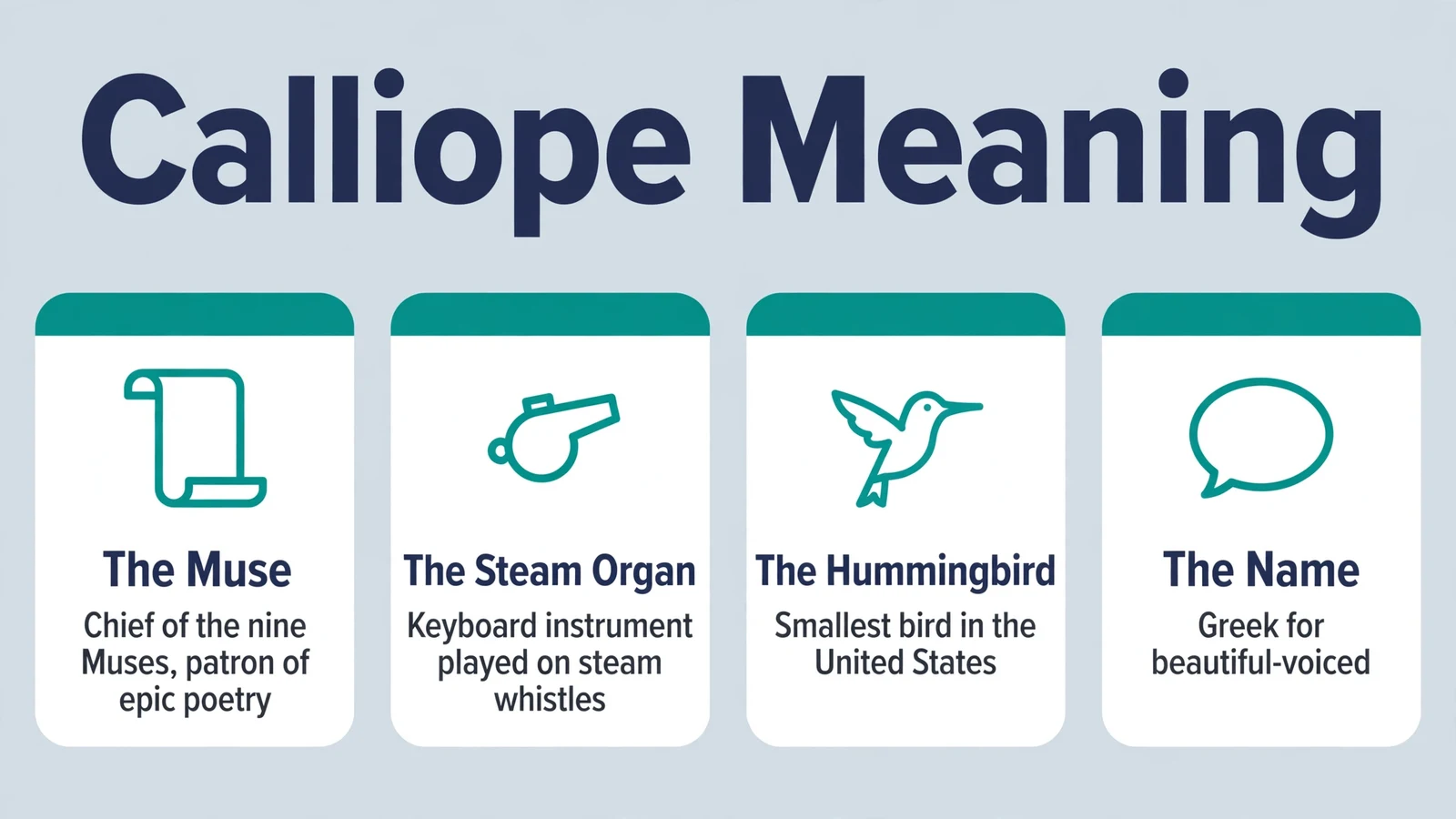
Few English words lead three lives at once. Calliope is a Greek goddess, a fairground organ loud enough to carry across a river, and the smallest bird in the United States. All three carry the same Greek name. All three also start arguments about how to say it.
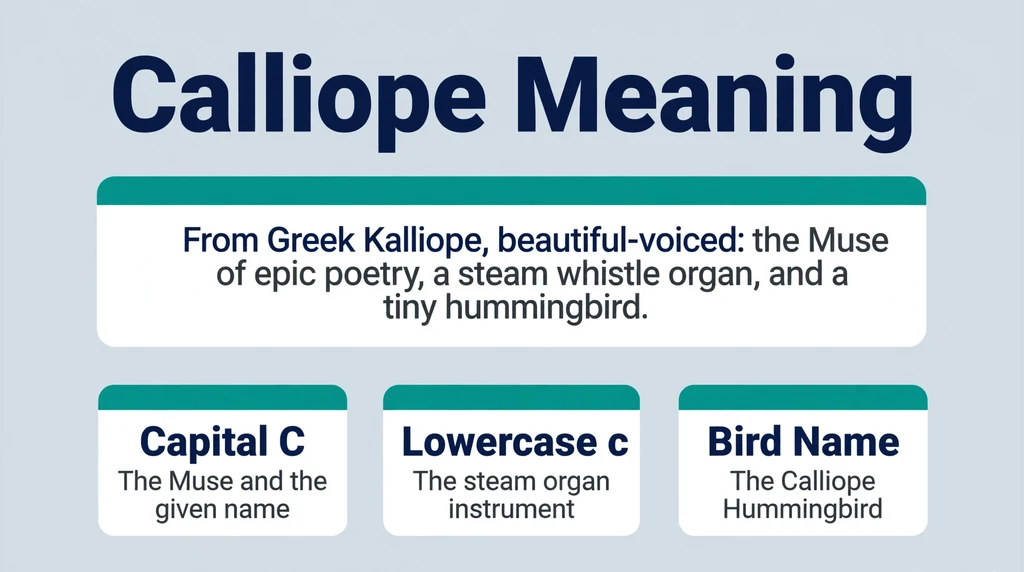
In short, Calliope comes from the Greek name Kalliopē, which means “beautiful-voiced.” With a capital C, it names the Muse of epic poetry, the chief of the nine Muses. In lowercase, it names a steam organ built from whistles. It also labels a tiny hummingbird of the western mountains.
This guide takes each meaning in turn. It starts with the pronunciation, since that is where most readers trip. Then it follows the word from ancient Greece to American riverboats, circus parades, and high mountain meadows.
What Does Calliope Mean?
Three meanings under one name
Merriam-Webster lists two dictionary senses for the word. The first is the proper name: Calliope, the Greek Muse of heroic poetry. The second is a common noun: a keyboard instrument like an organ, built from a set of whistles sounded by steam or compressed air.
Bird guides add a third use that dictionaries treat as a name rather than a sense. The Calliope Hummingbird is a real species, *Selasphorus calliope*, and the smallest bird in the United States. On top of that sits a fourth use: Calliope as a girl’s given name, now rising in the baby name charts.
So the word works as a small family. A goddess stands at the head of it. An instrument, a bird, and a baby name all borrow her name and her link to a beautiful voice.
Capital C or lowercase c
Capitalization quietly tells you which meaning a writer intends. The Muse always takes a capital C, because she is a person in the myths. A girl named Calliope takes one too.
The instrument drops to lowercase. Writers speak of “a calliope” on a steamboat or at a fair, the way they speak of a piano or an organ. The hummingbird keeps a capital C because bird names are capitalized by convention, so it appears as the Calliope Hummingbird.
This small detail solves many confusing sentences. If a text praises Calliope beside Homer, it means the goddess. If it complains that the calliope drowned out the brass band, it means the organ.
Which meaning do people usually want?
Context gives the answer away. Readers meeting the word in a mythology book, a poem, or a baby name list want the Muse or the name. Readers who land here from “calliope music” or a steam fair video want the instrument.
Birders are the most single-minded group. Nobody searches for the Calliope Hummingbird by accident, since the name belongs to a prized species on many life lists. Knowing all three meanings still helps, because the senses cross paths in crosswords, quizzes, and trivia nights, where setters love exactly this kind of three-way word.
How to Pronounce Calliope
The dictionary pronunciation
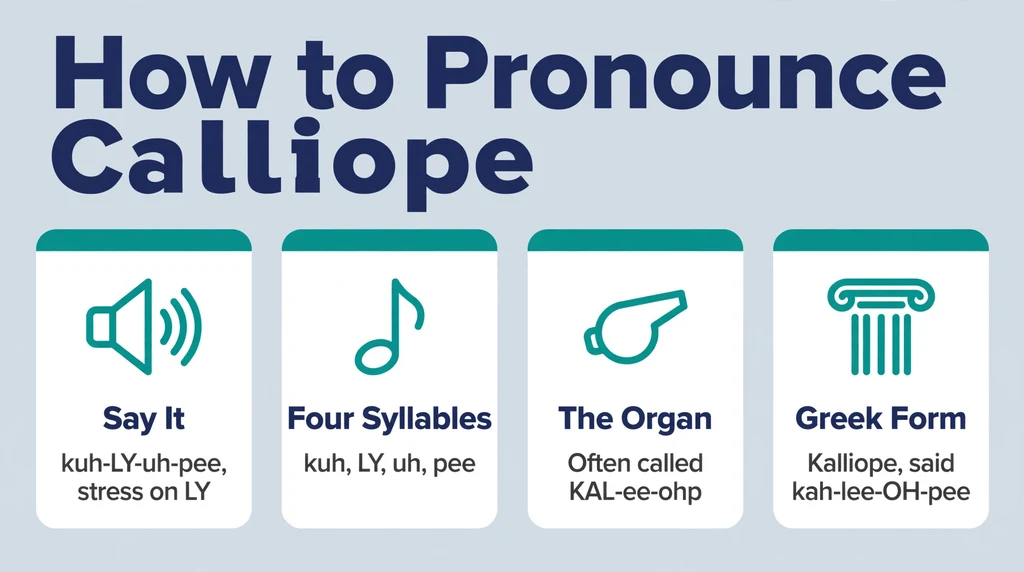
Most people meet this word on paper first, and the spelling gives poor clues. Dictionaries solve it with a simple pattern: kuh-LY-uh-pee. Say it in four syllables, and put the stress on the second one, the “LY” sound that rhymes with “fly.”
Merriam-Webster writes the pronunciation as kə-ˈlī-ə-(ˌ)pē, and Collins gives the same shape for British English. So the Muse, the name, and the bird all share this one standard sound. If you learn only one version, this is the safe choice for every setting.
Practice helps because the eye wants to split the word wrongly. It is not “callie-ope” and not “kuh-LOP-ee.” The long I in the middle does most of the work, and the final “pee” stays light and quick.
The instrument’s shorter pronunciation
The steam organ picked up a second, shorter pronunciation in the United States. Many players and fairground workers say KAL-ee-ohp, in three syllables, with the stress at the front. Merriam-Webster records this version for the instrument sense alone.
Neither version is a mistake. The long form suits the goddess and the name. The short form grew up around the machine, where brevity won over classical polish. You may hear both at a steam fair on the same afternoon.
Regional habits explain most arguments about the word. A classics teacher will likely insist on kuh-LY-uh-pee. A riverboat musician may answer with KAL-ee-ohp. Each is defending the Calliope they know best.
Why the Greek original sounds different
In Greek, the name is Kalliopē, said roughly as kah-lee-OH-pee, with the weight near the end. English pulled the stress forward and stretched the middle vowel, a normal fate for Greek names in English mouths.
Penelope followed the same path, and so did Antigone and Persephone. Once you hear the pattern, the whole family of names becomes easier to read aloud. Calliope only looks hard until its rhythm clicks.
A quick way to lock it in
Try saying the word as two chunks: “kuh-LY” plus “uh-pee.” Repeat the pair slowly three times, then run them together. Most people find the rhythm sticks after a single practice round.
Reading it aloud inside a sentence helps too. “Calliope was the chief of the Muses” forces the stress onto the right syllable. After that, the spelling stops looking like an obstacle and starts looking like a rhythm.
Where the Word Comes From
Beauty plus voice
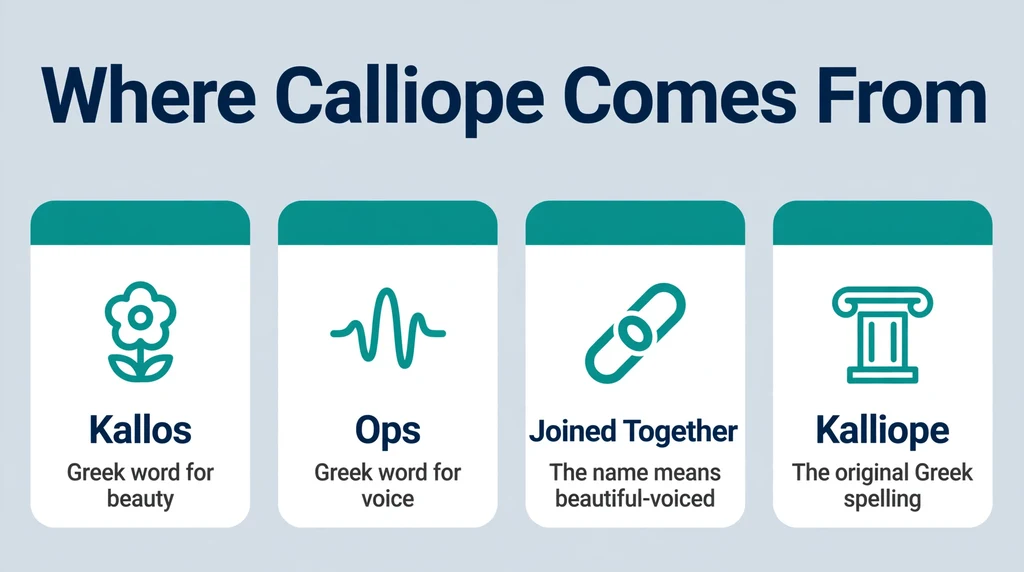
The Greek name Kalliopē joins two plain words. The first, *kallos*, means beauty. The second, *ops*, means voice. Put together, they give “beautiful-voiced,” or in looser English, “she of the beautiful voice.”
Merriam-Webster and Collins both trace the name to exactly these roots. The meaning fits the Muse neatly, since epic poetry was sung or chanted aloud for centuries. In a world before printing, a great voice was how a long story survived.
The name therefore describes a job as much as a person. Calliope was the beautiful voice that carried the deeds of heroes from one generation to the next.
From Kalliopē to Calliope
Greek spelled the name with a K and a double L: Καλλιόπη, Kalliopē. Latin retold the myths and softened the spelling to Calliope, the form English inherited. That is why both spellings still circulate today.
Kalliope remains the closer transliteration of the Greek, and modern Greek families often use the related form Kalliopi. English, however, settled on Calliope centuries ago. Dictionaries list Calliope as the standard English spelling, with Kalliope as a variant.
The instrument word is much younger than the name. Reference books date lowercase calliope, the steam organ, to American English of 1855 to 1860. The machine took the goddess’s name at the moment of its patent, a story told in full below.
Why the name keeps getting reused
A name meaning “beautiful-voiced” invites borrowing. An inventor naming a very loud organ reached for it as a compliment and a joke at once. A naturalist naming a jewel-like bird borrowed it for its classical shine.
Each borrower kept the sound and dropped most of the myth. That is why one Greek name can sit comfortably in a poetry handbook, a fairground, and a field guide at the same time.
Relatives from the same roots
The *kallos* root, beauty, shows up in other English words. Calligraphy is “beautiful writing,” built from the same first element. Calisthenics joins *kallos* to *sthenos*, strength, to suggest beautiful strength in exercise.
The name Callista comes from a related Greek word for “most beautiful,” which explains its similar sound. None of these words contains the *ops*, voice, element, though. That second half belongs to Calliope alone in common English, and it is the half that carries her identity as a voice.
Calliope the Muse of Epic Poetry
Chief of all Muses
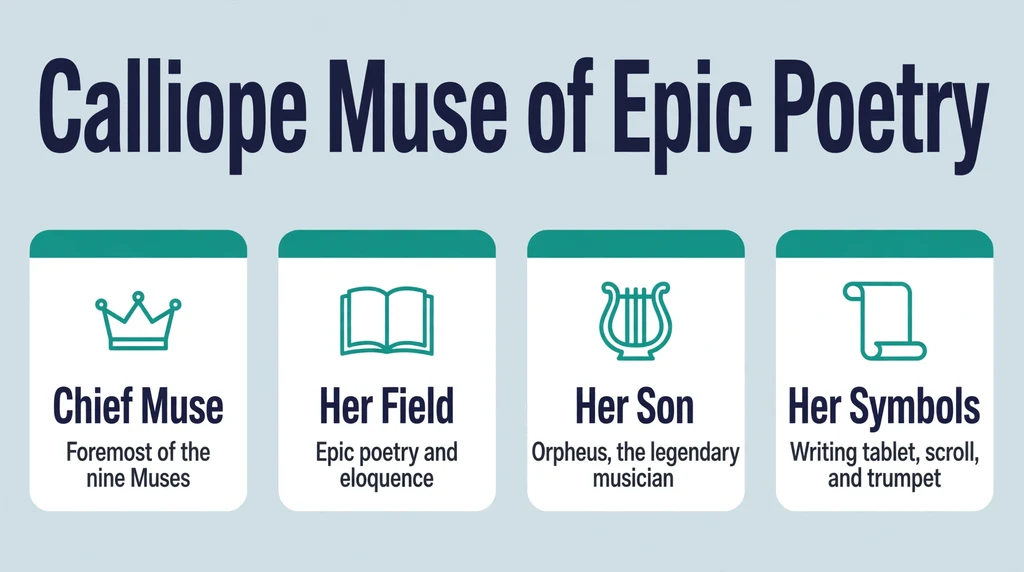
Greek myth gives Zeus and Mnemosyne, whose name means Memory, nine daughters called the Muses. Each Muse guarded one art or science. Hesiod lists all nine in his poem the *Theogony*, and he singles Calliope out from her sisters.
Hesiod names her last, yet calls her the chiefest of them all, because she attends on respected princes and kings. Later writers, Hesiod and Ovid among them, kept the title: Chief of all Muses. Britannica sums her up the same way, as foremost of the nine.
Her special field grew clearer over time. Early on she stood for eloquence and fine speech in general. Later tradition made her the patron of epic poetry, the long heroic verse of Homer and Virgil.
Mother of Orpheus
The myths also make Calliope a mother, and here the versions split, as myths often do. In most accounts, she and King Oeagrus of Thrace were the parents of Orpheus, the greatest musician of Greek legend. Some tellings name the god Apollo as Orpheus’s father instead.
Other stories give her further sons. Britannica notes Hymen and Ialemus, children by Apollo, while still other versions credit her with Linus, said to have invented melody and rhythm. The details shift from author to author, so careful writers present them as tradition, not fact.
Why Orpheus matters to her story
Orpheus grew into the most famous musician in Greek myth, a singer whose lyre could charm animals, trees, and stones. Tradition credits his mother with his gift. Some accounts even say Calliope taught him his verses for singing.
That teaching role fits her office. Epic poetry in the Greek world was performed aloud, often to the lyre, so the Muse of epic and the mother of music’s hero belong in one household. Storytellers made the family tie to explain where such skill came from.
One duty, though, shows her rank clearly. At Zeus’s request, Calliope judged the dispute between Aphrodite and Persephone over the beautiful Adonis. Only the chief Muse would be handed a quarrel between goddesses.
Tablets, scrolls, and trumpets
Artists needed a way to mark Calliope out from eight similar sisters. They settled on the tools of the poet. She usually holds a writing tablet, a scroll, or a book, and sometimes a stylus for the tablet.
Merriam-Webster describes her holding an epic poem in one hand and a trumpet in the other. The tablet stands for the written word. The trumpet stands for the fame that epic poetry trumpets across the world.
Her image is old in art as well as in verse. Britannica points to the François Vase, painted around 570 BCE, where she already appears among the Muses. Few literary figures have been pictured so steadily for so long.
The voice behind Homer and Virgil
Epic poets opened their works by calling on a Muse, and tradition assigned that honor to Calliope. She was believed to be Homer’s Muse for the *Iliad* and the *Odyssey*, the two founding epics of Western literature.
Virgil follows the custom in the *Aeneid*, crying, “Aid, O Calliope, the martial song!” Dante, writing many centuries later, invokes her too at the start of the *Purgatorio*, asking her to strike a higher key.
So for over two thousand years, the biggest poems in the tradition began by asking this one goddess for help. That long habit is the real source of her fame today.
Calliope among her sisters
The nine sisters divided the arts between them, and later tradition assigned each a clear post. Clio took history, and Urania took astronomy. Erato handled love poetry, while Euterpe covered music and lyric song.
Melpomene took tragedy, and Thalia took comedy. Terpsichore ruled dance, and Polyhymnia ruled sacred hymns. Calliope, as chief, held epic poetry and eloquence, the most public and honored arts of the group.
Writers did not always keep these borders tidy, and early sources assign the fields loosely. Still, the pattern explains her crown. The sister who spoke for kings and heroes naturally led the family.
The Steam Calliope: An Organ Made of Whistles

An organ that plays whistles
A calliope is a musical instrument that makes its sound with steam. Inside sits a boiler and a row of tuned whistles, close cousins of the locomotive whistle. Press a key, and steam rushes through one whistle to sound one note.
The player works from a keyboard, much like an organist. Early models instead used a pinned metal cylinder, which turned like a music box roll and opened the valves on its own. Keyboards soon took over, since they let a musician choose the tunes.
One limit defines the instrument: volume never changes. A calliope cannot play softly, and its tone stays fixed, so expression comes only from pitch, rhythm, and timing. Worse, the steam’s heat bends the tuning, so a calliope always sounds slightly wild, which fans count as part of its charm.
Joshua Stoddard and the 1855 patent
The instrument is an American invention. Joshua C. Stoddard, an inventor from Worcester, Massachusetts, patented his steam calliope on October 9, 1855. He first called it a “steam piano,” then chose the Muse’s name for its beautiful voice.
Stoddard formed the American Steam Music Company to build and sell the machines. His design grew from earlier steam trumpet ideas, the same technology that produced the train whistle. Showmen, rather than churches or concert halls, became his real customers.
Not everyone credits Stoddard alone. Arthur S. Denny had built a similar steam instrument around 1850 but never patented it, and he later marketed an “Improved Kalliope” in London. The patent, though, was Stoddard’s, and history attached the invention to his name.
Riverboats and circus parades
The calliope found its stage on the river. Steamboats carried boilers anyway, so adding a calliope cost little, and its blast announced a boat long before the vessel came into view. A showboat could gather a crowd on the bank from miles away.
Circuses wanted the same effect on land. They mounted calliopes on carved, painted wagons and placed them in street parades, where the music pulled whole towns toward the big top. Carnivals and fairs followed, and the instrument became the sound of American outdoor fun.
Merriam-Webster explains the logic plainly: because the sound could be heard for miles, the calliope lured patrons to river showboats, circuses, and carnivals. No quieter instrument could compete for that job.
Adoption was fast once showmen heard it. Circus histories record outfits buying calliopes within two years of the patent, and floating palaces added them soon after. A rival boat or circus without one simply sounded smaller, so the machines spread along every major river and rail line.
The calliopist’s hot seat
Playing the thing was punishing work. The brass keys sat close to live steam, and they grew hot enough to blister fingers. Condensation dripped, steam leaked, and the player worked half-scalded through every tune.
Old accounts describe calliopists staggering away from the keyboard, soaked and deafened, when a performance ended. Steamboat crews joked about the “perfessor” at his post above the boilers. The Delta Queen later solved the problem by placing the keyboard a safe distance from the whistles.
Skill mattered because nothing could be hidden. With no volume control and drifting tuning, a good player won the crowd through timing, choice of tunes, and sheer nerve.
Air, music rolls, and survivors
Steam slowly gave ground in the 1900s. Many later calliopes run on compressed air instead, which is safer and easier to manage. Music rolls also arrived, letting the machine play by itself in the manner of a player piano.
Most surviving steam calliopes came from one builder, Thomas J. Nichol of Cincinnati, who made them from 1890 to 1932. His instruments still play on famous riverboats, including the *Delta Queen*, the *Belle of Louisville*, and *President*.
Working calliopes are rare now, and hearing one is an event. Yet wherever a paddle-wheeler docks with its whistles singing, the Muse’s name is still doing its old work of drawing a crowd.
The Calliope Hummingbird
The smallest bird in the United States
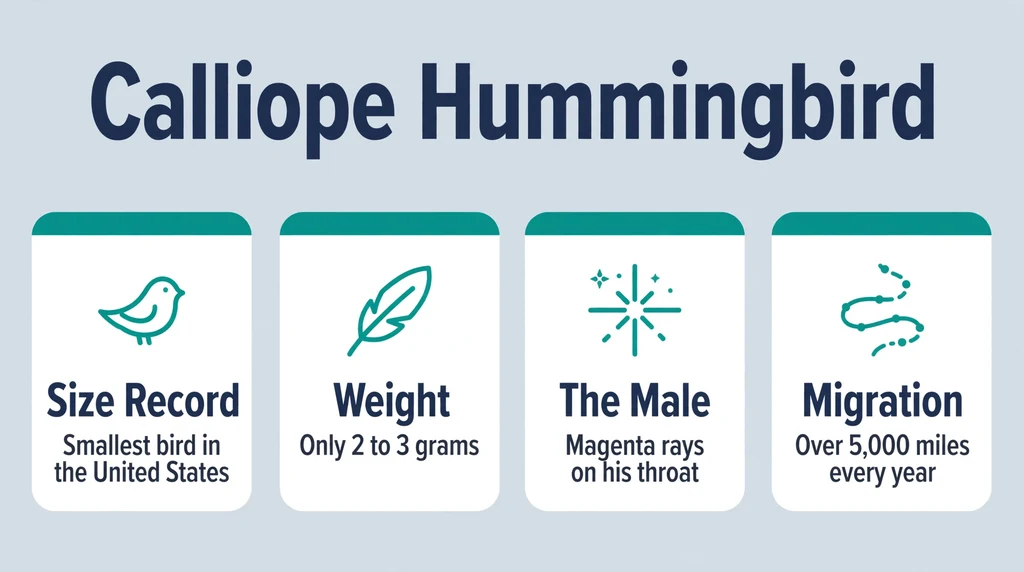
The Calliope Hummingbird holds a size record, and the Cornell Lab of Ornithology calls it the smallest bird in the United States. Montana’s field guide adds the wider title: the smallest North American breeding bird.
An adult measures roughly three inches long and weighs only two to three grams, about as much as a penny or two paper clips. Its scientific name, *Selasphorus calliope*, places it among the bee and rufous hummingbirds’ relatives in the genus *Selasphorus*.
John Gould described the species in 1847. For many years it sat in a genus of its own, *Stellula*, before classifiers moved it into *Selasphorus*, where it remains today.
Magenta rays and U-shaped dives
The male is unmistakable when his throat catches the light. His gorget, the glittering throat patch, breaks into separate magenta rays over white, like a tiny starburst. Montana’s field guide notes that no other North American hummingbird wears its color in split rays like this.
Courtship turns the rays into a display. The male climbs, then plunges in a U-shaped dive past the female, buzzing with his tail feathers and giving a sharp zinging call. Cornell’s guide describes the dive and its sputtering buzz in detail.
Females are quieter in dress: green backs, pale buff sides, and a white throat with fine dark streaks. Their short bill and short tail help separate them from the similar rufous and Allen’s hummingbirds.
Mountains in summer, Mexico in winter
This tiny bird breeds high. It nests in mountain meadows and open forests across western North America, from southern British Columbia and Alberta down to Colorado and southern California. Nests have been found from about 600 feet up to above 11,000 feet.
Then comes the surprise. Each year the Calliope travels more than 5,000 miles, looping up the Pacific side in spring and returning through the Rockies in fall. It winters in the pine-oak forests of Mexico, with some birds reaching Guatemala and Belize.
Measured against its body, that journey is heroic. A three-gram bird crossing a continent twice a year is doing the work of an epic in miniature, which suits its borrowed name.
How to spot one
Cornell’s birding guide offers practical advice for finding the species. Look for its favorite perch first: a bare twig sticking up from a willow or alder near a mountain stream. Males return to the same perches again and again.
Listening helps as much as looking. The male’s diving display makes a sharp zing that carries across a meadow, and summer visitors often hear a Calliope before they see one. In spring, watch coastal routes; in fall, the birds favor higher interior trails along the Rockies.
Females build the nests, often over creeks or beside streams, and they sometimes repair last year’s nest or stack a new one on top of the old. Two tiny eggs, a hidden cup of bark and moss, and a three-gram architect: the whole nursery weighs almost nothing.
A muse’s name on a bird
Why call a hummingbird after the Muse of epic poetry? Gould gave the species the epithet *calliope* in 1847, borrowing the goddess’s name in the classic style of the period.
Nineteenth-century naturalists often reached for mythology when naming new species, and beauty guided many of their choices. The Calliope is the showpiece of its family in North America, so a name tied to beauty and voice fits collectors’ tastes.
The link is only a name, since hummingbirds hum rather than sing. Still, of all the birds Gould might have honored, he chose the smallest and brightest for the chief of the Muses.
How the species is doing
Field guides describe the Calliope as widespread and relatively common across its mountain range. Montana’s guide rates it secure overall, while noting minor to moderate declines in places. Its high, scattered habitat makes counting hard, so watchers rely on breeding surveys and migration tallies.
For a bird this small, remoteness is protection. Meadows above the roads and resorts change slowly, and the species still fills them each summer.
Calliope as a Given Name
What the name promises
As a girl’s name, Calliope sells the Muse herself: a beautiful voice, a love of stories, and a touch of classical drama. Parents who choose it usually know the mythology and want exactly that flavor. It sits naturally beside Penelope, Persephone, and Athena in the current Greek revival.
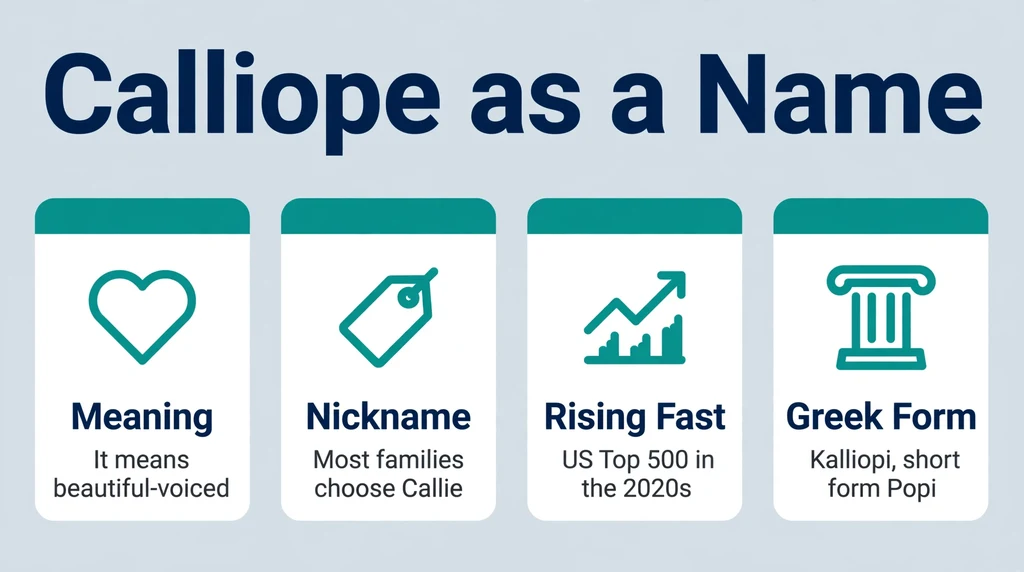
The name also solves the nickname question in advance. Most families shorten it to Callie, a friendly everyday form, while the full name waits for formal moments. Some use Clio, Lola, or Poppy instead.
A slow climb up the charts
For most of the twentieth century the name barely registered in the United States. Federal records list only scattered births, and many Americans met the word first as the fairground organ.
Then the curve turned. Social Security data show Calliope entering the US Top 1000 in 2016, at rank 941. It climbed into the Top 500 in the 2020s, reaching 491 in 2023 and 451 in 2025, its highest place so far.
Name watchers credit television for part of the rise. *Grey’s Anatomy* put a Dr. Calliope “Callie” Torres on screens for years, proving the name could suit a modern adult. The similarity to chart favorite Penelope helped as well.
Calliopes you may have heard of
The name has a modest line of real-life bearers. Calliope Tatti helped organize resistance in the Greek War of Independence. In our own time, actress Callie Thorne, born Calliope, carried it onto American television.
Greek composer Calliope Tsoupaki has held national honors in the Netherlands, and Greek sport has its own Kalliopi in former national-team footballer Kalliopi Stratakis. None of them made the name common, but together they keep it visible across very different fields.
The Greek form at home
In Greece itself, the name never went away. The modern Greek form Kalliopi stays in steady use in Greece and Cyprus, carried through church and family tradition rather than fashion. Its everyday short form there is Popi, which sometimes crosses into English as Poppy.
So the name lives two lives at once. In Athens it is a familiar classic, and in Austin it is a daring revival pick. Both rest on the same Muse and the same meaning.
Calliope in Sentences
Examples show the senses faster than definitions can. Each sentence below uses the word in one of its main roles, with the meaning noted after it.
- “The epic opens by calling on Calliope, as poets had done since Homer.” (the Muse)
- “As chief of the Muses, Calliope was said to attend on kings and princes.” (the Muse)
- “You could hear the calliope from the far side of the river before the showboat rounded the bend.” (the instrument)
- “The circus parade ended with a gilded wagon carrying the calliope, still cheerfully out of tune.” (the instrument)
- “A Calliope Hummingbird, no heavier than a penny, worked the penstemon at 9,000 feet.” (the bird)
- “They named their daughter Calliope, but everyone calls her Callie.” (the given name)
- “Tourists covered their ears, grinning, as the calliope launched into a waltz.” (the instrument)
- “Of the nine Muses, Calliope alone was called their chief by Hesiod.” (the Muse)
- “The Calliope winters in Mexico and returns to the high meadows by June.” (the bird)
Notice the capital letters doing quiet work in these lines. The goddess, the bird, and the baby take capitals. The organ does not, because it is a thing rather than a name.
Common Mix-Ups and Misconceptions
Calliope or Kalliope?
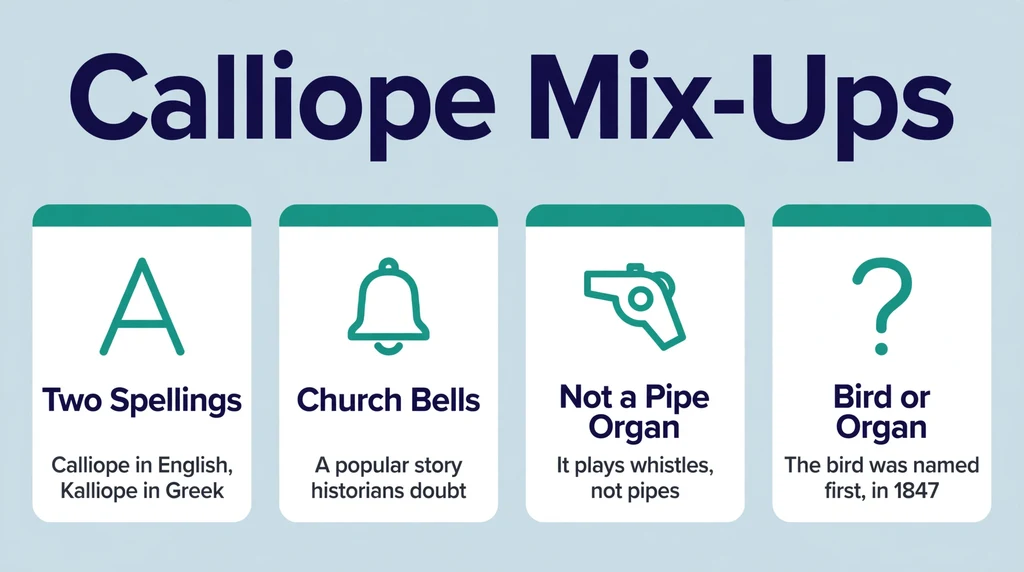
Both spellings point to the same figure, and neither is wrong in every context. Kalliope is the direct transliteration of the Greek Καλλιόπη, so scholars and Greek speakers often prefer it. Calliope is the Latin-shaped spelling that English adopted.
For English writing, Calliope is the standard choice, and it is the spelling dictionaries headword. Use Kalliope when quoting Greek material or when a person’s name is registered that way. Mixing the two inside one text, though, looks careless.
The church bell story
A favorite tale says Stoddard invented the calliope to replace church bells, summoning worshippers with steam instead of bronze. The story appears in many older accounts and still circulates at fairs.
Instrument historians treat it with caution. Reference works on the instrument note that the church tale was popularized in the 1950s, long after the patent. Stoddard’s own early aims, they say, leaned toward signaling for railroads and steamboats. The honest verdict is that the bell story may hold a grain of truth, but it grew in the retelling.
Not a pipe organ and not a carousel organ
People often file the calliope under “organ” and picture church pipes. The resemblance stops at the keyboard. A pipe organ pushes air through pipes with steady, controllable pressure. A calliope forces steam or air through whistles and cannot soften its voice at all.
Carousel music adds a second mix-up. Many fairground organs play from pinned barrels or folded cardboard books and use reeds and pipes at modest volume. A true calliope is the steam whistle instrument, far louder and far rarer. If the music politely accompanies the merry-go-round, it is probably not a calliope.
Was the bird named after the organ?
No, and the dates prove it. Gould named the hummingbird *calliope* in 1847. Stoddard patented his steam calliope eight years later, in 1855. Neither inventor nor naturalist borrowed from the other.
Both reached back to the same source instead: the Muse. Nineteenth-century coinages often dressed new things in classical names, and “beautiful-voiced” suited a glittering bird and a whistling organ equally well, even if only one of them sings sweetly.
Frequently Asked Questions
What does Calliope mean in Greek?
Calliope comes from the Greek Kalliopē, built from *kallos*, “beauty,” and *ops*, “voice.” The name means “beautiful-voiced” or “she of the beautiful voice.” It was the name of the Muse of epic poetry, which is why the steam organ and the hummingbird later borrowed it.
How do you pronounce Calliope?
Say kuh-LY-uh-pee, with the stress on the second syllable. Dictionaries give this as the standard pronunciation for the Muse, the name, and the bird. For the steam organ, many Americans also say KAL-ee-ohp, a shorter form that Merriam-Webster records for that sense alone.
Who was Calliope in Greek mythology?
Calliope was one of the nine Muses, daughters of Zeus and Mnemosyne. Hesiod called her the chief of all the Muses, and later tradition made her the patron of epic poetry and eloquence. In most accounts she was the mother of Orpheus, the legendary musician, by King Oeagrus of Thrace.
What is a calliope instrument?
A calliope is a keyboard instrument that plays a row of tuned whistles with steam or compressed air. Joshua C. Stoddard patented it in Massachusetts in 1855. Because it is extremely loud, it became a fixture on river showboats, circuses, and fairs, where it drew crowds from miles away. A few historic examples still play today on heritage steamboats such as the *Delta Queen* and the *Belle of Louisville*.
Why is the hummingbird called Calliope?
Ornithologist John Gould named the species *calliope* in 1847, borrowing the Muse’s name in the classical naming style of his day. The Calliope Hummingbird is the smallest bird in the United States, and its scientific name is now *Selasphorus calliope*.
How popular is the name Calliope?
The name is rising fast but is still uncommon. US Social Security data show it entering the Top 1000 in 2016 and reaching rank 451 in 2025, with 682 girls given the name that year. Most Calliopes answer to the nickname Callie.
What is the difference between Calliope and Kalliope?
There is no difference in meaning. Kalliope is the direct transliteration from Greek, while Calliope is the Latin-influenced spelling that English adopted. Dictionaries use Calliope as the standard English form. The modern Greek name Kalliopi is a close relative of both.
What does a calliope sound like?
Bright, shrill, and gloriously loud. A steam calliope plays familiar tunes on whistles, but the heat of the steam keeps it slightly out of tune, and the player cannot make it quieter. Listeners historically heard one from several miles away, which was the whole point.
Final Thoughts
One Greek compliment, “beautiful-voiced,” ended up naming a goddess, an organ, a hummingbird, and a growing crowd of little girls. The senses look unrelated until the voice connects them: epic song, whistle music, and a name chosen for its music.
When you meet the word now, check the capital letter and the company it keeps. Homer and Orpheus mean the Muse. Steam, keyboards, and showboats mean the organ. Mountains and magenta feathers mean the bird.
Pronounce it kuh-LY-uh-pee and you will be right in nearly every room. For a deeper look at the goddess who started it all, the Encyclopaedia Britannica profile of Calliope is a solid next read.