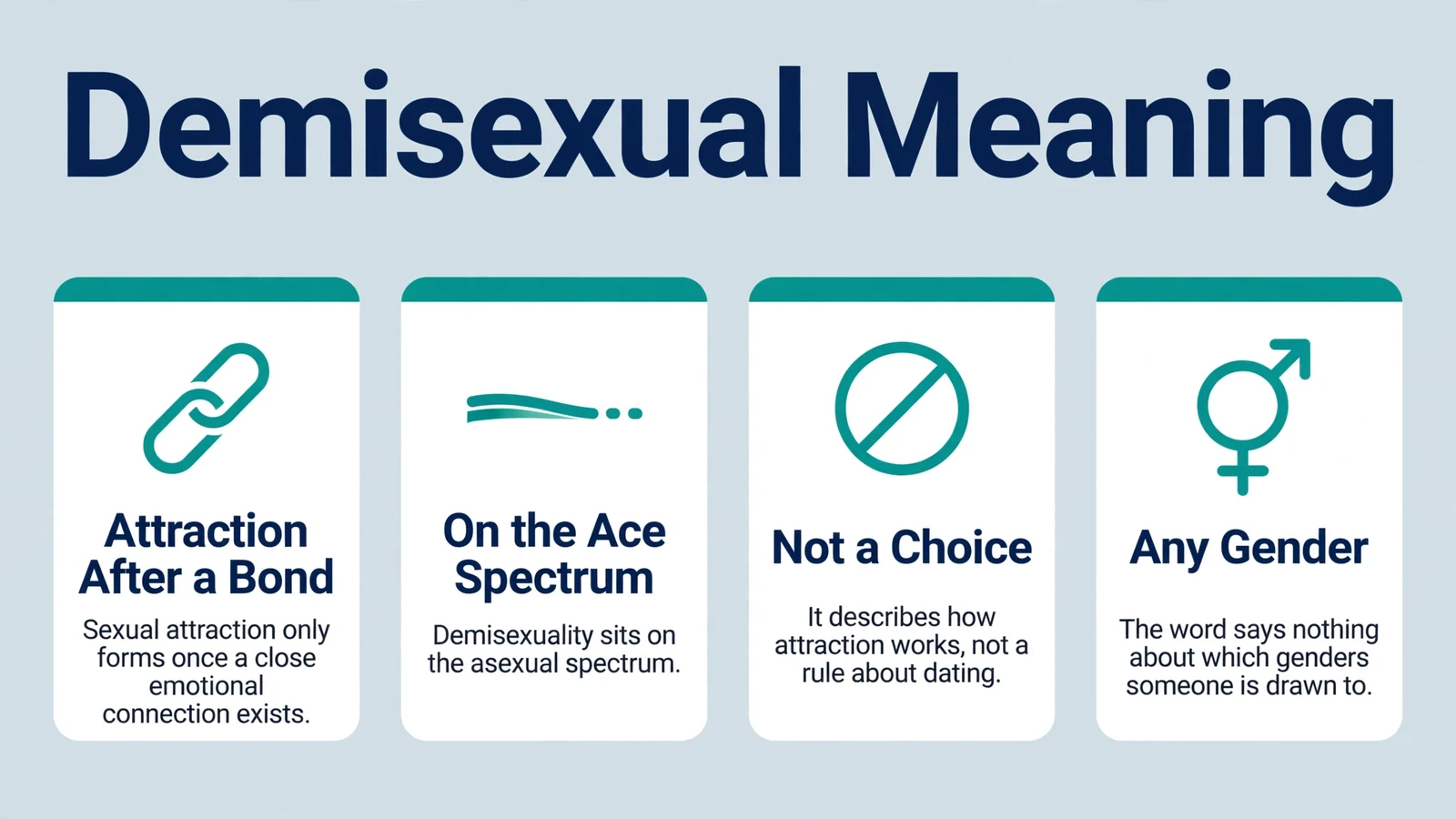
Most people can point to a moment of instant attraction. A look across a room is enough. For a demisexual person, that moment simply never happens.
Demisexual meaning, in plain terms, is this: a demisexual person experiences sexual attraction only after forming a strong emotional bond with someone. Without that closeness, the attraction does not switch on at all. It is not shyness, and it is not a dating rule.
The word comes from the asexual community, and demisexuality sits on the asexual spectrum. This guide explains the definition, the spectrum, the origin of the word, and the signs people describe. It also clears up the most common myths. Along the way, it compares demisexual with asexual and demiromantic, two labels it is often confused with.
What Does Demisexual Mean?
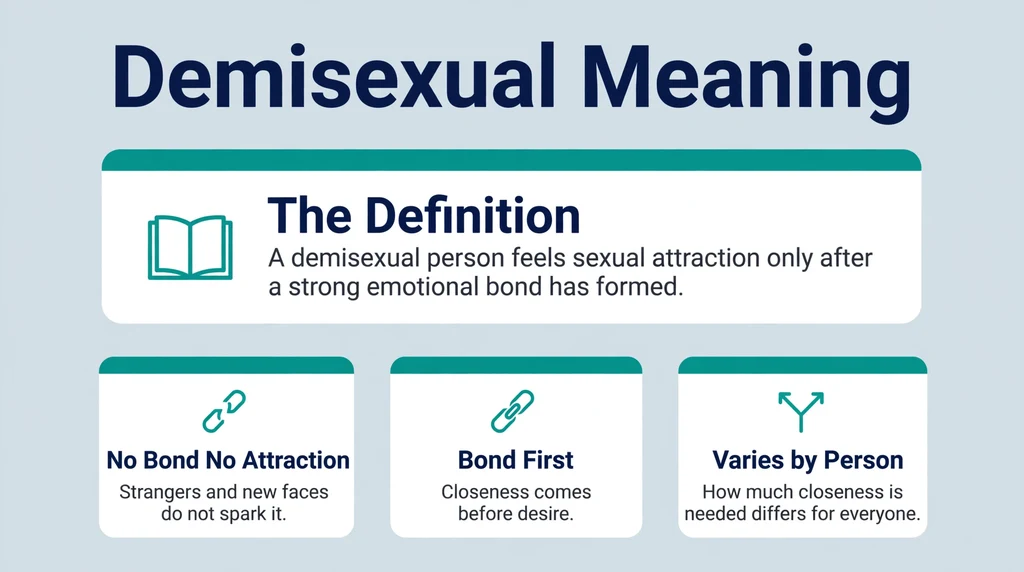
Demisexual describes a pattern of attraction, not a set of dating rules. A demisexual person feels sexual attraction only toward people they already share a deep emotional connection with. Until that bond exists, the attraction is simply absent.
That absence is the part people most often miss. A demisexual person does not meet someone, feel a spark, and then hold back. Instead, there is no spark to hold back in the first place. Attraction arrives later, if it arrives at all, and it grows out of closeness.
The short definition
Dictionaries and community sources define the word in nearly the same way. Demisexuality is a sexual orientation marked by experiencing sexual attraction only after a strong emotional connection forms. The Asexual Visibility and Education Network, known as AVEN, uses the same core wording. In short, the bond is a prerequisite, not a bonus.
What counts as an emotional bond
There is no single test for the bond, and the label does not set one. For some people, it grows through a long friendship. For others, it forms across months of deep conversation and shared experience. Importantly, the bond does not have to be romantic. A close platonic friendship can be the soil attraction grows from, even when romance was never the plan.
Depth matters more than the calendar here. Two people can know each other for years as casual acquaintances and never cross the line into closeness. Another pair might bond deeply within a single intense season of life. Demisexual people describe the requirement in terms of trust and emotional knowledge, not hours logged. When they say they need to really know someone, the word really is doing heavy lifting.
The attraction can still be strong
Once the bond exists, the attraction that follows can be full and strong. Demisexual people are not limited to faint or watered down feelings. The difference lies in the trigger, not the intensity. Closeness opens a door that stays shut for strangers, no matter how attractive those strangers look on paper.
How it feels from the inside
People who use the label often describe a long stretch of feeling out of step. School friends traded crushes while they felt nothing in particular. As adults, they may watch dating culture revolve around instant chemistry they never experience. Discovering the word tends to bring relief rather than concern. It reframes years of confusion as a recognizable pattern. Nothing was broken. The attraction system simply runs on a different input, and that input is emotional closeness.
Primary and Secondary Attraction: The Idea Behind the Word
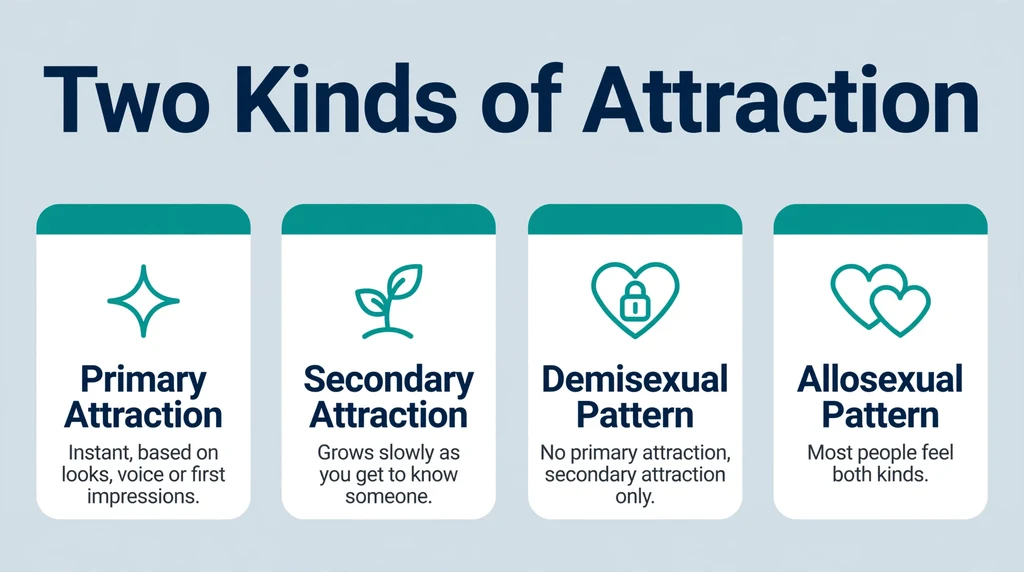
The definition makes more sense with one simple model. The asexual community often splits attraction into two kinds. That split explains exactly where the word demisexual came from.
Primary sexual attraction
Primary attraction is the instant kind. It fires on sight, based on information available right away. Appearance, voice, style, and first impressions all feed it. Most people feel this kind of attraction toward strangers, acquaintances, and celebrities they will never meet.
Secondary sexual attraction
Secondary attraction works on a slower clock. It develops only after you know a person well. Shared jokes, trust, and emotional history build it over time. Instead of reacting to a face, it reacts to a relationship.
How the two kinds combine
In this model, allosexual people typically feel both kinds of attraction. Asexual people feel neither kind. Demisexual people sit in a specific middle spot. They do not experience primary attraction, yet they can experience secondary attraction. That single distinction is the whole engine of the word. It also explains why many demisexual people describe themselves as feeling asexual until, one day, they are not.
A simple everyday example
Picture two coworkers who meet every day for a year. An allosexual person might feel a spark during the first week. A demisexual person feels only friendly neutrality for months. Then the shared projects, long talks, and mutual trust add up. Somewhere along the way, the feeling changes into attraction. The person did not become more attractive in the mirror. The relationship became deeper, and depth is what flipped the switch.
Where Demisexual Sits on the Asexual Spectrum
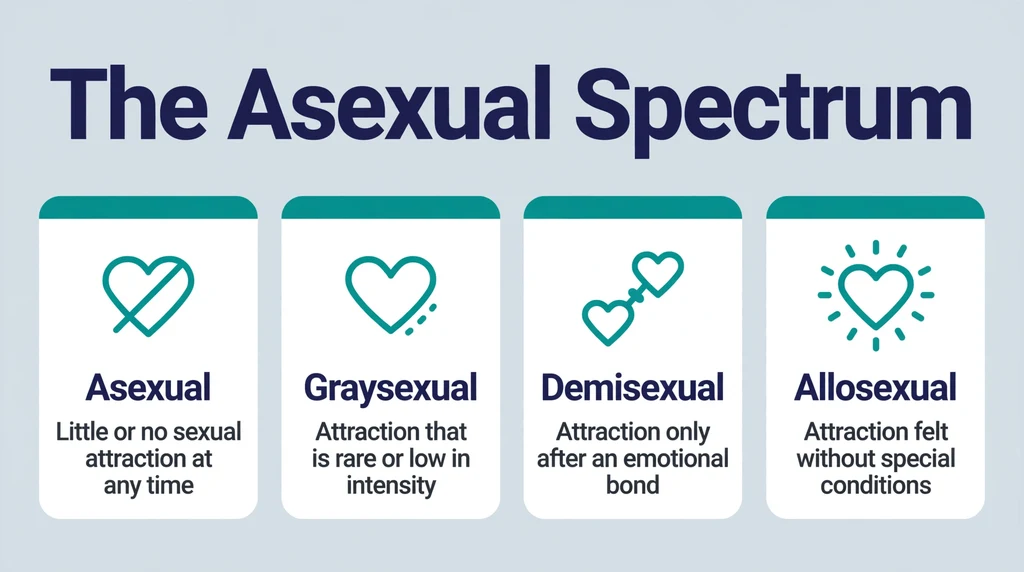
Demisexuality is generally classed as part of the asexual spectrum. That spectrum describes how much sexual attraction a person experiences, and under what conditions. It runs from no attraction at all to attraction without conditions.
The asexual end of the spectrum
Asexual people experience little or no sexual attraction to anyone. Crucially, a close bond does not usually change that. An asexual person can love deeply and still feel no sexual pull. Asexuality also says nothing about behavior or romance, which are separate questions.
The gray area in the middle
Graysexuality covers the gray area between asexual and allosexual. Graysexual people may feel attraction rarely, or only at low intensity. Demisexuality is often grouped into this gray zone as well. The grouping makes sense, because demisexual attraction depends on a condition that is rarely met.
The allosexual end of the spectrum
Allosexual is the community term for people who are not on the ace spectrum. Allosexual people can feel attraction based on first impressions alone. They may still choose to wait for a connection before acting. However, the attraction itself needs no waiting period.
A spectrum, not a ladder
A spectrum describes variety, not rank. Nobody sits at a better or more evolved point on it. An asexual person is not missing something a demisexual person has. An allosexual person is not more complete than either. The scale simply maps different settings of the same human system. Keeping that flat picture in mind makes the vocabulary feel less like a contest and more like a map.
Why the placement is debated
Some people question whether demisexuality belongs under the ace umbrella at all. Their argument is that the word describes when attraction happens, not how much of it happens. Others answer that attraction limited to rare conditions fits the spectrum naturally. In practice, many demisexual people find the ace community the closest match for their experience. The label you choose remains a personal call.
Labels can overlap and change
Spectrum labels are descriptions, not sealed boxes. A person might call themselves graysexual for years, then find demisexual more precise. Someone else may use asexual as an umbrella and demisexual as the detail underneath. Movement between neighboring labels is common in ace communities. It usually reflects better self knowledge, not confusion or trend chasing. The vocabulary stays useful precisely because it allows that kind of honest revision over time.
Origin of the Word Demisexual
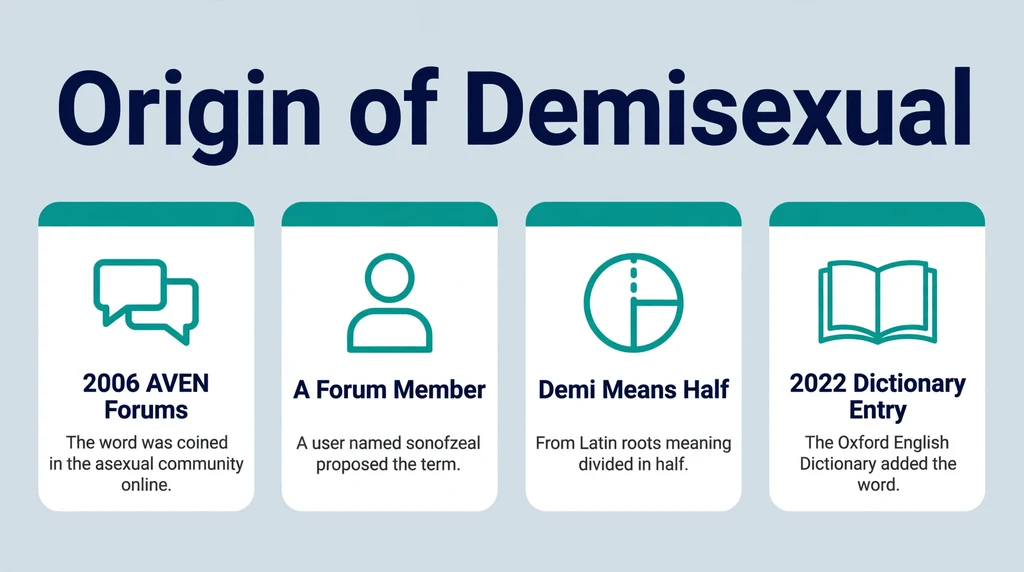
Unlike many identity words, this one has a traceable birthplace. It appeared online, inside a community that was busy building language for itself.
Coined on the AVEN forums in 2006
The term was coined in February 2006 on the forums of AVEN. A member using the name sonofzeal proposed it. He described feeling neither completely asexual nor completely non-asexual. Existing words missed his experience, so he built a new one. His core point was simple: for him, an emotional bond was a prerequisite for sexual attraction, not an optional extra.
Why the community needed a new word
AVEN had been founded in 2001 to give asexual people visibility and shared language. Its forums drew thousands of people comparing experiences that mainstream vocabulary ignored. Some members felt no attraction ever, while others felt it only inside close relationships. Without a word, that second group sounded like a contradiction. Demisexual filled the gap neatly. The coinage shows how identity language often grows: a community names a pattern it keeps seeing.
What the prefix demi means
The prefix demi comes from Latin roots meaning halved, or divided in half. Community writers use it to signal a position between asexual and allosexual. It does not mean half a person, and it does not mean half an orientation. Think of it as a marker on a scale, not a measure of worth or completeness.
From forum word to dictionary word
By 2008, the term was seeing widespread use across online ace spaces. Dating platforms followed later. OkCupid recognized demisexuality as a selectable orientation, and Tinder added it as a profile option in 2019. Finally, in March 2022, the word entered the Oxford English Dictionary. Its earliest recorded use there dates to 2006, which matches the forum coinage. A similar word, semisexual, had been floated by AVEN founder David Jay in 2003, but demisexual is the one that stuck.
Recognition kept widening beyond dating apps. Community projects such as the Demisexuality Resource Center collected definitions, stories, and dating advice under the label. Larger LGBTQ organizations also took notice. GLAAD and The Trevor Project both include demisexuality in their educational resources on the asexual spectrum. Each step moved the word further from forum slang toward standard vocabulary.
Signs You Might Be Demisexual
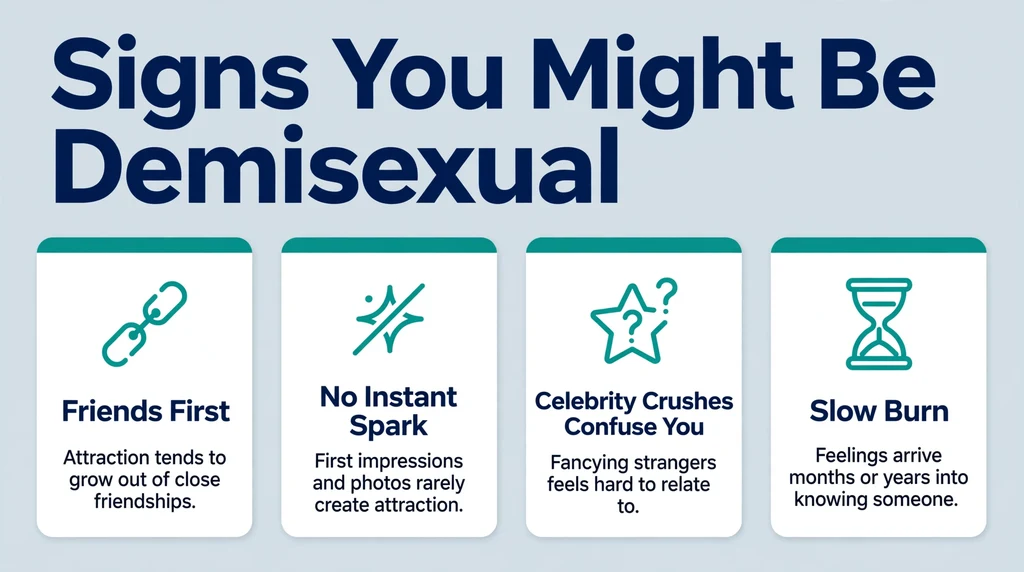
No checklist can hand you an identity, and no quiz result is a verdict. Still, demisexual people tend to describe a shared set of experiences. If several of these feel familiar, the label may be worth exploring.
Attraction grows out of friendship
The most commonly reported sign is the friends first pattern. Relationships and attractions tend to begin as ordinary friendships. Then, sometimes months or years later, the feeling quietly changes character. Many demisexual people say most of their crushes have been close friends.
Looking back, the pattern often stretches across a whole life. The childhood best friend, the colleague from a long project, the teammate from a shared hobby: the list of real attractions tends to read like a list of deep relationships. Strangers, however charming, rarely appear on it. That consistency across years is what convinces many people the label fits.
Strangers and celebrities leave you cold
Demisexual people often report no attraction to strangers at all. A handsome face on a train produces nothing. Celebrity crushes can feel equally puzzling. Friends may rank actors by hotness while you genuinely cannot play along. The issue is not pickiness. The raw material of instant attraction is missing.
Photo-based dating feels strangely empty
Apps built on rapid photo judgments can feel broken from the inside. Every profile looks like a stranger, because every profile is one. As a result, demisexual daters often prefer meeting people through hobbies, classes, work, or friend groups. Those settings give a bond time to form first.
Your timeline runs slower than everyone else’s
Friends may develop crushes within a single evening. Your feelings, by contrast, tend to need a season. People around you might call this mysterious or old fashioned. In reality, the delay is not a strategy. It is simply the speed your attraction runs at.
Personality pulls you before appearance does
Demisexual people often say they fall for how a mind works. Humor, kindness, and intelligence become attractive as they are witnessed up close. A conventionally gorgeous stranger, meanwhile, registers as simply a face. This is sometimes confused with sapiosexuality, which centers intellectual attraction specifically. The demisexual pattern is broader: it is the whole emotional bond, not one trait, that matters.
Your dating pool stays small, and that is fine
Because attraction needs history, the number of people you could ever be drawn to stays small. Most of them will be people already in your life. Some demisexual people find this limiting, while others find it peaceful. Either way, a small pool is a predictable side effect of the pattern, not a personal failure.
Enjoying sex was never the issue
A final common report surprises people. Many demisexual adults enjoy sex perfectly well inside bonded relationships. They were never cold, broken, or afraid of intimacy. The missing piece was only ever the trigger. Once someone becomes emotionally close, desire can behave like anyone else’s. This is why describing demisexuality as a fear of sex gets the story backwards.
Demisexual in Dating and Relationships
Knowing the definition is one thing. Living with the pattern inside modern dating culture is another. A few themes come up again and again in community discussions.
Dating at a slower pace
Standard dating scripts assume attraction on the first meeting. Demisexual daters often rewrite that script. They may prefer several low pressure meetings with no romantic verdict attached. Coffee, group activities, and shared projects work better than candlelit auditions. The goal is not to stall. The goal is to give a possible bond room to exist before anyone judges chemistry that was never going to be instant.
Explaining the label to a partner
Many demisexual people eventually explain the word to someone they are seeing. The conversation usually goes better than feared. It helps to separate attraction from affection: you can care about someone, enjoy their company, and still be waiting for attraction to develop. Partners often feel relieved to learn the slow pace is not rejection. It also sets honest expectations about timelines neither person controls.
When a friendship turns into something more
The classic demisexual story starts as pure friendship. Two people grow close with no agenda at all. Then one of them notices the feeling has quietly changed category. This can be joyful, and it can also be frightening. The friendship itself is precious, and risking it feels costly. Many couples in the community, though, say a foundation of friendship made the relationship unusually sturdy.
What tends to help in practice
Community advice repeats a few practical themes. Meeting people through recurring activities beats one off encounters, because repetition builds familiarity naturally. Being upfront early saves both sides confusion, even a simple line about needing time. Choosing partners who respect a slow pace matters more than any technique. Above all, people advise against forcing instant feelings to match someone else’s timeline. The pattern cannot be rushed, and pretending otherwise tends to end in guilt rather than love.
Demisexual vs Asexual: What Is the Difference?
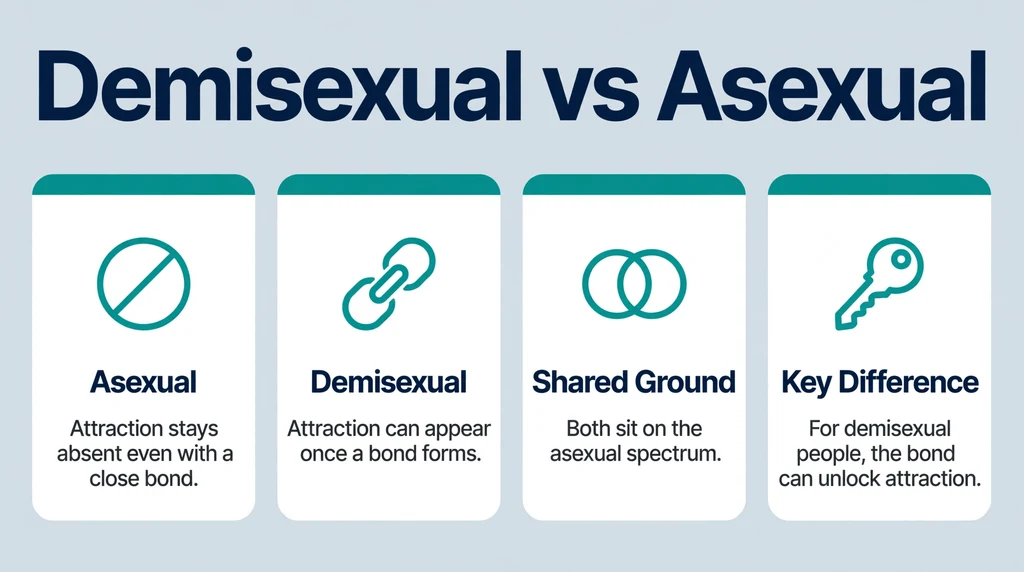
These two labels share a spectrum, so people often blur them. The difference comes down to one question. Can a strong bond eventually unlock sexual attraction?
For an asexual person, the answer is generally no. Attraction stays absent, even inside loving, long term relationships. For a demisexual person, the answer can be yes. Once an emotional bond is deep enough, attraction may appear where none existed before.
Notice what the difference is not. It is not about how much someone values sex, romance, or commitment. Asexual and demisexual people can hold identical values and still differ completely in attraction. Nor is one label a stepping stone toward the other by default. They are neighboring descriptions of different inner mechanics, and each stands on its own.
A quick side by side
Think of it as a door that responds differently. For asexual people, the door to sexual attraction rarely opens at all. For demisexual people, the door exists, but only one key fits it. That key is emotional closeness with a specific person. Neither experience is more valid, and neither is a problem to solve.
Why the labels still overlap
Daily life can look identical from the outside. A demisexual person with no close bond may feel exactly like an asexual person for years. Labels can also shift as self knowledge grows. Some people move from asexual to demisexual, or the reverse, and the community treats that as normal.
Can someone relate to both?
Yes, and many people do. Asexual works as an umbrella term for the whole spectrum. Someone might introduce themselves as ace in broad company and use demisexual when precision matters. The two words answer at different zoom levels. Choosing one in a given moment does not cancel the other.
Demisexual vs Demiromantic
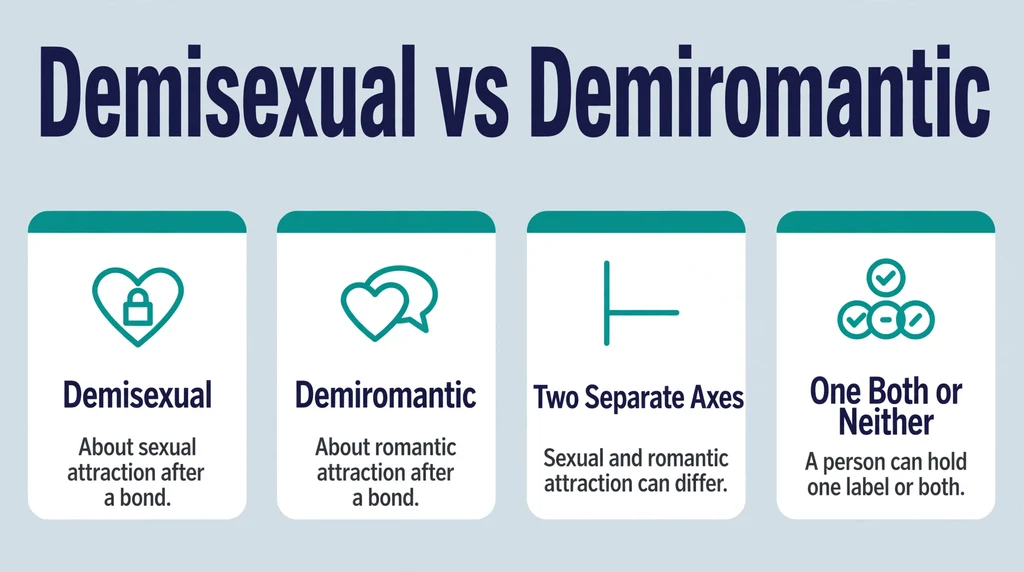
This comparison causes the most confusion, because the words differ by only a few letters. The key is that they describe two different kinds of attraction.
The split attraction model
Ace and aromantic communities often use the split attraction model. It treats sexual attraction and romantic attraction as separate settings. One can be high while the other is low. Because of that split, a person can need a bond for one kind and not the other.
The model sounds technical, but everyday experience supports it. People routinely describe wanting romance without sex, or sex without romance. The split model just gives that observation a structure. Once you accept two settings instead of one dial, labels like demisexual and demiromantic stop looking like duplicates. Each one adjusts a different setting.
What demiromantic means
Demiromantic describes romantic attraction with the same condition attached. A demiromantic person develops romantic feelings only after a deep emotional connection. Their sexual attraction, meanwhile, may follow an ordinary pattern. The mirror image also exists: a demisexual person may fall romantically at first sight while sexual attraction waits for a bond.
One label, the other, or both
Some people are demisexual but not demiromantic. Others are demiromantic but not demisexual. Many are both, and they often shorten the pair to just demi. None of these combinations is unusual. The two labels simply answer two different questions about the same person.
Example combinations in plain language
Consider three quick sketches. One person falls in love easily but only feels sexual attraction after deep trust: demisexual, not demiromantic. Another feels sexual attraction normally yet needs years of closeness before romance: demiromantic, not demisexual. A third needs the bond before either kind of attraction wakes up: both labels apply. The sketches show why one umbrella word was never going to be enough.
Common Misconceptions About Demisexuality
Few orientation words collect myths as quickly as this one. Most of the confusion comes from mixing up attraction with behavior. Here are the claims that come up most, and why they miss.
Myth: everyone needs an emotional connection
This is the most common objection, and it rests on a mix up. Plenty of people prefer to know someone well before sleeping with them. However, preference is about behavior and choice. Demisexuality is about the attraction underneath. A non-demisexual person can feel drawn to a stranger and simply decide not to act. A demisexual person never feels that first pull at all.
Myth: it is just wanting to wait
Waiting implies the desire exists and is being postponed. For demisexual people, the desire genuinely is not there yet. Nothing is being delayed, resisted, or saved. When attraction finally appears, it often surprises the person feeling it. Framing the label as patience misreads the entire experience.
The confusion is understandable from the outside. Both people, the one waiting and the demisexual one, decline casual encounters. Their calendars can look identical for months. Inside, though, the machinery differs completely. One person is steering around a feeling. The other person simply has no feeling to steer around yet.
Myth: it is a choice or a moral stance
Demisexuality is not a rule someone adopts, and it is not tied to religious or moral beliefs about sex. People do not choose when attraction switches on. The term describes an orientation, in the same way other orientation words do. Treating it as a lifestyle decision misses that it is about wiring, not willpower.
Myth: demisexual people have no interest in sex
The label says nothing about libido once attraction exists. With the right bond in place, a demisexual person may have a strong sex drive and a very active love life. The condition concerns who triggers attraction, not how much someone enjoys sex. Frequency, drive, and attraction are three different dials.
Myth: demi means half a person
The half in the word points to the spectrum, not to the person. It marks a spot between asexual and allosexual experience. A demisexual identity is complete on its own terms. Nobody using the label is describing themselves as fifty percent finished.
Myth: it is just being picky
Picky people feel attraction and then reject options against a checklist. Demisexual people are missing the attraction long before any checklist appears. Standards are chosen and can be relaxed at will. An attraction pattern is neither. Calling it pickiness confuses a filter with an engine that has not started.
Myth: it is a brand new invention
The word is young, dating to 2006, but the experience is not. People have described slow, friendship first attraction for generations without having a term for it. What changed is the vocabulary, helped by online communities and, eventually, dictionaries. A new label for an old pattern is not a fad. It is usually a sign the pattern was common all along.
The Demisexual Flag and What Its Colors Mean
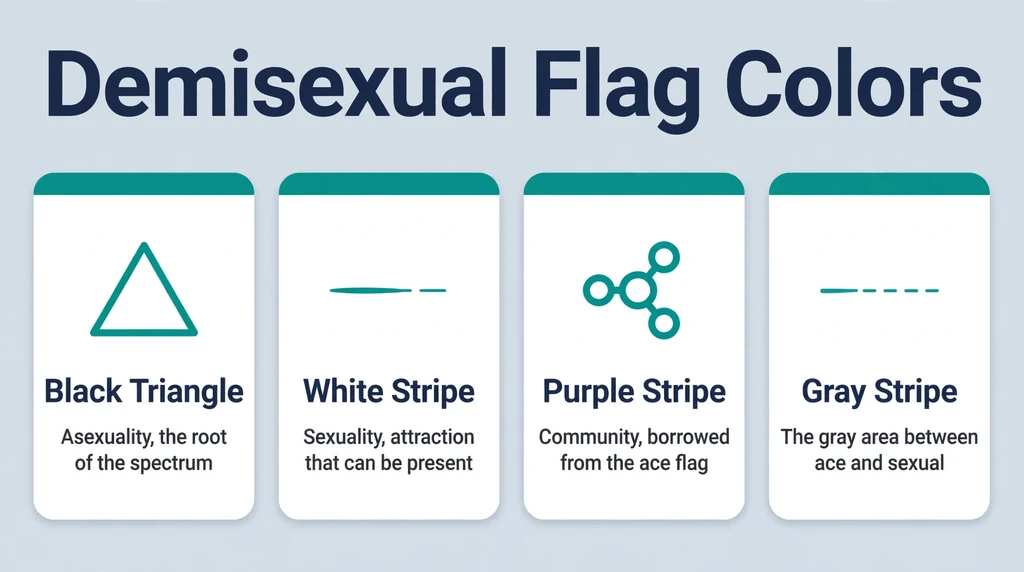
Like many spectrum identities, demisexuality has its own pride flag. The design was modeled on the asexual pride flag, which the ace community created in 2010. Community accounts place the demisexual version in the same period, emerging from AVEN forum circles. Sources differ on who exactly designed it, so the flag is best described as a community creation.
Flags matter most for identities that stay invisible in daily life. Nobody can see an attraction pattern from across a street. A flag turns that private pattern into something shareable and recognizable. For younger people especially, spotting the colors on a backpack or profile can be the first hint that a word for their experience exists at all.
How the flag looks
A black triangle points in from the left edge. Behind it run horizontal bands of white, a thin purple stripe, and gray. The layout echoes the ace flag’s colors while arranging them in a distinct pattern. You will spot it at Pride events, in profile pictures, and on pins and stickers.
What each color stands for
The black triangle stands for asexuality itself, the absence of sexual attraction. White represents sexuality, meaning the presence of attraction. Purple represents community, a color borrowed from the asexual flag. Gray represents the gray area of the spectrum, where graysexual and demisexual experiences live. Together, the colors tell the same story as the definition: attraction that is absent by default, possible through connection, and held by a community.
The demiromantic flag looks almost the same
The demiromantic flag uses the same layout with one change. Its middle stripe is green instead of purple. Green echoes the aromantic flag, just as purple echoes the asexual flag. The tiny swap quietly encodes the split attraction model: same bond first structure, different kind of attraction.
Demisexual in a Sentence and Everyday Use
Words settle into a language through ordinary sentences. Seeing demisexual used naturally also sharpens the definition better than any glossary line.
Example sentences
She identifies as demisexual, so first dates rarely tell her anything about attraction. He realized he was demisexual after every crush of his life had started as a close friend. Their relationship began platonically, which suited his demisexual pace perfectly. Explaining that she is demisexual helped her partner stop taking the slow start personally. The forum thread asked whether feeling attraction only after years of friendship counted as demisexual. Each example keeps the same core: the bond comes first, and the attraction follows it.
Adjective, noun, and the noun form demisexuality
Demisexual works as both an adjective and a noun. You can describe a demisexual person, or call someone a demisexual. The abstract noun is demisexuality, as in a guide to demisexuality. The word is pronounced DEM-ee-SEK-shoo-al, with the stress on the first syllable. In writing, it stays lowercase, like other orientation words, unless it opens a sentence.
Related words in the same family
A handful of neighbors complete the vocabulary. Ace is the everyday short form for the asexual spectrum. Graysexual covers rare or low intensity attraction. Allosexual names everyone off the spectrum. Demiromantic applies the same bond first logic to romance. Learning the set together makes each word easier to place, because every term borrows its meaning from its position among the others.
Frequently Asked Questions
What does demisexual mean in simple words?
It means sexual attraction shows up only after a strong emotional bond. A demisexual person does not feel drawn to strangers or new acquaintances. Attraction becomes possible once real closeness exists with a specific person.
Is demisexual part of the asexual spectrum?
Yes, it is generally classed that way. The asexual spectrum covers experiences from no attraction at all to attraction under limited conditions. Demisexuality fits because attraction depends on a condition that takes time to build. Some debate the placement, but ace communities commonly include it.
What is the difference between demisexual and demiromantic?
The difference is the type of attraction involved. Demisexual concerns sexual attraction, while demiromantic concerns romantic attraction. Both need an emotional bond first. A person can be one of them, both of them, or neither.
Can a demisexual person be straight or gay as well?
Yes. The word demisexual says nothing about which genders attract someone. It only describes when attraction happens. People therefore combine it with other labels, such as bisexual demisexual or heterosexual demisexual, plus a romantic orientation if they use one.
Is demisexual a choice?
No. It describes how a person’s attraction works, not a decision they make. Nobody picks the moment attraction switches on. Choosing to wait for a connection is a behavior. Being unable to feel attraction without one is an orientation.
How long does the bond take to form?
There is no fixed timeline, and the label sets no minimum. For some people, weeks of intense closeness are enough. For others, it takes months or years of friendship. The required depth varies from person to person and from bond to bond.
What do the demisexual flag colors mean?
The black triangle means asexuality. White means sexuality, purple means community, and gray means the gray area of the spectrum. The design grew out of the asexual flag, which uses the same four colors. Each color maps to one part of the demisexual experience.
Is demisexual part of the LGBTQ community?
Demisexuality is included in the resources of major LGBTQ organizations, including GLAAD and The Trevor Project. Views differ on where spectrum labels sit, partly because a demisexual person can also be straight. Many ace spectrum people do identify with the wider community. The word itself simply describes an attraction pattern.
Final Thoughts
Demisexual meaning comes down to order. For most people, attraction comes first and closeness follows. For a demisexual person, the order flips: closeness comes first, and attraction may follow. Neither order is better, and neither needs fixing. The word simply gives a name to a pattern many people lived with long before 2006.
It is also fine to hold the label lightly. Some people use it for life, while others use it for a season of self discovery. The spectrum vocabulary exists to describe experience, not to police it. What matters is whether the word helps you understand yourself, or helps someone else understand you, a little more clearly than before.
If the definition feels familiar, take your time with it. Labels work best as tools for self understanding, not as boxes to squeeze into. For primary community resources, the Asexual Visibility and Education Network hosts the forums where this vocabulary was born, along with guides to the whole ace spectrum.