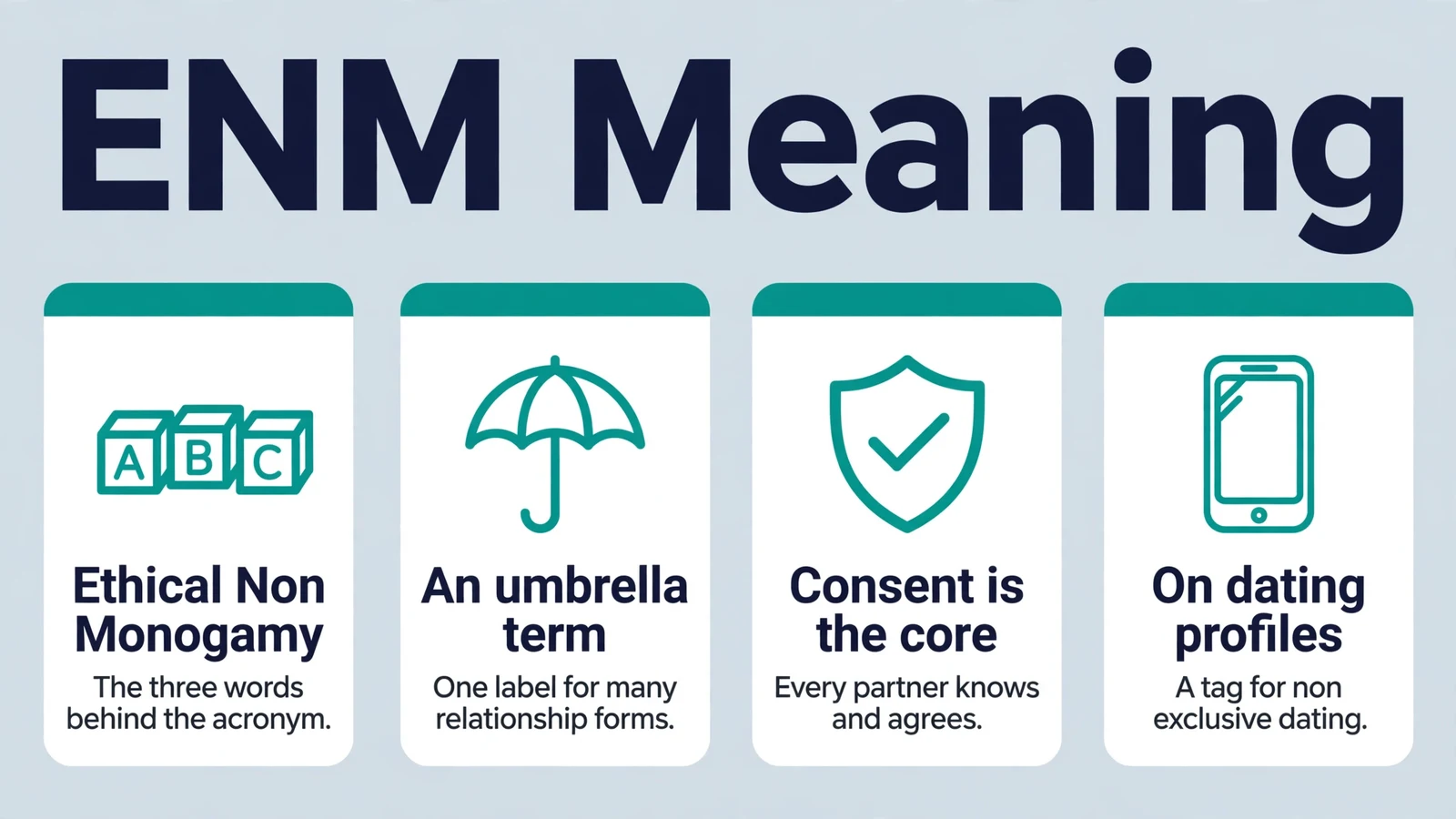
You are reading a dating profile, and the bio ends with three small letters: ENM. They sit next to words like partnered, open or poly, and they are doing a lot of quiet work. So what do they actually mean?
ENM stands for ethical non-monogamy. It is an umbrella term for relationship structures where people may have romantic or sexual connections with more than one person. Everyone involved knows about it, and everyone agrees to it. That shared knowledge and consent is the whole point of the word ethical.
This guide follows the definitions used by relationship researchers and reference works. It breaks the term down word by word, lists the forms it covers, and separates it from cheating and from polyamory. It also explains why the acronym turned up on dating apps, and it answers the questions people ask most often.
What Does ENM Mean?
The plain definition
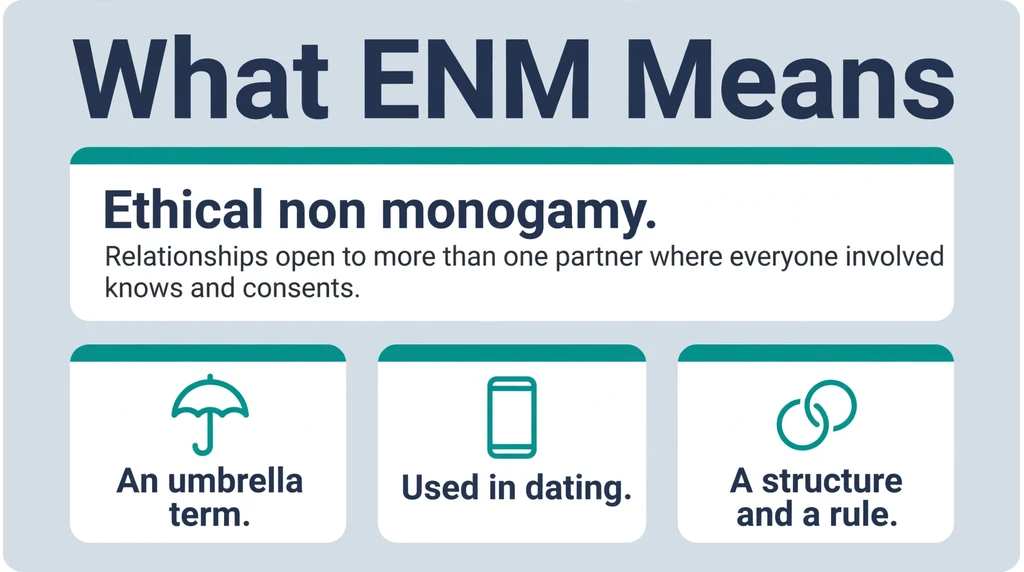
Ethical non-monogamy describes any relationship arrangement in which partners are not exclusive to one person, and the non-exclusivity is open and agreed. In practice, that means nobody is being deceived. Each person knows the relationship allows other connections, and each person has consented to that setup.
Reference works treat it as an umbrella term. The American Psychological Association’s Division 44 fact sheet on consensual non-monogamy uses the same framing. In its words, all partners give explicit consent to romantic, intimate or sexual relationships with multiple people. ENM is the label the public uses most for that umbrella.
The word ethical does quiet sorting work here. Plain non-monogamy is a wider, neutral label that also covers affairs and one-sided arrangements. By adding ethical, speakers narrow the term to the open and agreed cases only.
A final framing point: ENM describes agreements, not outcomes. It does not promise that an arrangement is happy, stable or wise. Like the word monogamy, it names a structure, and it leaves the quality of any particular case to the people in it.
One acronym, several jobs
The letters can describe a relationship, as in an ENM relationship. They can also describe a person, as in someone who identifies as ENM. On profiles, they often work as a preference tag, signaling that the writer dates non-exclusively.
Outside dating, the same three letters appear in unrelated places. Acronym databases list dozens of ENM entries, from French schools to network management. In dating and texting contexts, though, ethical non-monogamy is the standard expansion, and it is the meaning this article covers.
Spelling and hyphen variants
Writers spell the long form in two ways. Community and dating writing usually keeps the hyphen: non-monogamy, non-monogamous. Academic writing often drops it: nonmonogamy, nonmonogamous. Psychology Today’s discussion of the two labels, for example, uses the closed form throughout.
The meaning does not change with the hyphen. Search engines treat the forms as the same phrase, and so do dictionaries of relationship terms. When you quote a source, though, keep its own spelling, since style guides differ.
Breaking Down the Three Words
Non-monogamy: the structure
Monogamy comes from Greek roots: monos, meaning single or alone, and gamos, meaning marriage. It names exclusivity with one partner. Non-monogamy simply reverses that: the structure allows romantic or sexual connection with more than one person.
On its own, though, non-monogamy says nothing about honesty. A secret affair is non-monogamous too, in the plain structural sense. That gap is exactly why the first word of the acronym matters.
Ethical: the condition
Ethical adds the standard the arrangement has to meet. Everyone affected knows what is going on. Everyone has agreed to it freely. And everyone is expected to deal honestly with the others as the arrangement continues.
Together, the three words describe a structure plus a rule. The structure is openness to more than one connection. The rule is that the openness stays informed and consensual.
The same sorting appears in research language from the other direction. There, the preferred adjective is usually consensual rather than ethical, for reasons the CNM comparison below explains.
Why Consent Is the Core of ENM
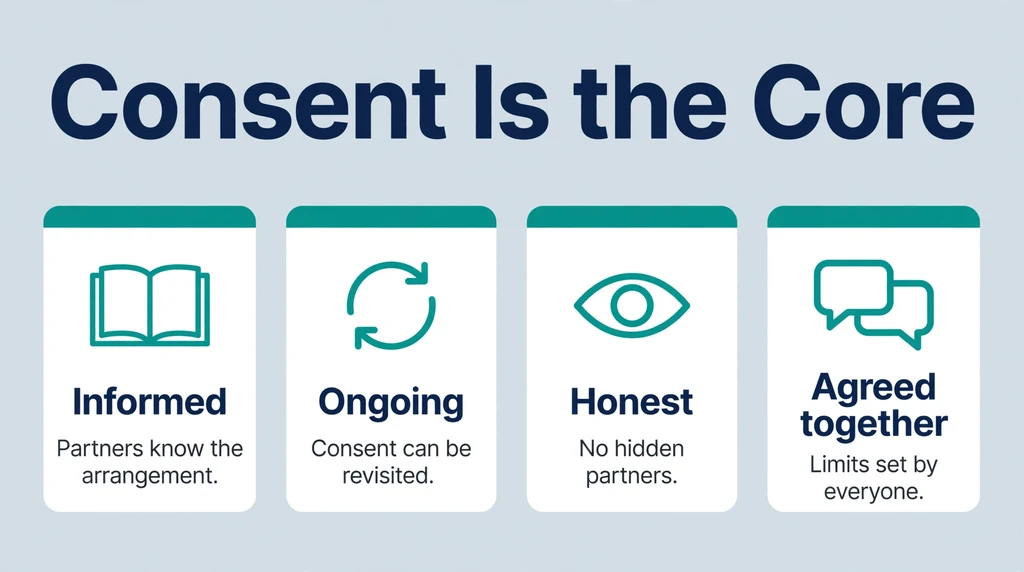
Strip the acronym down, and consent does most of the work. Monogamy and ENM differ in structure, but ENM and cheating differ in consent. Researchers return to that point whenever they define the term.
Informed consent, in plain terms
Consent here means more than a one-time yes. Each partner knows the relationship is open in an agreed way before anything happens. Each partner can ask questions, set limits, and raise problems as they appear.
Consent also stays live. People can renegotiate an agreement when circumstances change, and a yes given last year is not treated as a blank check for this year.
Honesty and communication as working parts
Because there is no single default script, ENM partners spell out expectations that monogamous couples often leave assumed. Who else is involved, what kind of connection is allowed, and what gets shared are all matters for explicit agreement.
That is why guides and researchers describe communication as a structural feature, not a bonus. The arrangement runs on stated agreements, so the stating has to keep happening.
Agreements can still be broken
Consent has a flip side. If a partner hides a connection, ignores an agreed limit, or lies about a detail the agreement covers, the others treat it as a breach. In everyday language, that is cheating, and it can happen inside an ENM structure too.
So the ethical label describes conduct, not a head count. It is earned by how people behave inside the arrangement, not by the arrangement itself.
Consent is specific, not general
Consent in ENM attaches to a particular arrangement, not to openness in general. Agreeing to an open relationship is not the same as agreeing to polyamory. Agreeing to one outside partner is not agreeing to any outside partner.
Each agreement names its own terms, and consent follows those terms, not the acronym.
ENM vs Monogamy
Monogamy is the default script in most dating cultures: two people, romantically and sexually exclusive, by agreement. ENM starts from the same place, an agreement, and changes one term of it. Exclusivity is replaced by negotiated openness.
The contrast is structural, not moral, in dictionary terms. A monogamous couple and an ENM couple can both be committed, honest and stable, or neither. The words describe how many people the agreement allows, not how well the people behave.
One more term sits beside them. Serial monogamy describes dating one person at a time, exclusively, across a series of relationships. It is common in modern dating, and it is still monogamy, because the exclusivity holds inside each relationship.
For profile readers, the comparison does practical work. An ENM tag is not a rejection of commitment as such. It is a statement about which agreement the writer is offering.
At a glance, the two scripts differ in three places. Monogamy allows one partner at a time; ENM can allow several. Monogamy treats exclusivity as the loyalty test; ENM treats honesty about the agreed terms as the loyalty test. And monogamy runs on a widely shared default, while ENM runs on terms each group states for itself.
Forms of ENM
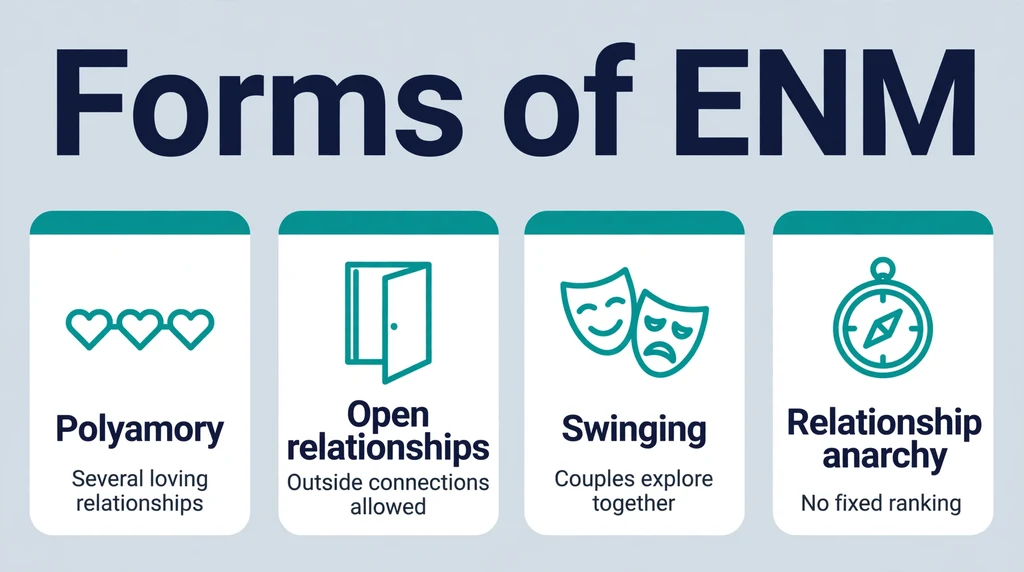
ENM names a family, not a single lifestyle. The forms below differ in what kind of connection they allow, and in how much structure they keep. What they share is the consent rule from the section above.
Real arrangements often mix features from several forms, and the labels are ideal types rather than sealed boxes. A couple might be open in one season of life and polyamorous in another. The vocabulary gives readers a map; individual relationships still draw their own borders.
Polyamory
Polyamory means having more than one romantic relationship at the same time, with everyone’s knowledge and consent. The emphasis falls on ongoing loving bonds rather than only sexual contact. A polyamorous person might have two partners who know each other, or several separate relationships that run in parallel.
Because it centers romance, polyamory is the form people most often confuse with the whole umbrella. The comparison section below untangles the two. Partners in one another’s other relationships are called metamours, a term the glossary below defines.
Open relationships
An open relationship usually starts from an existing couple. The partners agree that sexual connections outside the couple are allowed. In many open relationships, the couple remains the central romantic bond, and outside connections stay secondary or casual.
Details vary widely. Some couples set narrow limits, others broad ones. The defining feature is simply the agreement itself.
The single word open is vaguer than the full label. On its own, it does not say whether the openness is sexual, romantic or both, which is why careful profiles add a clarifying phrase.
Swinging
Swinging describes couples who seek out sexual experiences with other people, usually together and often in social settings such as parties or clubs. Partners typically stay romantically exclusive to each other. The outside activity is recreational and shared rather than a separate dating life.
Of all the forms, swinging is the one most often organized around events and communities rather than individual dating. The APA fact sheet describes swinging partners as romantically exclusive to one another while mutually seeking other sexual relationships, and most definitions follow that pattern.
Relationship anarchy
Relationship anarchy rejects ready-made rankings between relationships. Instead of ranking a romantic partner above friends by rule, each connection is defined by the people in it. The approach comes from a short manifesto by the Swedish writer Andie Nordgren, published in 2006.
Its principles include treating love as abundant rather than limited, and building commitments case by case. Its other stated points include finding a core set of relationship values, and customizing commitments instead of copying standard ones. Relationship anarchists may or may not have several romantic partners. The rejection of fixed hierarchy is the marker, not the partner count.
Some writers treat relationship anarchy as a philosophy that can sit inside or outside ENM. This guide follows the common reference pattern and lists it under the umbrella, because its relationships are openly non-exclusive by design.
Monogamish
Monogamish sits at the edge of the umbrella. The word was coined by advice columnist Dan Savage in 2011 for couples who are mostly monogamous. A monogamish couple allows rare, agreed exceptions to exclusivity while keeping monogamy as the center of the relationship.
Some references place monogamish inside ENM, since the exceptions are open and agreed. Others treat it as its own halfway category. Either way, it shows how wide the umbrella’s edge can be.
Polyfidelity
Polyfidelity is a closed form of polyamory. A group of partners is romantically and sexually exclusive within the group, and new members join only by group agreement. The term was coined in the 1970s by members of the Kerista Commune in San Francisco, the same community that coined compersion.
ENM vs Cheating
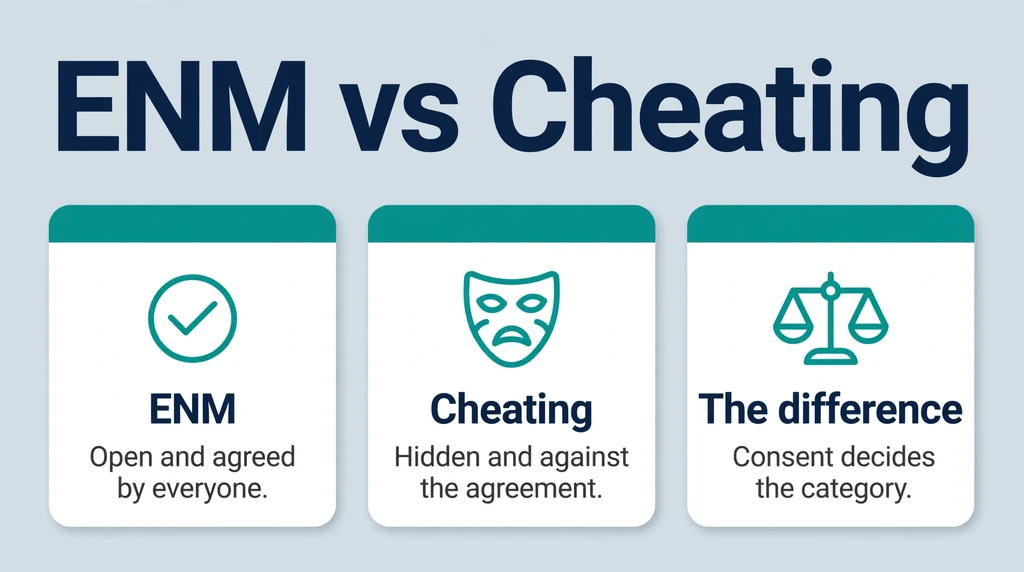
The shortest honest answer is that the difference is not the number of partners. It is the presence or absence of consent. Cheating means breaking the agreement a relationship actually has, and doing so in secret.
In a monogamous relationship, the agreement is exclusivity, so a hidden affair breaks it. In an ENM relationship, the agreement allows outside connections, so those connections break nothing. What breaks an ENM agreement is secrecy, deception, or stepping outside the limits the partners set.
Reference definitions line up on this point. The APA fact sheet stresses that consensual non-monogamy is not to be confused with infidelity. Therapists draw the same line: infidelity is an outside relationship without a partner’s knowledge or consent.
So the two words describe different things. ENM describes an agreed structure. Cheating describes a betrayal, and betrayal is possible in any structure.
ENM vs Polyamory
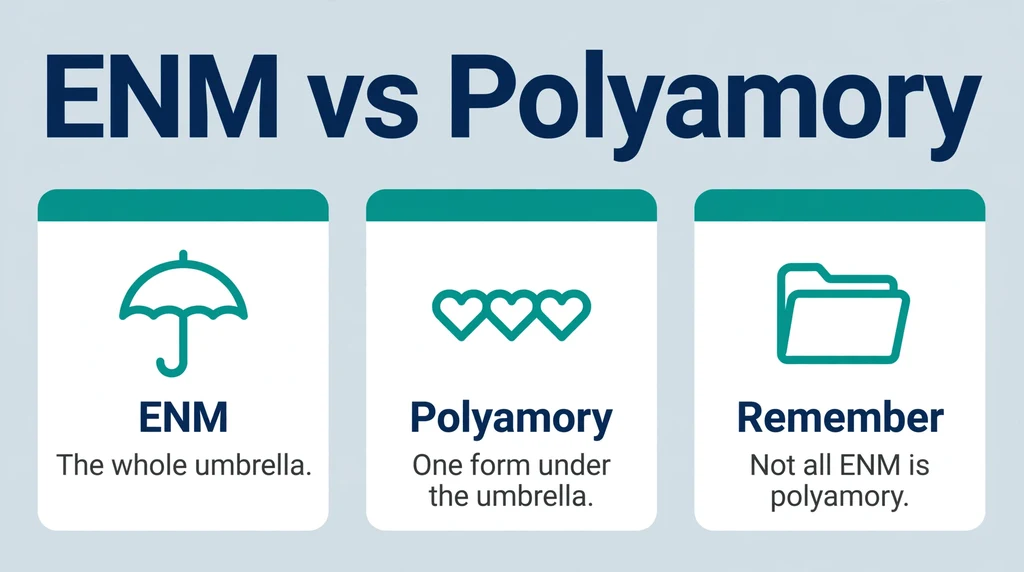
Think of ENM as the folder and polyamory as one file inside it. Every polyamorous relationship is ethically non-monogamous, because it involves several romantic partners with everyone’s consent. But plenty of ENM is not polyamory at all.
A swinging couple, for example, is ENM without polyamory, since their outside connections are sexual and recreational rather than romantic. An open relationship centered on one couple is also ENM without polyamory. Polyamory begins only where multiple romantic relationships are part of the design.
The confusion is understandable. Polyamory is the most discussed form, with the largest shelf of books and the oldest community vocabulary. In headlines and casual talk, it often stands in for the whole family, even when the arrangement being described is really an open relationship or swinging.
ENM vs CNM: two labels, one umbrella
Readers also meet the acronym CNM, for consensual non-monogamy. It covers the same umbrella, and the two terms are used almost interchangeably. Researchers and clinicians tend to write CNM, while the wider public tends to say ENM.
Psychologist Elisabeth Sheff has explained the preference in Psychology Today. Consent, she notes, is an observable fact: either everyone knew and opted in, or they did not. Ethical is a value judgment, and people can disagree about whose ethics count. The dating world kept the warmer word, and research kept the stricter one.
ENM and Polygamy: A Necessary Distinction
One neighbour causes real confusion. Polygamy means marriage to more than one spouse at the same time. It names a marriage system, usually discussed in legal, historical or religious contexts, and in world usage it most often refers to one husband with several wives.
ENM is not that. The umbrella covers dating and relationship structures between consenting adults, and marriage is not part of the definition. A person can be ENM with no spouse at all, or married to one person while dating others by agreement.
Polyamory sits between the two words and is often confused with both. Like ENM, it concerns relationships rather than marriage law. Professional guides on consensual non-monogamy flag the polyamory and polygamy mix-up explicitly, because the similar sound hides a basic difference: one word is about love and consent, the other about marital status.
Where You See the Term: Dating Profiles and Apps
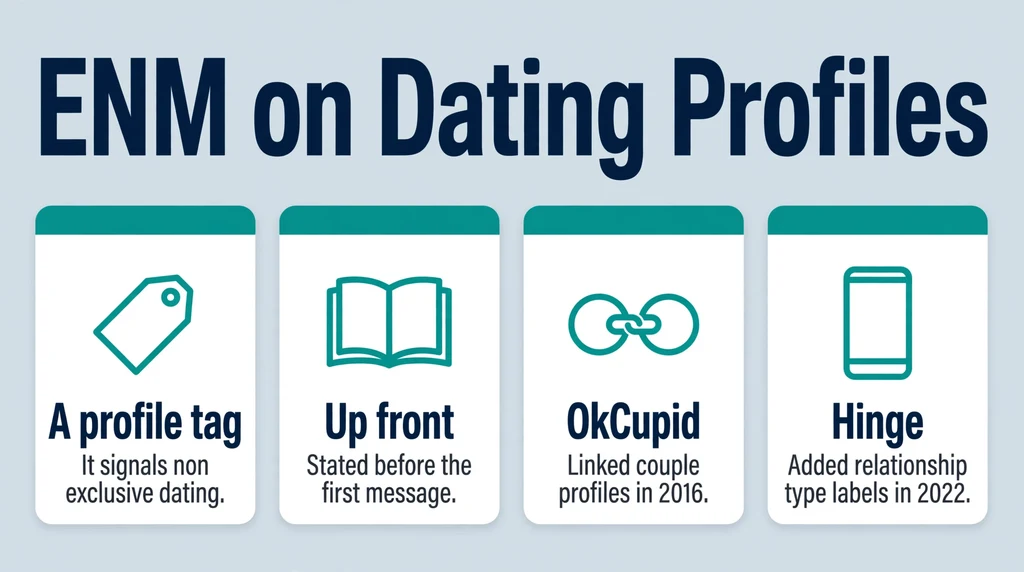
Most people meet ENM as three letters in a bio, not as a phrase in a textbook. The acronym is short, searchable and easy to filter by, which is exactly what profile design rewards.
What ENM signals in a bio
On a profile, ENM is a disclosure. It tells readers that the person dates non-exclusively, or is already in a relationship that allows dating. It often appears beside clarifying words such as partnered, open or solo, which narrow down which form the writer means.
For readers, the tag works as a filter in both directions. People who want monogamy can move on early. People who date non-monogamously can find each other without a long explanation.
How apps made the acronym mainstream
Apps standardized the label step by step. OkCupid let couples in polyamorous relationships link their profiles back in 2016. Then, in November 2022, Hinge added a Relationship Type field, letting users mark themselves as monogamous, non-monogamous or still figuring it out.
Specialist apps built for non-monogamous dating, such as Feeld, grew alongside the mainstream ones. By the time profile labels became normal, the acronym had traveled far beyond the communities that first used it.
Common Profile Phrases, Decoded
The acronym rarely travels alone. These are the phrases that most often appear beside it in bios, and what each one claims.
Partnered and open. The writer is in an established relationship, and that relationship allows dating or outside connections. Partnered answers the availability question before it is asked. Readers who want a single, unattached partner can stop there.
Dating separately. The partners in a couple meet and date other people on their own, rather than only as a pair. Its opposite, dating together, means the couple looks for people to date jointly.
Solo poly. Short for solo polyamory. The writer has or wants several romantic relationships, but keeps an independent household and no primary partner.
ENM couple. A couple presenting as a unit. It usually signals that both partners are involved in the search, whether they plan to date together or alongside each other.
Ethically non-monogamous, spelled out. Some writers avoid the acronym and use the full adjective instead. It claims exactly the same thing, and it leaves nothing for a reader to decode. Profiles limited by a filter or a search box tend to prefer the short form.
A Short History of the Words
The practices are old, but most of the vocabulary is young. Much of it spread first through newsletters, magazines and early internet forums, years before dictionaries recorded it. The word polyamory was coined only in 1990, when Morning Glory Zell-Ravenheart used the form poly-amorous in an article in Green Egg magazine. A Usenet group, alt.polyamory, followed in 1992, and the word entered the Oxford English Dictionary in 2006. In 1999, the dictionary’s editor had asked Zell-Ravenheart herself to supply the definition.
The 1970s had already supplied two lasting words. In San Francisco, the Kerista Commune coined both compersion and polyfidelity for its own multi-partner household model. Neither word stayed local, and both are now standard glossary entries, as the glossary below shows.
In 1997, Dossie Easton and Janet Hardy published The Ethical Slut, a guide that put honest, negotiated non-monogamy at its center. The book became the movement’s best-known text, and its language of ethics and consent still echoes in the acronym. Updated editions appeared in 2009 and 2017, and the book has sold over 200,000 copies.
Relationship anarchy arrived with Nordgren’s 2006 manifesto, and Dan Savage added monogamish in 2011. Researchers, meanwhile, settled on consensual non-monogamy as their umbrella label. ENM itself has no single credited coiner. It spread as the public short form while the apps of the 2010s and 2020s turned it into a standard profile tag.
How Common Is ENM?
The best-known figure comes from a 2016 study in the Journal of Sex & Marital Therapy, led by Kinsey Institute researcher M. L. Haupert. The team analyzed two national samples of single adults in the United States, with about 3,900 and 4,800 participants.
In those samples, just over one in five people said they had engaged in consensual non-monogamy at some point in their lives. The exact figures were 21.9 percent in one sample and 21.2 percent in the other. The researchers defined it as any relationship in which all partners agree that each may have romantic or sexual relationships with other partners.
Two limits matter. The respondents were single adults, so the figure is not a share of the whole adult population. And it measures lifetime experience, not how many people are in such a relationship right now. Even with those limits, the study helps explain why a once-niche acronym became ordinary profile vocabulary.
Platform figures tell a matching story about visibility. Hinge reported in 2022 that one in five of its users would consider an open relationship, and one in ten said they had already tried one. Those numbers measure openness among app users, not practice in the general population. Still, they track how ordinary the vocabulary has become.
Methodology explains part of the gap between figures. Lifetime questions always collect more yes answers than questions about a current relationship. Researchers therefore quote the two kinds of figure separately, and careful writers do the same.
ENM Glossary: Words You Will Meet
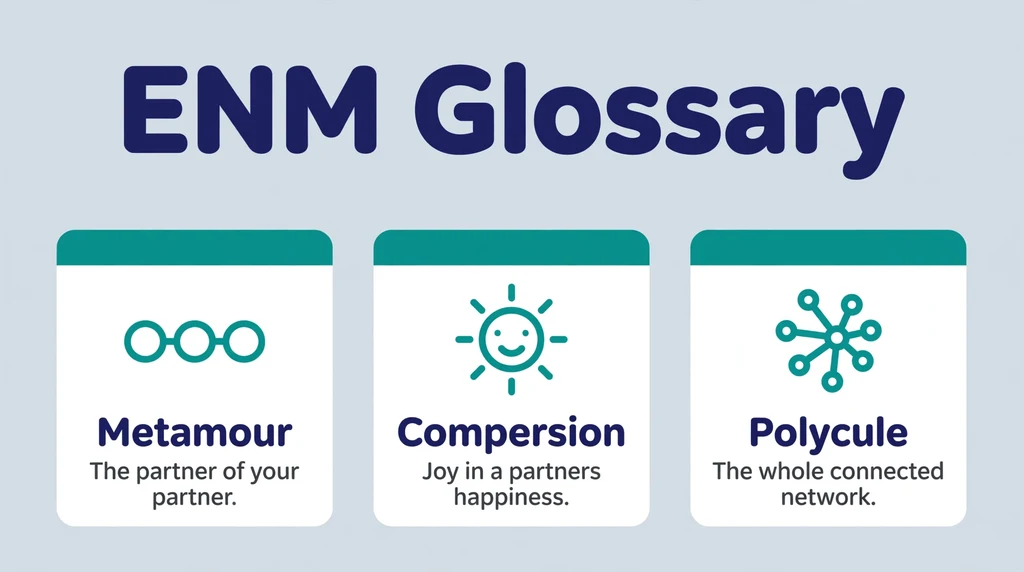
ENM writing uses a small shared vocabulary. These are the terms that appear most often in profiles, books and research summaries.
People in the network
Metamour. Your partner’s partner, where you and that person have no direct romantic relationship of your own. Metamours may be close friends, distant acquaintances, or anything in between.
Polycule. The whole connected web of partners and metamours around a person or group. The word pictures the network as a molecule of linked points.
Nesting partner. A partner someone lives with, often sharing rent, bills and daily routines. The term describes the household bond without claiming it outranks other relationships.
Throuple. A romantic relationship of three people who treat the trio as one unit. The word blends three and couple, and profiles use it for an established three-person relationship.
Feelings and states
Compersion. A feeling of joy when a partner is happy in another of their relationships. It is often described as the flip side of jealousy. The term was coined by the Kerista Commune in San Francisco.
New relationship energy, or NRE. The intense excitement and focus that often arrive at the start of a new connection. Writers use the term when they discuss balancing a new bond against existing ones.
Ways of organizing
Kitchen table polyamory. A style in which partners and metamours know each other well enough to socialize comfortably. The name comes from the image of everyone sitting around one kitchen table.
Solo polyamory. Practicing polyamory while keeping an independent home, and not building life around a primary partner. Solo poly people date several partners without merging households or finances by default.
Hierarchy. Some networks rank one partnership as primary and others as secondary. Others deliberately avoid ranking. The word hierarchy names that design choice, whichever way a group answers it.
Common Misconceptions About ENM
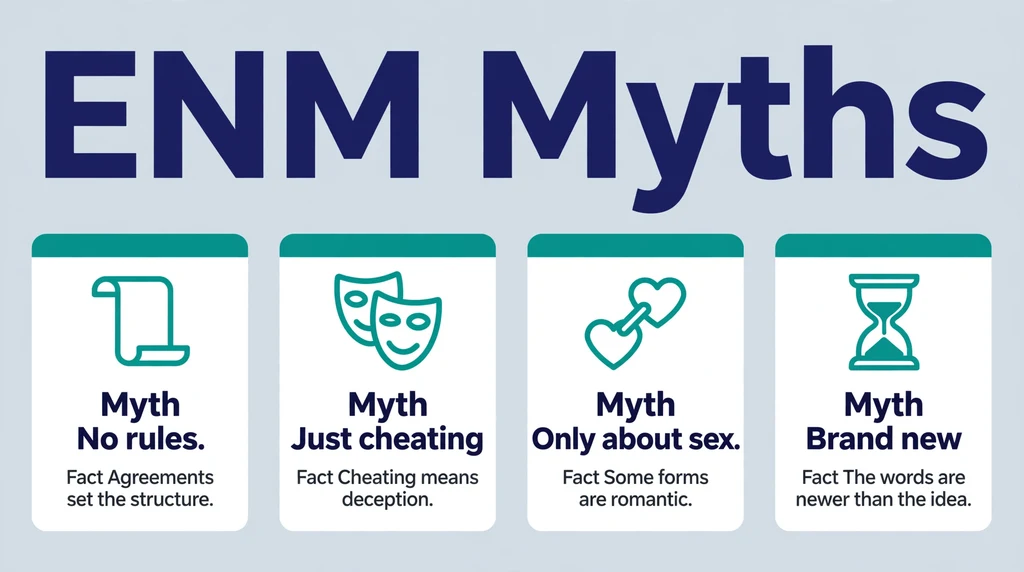
“ENM is just cheating with a nicer name”
This is the most common mix-up, and the definition answers it. Cheating is defined by deception, by breaking an agreement in secret. ENM arrangements are defined by the opposite: the agreement itself allows the outside connections. Remove secrecy and add consent, and the category changes.
“ENM means there are no rules”
In practice, ENM usually means more stated rules, not fewer. Partners negotiate limits that monogamous couples often leave unspoken, because there is no default script to fall back on. Breaking those stated limits is treated as a serious breach, which only makes sense in a system built on rules.
“ENM is only about sex”
Some forms are mostly sexual, such as swinging. Others are mostly romantic, such as polyamory, where partners build ongoing loving relationships. The umbrella covers both, so any claim that ENM is only about one or the other shrinks the term.
“ENM is a brand-new invention”
The acronym is new, and the profile tag is newer. The underlying idea, that adults might openly agree to non-exclusive relationships, is not. What changed recently is the vocabulary and its visibility, as books, research and profile labels carried it into the mainstream.
“ENM partners never feel jealousy”
Jealousy is not treated as a disqualifying failure in ENM writing. It is treated as an emotion to name and discuss, like any other. Its researched opposite, compersion, is described as a possible benefit, and the professional guide published by the National Coalition for Sexual Freedom notes plainly that compersion is not necessary for a happy consensually non-monogamous relationship.
ENM in Sentences
Dictionaries show a word at work, so here is ENM in the kinds of sentences where it actually appears.
1. “ENM and partnered, dating separately.” A profile line. The writer is in a relationship, dates on her own, and her partner knows.
2. “He added ENM to his bio so nobody would assume he was looking for monogamy.” The tag does the explaining before the first message.
3. “They describe their marriage as ENM: open to dating others, closed to secrets.” A compact summary of the consent rule.
4. “She is ethically non-monogamous, so each of her partners knows about the others.” The adjective form in ordinary prose. 5. “The couple moved from monogamy to ENM after a year of long conversations.” The acronym as a destination a structure can change into. 6. “In the survey, about one in five single adults reported ENM experience.” Research shorthand, where the acronym saves a long phrase. 7. “Their bio says ENM because the couple dates together and separately.” A profile summary covering both patterns at once. 8. “The counselor asked whether their ENM agreement covered overnight guests.” The acronym inside ordinary professional conversation. 9. “ENM, CNM and poly are related tags, but they are not interchangeable.” A reminder that near neighbours in this vocabulary still differ.
What the Label Does Not Tell You
ENM is a category label, and category labels compress. Two profiles can carry the same three letters and describe very different arrangements. A swinging couple, a solo polyamorous dater, and a mostly monogamous pair with rare exceptions all qualify.
Nor does the label rank anyone’s relationships for you. An ENM profile may belong to someone with a nesting partner of ten years, or to a single person dating casually with no wish to settle. The tag states the rule about consent, not the shape of the life around it.
So the acronym answers the first question and raises the next ones. Which form? On what terms? The clarifying words and the backstory text beside the tag exist to answer those follow-ups. Read as the first line of a description rather than the whole description, the label does its job honestly.
Frequently Asked Questions
What does ENM stand for?
ENM stands for ethical non-monogamy. It is an umbrella term for relationship structures where people may have romantic or sexual connections with more than one person, with the knowledge and consent of everyone involved.
What does ENM mean on a dating profile?
It means the writer dates non-exclusively, or is in a relationship that allows dating others, and is saying so up front. Read it as a disclosure and a filter: the person is looking for people who are comfortable with that structure. It says nothing by itself about which form of ENM the writer practices.
Is ENM the same as polyamory?
No. Polyamory is one form of ENM, focused on multiple romantic relationships. ENM is the wider category, and it also covers open relationships, swinging, relationship anarchy and similar arrangements.
Is ENM cheating?
No, by definition. Cheating means breaking a relationship’s agreement in secret. ENM connections happen inside an agreement that allows them. A person can still cheat within ENM by hiding a connection or breaking an agreed limit, which shows that cheating is about honesty, not about partner counts.
What is the difference between ENM and CNM?
Almost nothing in practice. CNM stands for consensual non-monogamy and names the same umbrella. Researchers and clinicians use CNM more often, while dating profiles and the wider public use ENM.
Is an open relationship the same as ENM?
An open relationship is one kind of ENM, not a synonym for it. It usually means an existing couple allows outside sexual connections. ENM also includes arrangements, such as polyamory, that go beyond that pattern.
Can a single person be ENM?
Yes. The term can describe a person’s approach to dating, not only a couple’s structure. A single person who dates several people openly, and keeps that honesty in future relationships, may describe themselves as ENM. Dating apps allow the label on single profiles for exactly this reason.
Does ENM mean anything else?
In dating and texting, no other expansion is in common use. The same letters do appear for unrelated organizations and technical terms in acronym lists. On a profile or in a relationship discussion, though, ENM means ethical non-monogamy.
Final Thoughts
ENM is a small acronym doing precise work. It expands to ethical non-monogamy, names an umbrella rather than one lifestyle, and rests on a single load-bearing idea: everyone involved knows, and everyone involved consents.
That one idea separates it from cheating, and the umbrella shape separates it from polyamory, which is only one of its forms. Readers who want the research framing can compare it with Psychology Today’s discussion of why many scholars write consensual non-monogamy instead. However the label is written, the definition stays the same, and the three letters in a bio stop being a riddle and start being a clear, honest label.
Three letters, one umbrella, and consent holding the roof up: that is the whole vocabulary lesson. Keep the distinction from cheating and the umbrella shape in mind, and the surrounding words, from metamour to monogamish, fall into place.