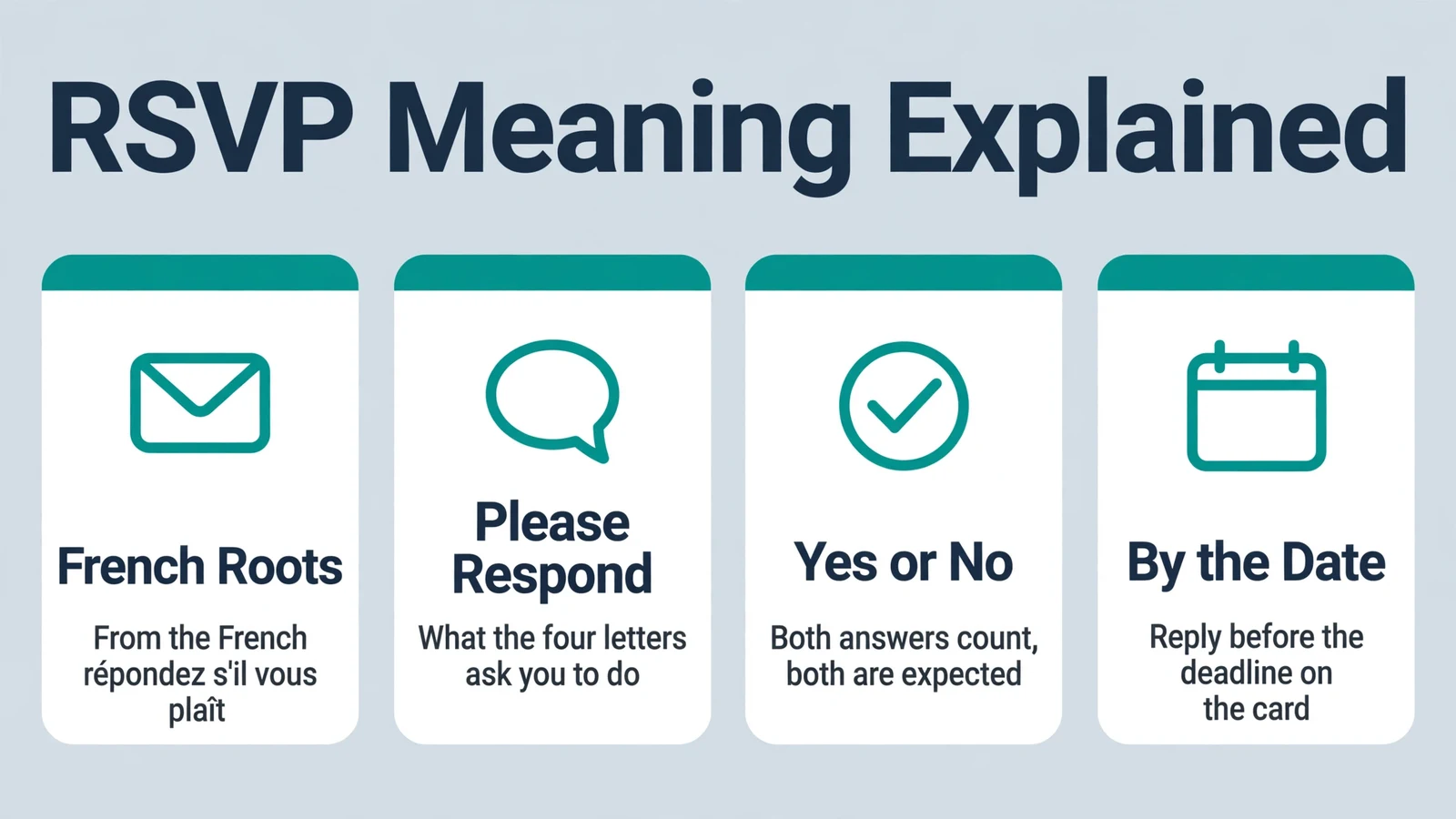
The invitation is beautiful. Thick card, gold lettering, a date circled on your calendar already. Then your eyes land on four small letters in the corner: RSVP. If those letters have ever left you unsure what to do next, here is the short answer. RSVP stands for the French phrase “répondez s’il vous plaît,” which means “please respond.” The host is asking one simple question: are you coming or not?
Every major dictionary gives the same expansion, and etiquette experts at the Emily Post Institute have explained the custom for generations. This guide follows their record. It covers what RSVP means, where the letters came from, and exactly how to answer. By the end, those four letters will never slow you down again.
What Does RSVP Mean?
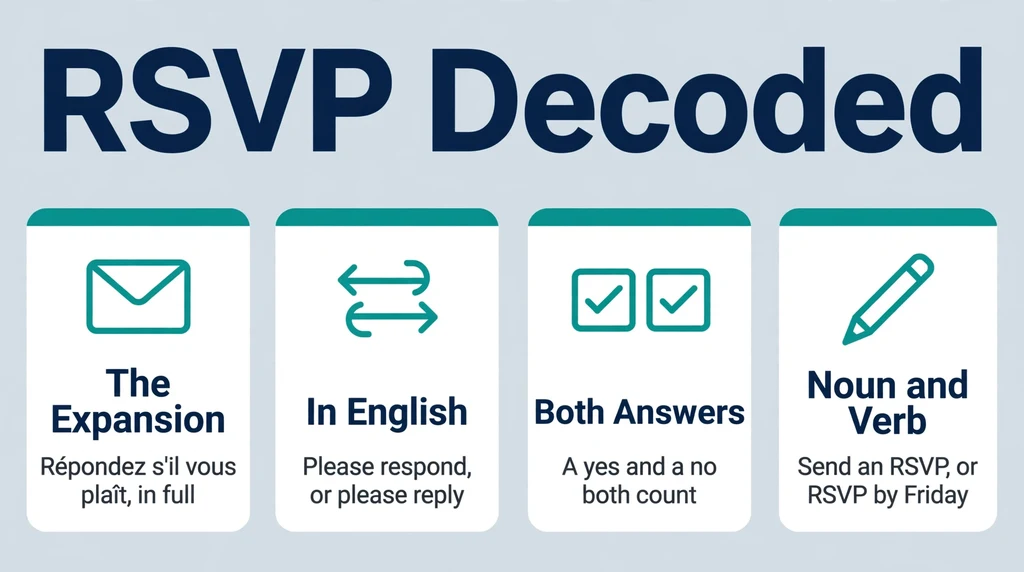
RSVP is a request for a reply, printed on an invitation. It tells you the host needs to know whether you will attend. Your answer can be yes or no. Both answers count, and both are expected.
The letters come from French, and the phrase is “répondez s’il vous plaît.” Dictionaries such as Collins render it in English as “please reply.” So when you see RSVP on a wedding invitation, a birthday card or a work event, read it as a polite instruction: please tell us if you are coming.
Here is the working definition to remember: RSVP means the host is asking for your answer, yes or no, by the date given. It is not decoration, and it is not a hint that a reply would be nice. It is a genuine question, and it deserves a genuine answer.
RSVP also works two ways in English grammar. As a noun, it means the reply itself, as in “she sent her RSVP on Tuesday.” As a verb, it means the act of replying, as in “please RSVP by Friday.” Dictionaries list verb forms too: RSVPed, RSVPing and RSVPs. Few French phrases get fully adopted into English grammar. This one did, which shows how deeply the habit is built into social life.
One more point clears up a lot of confusion. RSVP does not mean “reply only if you can come.” It means reply either way. The single exception is the phrase “regrets only,” which flips the rule, and this guide covers it in detail below.
RSVP at different kinds of events
The dress code changes; the request does not. A wedding invitation makes the ask with a card and a deadline three or four weeks out. A gala or corporate dinner may route replies through an events team or a registration page. At the casual end, a friend texts, “Backyard barbecue at ours on Saturday, RSVP so I know how much food to buy.” The word does the same work in every register. It marks the point where an invitation stops being an announcement and becomes a question. Answer it the same way at every level: quickly, clearly and through the channel offered.
The French Behind the Letters
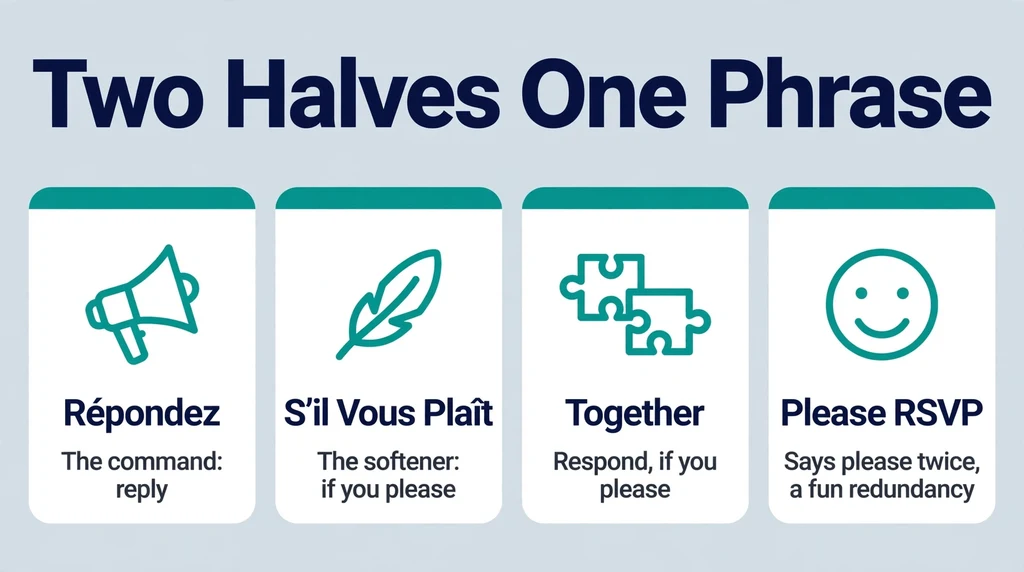
Each letter in RSVP stands for part of one short French sentence. Break the sentence down and the meaning becomes obvious. The phrase also explains a small joke hiding inside modern usage.
Répondez: the command
“Répondez” is the polite command form of the French verb répondre, which means to reply or respond. On its own it simply says “reply.” French speakers use this vous form for formal situations and for addressing more than one person. An invitation speaks to every guest at once, so the formal plural form fits perfectly. The tone is courteous but firm. It is a request, yet it clearly expects action.
S’il vous plaît: the softener
“S’il vous plaît” means “if it pleases you,” and everyday English renders it as “please.” This is the softener that turns a command into good manners. Put the two halves together and you get “respond, if you please,” which English smooths into “please respond.” The politeness is baked into the phrase itself. That is why RSVP can sound formal and friendly at the same time.
Why an English invitation speaks French
French was the language of diplomacy, fashion and fine dining for much of the 18th and 19th centuries. English borrowed heavily from it, especially for social life. Words like menu, fiancé, soirée, rendezvous and etiquette itself all arrived from French. RSVP travelled in the same company. Using the French formula signalled refinement, and the habit stuck long after the fashion faded. In fact, the phrase outlived its homeland. Wikipedia notes that RSVP is no longer widely used in France, where it now reads as formal and old-fashioned. French hosts today more often write “Réponse attendue avant le,” meaning your answer is expected before a given date. The custom survives most strongly in the English-speaking world, and it remains common in French-speaking Canada.
The “please RSVP” joke
Because “s’il vous plaît” already means please, the phrase “please RSVP” says please twice. Language writers call this pattern RAS syndrome, a pleonasm where an abbreviation swallows a word that then gets repeated. “ATM machine” is the famous example. None of this makes “please RSVP” a scandal. People write it constantly, hosts understand it instantly, and no guest has ever lost a seat over it. Still, now you know why editors smile when they see it.
How to say RSVP
Say the letters one by one: ar-ess-vee-pee. Collins gives the British pronunciation as (ɑːr es viː piː), and the American version runs on the same four beats. Nobody pronounces it as a word, and playful attempts exist only as jokes. Written style has loosened over time, too. Formal invitations once printed R.S.V.P. with a period after each letter. The Oxford English Dictionary now renders it without periods, as plain RSVP. Either way, readers understand it instantly, which is the real test of an abbreviation.
A Short History of RSVP

The letters feel modern, but the habit behind them is more than two centuries old. The story moves from French drawing rooms to London card trays, then to the printed reply card in your envelope today.
French drawing rooms
In 18th-century France, elite hosts ran salons where politics, art and business mixed over dinner. A host planning such an evening needed numbers in advance. Food, seating and servants all depended on the count. So invitations began asking guests to respond, using the courteous formula “répondez s’il vous plaît.” The phrase was practical before it was fashionable. It solved a planning problem, and it did so politely.
London adopts the letters
English high society borrowed the custom, as it borrowed so much French manners vocabulary. The Online Etymology Dictionary quotes an 1825 description of London life: it was “the custom among persons of the first rank in London, to add at the bottom of their invitation cards, R.S.V.P.” Notice the periods. The older style wrote R.S.V.P., point by point. Modern style drops them, and most dictionaries now list RSVP without punctuation.
Through the Victorian era, printed invitations spread as printing grew cheaper. Middle-class hosts adopted forms that aristocrats had set. By the late 1800s, the abbreviation was standard across the English-speaking world. One oddity is worth knowing. Dictionaries disagree slightly on dating the abbreviation as an English word, with records ranging from the 1830s to the century’s end. The safe summary is simple: the phrase is older, the letters appear in English by the 1820s, and the practice was normal by 1900.
The reply card arrives
Tradition once demanded a serious effort from guests. Etiquette histories recount that a guest replied with a formal handwritten note, written in the third person on personal stationery. It might read, “Miss Anna Reyes accepts with pleasure the kind invitation.” Beautiful, but easy to postpone. So hosts began enclosing a small pre-printed reply card with its own stamped envelope. The guest only had to fill in a name and tick a box. Reply rates improved, and the reply card became the classic image of RSVP. When you open a wedding invitation today and find that little card, you are holding a two-hundred-year-old fix for a familiar problem: people mean to reply, and then life happens.
Emily Post and the American standard
In the United States, one name turned good manners into a publishing industry. Emily Post published her book Etiquette in 1922, and it set the American standard for social behavior for decades. Her institute, now run by the fifth generation of her family, still answers RSVP questions today. Its recurring message has barely changed in a century: hosts need numbers, guests owe answers, and a reply is a basic courtesy. Much of the guidance in this guide traces back to that tradition. When modern advice sounds strict about deadlines, it is usually Emily Post talking.
What the Host Is Really Asking
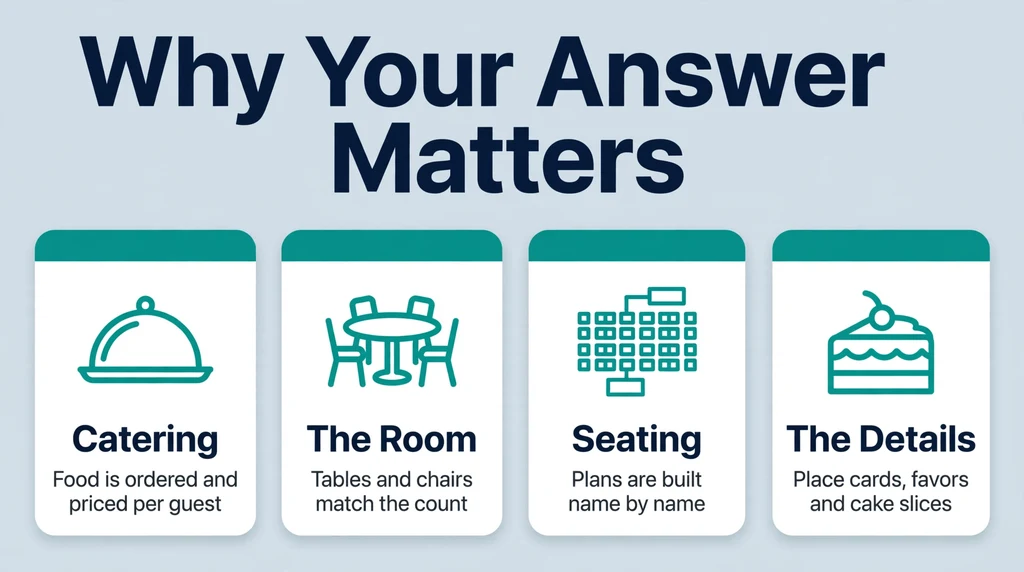
An RSVP request looks small, yet a great deal of planning hangs on your answer. Understanding the host’s side makes the duty feel lighter, and it explains why silence causes real trouble.
Behind your one answer sit several expensive decisions. Caterers charge per guest, and they need final numbers ahead of time. Venues set rooms for a fixed count of tables and chairs. Seating plans take hours, and every late change unbalances them. Then come the small items: place cards, favors, printed programs, slices of cake. Each one multiplies by the guest count.
So the host is really asking for certainty, not enthusiasm. A cheerful maybe is far less useful than a clear no. A no lets the host invite someone from the waiting list. It also releases a seat, a meal and a budget line. That is why etiquette treats a prompt decline as a kindness. You are not rejecting the host. You are handing back a planning slot they can use.
Silence, by contrast, is the worst answer of all. The host must guess, and guessing costs money either way. Guess high, and the host pays for empty chairs and wasted food. Guess low, and a surprise guest gets no seat and no dinner. As a result, hosts spend the final week chasing replies by phone and text. Almost every host has done this dance. Almost every guest has caused it once. Knowing what the letters mean is the first step to breaking the cycle.
How to RSVP, Step by Step
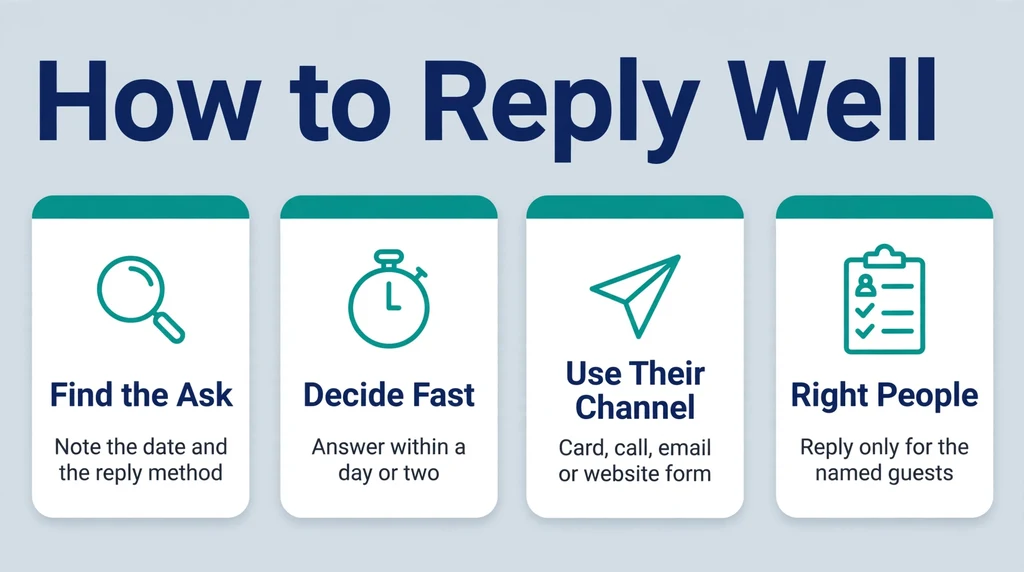
Replying well takes about two minutes. The method matters more than the words. Follow the route the host laid out, answer for the right people, and do it inside the deadline.
Step 1: Read the invitation closely
Start by finding three things: the RSVP line, the reply-by date, and the reply method. The method might be a card, a phone number, an email address or a website. Note the exact names on the envelope too. Those names define who is invited. If the envelope says “and Guest,” you have a plus-one. If it names only you, the invitation covers only you.
Step 2: Decide, then answer promptly
Check your calendar once, decide, and reply. The Emily Post Institute advises answering within a day or two of receiving the invitation. At the very latest, answer by the deadline printed on it. If you already know you cannot come, say so at once. An early no is a gift to the host. Waiting rarely changes the answer, and it always raises the pressure.
Step 3: Use the method given
Reply the way the host asked. If a reply card is enclosed, fill it in and post it in the envelope provided. If a phone number is given, call and give your answer to a person, since messages can go astray. An email address calls for an emailed reply. If the invitation points to a website, use the website form. Matching the method keeps all answers in one place for the host.
Step 4: Fill in the card correctly
Paper reply cards have their own small traditions. Many begin with a printed “M” and a line. That M starts your title: Mr., Mrs., Ms., Miss, Mx. or Dr. Write your title and full name after it. Then mark accepts or declines, and add the number attending where the card asks. Write legibly, because the host is building a seating plan from these cards. Couples are often advised to number their reply cards lightly in pencil, matching a guest list, in case one comes back unsigned. If your card has a faint pencil number, that is the reason.
Step 5: Answer for the right people only
Reply for the people named on your invitation, and no one else. Do not add children who were not named. Do not upgrade a solo invitation into a pair. If the wording is genuinely unclear, a polite question to the host is fine. Asking is always better than assuming. Meanwhile, if your household received one invitation, one reply covering the named guests is enough.
Step 6: Lock it in
After a yes, finish the job. Put the event in your calendar, with the address and the start time. Note anything extra the host asked for, such as a meal choice or a song request. If your plans later change, update the host through the same channel, as early as you can. A reply is a snapshot; your calendar is the commitment. Treating the two as a pair stops most accidental no-shows before they happen.
RSVP Etiquette: The Rules That Matter
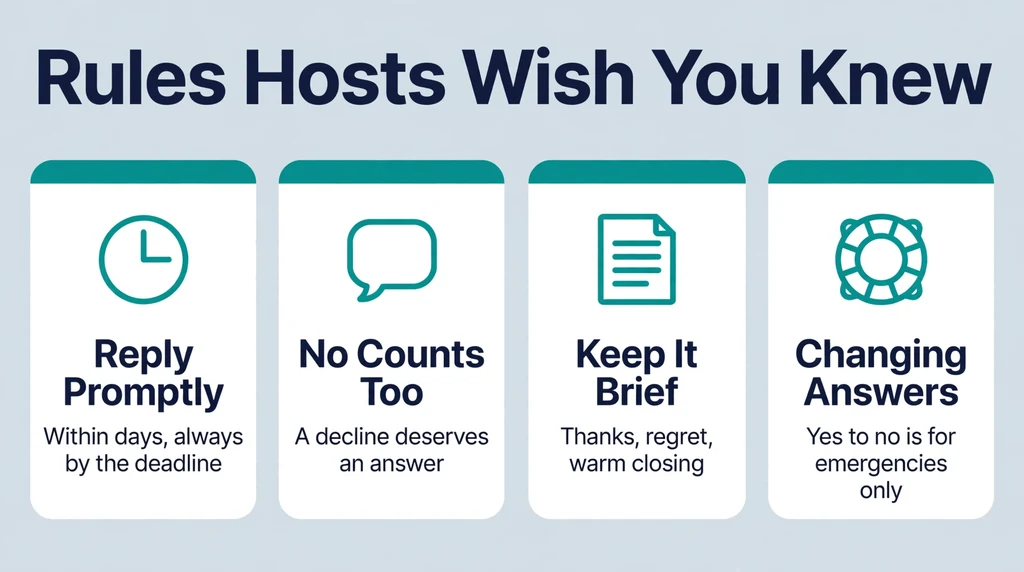
Meaning is only half the topic. The other half is behavior, and etiquette writers have been remarkably consistent about it. These are the rules that hosts wish every guest knew.
Reply fast, and reply in kind
The first rule is speed. The Emily Post Institute calls failure to reply the etiquette complaint it hears about most. Its guidance is simple: reply promptly, within a day or two, and always by the deadline if one is given. The second rule is symmetry. Take your cue from the invitation itself. A formal engraved invitation calls for a written reply. An emailed invitation makes an emailed reply perfectly proper. A text invitation can take a text answer. The formality of your reply should match the formality of the ask.
A no deserves the same reply as a yes
Many guests reply only when they can attend. That habit is the single biggest misunderstanding around RSVP. Unless the invitation says regrets only, declining requires an answer too. Your no is information the host needs, and it is not rude. Hosts expect a share of declines for any event. Weddings in particular plan around them. What hosts cannot plan around is a blank space where your answer should be.
Keep a decline short
A decline needs no essay and no detailed excuse. The Emily Post Institute advises keeping replies brief, with a simple note of regret. A graceful pattern is thanks, regret, and a warm closing. For example: “Thank you for the invitation. I am so sorry to miss it, and I hope the day is wonderful.” Long explanations can sound like negotiations. They also tempt the host to solve your problem, which neither of you wants. Short and warm wins every time.
Changing your answer
Life happens, and etiquette allows for it, within limits. Changing a yes to a no is acceptable for genuine emergencies: illness or injury, a death in the family, or an unavoidable work conflict. Call the host immediately if any of these strikes. Canceling because a better offer arrived is never acceptable. Being a no-show is worse still, since the host has paid for your seat and your meal. Changing a no to a yes is gentler. It is fine when it will not upset the host’s arrangements, but ask rather than announce. After the deadline, caterers’ numbers are locked, and your yes may no longer fit.
Hosts have homework too
Fairness runs in both directions. A host who wants answers must make answering easy. That means naming a method and a date on every invitation. It means enclosing the card, the link or the phone number, not just the letters. It also means accepting replies gracefully, without demanding explanations from guests who decline. A polite reminder near the deadline is reasonable, especially for a wedding. A guilt trip is not. In short, the system works when hosts ask clearly and guests answer promptly. Each side holds up one half of the bargain.
Regrets Only and Other Variations
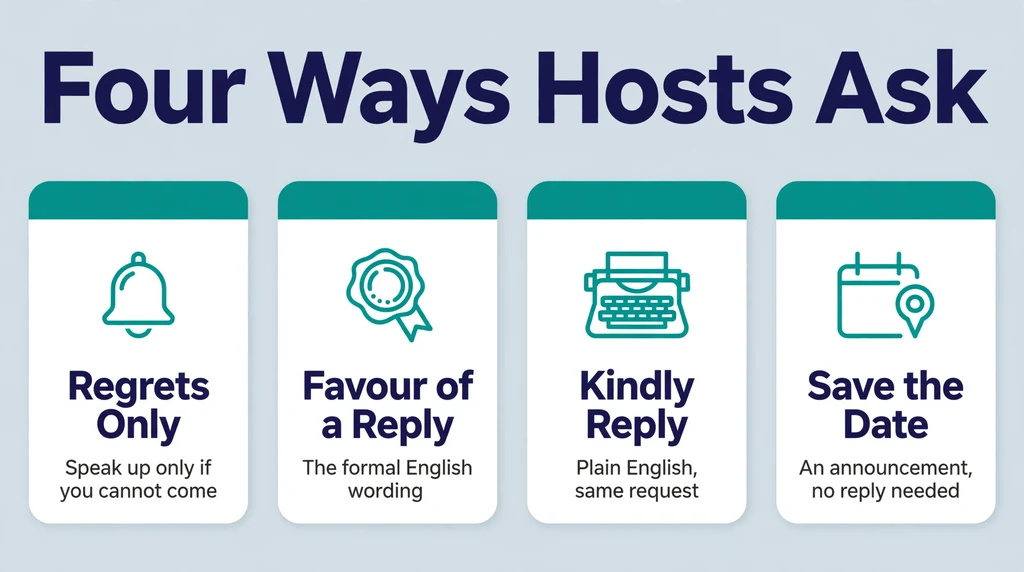
Hosts have invented several variations on the basic ask. Each one changes what you must do, so read the exact wording on your invitation.
“Regrets only”: the one exception
“Regrets only” reverses the default rule. It means: contact us only if you cannot come. Silence counts as acceptance, and the host will expect you. Emily Post states the point bluntly: if the host does not hear from you, he is expecting you. This wording suits events where most guests will surely attend, such as a close-family gathering. It reduces reply traffic for the host. The risk is obvious, though. A guest who misses the wording and stays silent out of laziness is now counted as coming. If your plans are firm, a short confirming note still does no harm.
“The favour of a reply is requested”
Very formal invitations sometimes skip the French entirely. Instead they print an English line: “The favour of a reply is requested,” usually followed by a date. Stationers describe this as the most traditional phrasing for a reply request. It often appears on weddings hosted by the bride’s parents, with the ceremony in a place of worship. The spelling is part of the style. British spelling pairs favour with honour, as in “request the honour of your presence.” American suites may use favor and honor instead. The meaning, either way, is identical to RSVP: reply, please, by this date.
“Kindly reply” and plain English versions
Modern invitations often choose plain English. “Kindly reply by June 1,” “Please respond by the first of May,” and “Let us know by Friday” all carry the same instruction. None of them is warmer or stricter than RSVP. Treat each one as the same request with the same deadline discipline. The only wording that changes your duty is regrets only. Everything else asks for an answer either way.
Save the date is not an RSVP
A save the date arrives months earlier and asks for nothing. It announces the date so you can hold it, arrange travel and avoid clashes. No reply is expected, and there is usually no way to send one. The formal invitation, with its RSVP request, follows later. Confusing the two causes a classic error: guests try to accept a save the date, or ignore the real invitation later because they think they already answered. Hold the date now, and answer when the invitation lands.
Replies sometimes go to someone else
Read the reply line carefully, because answers do not always go to the person throwing the party. On a traditional wedding invitation, replies may go to the bride’s parents, who are hosting. At work events, an assistant or an events team often collects them. The invitation names the collector for a reason: that person owns the master list. Sending your answer to a friend, a sibling or the group chat instead can leave you off it. Always reply to the address, number or link actually printed.
RSVP in the Digital Age
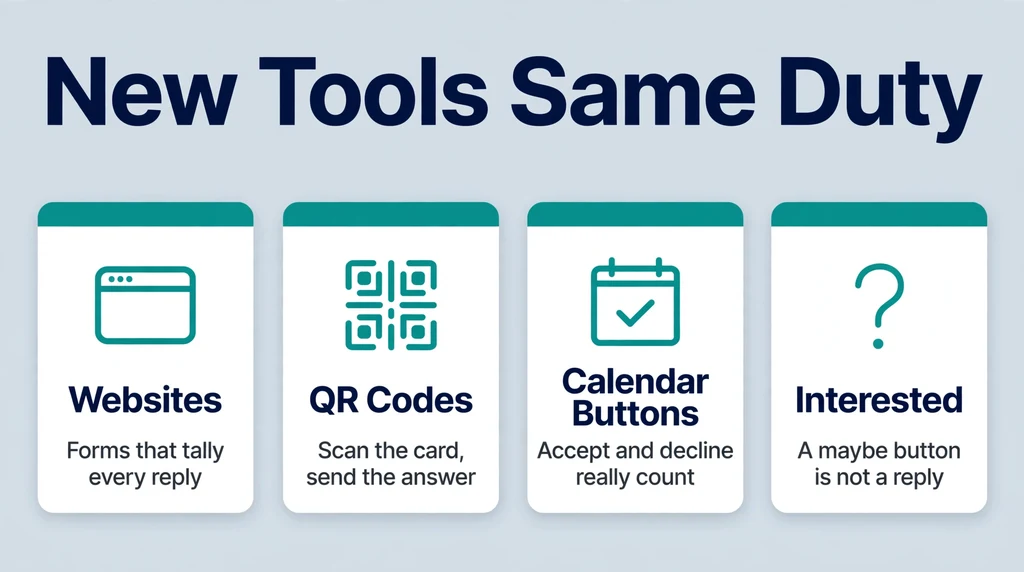
The card and the stamped envelope now share the job with links, apps and QR codes. The tools changed completely. The obligation did not change at all.
Wedding websites and online forms
Most couples now collect replies on a wedding website. Guests find their name, tick attending or not, pick a meal, and submit. The site tallies everything instantly, which removes the lost-card problem. Party platforms such as Evite built the same flow for birthdays and office events. Emily Post’s guidance even covers the e-vite directly: follow the directions to reply, and if you choose maybe, follow up with a final answer later. A maybe that never resolves is a silence by another name.
QR codes on paper invitations
A newer habit bridges both worlds. The invitation stays on paper, but a small QR code or short link replaces the reply card. You scan, the form opens, and your answer lands in the host’s spreadsheet. Treat the scan as seriously as the card. It is the official channel, and answers given elsewhere, in a chat thread or a hallway chat, may never reach the list. If you are unsure the form saved, a quick confirmation message to the host is thoughtful, not pushy.
Calendar invites and group chats
Work and social apps have their own RSVP buttons. Accept, tentative and decline on a calendar invite are true RSVPs, and organizers plan rooms and catering from them. So click honestly, and update the click when plans change. Group chats are looser. A thumbs-up emoji under a party message is friendly, but it is a weak reply. If the host asked a direct question in the chat, answer in words. “Count me in, party of two” takes four seconds and saves the host a follow-up.
The “Interested” button is not a reply
Social platforms added a tempting halfway house. Event pages offer Going, Interested and Can’t Go buttons. Hosts know that Interested means almost nothing: perhaps, maybe, or simply good luck. If a platform event matters to you, pick a definite side, and tell the host directly as well. For small gatherings, the host is probably counting heads from that page. Moving yourself from Interested to Going, or sending one short message, turns a shrug into a number they can cook for.
Deadlines: How Much Time Do You Have?
Every RSVP sits inside a timeline. Guests see only their own deadline, but hosts and vendors stack several deadlines together. Knowing the stack explains why your date is not flexible.
For weddings, the usual pattern runs like this. Invitations go out six to eight weeks before the day. The reply deadline is typically set three to four weeks before the wedding. That gap is not spare time. The couple must chase missing answers, build the seating plan and print place cards. Then, about one week before the wedding, they hand the caterer and venue a final headcount. As The Knot advises guests, the absolute latest point to reply is about two weeks before the event. After that, your answer may simply arrive too late to use.
Other events run shorter cycles. A dinner party host may ask for replies a week out, because the shopping list depends on it. A conference or workshop may close registration earlier still. The printed date always rules. If no date is printed, fall back on the Emily Post standard: within a day or two of receiving the invitation. And if the reply travels by post, mail the card early. Post time is your problem, not the host’s, so drop the card several days before the deadline rather than on it.
If you miss the deadline
Reply anyway, and reply at once. A late answer with a brief apology is far better than continued silence. Understand, though, that the host may have handed your place to the waiting list or locked the caterer’s count. Accept a no gracefully if the numbers no longer stretch. Above all, never simply arrive. An unannounced guest creates the exact problem the deadline existed to prevent. One honest message, sent the moment you realize, repairs most of the damage.
Common RSVP Mistakes
Most RSVP trouble comes from a handful of repeat errors, and each one is easy to avoid.
Treating RSVP as reply-if-coming. The classic error. Unless you see regrets only, your no needs sending too.
Letting the deadline slide. The date is a planning tool, not a suggestion. Late answers collide with caterer deadlines and seating plans.
Adding uninvited guests. A plus-one exists only if the invitation grants one. The envelope names the invited; extra names are a problem, not a surprise gift.
RSVPing for children who were not named. If children are invited, their names or “and Family” will say so. An adults-only note settles the question completely.
Writing a novel of excuses. A decline needs warmth, not evidence. One or two sentences of regret are complete and correct.
Using the wrong channel. A reply buried in a group chat may never reach the host’s list. Use the card, number, email or link the host provided.
Saying yes and not showing. The costliest mistake on the list. The host paid for your chair and your plate. Only a real emergency excuses it, and a call softens it.
Forgetting to update a maybe. Tentative answers are placeholders, not answers. Convert yours to a yes or a no well before the deadline.
Replying to the wrong person. Your answer belongs with the host or organizer named on the invitation. Telling a mutual friend does not count unless they pass it on and confirm it landed.
Leaving a maybe hanging forever. A tentative reply buys thinking time, nothing more. If the deadline passes with your maybe unconverted, the host reads it as a no, or worse, guesses.
Frequently Asked Questions
What does RSVP stand for in English?
RSVP stands for the French phrase “répondez s’il vous plaît.” Word for word, it means “respond, if you please.” English smooths that into “please respond” or “please reply.” The four letters are an initialism, so you say each letter separately: ar-ess-vee-pee.
Do I have to RSVP if I am not going?
Yes. A decline is an answer, and the host needs it for catering and seating counts. The only exception is an invitation marked regrets only. On those, silence means you are attending, and only guests who cannot come need to reply.
Is it rude to write “please RSVP”?
It is redundant rather than rude. The please is already inside the French, since s’il vous plaît means please. Language writers file “please RSVP” under RAS syndrome, alongside “ATM machine.” In real life it is everywhere and nobody minds. Formal invitations, however, usually print RSVP on its own.
How quickly should I RSVP?
As soon as you know your answer. The Emily Post Institute suggests replying within a day or two of receiving the invitation. The printed deadline is the outer limit, not the target. If your reply travels by mail, post it several days before that deadline.
What does the M mean on an RSVP card?
The M begins your title. Complete the line with Mr., Mrs., Ms., Miss, Mx. or Dr., followed by your full name. The convention comes from formal stationery, where replies used titles. Modern cards increasingly print “Name(s)” instead, which means exactly the same thing with less puzzling.
Can I change my RSVP after replying?
Sometimes. Changing a yes to a no is reserved for real emergencies such as illness, a death in the family or an unavoidable work conflict, and you should call the host at once. Changing a no to a yes is acceptable only when it does not disturb the host’s final numbers, so ask rather than assume.
Is RSVP still used in France?
Not much. Wikipedia notes that RSVP now reads as formal and old-fashioned in France, where hosts more often write that a response is expected before a date. The abbreviation remains common in French-speaking Canada, and SVP alone is a everyday shorthand for s’il vous plaît in French.
What should I write when I decline?
Keep it short, warm and final. Thank the host, express regret, and wish the event well. For example: “Thank you so much for the invitation. I am sorry to miss it, and I hope you have a wonderful day.” No detailed excuse is required, and long explanations help nobody.
Final Thoughts
Four letters, one courteous question, and a two-minute job for the guest. RSVP means “please respond,” and everything else in this guide is a footnote to that sentence. Reply promptly, reply either way, and reply through the channel the host gave you. Do those three things and you will be the guest every host hopes for. You will also, quietly, get invited to more parties. Reliability is a social skill that people notice.
The custom began in French drawing rooms, crossed to London on printed cards, and now lives in QR codes and wedding websites. Tools will keep changing. The kindness underneath them will not. For the classic rules in their original home, the Emily Post Institute’s guide to invitation etiquette is the reference hosts and guests have trusted for a century. Next time an invitation lands, you will know exactly what the corner is asking.