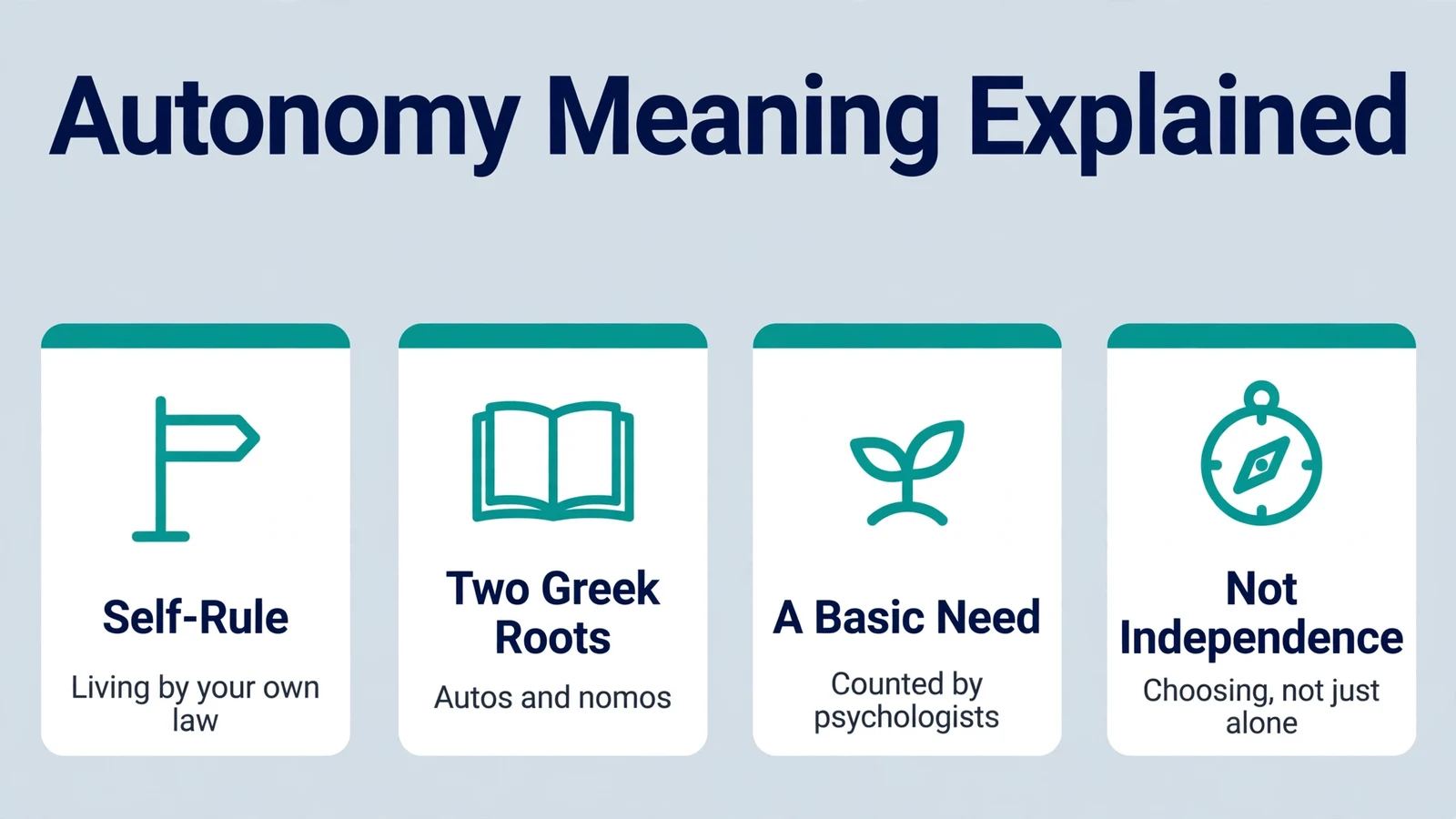
A nurse asks a patient to sign a consent form. A teenager insists on choosing her own subjects at school. An island community in the Baltic Sea votes in its own parliament, in its own language, while remaining part of a larger country. Three very different scenes, one word: autonomy.
Autonomy means self-governance. It is the freedom to make your own decisions and live by rules you have chosen, instead of rules imposed on you by someone else. Cambridge Dictionary puts it plainly: autonomy is “the ability to make your own decisions without being controlled by anyone else.”
This guide was built from the major dictionary entries and the fields that use the word most: philosophy, psychology, medicine and politics. It covers the definition, the Greek roots, Kant’s famous version of the idea, bodily and patient autonomy, autonomy at work, and the one confusion almost everyone has, the difference between autonomy and independence.
What Does Autonomy Mean?
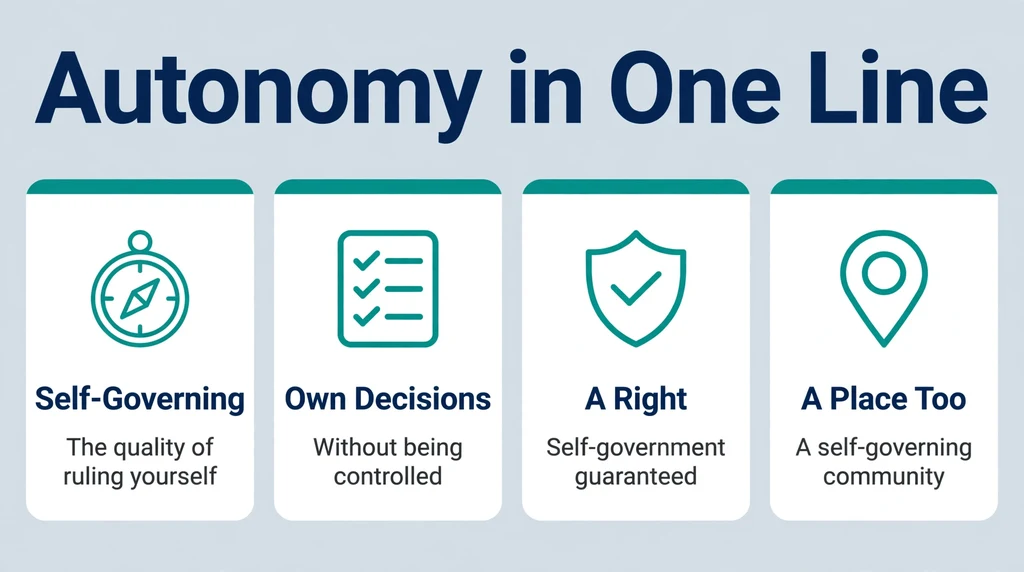
Autonomy is a noun, pronounced aw-TON-uh-mee. Merriam-Webster’s first sense is “the quality or state of being self-governing, especially: the right of self-government.” The same entry adds a personal sense, “self-directing freedom and especially moral independence,” and a third sense, “a self-governing state.”
So one word covers two scales. It describes a person directing their own life, and it describes a place governing itself. Dictionary.com shows the same spread: “independence or freedom, as of the will or one’s actions,” then “self-government or the right of self-government,” then “a self-governing community.”
The Working Definition
Strip away the technical language and the working definition is this: autonomy is living by your own rules instead of someone else’s. An autonomous person makes their own decisions about their body, money, work and beliefs. An autonomous region makes its own laws about local matters such as schools and language.
Notice what the definition does not say. It does not say an autonomous person has no rules. It says the rules are theirs. That single point separates autonomy from chaos, and it runs through every use of the word in this guide.
The adjective form is autonomous. It describes anything that governs or runs itself: an autonomous region, an autonomous university, an autonomous research team. Tech companies use the same adjective for machines, as in autonomous vehicles. A self-driving car makes its own steering decisions, with no operator’s hands on the wheel. The machine sense borrows from the human one, but the family resemblance is real: in both cases, the decisions come from inside the system.
One Word, Many Rooms
You will meet autonomy in several rooms of life. In philosophy, it is about the will giving itself moral law. Psychology treats it as a basic human need, like food for motivation. In medicine, it protects a patient’s right to decide about treatment. Politics uses it for regions that govern themselves inside a state.
However, the center never moves. In every room, autonomy answers one question: who makes the rules here, the person themselves, or somebody else?
Where the Word Comes From: Self Plus Law
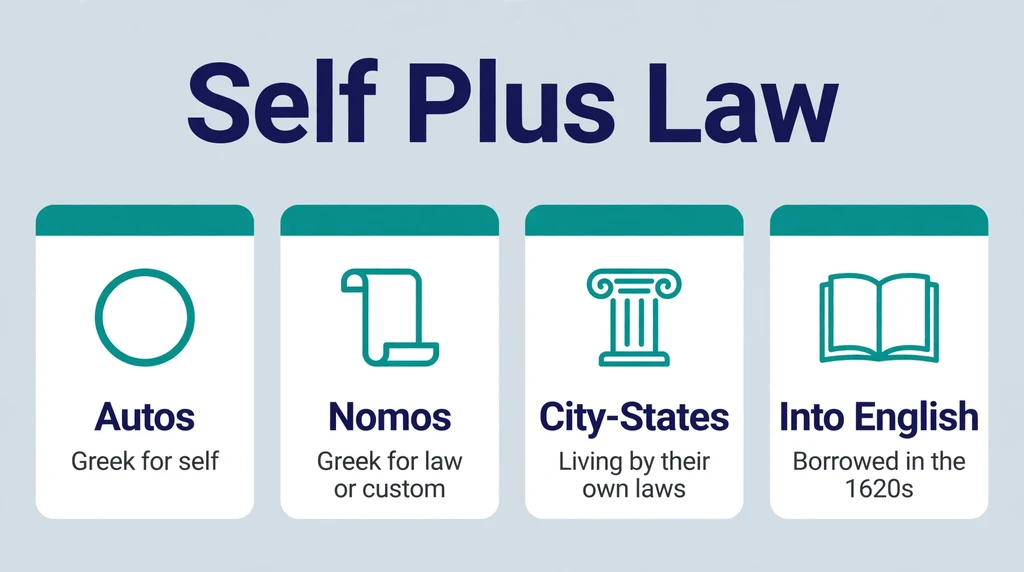
Autonomy comes from Greek, and the Greek tells the whole story in two pieces. The first piece is *autos*, meaning “self.” The second is *nomos*, meaning “law” or “custom.” Put them together and you get “living by one’s own laws.”
The Online Etymology Dictionary traces the word to the Greek *autonomia*, “independence,” from *autonomos*, “independent, living by one’s own laws.” In the ancient Greek world, that adjective described city-states. A city was autonomous when it ran its own affairs under its own laws, rather than taking orders from a foreign king.
From City-States to English
English borrowed the word in the early 1600s, and at first it kept the political sense. The etymology record dates it to the 1620s, “of states.” Writers used it for communities that governed themselves, much as the Greeks had.
Then the word turned inward. From 1803, the record shows autonomy used of individual persons. The idea of a self-governing city had become the idea of a self-governing self. That journey, from the city to the soul, explains why the word still carries both meanings today.
Why the Roots Still Matter
The roots are not trivia. They settle arguments about what the word means now. Because *nomos* means law, autonomy has never meant doing whatever you feel like in the moment. From its first day, it has meant living under a law. The only question the word asks is whose law it is.
The Key Idea: Rules You Genuinely Endorse
Here is the test that philosophers and psychologists keep returning to. A decision is autonomous when you can honestly say: this rule, this choice, this direction is mine. You might follow a law, a diet, a faith or a manager’s instruction. What matters is whether you endorse it, or merely obey it.
For example, two employees follow the same office rule about working hours. One resents it and feels watched all day. The other understands the reason for it and agrees the team needs it. Their behavior looks identical, but only the second employee experiences autonomy. The difference lives inside the person, not in the rule book.
Autonomy Is Not the Absence of Rules
This is the most common misunderstanding of the word. Autonomy is not a rule-free life, and it is not rebellion. A monk who freely chooses a strict daily routine is highly autonomous. A drifter who follows every impulse may not be autonomous at all, because impulses can control a person just as a boss can.
In short, autonomy means authorship. You are the author of the rules you live by, even when you borrow some of them from others. The sections that follow show this same test at work in daily life, in philosophy, in clinics and in parliaments.
Autonomy in Everyday Life
Personal autonomy is the everyday version of the idea. It is the degree to which your daily life reflects your own choices rather than other people’s instructions. You do not need a philosophy degree to feel it. You feel it in your schedule, your wallet and your weekend plans.
Think of a young cook saving to open a small bakery. She chooses the menu, the prices and the opening hours. Her days are hard, and money is tight. Still, her work is autonomous, because the direction of it is hers.
Now think of her friend in a large company kitchen. He earns more and worries less. However, every dish, shift and break is set by someone else. On paper his life looks easier. In terms of autonomy, hers is larger.
What Personal Autonomy Looks Like
Autonomy shows itself in ordinary decisions. You choose where to live, and who to live with. Your career path is yours to choose, and yours to change. Money, time and beliefs are yours to manage. You can also say no, to a request, a tradition or a plan that does not fit your values.
It also shows in smaller ways. A student picks the topic of her own essay. A grandfather decides how to spend his retirement mornings. One freelancer turns down a client whose demands clash with her principles. Each case has the same shape: the choice came from the person, not from pressure.
When Autonomy Shrinks
Autonomy shrinks when control moves outside you. A controlling partner decides who you may see. A workplace tracks every minute and punishes initiative. Debt can shrink it too, because a lender’s demands start steering your choices. Illness and disability can reduce it in practical ways, which is why support that protects choice matters so much.
Notice the pattern in these examples. Autonomy grows or shrinks by degrees. Almost nobody has total autonomy, and almost nobody has none. The useful question is never “am I autonomous?” It is “where is my autonomy strong, and where has it thinned?”
Autonomy Across a Lifetime
Autonomy also changes shape as we age. A small child has almost none, and needs almost none. Teenagers demand more of it, often before they can handle all of it, which is why those years feel like negotiation. Adults are expected to run their own lives in full. Then old age can thin autonomy again, through illness or dependence on carers. The thread through every stage is the same: people flourish when the amount of self-rule in their life roughly matches their capacity to use it.
Kant and the Autonomy of the Will
The philosopher who gave autonomy its most famous meaning is Immanuel Kant. In his *Groundwork of the Metaphysics of Morals*, published in 1785, Kant asked a deep question. What makes a moral rule truly binding on us? His answer changed philosophy: a rule binds us when we give it to ourselves.
For Kant, the will, our capacity to choose, is autonomous when it follows laws it has legislated for itself through reason. You do not merely obey the moral law. You are its author. That is why it can command you without humiliating you: the commander and the obeying citizen are the same person.
Autonomy Versus Heteronomy
Kant set autonomy against its opposite, heteronomy. The word uses the Greek *heteros*, meaning “other.” A will is heteronomous when its law comes from outside itself. Desire, fear, habit, social pressure and hope of reward are all outside sources. Acting only for pleasure or praise is, for Kant, being ruled by something other than your own reason.
His test for a self-given law is the categorical imperative. In simple terms: act only on rules that you could honestly will everyone to follow. A rule that passes that test is fit to be your own law. A rule that fails it, like lying whenever it suits you, cannot be universal, so it cannot be autonomous law.
Autonomy also grounds human dignity in Kant’s system. Because a person can give herself moral law, she is not a thing to be used, but an end in herself. Other people must treat her that way, and she must treat them the same. This is why Kant’s autonomy is not a private luxury. The law you legislate for yourself must respect the same lawgiving power in everyone else.
Kant’s version is demanding, and most readers will not live by it fully. Still, his core insight survives in everyday language. When we say people should think for themselves and own their principles, we are speaking Kant’s language without knowing it.
Autonomy in Psychology: A Basic Human Need
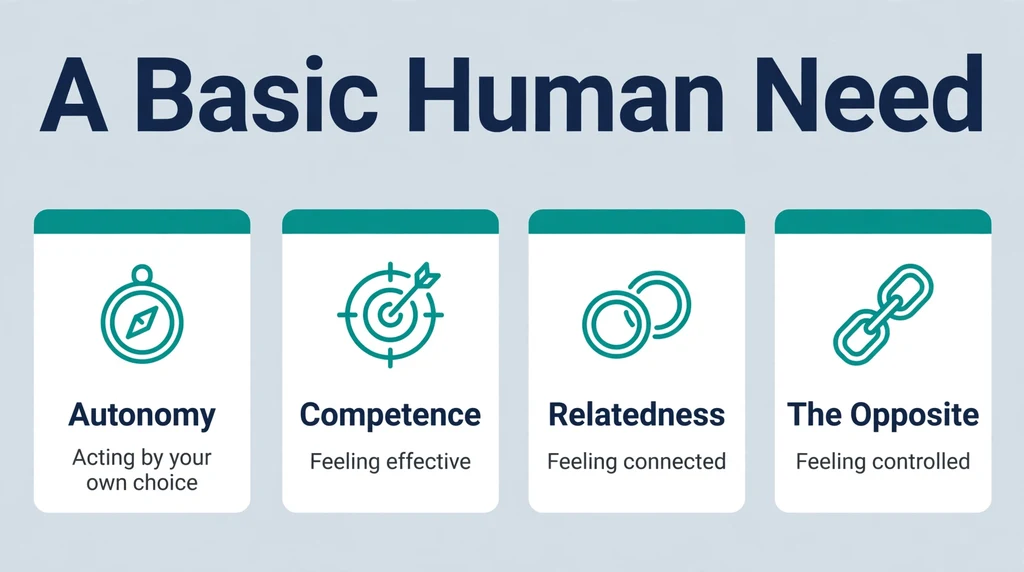
Psychology turned autonomy from a philosophy topic into a measurable human need. The key work is self-determination theory, developed by psychologists Edward Deci and Richard Ryan. According to the American Psychological Association, the theory is a global framework for understanding human motivation and development.
The theory says that human beings have three basic psychological needs. When these needs are met, people tend to be more motivated, more satisfied and healthier. When the needs are blocked, motivation and well-being fall.
The Three Basic Needs
The first need is autonomy: the feeling that you are choosing your behavior, rather than being controlled or compelled by others. The second is competence: the feeling that you can be effective at what you do. Third comes relatedness: a feeling of connection and belonging with other people.
Autonomy holds a special place in the theory. According to Deci and Ryan, people act with real energy when they experience their actions as their own. They call this autonomous motivation. It covers doing something because you enjoy it, and also doing something you find genuinely worthwhile, even when it is hard.
Autonomy Versus Control
The opposite of autonomy, in this research, is not dependence. It is control. A student can follow a strict curriculum and still feel autonomous, if she understands its point and endorses it. Another student can have total freedom to choose courses and feel lost, if none of the choices feel like his own.
That is why good teachers and managers in this tradition do two things. They offer meaningful choices where they can. And they explain the reasons behind the rules they cannot change. Reasons turn orders into something a person can endorse, and endorsement is what autonomy is made of. Parents use the same tools at home. Explaining why a rule exists, and offering real choices inside it, helps a child treat the rule as her own. The rule does not disappear. Its ownership changes.
Bodily Autonomy: Your Body, Your Decisions
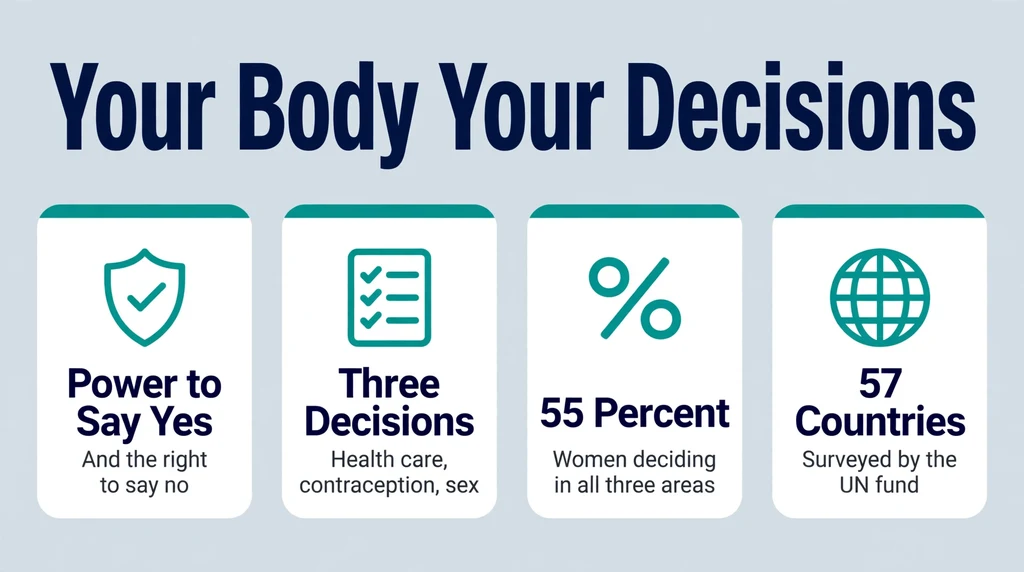
Bodily autonomy is autonomy applied to the most personal territory there is: your own body. It means you have the power and agency to make choices about your body, without fear of violence and without someone else deciding for you. The phrase is used most often in debates about health care and reproductive rights.
The idea is easy to state. Your body belongs to you. Therefore decisions about it, from medical treatment to pregnancy, should be yours to make. Other people may advise, persuade or disagree. Bodily autonomy says the final decision sits with the person whose body it is.
What the Global Data Shows
In 2021, the United Nations Population Fund devoted its flagship State of World Population report to this idea. The report was titled *My Body Is My Own*. For the first time, a UN report measured bodily autonomy across countries in a systematic way.
The researchers tracked three decisions: whether to seek health care, whether to use contraception, and whether to say yes or no to sex. Across the 57 countries surveyed, only 55 percent of women could make their own decisions in all three areas. In other words, nearly half of the women surveyed did not fully govern their own bodies.
Supporters and critics argue about what laws should follow from such numbers. However, the meaning of the term itself is not in dispute. Bodily autonomy names the claim that decisions about a body belong to the person living in it.
Autonomy in Medicine: The Patient Decides
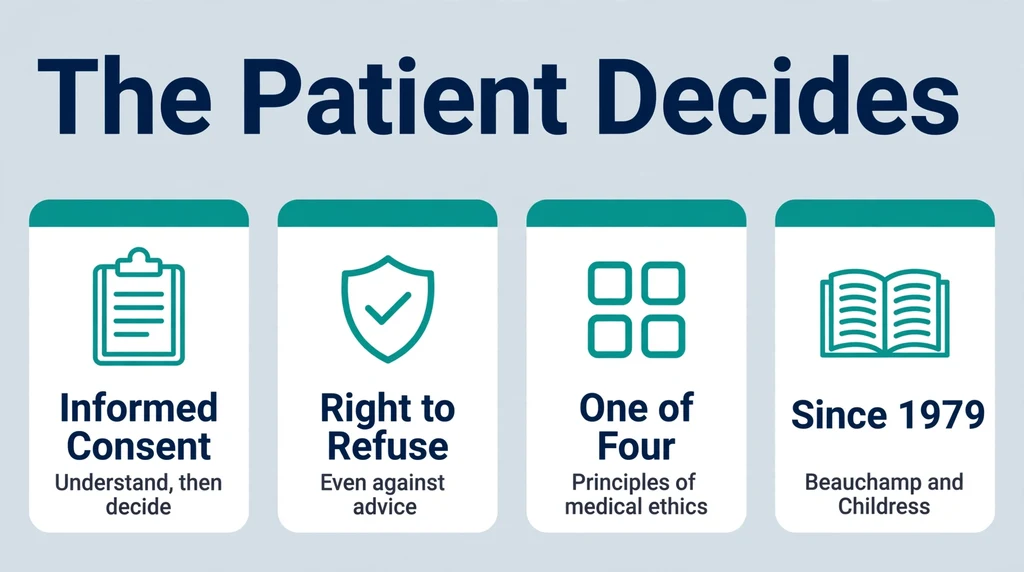
Walk into a clinic and autonomy takes a practical form: patient autonomy. Modern medical ethics holds that a competent patient has the right to decide what happens to their own body. Doctors advise, explain and recommend. The patient decides.
The framework most students learn comes from Tom Beauchamp and James Childress. Their book *Principles of Biomedical Ethics*, first published in 1979, set out four principles for medical ethics. The first is respect for autonomy. The others are beneficence, nonmaleficence and justice: do good, do no harm, and treat people fairly.
Informed Consent: Autonomy on Paper
Respect for autonomy becomes real through informed consent. Before treatment, the patient should understand the diagnosis, the options, and the risks and benefits of each. Then the patient agrees, or refuses, freely. A signature given without understanding is paperwork. A decision made with understanding is autonomy in action.
The right to refuse is the sharpest edge of the principle. A patient may decline a treatment the doctor strongly recommends, even a life-saving one. Clinicians often find such refusals hard to watch. However, the principle holds that a competent adult’s informed “no” is theirs to give.
Autonomy in medicine has limits, and the textbooks say so. A patient who cannot understand or decide, for example in a coma or with advanced dementia, cannot exercise it directly. In those cases, families and clinicians decide together, guided by the patient’s known values. Advance directives exist for exactly this problem: they are autonomy written down early, instructions a person leaves so future care still follows their own choices. Children sit in a middle zone, gaining a say in decisions as they mature. The goal stays the same: honor the person’s own law, even when they cannot speak it.
Autonomy at Work
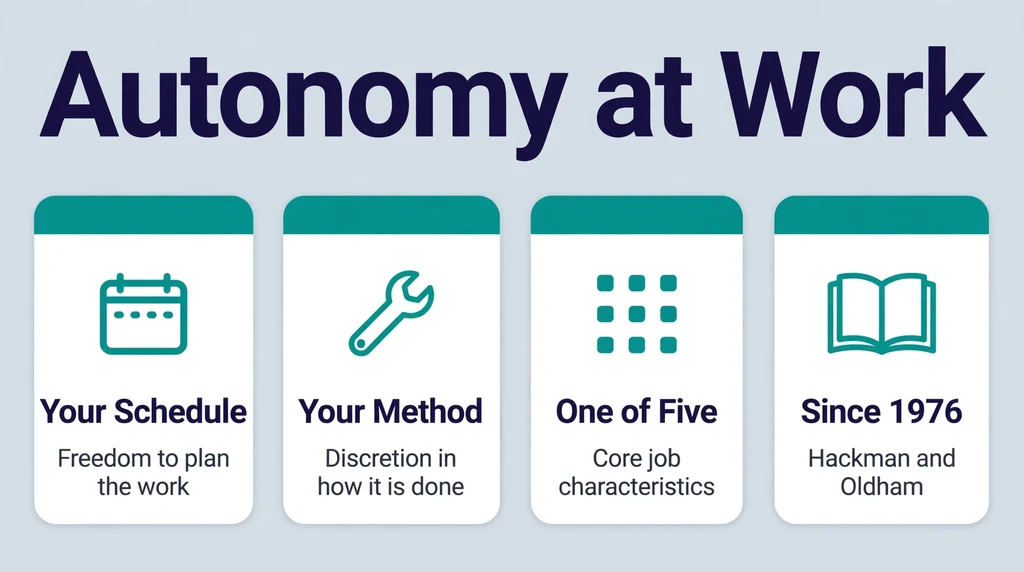
Autonomy has a quieter career in the world of jobs. Workplace autonomy means the discretion an employee has over how their work gets done. It covers scheduling your tasks, choosing your methods, and making small decisions without asking permission first.
Organisational psychology has measured this for decades. In 1976, J. Richard Hackman and Greg R. Oldham published their job characteristics model. The model lists five features that make a job motivating: skill variety, task identity, task significance, feedback, and autonomy.
What the Research Found
In their definition, autonomy is the degree to which a job gives a worker freedom and discretion in scheduling the work and choosing how to carry it out. The model predicts that autonomy creates a feeling of personal responsibility for results. People who feel responsible for outcomes tend to care more about quality.
Later research reviews kept the finding alive. Jobs with more autonomy generally come with higher satisfaction and stronger motivation. Jobs with almost none, where every step is scripted and monitored, tend to drain both. The details vary by industry and by person, but the direction of the result has proved durable.
Notice that workplace autonomy is not the absence of a boss. A surgeon, a pilot and a senior engineer all work inside strict rules. Their autonomy lies in the judgment calls the rules leave to them. As in the rest of this guide, autonomy means self-direction inside a structure, not life without one.
Political Autonomy: Self-Rule Inside a State
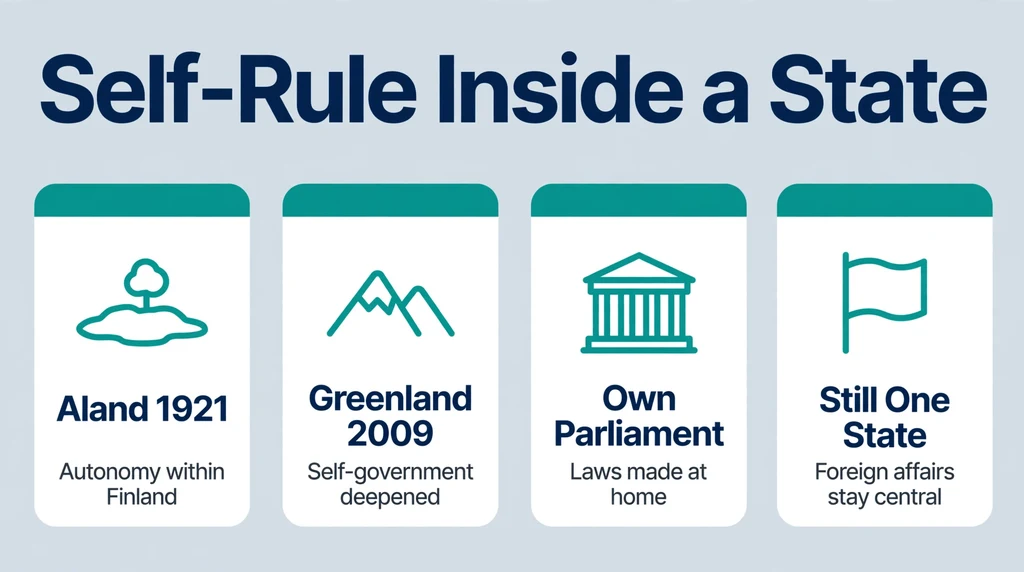
Return now to the word’s first job. Political autonomy describes a region or community that governs itself while remaining part of a larger country. The region runs its own local affairs. The central state keeps the powers it reserves, such as foreign policy, defence and currency.
This arrangement is a middle path. Full independence cuts the tie completely. Ordinary provinces simply follow the center’s rules. Autonomy sits between them: real self-government, guaranteed in law, inside an existing state. It often protects a distinct language or culture that a simple majority vote would wash away.
Autonomy is usually created by law, not seized by force. A constitution or a negotiated statute lists the powers the region controls, the powers the center keeps, and the rules for changing the deal. Because the arrangement is written down, both sides know where they stand. That legal frame is what separates autonomy from a vague promise of good treatment.
Åland: The Classic Settlement
The Åland Islands are the textbook example. The islanders speak Swedish, but their islands belonged to Finland. In 1921 the League of Nations settled the dispute. Finland kept sovereignty over the islands. In return, Åland received guaranteed autonomy, protection for its Swedish language and culture, and a demilitarised status.
A century later, Åland still has its own parliament and government. It controls areas such as education and health care, and it legislates in Swedish. The settlement is often cited as a model of peaceful conflict resolution, because autonomy gave the islanders self-rule without redrawing the map.
Greenland: Autonomy That Can Grow
Greenland shows a second pattern. It gained home rule from Denmark in 1979. Then, on 21 June 2009, a deeper Self-Government Act came into force. Greenland took over fields such as policing, courts and natural resources. Denmark kept foreign affairs, defence and currency.
The 2009 act also recognised the Greenlandic people as a people under international law. It set out a path by which Greenland could choose independence in the future, if its people decide so. Autonomy here is not a final answer. It is a framework that can deepen, or one day be exchanged for statehood.
Other places use versions of the same tool. Catalonia in Spain and Scotland in the United Kingdom govern many local matters through their own parliaments, inside larger states. The details differ, but the family resemblance is clear: self-rule, defined and limited by law.
Autonomy vs Independence: Not the Same Thing
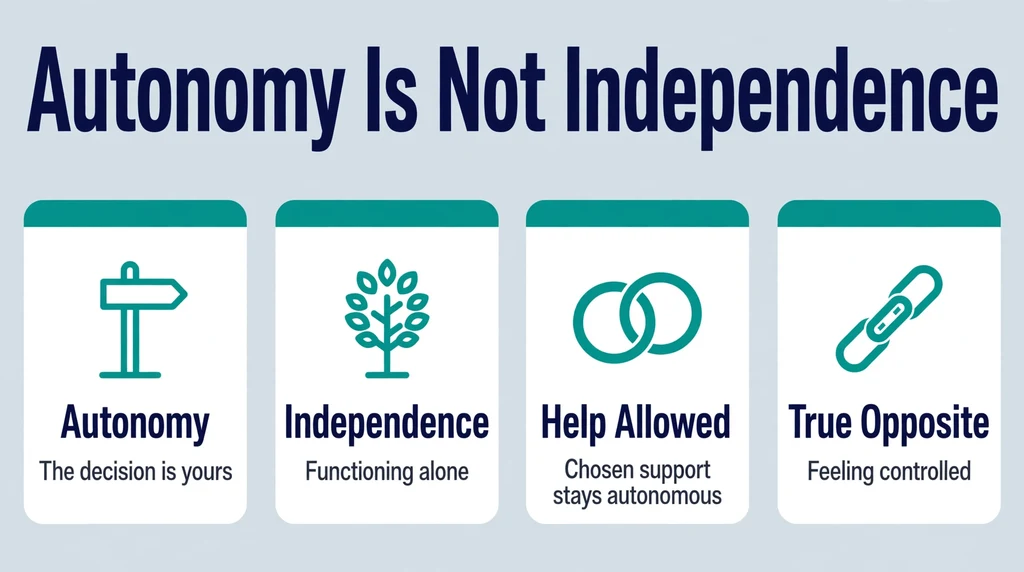
Searchers often treat autonomy and independence as synonyms. They are not, and the difference is one of the most useful ideas in this guide. Independence means functioning alone and not relying on others. Autonomy means acting by your own choice, with a sense of ownership over what you do.
Deci and Ryan draw the line carefully in their work. In their terms, autonomy means to act volitionally, with a sense of choice. Independence means to function alone and not rely on others. Two different axes: one is about who decides, the other is about who helps.
You Can Be Dependent and Autonomous
Consider a woman recovering from surgery. She depends on nurses, family and a physiotherapist every day. By the independence test, she scores low. By the autonomy test, she may score high. She chose the surgery, she sets her recovery goals, and she accepts help because she endorses the plan.
Now consider a man who relies on nobody and refuses all help. He looks independent. Yet he may be driven by fear of seeming weak, a rule he never chose and cannot question. His dependence score is zero. His autonomy, on close inspection, is shaky.
Self-determination research has a phrase for the first case: a person can be autonomously dependent. Willingly accepting guidance, care or support does not reduce autonomy. What reduces autonomy is pressure you have not endorsed, whether it comes from a person, a habit or a fear.
Why the Distinction Matters
The distinction protects real people. Parents who equate autonomy with total self-reliance may push children too hard, too early. Adult children may feel guilty for accepting help in old age, as if help were failure. Managers may confuse autonomy with leaving staff alone, and withdraw support people actually want.
Read autonomy the right way and those errors disappear. The question is never “did you do it alone?” The question is “was it truly your choice?” Help that you choose is part of autonomy. Help forced on you is not.
Words Often Confused with Autonomy
Autonomy travels with a family of similar words. Each neighbour shares part of its meaning and hides part of it. Here is the short version, because this site’s separate guide lists the synonyms of autonomy in full.
Sovereignty
Sovereignty is supreme and final authority. A sovereign state answers to no higher power. An autonomous region, by contrast, governs itself under a higher power that still exists. John Stuart Mill borrowed the word for the individual in *On Liberty* (1859): “Over himself, over his own body and mind, the individual is sovereign.” For regions, though, autonomy and sovereignty are different rungs of the ladder.
Self-Determination
In politics, self-determination is a people’s right to choose their own political status, which can include full independence. Autonomy is one possible outcome of that choice, not the whole of it. In psychology, the same phrase names Deci and Ryan’s theory, where autonomy is one need among three. Context tells you which job the phrase is doing.
Agency
Agency is the capacity to act and to make things happen. It is best understood as a building block. Autonomy needs agency, because self-rule is impossible if you cannot act at all. But agency alone is not autonomy: a skilled employee may act very effectively while following orders she privately rejects.
Freedom and Liberty
Freedom and liberty are the broadest words in the family. They mainly name the absence of constraint: nobody is stopping you. Autonomy adds a second element, direction from within. A person can be free to do a hundred things and still feel ruled by cravings, debts or other people’s expectations. Autonomy is freedom that has found its own law.
Common Misconceptions About Autonomy
Four misunderstandings follow this word around. Each one is easy to state and easy to test against the definition.
“Autonomy Means Doing Whatever You Want”
This is the biggest myth. Doing whatever you want, moment by moment, is usually a sign of being ruled by impulses. Autonomy, remember, contains the word law. It means your considered values do the ruling. Sometimes autonomy looks like discipline: the athlete who trains at dawn is not obeying a whim, she is obeying herself.
“Autonomy Means Being Selfish”
Self-rule is not self-obsession. An autonomous person can choose generosity, duty and sacrifice, and the choice is autonomous precisely because it is chosen. Kant’s whole system points this way: the law you give yourself is a moral law that respects other people as ends in themselves. Autonomy governs how you decide, not whether you care.
“More Choice Always Means More Autonomy”
A menu with two hundred options can paralyse rather than free. Autonomy depends on choices being meaningful and endorsable, not merely numerous. A patient given one clear treatment path, explained honestly, may experience more autonomy than a patient handed forty unexplained options. Quality of choice beats quantity.
“Autonomy and Independence Are the Same”
The previous sections covered this one, and it returns because dictionaries list the words near each other. Keep the psychology distinction in your pocket. Autonomy: the decision is yours. Independence: the work is yours alone. A wise life usually wants the first, and takes the second only when it helps.
Autonomy in Sentences
Seeing the word at work fixes its meaning better than any definition. Here are examples across its main senses, with the sense noted in brackets.
- “After ten years of saving, she finally had the autonomy to leave her job and open a studio.” (personal freedom)
- “The territory was granted autonomy, but its foreign policy remained with the capital.” (political)
- “Good managers give their teams autonomy over how projects are done.” (workplace)
- “The patient exercised her autonomy and declined the operation.” (medical)
- “He values his autonomy too much to let an algorithm plan his day.” (everyday)
- “In Kant’s philosophy, autonomy means the will obeys laws it gives itself.” (philosophical)
Notice the pattern in each sentence. Somebody is deciding for themselves, inside a situation that could easily have decided for them. That tension, between the self and outside control, is where the word lives.
Frequently Asked Questions
What does autonomy mean in simple words?
Autonomy means governing yourself. In simple words, it is the freedom to make your own decisions and live by your own rules, instead of being controlled by someone else. It applies to people, and also to regions that run their own affairs inside a country.
What is the difference between autonomy and independence?
Independence means functioning alone, without relying on others. Autonomy means your actions are truly your choice. Psychologists stress that the two differ: you can willingly depend on others, for care, teaching or teamwork, and still be fully autonomous. What breaks autonomy is control you have not endorsed, not help you have chosen.
What is an example of autonomy?
Choosing your own career is a clear example. So is a patient signing an informed consent form after understanding the options. At the political level, the Åland Islands governing themselves inside Finland is a classic example. In each case, the person or community makes its own governing decisions.
What does bodily autonomy mean?
Bodily autonomy means you have the right to make decisions about your own body. It covers choices about health care, contraception and sex. The United Nations Population Fund measured it in a 2021 report and found that only 55 percent of women in 57 surveyed countries could make their own decisions in all three areas. You can read the report at the UNFPA website.
What did Kant mean by autonomy?
Kant meant the will giving itself its own law. In his *Groundwork* of 1785, he argued that moral rules bind us because our own reason legislates them. The opposite, heteronomy, is taking your law from outside sources such as desire, fear or reward. For Kant, only self-given law is fully moral law.
What are synonyms for autonomy?
The closest synonyms are self-government, self-rule, self-determination, independence and freedom. Each leans a slightly different way: sovereignty implies final authority, agency means the capacity to act, and independence stresses not relying on others. This site’s companion guide lists synonyms of autonomy with examples.
How do you pronounce autonomy?
Autonomy is pronounced aw-TON-uh-mee, with the stress on the second syllable. The adjective is autonomous, pronounced aw-TON-uh-mus. Both come from the Greek words autos, meaning self, and nomos, meaning law.
Can autonomy be taken too far?
It can be misunderstood that way, but the concept itself has a brake built in. Autonomy ends where another person’s begins: your self-rule does not license ruling others. Kant required your rules to be fit for everyone, and medical ethics balances autonomy against doing good and avoiding harm. Healthy autonomy is self-government, not a licence to ignore everyone else.
Final Thoughts
Autonomy is an old Greek word for a permanent human question: who governs this life, this body, this community? The dictionaries answer with self-government. Kant answered with a will that legislates for itself. Psychologists answer with a basic need to feel that your actions are your own.
However you meet the word, keep the test from the start of this guide. Autonomy is not the absence of rules, help or structure. It is the presence of your own endorsement inside them. A life, a clinic or a country has autonomy when the people inside it can honestly say: these rules are ours.