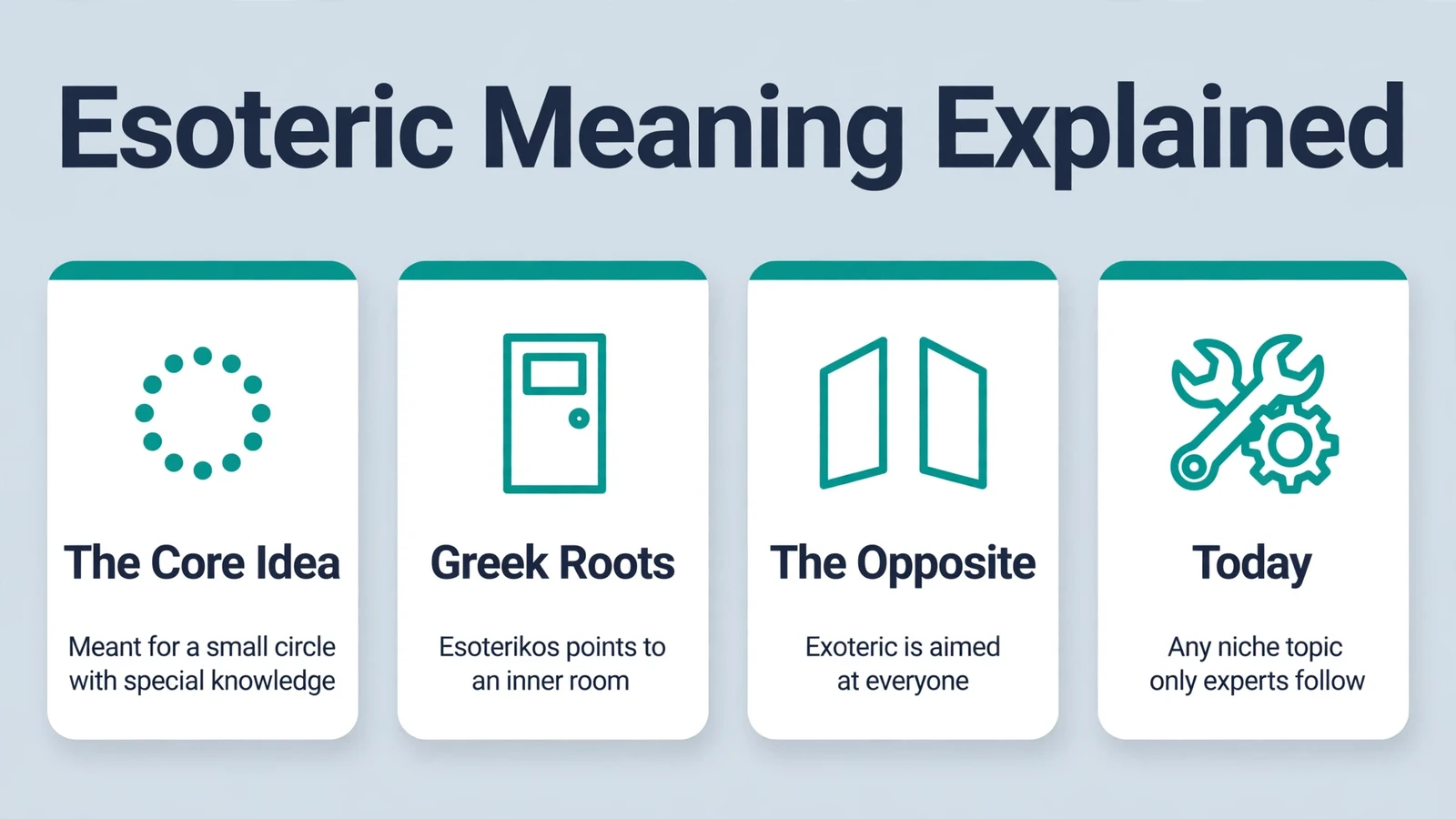
Some words describe a locked door. Esoteric is one of them. When a subject, a joke or a book is called esoteric, the content is meant for a small circle of people with special knowledge. Or it only really makes sense to them. Everyone else is left outside.
Dictionaries word it in almost the same way. Merriam-Webster defines esoteric as designed for or understood by the specially initiated alone. Cambridge describes it as understood or liked by only a small number of people, especially those with specialised knowledge.
This guide unpacks the word from the inside. It covers the Greek roots, the ancient schools that split teaching into outer and inner layers, and the inner teachings of world religions. It also follows the word into staff rooms, group chats and meme pages, where it now lives a second life.
What Does Esoteric Mean?
Esoteric is an adjective. It describes knowledge, language or activity that is intended for a small, prepared audience. That audience might be initiates in a tradition. It might be specialists in a field. Or it might simply be the few people who share a deep interest.
Two ideas sit inside the definition, and they are worth pulling apart.
The Audience Is Small
First, esoteric content has a restricted audience by design or by difficulty. A lecture on advanced knot theory is esoteric because few people can follow it. A ritual teaching is esoteric because only initiates are meant to hear it. In both cases, the circle of people who get it stays small.
Crucially, the word describes the audience, not the quality of the content. Esoteric material can be profound, trivial, true or false. The word only tells you who it is for.
The Door May Be Locked, or Just Heavy
Second, esoteric content is not always secret. Some of it is guarded on purpose, and outsiders are simply not told. However, much of it is published openly and still counts as esoteric. A dense tax ruling sits in a public database, yet only accountants can decode it.
So the locked door in our opening image is sometimes locked. More often, it is just very heavy. Either way, most people stay outside it.
How to Say It
The word is pronounced es-uh-TAIR-ik, with the stress on the third syllable. In the International Phonetic Alphabet it is written /ˌɛs.əˈtɛr.ɪk/. Once you hear the rhythm, the word is hard to misread. It rhymes loosely with “generic,” though it means nearly the opposite.
A Quick Test: Is It Esoteric?
When you are unsure whether the word fits, ask two questions. First, who can actually follow this? If the honest answer is a small, specific group, the word is in play. Second, what does following it require? Training, initiation, shared history or years of hobby hours all count.
Notice what the test leaves out. It never asks whether the content is good, true or important. A forty-page thread about a forgotten cartoon can be deeply esoteric. So can a proof that changes mathematics. The word measures the doorway, not the room.
The Greek Roots: A Word Built From “Within”
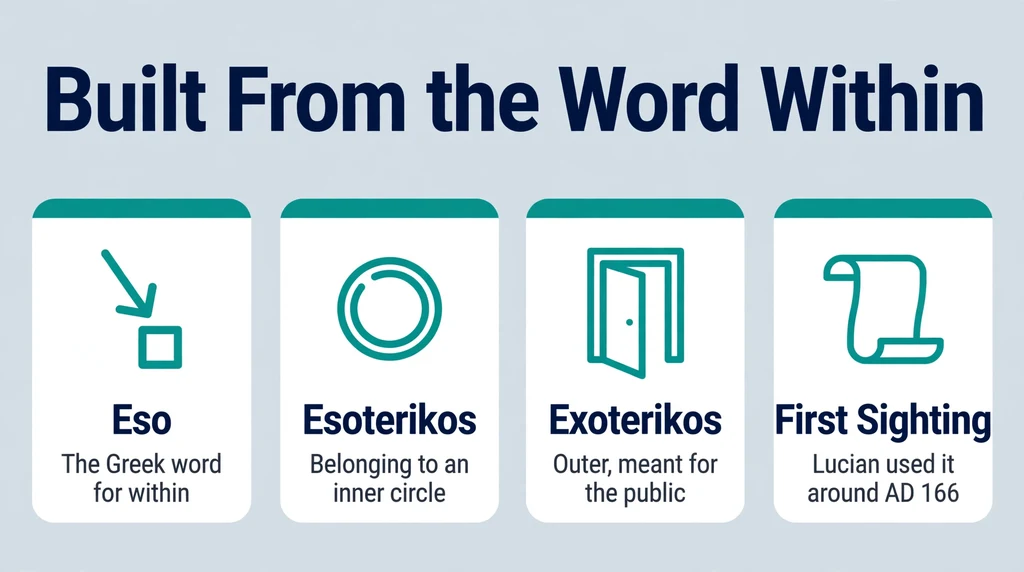
Esoteric comes from the Greek adjective *esōterikos*. It means “belonging to an inner circle.” Behind it sits the small Greek word *esō*, which means “within.”
The form is comparative, which adds a nice nuance. *Esōterō* means “further inside.” So an esoteric teaching was not just inside the building. It sat deeper inside than the ordinary material.
The Matching Half: Exoteric
Greek also gives us the natural partner word. *Exōterikos* means “outer.” From it comes the English word exoteric, which describes content aimed at the general public. A press release is exoteric. A textbook introduction is exoteric.
In fact, the pair works like two doors in one wall. Exoteric teaching happens in the courtyard, where anyone can listen. Esoteric teaching happens in the inner room, after the door has closed.
Plato had already used the raw ingredients of this contrast. In one dialogue he speaks of *ta esō*, “the inner things.” In another he uses *ta exō*, “the outside things.” The finished adjective came later, but the picture was ready.
The First Sighting of the Word
The earliest surviving use of *esōterikos* turns up in satire. The Greek writer Lucian of Samosata used it in “The Auction of Lives,” written around AD 166. Even at birth, it seems, the word carried a hint of mockery toward insiders.
The word then slept for a long stretch of history. It entered English only around 1660. The writer Thomas Stanley used “esoterick” in his *History of Philosophy*, and he used it about a very old school indeed. That school is where the story goes next.
Inner Circles of the Ancient World
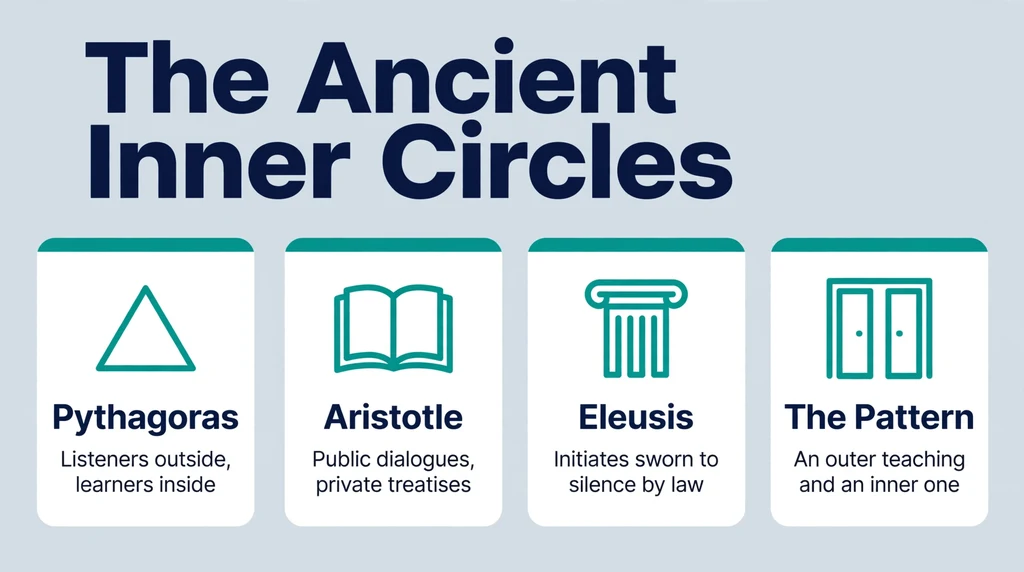
When Thomas Stanley reached for the word “esoterick,” he pointed it at Pythagoras. The choice stuck. For many readers, esoteric still summons an ancient classroom with two rows of students. One row hears the sayings. The other row hears the reasons behind them.
The reality is more tangled, and more interesting. Three ancient cases explain why the word carries so much history.
Pythagoras and the Two Rows of Students
Pythagoras founded his community in southern Italy in the sixth century BC. He left no writings of his own. As a result, almost everything about his teaching comes from much later writers.
Those writers, especially Iamblichus and Porphyry, describe two tiers of followers. The *akousmatikoi*, or “listeners,” received the master’s sayings and rules of life. They memorised short, cryptic maxims called *akousmata*. The *mathēmatikoi*, or “learners,” formed the inner circle. They were taught the proofs, the mathematics and the reasoning behind the rules.
Old reference books add a famous flourish to this picture. In that story, Pythagoras taught from behind a curtain. New students could hear his voice for years before they ever saw his face. Treat the curtain as a legend, not a fact. It appears in later tradition, not in anything like a contemporary record.
Here is the honest summary. A two-tier school fits what later sources say about the Pythagoreans. Still, the word “esoteric” itself was pinned on them only in the 1600s, roughly two thousand years after the fact.
Aristotle: The Books Everyone Read Are Gone
Aristotle gives the contrast its clearest ancient form. The Roman writer Gellius reports that Aristotle’s works fell into two classes. One class was exoteric, written for the wider public. Much of it took the form of polished dialogues, in the manner of his teacher Plato.
Those public works are the famous ones of the ancient world. Titles such as *Eudemus* and *On Philosophy* were admired for centuries. Cicero praised Aristotle’s writing warmly. Yet almost all of it is lost, surviving only in fragments quoted by later authors.
The second class was written for the school itself. These treatises are dense, technical and compressed, a bit like lecture notes. Ironically, they are the books that survived. The *Metaphysics* and the *Nicomachean Ethics* belong to this inner shelf.
Ancient writers even preserved a rescue story for them. Strabo and Plutarch tell how the manuscripts passed to Aristotle’s successor, then travelled to a town in Asia Minor. There they allegedly sat in storage for generations, until collectors recovered them in the first century BC. Editors in Rome then produced the editions behind the texts we read now.
So the modern puzzle makes sense. Readers meet Aristotle through his inner-circle notes and find them hard going. The friendly public versions, the exoteric Aristotle, mostly vanished.
Eleusis: Secrecy Enforced by Law
Schools were not the only ancient institutions built on this pattern. The most famous were the Mysteries of Eleusis, near Athens. For nearly two thousand years, initiates gathered there to honour Demeter and Persephone.
Much of the festival was public, including a great procession from Athens. The core rite was not. Inside a hall called the Telesterion, initiates witnessed sacred acts and objects. What exactly happened there, nobody wrote down.
That silence was not just custom. It was law. Athenian law punished disclosure of the Mysteries with death. Initiation was unusually open for the ancient world, welcoming women and even slaves who met the conditions. Yet the centre of the rite stayed sealed.
Eleusis shows the strongest form of the esoteric pattern. A whole society agrees that one room stays closed, and the agreement holds for centuries.
Why Inner Circles Formed
Step back, and the ancient cases share a logic. Inner circles protect things their holders value. Sometimes the treasure is a rite, and secrecy guards its power. Sometimes it is a skill, and graded teaching guards its quality.
Graded teaching also solves a practical problem. Advanced material confuses beginners and bores nobody more than the unprepared. A school that sorts listeners from learners can feed each group honestly. The outer teaching stays true, as far as it goes. The inner teaching simply goes further.
That charitable reading has a shadow, of course. Every inner circle also flatters its members and tempts them to hoard. The word esoteric has carried both scents ever since: reverence for depth, and suspicion of gatekeeping. Modern usage still swings between the two.
Inner Teachings in World Religions
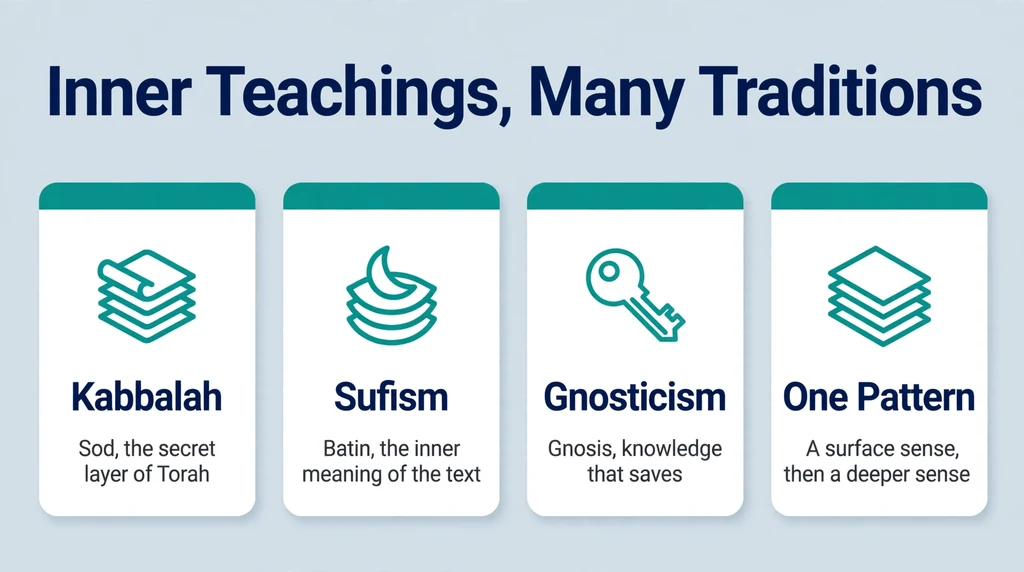
The pattern of an outer teaching and an inner meaning appears far beyond Greece. Several major traditions built exactly that structure into their reading of sacred texts. Scholars call this layer the esoteric dimension of a religion.
A note on method before we tour them. This section reports what each tradition teaches and how its own readers describe it. It does not endorse or dispute any belief.
Judaism: Kabbalah and the Secret Layer
The Hebrew word Kabbalah means “receiving” or “tradition.” It names the esoteric discipline within Jewish mysticism. Kabbalists hold that the Torah carries far more than its plain sense, and they read it for those hidden depths.
Traditional Jewish reading sorts interpretation into four levels, remembered by the acronym PaRDeS. The levels move from the plain meaning, through hints and homiletic readings, to the deepest level of all. That level is called *Sod*, which simply means “secret.”
Kabbalah works at the level of Sod. Its central text, the *Zohar*, appeared in Spain in the late thirteenth century. Scholars generally attribute it to Moses de León, a Spanish kabbalist. The *Zohar* explores, among other things, how the infinite God, called Ein Sof, relates to the finite world. For its readers, that exploration is the inner meaning of scripture itself.
Islam: The Outer Sense and the Inner Sense
Islamic thought has its own matching pair of terms. *Zahir* is the outer, apparent meaning of a text. *Batin* is the inner, hidden meaning behind it.
From the late eighth century, the word *ta’wil* came to name the esoteric interpretation of the Quran. It stood alongside *tafsir*, the conventional commentary on the text’s plain sense. The distinction was about depth, not loyalty. An esoteric reading usually adds a layer rather than replacing the outer one.
Sufi interpretation works extensively with these inner levels. In the Sufi view, verses can speak to the state of the reader’s heart as well as to law and history. Ismaili thinkers also stressed the balance between zahir and batin. Their emphasis on the inner sense was so marked that opponents nicknamed them the *Batiniyya*, the Esotericists.
Early Christianity: Gnosticism and Saving Knowledge
“Gnosticism” is a modern umbrella term, not the name of one ancient church. It gathers diverse movements that took shape in the first and second centuries AD, many of them around early Christianity.
What unites them, in the scholarly picture, is the prize they placed on *gnosis*. The Greek word means knowledge, but of a direct, experiential kind. Gnostic systems typically describe a hidden, perfect God beyond the material world. The world itself, in these systems, was made by a lesser and flawed creator, often called the demiurge.
On that view, the human problem is ignorance rather than guilt. Saving knowledge of one’s divine origin is therefore the way out. Such knowledge was, by design, not for everyone at once. It arrived through teachers, texts and insight, which makes Gnosticism a textbook case of esoteric religion.
One Pattern, Many Doors
These traditions differ enormously in belief and practice. Yet their reading habits rhyme. Each one distinguishes a surface that everyone may approach from a depth that asks for preparation.
The preparation takes many forms. It can be years of study under a teacher. It can be initiation, discipline or moral training. In every case, the inner sense is treated as something a reader grows into, not something a reader simply downloads.
That shared structure is why scholars reach for one word across all of them. “Esoteric” names the depth layer, whatever the tradition calls it at home: Sod, batin, gnosis or something else. The word travels well precisely because it describes a shape, not a doctrine.
Western Esotericism: How “Rejected Knowledge” Became a Subject

So far, “esoteric” has been an adjective in search of its noun. The noun arrived late. French writer Jacques Matter coined *ésotérisme* in 1828, and the occultist Éliphas Lévi spread it in the 1850s.
English followed a generation later. In the 1880s, writers linked to Theosophy, above all Alfred Sinnett, put “esoteric” into wide circulation. The word now labelled a whole territory: alchemy, astrology, Hermetic philosophy, ritual magic, Kabbalah in its Christian and occult forms, and much more.
From Wastebasket to University Field
For most scholars, that territory long looked like a wastebasket. It held whatever the mainstream story of Western culture had thrown out. Serious historians studied philosophy, science and churches. The rest was filed under superstition and politely ignored.
In the late twentieth century, that changed. Scholars such as Frances Yates and Antoine Faivre argued that these currents deserved real historical study. Universities slowly agreed. The University of Amsterdam went furthest, creating a centre and chair for the History of Hermetic Philosophy and Related Currents.
The chair’s best-known holder is Wouter J. Hanegraaff. His book *Esotericism and the Academy* makes the field’s founding argument. In his account, “Western esotericism” is largely a collection of *rejected knowledge*. These are bodies of thought that the dominant culture pushed aside during the making of the modern world.
That framing explains the field’s odd shape. Its unity is not a shared creed. Its unity is a shared fate: rejection by the mainstream. Hanegraaff’s point, in short, is that the wastebasket itself has a history worth studying.
What Counts as Western Esotericism?
Catalogues of the field usually include Hermeticism, alchemy and astrology. They add Renaissance magic, Rosicrucianism and Christian Kabbalah. Later centuries contribute Freemasonry, Spiritualism, Theosophy and the modern occult revival.
Notice what this list is and is not. It is a historian’s shelf, built by scholars looking back. The people on it did not all know each other, agree with each other or use our label. “Western esotericism” is the name of the shelf, not of a single movement.
A Label Scholars Still Argue About
The shelf label remains contested, and the argument is instructive. Some historians worry that “esotericism” bundles together movements that never saw themselves as kin. A Renaissance alchemist and a Victorian medium share a shelf, they note, mostly because later centuries excluded both.
Others answer that the exclusion itself is the historical fact worth tracing. On that view, the label works like the label “heresy.” It records how a mainstream drew its borders, and who ended up outside them. The debate continues in journals and conferences, which is a healthy sign for a young field.
For the general reader, the takeaway is modest but useful. When a book says “Western esotericism,” hear “the currents the mainstream pushed aside.” Then check which specific tradition the author actually means.
Esoteric in Everyday English

Most modern uses of the word have nothing to do with temples or initiations. The circle is smaller and the stakes are lower. Still, the structure is the same: some people are inside the knowledge, and most people are not.
At Work and in Study
Every profession grows its own inner room. Lawyers trade in doctrines that read as pure fog to clients. Programmers debug faults whose fixes make sense to three colleagues and nobody else. Tax advisers discuss rulings that the rest of us experience as weather.
Call such material esoteric and nobody blinks. A journal article can be esoteric because its methods assume years of training. A clause in a contract can be esoteric because its meaning depends on case law. In these settings, the word simply marks a training gap.
In Taste and Conversation
The word also patrols the borders of taste. A friend with esoteric taste in music collects artists nobody else at the table has heard. An esoteric joke lands only for people who share the reference behind it. An esoteric hobby, like restoring antique radios, has its own vocabulary and saints.
Here the tone turns playful. The speaker usually admits being outside the circle, or teases someone for living inside it. Either way, the smallness of the audience is the whole point of the remark.
Compliment, Complaint or Neutral?
Context decides the flavour. Praising a scholar’s esoteric knowledge honours rare depth. Complaining that a manual is too esoteric accuses it of needless obscurity. The same sentence frame carries both charges.
Writers should handle the word with that in mind. If you call a colleague’s report esoteric, she may hear “impressively deep.” She may equally hear “why could you not just say it plainly?” When the distinction matters, add a word of your own to steer it.
On Bookshop Shelves and Syllabus Lists
Walk into a large bookshop and you may find the word doing retail work. Many stores keep an “esoteric” or “mind, body, spirit” section for tarot, astrology and mysticism. There the word functions as a shelf sign, promising browsers a particular flavour of hidden knowledge.
Universities use it more coolly. A syllabus might call a topic esoteric to warn students about its narrow appeal. Curriculum committees use the same word when they ask whether a course can find an audience. In both settings, the word quietly predicts the size of the room.
A Bonus Sense: Esoteric Programming Languages
Computing gives the word one more twist. Dictionary.com records a sense for programming languages designed to test an unusual concept, regardless of usefulness. Fans call them esolangs.
An esolang is a joke, a puzzle and an art project in one file. Its author deliberately makes it hard for outsiders to read. In other words, it is esoteric on purpose, which makes it the purest modern specimen of the word.
The Internet Sense: Esoteric as a Joke About Lore

Spend time in fandom spaces and you will meet the word in the wild. A meme gets called esoteric when its humour depends on deep background knowledge. The joke is not hidden by a priesthood. It is hidden by homework.
Deep Lore as a Locked Door
Long-running games, comics and series accumulate decades of backstory. Fans call this body of knowledge the lore. A meme that needs three seasons of lore to parse is, functionally, an inner teaching. Only initiates of the fandom laugh on time.
This is why “esoteric” pairs so well with the phrase “deep lore.” Both expressions praise and mock the same thing. The knowledge is real, hard-won and almost entirely useless outside the circle. Everyone involved knows it, and that shared knowing is the joke.
The Gate Is the Joke
Internet usage adds one twist the ancient world lacked. At Eleusis, secrecy was sacred and enforced. Online, the gatekeeping is itself the comedy. Posting an incomprehensible meme and labelling it esoteric invites outsiders to feel outside, briefly and safely.
The slogan of this humour might be “if you know, you know.” Getting the reference makes you a temporary insider. Missing it costs nothing but a shrug. The inner circle dissolves by morning, and a new one forms around the next post.
In short, the internet kept the word’s structure and dropped its solemnity. The small circle remains. The death penalty for talking has been replaced by a comments section.
Group chats run the same economy at kitchen-table scale. Every long friendship stores references that baffle partners and new colleagues. Dropping one without explanation is a tiny act of esotericism. It sorts the room into those who were there and those who were not, and it takes half a second.
Esoteric vs Similar Words
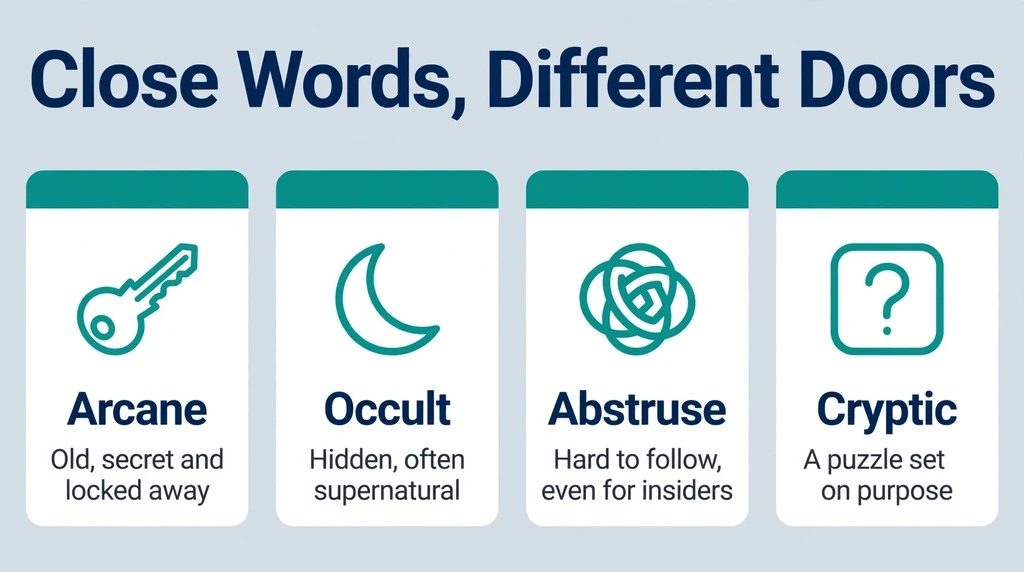
Esoteric keeps crowded company. English owns a shelf of words for hard, hidden or specialised things, and writers swap them carelessly. Each neighbour, however, guards a slightly different door.
Esoteric vs Arcane
Arcane means known or understood by very few, with a flavour of age and secrecy. An arcane rule in an old rulebook feels dusty and guarded. Esoteric stresses the prepared audience, arcane stresses the hiddenness. If the knowledge is old and locked away, arcane fits. If it is current but only experts follow it, esoteric fits.
Esoteric vs Occult
Occult comes from a Latin word for “hidden,” and it points at the supernatural. Occult practices involve magic, spirits, astrology or divination. An occult bookshop sells tarot decks, not tax manuals. Esoteric is wider and drier: it can describe occult material, but also mathematics, law and engineering. Every occult subject is esoteric to outsiders, yet most esoteric subjects are not occult.
Esoteric vs Recondite
Recondite describes knowledge that is deep, obscure and little known. Scholars enjoy it for abstruse corners of learning, and it carries no hint of initiation. A recondite fact is simply buried in the literature. Choose recondite when the barrier is obscurity alone. Choose esoteric when the barrier is a circle of people, trained or initiated, who hold the key.
Esoteric vs Abstruse
Abstruse complains about difficulty of understanding. An abstruse proof is hard even for its intended audience. Esoteric material, by contrast, may be perfectly clear to its insiders. A cockpit checklist is esoteric to passengers and transparent to pilots. If the problem is the audience, say esoteric. If the problem is the thinking itself, say abstruse.
Esoteric vs Cryptic
Cryptic means deliberately puzzling, like a riddle or a crossword clue. A cryptic remark hides its meaning on purpose and dares you to crack it. Esoteric content need not be a puzzle at all. It can be stated plainly and still defeat outsiders, because they lack the background. Cryptic is about intention. Esoteric is about access.
Esoteric vs Obscure
Obscure is the everyday rival, and the two overlap without matching. Something obscure is simply little known or hard to find. Forgotten silent films are obscure. Nobody guards them, and nobody needs initiation to watch them.
Esoteric adds the prepared audience to the picture. Obscure knowledge may have no circle at all, just neglect. Esoteric knowledge always implies insiders somewhere, even if the circle is three retired engineers. If a topic is unknown because the world moved on, call it obscure. If it is unknown to you because a group holds the training, call it esoteric.
The Word Family: Esoterica, Esotericism and Friends

A successful adjective usually breeds a family, and esoteric has bred a busy one. Knowing the relatives helps you pick the exact form a sentence needs.
Esoterica is a plural noun for the things themselves. Book dealers use it for volumes on magic, mysticism and fringe philosophy. It can also mean the assorted items of any niche obsession. A shelf of esoterica might hold grimoires, first editions and a great deal of incense.
Esotericism is the abstract noun for the whole phenomenon. It can mean the holding of esoteric beliefs, or the traditions that carry them. When scholars debate definitions, this is the word on the table. A rarer twin, esoterism, means the same and appears mostly in older or translated writing.
Esoterically is the adverb, and it does quiet work. A symbol can be read esoterically, meaning at its inner level rather than its plain one. The adverb is the natural partner of interpretation, translation and design.
Exoteric remains the family’s most useful member. It is the standing opposite, meaning suitable for or aimed at the general public. Course descriptions, museum labels and safety briefings all aspire to be exoteric. Paired in one sentence, the two words map any audience problem in four syllables each.
Common Misconceptions About Esoteric
Because the word sounds mysterious, myths gather around it. Four of them deserve a quick clearing.
Myth one: esoteric always means secret. Not so. Secrecy is only one way to keep an audience small. Difficulty does the same job in daylight. Most esoteric material today sits in public libraries, unread rather than forbidden.
Myth two: esoteric means occult or evil. The word names an audience, not a morality. Medieval sermons treated it neutrally, and modern academics use it for filing systems. Some esoteric currents involve magic, and some involve mathematics. Labelling either as sinister says more about the speaker than the subject.
Myth three: esoteric knowledge is deeper truth by definition. Insiders often claim depth, and sometimes they are right. Sometimes, though, a circle guards very little. Small audiences can form around trivia as easily as around wisdom. The word certifies exclusivity, never quality.
Myth four: if I cannot understand it, it must be esoteric. Plain bad writing also defeats readers. So does ordinary jargon doing honest work. Esoteric describes a relationship between content and a prepared audience. Confusion alone does not qualify, or every broken instruction manual would be a mystery text.
Frequently Asked Questions
What does esoteric mean in simple words?
It means meant for, or understood by, only a small number of people with special knowledge or training. An esoteric subject is one that outsiders cannot easily follow. Think of advanced mathematics, old ritual teachings or a joke that needs years of fandom background.
Is esoteric a compliment or an insult?
It can be either, and context decides. Applied to knowledge or taste, it often praises rare depth. Applied to writing or speech, it often complains that the speaker made things needlessly hard. If the tone matters, most listeners check the speaker’s face before deciding.
What is the difference between esoteric and exoteric?
They are opposites built from Greek words for inner and outer. Esoteric content is aimed at a small inner circle of the prepared. Exoteric content is aimed at everybody else. A public lecture is exoteric, while the specialists’ seminar after it may be esoteric.
What is esoteric knowledge?
Esoteric knowledge is any body of knowledge held by a small, prepared group. In religious settings, it means the inner teachings of a tradition, such as Kabbalah or the batin level of Quranic reading. In ordinary settings, it can mean any expert lore, from case law to speedrunning techniques.
What does esoterica mean?
Esoterica is a plural noun for books, objects or material of esoteric interest. Antique dealers use it for stock on magic, mysticism and unusual philosophy. More loosely, it covers the collected clutter of any deep niche interest.
Is esotericism a religion?
No. Esotericism is a category, not a creed. Scholars use it to group many traditions, movements and ideas that work with inner or hidden knowledge. Those traditions include religious ones, but also philosophical and artistic currents with no worship at all.
Why is the word esoteric linked to Pythagoras?
Later writers described Pythagoras’s school as split between outer listeners and an inner circle of learners. In about 1660, Thomas Stanley applied the word “esoterick” to that school in his *History of Philosophy*. The label stuck, and Pythagoras became the word’s ancient poster figure, fairly or not.
How do you pronounce esoteric?
Say es-uh-TAIR-ik, with the stress on the third syllable. The phonetic spelling is /ˌɛs.əˈtɛr.ɪk/. British speakers often start it with a longer “ee” sound, but the rhythm stays the same.
Final Thoughts
Esoteric began as a Greek way of saying “further inside.” It still does that job, for mystery schools and maintenance manuals alike. Wherever a small circle understands what the crowd cannot, the word finds work.
That makes it an unusually honest piece of vocabulary. It does not call content good or bad, true or false. It simply asks who the content is for, and how they got in.
If you want to watch the word at work in scholarship, the University of Amsterdam’s Hermetica centre shows how historians now study these inner circles. Or test the word closer to home. The next time a group chat erupts over a joke you cannot parse, congratulations: you have met the esoteric, and you are standing outside it.