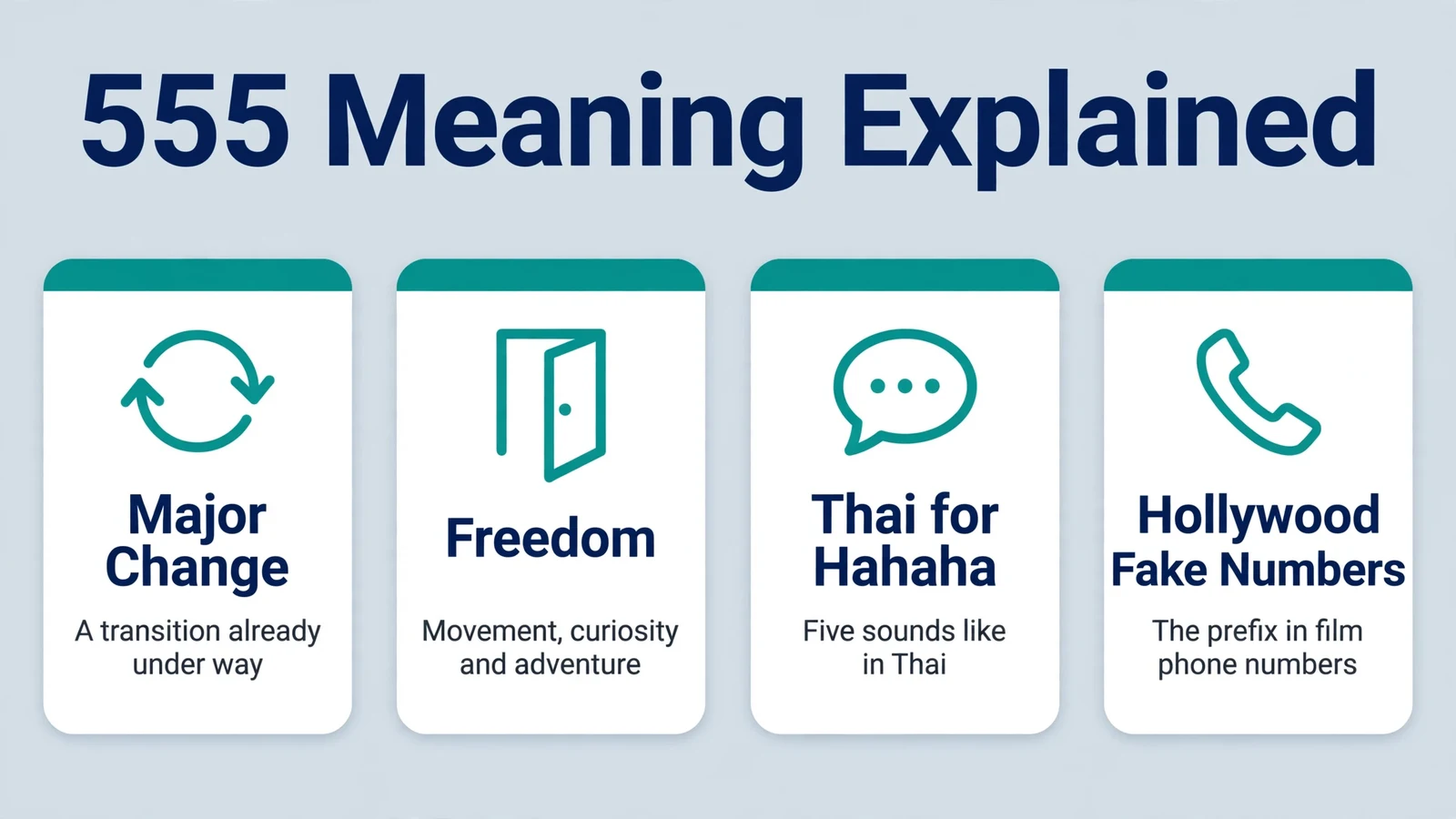
The clock says 5:55. Your coffee costs $5.55. Then a Thai friend ends a chat message with “555”. The same three digits are following you across two different worlds. In modern numerology, 555 is an angel number. It is a repeating sequence read as a message: a major change is already under way in your life. In Thai texting, it means something far simpler: laughter. Five in Thai is pronounced “ha”, so 555 just says hahaha.
This guide records both lives of the number, from the sources. It covers what the angel number tradition says 555 means for love, work and money. Thai slang and its strange Chinese mirror image get explained too. It also tells the plainer stories: Hollywood’s fake phone numbers and a legendary computer chip. And it covers what psychologists say about a number that seems to follow you.
What Does 555 Mean as an Angel Number?
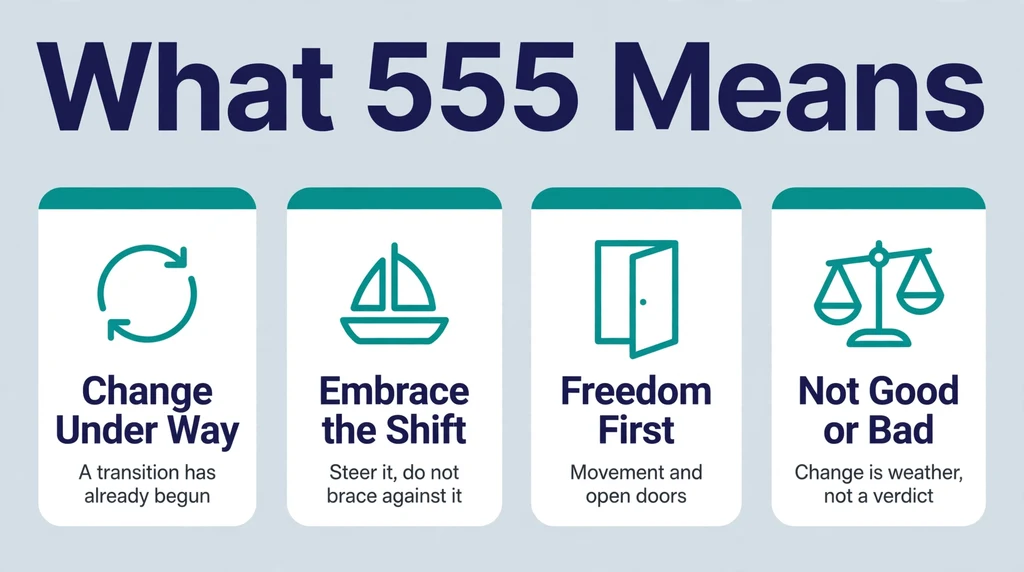
In the angel number tradition, repeating digits are read as messages. Each digit carries a theme, and repetition turns that theme up to full volume. The number 5 carries change, freedom and curiosity. Tripled, it gives 555 a single loud message: something in your life is shifting, and the shift has already started.
USA TODAY and Mental Floss have explained the trend, and the dedicated numerology sites agree with them. Their consensus interpretation combines into a short list:
- Change is under way. A transition is not just coming. On this reading, it has begun, in your home, your work, your relationships or all three.
- Freedom is the theme. Five is the digit of movement and open doors. So 555 is read as a push toward the freer version of your life.
- Let go of the old arrangement. What falls away during a 555 season is usually described as making room, not as loss.
- Stay flexible. The tradition’s standard advice is to steer the change rather than brace against it. Resistance, on this reading, is what makes transitions hurt.
- The change is neutral. The original source of the modern system insists the shift is not labelled good or bad in advance. It is weather, not a verdict.
That last point matters, because it separates the original system from many of its copies. Most modern pages present 555 as exciting news. The founding text is calmer, and it deserves its own hearing below.
The Original Entry: Buckle Your Seatbelts
Nearly every 555 interpretation on the internet descends from one short paragraph. It comes from Doreen Virtue, the Californian author who codified the modern angel number system. Her entry for 555, published in her number-sequence lists and in *Angel Numbers 101* (2008), reads: “Buckle your seatbelts. A major life change is upon you. This change should not be viewed as being ‘positive’ or ‘negative’ since all change is but a natural part of life’s flow. Perhaps this change is an answer to your prayers, so continue seeing and feeling yourself to be at peace.”
Notice what that paragraph does not do. It does not promise a lottery win or warn of a breakup. It treats change as a season to pass through calmly. Later sections tell the stranger story of Virtue herself, who went on to renounce the whole system.
Is 555 a Warning?
Newcomers often ask whether 555 is a warning sign, and inside the tradition the answer is no. A warning number, in this system, would counsel patience or caution. 555 does the opposite. It is read as advance notice that the ground is moving. The advice paired with it: keep your balance and your sense of humour. Numerologist Elizabeth Summers, quoted by USA TODAY, calls five a dramatic number that can bring restless, “itchy” feelings. Ignoring the possibility of change is the risky move, because the external world then forces the change anyway. Treat that as guidance or as folklore, as you like. The tradition’s own framing stays consistent: 555 is an announcement, not an alarm.
What Are Angel Numbers?
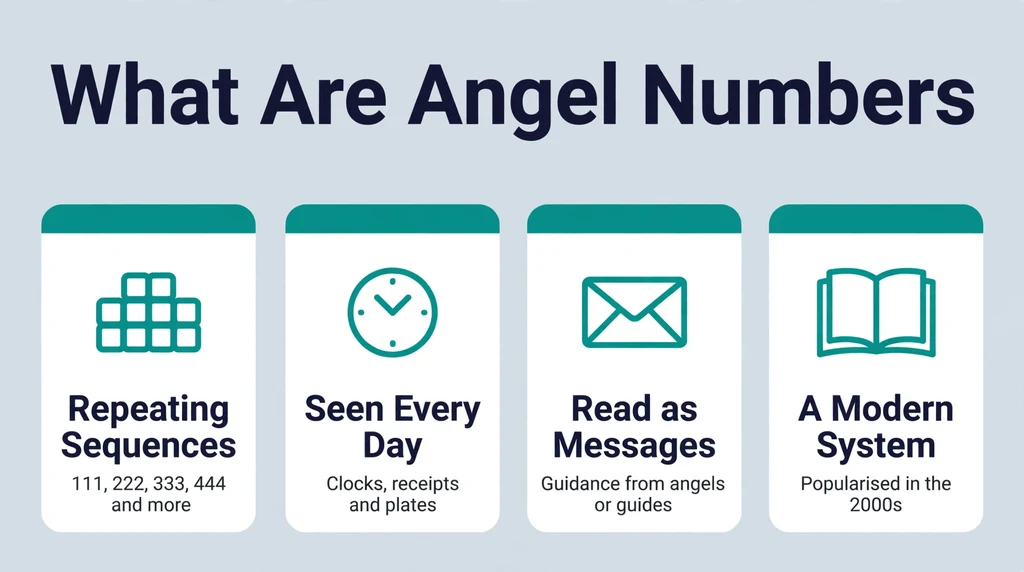
Angel numbers are repeating number sequences, such as 111, 222, 333 and 555, that people notice in everyday places. They turn up on clocks, receipts, licence plates, addresses and order confirmations. Inside the tradition, they are read as messages from angels, spirit guides or the universe. Each sequence is assigned a theme. Noticing it repeatedly is taken as a sign that the theme applies to you right now.
The system is modern, even though its raw material is old. People have loaded numbers with meaning for thousands of years. Britannica records that the Pythagoreans of the 6th century BCE assigned symbolic meanings to specific numbers. Theirs was the earliest known systematic movement based on the rule of numbers. The English word “numerology” itself, though, is not recorded before about 1907. The angel number version came much later. That dictionary, covering sequences from 000 to 999, was assembled and popularised only in the 2000s, largely by Doreen Virtue.
Interest surged again in the 2020s. Mainstream outlets such as USA TODAY and Mental Floss began explaining the sequences to general readers. The numbers became a fixture of social media feeds.
Two ground rules help a reader stay oriented. First, every meaning in this guide is a belief inside a tradition. It is reported here the way a guide to a festival reports its rituals. Second, the tradition expects personal context to do half the work. A sighting is usually linked to whatever you were thinking about at that moment. Critics call that flexibility the system’s weakness. Believers call it the point.
The Number 5, Three Times: Digit, Root and Midpoint
To see why 555 means change in this system, start with the single digit. In numerology, 5 sits at the exact midpoint of the cycle from 1 to 9. It is the pivot of the sequence, the point where the story turns. Sites across the tradition give it the same cluster of themes: freedom, movement, curiosity, adventure and experience.
The body is part of the symbolism. Five is tied to the five senses. So 5 is read as the number of physical life and appetite: travel, sensation, trying things. Writers in the tradition also define 5 against its neighbour. Four stands for stability, structure and the four corners of a room. Five is what steps outside those corners. Esoteric Esa, writing in Cosmopolitan, puts it as going beyond the four corners and extending yourself outside your comfort zone.
There is a second piece of arithmetic that some numerologists add. Add the digits of 555 and you get 15. Add again and you get 6. Six, in the same system, carries home, love, harmony and responsibility. Readers who use this root number blend the two themes. It is the change of 5, with the home base of 6 underneath. On that combined reading, 555 describes change that is ultimately about where and how you belong.
Small crossovers complete the picture. In tarot, the number 5 corresponds to the Hierophant, a card read as spiritual guidance and learning. In Christian number symbolism, five is traditionally linked with grace. Neither link is needed to understand 555. But both show how one digit collects meanings across systems, like a word collecting senses across languages.
555 in Love and Relationships
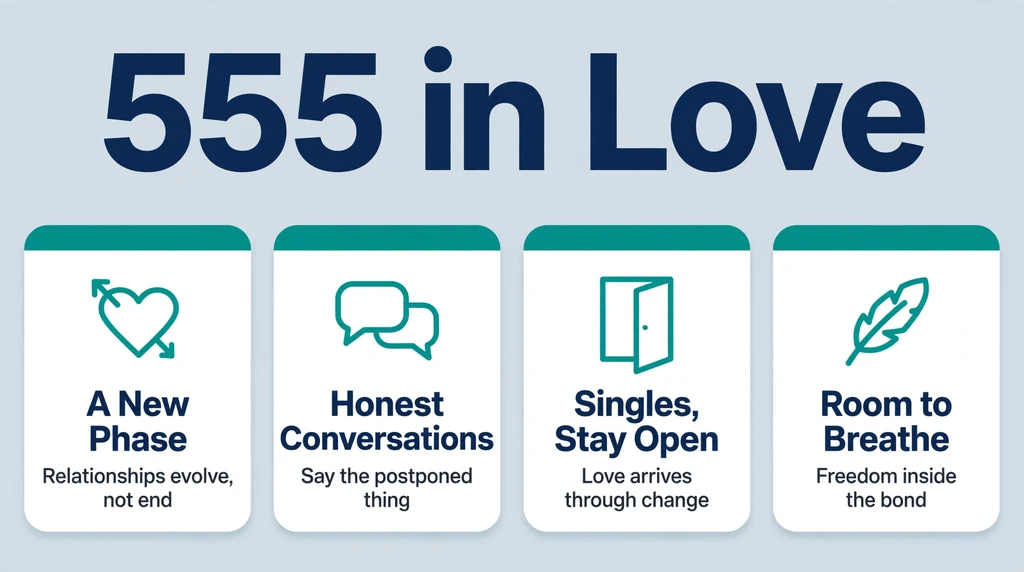
Love is where most 555 searches land, and the tradition’s reading follows the master theme. In love, 555 is read as a relationship entering a new phase. The number is not usually read as an ending. It is read as an evolution, sometimes a welcome one and sometimes an overdue one.
For Couples
For people in a relationship, the common reading is that the partnership is about to change shape. The examples given across the sources are concrete: moving in together, marrying, starting a family. Or finally having the difficult conversation that has been postponed for months. Old patterns are described as falling away so the relationship can continue on new terms. A recurring phrase in the tradition is that the relationship is levelling up, not breaking down. The advice paired with it is practical by the system’s standards. Talk honestly. Expect a period of adjustment. And do not mistake a transition for a failure.
For Single People
For single readers, 555 is read as a sign that love will arrive through change rather than through routine. The classic version of the claim is specific. A new person may appear from an unexpected direction, and may not match your usual type. The deeper point the sources return to is freedom. Five is the digit of room to breathe. So the reading often starts at home: become the freer version of yourself first. Let a relationship meet you there. As with every reading in this guide, this is the tradition talking, recorded as it states it. Nothing in it replaces the ordinary evidence of your own life.
The Honest Summary of the Love Reading
Strip away the decoration and the love reading is one sentence long. Do not expect the relationship chapter of your life to stay in its current shape. For some readers that is hope. For others it is a nudge they needed. The tradition is comfortable with both. Its founding text refused to call change positive or negative in the first place.
555 and Twin Flames
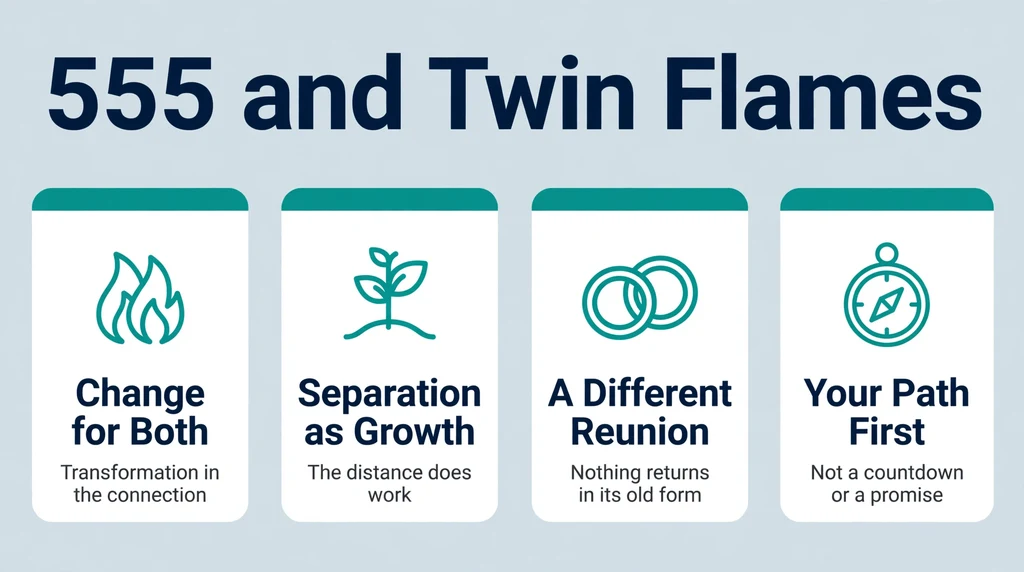
The twin flame idea holds that one soul can be split across two people. Their meetings and partings are said to drive each other’s growth. It sits inside the same spiritual culture as angel numbers. And 555 is one of the sequences its followers ask about most.
Within that framework, 555 is read as transformation arriving inside the connection. During a separation, the number is commonly read as a sign that the parting is doing work. Both people are being changed by it. The growth, not the distance, is the message. Around a reunion, 555 is read the other way. It marks a relationship that will not return in its old form. Whatever comes back has to be built on the changed versions of both people.
Two cautions appear even in sympathetic sources, and a fair guide should pass them on. First, 555 is not treated as a reunion countdown or a promise about dates. Second, the number is aimed at your own transformation first. Even the tradition’s keenest writers frame these readings as prompts for self-examination. They advise readers to weigh real behaviour, and real communication, far above any sequence on a clock.
555 for Money and Career
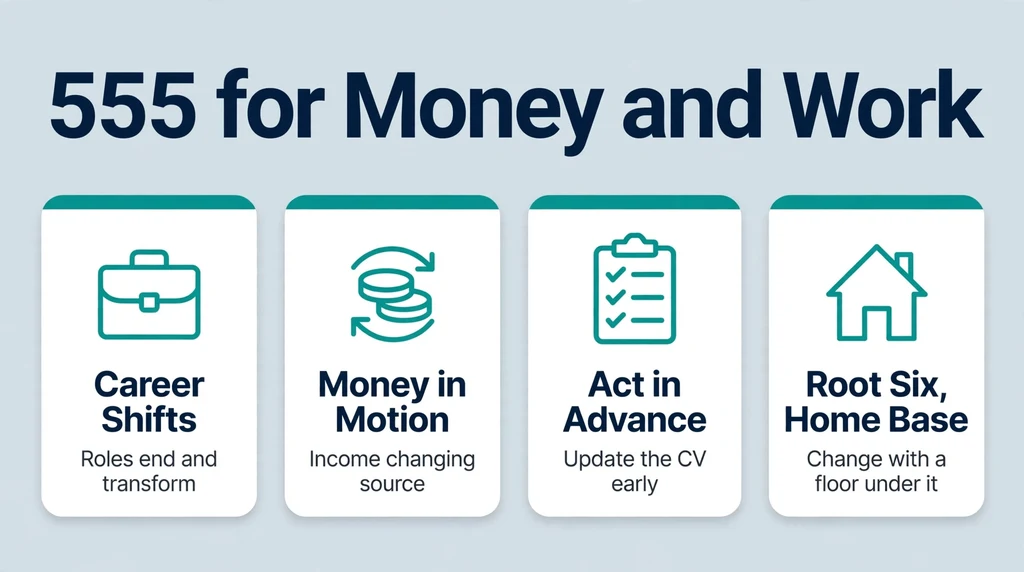
At work, the tradition reads 555 as a season of movement. USA TODAY’s expert ties five directly to changes of job and location. The work reading across the sources is built from the same pieces. Think of a role ending or transforming. Or a move of desk, city or industry. Or a side project asking to become the main project.
The money reading has a specific flavour worth recording. Five is the digit of appetite and experience. So 555 is often read as money moving rather than money settling. Income changing source. A budget being rebuilt. An opportunity arriving dressed as disruption. The root number adds the counterweight. Reduced to 6, the sequence points back to home and responsibility. The combined reading is change with a floor under it. Spend the transition building, the sources suggest, not scattering.
The practical advice attached to this reading is the least mystical part of the whole system. Update the CV before you need it. Keep an emergency fund if you can. Say yes to the conversation, the course, the introduction. A sceptic would call that ordinary prudence in a changing season. The tradition would answer that this is exactly what the number was trying to say.
Seeing 555 Everywhere: Clocks, Receipts and 5:55
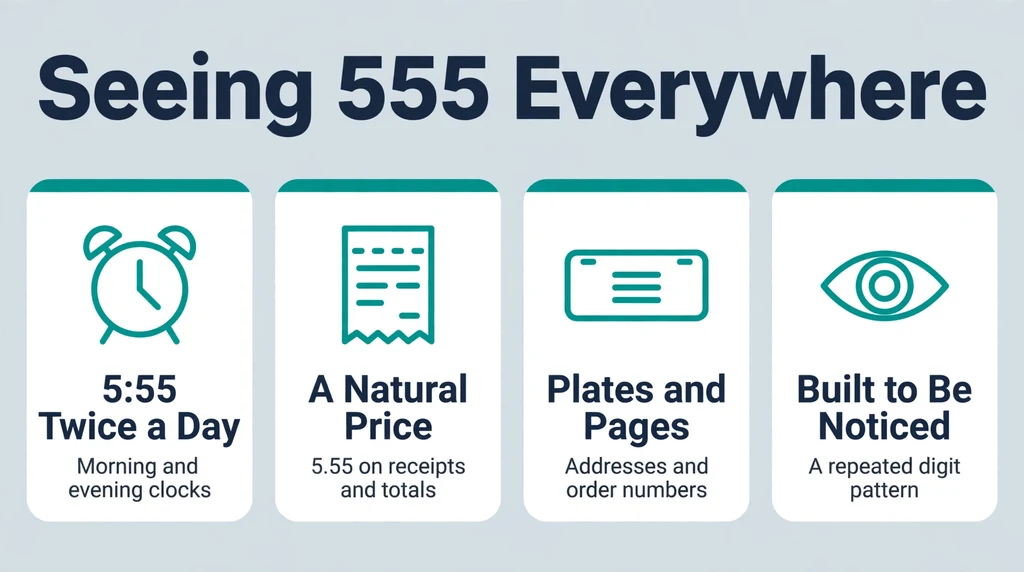
The commonest experience behind this search is not a single sighting. It is a run. 5:55 on the bedside clock. $5.55 at the till. A delivery slot at 5:55. All inside one week. The tradition reads such runs as an intensified message. It usually asks what you were thinking about at the moment of each sighting. The psychological account of the same week is covered in full later in this guide. Here, the plain facts deserve their moment first.
Why 555 Is Easy to Meet
Some numbers are simply well placed to be met. On a twelve-hour clock, 555 appears as 5:55 twice every day, morning and evening. It is also a natural price point: $5.55, £5.55 and €5.55 sit exactly where shops like to price small things. Add page numbers, addresses, jersey numbers, timers and order numbers, and a week contains far more 555s than intuition suggests. The number is also built to be remembered. A repeated digit is the easiest pattern the eye can catch. And 555 is one of only ten three-digit repdigits in existence.
What the Tradition Says to Notice
Inside the tradition, a run of sightings is treated as emphasis. The recommended response is attention rather than action. Note the thought in your mind when the number appears. Note which area of life feels unsettled. The reading writes itself from there, because 555 is always read against the part of life that is already moving. Whether that is a message arriving or a mind pattern-matching is the question the sceptical section takes up. Either way, the experience itself is real: that small jolt of significance at 5:55. It is the engine of the whole phenomenon.
555 in Thai: The Number That Means Laughter
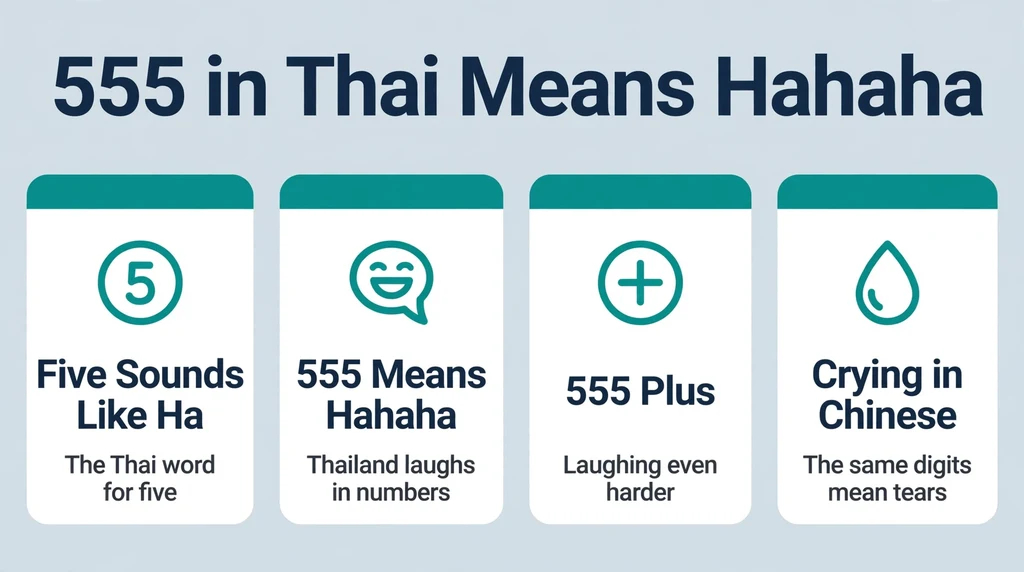
Now for the meaning that has nothing to do with angels. If a Thai friend ends a message with 555, they are laughing at you, with you, or at the joke. It is one of the most common pieces of slang in Thai digital life, and it works by sound.
How 555 Became “Hahaha”
Thai is a tonal language, and its number words are short. The Thai word for five is ห้า, pronounced “hâa”, with a falling tone. Say it three times and you have performed laughter: ha, ha, ha. Typing 555 is faster than typing the Thai script for the sound, and every Thai reader hears it instantly. Learner guides, including Talkpal and the Ling App, present 555 as the standard Thai equivalent of LOL. Thai speakers use it everywhere, from family chats to video comment sections.
The system scales, the way typed laughter does in any language. More fives mean more laughter: 5555 out-laughs 555, just as “hahahaha” out-laughs “haha”. Thai users also play with length for tone. They stretch the string when something is genuinely funny, and keep it short for a polite chuckle.
It also does quieter work. A 555 dropped after your own message marks it as a joke. It works as a small tonal flag that says: do not take this one seriously.
555+: Laughing Even Harder
The sharpest form of the slang adds a symbol. 555+ is read as laughing even harder, the plus sign working like the words “and more” or “plus shipping”. Seasia, a Southeast Asia culture site, lists 555+ as the next level up from a plain 555. Learners’ guides describe it the same way. If your Thai colleague replies “555+” to your message, the joke landed well. No reply in the thread will top it without adding several more fives.
The Chinese Mirror: Where 555 Means Crying
Here is the twist that makes this number a small masterpiece of internet linguistics. In Chinese online slang, 555 means the opposite of laughter. The Mandarin word for five is 五, pronounced “wǔ”. That sound sits close to 呜, the written sound of sobbing. So a run of fives, 呜呜呜, “wuwuwu”, is the sound of someone crying. Chinese slang guides from Preply and Everyday Easy Chinese both list 555 as the crying shorthand. It is typed when something is sad, unfair or adorably upsetting.
Put the two side by side and the lesson is pure lexicography. Digits have no meaning of their own in these systems. Each language hears its own number words inside them. Bangkok hears “ha” and laughs. Beijing hears “wu” and cries. The angel number tradition, meanwhile, hears a message about change. Same three digits, three unrelated readings, each one obvious to the people who use it.
The Other 555s: Hollywood Phones and a Famous Chip
Two more 555s live outside language and numerology entirely. Both are documented, checkable and quietly famous.
The Phone Number That Reaches Nobody
Every phone number in an American film seems to start with 555, and that is deliberate. From the 1960s, telephone companies encouraged producers to use the 555 prefix on screen. The point was simple: curious viewers should not harass real subscribers. Two early examples survive in the record. *The Second Time Around* (1961) used 555-3485. *Panic in Year Zero!* (1962) used 555-2106.
The modern rule is narrower than most people think. 555 is a central office code, the middle three digits of a number, not an area code. Only one block is specifically reserved for fictional use in entertainment and advertising. It is 555-0100 through 555-0199, set aside by the North American Numbering Plan Administrator. A number in that range reaches nobody, by design. Not every 555 number is fake, though. 555-1212 has long been real directory assistance in the US and Canada. So when a character reads out a number ending in 555-0143, enjoy the detail. You are watching a small piece of telecom regulation doing its job.
The Chip That Times the World
Ask an electronics engineer what 555 means and angels will not come up. The NE555 is a timer chip, an eight-pin integrated circuit used to produce time delays, pulses and oscillations. It sits inside toys, timers, flashing lights, musical gadgets and industrial controls. It was designed by the Swiss engineer Hans Camenzind, under contract for the Signetics company, and introduced in 1972.
Its success is difficult to overstate. Wikipedia calls the 555 the most popular integrated circuit ever manufactured. An estimate from 2003 put production at a billion units a year. Camenzind’s little timer outlived its maker, its decade and most of its rivals. One beloved story claims the chip was named after three 5,000-ohm resistors inside it. Camenzind himself said the number was chosen arbitrarily, so enjoy the resistor story as folklore. The angel number readers would appreciate the pattern, from their side of the digits. Everyone who meets 555 seems to find a meaning in it.
555 the Plain Number
Strip away every story and 555 is still a tidy piece of arithmetic. It is a repdigit, a number built from one repeated digit, like 111 or 777. Its factors are small and neat: 555 = 3 × 5 × 37. Add its digits and you get 15. Add again and you get 6, the same reduction the numerologists use for its root number. In Roman numerals it is written DLV: 500, 50 and 5 in a single descending row.
None of this makes 555 magical. It does help explain its grip. Repeated digits are the easiest pattern in the number system for a human eye to catch. A number that reduces this cleanly also invites stories. The arithmetic is plain. What people build on it is not.
The Woman Who Popularised Angel Numbers, and Renounced Them
The modern angel number system has an identifiable author figure. Doreen Virtue, a Californian writer with a background in psychology, codified the numbers in two books. *Angel Numbers* came in 2005, with Lynnette Brown. *Angel Numbers 101* followed in 2008. Her 555 entry, quoted earlier in this guide, is the ancestor of almost every 555 page on the internet.
Then the story turns. Virtue converted to Christianity and was baptised in February 2017. Later that year she publicly renounced her New Age work, angel numbers included. She told the story at length in *Deceived No More* (2020). Profiled by The Cut in 2024, she looked back at the whole enterprise. Her verdict: “I regret it, and I’m sorry that I made them.”
The renunciation changed nothing about the numbers’ popularity. Detached from their author, the readings had become folk property, copied into thousands of pages and apps. The site’s companion guide to 333 tells her story in full. For 555, the essential point is hers. It is the calmest sentence in the system: the change this number announces is neither positive nor negative. It is simply part of life’s flow.
The Sceptical View: Why the Number Finds You
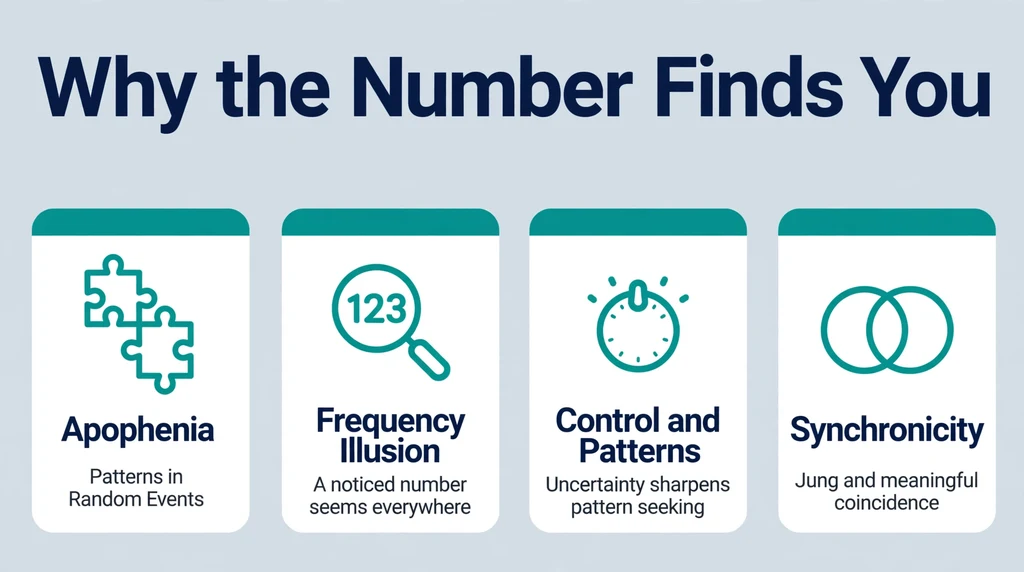
Psychology has named the machinery behind the 555 experience, and its account deserves a full hearing. It explains the experience without mocking it, which is more than can be said for most arguments about this number.
Apophenia: The Pattern Habit
Apophenia is the human tendency to perceive meaningful patterns in random or unrelated data. The term was coined by the psychiatrist Klaus Conrad. His 1958 work concerned the early stages of schizophrenia, where the pattern sense runs painfully strong. The underlying faculty, though, is universal and mostly useful. It is the same pattern finding that lets humans read faces, learn languages and spot the tiger in the grass.
The Frequency Illusion
The frequency illusion, also called the Baader-Meinhof phenomenon, is the specific mechanism for the number that follows you. Once a pattern is noticed, attention is primed for it. The mind filters out nearly every number it passes. Now it flags each 555. The count of sightings climbs steeply, while the number’s real frequency in the world has not changed at all. Experiments on perceived control add the emotional layer. Whitson and Galinsky (2008) showed that people who feel a loss of control detect patterns more readily. That fits the biography of most angel number searches. They are typed at turning points, in transitions, in suspense about a job or a person.
Synchronicity: The Bridge Concept
Synchronicity is the bridge concept between the two worldviews. Carl Jung developed the idea of meaningful coincidence, an “acausal connecting principle”. He set it out fully in a 1952 essay written alongside the physicist Wolfgang Pauli. Believers in angel numbers often cite synchronicity as their framework. Sceptics reply that the frequency illusion explains the sightings without residue. A guide need not referee. It can note that both sides agree on the experience itself. They disagree only about where that surge of significance at 5:55 comes from.
There is a fitting detail in the sceptical account for this particular number. 555 is supposed, by its own tradition, to appear during change. Psychologists note that people notice patterns most during exactly those seasons, when life is unsettled and control feels low. The believer and the psychologist are describing the same week of your life. They simply file it in different cabinets.
555 Among the Repeating Numbers
Every triple sequence in the system has its own headline. Placing 555 in the family shows what is distinctive about it:
- 111: new beginnings; watch your thoughts.
- 222: balance, patience and trust in the process.
- 333: encouragement, support and creative growth.
- 444: protection and stability; foundations holding.
- 555: major change, freedom and transition.
- 666: rebalance your thoughts; less material focus.
- 777: luck, applause and spiritual momentum.
- 888: abundance and a phase ending well.
- 999: completion; a chapter closing.
Read down the list and 555 is the only one about motion for its own sake. Its neighbours counsel patience, stability or endings. 555 is the hinge of the sequence, the midpoint digit tripled. The tradition treats it exactly that way: the moment the story changes direction.
What to Do When You Keep Seeing 555
The tradition’s own guidance is modest, and it can be followed without believing a word of the system.
First, note the pattern honestly. When did the sightings start, and what else started then? Most people who search this number are already standing inside a decision. It might be a job, a move or a relationship. It might be a version of life that has stopped fitting. The number is rarely the news. The decision is.
Second, borrow the founding text’s calm. Virtue’s entry refuses to call the change positive or negative. Translated out of the system, that is sound advice for any transition. Do not grade the change before you have lived it. Grade the practicalities instead. Money, timing, who is affected, what can be reversed.
Third, take the small version of the step. The tradition frames 555 as permission to move, not as a command to leap. Update the application. Book the viewing. Start the conversation. If the number means anything in your week, it is probably this. The waiting, not the change, is the part that has stopped working.
And if a Thai friend sent you here, the instructions are simpler. Reply with more fives than they sent you. You will have said exactly the right thing.
Frequently Asked Questions
What does 555 mean spiritually?
Inside the angel number tradition, 555 is the spiritual sign of major change. The message: a transition is under way in your life, and freedom sits on the other side of it. The reading comes from modern numerology, popularised by Doreen Virtue in the 2000s. It is a belief reported by this guide, not a verified property of the number.
Is 555 a good sign or a bad sign?
The tradition itself declines to grade it. Doreen Virtue’s original entry says the change “should not be viewed as being ‘positive’ or ‘negative'”, because change is a natural part of life’s flow. Most modern sites lean positive and read 555 as encouragement to embrace a shift. Nobody inside the system reads it as a warning or a curse.
Why do I keep seeing 555 everywhere?
Two answers share the evidence. The tradition says repeated sightings are an intensified message, timed to your thoughts. Psychology names the frequency illusion. Once 555 catches your attention, your mind flags every later copy. It filters out the rest, so sightings seem to multiply. The number is also genuinely common, appearing at 5:55 twice a day and in prices like $5.55.
What does 555 mean in a text message from a Thai person?
It means laughter. The Thai word for five, ห้า, is pronounced “ha”, so 555 reads “hahaha”. It is the everyday Thai equivalent of LOL. A longer string, or 555+, means the sender is laughing even harder. It carries no numerological meaning in that context at all.
What does 555 mean in love?
The tradition reads 555 in love as a relationship changing shape. A new phase for couples. Love arriving through change, for single people. It is usually framed as evolution rather than an ending. Twin flame readers use it the same way, as a marker of transformation for both people in the connection.
Is 555 a real phone number I can call?
Mostly, no. In North America, numbers from 555-0100 to 555-0199 are reserved for fictional use. They appear in films, TV and advertising precisely so that nobody answers them. Other 555 numbers exist for special purposes, and 555-1212 is genuine directory assistance. The 555 you see on screen is regulation, not a plot hole.
What is the difference between 555 and 333?
The two numbers carry opposite temperatures in the same system. 333 is the number of encouragement: support is near, keep growing, you are backed. 555 is the number of change: the furniture of your life is about to move, so stay flexible. People often report seeing them in the same season, which the tradition reads as change arriving with support attached.
Does 555 mean the same thing in China?
No, it means the reverse. In Chinese internet slang, 555 imitates the sound of sobbing, “wuwuwu”. The Mandarin word for five (五, wǔ) echoes the written cry 呜呜呜. Chinese users type it for sadness or mock despair. The same digits that laugh in Thai cry in Chinese, because each language hears its own number words.
Conclusion
555 is a small number with an unusual number of jobs. To the angel number tradition, it is the loudest announcement of change in the whole sequence. A seatbelt warning for a life in transition. Its author insisted that change is neither prize nor punishment. To Thai speakers it is simply the sound of laughter, three syllables of it. Hollywood knows it as a phone number that reaches nobody. To engineers it is a chip, designed in 1972, that still times the world.
Underneath all four sits the oldest instinct of the set. People have read meanings into numbers since the Pythagoreans assigned them symbols, back in the 6th century BCE. Britannica tells that story in its account of Pythagoreanism. The digits change; the reading habit does not. Your 555 may have arrived as a message, a joke or a film prop. It may just be pattern-hunger at 5:55. Either way, you now know every trade it works in. Choose your own filing cabinet.