Your phone buzzes. A new contact, a fresh Snapchat add, or a match on a dating app has sent you one tiny message: “wyf.” Three letters, no context, and no question mark. So what are they actually asking you?
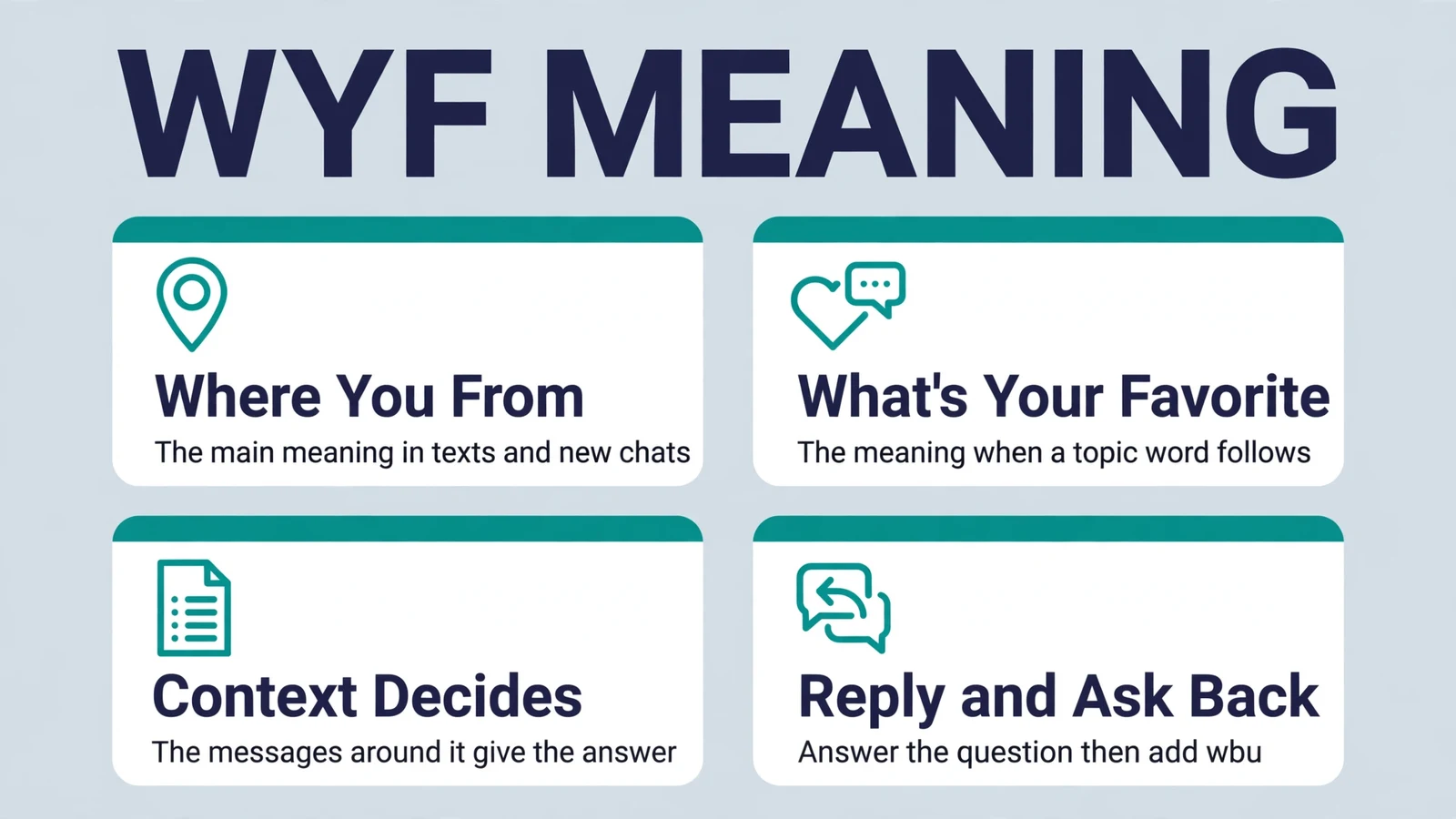
In most texts and direct messages, wyf means “where you from?” The sender wants to know your hometown, your city, or the place you live now. It is one of the standard first questions of online small talk. However, wyf has a second life as “what’s your favorite?”, and that reading shows up whenever a topic word follows it.
To keep this guide accurate, we checked the term against CyberDefinitions, Urban Dictionary, AcronymFinder, and The Word Counter. Below, you will find both main meanings, the minor ones, platform-by-platform notes, and word-for-word replies you can copy.
What Does WYF Mean?
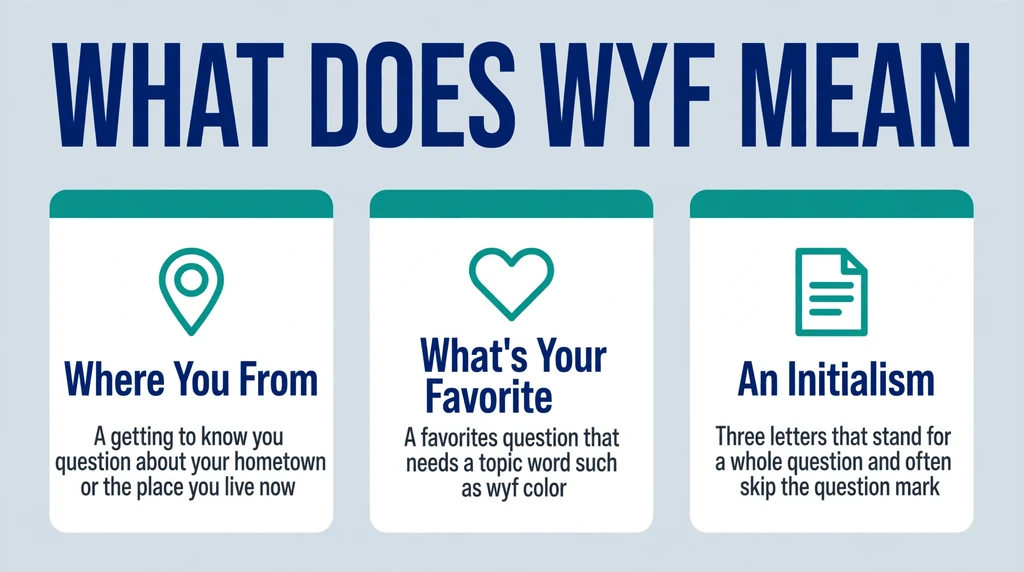
WYF is an initialism, a short form built from the first letters of a spoken question. Unlike a fixed phrase, though, it can unpack into more than one question. The right expansion depends entirely on the chat around it.
The main meaning: “where you from?”
In a one-to-one conversation, wyf almost always means “where you from?” The Word Counter describes this as the most common use, following Urban Dictionary, whose top entry for the term gives exactly that definition. AcronymFinder carries the same reading in its slang list.
People send it when they are placing a stranger. They want a hometown, a city, or a country, and they usually want it early, before the chat goes anywhere else. In other words, it works like the digital version of a question you would hear at a party.
Answers follow a set scale. From a stranger, a country or a state is a complete reply. From someone friendlier, a city is normal. Nobody expects more detail than that, and most people match the level the other person sets.
One small choice hides inside the answer: hometown or current home. Some people name where they grew up, others name where they live now, and both count as correct. If the two differ, many people give both, because the follow-up question usually asks anyway.
The second meaning: “what’s your favorite?”
WYF can also mean “what’s your favorite?” CyberDefinitions lists this reading, and Urban Dictionary has carried an entry for it since December 2008. The example there is simple: “WYF type of food?” “Chinese, for sure.”
Notice the pattern in that example. The favorite reading almost never travels alone. Instead, it arrives with a topic attached, such as a color, a song, or a movie. A close variant, “who’s your favorite?”, does the same job for people, as in “wyf actor?” asked about a cast list.
Why references list the meanings in different orders
Honest guides admit a small disagreement here. CyberDefinitions puts “what’s your favorite?” at the top of its list. By contrast, Urban Dictionary’s top entry and most reply guides lead with “where you from?”
In practice, the ordering matters less than the setting. A bare “wyf?” from someone new is a location question. Meanwhile, “wyf” plus a topic word in a group chat or poll is a favorites question. The sections below show you how to tell the two apart at a glance.
Three quick checks before you answer
You rarely need more than five seconds to work out the meaning. First, look for a topic word. A noun right after wyf, like color or song, means the favorite reading.
Second, look at who sent it. A brand-new contact has nothing to ask favorites about yet, so they are asking where you are from. A close friend already knows your hometown, so their wyf points somewhere else.
Third, look at where it appeared. A private DM leans toward location, while a story poll or group chat leans toward favorites or plans. Run those three checks, and the right answer almost always becomes obvious.
Watch the checks work together. A brand-new follower sends bare “wyf”: no topic word, no history, private setting, so location wins three times over. A story asks “wyf snack?”: topic word present, public setting, so favorites wins just as clearly.
WYF Meaning in Texting
Texting is the natural home of wyf. It belongs to the same family as wyd and wya, the three-letter openers that start thousands of casual chats every day. Understanding how it behaves on screen makes the meaning much easier to read.
Where it shows up in chats
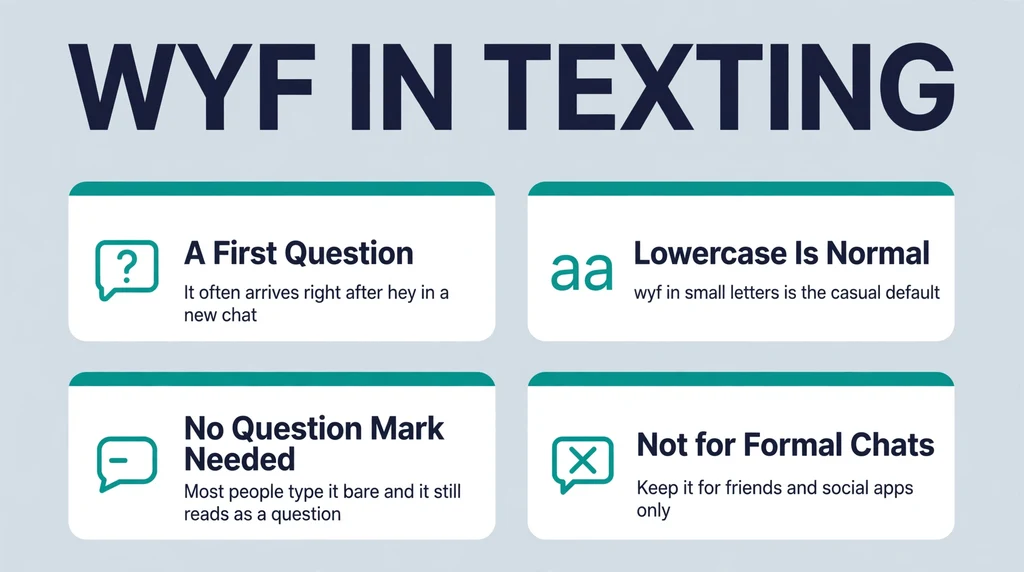
Most often, wyf appears near the very start of a conversation. Someone adds you, matches with you, or follows you, and after a quick “hey” comes “wyf.” The Word Counter notes its use in SMS chat and on social media and dating sites such as Tinder and Snapchat.
It also appears in gaming chats. There, the question often has a practical side, because your country or region affects your server, your ping, and sometimes your language. Group chats use it too, although there it leans toward the favorite reading covered later.
How it looks on screen
CyberDefinitions classifies wyf as an initialism abbreviation. It also notes that wyf plays the role of a question, yet people commonly write it without a question mark. A bare “wyf” in lowercase is completely normal, and it still reads as a question.
Capital letters change nothing about the meaning. “WYF” in caps might look louder, but it asks the same thing. Likewise, adding a question mark adds politeness, not a new definition. The form is casual in every version.
Who sends it, and why
The sender is usually someone who barely knows you yet. They are filling in the basics: place first, then maybe age, school, or work. For that reason, wyf signals interest in continuing the chat, even when it feels abrupt.
Friends send it too, but between friends it usually does different work. With people who already know where you live, wyf tends to mean “what you feeling?” or “what’s your favorite?” instead. The next sections unpack those cases one by one.
When the chat moves past wyf
WYF rarely travels alone for long. A typical opening runs through a short sequence: greeting, wyf, then questions about age, school, work, or hobbies. Each answer unlocks the next topic, which is exactly how small talk is supposed to work.
Knowing the sequence helps you pace your answers. You can share at the speed the other person shares. When their replies stay one word long while yours grow detailed, the balance is off, and you are free to slow down or stop.
Using wyf yourself
If you want to send wyf, pair it with a greeting first. A plain “hey, wyf?” feels warmer than the bare letters, and it earns better replies. Follow up on the answer too, because a question with no reaction feels like a form being filled in.
Share your own answer without being asked. “Wyf btw, I am from Ohio” models the exchange and keeps things even. And keep the term in casual spaces only. The Word Counter is blunt on this point: wyf is extremely casual text speech, so it has no place in work messages or formal writing.
When WYF Means “What’s Your Favorite?”
The favorite reading deserves its own section, because it causes the most crossed wires. Someone answers a hometown when the sender wanted a song, and the chat stumbles. Luckily, this reading carries a clear signal.
The topic word gives it away
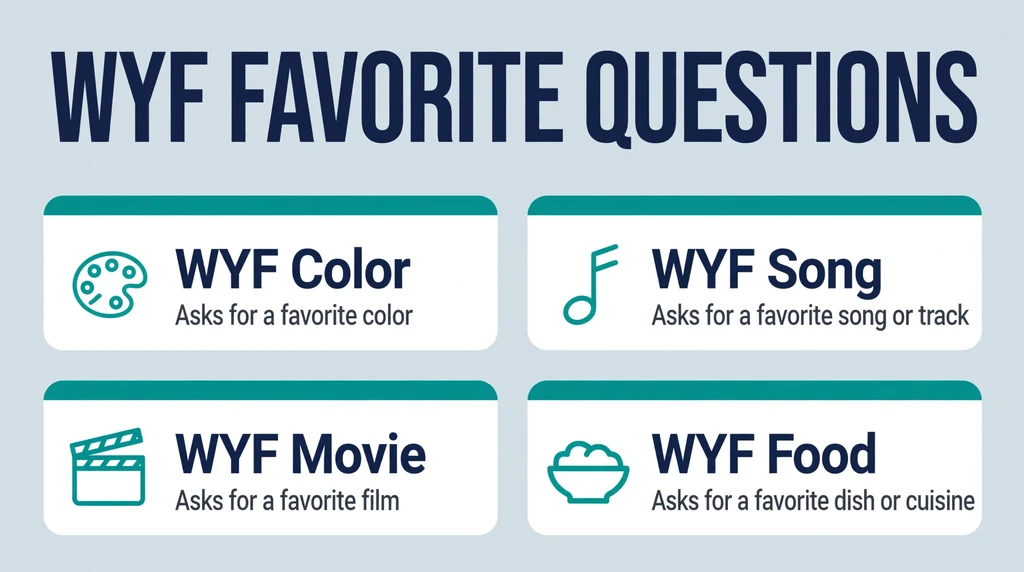
A favorite question needs something to be favorite about. So the sender attaches the topic directly: “wyf color?”, “wyf song on the album?”, or “wyf movie this year?” Slang guides describe this pattern in polls, captions, and comment games, where the word after wyf names the category.
Once you spot the topic word, the reading is settled. You do not need to share a location. You simply name your pick, and the conversation moves on to comparing answers.
“Who’s your favorite?” for people
When the topic is a person, the same letters mean “who’s your favorite?” CyberDefinitions lists this variant directly. The Word Counter glosses it as asking which person someone likes best from a specific list.
You will see it around sports, music, and shows. “Wyf player on the team?” or “wyf character?” asks for a person, not a place. The answer format stays the same: one name, maybe with a short reason.
Where the favorite reading lives
This version thrives in public and semi-public spaces. Instagram story polls, TikTok comment threads, and group chats all run on quick opinion questions. Favorites are perfect fuel there, because everyone can answer in two seconds.
By contrast, it rarely opens a private chat with a stranger. A new contact who writes only “wyf” is asking where you are from. Context, as always, makes the call.
Favorite questions people ask most
Certain categories come up again and again. Color, food, song, and movie lead the list, because everyone has an answer ready. Season, sport, and video game follow close behind in group chats and gaming spaces.
The answers follow a ritual too. People state a pick, defend it in half a sentence, then challenge someone else’s choice. That loop is the whole game, and it is why the favorite version of wyf thrives anywhere an audience can pile in.
Other Meanings of WYF
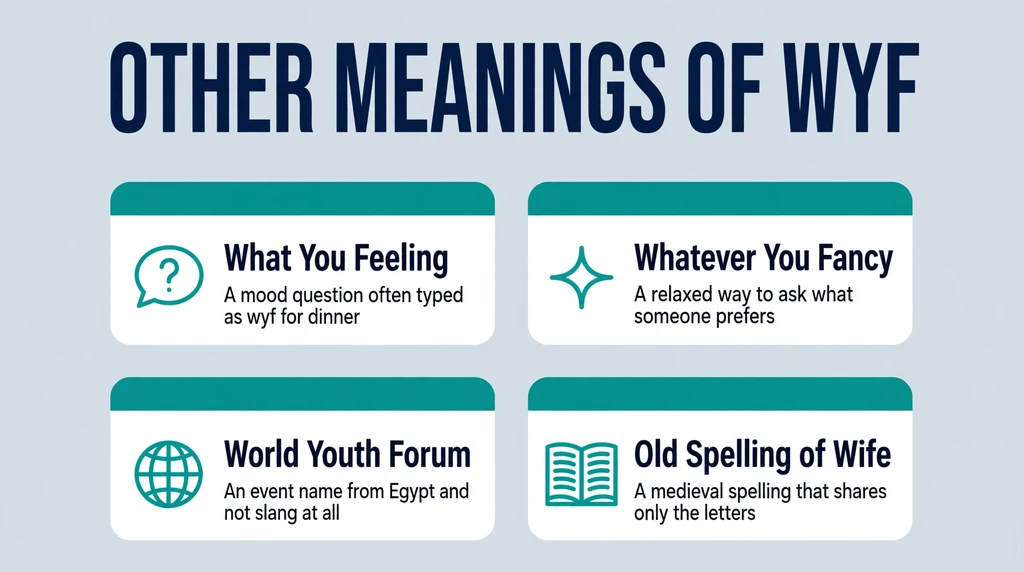
Beyond the two main readings, wyf picks up a few smaller jobs. None of them leads a chat with a stranger, but each one is real enough to recognize. A couple of fringe readings also exist, and they deserve an honest warning label.
“What you feeling?”
Between people who know each other, wyf can mean “what you feeling?” AcronymFinder lists this expansion, and slang guides point to a giveaway: the word “for.” The classic example is “wyf for dinner?”, which asks what you are in the mood to eat.
The same reading can ask about mood in general. A friend who knows your week has been rough might check in with it. Either way, the answer is a feeling or a craving, never a hometown.
“What you fancy?” or “whatever you fancy”
A close cousin is “what you fancy?” AcronymFinder lists it as “whatever you fancy,” and usage guides describe it as a relaxed preference question. It appears while people make plans, especially around food, drinks, or a night out.
In that setting, wyf works like an open door. The sender is not demanding a decision. They are asking what sounds good to you right now.
Both of these smaller readings share one trait. They only appear between people who already know each other. A stranger has no plans to make with you yet, so their wyf cannot be about dinner or mood.
World Youth Forum
One expansion has nothing to do with slang at all. WYF also stands for the World Youth Forum, an Egyptian initiative first held in November 2017. CyberDefinitions explains that it brings young people from around the world together to exchange views and make recommendations to decision-makers.
You will only meet this meaning in formal or news contexts. If a headline or an event page uses WYF, it means the forum, not a text message.
Minor readings and an old spelling
Two footnotes complete the picture. First, Urban Dictionary carries a few user-submitted expansions, including playful and crude ones, that mainstream slang references do not list. Treat those as unverified one-off entries rather than real meanings.
Second, “wyf” was once a Middle English spelling of “wife.” That is a spelling coincidence, not the origin of the slang. Still, it explains why a search for wyf occasionally surfaces old texts instead of texting guides.
WYF on Snapchat, TikTok, and Instagram
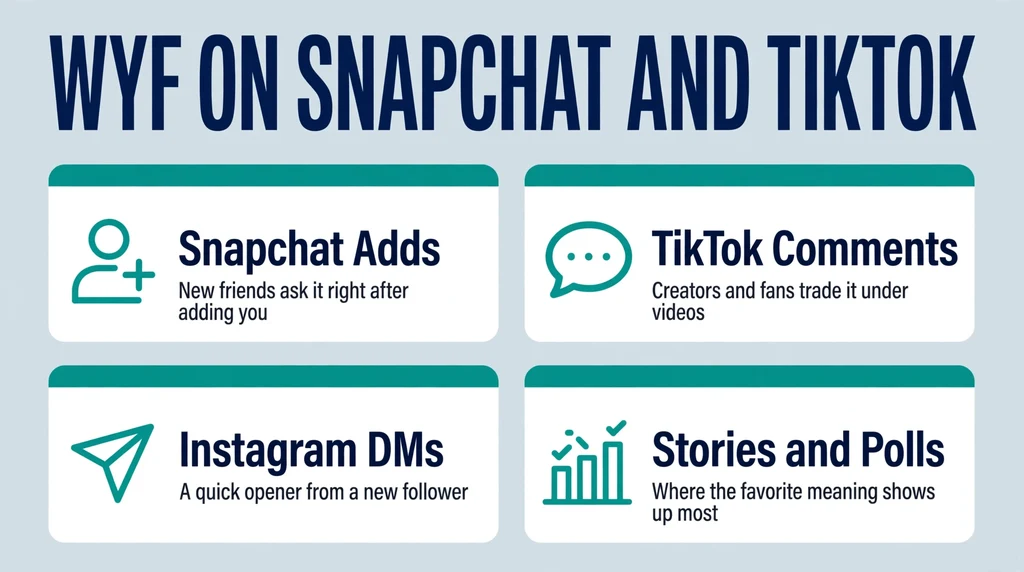
Each platform gives wyf a slightly different flavor. The letters stay the same, but the setting shifts the odds of each meaning. Here is how it plays on the big three, plus a note on gaming spaces.
WYF on Snapchat
Snapchat is prime wyf territory. Quick adds and friend requests lead straight into short, fast chats, and “wyf” is a standard early question there. In a fresh Snapchat conversation, read it as “where you from?” unless a topic word says otherwise.
Replies on Snapchat tend to stay light. A city or state is enough, and most people bounce the question straight back.
WYF on TikTok
On TikTok, wyf moves between comments and direct messages. In comments under a video, creators and viewers use it to place each other, especially on local or regional content. A creator might also use the favorite version to spark comments, as in “wyf video of mine?”
Speed matters on TikTok. Comment threads move fast, so short questions win. That pressure keeps three-letter slang alive and well there.
Local content pulls the term out too. A video filmed in a recognizable city draws comments like “wyf, that park looks familiar.” There the question works as a friendly test: locals recognize locals, and the thread turns into neighbors comparing notes.
WYF on Instagram
Instagram splits the term across two spaces. In direct messages from a new follower, wyf usually means “where you from?” and opens a getting-to-know-you chat. In stories, though, the favorite reading takes over, because story polls and question stickers are built for quick picks.
So the same app can host both meanings in one day. The space, a private DM or a public story, tells you which one you are looking at.
WYF in gaming and Discord chats
Gaming lobbies and Discord servers add one more setting. There, “wyf” from a teammate usually asks for your country or region. The answer helps the group understand server choice, time zones, and connection quality.
It is small talk with a practical edge. Answer with a country or region, and the team gets what it needs.
WYF in regular text messages
Away from the apps, wyf still lives in ordinary SMS threads. The Word Counter lists simple texting among its main homes, alongside social media. There it behaves exactly as it does in a DM: a bare wyf from a new number means “where you from?”
Old friends use it the same way apps do. A contact you have not spoken to in months might reopen with favorites or plans. The channel changes little. The relationship decides the meaning.
How to Reply to WYF
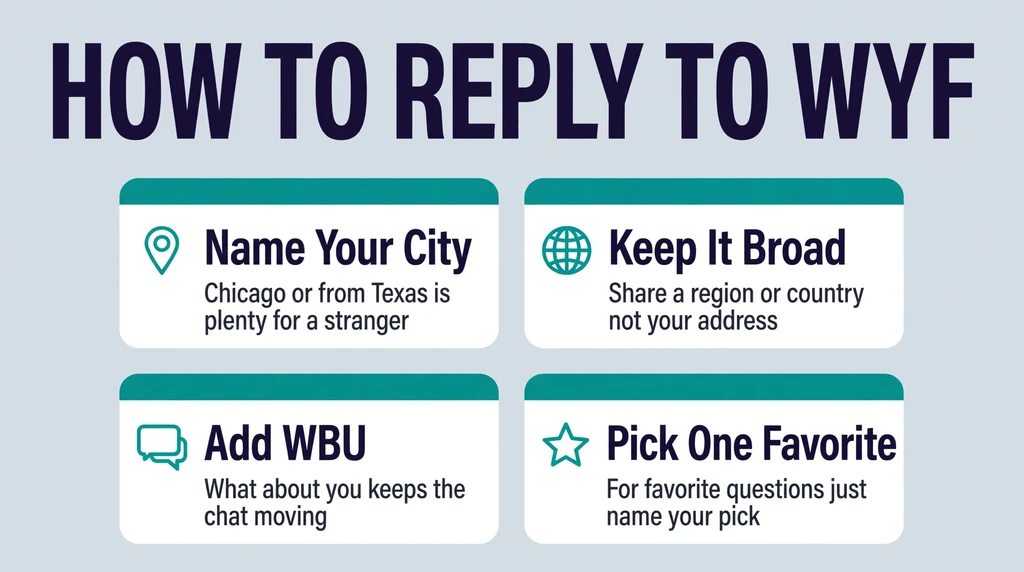
Knowing the meaning is only half the job. You also need something to type back. The good news is that every reading of wyf has a short, natural reply, and most take under five words.
Replying to “where you from?”
Start with your city, state, or country, then add “wbu,” short for “what about you?” Slang guides use exactly this pattern, with model replies like “outside Atlanta, wbu?” The bounce-back keeps the chat balanced and shows the same friendly interest.
A little detail makes your answer warmer. “Chicago, born and raised” or “Texas, but I live in Denver now” gives the other person something to respond to. After that, the conversation usually flows into school, work, or shared interests.
Moved around a lot? A two-part answer handles it gracefully: “grew up in Ohio, based in Seattle now.” People with military families, expat parents, or several moves use this pattern constantly. It answers the question fully without a long life story.
Replying to “what’s your favorite?”
For the favorite reading, just name your pick. “Blue, always” or “the second album, easily” are complete answers. You do not need a long defense of your taste, although one short reason makes the reply more fun.
If you cannot decide, say so playfully. “Tough one, probably pasta” still answers the question. Then ask theirs back, and the game continues.
Replying to “what you feeling?” or “what you fancy?”
Plan-making wyf calls for a mood or a craving. “Tacos for sure,” “something chill tonight,” or “whatever you fancy” all work. The last option is handy when you genuinely do not mind, because it hands the choice back politely.
Notice how short these replies stay. Nobody writes an essay in answer to wyf, whatever it means.
When you do not want to answer
You never owe a stranger your location. If a bare “wyf” feels too fast, answer broadly: “the US,” “Europe,” or “east coast.” A region satisfies the small talk without pinning you down.
You can also deflect with humor or a question. “Why, you writing a book?” sounds playful in the right chat, and “where are YOU from?” flips the spotlight. If the sender pushes for specifics after that, the chat has told you something important about them.
Copy-and-send reply ideas
Short on inspiration? These replies cover each reading, and each one takes seconds to send. For location: “NYC, wbu?” or “small town in Ohio lol, you?” For favorites: “green, no contest” or “the new album, track two.” For plans: “feeling like pizza tbh” or “idk, whatever you fancy.”
Swap in your own details and they stop sounding copied. The pattern matters more than the words: answer, keep it light, return the question.
Replies that keep the chat alive
A plain answer ends the exchange, but a small hook continues it. Add one detail the sender can grab: “Chicago, moved here for college last year.” Suddenly there are three new threads to pull.
Questions work as hooks too. “Denver, have you ever been?” invites a story instead of a fact. Chats built on stories last longer than chats built on data, and wyf is only ever the first step.
WYF in Example Conversations
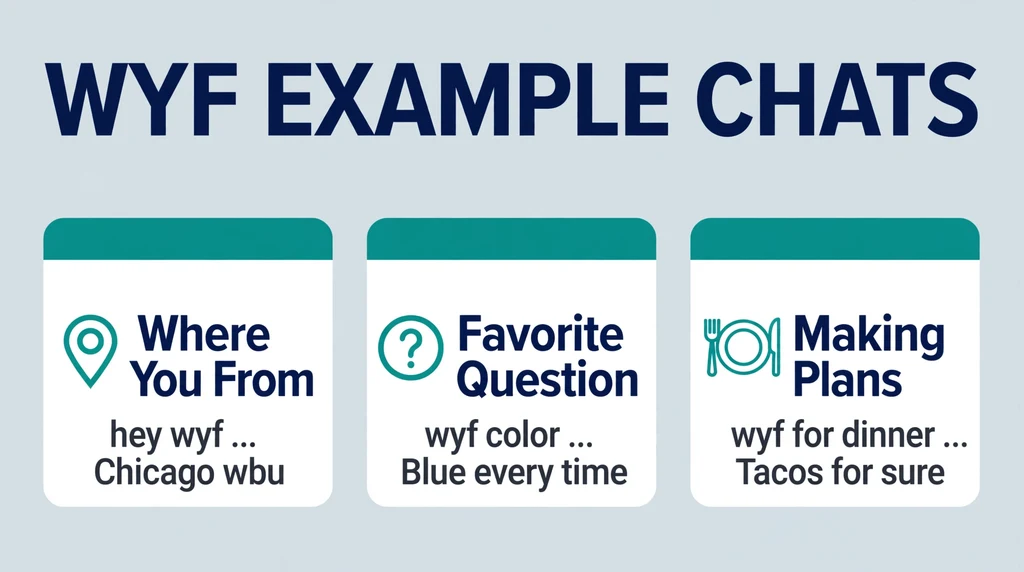
Examples lock the meanings in place better than definitions alone. Each short chat below uses wyf the way people actually type it. Read the exchange first, then the note under it.
Example 1: A new Snapchat add
Sam: hey Alex: hey, wyf? Sam: Denver, wbu? Alex: same, south side
This is the classic pattern. A new contact asks where you are from, and the reply gives a city and returns the question with “wbu.”
Example 2: A dating app opener
Jordan: so wyf Priya: Austin originally, living in Dallas now Jordan: nice, Houston here
Here, wyf opens the getting-to-know-you stage. The two-part answer, hometown plus current city, is very common and easy to copy.
Example 3: A favorite question in a group chat
Lee: wyf song on the album? Ana: track 3, easily Lee: wrong, it is the opener
The topic word “song” settles the meaning instantly. Nobody shares a location, because nobody asked for one. The fun is in disagreeing about the pick.
Example 4: Making dinner plans
Mia: wyf for dinner Ben: tacos? Mia: always tacos
The word “for” signals the “what you feeling?” reading. Ben answers with a craving, and Mia closes the deal in two words.
Example 5: A gaming lobby
Rex: gg, wyf btw Kai: Canada, east server Rex: explains the ping lol
In a lobby, the question is about region and servers. Kai answers with a country and a server, which is exactly the information the team wanted.
Example 6: A story poll favorite
Ana (story): wyf season? Replies: fall, and it is not close Replies: summer forever
Posted publicly, wyf invites quick picks from everyone watching. The favorite reading is the only one that makes sense here.
Example 7: Checking in with a friend
Ben: wyf today Mia: tired tbh, early night for me Ben: same, movie at mine?
Between close friends, wyf asks about mood and appetite for plans. Mia answers both parts at once, and Ben builds the plan from her answer.
WYF vs WYD vs WYA
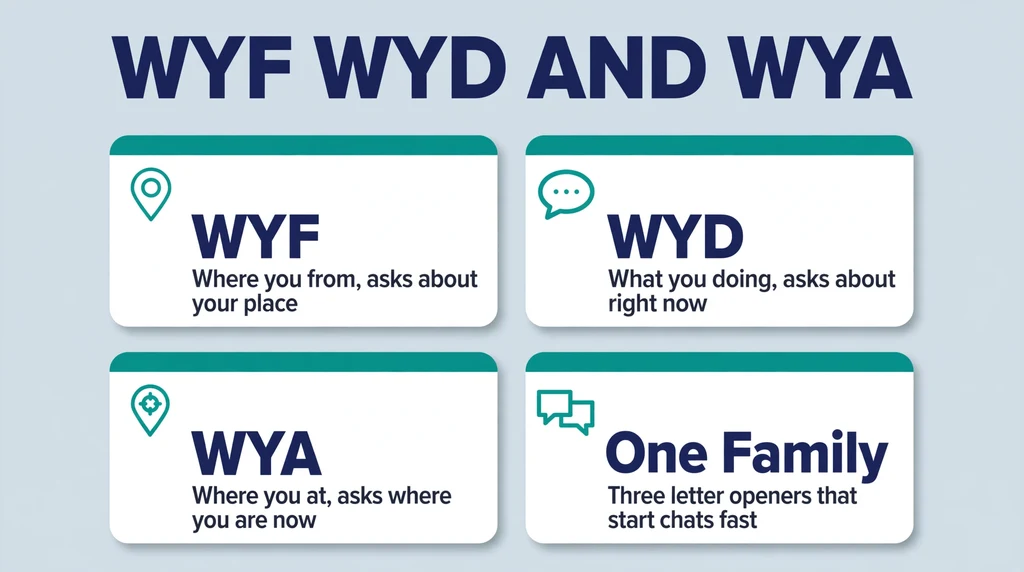
WYF belongs to a small family of three-letter openers. The members look alike, and new readers often mix them up. A side-by-side look clears the confusion in seconds.
WYF: where you from?
WYF asks about background. The answer is a place you come from or live in now, and it stays true tomorrow. Because it covers identity basics, it usually appears early, when two people have just met online.
WYD: what you doing?
WYD asks about the present moment. The answer is an activity: studying, working, watching a game. It works at any point in a friendship, and it often leads to plans, since your answer reveals whether you are free.
WYA: where you at?
WYA sounds close to wyf, but the target differs. It asks where you are right now, not where you are from. Friends use it when they are meeting up, running late, or trying to find each other.
So the split is simple. WYF is about origin, WYA is about current location, and WYD is about current activity. Add wbu, “what about you,” and you hold the full starter set of three-letter openers.
Which one should you use?
Choose based on what you actually want to know. Asking a new online friend about their background? That is wyf, ideally with a greeting in front of it. Checking whether a friend is busy? That is wyd. Trying to meet someone who is already out? That is wya.
When in doubt, spell the question out. “Where are you from?” costs two extra seconds, and it removes all doubt. Slang is a shortcut, not a requirement.
The Tone Behind WYF
Three letters can land in very different ways. To the sender, wyf is efficient and friendly. To the receiver, the same message can feel warm, random, or slightly nosy. Both reactions make sense.
A casual opener, not a rude one
In most chats, wyf carries no edge at all. It says, “I want to keep talking, so let us start with the basics.” Read in that spirit, it is closer to a handshake than an interrogation.
The brevity can even feel confident. Short openers are the house style of Snapchat and TikTok, and wyf fits the style perfectly.
When it feels random or lazy
Context still matters. A bare “wyf” as the very first message, with no greeting before it, can feel copy-pasted. On dating apps especially, people receive the same opener many times, so it may earn a shrug instead of a reply.
Timing plays a role too. The question works when a chat is starting. It feels odd in the middle of a deep conversation, where it reads like the sender stopped paying attention.
Cultural habits soften or sharpen it as well. In plenty of communities, asking where someone is from is ordinary first-minute small talk. If you grew up with that norm, wyf feels like nothing at all. The oddness is about expectations, not the letters.
How much location to share
A city or region is the standard answer, and it is plenty. There is no need to share a neighborhood, a school name, or anything closer to an address with someone you just met.
That balance keeps small talk friendly and safe. If the chat grows into a real friendship, details can come later, at your pace.
Reading the sender’s intent
A wyf with a greeting and follow-up questions usually signals genuine interest. The sender is building a picture of you and offering their own details in return. That pattern is friendly, and sometimes lightly flirtatious, but the word itself stays innocent.
A wyf with nothing around it means less. It might be habit, boredom, or a mass-sent opener. Judge the messages that follow, not the three letters alone. Effort after the opener is the real signal.
Where Does WYF Come From?
WYF was not launched by a company or coined by a celebrity. It grew out of everyday typing habits, the same habits that produced brb, wyd, and wya. People shortened a question they typed constantly, and the short form stuck.
Guides that trace this pattern point to the tools of the era: small screens, character limits, and slow typing on phone keypads. A four-word question asked ten times a day begs to shrink. WYF shrank the same way brb did, one dropped word at a time.
The building blocks are plain. The slang form drops the word “are” from “where are you from,” exactly the way speech drops it. What remains, where you from, compresses neatly into three initials.
Written records give the term a rough timeline. Urban Dictionary carried the “what’s your favorite?” sense by December 2008. Its “where you from?” entry, now the top definition, dates to July 2014. Beyond that, the trail goes quiet.
Slang guides are honest about the gap: nobody knows who typed wyf first or where. It circulated informally for years before dictionaries recorded it. That untidy history is normal for texting slang, and it is one more reason context, not a single rule, defines it.
Why slang dictionaries disagree
References argue about words like wyf because they record usage differently. Crowdsourced dictionaries capture whatever users submit, early and unfiltered. Edited slang guides weigh the entries and order meanings by how common they judge each one to be.
Neither approach is useless, but they answer slightly different questions. One shows everything the letters have meant somewhere. The other shows what they most likely mean in your chat. For a message you just received, the second question is the one that matters.
Frequently Asked Questions
What does WYF mean in texting?
In texting, wyf usually means “where you from?” Someone who barely knows you is asking about your hometown, city, or country. With a topic word attached, it can also mean “what’s your favorite?”
How do you reply to WYF?
Answer with your city, state, or country, then add “wbu” to ask the same back. For example: “Chicago, wbu?” If the message asks for a favorite instead, simply name your pick.
What does WYF mean on Snapchat?
On Snapchat, wyf almost always means “where you from?” New adds send it right after the first “hey” to start a getting-to-know-you chat. A city-level answer and a “wbu” back is the standard reply.
Is WYF the same as WTF?
No. WTF is a shocked or annoyed reaction, short for “what the” plus a swear word. WYF is a question about your hometown or your favorite thing. One letter changes the tone completely.
What is the difference between WYF and WYD?
WYF asks where you are from, a background fact. WYD asks what you are doing right now, a present activity. WYF usually opens a new chat, while wyd works at any point between people who know each other.
Is WYF rude?
Usually not. It is a casual opener, and most senders mean it as friendly small talk. It can feel abrupt from a stranger with no greeting first, and you can always answer broadly or not at all.
Does WYF always mean “where you from?”
No. That is the main meaning in one-to-one chats, but wyf also means “what’s your favorite?” when a topic word follows it. Between friends making plans, it can mean “what you feeling?” instead.
What does WYF mean from a girl or a guy?
The meaning does not change with the sender. A “wyf” from a girl, a guy, or anyone else asks where you are from, or a favorite if a topic follows. Read the context, not the person, and reply the same way.
Final Thoughts
WYF is a small message with more than one question inside it. In a new chat, it means “where you from?” and invites a city plus a “wbu.” With a topic word attached, it means “what’s your favorite?” and invites a pick. And between friends, it can simply ask what you are feeling like doing.
The habit to build is simple: read the chat before you answer it. Who sent it, where it appeared, and what word came after it will tell you which question you were asked. Slang references such as CyberDefinitions keep full lists of these readings, and they are worth a bookmark if three-letter messages keep puzzling you.
Now the next “wyf” in your inbox will not slow you down. You will know the question, and you will know exactly what to type back.