A long chat finally winds down. Your friend is moving away, or starting something big tomorrow. The last message arrives: “wytb.” Four letters, no emoji, nothing else. If you stared at it for a second, you are not alone.
In most texts, WYTB means “wish you the best.” It is a sign-off, a small way of saying good luck and take care in one breath. People send it when a conversation ends on a hopeful note. But the same four letters can also ask a question: “what you talking about?” The conversation around them tells you which one it is.
This guide is based on how WYTB is actually used in real chats and documented slang dictionaries. Below, you will find both meanings, the tone behind each one, real examples, and replies you can copy. By the end, a bare “wytb” will never leave you guessing again.
WYTB Meaning in Text at a Glance
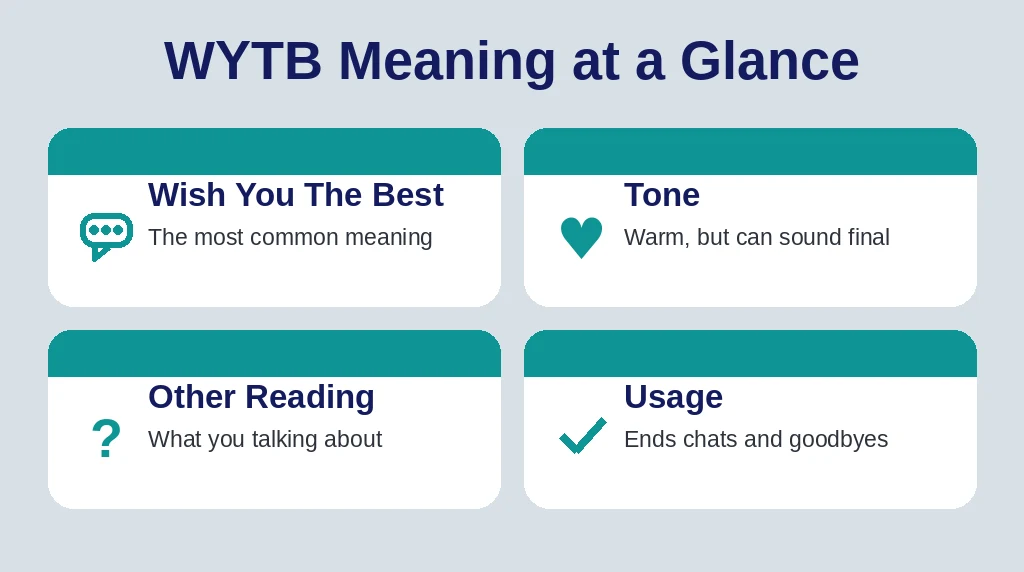
Short on time? Here is the fast version. In a modern text, WYTB almost always means “wish you the best.” It is a friendly closing line, the texting cousin of good luck and all the best. It appears at the end of conversations, rarely in the middle. The one exception is the question reading, “what you talking about,” which shows up mid-chat when someone is confused.
| Detail | Explanation |
|---|---|
| Most Common Meaning | Wish you the best |
| Full Form | Wish you the best (a well-wish, not a technical acronym) |
| Tone | Warm and supportive, but can sound final after a fallout |
| Common Platforms | Text messages, WhatsApp, Snapchat, Instagram, TikTok |
| Formal or Informal | Informal only |
What WYTB Really Means in a Text
WYTB is a goodbye with good wishes packed inside it. When someone types “wish you the best,” they are hoping things go well for you in whatever comes next. The abbreviation keeps that feeling short enough for a fast-moving chat. Think of it as good luck, take care, and I am rooting for you, all folded into four letters.
You will usually meet it at a turning point. A friend lands a new job in another city. A classmate has a huge exam in the morning. Someone is leaving a group, a team, or even a relationship. Instead of a long speech, the other person closes the chat with “wytb” and lets it carry the whole send-off. It works because the words before it have already done the heavy lifting.
Spelling barely matters here. Lowercase “wytb” and uppercase “WYTB” mean the same thing, and both are read as the full phrase. What matters far more is placement. WYTB belongs at the end of an exchange, the way a wave belongs at the end of a visit. Dropped into the middle of a chat with no setup, it can confuse people, because mid-conversation is exactly where its second meaning lives.
One honest note: nobody is credited with inventing WYTB, and its first use is not documented. It grew out of the same abbreviation habit that gave texting most of its short forms, where any phrase typed often enough eventually shrinks to its initials.
Other Meanings of WYTB You Might See
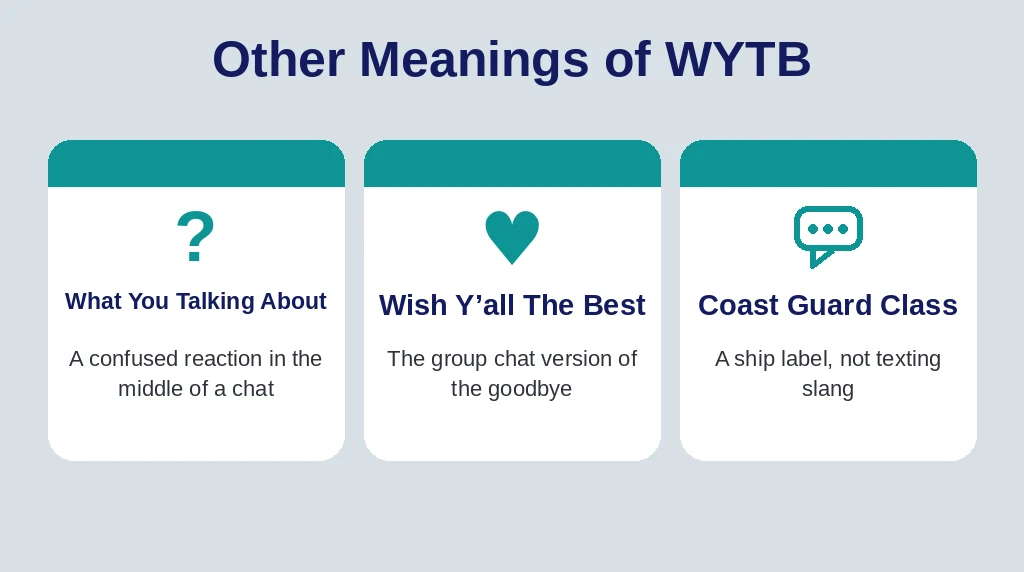
WYTB has one main meaning, but it is not the only reading your sources will turn up. The table below covers the others honestly, including one that has nothing to do with texting at all.
| Meaning | Context | Tone | Example |
|---|---|---|---|
| What You Talking About | Mid-chat reaction to something confusing | Surprised, teasing | “wytb?? that never happened” |
| Wish Y’all The Best | Group chats, team goodbyes | Warm, casual | “Last game together, wytb everyone” |
| Coast Guard Vessel Class | US Coast Guard ship designations (WYTB hull symbol) | Formal, technical | “The cutter is classed as a WYTB.” |
The second meaning is the one that matters day to day. “What you talking about” is a reaction, not a goodbye. It appears in the middle of a conversation, usually with a question mark, when someone says something confusing, wild, or hard to believe. It asks the other person to explain themselves, somewhere between genuine confusion and playful disbelief.
The Coast Guard reading is real but lives far from chat slang. WYTB is also a United States Coast Guard hull classification for a class of large icebreaking tugs. Unless you are reading about ships, you will never meet that one in a conversation.
How Context Changes the Meaning
Four quick signals separate the goodbye from the question almost every time. First, look at placement: a WYTB at the very end of a chat is the well-wish, while one in the middle is probably the question. Second, check punctuation, because “wytb?” with a question mark is asking what you are talking about. Third, look at what came before: good news, a farewell, or a big moment points to wish you the best, while a confusing claim points the other way. Fourth, consider the relationship, since close friends use the teasing question reading far more freely.
Watch how the same four letters shift across these short exchanges:
- “Big day tomorrow. wytb, you have got this” is the well-wish, sent before an exam or interview.
- “Wait, wytb??” after a wild story is the question, asking the sender to explain.
- “It was fun working with you. wytb” at the end of a last-day chat is a warm goodbye.
- “wytb, I never said that” pushes back on a claim, confused and a little annoyed.
WYTB on Snapchat, TikTok, and in Regular Texts
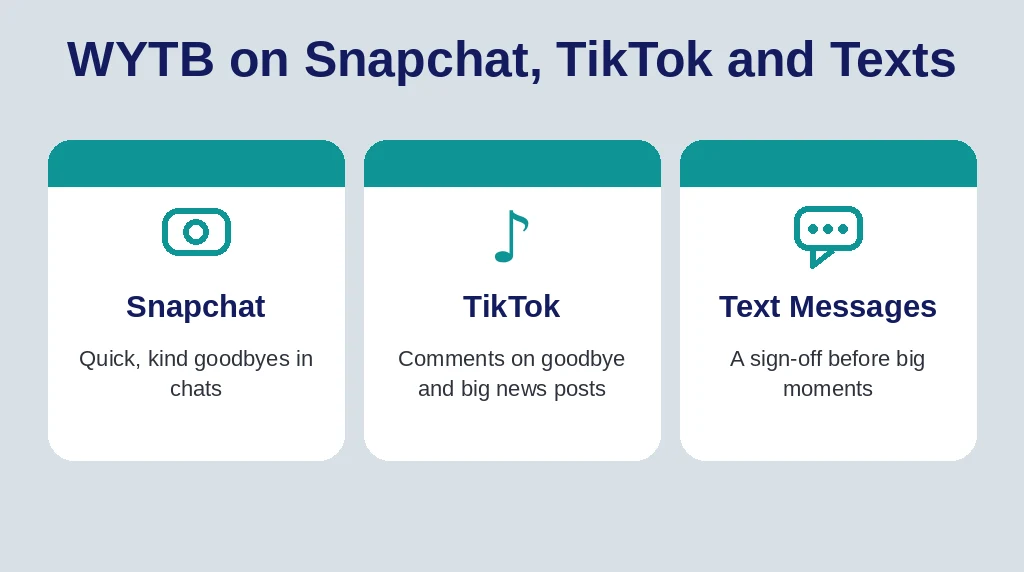
On Snapchat and in regular text messages, WYTB does its main job: closing chats kindly. It appears in quick goodbyes, in replies to big news, and in those last messages before someone goes quiet for a while. On WhatsApp, family and friend group chats use it the same way, often right after congratulations or travel news.
On TikTok and Instagram, you will see it in comments and captions more than in private chats. Fans drop “wytb” under goodbye posts, graduation clips, and creators announcing a break or a move. The question reading shows up there too, usually under a confusing claim in a comment thread. Across every platform, though, the split stays the same: end of the exchange means the wish, middle of the exchange means the question.
Real Conversation Examples
Person A: “Final round of interviews is tomorrow morning”
Person B: “You have prepared for weeks. wytb, you will crush it”
Meaning: Person B is sending the well-wish. WYTB means wish you the best, a warm send-off before a big moment.
Person A: “I think we should stop talking for a while”
Person B: “Okay. wytb.”
Meaning: Person B is closing the door politely. The words still mean wish you the best, but after a fallout the short reply sounds final, not warm.
Person A: “The teacher moved our exam to today”
Person B: “wytb?? nobody told us that”
Meaning: Person B is using the question reading. WYTB here means what you talking about, a shocked request for an explanation.
Is WYTB Warm or Cold?
This is where WYTB gets interesting, because the honest answer is both. The phrase itself is kind. Wishing someone the best is a generous thing to say, and in a supportive chat it lands exactly that way. Before an exam, a move, or a new job, a simple “wytb” feels like a hand on your shoulder.
After an argument, the same words change temperature. “Wish you the best” is famous as the polite way to end things for good, the texting version of closing a door quietly. A bare “wytb.” with a full stop, no emoji, and nothing after it can read as dismissive, even when the sender only meant to be civil. The shorter and flatter the message, the colder it feels.
Emojis and extra words warm it back up. “wytb ❤️” or “wytb, seriously, you deserve it” leaves no doubt about the kindness. If you receive a cold-looking WYTB, judge it by the conversation that came before it, not by the four letters alone. And if you are sending one after a fallout, decide first whether you want it to sound kind or final, because the reader will pick one.
How to Reply When Someone Sends WYTB
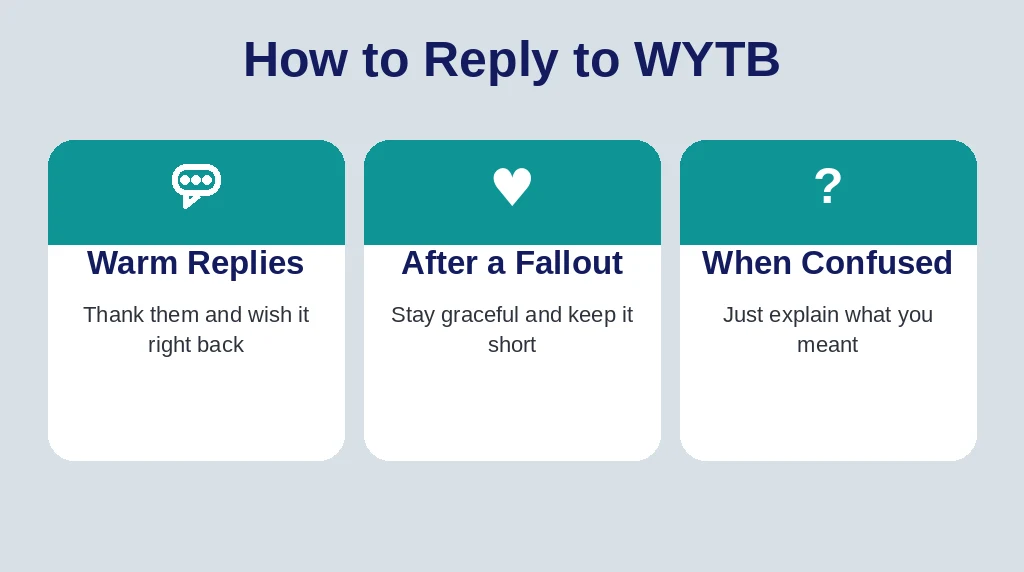
The right reply depends on which WYTB you received. Thank the well-wish and return it, stay graceful after a fallout, and simply explain yourself when it was the question.
Warm Replies
- “Thank you! That means a lot, wytb too”
- “Appreciate it, I will do my best”
- “Thanks for always backing me”
- “Same to you, we both need it this week”
Replies After a Fallout
- “Thank you. Take care as well”
- “I appreciate that. Goodbye, and good luck”
- “Wishing you well too, truly”
Replies When It Meant the Question
- “I mean the plan changed, here is what happened”
- “lol sorry, let me explain from the start”
- “check the screenshot I just sent, that is what I mean”
When to Use WYTB
WYTB fits the end of casual chats with friends, family group chats, and comment sections where someone is starting something new. Use it before exams, interviews, competitions, moves, and first days, anywhere a short good luck would feel right. It works best with people who already text in abbreviations, because then the warmth survives the shortening. Paired with a name or a short sentence before it, it reads as thoughtful rather than lazy.
When to Avoid WYTB
Skip WYTB in work emails, applications, and messages to teachers, managers, or anyone who may not know the abbreviation. In formal goodbyes, spell out “I wish you the best” in full, because the long version carries the respect the short one cannot. Avoid it right after delivering bad news too, where a four-letter sign-off can sound like you are rushing away from the conversation. And if there is any chance the other person will read it as the question, write the full words instead.
Common Mistakes People Make With WYTB
Assuming it only has one meaning. Most of the time WYTB means wish you the best, but mid-chat it can be the question “what you talking about.” Placement and punctuation settle which one you are looking at.
Using it in formal writing. WYTB is chat shorthand. In an email, a cover letter, or a farewell message at work, the abbreviation looks careless even though the wish behind it is polite.
Expecting a bare WYTB to sound warm after a fight. After an argument, four flat letters usually read as a door closing. If you mean kindness, add a word or two so the warmth actually arrives.
Sign-Offs and Slang Similar to WYTB
WYTB belongs to a family of short closings and quick reactions. Knowing its neighbors helps you pick the right one and read whole threads faster.
| Term | Meaning | Main Difference |
|---|---|---|
| GLHF | Good luck, have fun | Used before games and challenges, not after goodbyes |
| TC | Take care | A plain goodbye with no luck or future wish inside |
| BFN | Bye for now | Says the chat is pausing, and expects more later |
| ATB | All the best | The closest cousin, a well-wish without the word wish |
Quick Recap
- In most texts, WYTB means “wish you the best,” a warm sign-off sent before goodbyes and big moments.
- Mid-conversation, especially with a question mark, WYTB can mean “what you talking about” instead.
- After an argument, a bare WYTB can sound cold and final, so context decides its temperature.
- Emojis, placement, punctuation, and a few extra words keep the kind meaning clear.
- Spell the phrase out in full for work, formal goodbyes, and anyone outside your close circle.
Frequently Asked Questions
What does WYTB mean in text?
WYTB usually means wish you the best, a warm sign-off people send before goodbyes, big exams, new jobs, and fresh starts.
What does WYTB stand for?
WYTB stands for wish you the best in most chats, although mid-conversation it can also mean what you talking about.
Is WYTB rude?
WYTB is not rude by itself, but after an argument a short, bare reply can sound cold, final, and dismissive.
Does WYTB always end a conversation?
WYTB usually closes a chat when it means wish you the best, but the question reading invites an answer instead.
How should you reply to WYTB?
Reply by matching the sender’s tone, thanking them warmly, returning the wish, or briefly explaining yourself if they meant the question.
Final Thoughts
WYTB is a small sign-off with a surprisingly flexible heart. At the end of a friendly chat, read it as “wish you the best,” a warm and hopeful goodbye that fits exams, new jobs, and fresh starts. In the middle of a chat, let the question mark warn you that it might be asking what you are talking about instead. The slang dictionary NoSlang lists WYTB with the same main meaning, which matches how people actually use it. Read the placement, mind the tone, and you will get it right.
Related slang guides: MYB meaning in text, WGO meaning in text, and TS meaning in text.