Someone in the group chat just typed: “I locked my keys in the car.” Three replies land at once. All of them say the same thing: “oof.” If that tiny word left you guessing, you are not alone. In texts today, oof is the standard reply to anything painful, awkward, unlucky, or embarrassing. It is a wince you can type.
Oof can carry real sympathy. It can also carry a laugh. One word covers a failed exam, a dropped phone, a brutal price tag, and a video you wish you could unsee. Capital letters make it louder, and “big oof” doubles the disaster. There is one twist, though. In a work inbox, OOF in all caps can mean out of office, and that mix-up causes real confusion.
This guide is based on how oof is actually used across texts, TikTok, Discord, and gaming chats today. Every meaning was checked against dictionaries and documented sources, including the dramatic story behind the Roblox death sound. Below, you will find each meaning, real examples, tone tips, and replies you can copy.
Oof Meaning in Text at a Glance
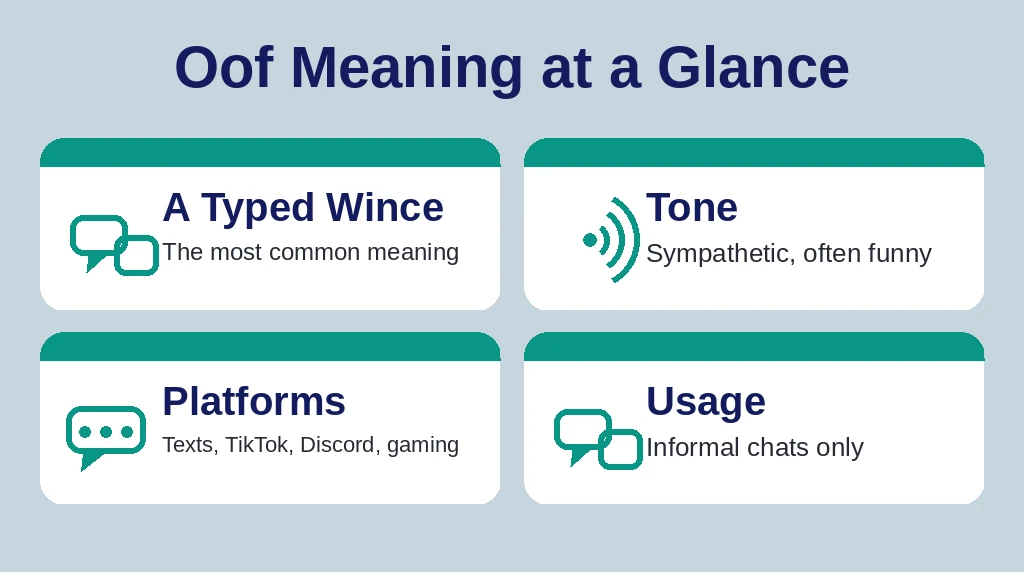
Short on time? Here is the fast version. In a modern text or comment, “oof” is a one-word reaction to something that hurt, flopped, or turned awkward. Dictionaries define it as an expression of discomfort, surprise, or dismay, and that covers most of what you will see. It is warm by default. The one exception is all-caps OOF in a work thread, where it usually means out of office.
| Detail | Explanation |
|---|---|
| Most Common Meaning | A reaction to pain, awkwardness, or bad luck |
| Full Form | None. Oof is a sound, not an acronym |
| Tone | Sympathetic, casual, often a little funny |
| Common Platforms | Texts, TikTok, Discord, Reddit, gaming chats |
| Formal or Informal | Informal (except OOF = out of office at work) |
What Oof Really Means in a Text
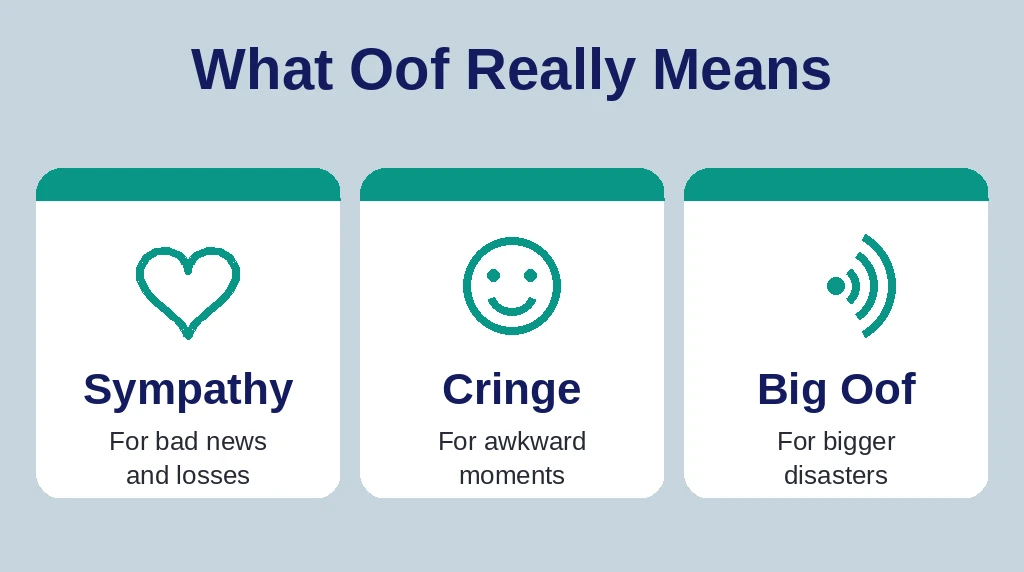
Oof began as a sound, not a word. It imitates the grunt you make when air gets knocked out of you, and that is exactly how it works in writing. When someone sends “oof,” they are reacting on behalf of the person in the story. Read it as “I felt that.” The drop, the fail, the sting landed on them too.
Most of the time, that reaction blends two feelings. The first is sympathy: your bad luck registered, and it hurt to read. The second is secondhand embarrassment, the cringe you feel when someone walks into a glass door or waves back at a stranger. Oof holds both at once, which is why it fits so many situations.
It also works for your own mishaps. “Just stepped in a puddle with brand-new shoes. Oof.” Prices earn it too: “Rent is going up again.” “Oof.” So does the end of a long day: “Finally home. Oof.”
Spelling tweaks change the volume. Lowercase “oof” is the everyday default. Stretch it to “ooof” and the pain gets bigger. A full stop makes it deadpan, almost flat: “oof.” An exclamation mark or a grimacing emoji keeps it light: “oof 😬”.
Big Oof and Stronger Versions
When plain oof is not enough, people upgrade it. “Big oof” is the standard intensifier, saved for larger failures: a missed flight, a public breakup, a team losing in the final minute. Gamers also use “oofed” as a verb for getting badly beaten, as in “I got oofed in that boss fight.”
Other Meanings of Oof You Might See
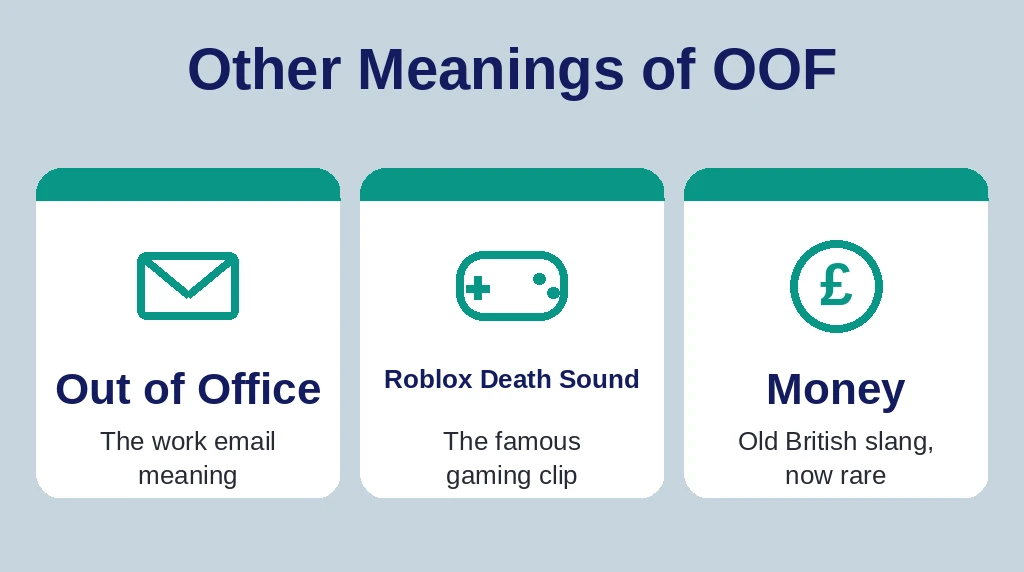
The reaction does most of the work, but the same three letters turn up in a few other places, including work and gaming history.
| Meaning | Context | Tone | Example |
|---|---|---|---|
| Out of Office | Work email, Outlook, and office chats | Professional, neutral | “I will be OOF Friday and back Monday.” |
| The Roblox death sound | Gaming and meme culture | Funny, nostalgic | “He missed the jump and fell. Oof.” |
| Money | Old British slang, now rare | Dated, playful | “He came into some serious oof.” |
The work meaning has the strangest backstory. At Microsoft, OOF became the standard shorthand for the out-of-office auto-reply, and people still write “I am OOF next week” in office chats today. Microsoft’s own history traces it to the company’s old Xenix mail system in the late 1980s, where “oof” was a command, and company lore links the last letter to “out of facility.” The slang reaction and the work abbreviation are unrelated, which is exactly why they collide so awkwardly in the same inbox.
How Context Changes the Meaning
Four quick signals tell you which oof you are looking at. First, check who sent it: a coworker in caps is probably talking about leave, while a friend in a group chat is reacting. Second, check the topic, because schedules and deadlines point to out of office, while mishaps point to the reaction. Third, look at capitalization in context: chat OOF is usually just a louder reaction, but OOF inside a sentence about next week is a status. Fourth, read what came right before it, since oof always answers the message above it.
Watch how the same word shifts across these short exchanges:
- “The meeting got moved to 7 a.m.” answered with “oof” means that hurts, not that anyone is on leave.
- “I am OOF next week, please cover the client call” from a coworker means out of office.
- A clip of a player missing an easy shot, captioned “OOF 😂”, is playful mock pain between friends.
- “His dog passed away last night” is the one message where “oof” would be the wrong reply entirely.
Oof on TikTok, Discord, and in Regular Texts
On TikTok, oof lives under fail videos, cringe clips, and painful stories, where a single word in the comments says what everyone is thinking. Discord and gaming chats run on it too: deaths, lost matches, and unlucky moments collect oofs fast, and Reddit replies work the same way.
In regular texts and WhatsApp chats, oof is the reply for a friend’s small disaster, when a full sentence would overdo it. Work chats are the danger zone. On Slack or Teams, a quick “oof” at bad news is normal among teammates, but the same three letters in caps can be read as an availability status, so keep the reaction lowercase there.
Real Conversation Examples
Person A: “I studied all night and still failed the quiz”
Person B: “oof, that is actually brutal”
Meaning: Person B is showing sympathy. The effort was real, the result was unfair, and oof carries both feelings at once.
Person A: “I waved back at a guy who was waving at someone behind me”
Person B: “oof 😬 I felt that in my soul”
Meaning: Person B is cringing along. This is the secondhand embarrassment use, half sympathy and half laughter.
Person A: “Can you review the report before Friday?”
Person B: “I am OOF until Monday, but I will look first thing”
Meaning: Person B is not reacting at all. Here OOF means out of office, and Friday is simply too early.
Is Oof Rude?
Oof is one of the gentlest reactions in slang, but it has one real risk: it can be too light for the moment. After everyday bad luck, it reads as warm and understanding. After genuinely serious news, like a death, a diagnosis, or an accident, a bare “oof” can land like a shrug. The word did not get ruder. The situation just outgrew it.
Delivery softens or sharpens it. “Oof, I am so sorry, are you okay?” is a complete act of sympathy. “Oof.” on its own, after someone’s worst day, is not. Oof can also carry a teasing edge between friends, like “oof, bold choice” under a questionable haircut, and that edge is fine between close friends. When in doubt, keep the oof and add real words after it.
What Does Oof Mean From a Girl or a Guy?
The same as it means from anyone else. A “oof” from a girl and a “oof” from a guy are read exactly the same way, because the word reacts to the situation, not to the sender. If it follows bad news, it is sympathy. If it follows a cringe story, it is shared embarrassment. Wording, emojis, timing, and how well you know each other tell you far more than who typed it, so do not hunt for a hidden meaning.
How to Reply When Someone Sends Oof
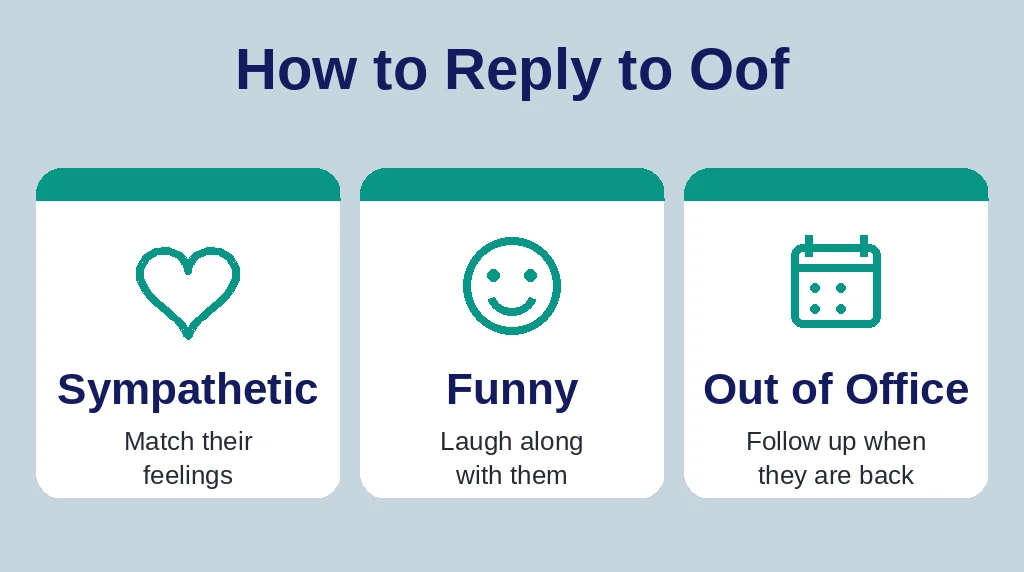
Your reply depends on which oof you got. If it was sympathy for your bad news, accept it warmly. If it was a joke, play along. If it was a work status in disguise, answer the schedule, not the sound.
Sympathetic Replies
- “right? it has honestly been a day”
- “thanks, I needed someone to get it”
- “tell me about it, I am still processing”
Funny Replies
- “big oof energy, I know”
- “add it to my highlight reel of failures”
- “the Roblox sound played in my head too”
Replies When It Meant Out of Office
- “got it, I will follow up when you are back”
- “no rush at all, enjoy the time off”
- “thanks for the heads up, talk Monday”
When to Use Oof
Oof fits casual chats with friends, gaming lobbies, comment sections under fail videos, and any small mishap that deserves a wince, not a speech. It works best when the other person already talks in the same casual register, because then the sympathy and the humor both land. It also works as a kind opener, and you can always follow it with a real sentence once the chat gets going.
When to Avoid Oof
Skip oof after serious or sad news, where a one-word reaction can feel dismissive. Keep it out of formal writing, client emails, and messages to people you barely know, because it reads as slang first and sympathy second. At work, think twice before using it as a reaction: in an office thread, OOF carries the out-of-office meaning, and a stray “oof” under a deadline announcement invites the wrong reading.
Common Mistakes People Make With Oof
Thinking oof is an acronym. In slang, oof does not stand for anything. It is a sound typed out, nothing more. Only the separate work term OOF points to out of office.
Dropping a bare “oof” on serious news. The word is light by design. Sent alone after a death, an accident, or a job loss, it can look like mockery even when it was meant kindly. Add words, or skip it entirely.
Mixing up the two OOFs at work. Typing “oof” as a reaction in a work thread can make a coworker think you are announcing leave, and reading a coworker’s “OOF Friday” as a reaction can make you miss that they will be gone.
Slang That Shows Up Next to Oof
Oof belongs to a small family of one-word reactions. They overlap, but each leans a different way.
| Term | Meaning | Main Difference |
|---|---|---|
| Ouch | A direct reaction to pain | More literal and physical, less about awkwardness |
| Yikes | Shock or awkward surprise | Stronger, and a little more judgmental |
| RIP | A joking “rest in peace” for a failure | Final and meme heavy, for things that are already over |
| Oops | Owning a small mistake you made | About your own slip-up, not someone else’s bad luck |
| Ugh | Frustration or disgust | Annoyed rather than sympathetic |
Where Oof Came From
The word itself is older than the internet. Dictionaries treat oof as an imitation of a real sound, the short grunt of air leaving your body when something hits you in the stomach. Similar sounds exist in Dutch (oef) and German (uff), and print examples of the pained “oof” go back decades.
The sound that made it famous came from a game. For years, every Roblox character that died or reset played the same short clip: “oof.” The clip was not made for Roblox at all. It traces back to the 2000 game Messiah, and the sound file’s metadata credits sound designer Joey Kuras with creating it. Players heard it millions of times, editors pasted it into fail videos, and a death sound became a word people type when anything goes wrong.
Then the story turned into a dispute. In 2019, video game composer Tommy Tallarico claimed that he owned the sound and had created it. A 2020 agreement turned the clip into a paid asset that developers could license for 100 Robux. That peace did not last. On July 26, 2022, Roblox removed the oof sound from the platform, citing a licensing issue, and replaced it with a new default sound. Later that year, a widely watched video investigation disputed Tallarico’s claim to have created the sound, pointing back to the Kuras credit in the file. In July 2025, Roblox announced that the classic oof would return, and the most argued-over half second in gaming is headed back under a falling blocky character.
Quick Recap
- In most texts, oof is a typed wince: a quick reaction to pain, awkwardness, bad luck, or a nasty surprise.
- All-caps OOF in a work thread usually means out of office, a separate term with a Microsoft backstory.
- “Big oof” is the stronger version, saved for bigger failures, and gamers use “oofed” for a bad defeat.
- Oof is gentle by default, but a bare oof after serious news can feel dismissive, so add real words.
- The Roblox death sound made the word inescapable, survived a licensing fight, and was announced to return in 2025.
Frequently Asked Questions
What does oof mean in text?
In texts, oof is a quick reaction to something painful, awkward, or unlucky, showing sympathy without needing a long reply.
What does OOF stand for?
Oof does not stand for anything in slang, although in work email OOF can mean out of office.
Is oof rude?
Oof is rarely rude, but it can sound dismissive after serious news, so save it for light or funny situations.
What does oof mean in Roblox?
In Roblox, oof was the famous sound a character made when dying, before a licensing dispute removed it in 2022.
How should you reply to oof?
Reply by matching the sender’s tone, laughing along with a joke, adding sympathy, or simply asking what happened next.
Final Thoughts
Oof looks like nothing, three letters and a shrug, but it does the work of a whole sentence. In everyday texting, read it as a typed wince: sympathy for bad luck, a laugh at an awkward moment, or a groan at a nasty surprise. Keep the work meaning in your back pocket, because an all-caps OOF from a coworker is about vacation, not feelings. Use oof freely with friends, soften it with real words when the news is heavy, and let context make the final call. For the full meme history behind the sound, Know Your Meme’s OOF page tracks how a death sound became internet vocabulary.
Related slang guides: OOP meaning in text, FOMO meaning in text, and TS meaning in text.