Your phone lights up. The whole message is three letters: “wgo?” No hello. No context. Just that. If you stared at it for a second, you are not the only one. In texts and chats today, WGO means “what’s going on.” It is one of the fastest ways to open a conversation or check in on a friend.
Here is the part that trips people up. WGO does two different jobs. Sometimes it is nothing more than a relaxed greeting, the texting version of “hey, what’s up.” Other times it is a genuine question. A friend sees your strange story, your venting, or your sudden silence, and “wgo?” really means “what happened?”
This guide is based on how WGO is actually used in real texts, chats, and comments, and every reading below was checked against documented slang references. You will find both uses explained, real examples, tone tips, and replies you can copy. By the end, you will know which WGO you are looking at in about two seconds.
WGO Meaning in Text at a Glance
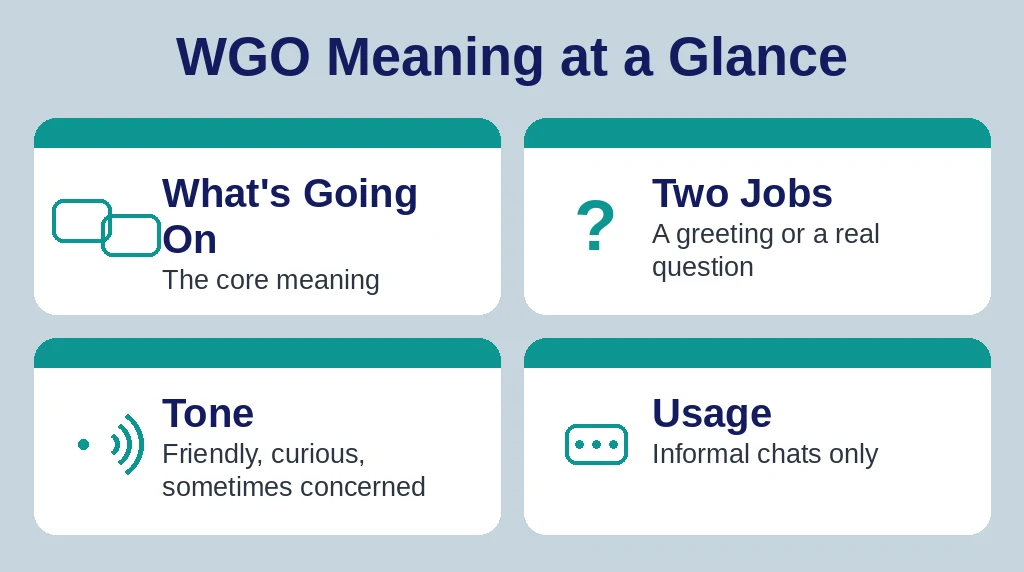
Short on time? Here is the fast version. WGO almost always means “what’s going on.” As the first message in a quiet chat, it is a friendly check-in. After dramatic news, a weird post, or a long silence, the same three letters turn into a real question. It is casual slang, so it belongs in friendly chats, never in formal or work messages where it could look lazy or nosy.
| Detail | Explanation |
|---|---|
| Most Common Meaning | What’s going on |
| Full Form | What’s going on (a spoken phrase shortened to its initials) |
| Two Main Uses | A casual greeting, or a genuine question when something seems off |
| Tone | Friendly and curious, can sound concerned or nosy |
| Common Platforms | Text messages, Snapchat, Instagram DMs, group chats |
| Formal or Informal | Informal only |
What WGO Really Means in a Text
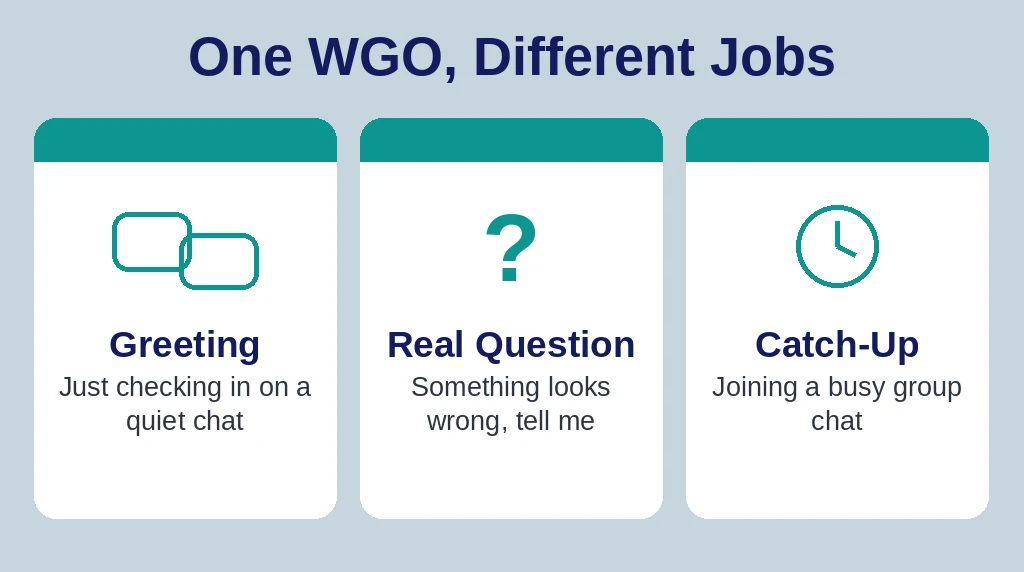
WGO is the written shortcut for a question people have been asking out loud forever: “What’s going on?” It carries none of its own topic. Instead, it points at whatever is already in the air. That might be your day, your mood, a plan for tonight, or a situation the sender just walked into. The letters are short because the question is familiar, and the sender trusts you to fill in the rest from context.
What makes WGO interesting is that it switches jobs without changing shape. The greeting version asks for nothing urgent. It simply opens the door and invites you to talk about whatever you want. The question version is focused. Something specific caught the sender’s attention, and they want the story behind it. Telling the two apart is the whole skill, and the next two sections break each one down.
WGO as a Casual Greeting
Sent out of nowhere, WGO is a warm-up message. It works like “hey,” “what’s up,” or “what are you up to” rolled into three letters. Friends send it when a chat has gone quiet, when they are bored, or when they want to talk but have no real topic yet. It asks about your world in the broadest possible way: your mood, your plans, your day so far.
Because it is so open, the greeting version expects an open answer. A short update is perfect. You can share what you are doing, how you are feeling, or what is happening around you. It starts a conversation without putting any pressure on the reply.
WGO as a Real Question
The same three letters become serious when something prompts them. A friend posts a photo crying. The group chat suddenly argues. You text “I cannot believe today” and nothing more. A “wgo?” after any of that is not small talk. It means “what happened?” and the sender is waiting for the actual story.
You can usually spot this version by what came right before it. There is almost always a trigger: a vague post, a dramatic message, raised voices in a call, or news that makes no sense alone. The sender is not checking in on your whole life. They are asking about one specific thing, and a one-word answer like “nothing” will rarely satisfy them. This WGO wants details.
Other Readings and Close Variants of WGO
WGO is a refreshingly honest abbreviation. Established slang references agree on the one core meaning, and the variety comes from context rather than from rival definitions. A longer variant, WIGO, spells out “what is going on” and means exactly the same thing, though you will see it far less often. The table below shows how the single phrase bends to fit different moments.
| Reading | Where You See It | What the Sender Wants |
|---|---|---|
| What’s going on (greeting) | First message in a quiet chat | A general update and a conversation |
| What’s going on (check-in) | After you have been silent for days | To know you are okay and what changed |
| What’s going on (reaction) | Reply to a dramatic story or post | The full story behind it |
| What’s going on (catch-up) | Joining a busy group chat | A quick summary of the discussion |
| What’s going on (situation) | Gaming and live event chats | The current state of play |
One warning belongs here. A few low-quality slang pages claim WGO means “let’s go.” Established references like Cyber Definitions and Abbreviations.com list “what’s going on,” and real chats back that up. If a friend meant “let’s go,” they would write “lfg” or “leggo,” not WGO. Treat the “let’s go” claim as internet misinformation.
How Context Tells You Which WGO It Is
Four quick signals settle the meaning almost every time. First, look at timing. A WGO that opens a fresh conversation is a greeting, while one that lands seconds after your post or message is a question about that post. Second, check punctuation. A plain “wgo” feels sleepy and casual, while “wgo??” or “WGO” in capitals carries urgency or alarm. Third, think about the sender. Close friends use it as a door-opener, but a near-stranger asking WGO usually saw something specific. Fourth, look at what surrounds it. Emojis like 👀 or 😳 signal curiosity about an event, while a WGO floating alone in an old chat means “talk to me.”
Watch the same three letters change across these short exchanges:
- “wgo” sent at noon to a friend you have not texted all week is a greeting, not an interrogation.
- “WGO??” under a photo of a smashed phone screen means “what happened here?” and nothing else.
- “just got here, wgo” in a group chat asks for a summary of what the group is discussing.
- “you have been quiet all day, wgo” is a check-in that carries real concern.
WGO on Snapchat, Instagram, and in Regular Texts
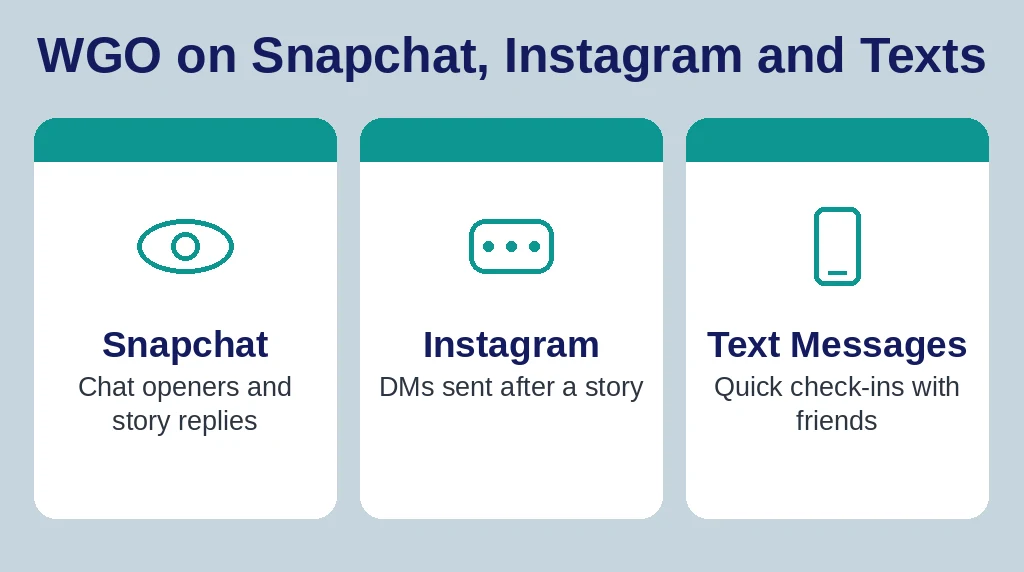
On Snapchat, WGO is a conversation starter. It arrives as a chat message or a reply to a story, and because snaps disappear, it often reacts to whatever the sender just saw. A story showing a hospital wristband, a packed suitcase, or a tearful selfie will pull a fast “wgo?” from anyone close to you. In plain snaps between friends, it can also be the whole message, a nudge that says “entertain me” or “catch me up.”
On Instagram, WGO lives mostly in DMs. Followers send it after stories that raise questions: a black screen, a cryptic quote, a location nobody expected. It also pops up in comment threads under chaotic posts, where “wgo in these comments” means the replies became the entertainment. Twitter and X see it less, and TikTok comments use it the same reaction way, aimed at the video rather than the person.
In regular text messages, WGO is at its most flexible. It can open a chat in the morning, revive one in the evening, or ask about a noise in the background of a voice note. Older or less slang-heavy texters may not know it at all, so with family members who type in full sentences, the spelled-out question is still the safer choice.
Real Conversation Examples
Person A: “hey stranger, wgo”
Person B: “not much, just got back from the gym. you?”
Meaning: Person A is using WGO as a greeting. They want a general update, and Person B answers with one and returns the question.
Person A: “I just walked out of my exam and started laughing in the hallway”
Person B: “wgo??”
Meaning: Person B is asking a real question. The odd message needs a story, and the double question marks show genuine confusion and curiosity.
Person A: “added you back to the group, you missed a lot”
Person B: “lol wgo, give me the summary”
Meaning: Person B is using WGO as a catch-up request. They want the group chat’s recent events compressed into a few lines.
Is WGO Rude?
WGO is not rude by nature. It contains no profanity, and between friends it usually feels warm, curious, or playful. Most people read a friendly “wgo” like “what’s up,” and nobody takes offense at it. The greeting version is about as harmless as slang gets.
Problems start with distance and timing. From a boss, a teacher, or someone you barely know, WGO can feel like prying, because the open question invites you to share more than a near-stranger has earned. It can also land badly in a tense moment. If someone is clearly upset and mid-crisis, a bare “wgo” may read as nosy entertainment-seeking rather than concern. Adding one soft word fixes most of this: “hey, wgo? you good?” signals care instead of curiosity. As with most slang, the relationship carries the tone more than the letters do.
How to Reply When Someone Sends WGO
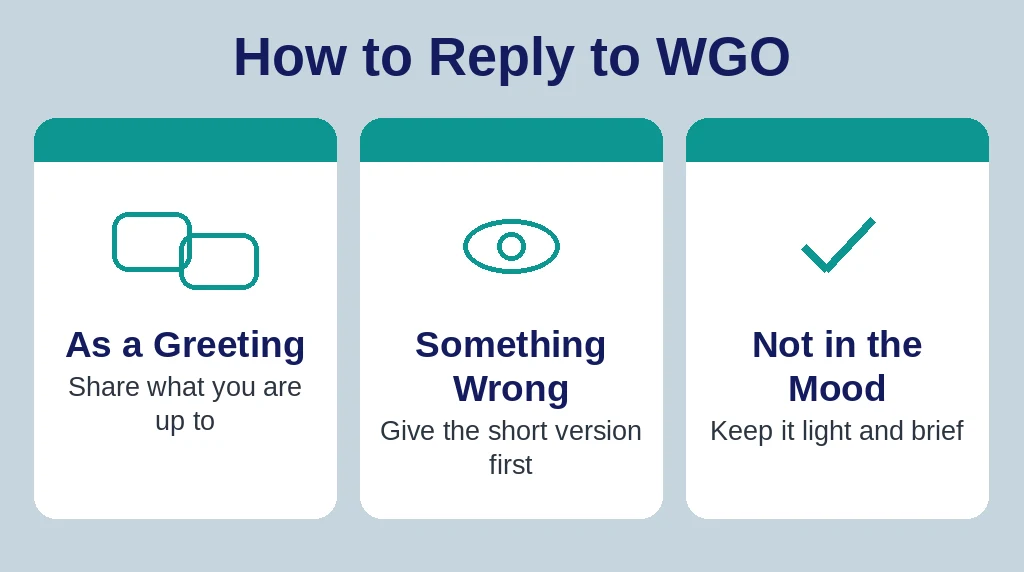
The right reply starts with one decision: is this a greeting or a real question? Answer the greeting with a light update, answer the real question with the short version of the story, and keep both as honest as the relationship deserves.
If It Is Just a Greeting
- “not much, just chilling. wgo with you?”
- “same old, work then gym. anything new?”
- “finally home, about to cook. you?”
- “nothing crazy, just bored lol”
If Something Is Actually Wrong
- “long story, but the short version is my car died again”
- “me and Sara had a dumb fight, I will explain”
- “work drama. I am fine though, do not worry”
- “a lot, honestly. can I call you in ten?”
If You Do Not Want to Get Into It
- “nothing much, all good here”
- “just life lol, same as always”
- “tell you later, it is a long one”
- “I am good, just tired. wgo with you?”
When to Use WGO
WGO fits casual texts with friends, sleepy group chats that need reviving, Snapchat conversations, and replies to stories that genuinely puzzle you. It works best with people who already text in shorthand, because they read the tone you intend, not the tone they fear. Use the question version when you honestly want the story and have time to hear it. A WGO that opens a door you then ignore feels worse than never asking at all.
When to Avoid WGO
Skip WGO in work chats, emails, and messages to teachers, clients, or anyone senior to you, since it reads as lazy shorthand in those settings. Avoid it with people who are grieving or in real trouble, where a three-letter nudge can look like entertainment instead of support. Do not use it to fish for gossip you have no stake in, and do not send it to someone who has gone quiet on purpose. Silence is sometimes an answer, and WGO should never become a crowbar.
Common Mistakes People Make With WGO
Thinking WGO means “let’s go.” This claim floats around low-quality slang lists, but established references agree that WGO means “what’s going on.” Reading excitement into a simple check-in can send a whole conversation sideways.
Answering a real question like a greeting. When a worried friend asks WGO after your dramatic post, “nothing much” feels like a door slammed in their face. If the message before yours was strange or heavy, assume they want the story.
Using WGO with everyone. Your best friend reads “wgo” as affection. Your manager reads it as unprofessional, and your grandmother may read it as a typo. Match the abbreviation to the audience, and spell the question out when in doubt.
Slang That Shows Up Next to WGO
WGO belongs to a small family of check-in slang. These terms all open conversations, but each one asks something slightly different, and mixing them up changes what you are really asking.
| Term | Meaning | Main Difference |
|---|---|---|
| WYD | What are you doing | Asks about your current activity, not the whole situation |
| WSG | What’s good | A greeting that expects a vibe check more than a report |
| WYO | What you on | Asks about your plans or what you are getting into |
| SUP | What’s up | The classic all-purpose greeting WGO closely mirrors |
| HBU | How about you | Returns a question instead of opening one |
Quick Recap
- In almost every text, WGO means “what’s going on,” asked either as a greeting or as a genuine question.
- A WGO that opens a quiet chat is a friendly check-in. A WGO after drama wants the full story.
- Punctuation is the loudest clue: plain “wgo” is relaxed, while “wgo??” or capitals carry urgency.
- WGO has no profanity and is rarely rude, though it can feel nosy from strangers or in tense moments.
- Established references do not support the “let’s go” claim. That reading is a mistake, not a meaning.
Frequently Asked Questions
What does WGO mean in text?
WGO means what’s going on, used as a casual greeting or as a genuine question when something seems wrong.
Is WGO a greeting or a question?
WGO works as both, acting as a relaxed greeting in quiet chats and a real question after surprising or worrying news.
What does WGO mean on Snapchat?
On Snapchat, WGO usually opens a chat or answers a story, asking what is happening or what someone is doing.
How should you reply to WGO?
Reply with a short honest update about your mood, your plans, or the situation, matching how serious the sender sounds.
Is WGO rude?
WGO is not rude between friends, though it can feel nosy or abrupt from strangers, bosses, or distant acquaintances.
Final Thoughts
WGO earns its place in texting because one short question can do two kind jobs. It can knock on a quiet chat like an old friend, or it can ask for the story when something looks off. Read the timing, the punctuation, and the person, and you will rarely mistake one job for the other. When you send it yourself, mean the question and stay for the answer. For the settled reference definition behind this guide, Cyber Definitions’ WGO entry lists the same core meaning.
Related slang guides: ASL meaning in text, WYTB meaning in text, and TS meaning in text.