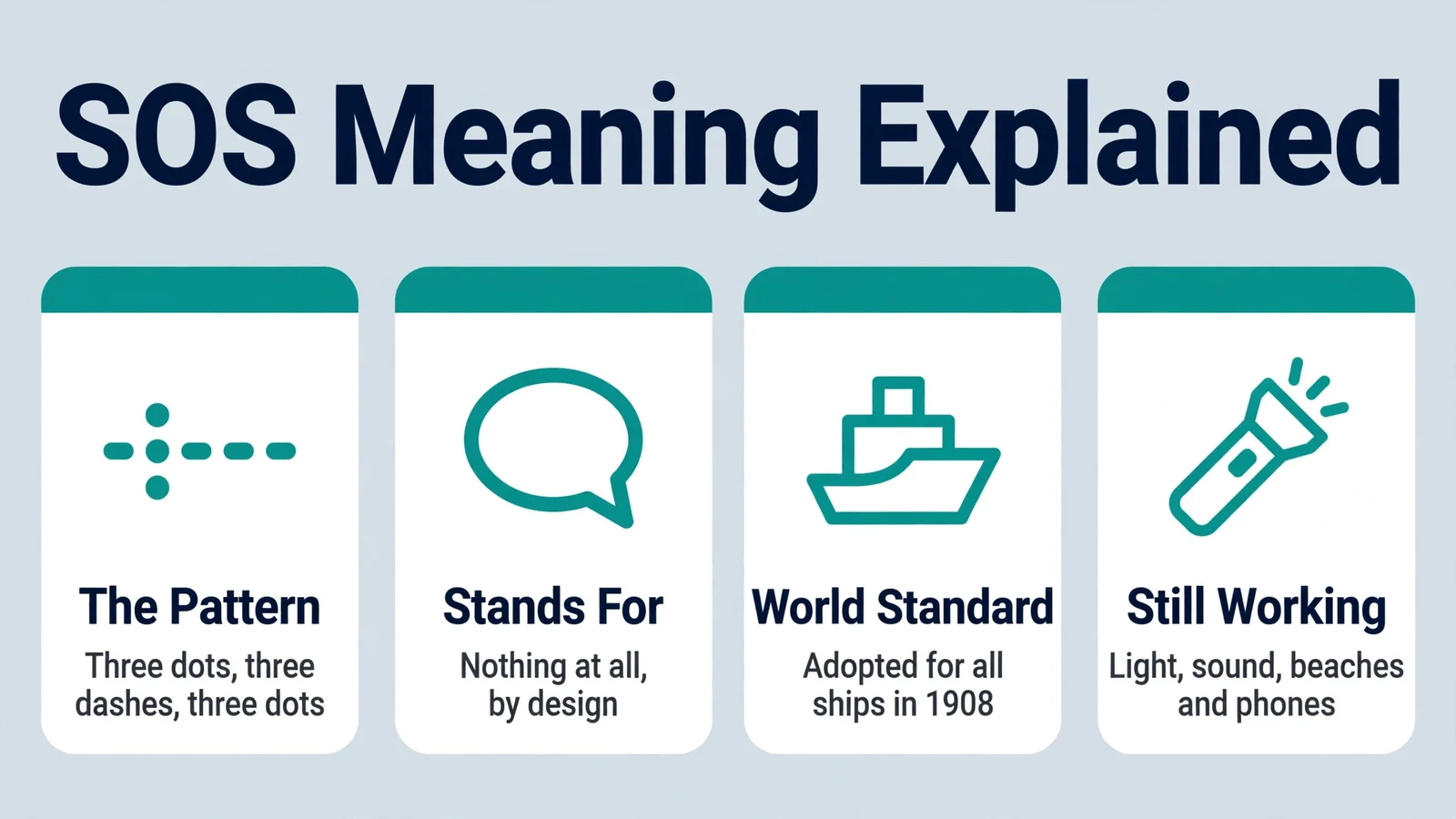
Three dots. Three dashes. Three dots again. That small rhythm is the most famous cry for help on Earth, tapped out by sinking ships, flashed from flashlights, and written in giant letters on empty beaches. If you have ever wondered what SOS means, here is the short answer. SOS is the international distress signal in Morse code, used when life is in immediate danger.
Here is the twist most people never hear. SOS does not stand for anything at all. It was chosen purely because its pattern is impossible to mistake for anything else.
This guide follows the documented record, from the German rule book of 1905 to the Titanic, and from Morse keys to the satellite phone in your pocket. Along the way, it clears up the myths that still cling to these three letters.
What Does SOS Mean?
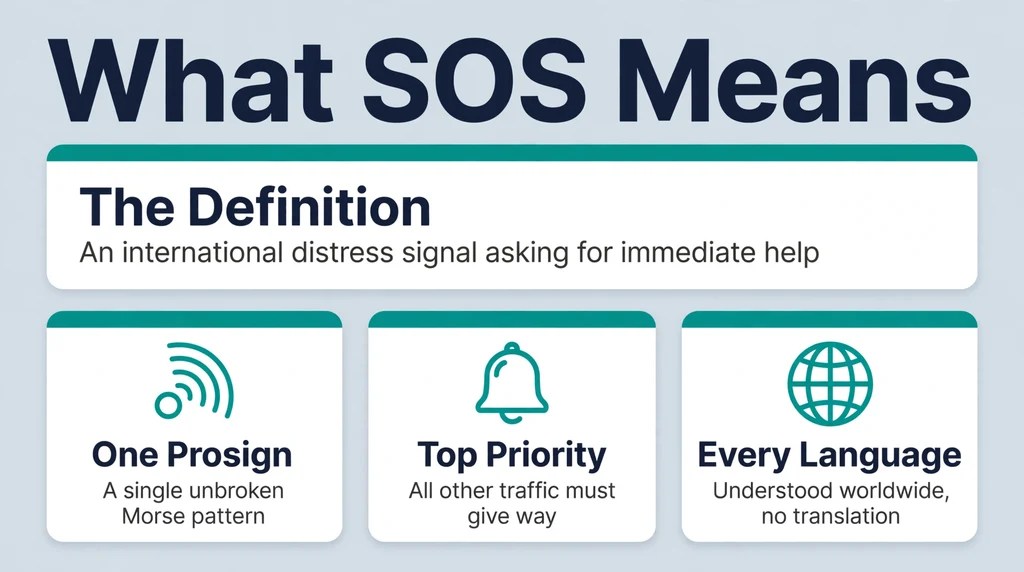
SOS means one thing in every language: help, urgently, because someone is in grave danger. It is not really a word. Technically, it is a procedural signal, the kind of fixed code that operators send to open a distress message.
Britannica describes SOS as an internationally recognized distress signal, used mainly by ships and aircraft to call for assistance. When an operator sent it, every listening station understood the situation at once. A vessel or aircraft was in trouble, and lives were at risk.
A Signal, Not an Abbreviation
Most three-letter codes shorten a phrase. SOS shortens nothing. It began as a bare pattern of sound, nine pulses of Morse code with no letters attached at all.
The letters arrived later, as a convenience. Because three dots spell S and three dashes spell O in Morse code, operators found the pattern easy to name. Calling it SOS was simply the fastest way to talk about it.
The Figurative Meaning Today
Over a century of emergencies stretched the meaning. Today, people use SOS for any desperate appeal for help, even when nothing is sinking. A student might text a friend an SOS before an exam. A manager might send out an SOS for volunteers on a failing project.
That figurative use is not new, either. Writers were already using SOS loosely by 1918, only a decade after the signal became standard. The distress call had escaped the radio room almost as soon as it entered it.
One Signal, Every Language
Part of the design genius is what SOS never required: translation. A French trawler, a Japanese freighter and a Brazilian patrol boat could all read the same nine pulses. No shared language, no shared alphabet, no shared flag code was necessary.
The rules gave the signal muscle as well. Distress traffic has priority over every other transmission, and stations hearing a distress call must stop interfering and listen. A pleasure boat’s routine message legally yields to a stranger’s SOS.
That combination explains the signal’s reach. It is at once a code, a law and a reflex. Sailors, pilots, soldiers, hikers and rescue services on every continent still learn it, usually before they learn almost anything else about signaling.
Does SOS Stand for Save Our Souls?
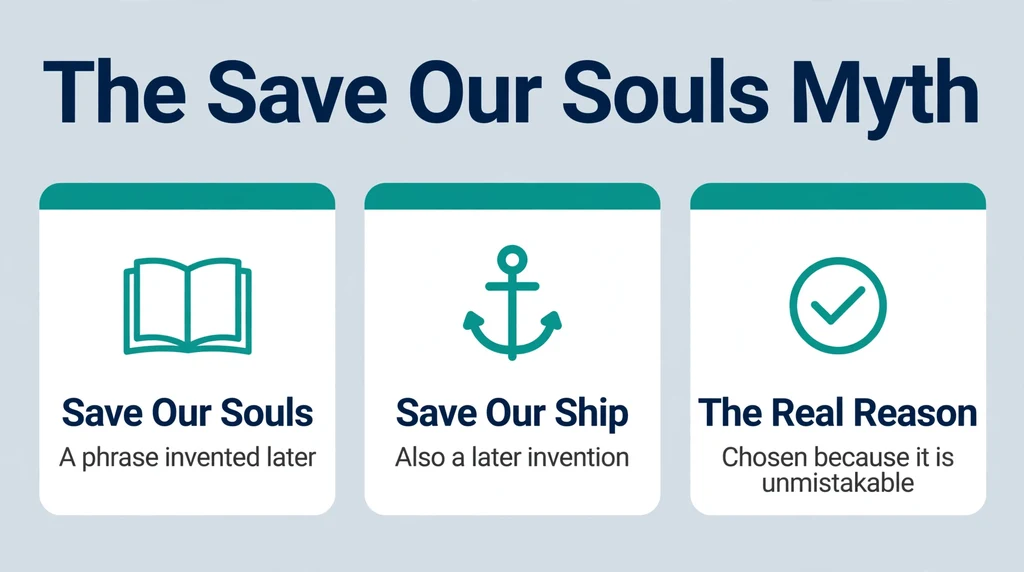
No. This is the most durable myth in radio history, and it survives because the phrases fit so neatly. Save Our Souls and Save Our Ship both match the letters S, O and S. Neither phrase had anything to do with choosing the signal.
What a Backronym Is
A backronym is a phrase invented after the fact to explain letters that already exist. People dislike meaningless codes, so they build meanings for them. SOS collected several, including Save Our Souls, Save Our Ship and even Stop Other Signals.
Each one sounds official. Each one is wrong. The phrases were memory aids at best, helping sailors and schoolchildren recall which letters the pattern spelled.
What the Record Actually Says
The people who standardized the signal left their reasoning in writing. A Marconi yearbook from 1918 put the matter plainly for operators. It said the signal was adopted “simply on account of its easy radiation and its unmistakable character.”
The yearbook then removed all doubt. “There is no special significance in the letters themselves.” Historians at Britannica and the ITU, the United Nations agency for telecommunications, tell the same story today. The rhythm came first. Letters came second. The phrases came last of all.
Why the Myth Refuses to Die
The false expansion has one big advantage over the truth. It is emotional, and it is easy to teach. A dramatic phrase sticks in the memory far better than a note about signal design.
There is also a simple visual trap. Because the letters form a tidy palindrome of dots and dashes, the pattern feels designed around words. In fact, it was designed around ears, not dictionaries. Its job was to punch through static and panic, and it still does.
The Signal Itself: Three Dots, Three Dashes, Three Dots
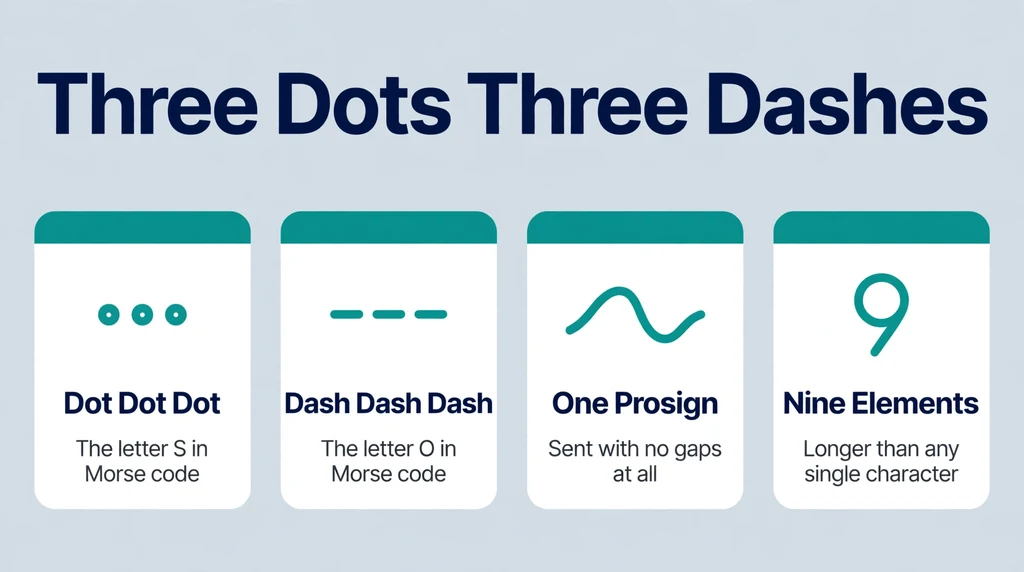
Strip away the legend and SOS is an elegant piece of engineering. It is a pattern built to survive the worst conditions imaginable: failing equipment, rough seas, static, fear and exhaustion. Every design choice in it serves that one purpose.
Sent as One Continuous Pattern
Operators did not send S, pause, O, pause, S. They sent one unbroken stream: dot dot dot, dash dash dash, dot dot dot. In Morse terms, SOS is a prosign, a single procedural unit rather than three separate letters.
Purists write it with a bar across the top to show the letters run together. That unbroken flow matters. It gives the signal a rhythm no ordinary message has, a rhythm a tired operator can recognize half asleep.
Timing gives the pattern its music. A dash lasts three times as long as a dot. So the signal sounds like a heartbeat: quick quick quick, slow slow slow, quick quick quick. Nothing else on the airwaves moves quite like it.
Why This Pattern Won
Length was one advantage. SOS runs to nine elements, longer than any single character in Morse code, where nothing exceeds six elements. A fragment of ordinary traffic could never accidentally add up to it.
Simplicity was another. The pattern asks almost nothing of the sender. Even an injured operator, or a passenger with no training, could tap it out on a key. Many real rescues began with exactly that kind of desperate, imperfect sending.
Distinctiveness was the third. The signal is symmetrical, easy to memorize and impossible to confuse with routine traffic. As a result, stations that heard it dropped everything. The regulations demanded nothing less.
The Letters That Read Both Ways
The pattern has one more accidental gift. Written as letters, SOS reads the same upside down. Text that works at any angle is called an ambigram, and SOS is the most useful one ever made.
That quirk matters far from any radio. A castaway can stamp SOS into a snowbank or lay it out in logs on a beach. A pilot flying over in either direction can still read it. The letters stay legible even if the writer gets them backwards or the viewer approaches from the far side.
Where SOS Came From
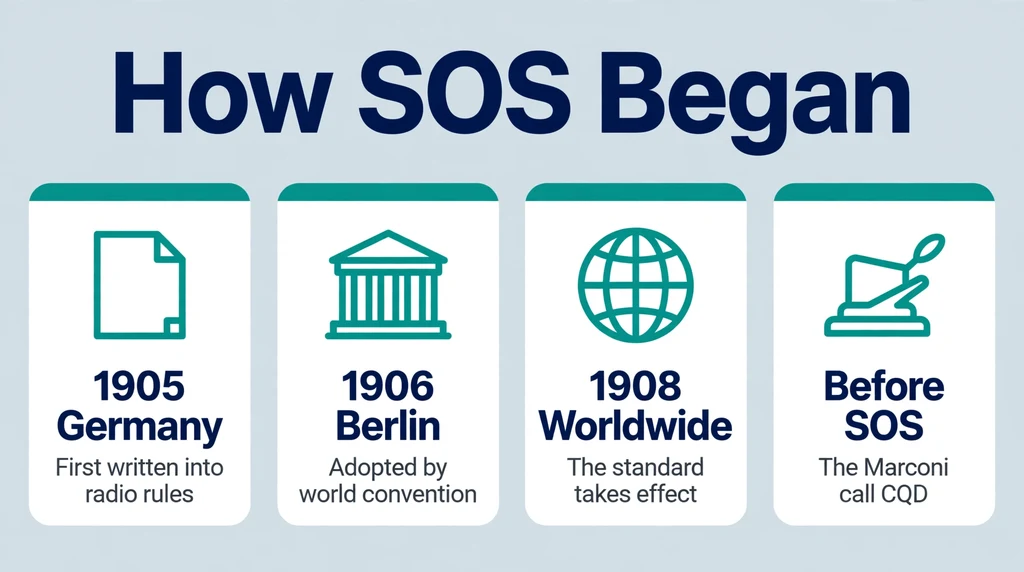
SOS was a bureaucratic invention before it was a famous one. It appeared first in government regulations, not in a disaster. Committees, not heroes, gave it to the world.
The World Before a Standard Call
Before wireless, a ship in trouble was nearly alone. Crews raised flags, fired rockets, rang bells and burned flares, all of which failed beyond the horizon. Help depended on another vessel happening to see the trouble.
Flag codes did offer a distress signal. The international code flags N over C meant “I am in distress and require immediate assistance.” It worked only in daylight, in clear weather, within sight of another ship.
Wireless telegraphy changed the geometry of rescue in the early 1900s. A signal could now cross hundreds of miles of empty ocean. What the new technology lacked was agreement, and rival companies promoted rival codes. That chaos is what regulators set out to fix.
Germany Writes It Into Law
Germany moved first. Its national radio regulations, effective from 1 April 1905, listed three official Morse sequences for shipboard use. One of them, the Notzeichen or distress sign, was three dots, three dashes, three dots.
German officials wanted a signal that stood apart from ordinary traffic. Their choice was already working on German ships when the rest of the world sat down to agree on a single standard.
Berlin Makes It Worldwide
In November 1906, delegates met in Berlin for the first International Radiotelegraph Convention. They signed the agreement on 3 November 1906. Its service regulations adopted the German pattern as the international distress signal.
Article XVI stated the rule in one dry sentence. “Ships in distress shall use the following signal,” it read, giving the sequence and adding that it should be repeated at brief intervals. The regulations took effect worldwide on 1 July 1908. From that date, SOS was the standard everywhere.
Notably, the official texts described only dots and dashes. No letters, and certainly no phrases, appeared anywhere in the rule. Operators and journals spread the name SOS afterward, because the pattern matched those letters so conveniently.
The Signal It Replaced: CQD
Before SOS, there was CQD. The Marconi company introduced it in 1904 for its operators, who then staffed most of the world’s shipboard radio rooms. CQ was an old telegraph general call, roughly “attention, all stations.” Adding D turned it into a distress call.
CQD had real weaknesses. It was never adopted as an international standard outside the Marconi world. Worse, in weak reception its final letter could be missed entirely. A distress call that fades into a routine CQ is a design failure waiting for a disaster.
CQD also collected folk meanings, such as Come Quick, Danger. Those expansions are backronyms too. The call was always just CQ plus D, whatever later storytellers preferred.
The First SOS Calls and the Titanic
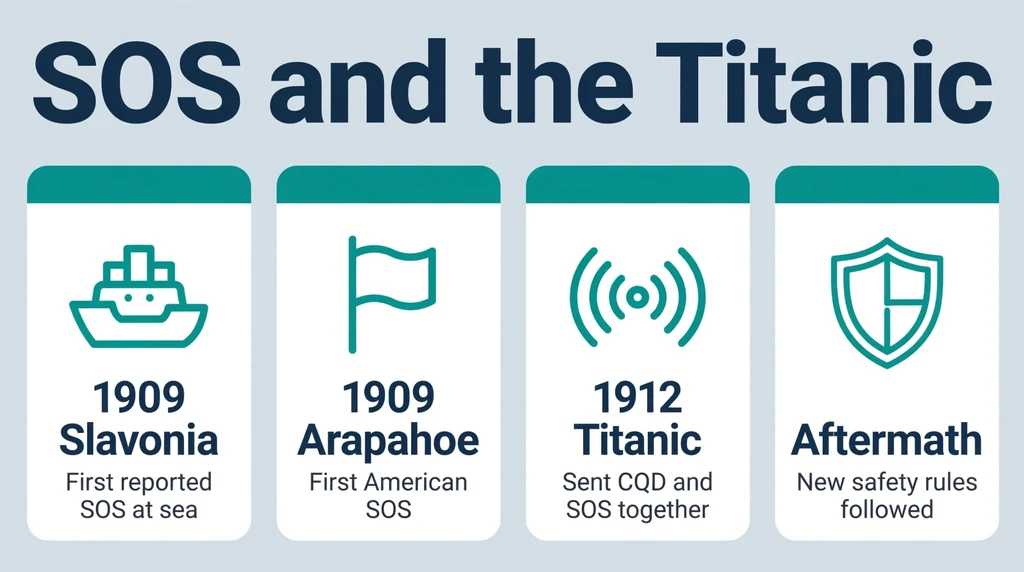
Standards take time to bite. In its first years, SOS shared the airwaves with the older CQD, and operators chose between them by habit and employer. Three famous emergencies trace how the new signal won.
Slavonia and Arapahoe, 1909
The earliest reported SOS came from the Cunard liner RMS Slavonia. On 10 June 1909 she wrecked on rocks off the Azores. Her operators sent the new signal, nearby ships answered, and everyone aboard was saved.
Two months later, the steamer SS Arapahoe lost her propeller off Cape Hatteras, North Carolina. On 11 August 1909 her operator sent SOS, the first reported use from an American ship. The call reached the shore station at Hatteras and rescue followed.
That same year showed the old code’s finest hour, too. In January 1909, the liner RMS Republic collided in fog, and operator Jack Binns sent CQD again and again. His endurance brought help and made wireless rescue famous. Both signals, clearly, could save lives.
Why Ships Were Slow to Switch
If SOS was law from 1908, why did operators keep sending CQD? Habit was part of it. Wireless men had trained on Marconi equipment, worked for Marconi companies, and trusted the call they had used for years.
Commercial rivalry played a role as well. In that era, shipboard operators were usually employees of the equipment companies, not the shipping lines. The ITU’s own history notes that rival firms fought for market share, and operators sometimes ignored signals from competing systems.
Safety reformers found this intolerable, and said so loudly. One international standard, honored by everyone, was the entire point of the Berlin agreement. The events of April 1912 settled the argument for good.
The Night Titanic Used Both
Titanic struck ice late on 14 April 1912. Senior operator Jack Phillips reached for the familiar call first, and CQD went out over the North Atlantic. His junior, Harold Bride, then suggested trying the newer signal as well.
By Bride’s own later telling, he joked that it might be Phillips’s last chance to use the new code. Phillips laughed, and from then on he alternated the two calls. CQD and SOS went out side by side for hours.
The detail matters because it corrects a popular error. Titanic did not send the first SOS, and it did not send only SOS. It sent a mixture, from a ship whose British Marconi operators still leaned on the old habit. The disaster made SOS famous, but fame is not the same as a debut.
The calls reached the liner Carpathia, which raced to the scene and rescued the survivors in the lifeboats. Meanwhile, the nearby Californian never came. Its crew had seen Titanic’s rockets but read them as harmless signals, a confusion the ITU’s history still uses to teach why shared standards matter.
Reform After the Disaster
The response to Titanic reshaped radio law within months. The 1912 London conference assigned the 600 metre wavelength, about 500 kilohertz, to ship distress traffic. It also created the famous silence periods, three minutes at a quarter past and a quarter to each hour, when operators stopped and listened for weak calls.
In 1914, the first Safety of Life at Sea convention, known as SOLAS, added wider safety rules. CQD quietly faded away as operators retrained around the international standard. One signal now ruled the airwaves, and everyone knew its rhythm.
SOS vs Mayday: The Voice of Distress
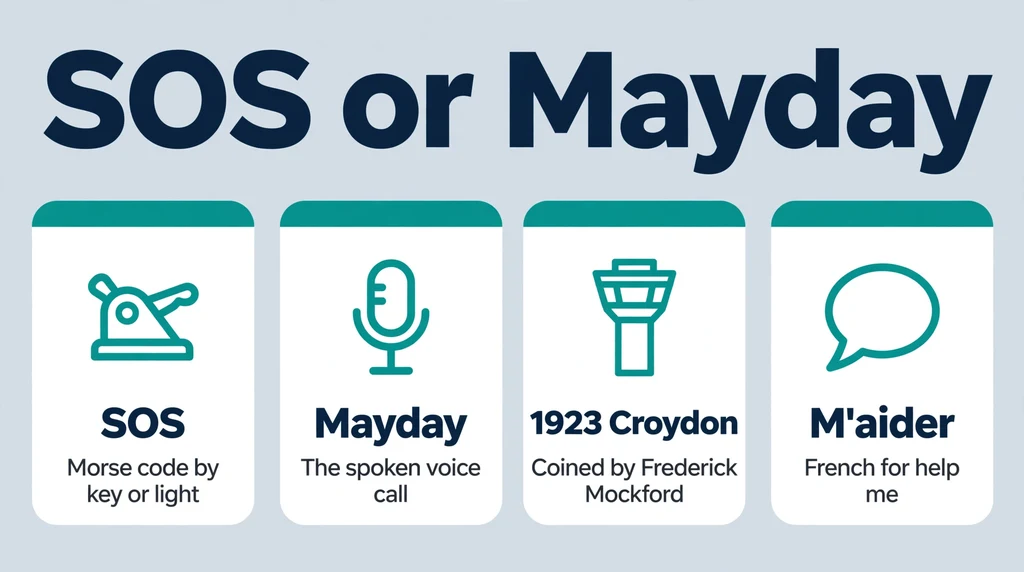
SOS belongs to the telegraph key. Mayday belongs to the human voice. The two calls cover the same emergency at different technological moments, and confusing them misses how radio actually developed.
Why Voice Radio Needed a New Word
By the early 1920s, aircraft were crossing the English Channel with early voice radios. Spelling out letters by telephone proved unreliable in noise and static. The letter S, in particular, could blur into other sounds.
The Times of London reported the problem in February 1923. Because S was so hard to distinguish by telephone, the paper explained, SOS would give place to a spoken word instead. Aviation needed a call that ears could catch the first time.
Mockford and the French Connection
Frederick Stanley Mockford, the senior radio officer at Croydon Airport in London, was asked to invent that word. Most of his traffic flew between Croydon and Le Bourget in Paris. So he reached across the Channel for it.
He proposed Mayday, from the French m’aider, meaning “help me.” It echoes the fuller phrase venez m’aider, “come and help me.” English and French pilots could both say it, spell it and understand it under pressure.
The word entered cross-Channel use in 1923. Four years later, the 1927 International Radiotelegraph Convention in Washington adopted Mayday as the official radiotelephone distress call. It stood alongside SOS rather than replacing it. Morse kept SOS, and voice radio took Mayday.
The Ladder of Urgency
Both calls sit at the top of a graded system. A Mayday call, repeated three times, means grave and imminent danger, the spoken twin of SOS. Below it sits Pan-pan, from the French panne, meaning a breakdown. Pan-pan marks an urgent problem that is not yet life-threatening.
A third call, Securite, introduces safety messages such as navigational warnings. Together, the three calls let crews announce exactly how bad things are. SOS remains the oldest rung of that ladder, and still the one the whole world recognizes.
Saying Mayday Correctly
Procedure gives the spoken call a strict shape. The caller repeats the word three times: Mayday, Mayday, Mayday. Then come the vessel or aircraft name, its position, the nature of the emergency and the help required.
The triple repetition is not ceremony. It separates a genuine distress call from stray mentions of the word in ordinary conversation. It also gives a listener in noise and static three chances to catch the call.
Misusing Mayday carries legal penalties in many jurisdictions, like pulling a false fire alarm. The same respect applies to SOS itself. Both signals work only because the world trusts them completely.
How to Send an SOS
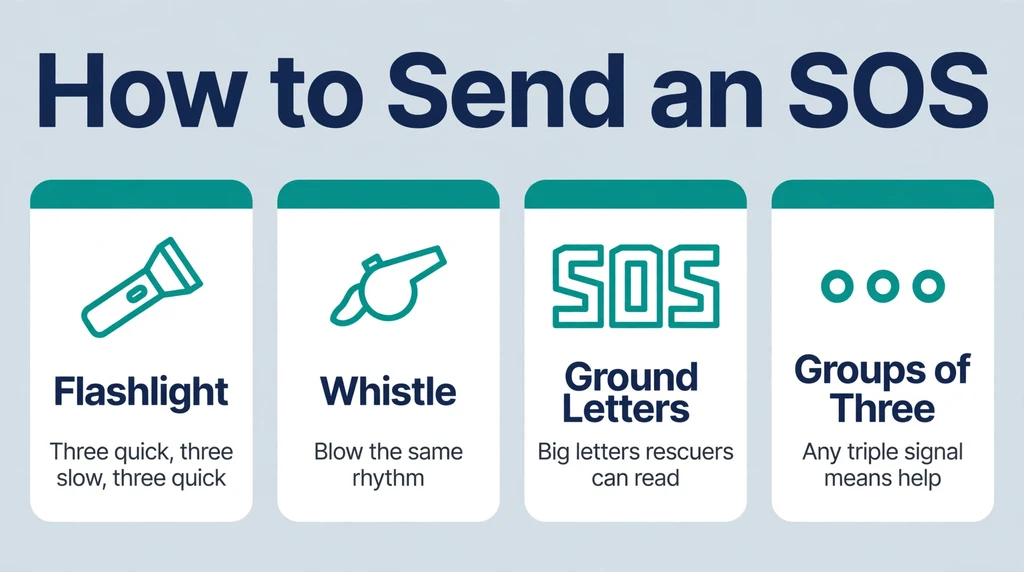
You do not need a radio, a ship or any Morse training. The pattern works in light, sound and touch, which is exactly why it outlived the technology that created it. Three short, three long, three short, then a pause, then repeat.
With a Flashlight or Mirror
Light is the classic substitute for the telegraph key. US National Park Service guidance describes the flashlight version simply. Give three quick flashes, then three slow flashes, then three quick flashes again.
Aim toward aircraft, boats, roads or buildings rather than the open sky. During the day, a signal mirror does the same job with sunlight. Even a phone flashlight works, and many torches and phones include a dedicated SOS flashing mode.
With Sound or Tapping
A whistle carries farther than a voice and costs far less energy. Blow the pattern in the same rhythm: short, short, short, long, long, long, short, short, short. Survivors trapped in collapsed buildings have used the same idea by tapping on pipes and walls.
Sound follows a broader survival rule as well. Any signal repeated in a group of three is treated worldwide as a call for help. Three whistle blasts, three fires or three flashes all speak the same language. Rescuers are trained to notice threes because nature rarely produces them on purpose.
With Letters on the Ground
When aircraft might pass overhead, size and contrast matter more than elegance. Build the letters as large as the space allows, using rocks, branches, clothing or stamped snow. Rescuers reading this guide’s history will remember why the letters work from any direction.
Keep the spacing clean and the lines straight. Then stay near your signal if you safely can, because a found message sends searchers to that exact spot.
After You Signal
Sending is only half of the discipline. Repeat the pattern at regular intervals rather than constantly, since rhythm reads as human and deliberate. Conserve your light, your voice and your whistle while you wait.
Listen between rounds. Rescuers answer signals, sometimes with three blasts or flashes of their own in North American practice. A reply means the pattern landed. Keep your position, keep signaling on schedule, and let the rescuers close the distance.
SOS in the Modern World
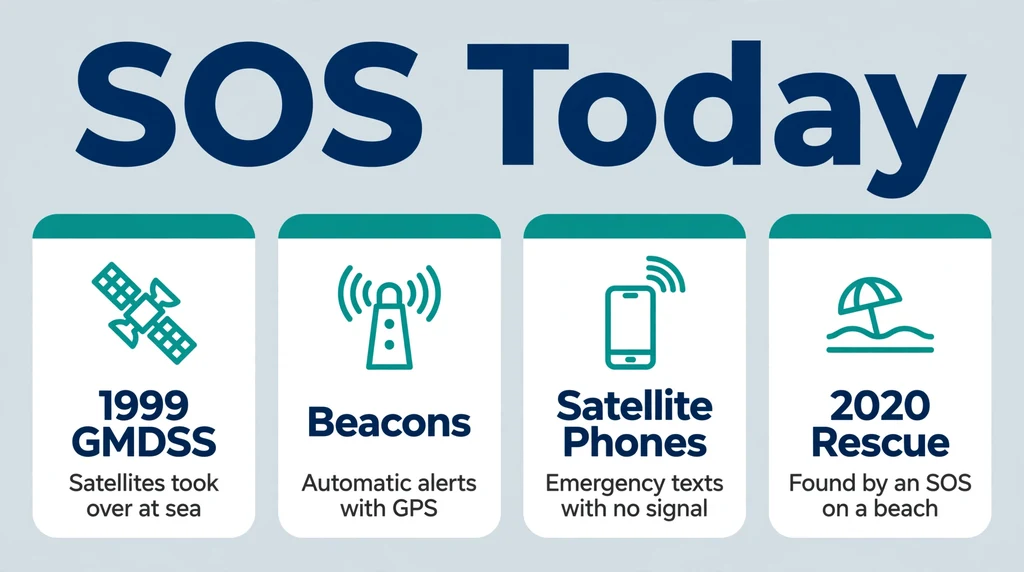
Morse code retired from the sea in 1999. SOS did not retire with it. The signal moved into satellites, phones and everyday speech, and it still performs real rescues every year.
1999: The Watch Ends, the Signal Stays
On 1 February 1999 the Global Maritime Distress and Safety System, GMDSS, became fully operational. Satellite and digital systems took over the distress watch that Morse operators had kept on 500 kilohertz. Ships no longer needed a human listening for dots and dashes.
Yet the conventions still recognize SOS as a standard distress signal with any signaling method. A flashlight pattern or a tapped rhythm remains official, not just traditional. Few technologies earn that kind of afterlife.
Beacons That Send It for You
Modern beacons automate the cry for help. Emergency position-indicating radio beacons on ships and personal locator beacons on land transmit a distress alert to the Cospas-Sarsat satellite network. Rescue centers then get your identity and, on modern units, your GPS position.
These devices do not literally tap out Morse. They inherited the role SOS created: a standardized, unmistakable alert that strangers are obliged to answer. The pattern changed, but the promise stayed the same.
Phones and Satellites
Phones kept the three letters as well. When a phone shows SOS where the signal bars should be, it means the home network is out of reach but emergency calls may still connect through another network. If your phone shows SOS after losing service, our separate guide to what SOS means on iPhone covers the phone side in depth.
In November 2022, Apple launched Emergency SOS via satellite for iPhone 14 in the US and Canada. It lets users message emergency services with no cellular or Wi-Fi coverage at all. Similar satellite messaging has since spread to other phones and countries.
A Beach in Micronesia, 2020
The old method still works, too. In August 2020, three sailors were stranded on tiny Pikelot Island in Micronesia after their boat ran out of fuel. They wrote a giant SOS on the beach.
Australian and American search aircraft spotted the letters, and the men were rescued. No radio, no beacon, no battery. Just three letters in the sand, doing the job they were shaped for over a century ago.
Three Letters on the Roadside
The letters also became public signage. Across Europe, emergency telephones along motorways are marked simply SOS, a usage visible on road signs from Belgium to Germany. A stranded driver needs no local language to understand the promise on the box.
Emergency phones, call boxes and some alarm points in stations and tunnels carry the same three letters. Urban designers borrowed the code for the same reason radio regulators chose it. Nothing else communicates “help point, right here” quite so fast.
SOS Beyond Emergencies
Spend a day listening to ordinary speech and you will hear the signal everywhere. SOS has become the default metaphor for any urgent plea, a journey few technical codes ever make.
The Everyday Cry for Help
People send an SOS when a project collapses, when a car breaks down, or when a group chat needs a hero. In texting, an SOS usually means “help me with this now,” with the danger scaled down to embarrassment or inconvenience.
This loose use began early. Print examples of figurative SOS appear by 1918, while the signal was still new at sea. The metaphor worked because everyone already knew the stakes the real signal carried.
SOS in the Age of the Group Chat
Texting gave the old signal a second career. In a chat, SOS now works as a one-word flare: send help, send answers, send rescue of almost any kind. It can be comic, pleading or genuinely urgent, and context does the decoding.
Unicode even reserves the signal its own emoji, the red SOS button, for moments when three letters are not loud enough. Phones also autocomplete the phrase “send an SOS” in a dozen contexts. Few pieces of 1905 engineering remain this fluent in 21st century slang.
SOS in Pop Culture
Songwriters reached for the same stakes. ABBA released “SOS” as a single in 1975, turning the distress call into a plea from a failing relationship. Four years later, The Police built “Message in a Bottle” around a castaway writing for rescue. Its chorus carries the famous line, “I’ll send an SOS to the world.”
Rihanna carried the pattern into the dance-pop era with her 2006 hit “SOS,” built around a lover’s rescue fantasy. The Jonas Brothers released their own “S.O.S” soon after. In every case, the joke and the hook depend on the audience knowing the real meaning instantly.
Common Myths and Mix-Ups
A century of fame gathered folklore around three letters. These are the errors that come up most often, including a few this guide has already passed on the way.
SOS was sent first by the Titanic. False, as the history above shows. The Slavonia and Arapahoe calls came in 1909, three years before Titanic sailed. Titanic made the signal famous, not first.
SOS is three separate letters. Not quite. Operators sent it as one continuous prosign with no gaps between the elements. The letters are a label pasted onto a rhythm, which is why the sequence, not the spelling, is the real signal.
CQD meant Come Quick, Danger. Also false. CQD was CQ, the general call, plus D for distress. The dramatic expansions were invented later, the same backronym habit that produced Save Our Souls.
SOS only applies to ships. It began at sea, but aircraft adopted it, and the standard now covers anyone in distress using any method. A hiker with a whistle and a sailor with a radio are using the same signal.
SOS is obsolete. The Morse watch ended in 1999, yet SOS remains a recognized distress signal, a phone feature and a living metaphor. Obsolete technologies rarely rescue people from beaches, as the Pikelot Island sailors could confirm.
Frequently Asked Questions
What does SOS stand for?
Officially, nothing. SOS is not an acronym and never was. It names the Morse pattern of three dots, three dashes and three dots, which happens to match the letters S, O and S. Save Our Souls and Save Our Ship were fitted to the letters later as memory aids.
Why was SOS chosen as the distress signal?
Because of how it sounds, not what it spells. The pattern is long enough to be unmistakable, simple enough for anyone to send, and symmetrical enough to recognize through static. A 1918 Marconi yearbook said it was adopted for its “easy radiation and unmistakable character,” with no significance in the letters.
When was SOS first used?
The earliest reported emergency uses came in 1909. Cunard’s liner RMS Slavonia sent SOS after wrecking off the Azores on 10 June 1909. The steamer SS Arapahoe followed off North Carolina on 11 August 1909. The signal itself had been Germany’s national standard from 1905 and the world standard from 1908.
Did the Titanic send the first SOS?
No. Titanic sent SOS in April 1912, three years after the first reported uses. Its operators actually mixed the new SOS with the older CQD for hours. The disaster made SOS world famous and pushed the remaining holdouts to adopt it.
What is the difference between SOS and Mayday?
SOS is a Morse code signal, sent by key, light or any other method. Mayday is a spoken word for voice radio, created in 1923 by Croydon radio officer Frederick Stanley Mockford from the French m’aider, “help me.” Both mean the same thing: grave and imminent danger. Mayday was adopted internationally in 1927 for radiotelephone use.
How do you signal SOS with a flashlight?
Use the rhythm of the Morse pattern. Flash three times quickly, then three times slowly, then three times quickly again. Pause, and repeat the whole sequence. Point the light toward anything that might see it, such as a road, a boat, a building or an aircraft.
What does SOS mean on a phone?
On a phone screen, SOS usually means the device cannot reach its own network but can still place emergency calls through any available network. Modern phones also carry features named after the signal, such as satellite emergency messaging on recent iPhones. Both uses borrow the authority of the original distress call.
Is SOS still used today?
Yes. The maritime Morse watch ended when GMDSS took over in 1999, but SOS remains an officially recognized distress signal with any signaling method. It is still taught to sailors, pilots and outdoor travelers. People were rescued by a beach SOS as recently as 2020.
What replaced SOS at sea?
Satellites did. The Global Maritime Distress and Safety System, fully in place by 1999, uses satellite alerts, digital selective calling and automated beacons instead of a human operator copying Morse. Ships still carry the knowledge of SOS, and the signal remains valid. The machinery changed more than the meaning did.
Final Thoughts
SOS is a rare kind of invention: a pattern so well designed that it escaped its own technology. It began as nine pulses in a German rule book. It became the sound of rescue at sea, the voice era’s benchmark for Mayday, a phone icon, a pop hook and a metaphor anyone on Earth can decode.
Its deepest lesson hides in the myth this guide kept correcting. SOS never needed words to work. Three dots, three dashes and three dots say everything, in every language, at any angle, through almost any medium. If you want the reference version of the story, Britannica’s entry on the SOS signal is a sound place to start. And if you ever need the real thing, remember the rhythm. Short, short, short. Long, long, long. Short, short, short.