You have probably met one without knowing its name. A small lizard flashes across the garden path, polished like a wet pebble, and dives under a log before you can focus. That was very likely a skink.
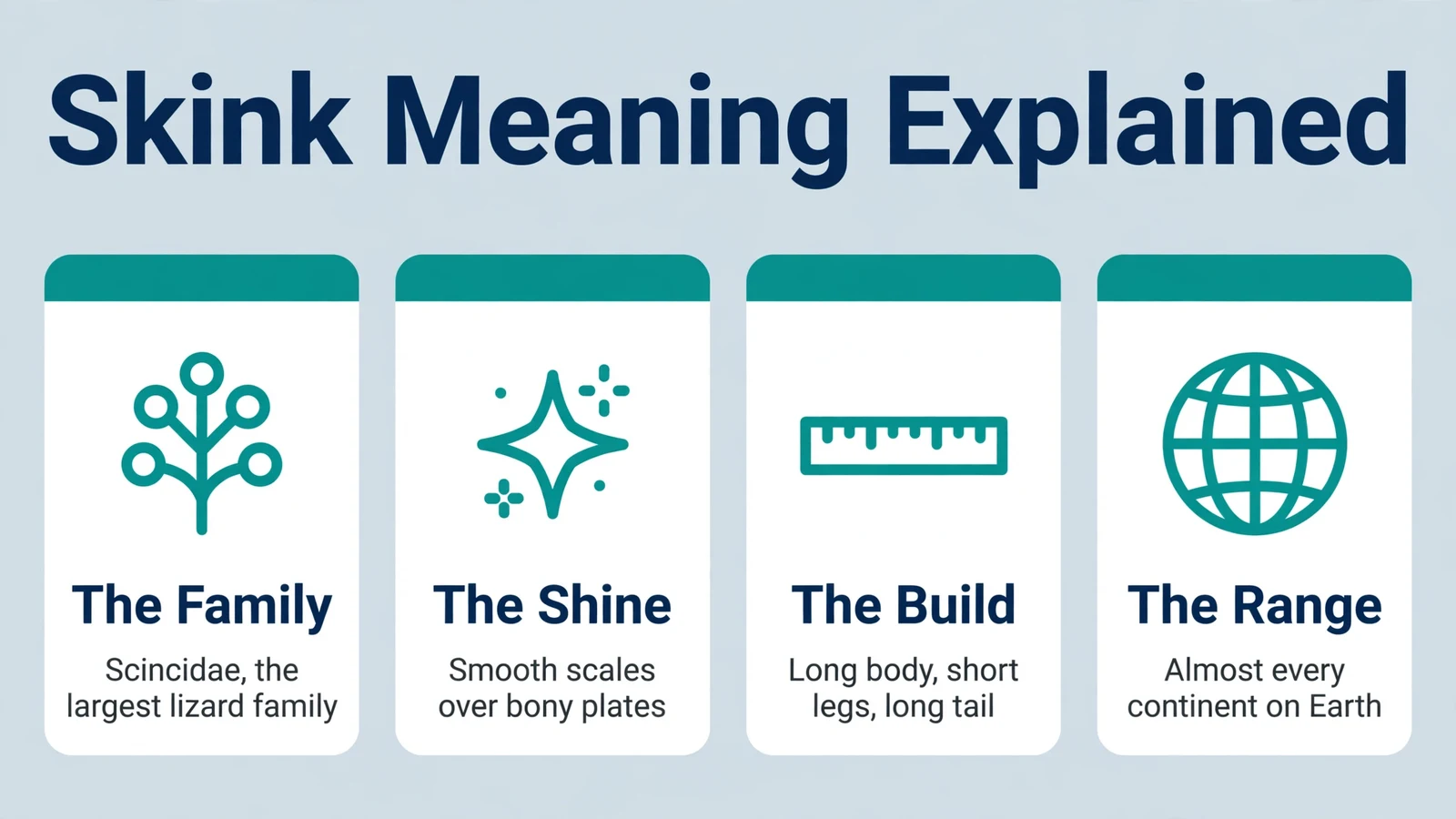
A skink is a lizard, and a record-breaking one at that. Skinks form the family Scincidae, the largest lizard family on Earth, with more than 1,500 species. They are the smooth, shiny lizards, built low to the ground and usually carried on short little legs.
This guide explains what a skink is and how to recognise one at a glance. It covers where skinks live, what they eat, and how they drop a tail and grow another. You will meet the famous species, settle the danger question, and weigh up skinks as pets.
Finally, the guide ends with a surprise second meaning. In Scotland, skink is also a verb, and it has nothing to do with lizards at all.
What Is a Skink?
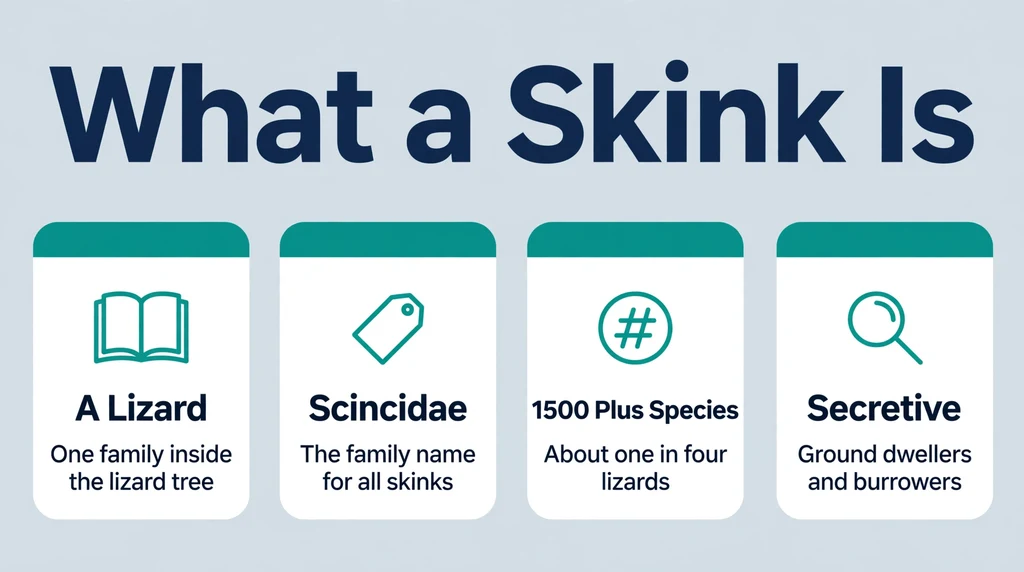
Start with the plain definition. A skink is any lizard in the family Scincidae, a huge group of mostly small, secretive reptiles. Most skinks live on the ground or under it, slipping through leaf litter, soil, and sand.
The word lizard covers thousands of species in many families. Skinks are one branch of that tree, the way spaniels are one branch of the dog family. So every skink is a lizard, but most lizards are not skinks.
The Largest Lizard Family of All
Size is the first surprise here. Scincidae holds more species than any other lizard family, roughly one in every four lizards alive. Geckos and iguanas get more attention, yet skinks quietly outnumber them both.
Counts vary between references, because scientists describe new species every year. Britannica currently lists about 1,275 species, while research based on the Reptile Database puts the total near 1,700. Either way, the family keeps growing, and its lead is not close.
Built for a Secretive Life
Most skinks share a lifestyle as well as a look. They stay low, stay covered, and stay busy in the litter layer where insects live. Many species are active by day, though plenty hunt at dusk or after dark.
This secretive habit explains a common puzzle. People often live alongside skinks for years without learning their name. The lizard on the wall gets called a gecko, and the one in the mulch gets called a baby snake. Half the time, both were skinks.
A Family Tree with Arguments
Scientists place skinks in the order Squamata, alongside all other lizards and the snakes. Inside that order, skinks form their own branch, the group called Scincomorpha. The classification sounds settled, but the family’s sheer size keeps provoking debate.
Some researchers argue that Scincidae is simply too big to manage as one family. Proposals have suggested splitting it into several smaller families, each with its own name. Others prefer to keep the giant family intact and argue about its internal branches instead. Either way, the animals themselves remain gloriously unbothered.
What Does a Skink Look Like?
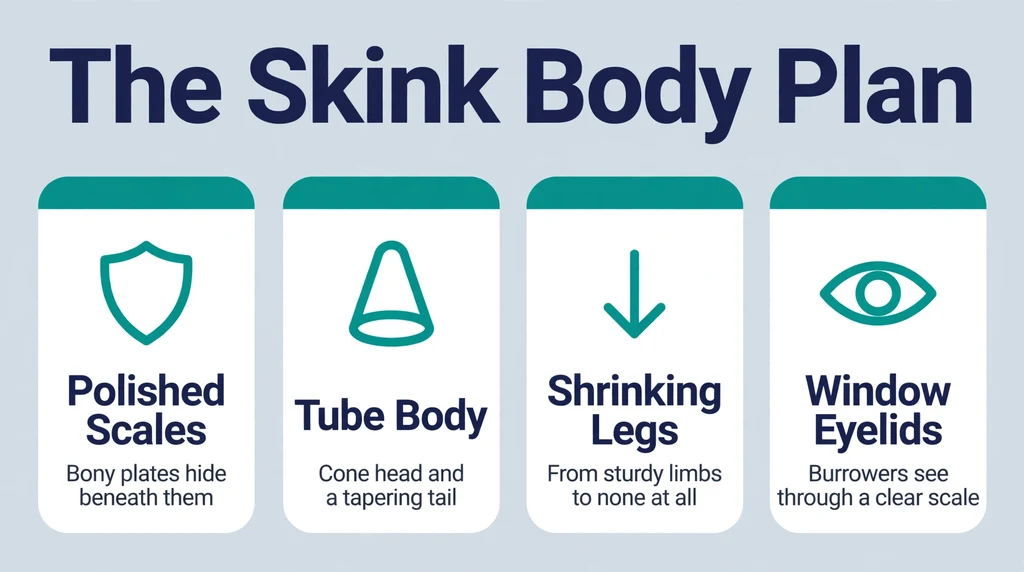
A typical skink looks lacquered. Its scales lie flat and overlap like roof tiles, and light slides off them in a soft shine. Hold that picture, because three features explain almost every skink you will ever see.
Smooth Scales over Hidden Armour
The shine has a structure behind it. Each scale sits on a tiny plate of bone called an osteoderm, so a skink wears flexible armour under its skin. The result feels firm and smooth at once, like a polished stone that bends.
Smooth scales do practical work as well. A burrowing skink glides through soil with little friction, and grit slides off instead of grinding. Meanwhile, the bony layer blunts the teeth and beaks of small predators.
A Tube Body on Shrinking Legs
The classic skink body is a cylinder. A cone-shaped head flows into a long body, and the body flows into an even longer, tapering tail. Legs, by contrast, look like an afterthought on many species.
In fact, shrinking legs are the family’s favourite experiment. Plenty of skinks have four sturdy little legs, and plenty more make do with tiny limbs and fewer toes. Some species have lost their legs completely and travel like snakes. Evolution has run this experiment again and again inside the family, which is why legless skinks turn up on several continents.
Eyes, Ears, and a Clear Window
Most skinks blink, which already separates them from geckos and snakes. Their eyelids move, and many species also have sunken eardrums that sit safely below the skin surface.
Burrowers take the idea further. Several have a transparent window scale where the lower eyelid should be, so they can see with the eye sealed shut. It is, in effect, a pair of built-in goggles for life underground.
How Big Do Skinks Get?
Most skinks stay small, under 20 cm (8 in) from nose to tail tip. The record holder breaks the pattern completely. The prehensile-tailed skink of the Solomon Islands reaches about 76 cm (30 in) and climbs trees with its gripping tail.
At the other end of the scale, the smallest adults measure only a few centimetres. A family that spans garden miniatures and a two-foot climber has clearly never agreed on one size.
Colour, from Camouflage to Carnival
Most skinks dress quietly. Browns, greys, and bronzes dominate, often with stripes running nose to tail for camouflage in dappled light. A skink that matches the leaf litter rarely needs its other defences.
Then the breeding season arrives, and the rules change. Males of many species develop brightly coloured heads, flushed orange, red, or copper to impress females and warn rivals. Add the juveniles and their flag-bright tails, and the family’s wardrobe looks far less modest than its reputation suggests.
Where Do Skinks Live?
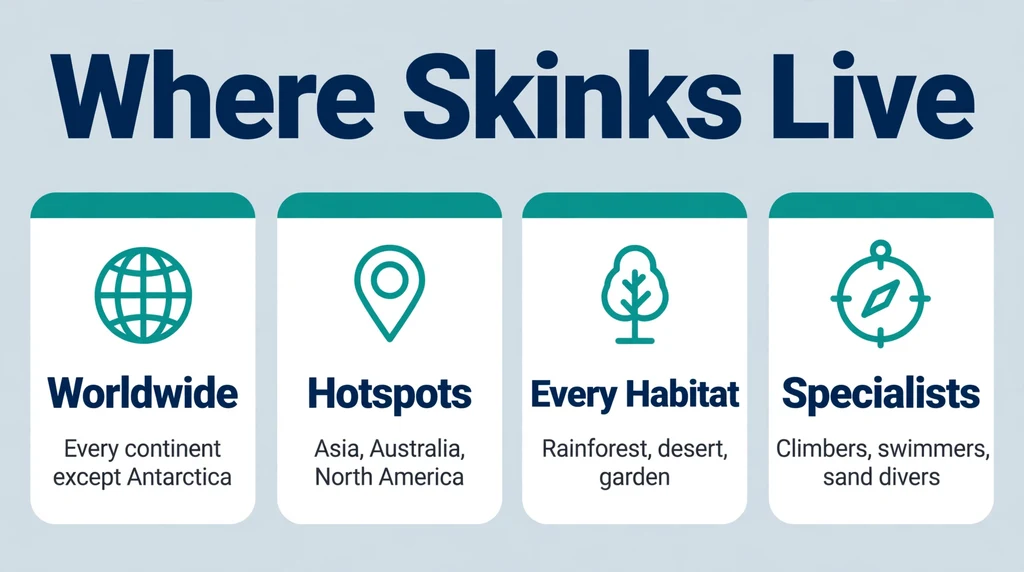
Skinks are nearly everywhere. The family lives on every continent except Antarctica, and it has also colonised countless islands across the oceans. Only the coldest climates shut skinks out, since a small cold-blooded body needs warmth to work.
Three regions stand out for sheer variety. Southeast Asia and its islands teem with skinks, and so do the deserts of Australia. Temperate North America holds a strong third share, which is why American readers meet skinks so often.
Almost Every Habitat You Can Name
Within that range, skinks occupy almost every niche. Most hunt on the ground or tunnel below it, yet some species climb trunks and live in the canopy. Others are semiaquatic and slip into streams to escape trouble.
Desert specialists may be the most theatrical of all. The sandfish of North Africa and Asia has fringed toes and a wedge-shaped snout. It runs across loose dunes, then dives and quite literally swims through the sand.
Island Skinks and Ocean Crossings
Skinks also solved the ocean problem. The family lives on islands scattered across the Pacific, the Indian Ocean, and the Caribbean, many of them far from any mainland. Lizards cannot fly or swim those distances, so how did they get there?
The leading explanation is accidental sailing. A storm tears a mat of vegetation loose from a riverbank, complete with soil, insects, and a few hiding skinks. Currents carry the raft for days or weeks, and the passengers step ashore on a new island. Small size, low food needs, and eggs or babies on board made skinks unusually good castaways.
The Garden Is Skink Country
You do not need a wilderness to find one. Log piles, rock walls, compost heaps, and flower beds all make fine skink habitat. A sunny garden with cover and insects is, to a small skink, a complete world.
This is why the animal keeps turning up in daily life. The skink under the porch and the skink in the rainforest are cousins, running the same body plan at different scales.
Knowing where to look makes them easy to find. Check the sunny edge of a rock pile in the morning, when skinks bask to warm up. Lift nothing and disturb nothing; just watch the gaps between stones. Sooner or later, a polished head will slide out to inspect the day.
What Do Skinks Eat?
Most skinks are insect hunters. Beetles, crickets, spiders, cockroaches, worms, and snails all feature on the menu, and larger prey gets added as the skink grows. A big skink may take a small frog, a baby mouse, or even a smaller lizard.
Unlike many lizards, skinks rarely sit and wait for dinner. Most forage actively, nosing through litter and flicking the tongue to taste the air for scent trails. Britannica notes that skinks hunt prey with this chemical sense, which suits a life spent rummaging in cover.
Size changes the diet at the top of the family. Large skinks shift heavily toward plants, eating fruit, flowers, and soft leaves. The great plant-eater is again the Solomon Islands skink, which lives largely on leaves and fruit in the treetops.
For gardeners, the practical summary is simple. A resident skink is unpaid pest control, working the beds for slugs, snails, and beetles. In return, it asks only for cover, water nearby, and freedom from cats.
Hunters That Get Hunted
Skinks also sit in the middle of the food web, and plenty of animals hunt them back. Birds snatch them from paths, snakes follow them into burrows, and domestic cats kill them in depressing numbers. A skink’s whole design, the armour, the burrowing, the spare tail, answers this pressure.
Some hunters need special tools for the job. Snails, for instance, come with body armour of their own, so snail-eating skinks evolved crushing teeth at the back of the jaw. A blue-tongue crunches through shells the way you might crack a nut, then licks up the prize.
The Tail Trick: Dropping and Regrowing
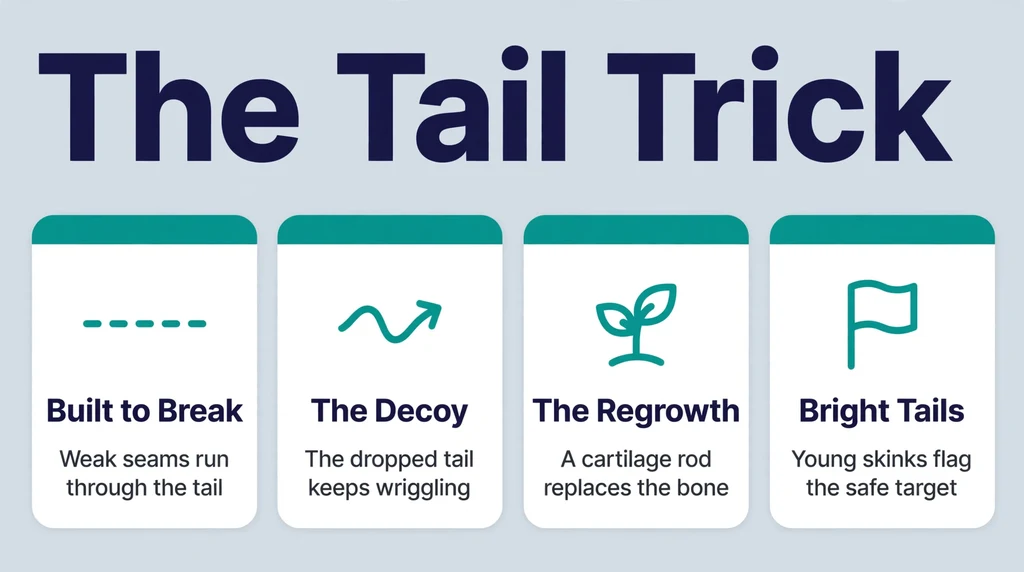
Every skink owner and gardener eventually witnesses the party trick. A predator, a cat, or a careless hand grabs the tail. The tail comes off in the grip, and the skink is gone.
A Tail Built to Break
Scientists call the trick autotomy, meaning self-cutting. The tail carries preformed fracture planes, weak seams running through its vertebrae. Muscles contract along a seam, the tail parts with little blood loss, and the lizard escapes whole where it matters.
The detached tail does one more job. It keeps wriggling and thrashing for several minutes, holding the attacker’s full attention. While the predator watches the decoy, the author of the trick slips under cover.
Colour helps the young play this game. Juveniles of many species wear bright blue, red, or orange tails, a flag planted on the one body part they can afford to lose. Attacks land on the flag, not on the head.
The Replacement Is a Downgrade
A lost tail regrows, but the copy is not the original. The new tail grows around a single rod of cartilage instead of a chain of bony vertebrae. Its scales often differ in pattern and colour, so a regrown tail is easy to spot.
The downgrade has a hidden cost. The cartilage section contains no fracture planes, so it cannot be shed again at the same place. A second escape must break the tail closer to the body, and each loss costs fat stores, balance, and status among other skinks.
Occasionally, an injury splits the difference. A tail wounded but not severed can sprout a second tip, producing a fork-tailed skink. Wildlife groups have recorded individuals with several extra tails after repeated injuries, a strange sight with a simple cause.
Researchers keep finding footnotes to the story. Curtin University scientists studying King’s skinks in Australia found that even a regrown tail can sometimes regrow again after a second injury. The cartilage rod lacks the original break points, yet healing finds a way. The spare part, it seems, can have a spare of its own.
Eggs, Live Babies, and One Skink That Does Both
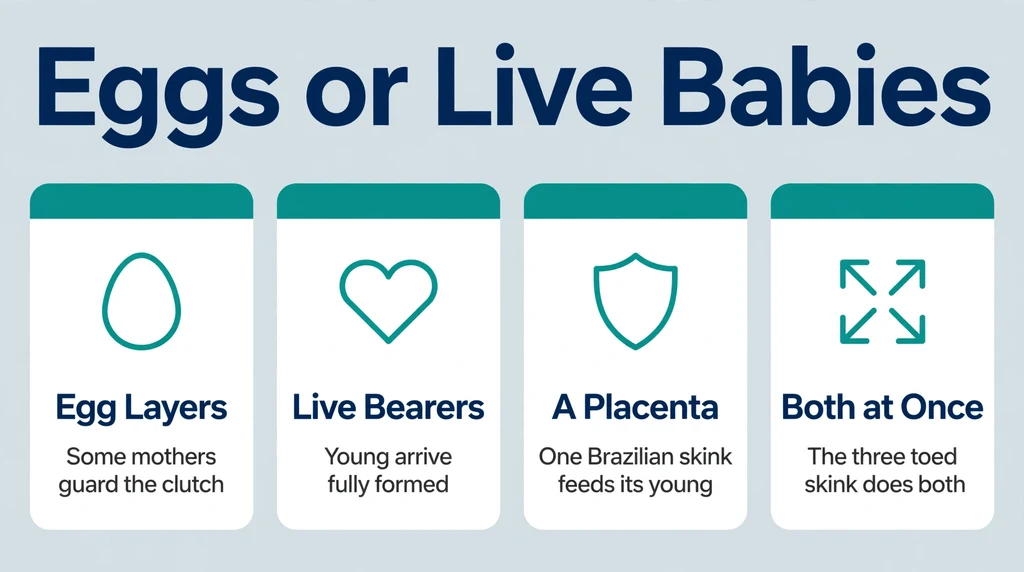
Ask how a skink reproduces and the honest answer is: which skink? This single family contains nearly the whole range of reptile reproduction. Some species lay eggs, others bear live young, and a few refuse to choose.
Many egg-laying skinks add care to the package. A female five-lined skink, for example, curls around her clutch under a log and guards it until hatching. Garden skink mothers go communal instead, and many females lay in one shared nest.
Climate helps explain the split. Live birth clusters in cold places, among alpine and far-southern skinks, where buried eggs might never warm up. A basking mother works like a mobile incubator, carrying her embryos into the sun each day. Eggs suit the warm lowlands; live babies suit the mountains.
Live Birth, Taken to a Mammal Level
Live birth has evolved many times among skinks. Most live-bearers nourish their young from a yolk, as an egg would. One Brazilian species goes far beyond that arrangement.
The female *Mabuya heathi* feeds her embryos through a placenta, passing nutrients from her own body across the pregnancy. Researchers describe the organ as comparable in complexity to a mammal’s placenta. For a lizard, that is an astonishing piece of engineering.
The Three-Toed Skink, Caught Mid-Change
Australia holds the family’s most famous reproductive puzzle. The yellow-bellied three-toed skink looks like one species, and genetically it is one species. Yet its populations reproduce in opposite ways.
In northern New South Wales, females give birth to live young. Near Sydney, females of the same species lay eggs instead. Researchers at the University of Sydney study this skink, one of only three lizards known to do both, precisely because it shows evolution mid-transition.
The details get stranger still. Egg-laying females hold their eggs so long that some hatch within five days of laying. One recorded female laid eggs and delivered a live baby in the same litter. If you want to watch a trait evolving, this small skink is the live show.
Skinks You Are Most Likely to Meet
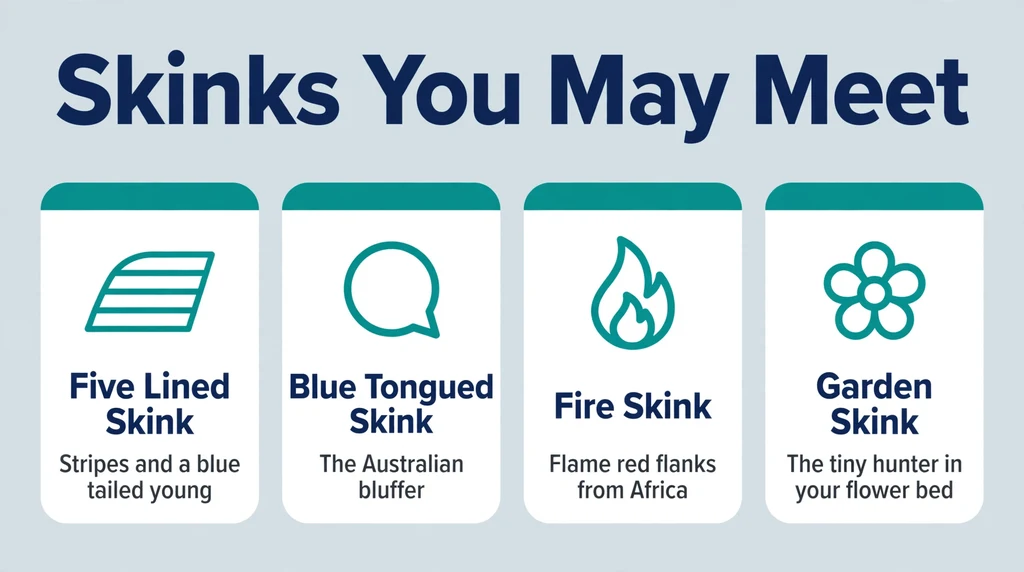
Fifteen hundred species is a lot of introductions. Start with six: the backyard regular, the Australian heavyweight, the African showpiece, the miniature, the giant, and the one that swims through sand.
The Five-Lined Skink
North America’s best-known skink lives across the eastern United States and into southern Ontario. Adults wear five pale stripes on a brown or black body, although older males fade to bronze and grow an orange-red head each spring.
The young steal the show. A juvenile five-lined skink is jet black, neatly striped, and finished with a tail of electric blue. Females lay a clutch of eggs under a rotten log and stay coiled around them until they hatch. In the far north of its range, this species holds a small title of its own: it is eastern Canada’s only lizard.
The Blue-Tongued Skink
Australia’s blue-tongues are the heavyweights of the pet world. These large, slow skinks amble through gardens and bushland, hoovering up snails, insects, fruit, and flowers. Nothing about them hurries.
Threatened, a blue-tongue performs instead of fleeing. It gapes its mouth, hisses, flattens its body, and sticks out a broad, startlingly blue tongue. The display is pure bluff, and it works on most predators. Blue-tongues give birth to live young, often ten or more at a time, and they commonly live beyond twenty years.
The Fire Skink
West and Central Africa hold the family’s showpiece. The fire skink wears glowing red and orange flanks barred with black, as if it had been painted for a festival. Adults reach about 30 cm and shine like polished enamel.
You will still have to look hard to see one. Fire skinks spend much of the day buried in leaf litter and soil, emerging to hunt insects. In the wild, the flame colours flash only in brief, startling moments.
The Garden Skink
The garden skink may be the skink you already know. These tiny, dark lizards dart around Australian gardens and parks, and their relatives turn up in warm suburbs worldwide. An adult measures only about 9 cm, tail included.
Garden skinks hunt small insects by day and shelter under rocks, bark, and plant pots. In the breeding season, females pool their eggs in communal nests, and a single nest can hold more than 200 eggs. Small animal, serious nursery.
The Solomon Islands Skink
The family’s giant deserves the last word. The prehensile-tailed skink of the Solomon Islands is the largest skink on Earth, at roughly 76 cm. It climbs at night in the island canopy, gripping branches with a tail that works like a fifth hand.
It also breaks the hunter stereotype. This great skink lives mainly on leaves and fruit, proving that the family of insect-chasers also produced a gentle treetop vegetarian.
The Sandfish
The last introduction lives inside a sand dune. The sandfish of North Africa and southern Asia is a skink so specialised that it barely walks on the surface at all. Instead, it dives into loose sand and swims, rowing with its body in smooth waves.
Every detail serves the dive. Fringes of scales widen its toes into paddles, its lower jaw is countersunk like a ploughshare, and flaps guard its ears and nostrils against the grit. Fish envy is rarely this justified.
Are Skinks Dangerous?
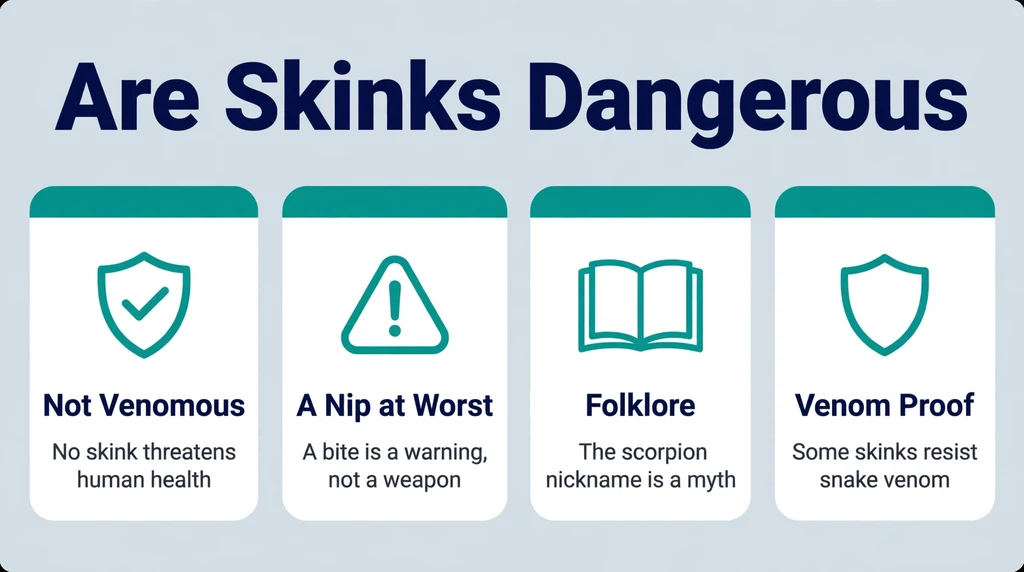
No. That is the short answer, and for once the short answer is complete. No skink is venomous, and no skink is considered medically significant to humans.
A grabbed skink may bite, because biting is its only reply to a hand. Small species can barely pinch the skin, while a big blue-tongue can deliver a stubborn, bruising nip. Even so, the bite is a warning, not a weapon, and it carries no venom.
The Blue Tail Poison Myth
Bright colours in nature often signal poison, so the blue-tailed young skink looks guilty. In some regions, people insist that the blue tail is venomous, or that the whole animal is a kind of scorpion. Rural folklore in the United States even nicknamed these skinks “scorpions.”
Wildlife agencies answer this one firmly. The five-lined skink and its blue-tailed cousins are completely harmless, and the tail is a decoy, not a warning. Its job is to be bitten, so the skink itself is not.
What About Venom Glands?
A newer claim circulates online, stating that skinks carry venom glands in the jaw. Treat it as unproven. Researchers have debated venom-like glands across lizards for years, but no authority classifies any skink as venomous, and no skink bite is a medical concern. The gland claim, at most, describes chemistry without a delivery system that matters.
The verified venom story runs in the opposite direction. In 2025, University of Queensland researchers reported that Australian skinks have repeatedly evolved resistance to snake venom. On 25 separate occasions, skink lineages changed a key muscle receptor so that neurotoxins could no longer bind. Skinks, it turns out, are not venomous themselves. Some of them are simply very hard to poison.
If a Skink Gets Indoors
Houses attract skinks for the same reasons gardens do: warmth, cover, and insects. A skink in the kitchen is lost, not invading, and it wants only a way back outside. Open a door near it, lay a towel as a ramp over any step, and give it time and quiet.
Never lift one by the tail, because the tail is designed to come off in exactly that grip. If you must move it, guide it into an open box with a soft broom, then release it beside cover outdoors. The whole rescue takes two minutes, and both parties keep all their parts.
Skink vs Gecko vs Anole: How to Tell Them Apart
Three small lizards cause most of the confusion. A skink, a gecko, and an anole can all appear on the same garden wall, yet each belongs to a different branch of the lizard tree. Four quick checks separate them.
First, feel the look of the skin. Skinks are glossy and smooth, geckos look soft and velvety, and anoles wear fine, slightly rough scales. Second, watch the eyes: skinks and anoles blink, while most geckos cannot and instead lick their eyes clean.
Third, check the feet. Geckos and anoles climb glass on wide, sticky toe pads, but a skink has ordinary little claws. Fourth, note the hour: geckos hunt mostly at night, while skinks and anoles are daytime animals.
| Feature | Skink | Gecko | Anole |
|---|---|---|---|
| Skin | Smooth, glossy, armour beneath | Soft, velvety | Fine, slightly rough |
| Eyelids | Movable, blinks | Usually fixed, licked clean | Movable, blinks |
| Feet | Small claws | Sticky toe pads | Sticky toe pads |
| Active | Mostly by day | Mostly by night | By day |
One more giveaway belongs to the anole alone. A male anole flashes a colourful throat fan, called a dewlap, to impress mates and warn rivals. No skink carries anything like it.
The Salamander Mix-Up
One confusion crosses a bigger boundary. People often mistake a five-lined skink for a salamander, because both are small, sleek, and found under logs. A wildlife report from Canada notes that even its shiny scales cause the mix-up.
The difference is fundamental. Salamanders are amphibians, with moist skin, no scales, and no claws, and they need damp places to survive. A skink is a true reptile, dry-scaled and clawed, at home in dry gardens. Same hiding place, entirely different animal.
Skinks as Pets
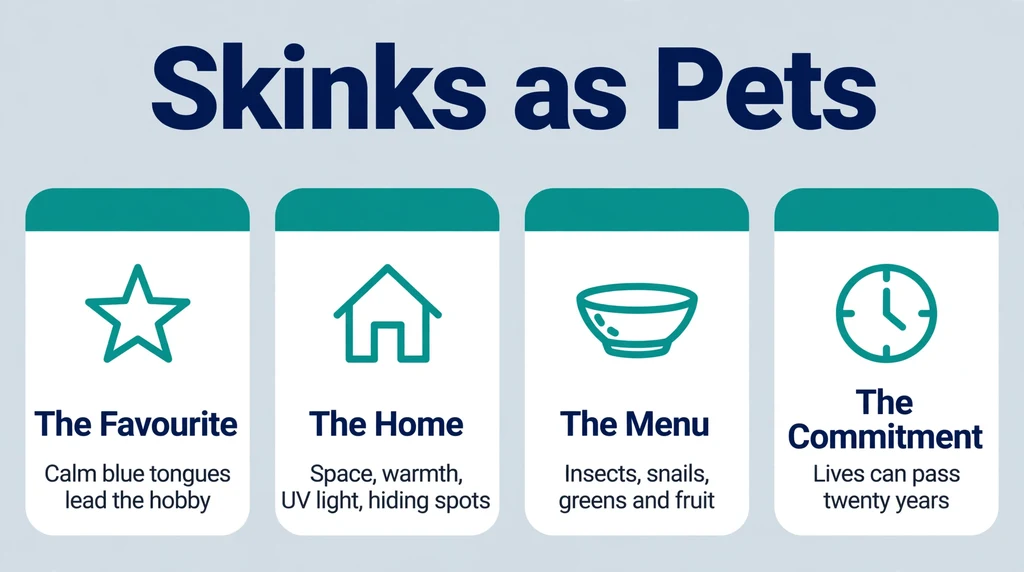
Skinks have quietly become reptile-keeping favourites. The blue-tongued skink leads the hobby, thanks to its calm temperament, curious personality, and that unforgettable tongue. Fire skinks attract keepers who want colour, while smaller species suit smaller spaces.
Temperament is only half the story, though. A pet skink is a long commitment, since blue-tongues commonly pass twenty years in good care. They need a spacious enclosure, a warm basking spot, ultraviolet light, and hiding places. Burrowing species also need deep substrate to dig in.
Diet at home mirrors the wild menu. Omnivorous species thrive on a varied mix of insects, snails, vegetables, and fruit. Good food and proper light prevent most of the health problems seen in captivity, including bone disease.
Two cautions belong in every buyer’s mind. Always choose a captive-bred animal from a reputable breeder, since wild-caught skinks suffer in transport and may be protected at home. And check your local rules first, because many countries and states restrict which skinks you may keep.
Handling has one golden rule. Support the whole body, move slowly, and never grab or lift a skink by its tail, since the tail may detach as an escape response. Most pet species calm down quickly with gentle, regular handling. A skink that trusts its keeper will walk onto an open hand, which is a far better trick than any it performs when frightened.
The Other Skink: A Scots Word for Pouring a Drink
Now for the plot twist, best served with a drink. In Scots, skink is also a verb, and it means to pour or serve liquor. A skinker, in old Scots, was the person who poured: in plain terms, the butler.
The word runs through older Scottish writing. Poets wrote of servants who “birl and skink” the wine, filling and refilling the cups. Robert Burns used a cousin of the word in *To a Haggis*, dismissing “skinking ware,” thin watery stuff that splashes in a wooden bowl.
Scotland also turned the noun into dinner. Cullen skink is the country’s famous soup of smoked haddock, potatoes, onions, and milk, named after the fishing town of Cullen. A word for thin, watery fare ended up on a rich and smoky classic.
The verb picked up side meanings as it travelled. Scots speakers also used skink for pouring liquid back and forth between two vessels, a cook’s mixing trick for gruel and toddy. In looser use, it meant pouring out freely, or lavishing something without restraint. Every sense keeps the same picture: liquid in motion, tipped from a height.
Where the Word Skink Comes From
Here is the elegant part: the two skinks are strangers. The lizard and the drink-pourer share a spelling by pure accident, and their histories never meet.
The animal’s name arrived late and learned. English took skink around the 1580s from Latin *scincus*, which came from Greek *skinkos*, a word for a lizard. Scholars and physicians carried the term, and it eventually named the whole shining family.
The pouring word is older and homelier. Middle English had the verb *skynken* by the 1300s, borrowed from Middle Dutch *schenken*, to pour out or present. Chaucer’s generation was skinking wine centuries before English speakers borrowed a Greek name for the lizard. Two words, two journeys, one spelling.
The Greek word never fully retired, either. It survives inside science, in the genus name *Scincus*, carried today by the sandfish and its desert relatives. The ancient lizard word ended up naming the most specialised skink of all, which feels exactly right.
Frequently Asked Questions
What is a skink, in simple terms?
A skink is a type of lizard with smooth, shiny scales, a long body, and usually short legs. Skinks form the largest lizard family in the world. Most live on the ground or in burrows, eat insects, and slip away through leaf litter when disturbed. If you spot a small lizard that looks varnished, you are probably looking at one.
Is a skink a lizard?
Yes. Skinks are lizards, in the same way that geckos and iguanas are lizards. The word skink names one particular family, Scincidae, inside the wider lizard group. So every skink is a lizard, although most lizards belong to other families.
Are skinks dangerous or venomous?
No. No skink is venomous, and none is medically significant to humans. A large skink can give a firm nip if you grab it, but the bite carries no venom. Stories about poisonous blue tails are folklore, and wildlife agencies describe these lizards as harmless. Even the biggest species would much rather run away or bluff than bite.
Do skinks regrow their tails?
Yes, most skinks can shed the tail when a predator grabs it, and a new one grows back. The regrown tail is built around cartilage instead of bone, and it often looks slightly different in colour and pattern. It also cannot be shed again at the same spot.
Do skinks lay eggs or give live birth?
Both. Many skink species lay eggs, and many others give birth to live young. One Brazilian species even feeds its babies through a placenta. Australia’s three-toed skink does both within a single species, which makes it famous among biologists. Clutches and litters range from a single baby to more than twenty.
What is the largest skink in the world?
The prehensile-tailed skink of the Solomon Islands holds the record. It reaches about 76 cm (30 in), climbs in the treetops, and eats mainly leaves and fruit. At the other extreme, the smallest skinks are only a few centimetres long. Most skinks, in fact, would fit easily in a child’s hand.
Can you keep a skink as a pet?
Yes, and blue-tongued skinks are among the most popular pet lizards. They are calm, hardy, and long-lived, often passing twenty years in care. They still need space, warmth, ultraviolet light, and a varied diet, so research the species and check local rules first. Smaller species, such as the fire skink, suit experienced keepers who can offer deep, moist substrate for burrowing.
What does skink mean in Scotland?
In Scots, to skink means to pour or serve a drink, and skink as a noun could mean liquor or a thin soup. The sense survives in Cullen skink, the smoked haddock soup named after the town of Cullen. This word is unrelated to the lizard.
Final Thoughts
The skink rewards a second look. Behind that plain little lizard sits the largest family in the lizard world, a clan of armoured burrowers, sand swimmers, treetop vegetarians, and mothers who range from egg guards to placenta builders. One of them can even drop its tail, grow a spare, and carry on as if nothing happened.
So the next time a polished shape flashes across the path, you will know what you are seeing. It is a skink: an old, successful idea in lizard design, still quietly at work in gardens on almost every continent. For the formal reference version, the Encyclopaedia Britannica entry on skinks is the natural next stop.
And if the word ever greets you in an old Scottish poem instead, raise a glass to the coincidence. One skink pours, the other prowls, and English, characteristically, kept both.