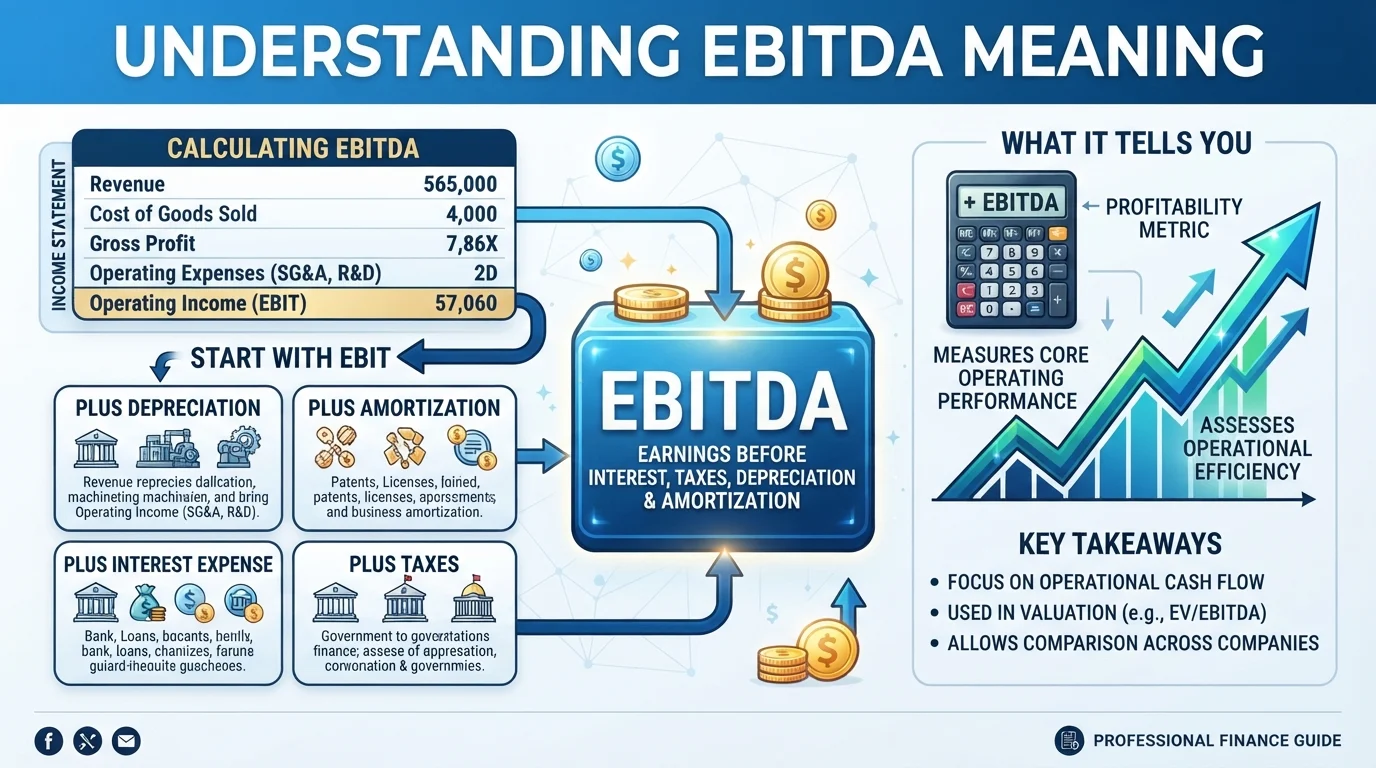
A business can report strong sales and still look less profitable after interest, taxes, and certain accounting expenses are included. That is where EBITDA meaning becomes useful. EBITDA stands for Earnings Before Interest, Taxes, Depreciation, and Amortization. It gives analysts and business owners a view of operating performance before those four items affect the calculation.
You’ll often see EBITDA in company reports, financial analysis, business valuations, lending discussions, and investment research. However, EBITDA is not the same as net income or cash flow. Understanding what it includes, what it excludes, and where it can mislead you helps you interpret financial numbers more accurately.
What Does EBITDA Mean?
EBITDA means Earnings Before Interest, Taxes, Depreciation, and Amortization. It is a financial performance measure used to examine earnings from business operations before financing costs, income taxes, and certain non-cash expenses are considered.
| Detail | Explanation |
|---|---|
| Full Form | Earnings Before Interest, Taxes, Depreciation, and Amortization |
| Main Purpose | Assess operating performance |
| Common Uses | Valuation, comparison, lending, financial analysis |
| Accounting Status | Non-GAAP measure |
| Related Metric | EBITDA margin |
EBITDA is especially useful when comparing companies with different debt levels, tax situations, or asset structures. Still, it should normally be reviewed alongside other financial measures rather than used by itself.
EBITDA Full Form Explained
The EBITDA full form has four important expense categories.
Earnings generally refers to profit before the expenses that EBITDA removes from the calculation.
Interest represents the cost of borrowing money, such as interest paid on business loans or bonds.
Taxes refers mainly to income tax expenses recognized by the business.
Depreciation reflects the allocation of the cost of physical assets over their useful lives. Examples include machinery, buildings, vehicles, and equipment.
Amortization usually refers to allocating the cost of certain intangible assets over time. Examples can include patents, software, licenses, or acquired customer-related assets.
By excluding these items, EBITDA attempts to focus attention on earnings before financing, taxes, and depreciation-related charges.
EBITDA Formula
There are two common ways to calculate EBITDA.
The first starts with net income:
EBITDA = Net Income + Interest + Taxes + Depreciation + Amortization
Another approach starts with EBIT:
EBITDA = EBIT + Depreciation + Amortization
EBIT means Earnings Before Interest and Taxes.
For example, imagine a company reports:
- Net income: $400,000
- Interest expense: $80,000
- Taxes: $120,000
- Depreciation: $100,000
- Amortization: $50,000
The calculation would be:
EBITDA = $400,000 + $80,000 + $120,000 + $100,000 + $50,000
EBITDA = $750,000
So, the company’s EBITDA is $750,000.
This doesn’t mean the company has $750,000 sitting in its bank account. EBITDA is a performance metric, not a direct measure of cash available to spend.
How EBITDA Is Used
EBITDA is commonly used to evaluate how a company’s core operations are performing before certain expenses are considered.
For example, two companies might generate similar operating earnings but have very different debt structures. One could carry significant debt while the other has very little borrowing. Their interest expenses would differ, which could make net income less comparable.
EBITDA can also help analysts compare businesses with different asset bases. A company that owns expensive machinery may record more depreciation than a company with fewer depreciable assets, even when their underlying operations appear similar.
This makes EBITDA particularly common in:
Business valuation: Buyers and analysts may compare enterprise value with EBITDA.
Company comparisons: Analysts can compare operating performance across businesses.
Debt analysis: Lenders may examine EBITDA alongside debt levels and other financial ratios.
Management reporting: Businesses may track EBITDA to monitor operating trends.
Investment analysis: Investors may use it as one metric among several when studying a company’s performance.
What Is EBITDA Margin?
EBITDA margin measures EBITDA as a percentage of revenue.
The formula is:
EBITDA Margin = EBITDA ÷ Revenue × 100
Suppose a business produces $2 million in revenue and $500,000 in EBITDA.
Its EBITDA margin is:
$500,000 ÷ $2,000,000 × 100 = 25%
That means EBITDA equals 25% of revenue.
The margin can help show how much operating earnings a company generates relative to its sales. Analysts may track the margin over several periods to see whether operating profitability is changing.
A rising EBITDA margin can indicate that EBITDA is growing faster than revenue, while a falling margin means EBITDA is growing more slowly than revenue or declining while revenue remains stable.
EBITDA vs Net Income
EBITDA and net income answer different questions.
Net income is the profit remaining after recognized expenses, including interest and taxes, along with other applicable costs.
EBITDA removes interest, taxes, depreciation, and amortization from the calculation.
That difference matters. A company can have positive EBITDA while reporting a much smaller net income, or even a net loss.
For example, a heavily indebted company may have substantial interest costs. Large depreciation charges can also reduce accounting profit without representing a current-period cash payment.
Neither measure automatically tells the complete financial story.
EBITDA vs Operating Profit
EBITDA is also different from operating profit, sometimes called operating income.
Operating profit generally includes depreciation and amortization as operating expenses. EBITDA adds those expenses back.
For example:
Revenue: $1,500,000
Operating expenses excluding depreciation and amortization: $900,000
Depreciation and amortization: $150,000
Operating profit would be:
$1,500,000 − $900,000 − $150,000 = $450,000
EBITDA would be:
$450,000 + $150,000 = $600,000
The gap between the figures comes from depreciation and amortization.
Is EBITDA a Measure of Profit?
EBITDA is often described as a measure of profitability, but it is not a substitute for net profit.
It excludes several significant expenses. Most importantly, it does not account for the actual cost of debt financing, taxes, or the economic cost associated with replacing long-lived assets.
A company may show strong EBITDA while needing substantial cash for:
- Interest payments
- Taxes
- Capital expenditures
- Working capital
- Debt repayment
That is why EBITDA should not be interpreted as free cash flow.
Adjusted EBITDA Meaning
You may also encounter the term adjusted EBITDA.
Adjusted EBITDA starts with EBITDA and then makes additional adjustments for items management or analysts consider unusual, non-recurring, or not representative of ongoing operations.
Examples might include certain restructuring costs, one-time transaction expenses, or other specifically identified adjustments.
The important point is that adjusted EBITDA can vary between companies because the adjustments depend on the reporting approach used.
You should therefore examine the reconciliation and definitions rather than assuming every adjusted EBITDA figure is calculated identically.
How Context Changes the Meaning
EBITDA itself has one standard financial meaning, but the context surrounding it changes what the number is being used to show.
“The company generated $10 million of EBITDA.”
This describes an earnings measure before interest, taxes, depreciation, and amortization.
“EBITDA margin increased from 15% to 20%.”
This focuses on EBITDA relative to revenue.
“The acquisition is priced at 8× EBITDA.”
This indicates a valuation multiple using EBITDA as the earnings reference.
“Adjusted EBITDA rose after restructuring.”
This signals that additional adjustments were made beyond standard EBITDA.
The surrounding financial term usually tells you whether the discussion concerns profitability, margins, valuation, or management adjustments.
EBITDA in Business Valuation
One of the most familiar uses of EBITDA is the EV/EBITDA multiple.
EV means Enterprise Value. The ratio compares a company’s enterprise value with its EBITDA.
For example, a company with an enterprise value of $80 million and EBITDA of $10 million has an EV/EBITDA multiple of:
8×
This multiple is widely used in corporate finance and valuation analysis because it provides a way to compare businesses using an operating earnings measure.
However, the multiple should not be viewed in isolation. Industry characteristics, growth, debt, capital spending requirements, margins, and other financial factors can all affect how a valuation multiple should be interpreted.
Real-World EBITDA Examples
Example 1: Small Business
A manufacturing company earns $900,000 in net income. It has $100,000 in interest, $150,000 in taxes, $120,000 in depreciation, and $30,000 in amortization.
Its EBITDA is:
$900,000 + $100,000 + $150,000 + $120,000 + $30,000 = $1.3 million
Example 2: Comparing Two Companies
Company A and Company B both report $20 million in EBITDA, but their net income figures differ substantially because their debt and depreciation expenses differ.
EBITDA shows that their earnings before those specific items are the same. It does not mean their overall financial positions are identical.
Example 3: Margin Analysis
A retailer has $5 million in revenue and $750,000 in EBITDA.
Its EBITDA margin is:
$750,000 ÷ $5,000,000 × 100 = 15%
Management could compare that margin with earlier periods to evaluate changes in operating performance.
Common Mistakes About EBITDA
| Common Mistake | Correct Understanding |
|---|---|
| EBITDA equals cash flow | EBITDA is an earnings measure and does not account for all cash requirements. |
| EBITDA equals net profit | Net income includes expenses that EBITDA excludes. |
| Higher EBITDA always means a healthier business | Debt, capital spending, working capital, and other factors still matter. |
| Every adjusted EBITDA figure is identical | Adjusted EBITDA may include company-specific adjustments. |
These misunderstandings can lead to poor financial decisions, especially when a single metric is treated as the complete picture.
Similar Financial Terms
| Term | Meaning | Main Difference |
|---|---|---|
| EBIT | Earnings Before Interest and Taxes | Includes depreciation and amortization |
| Net Income | Profit after applicable expenses | Includes interest and taxes |
| EBITDA | Earnings Before Interest, Taxes, Depreciation, and Amortization | Excludes all four listed items |
| Operating Income | Profit from operations after operating expenses | Generally includes depreciation and amortization |
| Cash Flow | Movement of cash into and out of a business | Measures cash activity rather than EBITDA earnings |
Knowing these distinctions makes financial statements much easier to interpret.
When EBITDA Is Useful
EBITDA can be useful when you need to compare operating performance, examine trends, or understand a valuation multiple.
It is especially helpful when businesses have different financing arrangements or asset structures. It can also provide a consistent starting point for certain financial comparisons.
Still, the best analysis usually combines EBITDA with revenue growth, operating income, net income, cash flow, debt, capital expenditures, and other relevant measures.
When EBITDA Can Be Misleading
EBITDA has limitations because it removes real economic costs from the calculation.
Depreciation may be a non-cash expense for the current accounting period, but the underlying assets may eventually need replacement. Interest is also a genuine financial obligation for a highly leveraged company.
For capital-intensive businesses, ignoring depreciation and capital expenditure can make operating performance appear stronger than the amount of cash the business can actually generate.
This is why analysts often look at EBITDA alongside free cash flow and other measures.
Quick Recap
- EBITDA stands for Earnings Before Interest, Taxes, Depreciation, and Amortization.
- It is used to examine earnings before four specific items are deducted.
- EBITDA is different from net income, operating profit, and cash flow.
- EBITDA margin expresses EBITDA as a percentage of revenue.
- Adjusted EBITDA includes additional adjustments that can vary by company.
- EBITDA is useful for comparison and valuation, but it should not be used alone.
Frequently Asked Questions
What does EBITDA mean in text?
EBITDA usually means Earnings Before Interest, Taxes, Depreciation, and Amortization when used in business or financial conversations.
What does EBITDA stand for?
EBITDA stands for Earnings Before Interest, Taxes, Depreciation, and Amortization, a commonly used financial performance measure.
Is EBITDA the same as net income?
No, EBITDA excludes interest, taxes, depreciation, and amortization, while net income reflects these and other applicable expenses.
How is EBITDA calculated?
EBITDA can be calculated by adding interest, taxes, depreciation, and amortization back to net income.
Why do companies use EBITDA?
Companies and analysts use EBITDA to examine operating performance, compare businesses, and support certain valuation and financial analyses.
Final Thoughts
The clearest EBITDA meaning is Earnings Before Interest, Taxes, Depreciation, and Amortization. It provides a way to examine earnings before financing costs, taxes, and depreciation-related charges enter the calculation. However, EBITDA is not the same as net income or cash flow, and it does not capture every cost a business faces. Use it as one part of a broader financial analysis. When you understand the formula, EBITDA margin, valuation multiples, and its limitations, financial statements become much easier to read and compare.
2 thoughts on “EBITDA Meaning |Number That Can Change How You Read a Business 2026”