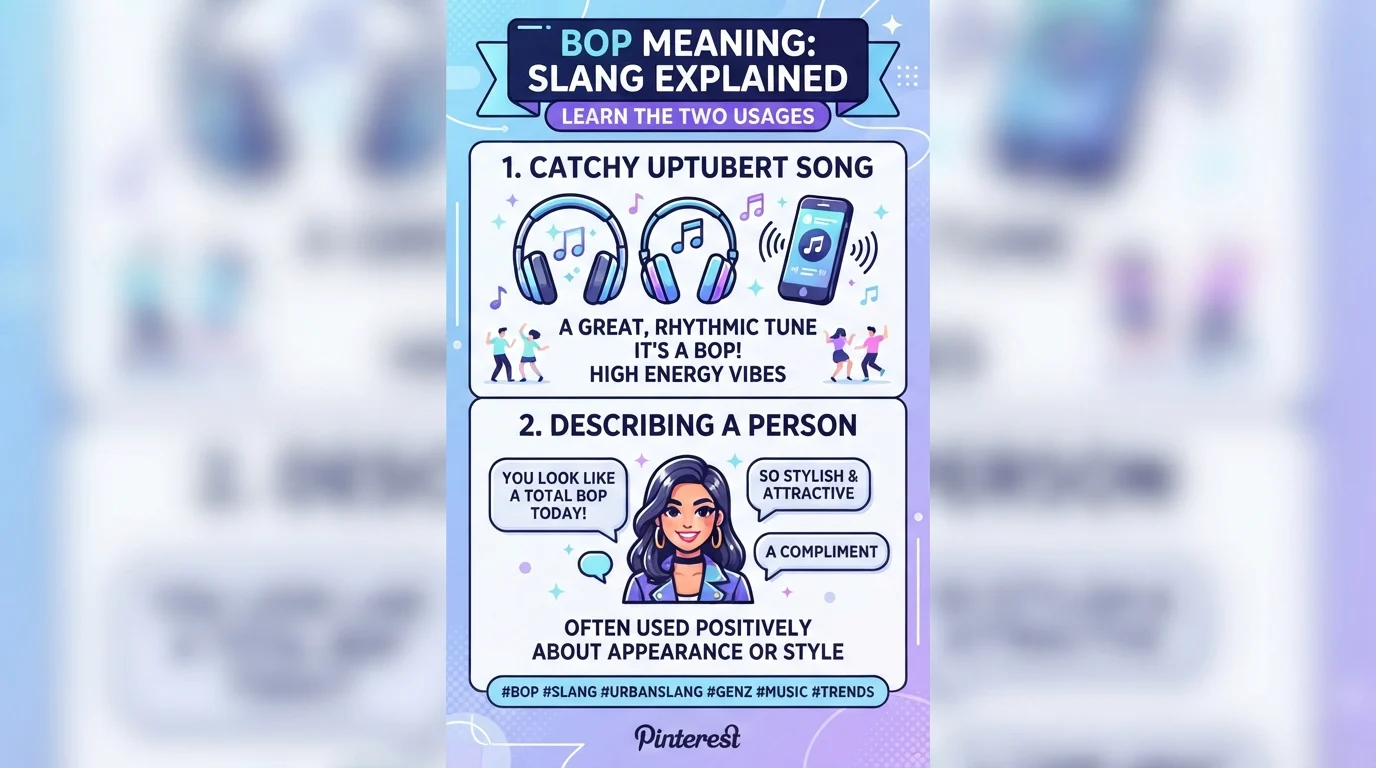
Someone might text you, “This song is such a bop,” and mean they love the track. Then you may see the same word used about a person, where the meaning becomes much more negative. That difference is the key to understanding bop meaning.
In slang, bop most commonly describes a catchy, enjoyable song, especially one with a strong beat that makes you want to move or sing along. However, bop can also be a derogatory term for a person, often implying that they have casual sexual relationships. The second use can be insulting or slut-shaming, so context matters a lot.
What Does Bop Mean?
When someone calls a song a bop, they usually mean it is catchy, fun, energetic, or very enjoyable to listen to. You may see the phrase in texts, TikTok comments, Instagram posts, group chats, and other casual conversations.
“Bop” is not normally a slang acronym with a full form. It is a standalone word.
| Detail | Explanation |
|---|---|
| Most Common Meaning | A catchy or enjoyable song |
| Full Form | None in common slang use |
| Tone | Positive for music; potentially insulting for a person |
| Common Platforms | Texts, TikTok, Instagram, Snapchat, group chats |
| Formal or Informal | Informal |
For example:
“Your new playlist has so many bops.”
Here, the speaker is saying the playlist contains several great songs. The word expresses enthusiasm rather than criticism.
The meaning changes sharply when bop describes a person instead of music. In that context, it can be used as an insult suggesting someone is sexually promiscuous. Because that use targets a person rather than a song, it can easily become disrespectful.
Bop Meaning in Text and Slang
In everyday texting, the music-related meaning is usually the easiest one to recognize.
You might receive:
“That song is a bop.”
The person is complimenting the song. They likely think it has a memorable melody, strong rhythm, or an enjoyable sound.
You may also see related expressions such as:
“Absolute bop” means the speaker thinks the song is especially good.
“This is a bop” means the song is enjoyable or catchy.
“Bopping to this” means the person is moving or dancing along with the music.
There is also an ordinary verb sense of bop, meaning to move lightly or rhythmically, but that is different from using “bop” as a slang label for a person.
Why Context Changes the Meaning
The easiest way to understand bop is to look at what the word describes.
If the surrounding words mention music, playlists, singers, dancing, beats, or albums, the positive music meaning is likely.
If someone uses bop to describe a person, the conversation needs more care because the term may be derogatory.
Here are a few examples:
Example 1
Person A: “Have you heard the new track?”
Person B: “Yeah, it’s a bop.”
Meaning: Person B thinks the song is catchy and enjoyable.
Example 2
Person A: “I’ve had this song on repeat all morning.”
Person B: “Same. Such a bop.”
Meaning: Both people are praising the song.
Example 3
Person A: “Why are people calling her a bop?”
Person B: “They’re using it as an insult about her dating or sexual behavior.”
Meaning: Here, bop refers to a person and carries a negative judgment.
Example 4
Person A: “This whole playlist is pure bop material.”
Person B: “Exactly. No skips.”
Meaning: The conversation is clearly about music, so the positive interpretation is obvious.
Bop Meaning on TikTok, Instagram, Snapchat, and Texts
The basic slang meaning generally does not change from one major social platform to another. What changes is how often people encounter each sense.
TikTok
On TikTok, bop often appears in comments about music, dance clips, playlists, and songs.
Example: “Okay, this is a bop.”
The tone is usually positive and enthusiastic when the subject is a track.
On Instagram, users may call a song a bop in comments, captions, Stories, or direct messages.
Example: “This song is such a bop 😭🔥”
The emojis reinforce excitement and approval.
Snapchat
In Snapchat conversations, bop can carry the same music-related meaning:
“Send me more bops for the drive.”
This means the person wants more enjoyable songs.
Text Messages
Texting gives you the least visual context, so surrounding words matter more.
“Your new song is a bop” is clearly positive.
“Stop calling everyone a bop” is discussing the insulting use of the term.
Is Bop Rude?
Bop is not inherently rude, but it can become rude when it describes a person in a sexual or judgmental way.
Calling a song a bop is usually harmless and complimentary. Calling a person a bop can carry a strong insult, especially when the speaker uses it to judge that person’s sexual behavior.
That distinction matters because someone may use the same word casually in one sentence and offensively in another.
Is Bop Flirty?
When bop refers to a song, it is not normally flirty.
When it refers to a person, the term is generally not a romantic compliment. It can carry a sexual implication, but that does not automatically make the message flirtatious.
For example, saying “That song is a bop 😍” expresses excitement about music. The heart-eyes emoji adds enthusiasm but does not change the basic meaning of the word.
Is Bop Offensive?
When bop is used to label a person, it can be offensive and degrading.
The problem is not simply the word itself. The issue comes from attaching a negative sexual judgment to someone. In many conversations, that use can be experienced as shaming or disrespectful.
If you are unsure what someone means, look at the sentence before reacting. A quick clarification can prevent a misunderstanding.
How to Reply to Bop
Your response should match the meaning and your relationship with the person.
Friendly Replies
When someone calls a song a bop, you can respond naturally:
“Right? It’s been stuck in my head.”
“I’ve had it on repeat too.”
“Finally, someone else gets it.”
“Adding this one to my playlist.”
Funny Replies
For a playful conversation:
“Certified car-sing-along material.”
“My speakers are filing a complaint.”
“One listen and suddenly I’m a DJ.”
“I fear this song owns me now.”
Replies When You Are Confused
When someone uses bop about a person and you are unsure what they mean:
“What do you mean by bop here?”
“Wait, are you talking about the song or the person?”
“I’m not sure I’m following the slang.”
These replies let you clarify the meaning before assuming the speaker’s intention.
When to Use Bop
The positive music sense works well in casual texts, group chats, social media comments, music discussions, and conversations with friends.
You can comfortably say:
“That’s a bop.”
“This playlist is full of bops.”
“This track has bop energy.”
The person-related use requires much more caution because it can be insulting. Even among friends, consider whether the wording could be taken as judgmental or disrespectful.
When to Avoid Bop
You usually do not need slang in professional emails, job applications, academic writing, client messages, or formal announcements.
Instead of writing:
“This song is a bop.”
A formal review might say:
“This song is highly catchy and enjoyable.”
More importantly, avoid using bop as a label for a person when the meaning could shame or insult them. Clear, respectful language is better when discussing someone’s relationships or personal behavior.
Common Mistakes
| Common Mistake | Correct Understanding |
|---|---|
| Assuming bop always means a great song | It can also be a derogatory term for a person |
| Treating bop as an acronym | Common slang use does not give it a standard full form |
| Assuming every use is offensive | The music-related use is generally positive |
| Ignoring the subject of the sentence | The word’s target often reveals its intended meaning |
One of the biggest mistakes is reacting to the word alone. The surrounding conversation usually tells you whether bop is praise, casual slang, or an insult.
Similar Slang Terms
A few music-related slang words overlap with bop, but they are not identical.
| Term | Meaning | Main Difference |
|---|---|---|
| Banger | An especially exciting or powerful song | Often emphasizes intensity or impact |
| Jam | A song someone really enjoys | More personal and general |
| Hit | A successful or widely recognized song | Can refer to popularity or success |
| Tune | An informal word for a song | Usually less enthusiastic than bop |
| Slaps | Says a song sounds extremely good | More strongly focused on how good it sounds |
For example, “That song slaps” and “That song is a bop” can express similar enthusiasm, but the wording and personal style differ.
Quick Recap
- Bop most commonly means a catchy, enjoyable song.
- Bop can also be a derogatory term for a person, often involving a judgment about sexual behavior.
- The subject of the sentence usually reveals which meaning is intended.
- TikTok, Instagram, Snapchat, and text messages generally use the same core meanings.
- When the meaning is unclear, asking for clarification is safer than assuming.
Frequently Asked Questions
What does bop mean in text?
In text messages, bop usually describes a catchy, enjoyable song, while the person-related use can be derogatory.
Is bop rude?
Calling a song a bop is usually friendly, but calling a person a bop can be insulting and disrespectful.
What does bop mean on TikTok?
On TikTok, bop commonly praises a song or audio as catchy, enjoyable, energetic, or worth replaying.
How should you reply to bop?
When it refers to music, agree casually; when unclear, ask whether the speaker means the song or person.
Can bop have different meanings?
Yes, bop can praise music or negatively label a person, so the surrounding context determines the intended meaning.
Final Thoughts
The most common bop meaning in casual online conversation is a catchy or enjoyable song. You might see it in texts, TikTok comments, Instagram captions, or group chats when someone wants to praise a track. However, bop can also describe a person in a derogatory way, especially when it implies sexual promiscuity. That distinction makes context essential. Pay attention to the subject, surrounding words, emojis, and tone before deciding what someone means. When the intended meaning is unclear, a simple clarification can keep the conversation respectful and prevent an unnecessary misunderstanding.