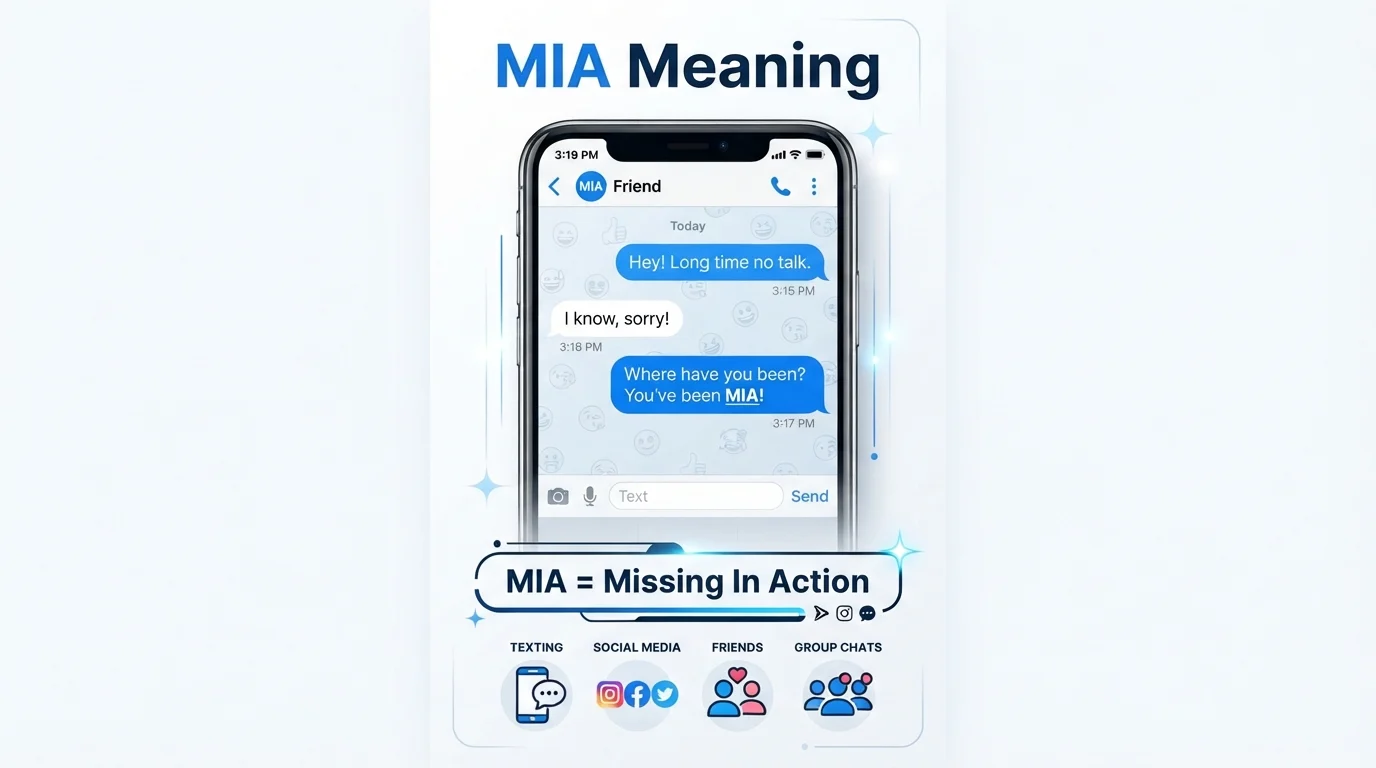
You get a message saying, “Why have you been MIA?” and wonder whether it sounds serious, rude, or just playful. MIA usually means “missing in action,” and in texting it describes someone who has been absent, unavailable, or unusually quiet. The phrase comes from military terminology, but people now use it casually when someone disappears from a conversation or stops showing up.
The exact feeling depends on context. A friend may use MIA as a light joke, while a serious conversation can make the same term sound more concerned.
What Does MIA Mean?
In text and chat, MIA means “missing in action.” It usually refers to someone who has disappeared from a conversation, stopped responding, or hasn’t been around for a while.
| Detail | Explanation |
|---|---|
| Most Common Meaning | Missing in action |
| Full Form | Missing in action |
| Tone | Usually casual, playful, or mildly concerned |
| Common Use | Texting, chats, social media, group conversations |
| Formal or Informal | Mostly informal |
For example:
“You’ve been MIA all week. Everything okay?”
Here, MIA doesn’t mean the person is literally missing. It means they have been unusually absent or hard to reach.
MIA Meaning In Text And Chat
When someone uses MIA in a personal message, they are usually pointing out your absence.
You might see it when:
- You haven’t replied to messages.
- You skipped a few group conversations.
- You haven’t posted or appeared online.
- You stopped attending social plans.
- Someone hasn’t heard from you recently.
The phrase can carry different emotions. A close friend may say, “Bro, you’re MIA 😂” simply because you haven’t joined the group chat. Another person might say, “You’ve been MIA lately. Are you okay?” with genuine concern.
The abbreviation keeps the sentence short while still making the point clear.
Why Do People Say MIA?
MIA originally refers to a military status for someone unaccounted for during military operations. The everyday figurative use refers to someone who is noticeably absent or missing from a situation.
In casual communication, people borrowed that idea and applied it to ordinary life.
So, when a friend writes:
“Where are you? You’ve been MIA.”
They generally mean:
“You’ve disappeared. We haven’t seen or heard from you.”
It can refer to physical absence, digital silence, or both.
How Context Changes The Meaning Of MIA
The words around MIA often tell you what the sender really means. Look at the conversation topic, punctuation, emojis, and your relationship with the person.
Friendly Teasing
“You’ve been MIA 😂”
The laughing emoji makes the message feel playful. The sender is probably teasing you for disappearing.
Genuine Concern
“You’ve been MIA lately. Everything alright?”
The second sentence changes the tone. The person may actually be worried rather than annoyed.
Group Chat Frustration
“Everyone was planning the trip and you were MIA.”
Here, MIA points to someone’s absence from an important conversation.
Online Absence
“Why have you been MIA on Instagram?”
The person means you haven’t been active or visible on that platform.
Context matters because MIA doesn’t automatically mean someone is ignoring you on purpose. It simply describes noticeable absence.
MIA On TikTok, Snapchat, Instagram, And WhatsApp
MIA generally keeps the same meaning across social platforms. There isn’t a widely established platform-specific definition that changes the basic phrase from “missing in action.”
On TikTok, someone might comment, “You’ve been MIA,” because a creator or friend hasn’t posted recently.
On Snapchat, a friend could send, “Where you been? MIA fr,” referring to your lack of replies or snaps.
On Instagram, MIA may describe someone who hasn’t posted stories, shared content, or answered messages.
On WhatsApp, it can refer more directly to someone disappearing from chats or group conversations.
The platform changes the situation, but the basic idea stays the same: the person has been unusually absent or quiet.
Real Conversation Examples
Person A: “You’ve been MIA since Friday.”
Person B: “Yeah, work got crazy. I’m finally free.”
Meaning: Person A noticed that Person B had disappeared from normal conversations.
Person A: “Why are you MIA in the group chat?”
Person B: “I muted it for two days 😭.”
Meaning: Person A is casually asking why Person B hasn’t participated.
Person A: “You’ve been MIA lately. Everything good?”
Person B: “Yeah, just needed some time away from my phone.”
Meaning: The sender sounds genuinely concerned rather than joking.
What Tone Does MIA Have?
MIA is usually casual and conversational when people use it in everyday messages.
Its tone can be:
Friendly: “Dude, you’ve been MIA!”
Playful: “Girl, MIA again? 😂”
Concerned: “You’ve been MIA lately. Are you okay?”
Mildly annoyed: “You went MIA right when we needed you.”
The tone comes from the surrounding words more than the abbreviation itself. An emoji can make it softer, while a blunt sentence or repeated complaint can make it sound critical.
Is MIA Rude?
MIA is not inherently rude, but it can sound accusatory when someone uses it to complain about your absence.
“Hey, you’ve been MIA!” sounds much lighter than “You always go MIA when I need you.”
Is MIA Flirty?
MIA is not inherently flirty, although someone you’re dating may use it playfully to point out that you’ve disappeared.
For example, “You’ve been MIA on me 👀” can sound teasing or suggestive because of the surrounding wording and emoji.
How To Reply To MIA
Your response should match the tone of the original message.
Friendly Replies
- “Haha, yeah. I’ve been super busy.”
- “I know! Life got hectic.”
- “I’m back now. What did I miss?”
- “Sorry, I disappeared for a bit.”
- “Been offline more than usual lately.”
Funny Replies
- “MIA but still alive 😂”
- “I was on a top-secret mission.”
- “Lost in the wilderness. Just returned.”
- “My phone and I needed some space.”
- “I have officially returned from the dead.”
Replies When You Are Confused
- “MIA how? 😂”
- “You mean I’ve been quiet?”
- “What makes you say I’ve been MIA?”
These responses keep the conversation moving without assuming the sender’s intention.
When To Use MIA
MIA works best in casual conversations with people who understand informal internet language.
You can naturally use it with friends, classmates, gaming friends, family members who use slang, and social media contacts. It also works well in group chats when someone hasn’t participated for a while.
For example:
“I’ve been MIA because I was studying for finals.”
That sounds natural in a personal message.
The key is familiarity. When the audience already understands casual abbreviations, MIA feels quick and conversational.
When To Avoid MIA
Use clearer wording when there is a real risk of misunderstanding.
Professional emails, job applications, academic writing, formal notices, and client messages usually benefit from direct language such as “unavailable,” “absent,” “away,” or “unable to respond.”
You should also choose your wording carefully in sensitive conversations. Since MIA comes from a military expression, using it carelessly around an actual military situation may sound inappropriate or insensitive.
Slang isn’t automatically wrong. The issue is whether the audience, context, and purpose make the abbreviation clear.
Common Mistakes About MIA
| Common Mistake | Correct Understanding |
|---|---|
| Assuming MIA always means someone is ignoring you | MIA mainly means someone is absent or unusually unavailable |
| Treating MIA as automatically rude | The tone depends on wording, relationship, and context |
| Assuming MIA has a different slang meaning on every platform | Its basic texting meaning generally stays the same |
Another common mistake is confusing MIA with an abbreviation for a completely different phrase simply because the letters appear in another context. Acronyms and initialisms can have multiple meanings outside casual texting.
For example, M.I.A. can also refer to “Master of International Affairs,” while MIA is used as an airport code for Miami International Airport. Those meanings depend entirely on context.
Similar Slang Terms
Several abbreviations describe absence, but they are not interchangeable in every situation.
| Term | Meaning | Main Difference |
|---|---|---|
| MIA | Missing in action | Highlights noticeable absence |
| AWOL | Absent without leave | Suggests leaving without permission or explanation |
| AFK | Away from keyboard | Usually means temporarily away from a device |
| BRB | Be right back | Signals a temporary departure |
| Ghosting | Deliberately cutting off communication | Usually implies ongoing or intentional silence |
MIA is broader than AFK and less specific than ghosting. Someone can be MIA without intentionally ignoring anyone.
MIA Origin And Everyday Use
The original phrase “missing in action” belongs to military terminology and refers to a person missing during military operations whose status has not been confirmed as killed. The abbreviation MIA is also used figuratively for someone who is conspicuously absent.
In ordinary conversation, people usually use the figurative sense. That’s why “MIA” can describe everything from a missing group-chat member to a friend who hasn’t answered messages.
The serious original meaning and the casual modern use are connected by the same basic idea: absence without an immediate explanation.
Quick Recap
- MIA means “missing in action.”
- In texting, it usually describes someone who has been absent, quiet, or hard to reach.
- The tone can be friendly, funny, concerned, or mildly annoyed.
- TikTok, Snapchat, Instagram, WhatsApp, and regular texting generally use the same basic meaning.
- Your best reply depends on whether the sender is teasing, checking on you, or expressing frustration.
Frequently Asked Questions
What does MIA mean in text?
MIA means “missing in action” and usually describes someone who has been absent, unavailable, or unusually quiet.
Is MIA rude?
MIA is not rude by itself, but it can sound critical when used to complain about someone’s repeated absence.
What does MIA mean on TikTok?
On TikTok, MIA usually means someone has been absent from posting, commenting, messaging, or other activity.
How should you reply to MIA?
Reply according to the tone by explaining your absence, joking back, or asking what made the person notice.
Can MIA have different meanings?
Yes, MIA can mean “missing in action,” while other contexts use it for names, places, or academic terms.
Final Thoughts
MIA means “missing in action,” and in texting it usually means someone has been noticeably absent or quiet. It can describe missed messages, disappearing from group chats, reduced social activity, or simply being unavailable for a while. The abbreviation itself is usually casual, but the surrounding words determine whether it sounds funny, friendly, concerned, or annoyed. You can use MIA naturally with people who understand informal language, while clearer wording works better in formal settings. When someone calls you MIA, consider the context before deciding whether they’re joking or genuinely checking on you.
1 thought on “MIA Meaning | What Does MIA Stand For in Texts & Social Media? When Someone Suddenly Disappears 2026”