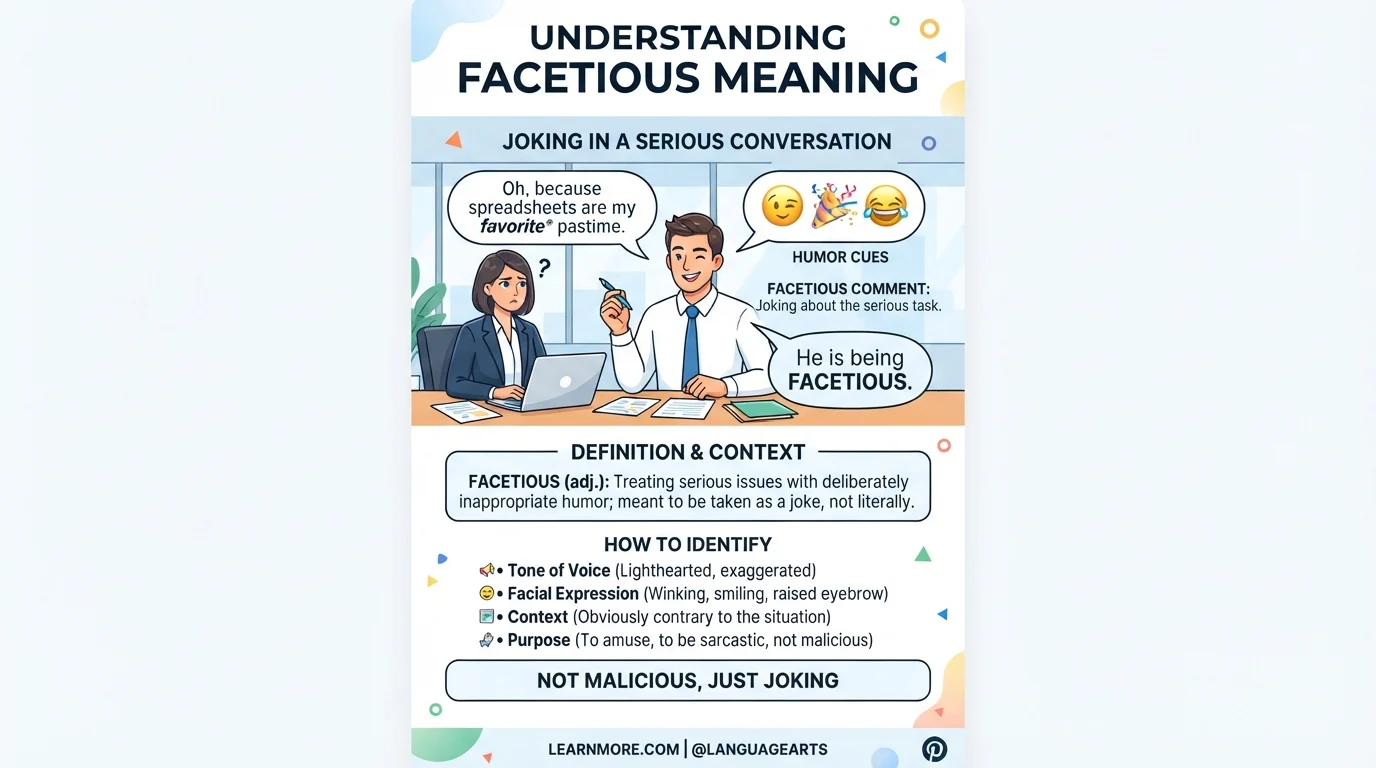
You may hear someone call a comment “facetious” after a joke lands badly or sounds overly playful. The facetious meaning is generally treating a serious subject in a joking, flippant, or not-quite-serious way. It often describes humor that does not match the seriousness of the situation.
For example, someone might ask, “Did you finish the report?” and you reply, “No, I decided to become a professional napper instead.” That response is facetious because you are joking instead of giving a serious answer. The word can sound harmless, funny, or mildly critical depending on context.
What Does Facetious Mean?
Facetious means joking or humorous in a way that treats something more seriously than it deserves, or treats a serious matter too lightly.
It is an adjective, not an abbreviation or acronym, so it has no “full form.” The word is common in standard English and appears in both everyday conversation and formal writing.
| Detail | Explanation |
|---|---|
| Most Common Meaning | Joking or flippant instead of being serious |
| Part of Speech | Adjective |
| Typical Tone | Humorous, playful, sarcastic, or dismissive |
| Full Form | Not applicable |
| Formal or Informal | Used in both, depending on context |
A facetious comment usually signals that the speaker does not intend the literal statement to be taken seriously.
For example:
“Sure, I’ll finish all 50 pages in five minutes.”
If the speaker clearly cannot do that, the statement is facetious. They are using humor to respond to an unrealistic request.
The Main Facetious Meaning in Everyday English
When people use facetious, they often describe a person who is deliberately being unserious.
Imagine your friend asks why you are late. You answer, “My limo got stuck behind a parade of penguins.” You obviously are not giving a factual explanation. You are making a deliberately ridiculous joke.
That is where the word becomes useful.
Someone can also say, “I was being facetious,” which means they want to clarify that their previous comment was meant as a joke rather than a literal statement.
The tone can vary. A facetious remark may be harmless between close friends, but it can feel dismissive when someone is discussing something serious.
How Context Changes the Meaning
The literal words alone do not always tell you whether a statement is facetious. You should look at the subject, relationship, wording, punctuation, and situation.
Here are a few examples:
Example 1
“Did you really eat the whole cake?”
“Absolutely. I also married it afterward.”
This is clearly facetious because the exaggerated response signals humor.
Example 2
“Can you send the file today?”
“Sure, I’ll get right on that.”
This may be completely serious, so context matters.
Example 3
“Thanks for deleting my presentation.”
“Happy to provide my professional services.”
This could be facetious because the overly formal wording creates humorous irony.
Example 4
“Are you seriously going to finish that entire pizza?”
“No, I’m saving some for breakfast.”
This could be a genuine answer or a joke, depending on facial expression, timing, and the surrounding conversation.
Emojis can also change interpretation in text. A laughing emoji can make a playful statement easier to recognize, while a blunt period can make the same words sound colder.
Is Facetious the Same as Sarcastic?
Not exactly.
Sarcasm often involves saying something that contrasts with what you really mean, sometimes to mock, criticize, or express irritation. Facetiousness is broader and focuses on being deliberately unserious or flippant.
The two can overlap.
| Term | Meaning | Main Difference |
|---|---|---|
| Facetious | Joking or treating something unseriously | Emphasizes flippancy or lack of seriousness |
| Sarcastic | Using ironic language to mock or criticize | Often carries a sharper edge |
| Flippant | Treating a serious matter too casually | More critical and less playful |
| Playful | Lighthearted and joking | Usually has a friendlier tone |
| Tongue-in-cheek | Deliberately humorous or ironic | Often signals that the statement should not be taken literally |
So, calling something facetious does not automatically mean it is sarcastic.
Facetious Meaning in Text and Chat
In texting, facetious keeps essentially the same meaning it has in spoken English. There is no special texting definition or common acronym behind the word.
People may use the word when explaining that a previous message was a joke.
For example:
Person A: “You could probably survive on coffee alone.”
Person B: “I was being facetious.”
Here, Person B is explaining that the statement was not intended literally.
Because text removes facial expressions and voice tone, facetious comments can sometimes be misunderstood. A joke that sounds obvious in person may look serious when reduced to a single sentence on a screen.
Facetious Meaning on TikTok, Instagram, and Snapchat
The word can appear on social media, but its basic definition does not change by platform.
On TikTok, someone might describe a deliberately absurd comment as facetious. On Instagram, the term may appear in captions, comments, or discussions about someone’s tone. On Snapchat, it can describe a joking reply in a private conversation.
For example:
“I was being facetious. I didn’t actually mean you should quit your job.”
There is no established platform-specific “facetious” definition that replaces the standard English meaning.
Real Conversation Examples
Friends
Person A: “Why did you miss the movie?”
Person B: “I was busy training for the Olympics.”
Meaning: Person B is joking rather than giving the real reason.
Workplace
Person A: “Can we finish this entire project by noon?”
Person B: “Sure, provided we invent time travel.”
Meaning: The response is facetious because the speaker jokingly points out that the deadline is unrealistic.
Family
Person A: “Who ate the last cookie?”
Person B: “Definitely the dog. He’s been acting suspicious.”
Meaning: The speaker is making a playful joke rather than seriously accusing the dog.
Is Facetious Rude?
Facetious is not automatically rude, but a facetious comment can sound rude when the subject is serious.
For example, joking about a friend’s favorite movie is usually harmless. Making jokes while someone is discussing a death, serious financial problem, or painful experience may come across as insensitive.
The relationship also matters. Close friends may understand playful teasing that would sound inappropriate from a coworker or stranger.
Is Facetious Sarcastic or Flirty?
A facetious remark can be sarcastic, but the terms are not interchangeable.
It can also appear in flirting, although “facetious” itself does not mean romantic or flirty. A playful response between two people may have a flirtatious tone because of the surrounding conversation, not because the word carries that meaning.
For example:
Person A: “You’re impossible.”
Person B: “Yet you keep talking to me.”
That response could be playful or flirtatious, but the context determines the tone.
How to Reply to a Facetious Comment
Your response should depend on whether you recognize the joke and whether you want to continue it.
Friendly Replies
“Okay, comedian.”
“I knew you weren’t serious.”
“Nice try.”
Funny Replies
“That’s the excuse you’re going with?”
“Your imagination deserves an award.”
“Please submit that story to Hollywood.”
Polite Replies
“Got it. I wasn’t sure whether you were joking.”
“Thanks for clarifying.”
“I figured you were joking, but I wanted to check.”
When you genuinely cannot tell whether someone is being facetious, a simple clarification works better than guessing.
When to Use the Term
You can use facetious when discussing humor, sarcasm, exaggeration, or deliberately unserious comments.
It works naturally in conversations with friends, classroom discussions, social media conversations, and writing where you need to describe someone’s tone precisely.
For example:
“I knew he was being facetious, so I didn’t take the comment literally.”
The word is especially useful when “joking” feels too broad and you want to point out that the joke involved treating a serious matter lightly.
When to Avoid the Term
You do not need to avoid facetious in professional settings simply because it sounds sophisticated. However, clearer wording may be preferable when communicating with people who may not know the word.
Instead of saying:
“Your response was facetious.”
You could say:
“I wasn’t sure whether you were joking.”
That second version is often clearer in customer service, workplace communication, sensitive discussions, and formal instructions.
The issue is not that the word is inappropriate. The issue is whether the reader will understand exactly what you mean.
Common Mistakes About Facetious
| Common Mistake | Correct Understanding |
|---|---|
| Thinking facetious means simply funny | It usually refers to humor that is deliberately unserious or flippant |
| Assuming facetious always means sarcastic | Sarcasm and facetiousness can overlap, but they are different concepts |
| Thinking facetious always means rude | The tone may be playful, harmless, dismissive, or inappropriate depending on context |
| Treating it like slang or an acronym | Facetious is a standard English adjective with no full form |
One especially common mistake is using facetious as a synonym for every joke. A joke can be funny without being facetious.
Origin and Popularity
The word facetious is an established English word rather than a modern internet expression. Its history is generally traced through French to Latin roots associated with wit or joking.
The exact details of historical word development can vary by dictionary and etymological source, but the modern sense centers on playful or flippant treatment rather than literal seriousness.
It is therefore better understood as a vocabulary word than as internet slang.
Quick Recap
- Facetious means deliberately joking, flippant, or unserious, especially when discussing something serious.
- It is an adjective and does not have a full form.
- Facetious and sarcastic can overlap, but they are not identical.
- Context, wording, punctuation, emojis, and relationships can affect how a facetious remark is understood.
- A facetious comment can be friendly, funny, or inappropriate depending on the situation.
Frequently Asked Questions
What does facetious mean in text?
Facetious means someone is joking or being deliberately unserious rather than expecting their message to be taken literally.
Is facetious rude?
Facetious is not inherently rude, but joking about serious subjects can make a comment seem insensitive or dismissive.
What does facetious mean on TikTok?
Facetious has the same standard meaning on TikTok, describing comments or statements made jokingly rather than literally.
How should you reply to facetious?
You can respond playfully when you recognize the joke, or ask for clarification when the person’s intended tone is unclear.
Can facetious have different meanings?
Facetious can vary in tone, but its core meaning remains deliberately humorous, flippant, or insufficiently serious.
Final Thoughts
The facetious meaning is straightforward: someone is being deliberately humorous or unserious, often while discussing something that normally deserves a serious response. The word does not automatically mean sarcastic or rude, although those qualities can appear in certain situations.
When you encounter “facetious” in a text, comment, conversation, or workplace discussion, focus on the surrounding context. The speaker’s wording, relationship with you, punctuation, and overall tone can reveal whether the remark is playful, ironic, or dismissive. Once you recognize that distinction, the word becomes much easier to understand and use naturally.
3 thoughts on “Facetious Meaning | What People Really Mean When They’re Being “Facetious” 2026”