
Serendipity means stumbling on something valuable or delightful that you were never looking for. You set out in one direction, and life quietly hands you something better instead. Perhaps you browse a bookshop for one title and leave with another that changes your year. Or you take a wrong turn and find the small cafe that becomes your favourite place in the city.
Few English words carry this much warmth in so few syllables. The word also has a rare gift among dictionary entries: a birthday. We know exactly who created it, when, and why. This guide walks through the definition, the fairy tale behind it, the famous discoveries it describes, and the habits that invite more of it into ordinary life.
What Does Serendipity Mean?

Merriam-Webster defines serendipity as the ability to find valuable or agreeable things that were not sought for. The same entry adds a second sense: luck that takes the form of such finding. Cambridge Dictionary phrases it more simply. For Cambridge, serendipity is the fact of finding interesting or valuable things by chance.
Both definitions rest on the same two pillars. First, the find is genuinely good. A stubbed toe is an accident, but nobody calls it serendipity. Second, the find is unplanned. You cannot schedule it, order it, or put it on a to-do list.
The event and the gift
Writers use the word in two slightly different ways. Sometimes it names a single event, as in “Meeting her that day was pure serendipity.” At other times it names a personal gift, a knack some people seem to have for lucky finds. A restless researcher, a curious traveller, or a friendly stranger at a bus stop can all show this faculty.
That second sense matters more than it first appears. The event needs luck, but the gift needs attention. Serendipity therefore sits halfway between fortune and skill, and that tension runs through its whole history.
A working definition
Here is a plain summary you can keep. Serendipity is a happy accident with a witness. Chance delivers something useful, beautiful or perfectly timed, and someone alert recognises its worth. Remove the value and you get a random event. Remove the accident and you get ordinary planning. Keep both, and you have the word at its best.
Dictionaries sometimes tag the word as literary, and the label fits its flavour. Serendipity rarely appears in instruction manuals or legal contracts. It thrives in essays, memoirs, love stories and laboratory histories, places where writers reflect on how life actually unfolded. That register is worth knowing. Dropping the word into casual speech signals delight and a touch of wonder, which is exactly why people reach for it at life’s turning points.
The Three Ingredients of a Serendipitous Moment
Every classic story of serendipity shares the same anatomy. Once you see the pattern, you start spotting it in your own life as well. Three ingredients must arrive together.
1. An unexpected event
Something unplanned interrupts the routine. A mold spore drifts onto a laboratory dish. In a distant church, a bookmark slips out of a singer’s hymnbook yet again. A train is missed, a street is chosen at random, a conversation starts with the person in the next seat. The event itself is usually small, and it often looks like a nuisance at first.
2. A prepared, noticing mind
The second ingredient is a person who pauses instead of shrugging. Plenty of people saw moldy dishes before Alexander Fleming did. Plenty of commuters have ignored the stranger beside them. The serendipitous person asks a better question: what is this, and could it matter? Curiosity turns an interruption into an opening.
3. A valuable outcome
Finally, the moment must pay off. The accident leads to a discovery, a friendship, a job, a book, a cure. The outcome feels oddly well matched to the person, almost as if it had been arranged. That feeling of fit is why the word carries such affection. It suggests the world occasionally conspires in your favour.
Keep these three parts in mind as you read on. The origin story, the science cases and the everyday examples all follow this script.
Origin of Serendipity: A Word Born in a Letter
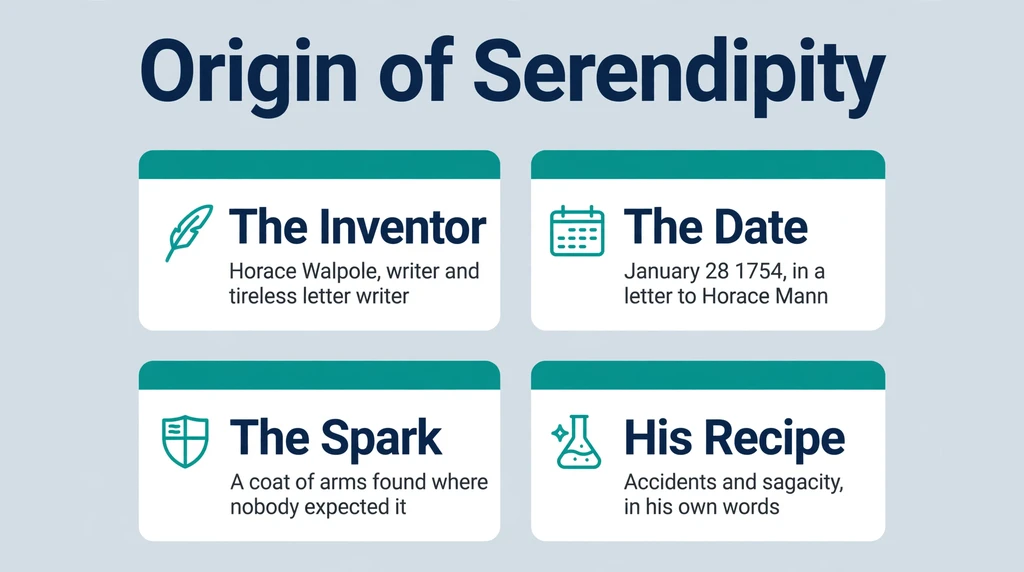
Most English words fade into view slowly, with no known inventor. Serendipity is the famous exception. We can date its birth to a single day: January 28, 1754.
The letter of 1754
Horace Walpole was an English writer, politician and tireless letter writer. On that January day he wrote to his friend Horace Mann, the British envoy in Florence. Walpole had just made a small discovery of his own. He had been hunting for the coat of arms of the Cappello family, to match a portrait of Bianca Cappello that Mann had sent him. He found the arms in an unexpected place, and the find delighted him.
Reaching for a word to describe that kind of discovery, he invented one. He told Mann the find was “almost of that kind which I call Serendipity, a very expressive word.” He explained that he had formed it from a “silly fairy tale” called The Three Princes of Serendip. Its heroes, he wrote, “were always making discoveries, by accidents and sagacity, of things which they were not in quest of.”
Notice the pairing in that sentence. Walpole wrote “accidents and sagacity,” not accidents alone. Sagacity means sharp, wise judgement. From its very first day, the word has meant chance plus a clever observer.
A word nobody used
The letter itself stayed private for decades. According to the Online Etymology Dictionary, it was apparently not published until 1833. Even then, the word barely stirred. It remained rare through the 1800s, more a curiosity for word lovers than a living term. The Saturday Review drew attention to it in 1877, and it began appearing in print more often in the 1890s.
The real fame arrived in the twentieth century. Scientists, inventors and sociologists adopted it for a pattern they kept meeting in their work. The American sociologist Robert K. Merton did much to reintroduce it into scholarly circulation. With Elinor Barber, he wrote a whole study of the word’s travels, fittingly titled The Travels and Adventures of Serendipity. Today the word appears everywhere from laboratory reports to film titles, which is quite a journey for a coinage tossed into a private letter.
Why scientists claimed the word
Science had needed this term for a long time. Research reports prefer clean logic: a hypothesis, a method, a result. Real laboratories run messier than that, and everyone in them knew it. Walpole’s word gave researchers an honest label for the messy part. It let them admit that a finding arrived uninvited, without surrendering credit for spotting it.
That honesty explains the word’s second career. Twentieth-century writers on discovery returned to it again and again, because it protects two truths at once. Breakthroughs cannot be commanded, and they are not pure lottery wins either. Somewhere between the plan and the accident stands a person who was ready. Serendipity names that person’s reward.
The Three Princes of Serendip
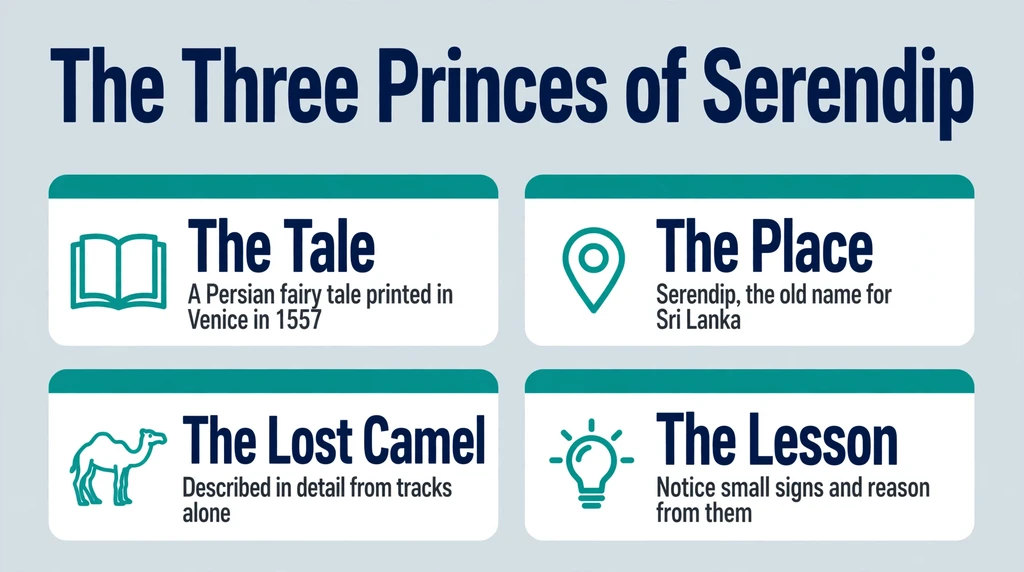
To understand Walpole’s invention, you need the fairy tale that inspired it. The story is far older than the word, and it travelled halfway across the world before reaching his desk.
A tale that crossed continents
The story reached print in Venice in 1557. Publisher Michele Tramezzino issued it as Peregrinaggio di tre giovani figliuoli del re di Serendippo, roughly “The Wanderings of the Three Young Sons of the King of Serendip.” The translator, Cristoforo Armeno, had rendered a Persian tale into Italian. His source reached back to Book One of the Hasht-Bihisht, a poem written in 1302 by Amir Khusrau.
An English version followed in 1722, arriving through a French translation. That is very likely the form in which Walpole knew the tale. Its title in English became The Travels and Adventures of Three Princes of Serendip, which Merton later echoed for his book.
And where was Serendip? It was an old name for the island we now call Sri Lanka, long known in English as Ceylon. The name travelled through Arabic as Sarandib and traces back to the Sanskrit Simhaladvipa. So the word for happy accidents begins, fittingly, with a faraway island most of its early readers would never see.
The case of the lost camel
The princes were the three sons of a king of Serendip, sent travelling to sharpen their wits. On the road they kept noticing small signs that others missed, and reasoning brilliantly from them.
The most famous episode involves a camel they had never seen. From tracks and clues along the path, they described the animal in startling detail. It was blind in one eye, missing a tooth, lame, and carrying loads of butter on one side and honey on the other. When a merchant reported his camel lost, the princes were accused of theft. How else could they know so much? In the end the camel was found, exactly as described, and their innocence was proved.
That episode is the whole concept in miniature. The princes were not hunting a camel. Chance put the clues in their path, and sagacity did the rest. When Walpole read it, he recognised the pattern in his own heraldic find, and English gained a word.
From fairy tale to detective story
The tale’s influence did not stop with one English word. Voltaire borrowed its reasoning for his 1747 novella Zadig, whose hero reads traces and draws startling conclusions from them. Scholars of literature trace a line from the princes, through Zadig, toward the modern detective story. The method is identical in each case: small overlooked facts, carefully connected, reveal a hidden truth. Every fictional detective who studies a footprint or a cigar ash works in the princes’ tradition. Serendipity, in other words, helped invent a genre built on noticing.
Serendipity Pronunciation and Word Forms

The word looks long, but it falls into a friendly rhythm once you hear it. Cambridge Dictionary gives the British pronunciation as /ˌser.ənˈdɪp.ə.ti/ and the American as /ˌser.ənˈdɪp.ə.t̬i/. In plain respelling: ser-uhn-DIP-uh-tee, five syllables, with the stress landing firmly on “dip.”
The word family
Serendipity is a noun. Its adjective, serendipitous, describes things found or occurring by happy chance, as in “a serendipitous meeting.” Dictionaries trace that adjective to 1914, a latecomer next to its parent. The adverb serendipitously follows the same pattern: “They met serendipitously, in a delayed train neither had planned to catch.”
You will also meet the plural, serendipities, though it stays rare. Most writers keep the noun uncountable and let it behave like luck or happiness. Common companions include “pure serendipity,” “sheer serendipity,” “a stroke of serendipity” and “by serendipity.”
One caution for learners: the word always carries a positive charge. A grim coincidence is not serendipity, however surprising it may be. Reserve the word for finds you are glad to have made.
Serendipity Examples in Everyday Life
Grand discoveries make the headlines, but most serendipity is small and personal. It hides inside ordinary weeks, waiting for someone to notice it. These everyday scenes show the shape of it.
People and love
Two strangers reach for the same last copy of a book, talk, and marry three years later. A cancelled flight seats old school friends side by side after twenty years apart. A dog escapes into a neighbour’s garden and returns with a friendship attached. Stories like these explain the word’s romantic glow. The 2001 film Serendipity, with John Cusack and Kate Beckinsale, built an entire love story on such engineered coincidences and the hope that fate approves.
Work and ideas
A designer overhears a complaint in a coffee queue and sketches the product her company needed. One job seeker chats with a taxi driver whose cousin happens to be hiring. A researcher shelved in the wrong library aisle pulls down the wrong book and finds the missing reference. Notice the pattern again: an unplanned encounter, an alert mind, and a result worth having.
Travel and small pleasures
Serendipity loves travellers, because travel multiplies accidents. The unmarked lane that leads to a waterfall. A festival nobody mentioned, stumbled into on the one free afternoon. The rain shower that drives you into a tiny museum you would never have chosen. Trip reports are full of the word for a reason. Plans create the journey, but accidents often create the memories.
Books, music and taste
Some of the richest finds are cultural. A song overheard through a shop doorway becomes the soundtrack of a decade. A friend’s throwaway recommendation introduces the author you will read for life. Algorithms now work hard to predict your taste, and they often succeed. Yet listeners still treasure the track no system would have chosen for them. The mismatch is the magic: serendipity delivers what your own profile could not have requested, because you did not know it existed.
Serendipity in Science: Discoveries Nobody Planned
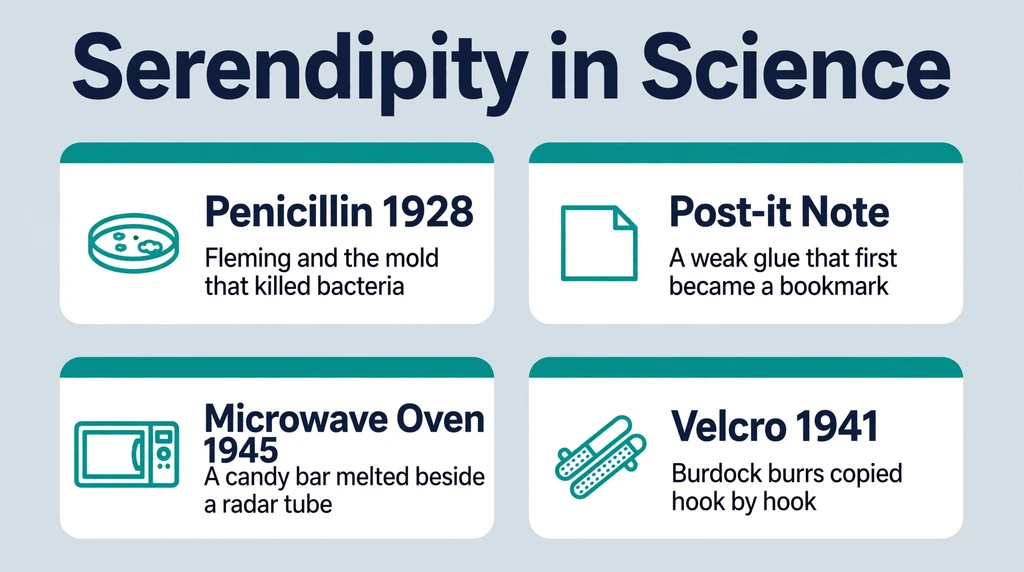
Scientists reach for this word more than any other profession. Their history is crowded with breakthroughs that arrived sideways, disguised as errors, spills and failures. Four cases are retold so often that they have become the word’s ambassadors.
Read the four stories as one argument. In each, a competent person was pursuing a clear goal. In each, reality interrupted with something unrelated and apparently useless. The discovery happened only because the person treated the interruption as data instead of dirt. That reflex, repeated across centuries and fields, is what the word really celebrates.
Penicillin: the mold that killed bacteria
In 1928, Scottish bacteriologist Alexander Fleming was studying Staphylococcus aureus, a common and dangerous bacterium. He returned to his London laboratory to find that one culture had been accidentally contaminated by a green mold, Penicillium notatum. Around the mold, the bacteria had died. Elsewhere on the dish, they thrived as usual.
A tidier scientist might have binned the ruined experiment. Fleming instead asked what the mold was doing, isolated it, and found it released a substance that killed many harmful bacteria. He named it penicillin and published his findings in 1929. Turning that observation into a medicine took another team: Howard Florey and Ernst Chain purified penicillin in the late 1930s, and an injectable form was ready by 1941. The three men shared the 1945 Nobel Prize. The accident supplied the clue, but a prepared mind supplied everything else.
The Post-it Note: a failure that stuck
In 1968, 3M chemist Spencer Silver was trying to develop a super-strong adhesive. He produced the opposite: a weak, reusable glue that barely held paper together. For years he promoted this “solution without a problem” around the company, convinced it had value.
In 1974 his colleague Art Fry sang in a church choir, and his paper bookmarks kept falling out of his hymnbook. Mid-service, he remembered Silver’s failed glue. A bookmark coated with it would stay put, then peel away without tearing the page. The pair developed the idea together. 3M launched it as Press ‘n Peel in 1977, and it flopped. Only after a free-sample campaign in Boise, Idaho, did the renamed Post-it Note take off, selling across the United States from April 1980. Even its canary yellow colour was an accident: the lab next door had only yellow scrap paper. Few stories honour the definition so completely: nobody was looking for a sticky note at all.
The microwave oven: a melted candy bar
Percy Spencer, a self-taught engineer at Raytheon, was an expert in radar equipment. In 1945 he stood near an active magnetron, the tube that powered radar sets, and felt something odd in his pocket. A candy bar there had melted. Rather than shrugging, Spencer experimented. He held popcorn kernels near the tube and watched them pop. An egg came next, and it exploded.
Raytheon filed a patent for cooking with microwaves in October 1945. The first commercial model, the bulky Radarange, appeared in 1947 for restaurants and ships. Decades of shrinking followed before the box reached home kitchens. Every reheated lunch since then owes something to a spoiled snack and an engineer who refused to ignore it.
Velcro: the burr that would not let go
Swiss engineer George de Mestral came home from a hunting trip in 1941 with burdock burrs clinging to his clothes and his dog’s fur. Most people would have picked them off and forgotten them. De Mestral put one under a microscope. He saw hundreds of tiny hooks, each catching on the loops of fabric and fur.
That structure became his blueprint. He spent years learning to copy it in manufactured fibres, and named the result Velcro, blending the French words velours, meaning velvet, and crochet, meaning hook. Patents followed in Switzerland in 1954 and the United States in 1955. The fastener now holds together everything from children’s shoes to equipment aboard spacecraft. Here the chance event was tiny and mildly annoying, which makes the lesson sharper: serendipity often begins as an irritation examined closely.
Set the four stories side by side and a pattern emerges. None of these people found what they were seeking. Fleming wanted clean cultures, Silver wanted strong glue, Spencer wanted better radar, de Mestral wanted a tidy coat. Each accepted the failure in front of them and interrogated it. Serendipity in science is rarely a lightning strike. It is a habit of pausing at the exact moment most professionals tidy up and move on.
Serendipity vs Luck, Coincidence and Synchronicity
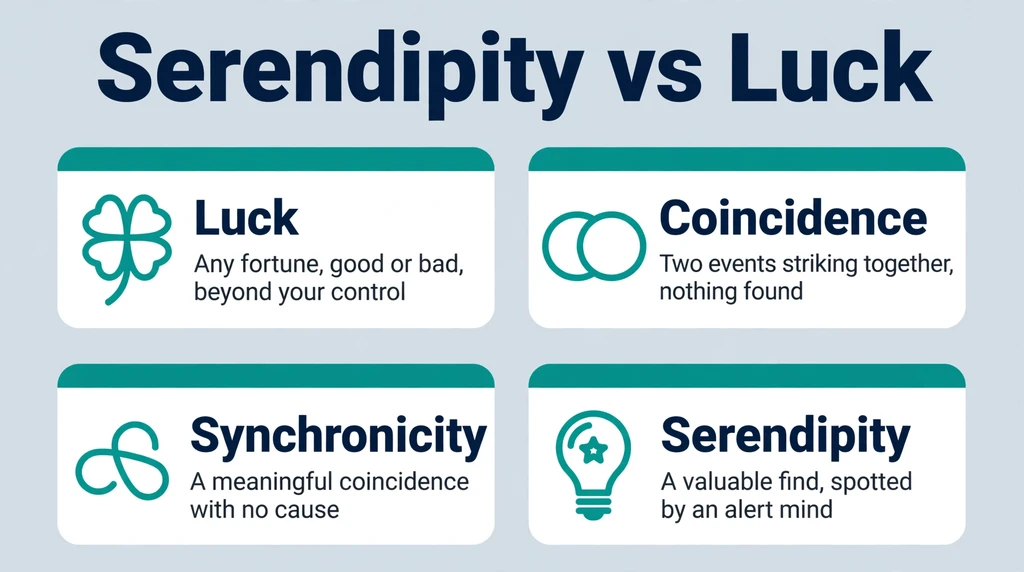
Serendipity keeps close company with several other words, and the boundaries matter. Using the right one makes your meaning sharper. Here is how the neighbours differ.
Serendipity vs luck
Luck is the broadest term of the group. It covers any good or bad fortune that arrives without your control, from winning a raffle to missing a bus in the rain. Serendipity is narrower and always positive. It involves a discovery: you find something valuable while engaged in something else. Luck can strike a passive person. Serendipity usually asks for a participant, someone whose attention converts the accident into a gain.
Serendipity vs coincidence
A coincidence is simply two events falling together in a striking way. You think of an old friend, and she phones that evening. The overlap is remarkable, but nothing has been found, and nothing needs to change. Serendipity adds a treasure to the overlap. When the phone call leads to the job, the recipe or the reunion you needed, coincidence has grown into serendipity.
Serendipity vs fate and destiny
Fate and destiny suggest a script written in advance. Events happen because they were always meant to happen, and human noticing plays no real part. Serendipity implies the opposite atmosphere. The find was not destined; it nearly did not happen at all, and it needed your eyes to complete it. That is why the word feels cheerful rather than solemn. It celebrates improvisation, not prophecy.
Serendipity vs synchronicity
Synchronicity is the psychiatrist Carl Jung’s term, set out fully in a 1952 essay, for a meaningful coincidence with no causal link. Dreaming of a scarab and then finding a similar beetle at the window was his kind of example. The emphasis there falls on meaning and the inner life. Serendipity stays more practical and worldly. It is about useful or delightful finds in the outer world, whether or not they carry a personal message.
The table below compresses the contrasts.
| Word | Core idea | Is your attention required? |
|---|---|---|
| Luck | Fortune, good or bad, beyond your control | No |
| Coincidence | Two events striking together | No |
| Fate | Events fixed in advance | No |
| Synchronicity | A coincidence charged with personal meaning | Yes, to feel the meaning |
| Serendipity | A valuable find you were not seeking | Yes, to spot the value |
Which word should you choose?
A quick test settles most cases. Ask what the sentence celebrates. If it celebrates fortune itself, choose luck. If it celebrates timing alone, choose coincidence. When the pattern feels destined, the word is fate, though serendipity’s fans would argue the case. And if it celebrates a discovery, something found, kept and used, then serendipity is the precise and generous choice. Precision here is more than pedantry. Each word tells the reader how much of the credit belongs to the world, and how much belongs to you.
Can You Make Serendipity Happen?

By definition, nobody can schedule a happy accident. Yet some people collect far more of them than others, and the gap is not pure chance. Researchers who study the phenomenon point to habits that raise the odds.
The prepared mind
Louis Pasteur captured the principle in an 1854 lecture at the University of Lille. “In the fields of observation,” he said, “chance favors only the prepared mind.” Fleming’s mold is the classic proof. The contaminated dish had probably sat in other laboratories too, in front of other eyes. Fleming’s years of hunting antibacterial substances meant he saw a weapon where others saw waste. Preparation does not create the accident. It creates the recognition.
Habits that raise your odds
Certain routines quietly multiply useful accidents:
- Vary your routes and inputs. Read outside your field, walk different streets, and accept odd invitations. New material gives chance more to work with.
- Talk to strangers and weak ties. Many finds arrive through people at the edge of your circle, who move in worlds you never enter.
- Follow small curiosities. The odd result, the strange footnote, the burr on your coat: each is cheap to examine and occasionally priceless.
- Keep a capture habit. Note the idea, save the clipping, write down the name. Serendipity fades fast when nothing records it.
- Leave slack in the plan. A diary packed to the minute has no doorway for the unexpected. Loose schedules let detours happen.
Habits that block it
The reverse habits quietly shut serendipity out. Treating every surprise as a defect trains you to discard clues quickly. Staying inside one circle of people and one shelf of books starves chance of raw material. So does the reflex to fill every pause with a phone screen, since so many finds begin as idle looking around. None of these habits feels costly on a given day. Together, they lower the surface area on which luck can land. The good news is that each one is reversible by Friday.
Information researchers describe habitual finders, people who treat every setting as a possible source. NPR’s reporting on the word notes that some scholars see serendipity as a skill that can be practised rather than a gift that simply lands. That view fits Walpole’s original recipe perfectly. Accidents are weather. Sagacity is climate, and climate is something you can build.
Serendipity in Sentences

Seeing the word at work fixes its rhythm better than any definition. Each example below is original, and each keeps the essential pattern of an unplanned, valuable find.
- Finding the first edition in a charity shop bin was pure serendipity; she had only gone in to escape the rain.
- By serendipity, the delayed train placed him beside the one passenger who could translate the letter.
- Their partnership began in serendipity, two stalls apart at a market neither had planned to visit.
- It was serendipitous that the archive stored the missing photograph in the very box she opened first.
- He serendipitously overheard the announcement while buying coffee, and reached the audition with minutes to spare.
- The recipe came from serendipity: a missing ingredient, a bold substitute, and a dish the family now demands weekly.
- “Call it serendipity,” she said, “but the wrong email address just hired our best editor.”
- A serendipitous detour around roadworks revealed the valley they would later choose for their home.
- The internship existed because of serendipity: a misdirected application, read by exactly the right manager.
- Years later, they still toast the serendipity of a shared umbrella at a soaked bus stop.
Notice how often the word pairs with discovery verbs: find, overhear, stumble on, reveal. That grammar is the meaning in action.
Common Misconceptions About Serendipity
Because the word is loved, it is also stretched. A few corrections keep it accurate.
“Serendipity is just luck”
This is the most common flattening of the word. Pure luck needs nothing from you. Serendipity, in Walpole’s founding sentence, needs accidents and sagacity together. Calling every fortunate event serendipity quietly deletes the observer, and with it the most useful half of the idea: that noticing is a trainable skill.
“Any coincidence counts”
A coincidence earns attention through timing alone. Serendipity must deliver something of value that you were not pursuing. Bumping into a neighbour at the shops is a coincidence. Learning from that neighbour about the house you then buy and love is serendipity. The difference is the treasure.
“Serendipity proves things were meant to be”
The word is often drafted into arguments about destiny, especially in romance. Its history points the other way. The princes found their clues by wandering and watching, not by following a script. Serendipity flatters human alertness, not cosmic planning. It says the world is full of unlabelled gifts, not that the gifts had your name on them all along.
“You cannot influence it at all”
The opposite error is claiming you can manufacture it on demand. The truth sits between the two. Nobody can order a happy accident for Tuesday. Anybody can build the conditions, varied inputs, open attention, unhurried margins, in which accidents turn valuable more often. Gardeners cannot command rain either, but they still prepare the soil.
“Serendipity only happens to other people”
This belief usually says more about attention than about fortune. People who seem magnetised by luck tend to retell their finds, examine them and follow where they lead. Quieter observers may receive the same accidents and file them as noise. The fairy tale makes the point neatly: an entire caravan passed the same tracks on that road. Only three travellers read them.
Frequently Asked Questions
What does serendipity mean in simple words?
It means finding something good that you were not looking for. You go out for one thing and come home with something better, thanks to a lucky accident and your own quick noticing. A wrong turn that leads to a wonderful cafe is serendipity in miniature.
Who coined the word serendipity?
The English writer Horace Walpole invented it in a letter dated January 28, 1754, written to his friend Horace Mann. He borrowed the idea from the fairy tale The Three Princes of Serendip, whose heroes kept finding things they were not in quest of.
Is serendipity the same as luck?
Not quite. Luck is any fortune outside your control, good or bad, and it can happen to someone paying no attention at all. Serendipity is always welcome, and it involves a discovery: chance offers something valuable, and an alert person recognises and uses it.
How do you pronounce serendipity?
Say ser-uhn-DIP-uh-tee, with the stress on the third syllable. Cambridge Dictionary writes it as /ˌser.ənˈdɪp.ə.ti/ in British English and /ˌser.ənˈdɪp.ə.t̬i/ in American English.
What is a famous example of serendipity?
Penicillin is the classic case. In 1928, Alexander Fleming noticed that a mold accidentally contaminating his bacterial culture was killing the bacteria around it. Instead of discarding the dish, he investigated, and the result became the first widely used antibiotic. The Post-it Note and the microwave oven began in similar accidents.
Can serendipity happen in love?
Yes, and the word is often used for exactly that. Two people meet through a missed train, a borrowed umbrella or a seating mix-up, and the unplanned meeting grows into a relationship. The romance comes from the pattern: nobody was searching, yet both people recognised the value of the encounter.
Is serendipity a good thing?
By definition, yes. The word only applies when the surprise turns out valuable, pleasant or useful. An accident with a bad outcome may be chance or coincidence, but English speakers would not call it serendipity.
How do I use serendipitous in a sentence?
Use it as an adjective before a noun, for meetings, moments, discoveries and finds. For example: “A serendipitous conversation at the conference led to their first book deal.” Its adverb form works too: “The manuscript surfaced serendipitously, inside a box marked for recycling.”
Final Thoughts
Serendipity began as one man’s thank-you note to a fairy tale. It has grown into the name we give a whole style of good fortune: the kind that rewards people who wander, watch and wonder. Its history rewards a look as well. Readers who enjoy word origins can trace this one in the Online Etymology Dictionary, which follows it from Walpole’s desk back to an island in the Indian Ocean.
Keep the recipe simple. Send yourself into the world with a purpose, but hold the purpose loosely. Read the tracks along the road, like three princes far from home. The camel you were never looking for may be exactly the thing you needed to find.