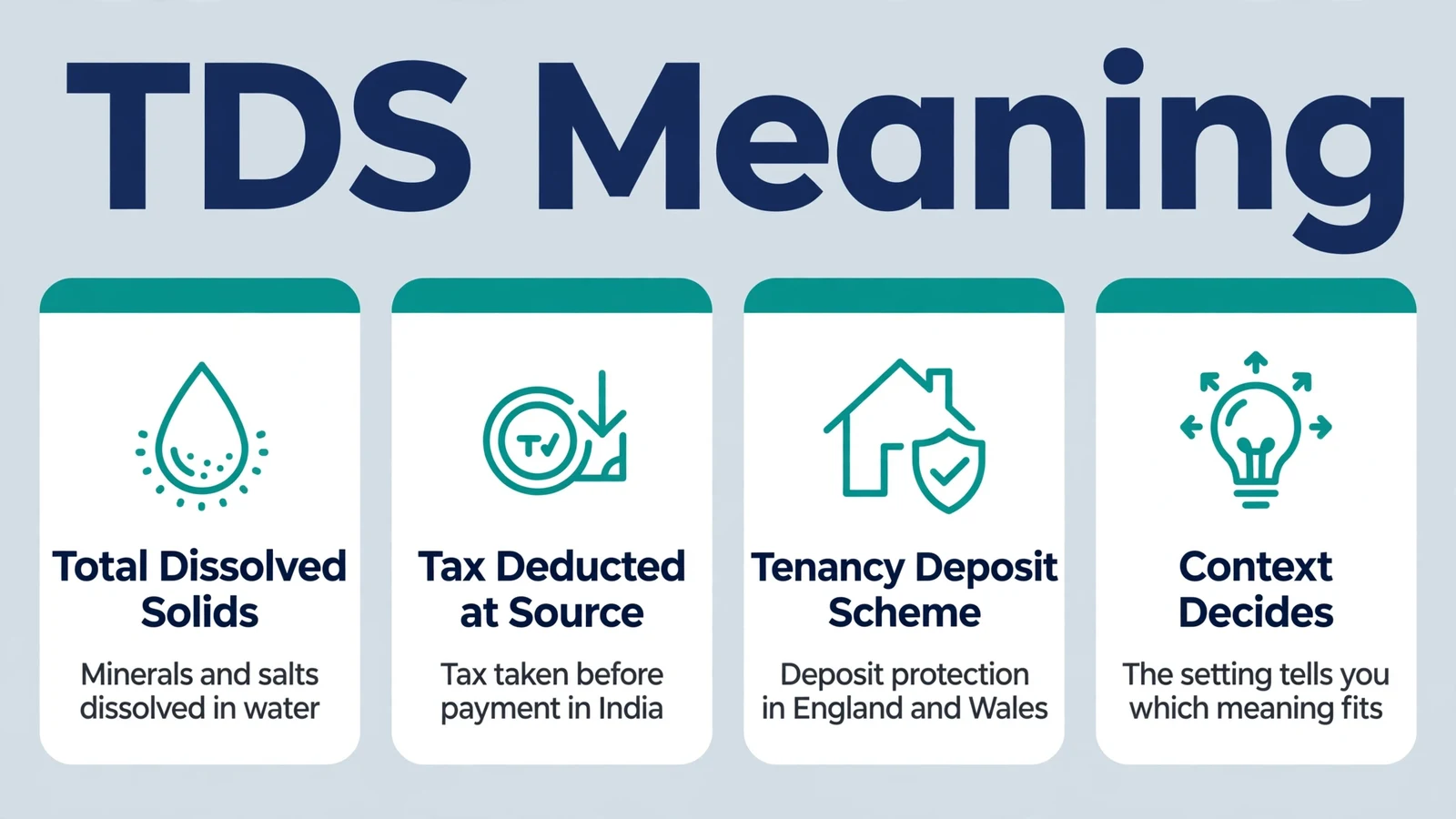
Three little letters, several very different worlds. If you met TDS beside a water purifier, it stands for total dissolved solids, the minerals and salts dissolved in your water. If you met it on an Indian payslip, it means tax deducted at source, the tax your payer hands to the government before paying you. And if you met it in a British rental listing, it points to a deposit protection scheme.
Context, not the letters, decides which meaning applies. This guide walks through each sense in plain words. You will learn what TDS measures in water, how a small meter reads it, and what the numbers actually say. You will also see how the tax version works step by step, and how to spot the right meaning in seconds.
What Does TDS Mean?
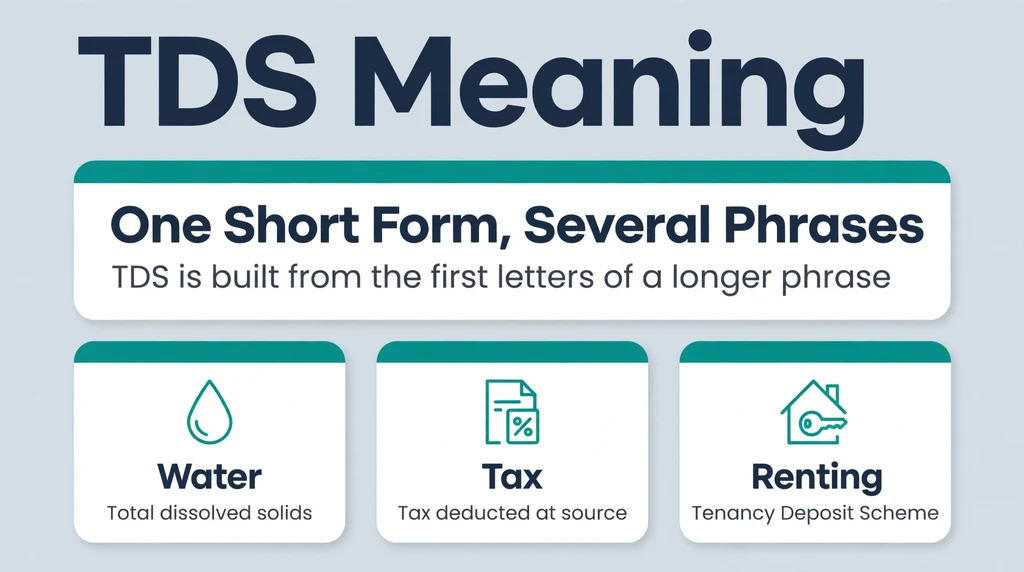
TDS is an initialism, which means it is built from the first letters of a longer phrase. The catch is that several longer phrases share the same three letters. So the honest answer to “what does TDS mean” always starts with a question back: where did you see it?
In most of the world, the default answer is water. Total dissolved solids is the sense used by scientists, plumbers, aquarium keepers and water filter brands. In India, however, the tax sense is just as common in daily life. A salary slip, a bank statement or a rent agreement there almost always means tax deducted at source.
The Main Meanings at a Glance
Here is the short map this article will unpack:
- Total dissolved solids: a measure of everything dissolved in water, from calcium to table salt.
- Tax deducted at source: India’s system of collecting income tax at the moment income is paid.
- Tenancy Deposit Scheme: a government-approved scheme that protects renters’ deposits in England and Wales.
- Political slang: in US commentary, a shorthand label discussed later in this guide.
Each sense belongs to its own field, and the fields rarely overlap. A water report never talks about tax, and a payslip never talks about minerals. Once you notice the setting, the meaning usually becomes obvious. The sections below take the two big senses in turn, then cover the smaller ones.
TDS in Water: Total Dissolved Solids Explained
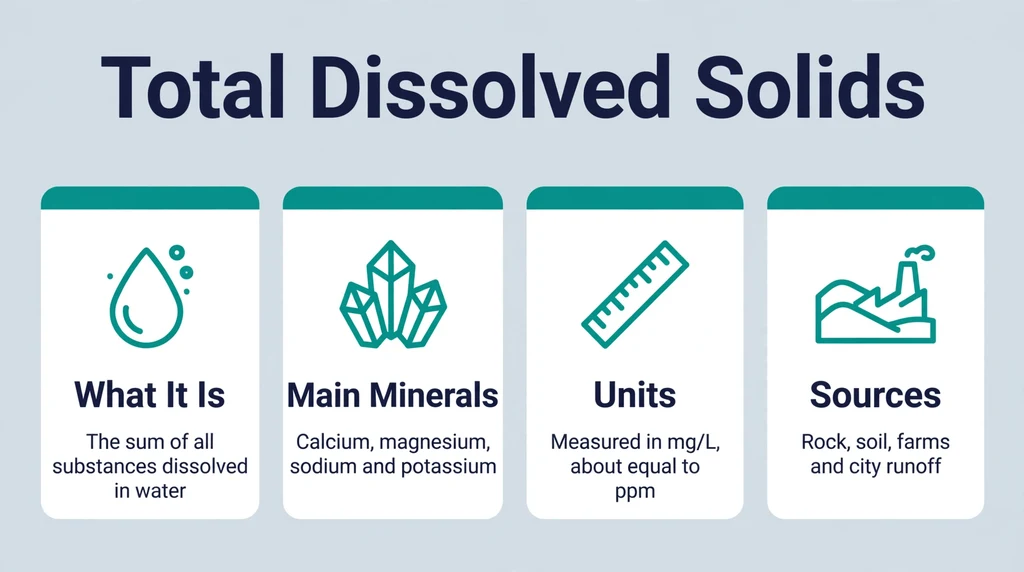
Total dissolved solids is the combined content of everything dissolved in a sample of water. The United States Geological Survey (USGS) describes it as the sum of all substances, organic and inorganic, that are dissolved in water. In other words, if you could evaporate a litre of water and weigh what stays behind, that residue is close to its TDS.
The number is reported in milligrams per litre, written as mg/L. For water, that figure is roughly equal to parts per million, or ppm. So a reading of 300 mg/L and a reading of 300 ppm describe the same thing. Most home meters display ppm, while laboratory reports usually prefer mg/L.
What Counts as a Dissolved Solid?
Most of the load comes from a familiar cast of minerals. The USGS lists calcium, magnesium, sodium and potassium among the main positive ions. Bicarbonate, sulfate, chloride, nitrate and silica cover most of the rest. When these ions pair up, they form salts, which is why scientists often use the word salinity alongside TDS.
Some dissolved material also comes from organic matter in small amounts. Leaves, soil and decaying plants all add their share. Meanwhile, gases such as oxygen and carbon dioxide dissolve in water too, although meters do not count them the same way. The bulk of any reading, though, is mineral.
One boundary matters here. TDS only counts material that is truly dissolved, down at the level of ions. Sand, silt and rust flakes floating in the water are suspended solids, a different measure covered later in this guide.
Where Dissolved Solids Come From
Rain starts out nearly pure, with a TDS close to zero. Then it falls through air, soaks into soil and runs over rock. Each step dissolves a little more mineral. Limestone country, for instance, loads water with calcium and magnesium, which is why such regions are famous for hard water.
Human activity adds a second layer. Farm fertilisers wash into rivers and raise nitrate levels. Road salt pushes chloride up in winter. Industry, mining and city runoff all contribute smaller amounts. Because of this mix, two towns a short drive apart can have very different readings.
Depth matters as well. Deep groundwater has spent years in contact with rock, so it often carries a higher TDS than a fast-flowing river. Seawater sits at the extreme end, with roughly 35,000 ppm of dissolved salt. Fresh water, by the usual classification, stays below about 1,000 ppm.
TDS Around the Home
Once you own a meter, you start seeing the number everywhere. Coffee lovers watch it because mineral content shapes extraction and flavour. Two cafes using the same beans can pour noticeably different cups when their water differs. Many brewers aim for a middle range rather than the purest water they can make.
Aquarium keepers track it for a different reason. Fish and shrimp evolved in particular waters, and sudden swings in dissolved content stress them. A stable reading often matters more than a perfect one. Houseplants tell a slower story: white crusts on soil and leaf tips can signal salts building up from hard tap water.
Appliances keep score quietly. Kettles scale, showerheads clog and washing machines work harder as dissolved minerals rise. None of these uses needs laboratory precision. All of them benefit from knowing roughly where your water sits.
How a TDS Meter Works
A TDS meter looks like a thick pen, and it costs less than a pizza in many markets. Yet it does not actually count solids. Instead, it uses a neat shortcut based on electricity, which is why its readings are estimates rather than exact weights.
The Conductivity Shortcut
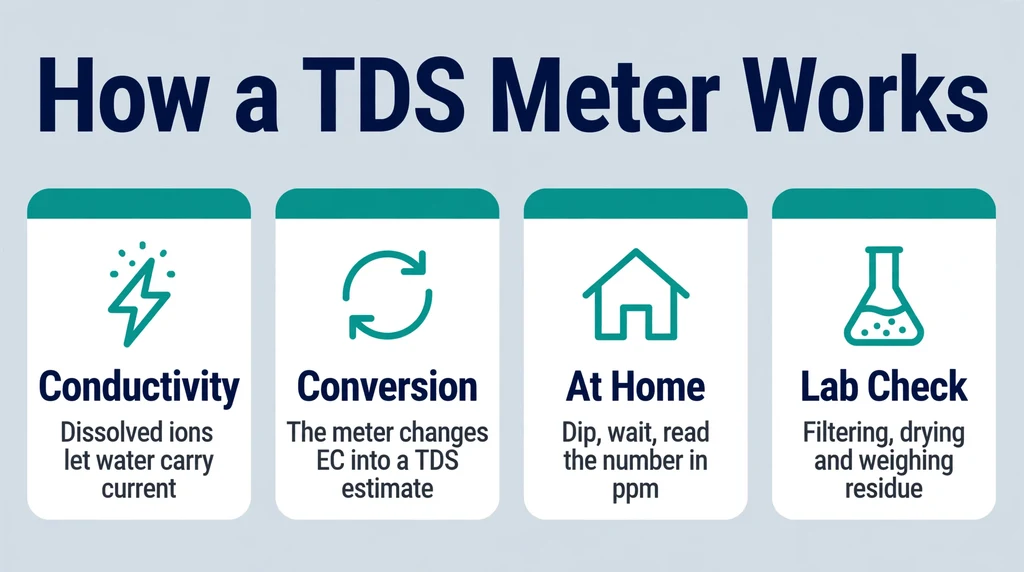
Dissolved minerals exist in water as charged particles called ions. Charged particles let water carry an electric current. Pure water, by contrast, has virtually no conductivity at all. So the more dissolved ions the water holds, the better it conducts.
The meter dips two small electrodes into the sample and measures that conductivity. Scientists call the measurement specific conductance, and the USGS uses it as a stand-in, or surrogate, for dissolved solids. Inside the meter, a fixed factor converts the conductivity reading into a TDS estimate. That factor usually falls between 0.5 and 1.0 times the conductivity value, depending on the meter and the type of water.
This shortcut explains both the strength and the limit of the tool. It is fast, cheap and repeatable. However, it cannot tell calcium from sodium, and it misses dissolved substances that carry no charge. Two waters can share one TDS number and still have very different contents.
How to Take a Reading at Home
Using the meter takes under a minute. First, rinse a clean glass and fill it with the water you want to test. Next, switch the meter on, remove the cap and dip the tip into the water. Then wait a few seconds while the number settles, and read the display in ppm.
A few habits improve accuracy. Test water at room temperature, because conductivity shifts with heat. Rinse the tip with clean water after each use. Also, compare like with like: test your tap and your filter output on the same day, in the same glass. Finally, remember that a single reading is a snapshot. Readings drift with seasons, rainfall and changes in the supply.
The Laboratory Method
Laboratories use a slower, more direct approach called the gravimetric method. A measured sample is filtered first, which removes suspended particles. The clear water is then evaporated in a dish, and the dried residue is weighed. That weight gives a true TDS value rather than an estimate.
Because the lab method takes hours, it suits official reports and research. The pocket meter suits daily checks. Both have their place, and sensible users treat the meter as a guide rather than a verdict.
Calibrating and Caring for a Meter
Meters drift over time, so occasional calibration keeps them honest. Most models are checked against a standard solution with a known value, sold in small bottles or sachets. If the meter reads off the mark, a small adjustment screw or button sequence corrects it. The manual for your model gives the exact steps.
Daily care is simpler. Rinse the electrodes with clean water after testing, especially after checking salty samples. Shake off droplets, replace the cap and store the meter dry and away from heat. Batteries fade quietly in cheap meters, and a fading battery often shows up first as wandering numbers. Replace it before blaming the water.
What TDS Levels Mean for Drinking Water
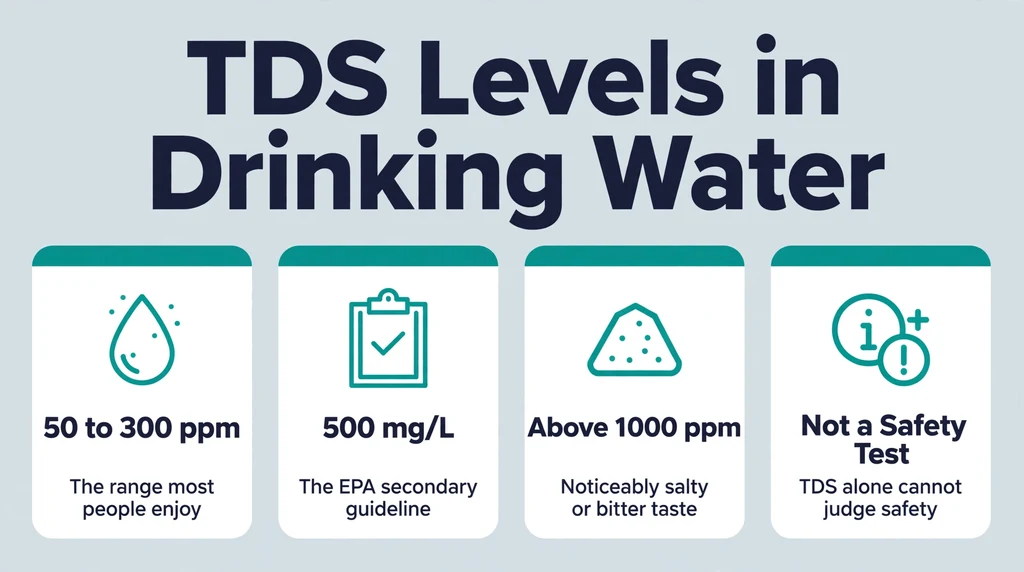
A number alone tells you little until you place it on a scale. Taste, scaling and common sense all change as the figure climbs. This section gives you the ranges people actually use, plus the reasoning behind them.
Reading the Numbers
Very low readings, near 0 to 50 ppm, describe almost pure water, such as distilled water. Rain and melted snow also land near this zone. Water here tastes flat to many people, simply because minerals add flavour.
Readings between roughly 50 and 300 ppm cover most good-tasting tap water and many bottled waters. Between 300 and 500 ppm, water is still widely accepted, although kettles may fur up faster. Above 500 ppm, taste complaints grow common. Past 1,000 ppm, most people find the water noticeably salty or bitter, and palatability drops away.
Treat these bands as guides, not laws. Preference varies by habit, and locals often enjoy water that visitors dislike. Still, the overall pattern holds everywhere: minerals help taste up to a point, then hurt it.
The EPA Guideline of 500 mg/L
The United States Environmental Protection Agency (EPA) lists total dissolved solids in its National Secondary Drinking Water Regulations. The secondary standard for TDS is 500 mg/L. That figure is the closest thing the topic has to an official anchor.
However, the word secondary matters. Secondary standards are non-enforceable federal guidelines. They deal with looks, taste and smell rather than direct health limits, and the EPA recommends them instead of requiring them. States may choose to adopt them as binding rules, but many do not.
Above the 500 mg/L level, the EPA lists effects such as hardness, deposits, coloured water, staining and salty taste. The USGS adds a practical warning from the plumbing side. High dissolved solids can contribute to corrosion of fixtures and shorten the life of water heaters and other equipment. In short, the guideline protects your kettle and your palate more than your body.
The World Health Organization takes a similar line. It sets no health-based guideline value for TDS. Its concern is palatability: as levels rise past roughly 1,000 mg/L, water becomes increasingly unpalatable to many drinkers.
Can TDS Be Too Low?
Surprisingly, yes, very low readings raise their own questions. Water stripped of nearly all minerals tastes dull, and some people simply drink less of it. Extremely pure water is also slightly more corrosive to pipes, because it tends to pick up metals on its way through.
For home filters, this is a balance question. Many reverse osmosis owners add a mineral cartridge after purification, lifting the reading into the 50 to 150 ppm range. The goal is not a magic number. The goal is water you enjoy drinking, from pipes that stay in good shape.
TDS in Bottled and Municipal Water
Labels can help, although they rarely shout about TDS. Some bottled waters print a mineral analysis or a total dissolved solids figure in small type. Mineral waters often sit higher than spring waters, which is precisely why they taste distinct. Two bottles on one shelf can honestly differ by several hundred ppm.
Municipal supplies publish their own data. Many cities release annual water quality reports that include dissolved solids or the related conductivity figures. Borewell and tanker water, common in fast-growing suburbs, varies far more from week to week. That variability is exactly why home testing took off: the meter answers in seconds what paperwork answers once a year.
How to Lower TDS in Water
If your reading sits higher than you like, a few proven methods can bring it down. Each removes dissolved material in a different way, and each has limits worth knowing first.
Reverse Osmosis
Reverse osmosis, usually shortened to RO, is the household standard for cutting TDS. It pushes water through a membrane with pores so fine that most dissolved ions cannot pass. A typical home unit removes the large majority of dissolved solids, often bringing very hard water down to double digits.
The trade-offs are real. RO systems discard some water as reject flow. They also strip helpful minerals along with unwanted ones, which is why taste can turn flat. Even so, for homes facing readings above 500 ppm, RO remains the most practical fix.
Other Methods and Their Limits
Distillation also works: boil the water, capture the steam, and leave the minerals behind. It is effective but slow and energy-hungry, so it suits small volumes. Deionisation, which swaps ions for hydrogen and hydroxide through special resins, serves laboratories and industry more than kitchens.
By contrast, common jug filters and activated carbon cartridges do not meaningfully lower TDS. Carbon improves taste and removes chlorine, but dissolved minerals pass straight through. Boiling alone does not help either. In fact, as water evaporates, the remaining water ends up slightly more concentrated. Knowing what cannot work saves money and frustration.
Choosing a Method for Your Situation
Match the tool to the problem. If your only complaint is a kettle furring up, a simple scale inhibitor or occasional descaling may be enough. If taste is the issue and the reading sits under 500 ppm, carbon filtration often satisfies. High readings with salty taste point toward reverse osmosis for drinking water at least.
Whole-house treatment is a bigger decision. It protects plumbing and appliances, but it costs more to buy and run. Many households split the difference: RO at the kitchen tap, untreated water elsewhere. Test first, spend second. The reading tells you which problem you actually have.
TDS in Tax: Tax Deducted at Source in India
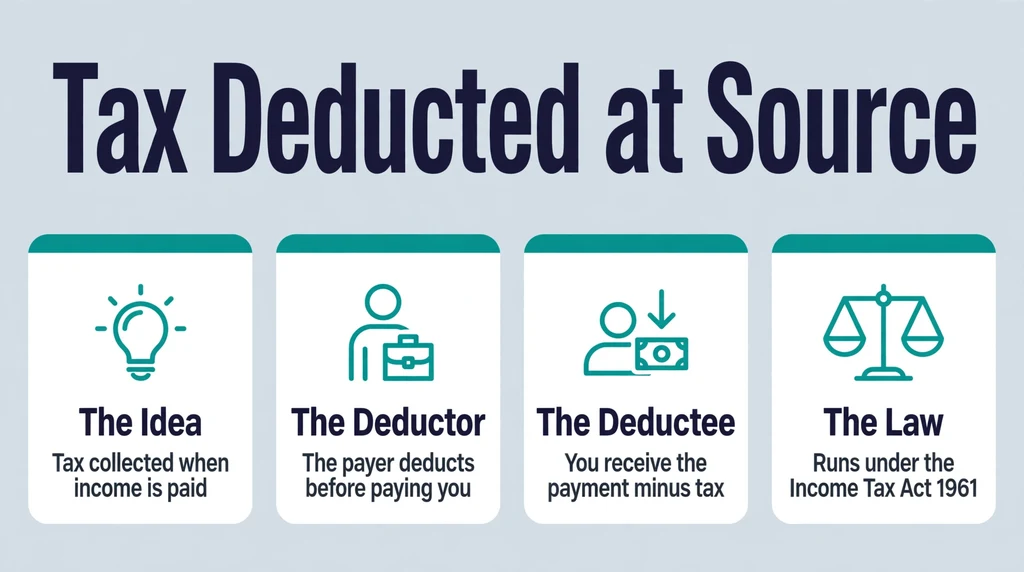
Cross over to India, and the same three letters describe a completely different system. Here, TDS stands for tax deducted at source. It is one of the main ways the Indian government collects income tax, and it touches almost every salary, bank account and rent payment in the country.
The idea is simple. Instead of waiting until the end of the year to collect tax from millions of people, the government collects it at the moment income is created. The system runs under the Income Tax Act, 1961, the law that governs income tax in India.
Who Deducts TDS?
The person or organisation making a payment does the deducting. Tax language calls this person the deductor. Your employer is the most familiar deductor, trimming tax from your salary each month. Banks deduct on certain interest payments. Tenants, clients and companies deduct on rent, fees and commissions when the rules require it.
The person receiving the money is called the deductee. The deductee gets the payment minus the tax, while the deductor deposits the deducted part with the government. Crucially, that deposit is credited to the deductee, not lost. It counts as tax the deductee has already paid.
Which Payments Does It Cover?
TDS reaches far beyond salaries. It commonly applies to interest from bank deposits, rent payments, professional and technical fees, commission and brokerage, and payments to contractors. Each type of payment sits under its own section of the Income Tax Act. Salary, for example, falls under section 192, while interest other than interest on securities falls under section 194A.
Two design features keep the system targeted. First, most heads have a threshold, so small payments escape deduction entirely. Second, the percentage deducted varies by the kind of payment and the section involved. Because governments adjust rates and thresholds in budgets, this guide describes the structure rather than quoting today’s figures. For current numbers, the Income Tax Department’s own publications are the source to trust.
Why India Uses TDS
The system solves three problems at once. First, it gives the government a steady flow of revenue across the year instead of one annual rush. Salaries, interest and fees arise every month, so tax arrives every month too.
Second, it widens the tax net. Each deduction creates a record tied to a PAN, which makes income harder to hide. A payment that passed through TDS leaves a trail the recipient cannot easily deny. Third, it softens the burden on honest taxpayers. Paying a little tax with each income receipt hurts less than facing one large bill in filing season. What feels like a nibble from each payslip is, in effect, an instalment plan arranged by the payer.
How TDS Deduction Works Step by Step
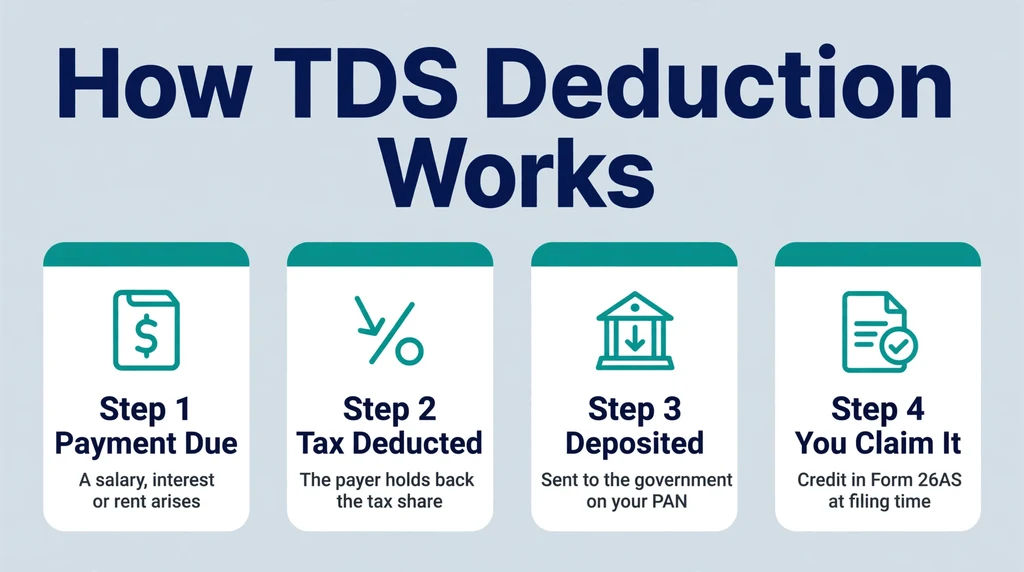
Understanding the flow removes most of the fear around the term. The whole cycle has four stages, and the deductee only needs to watch the last two.
The Four Stages
First, a payment becomes due: a salary, an interest credit, a rent cheque. Second, the deductor works out whether TDS applies and how much to deduct. Third, the deductor pays the recipient the reduced amount and deposits the tax with the government, linked to the recipient’s PAN, the permanent account number used across Indian tax records. Fourth, the deduction appears in the recipient’s tax records, ready to be claimed.
A monthly salary shows the rhythm clearly. The employer estimates the employee’s tax for the year, then deducts roughly a twelfth of it each month. The employee receives the net salary, and the deducted share travels to the government in the employee’s name. Nothing vanishes; the money simply reaches the tax office early.
How You Claim the Credit
Deductors must issue proof of what they deducted. Employees receive Form 16 from their employer, covering salary TDS for the year. For most other payments, the certificate is Form 16A. Alongside these, every deduction shows up in Form 26AS and in the Annual Information Statement, both of which the tax department maintains for each PAN.
When the deductee files an income tax return, the TDS already paid is set against the final tax bill. If the total deducted is more than the final liability, the extra comes back as a refund. If it is less, only the difference remains payable. So TDS is not an extra tax. It is the same tax, collected in advance, in smaller pieces, at the source.
The Payer’s Paperwork
Deductors carry homework of their own. They deposit the tax they collect with the government on a monthly cycle. They also file quarterly TDS returns that list each deduction against each recipient’s PAN. Those returns are what feed Form 26AS, so accuracy matters on both sides.
Most deductors also need a TAN, a tax deduction and collection account number, before they can deduct at all. Late deposits attract interest, and late returns attract fees, which is why payroll teams treat TDS dates with respect. For the recipient, all this paperwork has one benefit: by the time you file, the trail already exists.
TDS and TCS: Not the Same Thing
Indian tax talk has a mirror term that often gets confused with TDS: TCS, or tax collected at source. The mechanics run in opposite directions. Under TDS, a payer deducts tax from money going out to a recipient. Under TCS, a seller collects extra tax from a buyer on certain specified sales and deposits it for the buyer’s credit.
Both systems feed the same records and the same PAN-based trail. Both amounts can be claimed when the person files a return. The difference is simply who hands the tax over, and at which end of the transaction it happens.
Other Meanings of TDS
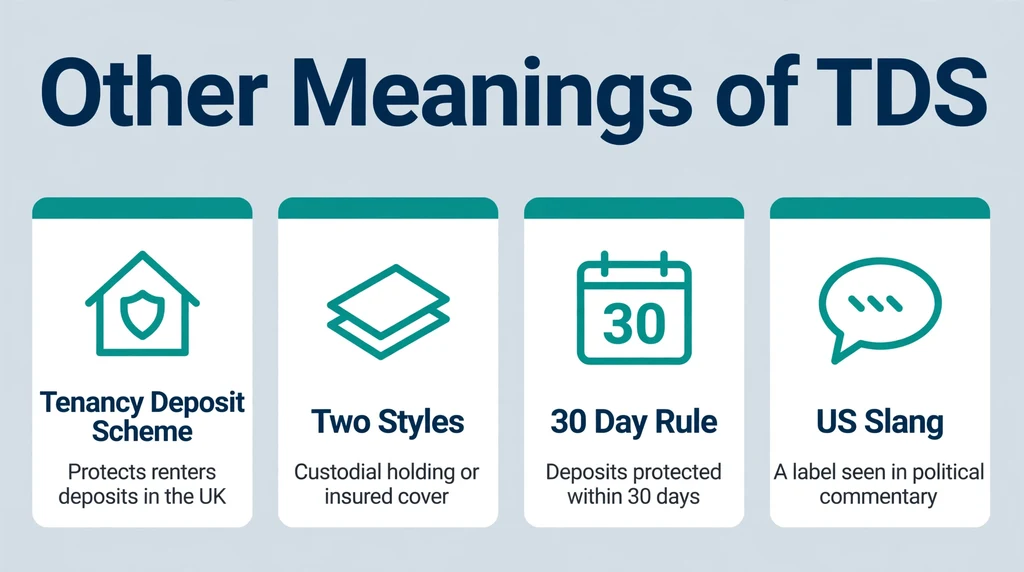
Two major senses cover most encounters, but TDS has a few smaller lives as well. Knowing them completes the picture and prevents the occasional crossed wire.
Tenancy Deposit Scheme in the UK
In British housing, TDS is the Tenancy Deposit Scheme. It is a government-approved scheme in England and Wales that protects the deposit a tenant pays at the start of a rental. GOV.UK lists it alongside the Deposit Protection Service and MyDeposits as one of the three approved schemes.
The scheme works in two styles. Under custodial protection, the scheme itself holds the deposit until the tenancy ends. Under insured protection, the landlord or agent keeps the money and pays a fee to insure it. Either way, the landlord must protect the deposit within 30 days of receiving it. The scheme also runs a free dispute service when tenant and landlord cannot agree on deductions. It is operated by The Dispute Service Ltd, a not-for-profit company.
A Note on Political Slang
In American political commentary, commentators also use TDS as shorthand for “Trump derangement syndrome,” a pejorative label for intense negative reactions to Donald Trump. It appears in partisan debate rather than in documents or science, and it is worth recognising mainly so the usage does not confuse you.
Telling the Senses Apart
A quick context check resolves almost every sighting. Numbers in ppm or mg/L, talk of filters, aquariums or coffee: that is water. Payslips, banks, rent or the word PAN: that is Indian tax. Landlords, tenants and deposits in Britain: that is the deposit scheme. Political arguments from the United States: that is the slang.
If none of those settings fit, look at the words standing next to the letters. Initialisms borrow meaning from their neighbours. The surrounding sentence nearly always gives the answer away.
TDS vs TSS: A Common Mix-Up
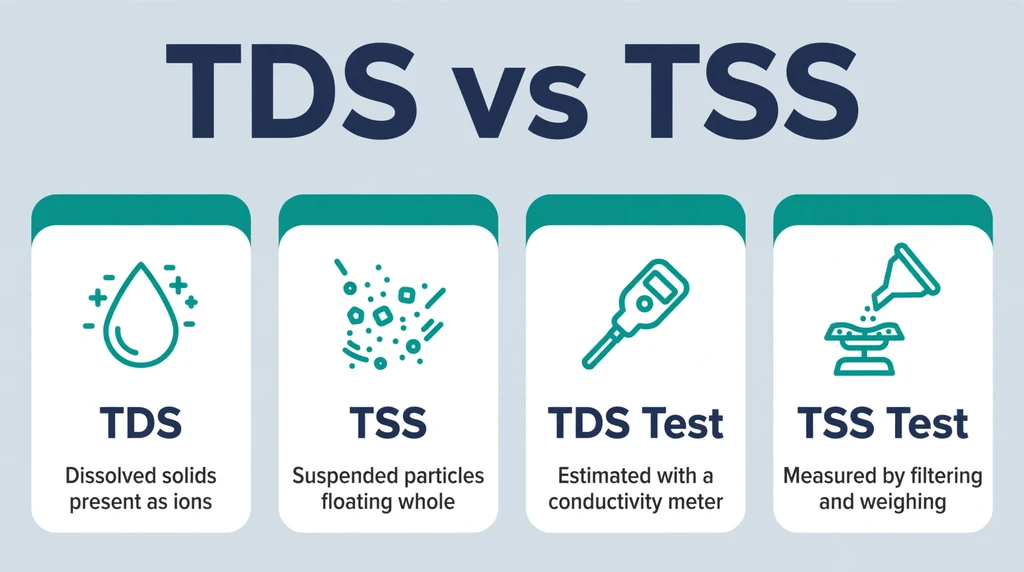
Water testing has a near-twin abbreviation that causes steady confusion. TSS stands for total suspended solids. The difference between the two is the difference between salt dissolved in tea and tea leaves floating in it.
Dissolved solids are present as individual ions, invisible and impossible to filter out with an ordinary filter. Suspended solids are tiny particles that remain whole: silt, clay, algae, rust and organic debris. A coffee filter or a sieve-like membrane can catch them, at least partly.
The measurements differ too. A conductivity meter estimates TDS, because ions carry current. Suspended particles barely conduct, so TSS is measured instead by filtering, drying and weighing, or by checking how cloudy the water looks. A sample can score high on one measure and low on the other. Muddy river water, for example, may carry heavy suspended loads with modest dissolved content.
Hardness causes a related mix-up. Hardness describes mainly the calcium and magnesium portion of the dissolved load. So hard water usually has a highish TDS, but TDS also counts sodium, potassium and other ions that do not make water hard. In short, hardness is one slice of the TDS pie.
Common Misconceptions About TDS
Myths gather around this term because a single number feels like a verdict. It is not. A few corrections clear the air.
Myth one: a TDS meter tests whether water is safe. It does not. The meter estimates dissolved minerals only. Bacteria, viruses, pesticides and many chemicals barely move the reading, and some, like lead, matter at levels far below what changes TDS. Safe water needs proper testing, not one pen-shaped gadget.
Myth two: lower TDS always means better water. Very low readings mean fewer minerals, not automatic purity. Distilled water scores near zero yet tells you nothing about how it was handled afterwards. Taste, storage and plumbing all enter the real judgement.
Myth three: high TDS water is always dangerous. The EPA treats TDS as a secondary, aesthetic concern, with effects centred on taste, staining and deposits. What matters for health is which substances are dissolved, not merely how much. That is why two waters with the same TDS can deserve very different verdicts.
Myth four: TDS deducted from a salary is money lost. As the tax section showed, the deduction is credited to the employee’s PAN. It reappears in Form 26AS and reduces the final tax bill, with any excess refunded. The confusion is understandable, but the records exist precisely to prevent loss.
Myth five: TDS and pH measure the same thing. They do not. pH describes how acidic or alkaline water is, on a scale from 0 to 14. TDS describes how much material is dissolved in it. Water can be neutral in pH and still carry a heavy mineral load, or be slightly acidic with almost nothing dissolved.
TDS in Real Sentences
Examples pin the senses down faster than definitions do. Notice how the surrounding words announce which TDS is speaking each time.
For the water sense: “The borewell water tested at 780 ppm, so we fitted an RO unit for the kitchen tap.” Or this one: “Her aquarium log tracks TDS every Sunday, right beside temperature and pH.” Filters, aquariums and units like ppm give the game away instantly.
For the tax sense: “His March payslip shows TDS of a few thousand rupees under section 192.” Or: “The bank deducted TDS on the fixed deposit interest and issued Form 16A.” Payslips, banks, forms and section numbers mark this territory just as clearly.
For the British sense: “The agent confirmed the deposit sits with the TDS, protected under the custodial scheme.” Deposits and tenancies point to the scheme. In American political threads, finally, the letters appear beside party names and election talk, and no numbers ever follow them.
Frequently Asked Questions
What is the full form of TDS?
It depends on context. Water science uses it for total dissolved solids. In Indian taxation, it means tax deducted at source. UK renting knows it as the Tenancy Deposit Scheme. The surrounding topic tells you which expansion is meant.
What is a good TDS level for drinking water?
Most people enjoy water somewhere between about 50 and 300 ppm. The US EPA suggests a secondary guideline of 500 mg/L, mainly for taste and scaling. Above roughly 1,000 ppm, water tastes increasingly salty or bitter to most drinkers. These are guides to palatability, not safety limits.
Does a TDS meter tell me if my water is safe?
No. A TDS meter estimates dissolved minerals through conductivity. It cannot detect bacteria, viruses or most chemical contaminants. Use it to track filters and taste, and use laboratory testing for safety questions.
How can I check the TDS of my water at home?
Dip a handheld TDS meter into a glass of the water and wait for the reading to settle. The display shows the estimate in ppm. Test tap water and filtered water side by side for a fair comparison.
Is TDS deducted from salary an extra tax?
No. It is your regular income tax collected in advance by your employer. The amount is credited against your name and PAN. When you file your return, it reduces your final bill, and any excess is refunded.
How do I know how much TDS has been deducted from my income?
Check Form 26AS or your Annual Information Statement, which list deductions against your PAN. Your employer also issues Form 16 for salary, and other payers issue Form 16A. These records should match each other.
What is the difference between TDS and TSS?
TDS counts substances dissolved in water as ions, measured through conductivity. TSS counts particles suspended in the water, measured by filtering and weighing. One describes what has melted into the water; the other describes what is floating in it.
Can boiling water reduce its TDS?
No. Boiling kills germs but leaves dissolved minerals behind. As some water evaporates, the minerals that remain become slightly more concentrated. To cut TDS, use reverse osmosis, distillation or deionisation instead.
Final Thoughts
TDS rewards a second look. In water, it is a humble estimate of dissolved minerals, useful for taste, filters and plumbing, and anchored by the EPA’s 500 mg/L secondary guideline, which you can read in the agency’s own guidance on secondary drinking water standards. On Indian payslips, it is tax collected early and credited carefully, not money lost. And in British renting, it keeps deposits safe.
Whichever sense you met first, the method is the same. Read the context, match the field, and the three letters fall into place.