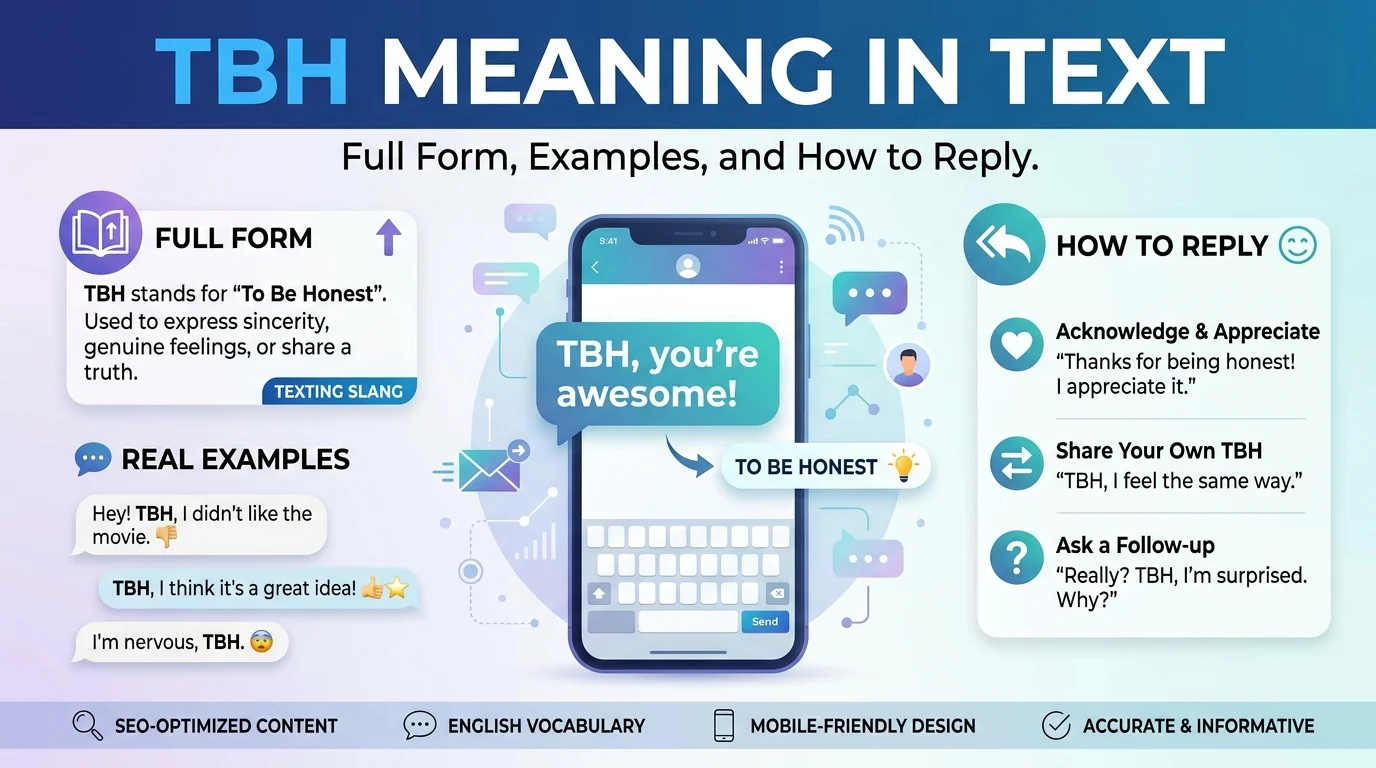
When someone sends you a message that starts with “TBH,” they’re usually about to share an honest opinion, express a personal feeling, or say something directly. This common texting abbreviation appears in everyday conversations, social media comments, and private messages.
The TBH meaning in text is “to be honest.” People use it when they want to introduce a candid statement, emphasize what they think, or make their feelings clear. For example, a friend might text, “TBH, I really enjoyed hanging out with you yesterday.”
Although the abbreviation looks simple, its tone can change depending on the situation. Sometimes TBH introduces a compliment. In other conversations, it signals criticism, disagreement, or a personal confession.
Understanding the surrounding message helps you interpret what someone actually means.
Quick answer: TBH stands for “to be honest.” It’s an informal texting abbreviation used to express an honest opinion, share feelings, or emphasize a statement.
What Does TBH Mean in Text?
The most common meaning of TBH in text messages is “to be honest.” It’s an informal expression that people use to introduce a thought they want to share openly.
For example:
- “TBH, I don’t really like that movie.”
- “TBH, you’re one of my favorite people.”
- “I thought the event would be boring, but it was fun, TBH.”
In each example, TBH signals that the sender is sharing a personal opinion or emphasizing a candid response. It doesn’t automatically mean something negative is coming next.
Imagine asking your friend whether they enjoyed a restaurant. They might reply, “TBH, the food was great, but the service was slow.” The abbreviation introduces their overall assessment without requiring a lengthy explanation.
TBH can also make a sentence sound more personal. Instead of simply saying, “You’re a good friend,” someone might write, “TBH, you’re a really good friend.” The second version emphasizes the speaker’s feelings.
However, TBH doesn’t guarantee that a statement is accurate. It only indicates that the speaker is presenting it as an honest opinion or response.
What Is the TBH Full Form?
The full form of TBH is To Be Honest.
Each letter represents the first letter of a word:
| Letter | Word |
|---|---|
| T | To |
| B | Be |
| H | Honest |
TBH is technically an initialism because people generally pronounce the individual letters rather than saying it as one word. In everyday conversations, however, people often group it with texting acronyms and internet slang.
The abbreviation saves space and makes casual messages quicker to type. Instead of writing the full phrase, someone can use three letters to introduce the same idea.
You might see it written as TBH, tbh, or Tbh. All three forms generally communicate the same meaning.
Is TBH an Acronym or Slang?
TBH is an informal abbreviation commonly associated with internet slang and digital communication. More precisely, it is an initialism because its letters are pronounced individually.
The distinction isn’t especially important when you’re texting a friend. Most people understand TBH as shorthand for “to be honest,” regardless of whether they call it an acronym, abbreviation, or slang term.
How Is TBH Used in Texting?
People use TBH in several ways, from expressing opinions to giving compliments. Its meaning usually stays the same, but the message following it determines the tone.
TBH Meaning When Expressing an Honest Opinion
One of the most common uses of TBH is to introduce a personal judgment or preference.
For example:
- “TBH, I prefer the original version.”
- “TBH, that restaurant is overrated.”
- “TBH, I think we should leave earlier.”
These statements express a viewpoint rather than an established fact. The sender uses TBH to make their opinion sound direct and personal.
This can be useful when two friends have different tastes. One person might love a particular movie while the other thinks it was disappointing. Adding TBH helps introduce the second person’s perspective without requiring a formal explanation.
TBH Meaning When Sharing Personal Feelings
TBH can also introduce emotions that someone finds difficult to express directly.
Examples include:
- “TBH, I was nervous about meeting everyone.”
- “TBH, I missed talking to you.”
- “TBH, I’ve been feeling a little overwhelmed lately.”
In these situations, the abbreviation can make a message feel more personal. The sender signals that they’re opening up about their feelings.
Still, TBH doesn’t always indicate a serious confession. Someone might use it before sharing something as simple as their excitement about a weekend plan.
TBH Meaning When Giving a Compliment
TBH often appears before a sincere compliment, especially in conversations between friends.
Examples:
- “TBH, you have an amazing sense of humor.”
- “TBH, you looked great in those pictures.”
- “TBH, you’re really good at explaining things.”
Here, TBH adds emphasis to the positive statement. The message suggests that the speaker genuinely wants to express their appreciation.
However, you shouldn’t assume that every compliment containing TBH has romantic meaning. Friends, classmates, coworkers, and family members can all use it to express appreciation.
TBH Meaning When Giving Honest Feedback
People sometimes use TBH to introduce constructive criticism or point out something that could improve.
For example:
- “TBH, your presentation would be stronger with fewer slides.”
- “TBH, the first draft was easier to follow.”
- “TBH, I think we need more time to finish this project.”
The abbreviation helps introduce direct feedback, but it doesn’t automatically make criticism polite. The wording still matters.
Compare these two messages:
- “TBH, your explanation was confusing.”
- “TBH, I think we could make the explanation clearer.”
Both express a concern. The second version offers a more constructive approach because it focuses on improving the result rather than blaming the person.
TBH Meaning When Disagreeing With Someone
TBH can introduce a different perspective without turning every disagreement into an argument.
For example:
“TBH, I don’t think that plan will work because we haven’t considered the cost.”
The sender expresses disagreement and explains the reason behind it.
Another example is, “TBH, I see things differently, but I understand your point.” This version acknowledges the other person’s perspective while maintaining an independent opinion.
Using TBH doesn’t guarantee that a disagreement will sound respectful. The surrounding language and the relationship between the people still influence how the message feels.
TBH Meaning for Emphasis
Sometimes people place TBH inside a sentence rather than at the beginning.
Examples:
- “That was the best part of the trip, TBH.”
- “I’m not sure about that idea, TBH.”
- “I didn’t expect the ending to be so good, TBH.”
In these messages, TBH reinforces the speaker’s personal assessment. It works almost like a brief signal that says, “That’s genuinely how I feel about it.”
TBH Meaning on Social Media Platforms
The abbreviation TBH appears across several messaging apps and social networks. Its basic meaning generally remains “to be honest,” although the context can influence how people use it.
What Does TBH Mean on WhatsApp?
On WhatsApp, TBH commonly appears in private messages, group chats, and conversations with friends.
Someone might write:
“TBH, I think we should start the meeting a little later.”
Another person might send:
“TBH, that was one of the funniest conversations we’ve had.”
In both cases, the abbreviation introduces an opinion. The sender doesn’t need to explain the meaning because the phrase is widely understandable in casual digital communication.
Example WhatsApp conversation
Alex: “Did you like the restaurant?”
Sam: “TBH, the food was amazing. The service could’ve been better, though.”
Here, TBH introduces Sam’s honest assessment, including both a positive observation and a criticism.
What Does TBH Mean on Snapchat?
On Snapchat, people may use TBH in direct messages, replies to snaps, and casual conversations with friends.
For example:
“TBH, your new haircut looks great.”
Or:
“TBH, I didn’t expect you to show up!”
Snapchat conversations often involve quick, informal exchanges. TBH fits naturally into this style because it communicates a thought without requiring the sender to type the full phrase.
The abbreviation doesn’t have a separate universal meaning on Snapchat. The message around it provides the relevant context.
What Does TBH Mean on Instagram?
On Instagram, TBH can appear in direct messages, comments, captions, and conversations about photos or videos.
Examples:
- “TBH, this is my favorite picture.”
- “TBH, your editing skills are impressive.”
- “TBH, I agree with your point.”
In some social media communities, TBH has also appeared in prompts that invite people to share candid opinions or compliments about others. The exact format depends on the community and the trend.
That usage is related to the general idea of honesty, but the specific activity can vary. A person asking for a TBH from a friend may be inviting a compliment or personal opinion rather than simply using the abbreviation to begin a sentence.
What Does TBH Mean on TikTok?
On TikTok, TBH can appear in comments, captions, messages, and discussions about videos or trends.
For example:
“TBH, this might be my favorite version of the trend.”
Or:
“TBH, the original video was funnier.”
These examples show how TBH introduces a reaction or personal judgment. A viewer uses it to express what they genuinely think about the content.
As on other platforms, context remains important. The same abbreviation can introduce praise, criticism, a confession, or an ordinary preference.
TBH Examples in Text Messages and Sentences
The easiest way to understand TBH is to see how it works in everyday conversations.
The following examples cover common situations and show how the abbreviation fits naturally into a sentence.
| Situation | TBH example | What it communicates |
|---|---|---|
| Friendship | “TBH, you’re easy to talk to.” | Appreciation for the friendship |
| Compliment | “TBH, you did an excellent job.” | Genuine praise |
| Personal opinion | “TBH, I prefer the first option.” | A personal preference |
| Feelings | “TBH, I was disappointed yesterday.” | An emotional response |
| Disagreement | “TBH, I don’t see it that way.” | A different viewpoint |
| Feedback | “TBH, this paragraph needs more detail.” | A suggestion for improvement |
| Plans | “TBH, I’d rather stay home tonight.” | An honest preference |
| Surprise | “TBH, I didn’t see that coming.” | A genuine reaction |
| Humor | “TBH, I laughed way too hard at that.” | An enthusiastic reaction |
| Recommendations | “TBH, you should try that restaurant.” | A personal recommendation |
| Gratitude | “TBH, I really appreciate your help.” | Sincere thanks |
| School or work | “TBH, the instructions weren’t very clear.” | A concern about the task |
Notice how the abbreviation stays the same while the message changes. The words that follow TBH tell you whether the sender is complimenting someone, expressing a concern, or sharing a preference.
TBH in a Realistic Conversation
Consider this exchange between two friends:
Mia: “What did you think of the party last night?”
Jordan: “TBH, I had a great time.”
Mia: “Really? You seemed quiet at first.”
Jordan: “Yeah, I was a little nervous, but everyone was friendly.”
In this conversation, Jordan uses TBH to introduce an honest evaluation. The later messages add context and explain Jordan’s feelings.
Here’s another example involving constructive criticism:
Chris: “Did you like my presentation?”
Taylor: “TBH, the information was useful, but a few slides had too much text.”
Chris: “That’s fair. I’ll simplify them for next time.”
TBH helps Taylor introduce direct feedback. The explanation that follows makes the message more useful than a vague judgment.
Can TBH Be Used at the Beginning of a Sentence?
Yes. Starting a sentence with TBH is one of its most familiar uses.
For example:
“TBH, I think you’ll enjoy the book.”
You can also place it near the end:
“I think you’ll enjoy the book, TBH.”
Both forms communicate the same general idea. Starting with TBH emphasizes the upcoming statement while ending with it can make the abbreviation feel like an afterthought or final emphasis.
In ordinary writing, place a comma after TBH when it introduces a sentence or introductory phrase.
Correct: “TBH, I don’t think we need another meeting.”
Also natural: “I don’t think we need another meeting, TBH.”
What Does TBH Mean From a Girl or a Guy?
When someone sends you TBH, it’s natural to wonder whether the message has a special meaning. However, the abbreviation itself doesn’t change meaning based on the sender’s gender.
A girl, a guy, or anyone else can use TBH to introduce a compliment, opinion, confession, or criticism. The surrounding words provide the clues you need to understand the intended message.
What Does TBH Mean From a Girl?
If a girl texts you “TBH, you’re really fun to talk to,” she’s expressing a positive opinion about your conversations.
Depending on your relationship, the message could reflect friendship, appreciation, or romantic interest. The abbreviation alone cannot establish which interpretation is correct.
Consider these examples:
- “TBH, you’re a great friend.” This directly expresses appreciation for friendship.
- “TBH, I really enjoyed spending time with you.” This communicates a positive experience.
- “TBH, I didn’t like how that conversation ended.” This expresses a concern.
Each message uses TBH differently because the words following the abbreviation determine the subject and tone.
What Does TBH Mean From a Guy?
A guy can use TBH in precisely the same ways. The abbreviation doesn’t automatically indicate flirting, seriousness, or criticism.
For example:
- “TBH, you did a great job today.”
- “TBH, I was hoping you’d come.”
- “TBH, I think we should talk about what happened.”
The first example expresses praise, the second shares a personal feeling, and the third introduces a potentially serious conversation.
To interpret the message accurately, consider the sender’s exact words, the history of your conversations, and the situation.
Does TBH Mean Someone Likes You?
Not necessarily. TBH is an expression of candor, not a specific signal of romantic interest.
A message such as “TBH, you look amazing” is a compliment. It may be flirtatious, but friends can offer compliments too.
A message such as “TBH, I like spending time with you” communicates a positive feeling more clearly. Even then, the intended meaning depends on the relationship and conversation.
Rather than trying to decode three letters, pay attention to the complete message and the person’s overall behavior.
Is TBH Positive, Negative, or Rude?
TBH is generally neutral by itself. It can introduce something positive, negative, or somewhere in between.
The tone depends on the statement that follows it, how the sender phrases their thoughts, and how the recipient interprets the message.
When TBH Sounds Positive
TBH often introduces appreciation or a favorable opinion.
Examples:
- “TBH, you’re one of the most helpful people I know.”
- “TBH, this is the best meal I’ve had all week.”
- “TBH, I’m proud of how much you’ve improved.”
These messages communicate praise or a positive personal reaction. The abbreviation adds emphasis without changing the basic meaning.
When TBH Sounds Negative
A sender can also use TBH before criticism or disappointment.
Examples:
- “TBH, that wasn’t a very good decision.”
- “TBH, I expected more from the presentation.”
- “TBH, I didn’t enjoy the movie.”
These messages express dissatisfaction or a negative judgment. TBH introduces the statement as the sender’s candid view, but the words themselves carry the criticism.
Is TBH Rude or Friendly?
TBH can sound friendly, blunt, or even confrontational. The abbreviation doesn’t determine the tone on its own.
Compare the following messages:
Friendly: “TBH, I think you’d look great in that color.”
Constructive: “TBH, I think we should revise the introduction.”
Blunt: “TBH, your idea doesn’t make much sense.”
All three use TBH, but their effects differ. The first offers a compliment, the second suggests an improvement, and the third dismisses someone’s idea.
Adding a little context can help make honest communication more respectful.
For example, instead of writing “TBH, your idea is bad,” you might say, “TBH, I see a few problems with that idea. Could we explore another option?”
The revised version still communicates disagreement. It simply makes room for a more productive conversation.
Does TBH Mean Someone Is Telling the Truth?
TBH signals that a person intends to speak honestly or candidly. It doesn’t prove that the statement is factually correct.
Someone can sincerely express an opinion and still be mistaken. For example, a person might write, “TBH, I think the store closes at eight,” while remembering the hours incorrectly.
It’s also important to distinguish between an opinion and a verifiable fact.
- Opinion: “TBH, this is the best restaurant in town.”
- Fact claim: “TBH, the restaurant closes at eight.”
The first expresses a preference. The second makes a factual claim that can be checked independently.
In other words, TBH communicates the speaker’s intended tone rather than guaranteeing the truth of everything they say.
How to Reply to TBH in a Text
When someone uses TBH in a message, respond to the meaning of their statement rather than treating the abbreviation as a question.
Your reply will depend on whether they offered a compliment, shared an opinion, expressed their feelings, or gave criticism.
| What they say | A natural reply |
|---|---|
| “TBH, you look great.” | “Thank you! That’s really nice of you.” |
| “TBH, I prefer the second option.” | “Fair enough. I can see why.” |
| “TBH, the presentation needs work.” | “Thanks for being honest. I’ll review it.” |
| “TBH, I missed you.” | “I missed you too!” |
| “TBH, I don’t agree with that decision.” | “That’s okay. What concerns you most?” |
| “TBH, I didn’t enjoy the movie.” | “Really? What didn’t you like about it?” |
| “TBH, you’re a great friend.” | “That means a lot to me. Thank you.” |
| “TBH, I was upset about yesterday.” | “I’m sorry you felt that way. Do you want to talk about it?” |
You don’t have to reply with TBH yourself. A normal sentence often sounds more natural and keeps the conversation moving.
How to Reply When TBH Introduces a Compliment
If someone compliments you, a simple thank-you usually works well.
For example:
Them: “TBH, you’re really good at making people laugh.”
You: “Thanks! I’m glad I can make you laugh.”
A relaxed response acknowledges the compliment without making the exchange awkward.
How to Reply When TBH Introduces Criticism
When someone uses TBH to share criticism, consider whether their message offers useful feedback.
For example:
Them: “TBH, the instructions were confusing.”
You: “Thanks for telling me. Which part was unclear?”
This approach encourages a more specific discussion instead of turning the conversation into an argument.
If the message feels insulting, you don’t need to accept every criticism as fair. You can ask for clarification or calmly explain your perspective.
TBH vs. NGL vs. IMO vs. IMHO
TBH belongs to a larger group of informal abbreviations used in online conversations. Several of them overlap in meaning, but each has a slightly different emphasis.
| Abbreviation | Full form | Typical meaning |
|---|---|---|
| TBH | To Be Honest | Introduces a candid statement or honest opinion |
| NGL | Not Gonna Lie | Often introduces a frank admission or reaction |
| IMO | In My Opinion | Identifies a statement as a personal viewpoint |
| IMHO | In My Humble Opinion | Introduces a personal opinion, sometimes modestly or ironically |
| TBF | To Be Fair | Adds a balancing point or consideration |
| FR | For Real | Expresses sincerity, agreement, or emphasis |
What Is the Difference Between TBH and NGL?
TBH and NGL often serve similar purposes. Both can introduce a candid opinion, a personal reaction, or an admission.
However, TBH places the emphasis on honesty, while NGL often introduces something the speaker is about to admit openly.
Examples:
- TBH: “TBH, I prefer working in the morning.”
- NGL: “NGL, I was nervous before the interview.”
The difference is subtle, and the two expressions can sometimes be used in nearly identical situations.
What Is the Difference Between TBH and IMO?
TBH emphasizes candor, while IMO explicitly signals that a statement represents a personal opinion.
For example:
- TBH: “TBH, I don’t think this plan will work.”
- IMO: “IMO, this plan needs more detail.”
The first emphasizes the speaker’s willingness to state their view directly. The second highlights that the judgment belongs to the speaker.
These meanings overlap because an honest statement can also be a personal opinion.
What Is the Difference Between TBH and IMHO?
IMHO stands for “in my humble opinion.” Like IMO, it presents a personal view.
The word “humble” can suggest modesty, but people sometimes use IMHO humorously or ironically. TBH focuses instead on the idea of speaking honestly.
Example:
- “TBH, I prefer the original design.”
- “IMHO, the original design is better.”
Both statements express a preference. However, the first emphasizes candor, while the second frames the statement as an opinion.
What Is the Difference Between TBH and TBF?
TBF means “to be fair.” People use it when introducing a balancing consideration, acknowledging another perspective, or adding context.
For example:
“TBH, the service was slow. TBF, the restaurant was packed.”
The first statement expresses an honest assessment. The second acknowledges a circumstance that might help explain the problem.
This distinction makes TBF particularly useful when someone wants to consider both sides of a situation.
Is TBH Formal or Informal?
TBH is primarily an informal abbreviation. It works naturally in casual conversations, text messages, social media comments, and messages between people who are comfortable using internet slang.
You can use it when chatting with friends, reacting to a video, or sharing a personal preference in a group conversation.
However, TBH may feel too casual in some professional or academic settings.
Consider these examples:
Casual message: “TBH, I think we should start earlier.”
Professional message: “To be honest, I believe an earlier start would help us finish on time.”
The full phrase is still conversational, but it reads more naturally in a professional message than the abbreviation might.
For formal documents, you can often omit the introductory phrase entirely and state the point directly.
For example:
“An earlier start would give us more time to finish the project.”
The right choice depends on your audience, your relationship with the reader, and the purpose of the message.
Is TBH Still Used in Texting?
TBH remains a recognizable abbreviation in digital communication. People use it in casual messages and online discussions to express opinions, share feelings, or emphasize their reactions.
However, recognizing an abbreviation doesn’t mean every person or online community uses it equally often. Usage can vary with age, platform, personal preference, and communication style.
Some people use TBH frequently, while others prefer spelling out “to be honest” or choosing a different expression, such as NGL.
The abbreviation also fits into a broader habit of using shorter expressions in digital conversations. Words and phrases such as “BTW,” “IDK,” and “IMO” serve similar practical purposes, although their meanings differ.
You don’t need to use TBH just because you see it in other people’s messages. Choose the expression that best communicates your intended meaning.
Common Mistakes to Avoid When Using TBH
Although TBH is easy to understand, a few mistakes can lead to confusion.
- Assuming TBH always introduces criticism. People use it for compliments, preferences, confessions, and positive reactions too.
- Treating TBH as proof of truth. The abbreviation signals intended honesty rather than verified accuracy.
- Assuming it always indicates romantic interest. A compliment containing TBH can be friendly rather than flirtatious.
- Using it in every sentence. Repeating TBH too often can make your writing sound forced.
- Confusing TBH with similar abbreviations. NGL emphasizes a candid admission, while IMO identifies a personal opinion.
- Ignoring the surrounding conversation. Context, tone, and word choice all affect how the sender’s message comes across.
- Using it without considering your audience. TBH suits informal messages better than many formal documents.
The key is to use TBH naturally. It works best when it adds emphasis or helps express a genuine thought.
Frequently Asked Questions About TBH Meaning in Text
What does TBH mean in texting?
TBH means “to be honest.” People use it in text messages to introduce an opinion, express feelings, share an admission, or emphasize a statement.
What is the full form of TBH?
The full form of TBH is To Be Honest. Each letter represents the first letter of one word in the phrase.
Is TBH slang?
Yes. TBH is commonly used as an informal texting abbreviation and is often grouped with internet slang. More precisely, it is an initialism.
How do you use TBH in a sentence?
You can use TBH at the beginning or end of a sentence.
Example: “TBH, I think we made the right choice.”
It introduces the speaker’s honest opinion.
What does TBH mean on social media?
TBH generally means “to be honest” on social media. People use it in comments, captions, direct messages, and conversations to share opinions or reactions.
In some contexts, a TBH request invites a candid opinion or compliment from another person.
What does TBH mean from a girl?
It generally means “to be honest,” just as it does when anyone else uses the abbreviation. The specific message determines whether she’s expressing friendship, a compliment, criticism, or personal feelings.
What does TBH mean from a guy?
TBH has the same basic meaning regardless of gender. A guy might use it to share an opinion, offer a compliment, explain his feelings, or express disagreement.
Is TBH positive or negative?
TBH is neutral by itself. The statement following it may be positive, negative, or neutral.
For example, “TBH, you’re amazing” is positive, while “TBH, I didn’t like the movie” expresses a negative opinion.
How do you respond to TBH?
Respond to what the person actually says. Thank them for a compliment, ask a question about their opinion, or discuss their feedback calmly.
For example, if someone writes, “TBH, I missed you,” you could reply, “I missed you too.”
Is TBH formal or informal?
TBH is primarily informal. It suits casual texts and social media conversations. In formal writing, consider spelling out “to be honest” or stating your point directly.
Can TBH be used at the beginning of a sentence?
Yes. Beginning a sentence with TBH is common.
Example: “TBH, I wasn’t expecting such a good result.”
You can also place it at the end, as in “I wasn’t expecting such a good result, TBH.”
Does TBH mean the same thing everywhere?
The standard meaning is “to be honest” across ordinary texting and social media conversations. However, some community-specific prompts or trends may use TBH in a more particular way, such as requesting an opinion or compliment.
What is the difference between TBH and NGL?
TBH means “to be honest,” while NGL means “not gonna lie.” Both can introduce candid statements, but NGL often emphasizes an admission or frank reaction.
Is TBH rude?
Not necessarily. TBH can introduce a compliment or a criticism. Whether it sounds rude depends on the words that follow, the situation, and the relationship between the people communicating.
Final Thoughts on TBH Meaning in Text
The TBH meaning in text is “to be honest.” It’s a simple, informal abbreviation that helps people introduce honest opinions, share feelings, give feedback, and emphasize personal reactions.
You might see it in a WhatsApp message, a Snapchat conversation, an Instagram comment, or a TikTok discussion. Its basic meaning usually stays the same across these platforms, although the context can affect its tone.
Remember that TBH doesn’t automatically mean something negative, prove that a statement is true, or signal romantic interest. The sender’s actual words provide the most useful clues.
When someone uses TBH in a message, focus on what they’re communicating. A thoughtful response to the complete message will almost always be more helpful than trying to interpret the abbreviation alone.