It is 9 p.m. You are home in sweatpants, and honestly, you are fine with that. Then a friend’s story pops up: the whole group, laughing, at a rooftop bar downtown. Suddenly your quiet night feels like the wrong choice, and your thumb is already checking who else is there.
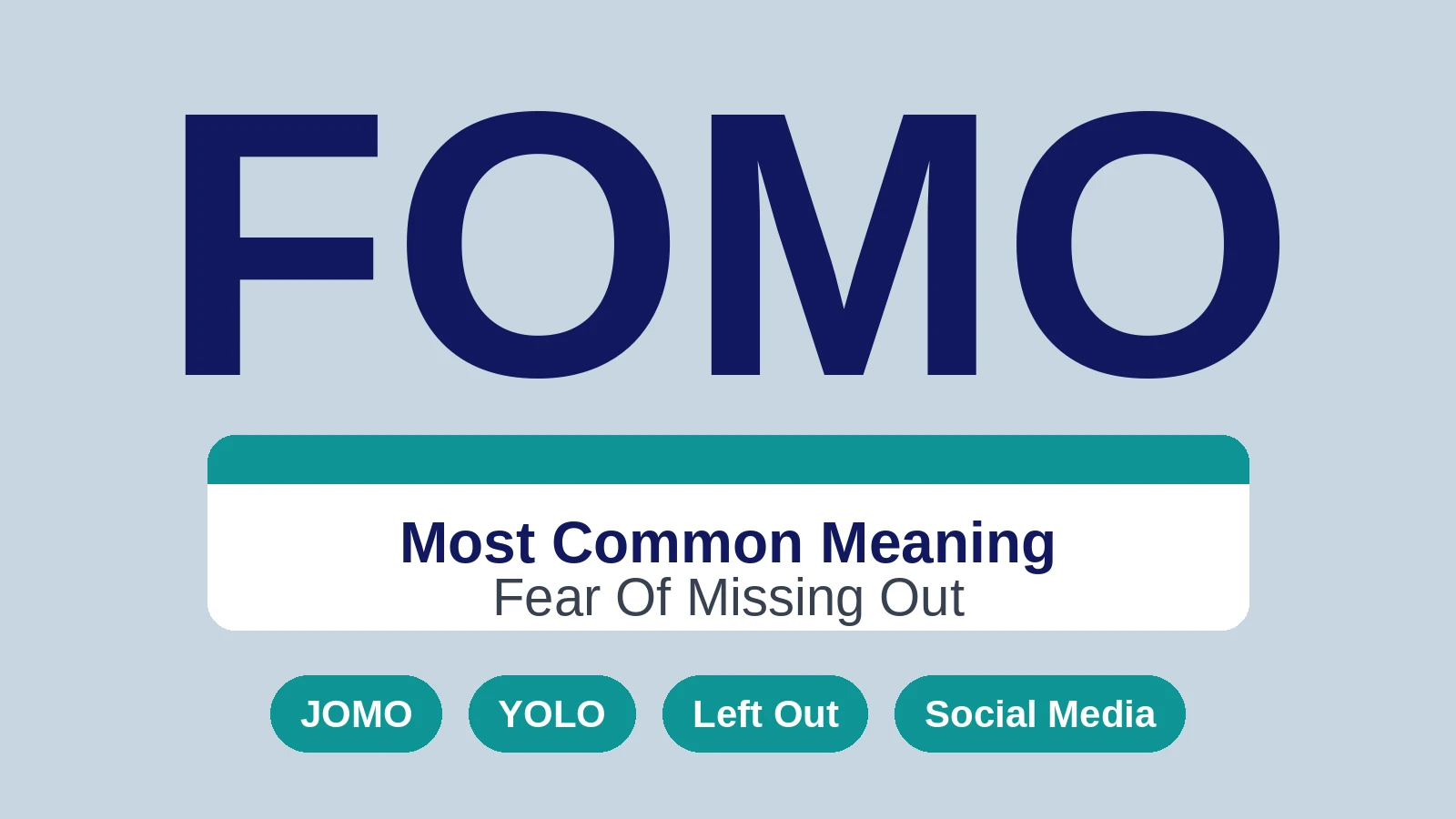
That sinking feeling has a name. In texts and online, FOMO means fear of missing out. It is the anxious pull you feel when other people seem to be having fun, making memories, or getting opportunities without you. Sometimes it is a joke. Sometimes it genuinely stings.
This guide is based on how people actually use FOMO in texts, captions, and group chats today. Every meaning and example below was checked against real everyday usage and trusted dictionary sources like Merriam-Webster and Dictionary.com. You will find what FOMO feels like, the signs to spot in a chat, how it compares with JOMO, and simple replies you can copy.
FOMO Meaning in Text at a Glance
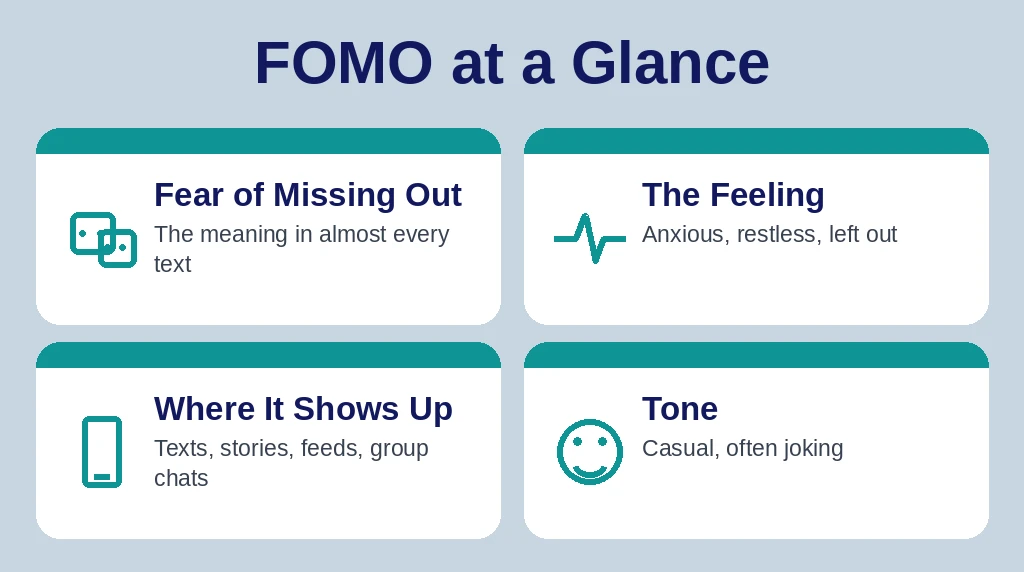
Short on time? Here is the fast version. FOMO stands for fear of missing out. When someone texts “I have FOMO” or “the FOMO is real,” they mean they feel left out of something fun, important, or rewarding that others are experiencing. Dictionaries define it as anxiety about not being included, and in casual chats it ranges from playful envy to real stress.
| Detail | Explanation |
|---|---|
| Most Common Meaning | Fear of missing out |
| Full Form | Fear of missing out (an acronym, spoken as one word, “FOH-moh”) |
| What It Describes | The anxious feeling that others are having fun or better experiences without you |
| Tone | Casual, often joking, sometimes genuinely anxious |
| Common Platforms | Instagram, TikTok, Snapchat, X, group chats |
| Formal or Informal | Informal, but widely understood almost everywhere |
What FOMO Really Means in a Text
Unlike a lot of texting slang, FOMO is not a reaction you fire off. It names a feeling. That is why people use it like a noun, the same way they would say stress or jealousy. You will see lines like “my FOMO is so bad right now,” “I only went because of FOMO,” or “the FOMO got me, I booked the ticket.” In each case, the word explains a decision or a mood: the person felt pushed by the fear of being left out.
So what does that fear actually feel like? Merriam-Webster defines FOMO as the fear of not being included in something others are experiencing. Dictionary.com calls it a feeling of anxiety or insecurity over the possibility of missing out on an event or an opportunity. Put into plain words, it is the nagging sense that a better version of your evening, your weekend, or even your life is happening somewhere else, without you.
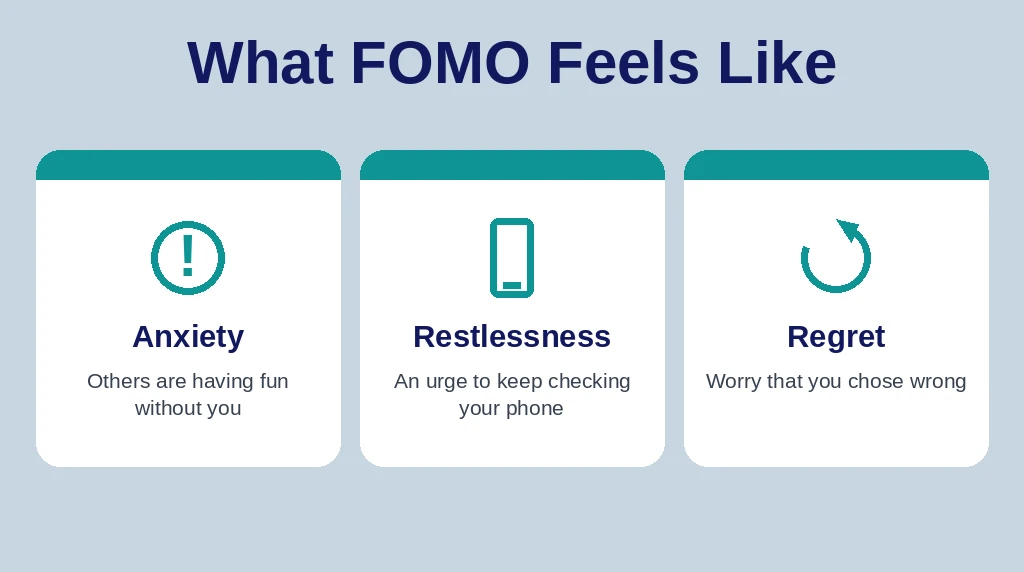
The feeling usually has a few moving parts. There is restlessness, the urge to keep checking your phone for updates. There is comparison, measuring your night against everyone else’s highlight reel. And there is a fear of regret, the worry that saying no was the wrong call and that you will be annoyed at yourself later. Researchers describe FOMO as a desire to stay continually connected with what others are doing, which is why a single photo can set it off.
It also reaches far beyond parties. People get FOMO over a flash sale ending tonight, a stock everyone seems to be buying, a game update their friends are playing, or a joke running through a group chat they have not opened yet. If missing it feels like falling behind, FOMO is usually the word people reach for.
FOMO in Texts and on Social Media
Social media is where modern FOMO lives. Platforms give you a nonstop stream of things you are not part of: trips, concerts, dinners, promotions, new relationships. People rarely post the boring parts, so the feed becomes a highlight reel, and your own evening looks dull next to it even when it is perfectly fine.
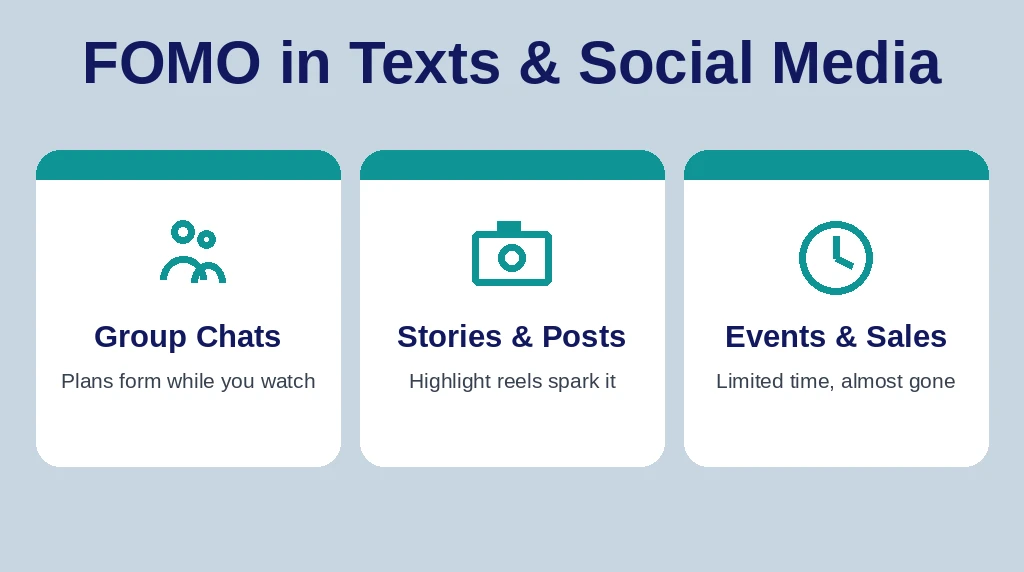
In texts and group chats, FOMO shows up in predictable moments. Plans form in a chat you muted, and you open it to forty messages and a decision already made. A friend posts stories from an event you skipped, and each one lands a little harder than the last. Someone drops a “you should have been here” into the chat, which is friendly on the surface and pure FOMO fuel underneath.
You will also see FOMO used as a caption or a confession. “FOMO won, see you tonight” under a selfie means the person talked themselves into going out. “Watching everyone’s stories with severe FOMO” means the opposite: they stayed home and feel every bit of it. The word works both as the reason someone shows up and as the name for what they feel when they do not.
Signs Someone Is Expressing FOMO
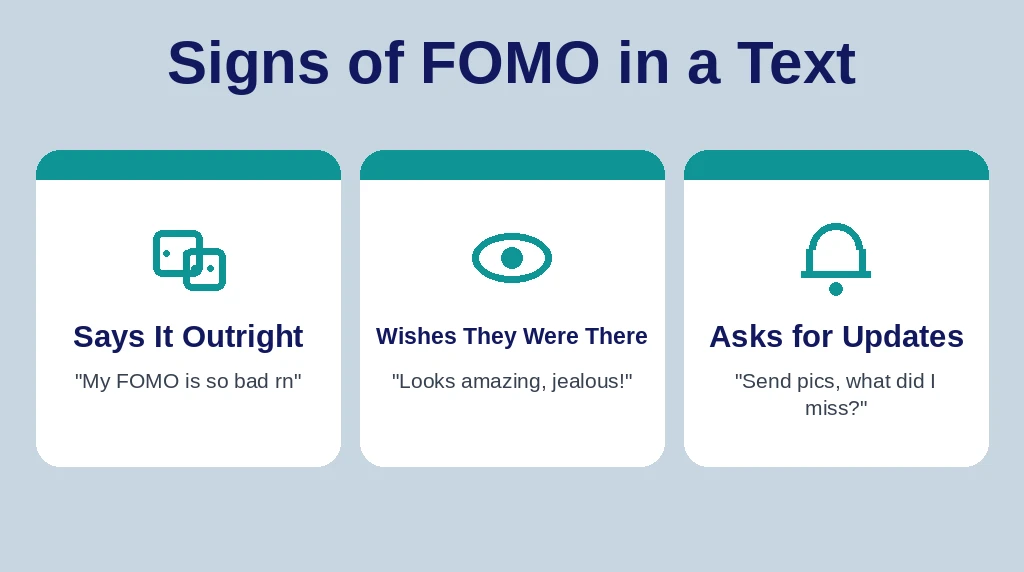
FOMO is not hard to spot once you know the patterns. These are the most common signs in a text or a chat:
- They say it outright: “my FOMO is unreal,” “I have the worst FOMO right now.”
- They comment with envy in plain words: “wish I was there,” “so jealous,” “looks amazing without me.”
- They ask for constant updates: “send pics,” “what did I miss,” “who all is there?”
- They reply unusually fast and keep the chat going, as if staying in the conversation keeps them included.
- They express instant regret about a choice: “knew I should have just come,” “why did I say no.”
- They joke about it with emojis or memes, which is usually the light version, half laughing and half serious.
One sign on its own might mean nothing. A cluster of them, right after photos or plans appear, almost always means the person is feeling left out.
Real Conversation Examples
Person A: “We made it to the lake house, look at this sunset”
Person B: “Stop it, my FOMO is so bad right now 😭”
Meaning: Person B feels left out and a little miserable about it, but they are keeping it playful with the emoji.
Person A: “Concert tickets are almost sold out, it says only a few left”
Person B: “Just bought mine. That was a total FOMO purchase”
Meaning: Person B admits they bought the ticket mainly because they were afraid of missing out, not because they had planned to go.
Person A: “You missed an insane game last night, it went to the last second”
Person B: “I know, I had FOMO all night just watching the highlights”
Meaning: Person B felt the anxiety of being absent even while following along from home. FOMO can hit without any invitation at all.
Is FOMO Rude or Serious?
Most of the time, FOMO is neither rude nor dramatic. Saying “I have FOMO” is usually self-aware and even flattering to the group, since it tells them their plans look genuinely fun. Among friends, it is a light way to say “I wish I was there with you” without making it heavy.
Tone depends on how it is used. With laughing emojis and jokes, it is clearly the playful version. Repeated messages, guilt-heavy comments, or using FOMO to pressure someone into changing their plans push it into uncomfortable territory. And sometimes the feeling underneath is real anxiety rather than a joke, especially when someone feels excluded often. If a friend’s FOMO messages sound less like teasing and more like hurt, treat them gently. The word is casual. The feeling is not always.
FOMO vs. JOMO: What Is the Difference?
JOMO is the joy of missing out, and it is the direct opposite of FOMO. Merriam-Webster lists JOMO as the word to compare with FOMO, and health writers describe it as the freedom of choosing your own quiet plans without worrying about what everyone else is doing.
The difference is the emotion behind the same situation. Two people skip the same party. The one with FOMO scrolls through stories, restless and annoyed at themselves. The one with JOMO puts the phone down, enjoys the calm, and feels good about the choice. FOMO says “everyone is having fun without me.” JOMO says “I am exactly where I want to be.” People often use the pair as a mindset goal, less FOMO, more JOMO, especially when they talk about taking breaks from social media.
How to Reply When Someone Says They Have FOMO
The best reply depends on how serious the person sounds. A joking “my FOMO is bad” needs a light answer. A friend who truly feels left out needs a kind one. These three styles cover most situations.
Friendly and Reassuring Replies
- “You were missed, honestly. Next one, you are planning it with us”
- “It was fun, but it was not the same without you there”
- “Saving you a seat next time, no excuses needed”
Funny Replies
- “The FOMO tax strikes again”
- “That is what the couch gets you”
- “Live footage of you regretting that power nap”
Replies That Include Them
- “Jump on FaceTime, we will toast you in”
- “Sending you every photo as it happens, honorary guest”
- “Round two is Saturday. You are in, right?”
When to Use FOMO
Use FOMO when you want to be honest and a little funny about your own feelings. It fits captions about giving in and going out, chats where you admit you only showed up so you would not miss anything, and jokes about checking stories you should be ignoring. Because nearly everyone knows the word now, it lands with friends, coworkers in casual chats, and even family. It works best when it is aimed at yourself, your own restlessness, your own last-minute decision, rather than at somebody else.
When to Avoid Using FOMO
Be careful with FOMO when it stops being a description and starts being a tool. Using it to guilt a friend who said no, “wow, okay, enjoy your FOMO then,” turns a light word into pressure. Marketers lean on it too, with countdown timers and “almost gone” warnings designed to make you buy before you think, and copying that tone in everyday messages feels manipulative fast.
Also skip it when someone is genuinely upset about being excluded. In that moment, “lol, FOMO?” sounds dismissive of a real feeling. And in formal or professional writing, spell out what you mean instead, because the acronym still reads as casual slang.
Common Mistakes People Make With FOMO
Thinking FOMO only means missing a party. Parties are just the most visible trigger. FOMO also covers sales, news, group chat jokes, games, and investments. If being left out of it stings, the word fits.
Using FOMO to pressure people. There is a line between naming your own feeling and weaponizing someone else’s. Reminding a friend of everything they missed, just to make them feel bad, is the fastest way to make the word ugly.
Confusing FOMO with simple jealousy. Jealousy wants what another person has. FOMO is the anxiety of being absent from the experience itself. You can feel FOMO about an event you would not even enjoy, simply because everyone else is there.
Terms Related to FOMO
FOMO sits in a small family of “missing out” words, and knowing the relatives helps you read captions and chats faster.
| Term | Meaning | Main Difference |
|---|---|---|
| YOLO | You only live once | The carefree motto people use to justify saying yes, often because of FOMO |
| JOMO | Joy of missing out | The opposite of FOMO, feeling happy and relaxed about staying out of things |
| FOBO | Fear of a better option | Anxiety about choosing wrong between options, coined alongside FOMO |
| ROMO | Relief of missing out | Feeling glad you skipped something, especially an event that turned out badly |
Where FOMO Came From
The feeling is as old as friendship, but the word has a surprisingly precise birthday. FOMO was coined in 2004 by Patrick J. McGinnis, then a student at Harvard Business School, in a piece he wrote for the school’s student newspaper, The Harbus. He used it to describe the anxious social overcommitment he saw around him, and he coined FOBO, fear of a better option, in the same period.
The word spread slowly at first, then all at once. As Facebook, Twitter, and later Instagram turned everyone’s social life into a live feed, FOMO became the perfect name for a brand-new kind of anxiety. In 2013, it was added to the Oxford English Dictionary, defined as anxiety that an exciting or interesting event may be happening elsewhere, often aroused by posts seen on social media. Not bad for a joke in a student newspaper.
Quick Recap
- FOMO means fear of missing out, the anxious feeling that others are having fun or better experiences without you.
- People use it as a noun: “I have FOMO,” “major FOMO,” “the FOMO is real.”
- In texts it can be a joke, a confession, or a real sign that someone feels left out.
- JOMO, the joy of missing out, is its opposite and the healthier mindset many people aim for.
- Reply with humor for the light version and kindness for the serious one, and never use FOMO to pressure anyone.
Frequently Asked Questions
What does FOMO mean in text?
In texts, FOMO means fear of missing out, the anxious feeling that others are having fun or gaining experiences without you.
What does FOMO stand for?
FOMO stands for fear of missing out, an acronym describing the worry that exciting things are happening somewhere without you in them.
What does FOMO mean on TikTok and Instagram?
On TikTok and Instagram, FOMO describes the left out feeling you get watching stories, trips, and parties you were not part of.
What is the difference between FOMO and JOMO?
FOMO is the anxiety of missing out, while JOMO is the joy of missing out and happily enjoying your own quiet plans.
How do you reply to someone with FOMO?
Reply with reassurance or humor, tell them they were missed, share photos, and invite them properly to the next plan.
Final Thoughts
FOMO survives as a word because it names something everyone has felt and nobody had a short name for. In a text, read it as fear of missing out: sometimes a joke about a party, sometimes a real pang of anxiety under a friend’s story, and sometimes the honest reason someone buys the ticket, opens the app, or shows up after all. Spot the signs, answer with humor or kindness as the moment needs, and try to trade a little of it for JOMO when you can. For the official dictionary take, Merriam-Webster’s FOMO entry is worth a look.
Related slang guides: OOP meaning in text, WGO meaning in text, and TS meaning in text.