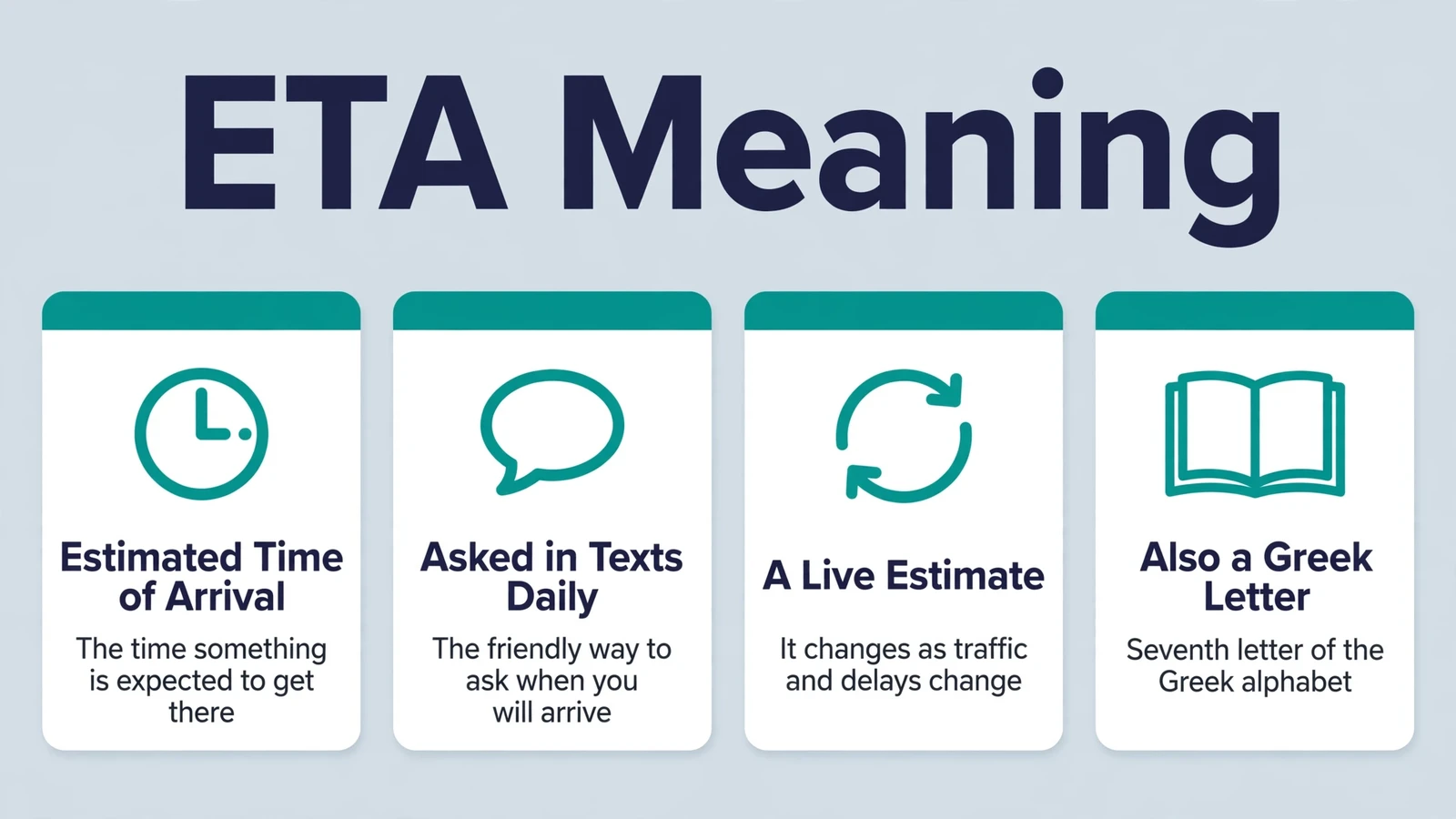
Your phone buzzes while you are still across town. A friend has typed three letters: “What’s your ETA?” You reply with one number, and somehow everyone relaxes. So what is the ETA meaning behind those three letters?
ETA stands for estimated time of arrival. It is the time you, a vehicle, or a delivery are expected to get somewhere. In other words, it answers the question “when will it be here?” with the best estimate available right now.
However, those same three letters can also name a Greek letter, eta, and older news readers know them as the initials of a Basque group in Spain. This guide covers the arrival meaning first, since that is the sense most people search for. After that, it explains the letter and the other senses, so you can always tell them apart.
What Does ETA Mean?
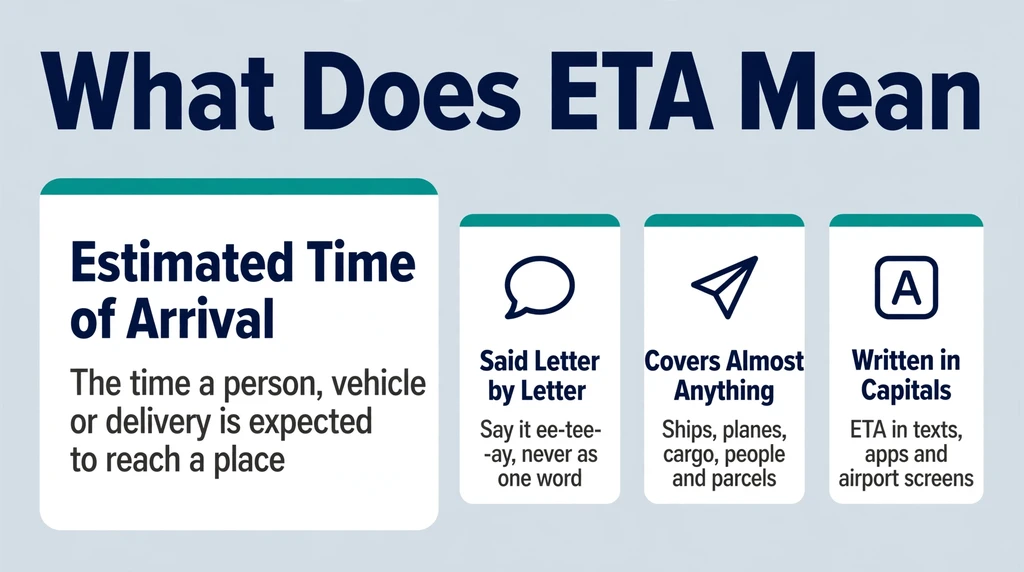
ETA is an abbreviation for “estimated time of arrival,” as Cambridge Dictionary defines it. The phrase describes the time at which a person, vehicle, or thing is expected to reach a destination. Wikipedia’s transport entry puts it just as plainly: it is the time when a ship, vehicle, aircraft, cargo, person, or emergency service is expected to arrive at a certain place.
People usually say the letters out loud, ee-tee-ay, rather than trying to pronounce ETA as a word. You will see it written in capitals in texts, apps, airport screens, and tracking pages. Interestingly, some shipping documents write the same idea as “expected time of arrival.” Both expansions mean the same thing, and the estimated version is far more common.
A Quick Example
Imagine your sister is driving to pick you up from the station. She texts, “Traffic is slow. My ETA is 6:40.” She has told you the estimated time of her arrival, 6:40, without typing the full phrase. If she instead replies “ETA 15 minutes,” she means the trip will take about fifteen more minutes. Both forms are normal, and the next sections explain each one.
Saying and Writing ETA Correctly
In speech, say the three letters separately: ee-tee-ay. In writing, capitals are standard, and older books sometimes printed the abbreviation with full stops, as E.T.A. The plural is simply ETAs, as in “the app shows ETAs for both buses.” You will also meet ETA used almost like an adjective in phrases such as “ETA updates,” where it labels the kind of update rather than giving one.
One small trap: never write “eta” in lowercase when you mean the travel term. Lowercase quietly switches the reader’s brain to the Greek letter. Keeping the capitals keeps the meaning.
How ETA Moved Into Everyday Language
For most of its life, ETA belonged to professionals. Dispatchers, harbour offices, and airline staff used it because their work ran on coordinated times. Ordinary travellers met it mainly on airport screens and station boards. It was useful jargon, but it stayed inside the industry.
Two habits carried it into daily speech. First, online shopping put a tracking page in every home, and each page carried an estimated arrival. Second, map apps put a live arrival time in every pocket. Once your phone answered “when will I get there?” all day, the three letters behind the answer became natural to say and type.
Core Meaning of ETA
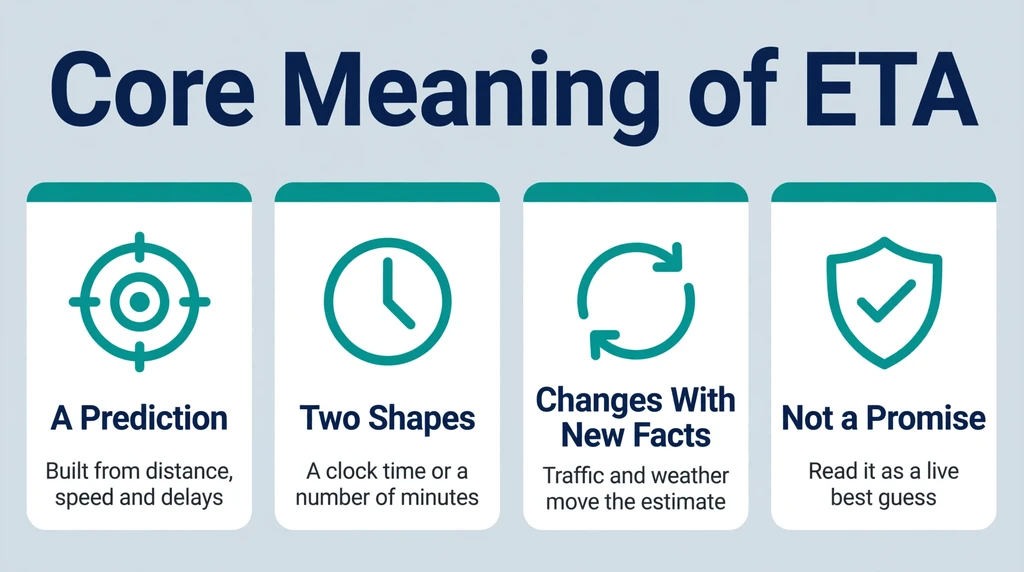
The most important word in the phrase is “estimated.” An ETA is a prediction, not a promise and not a guarantee. It is built from the information available at that moment, such as distance, speed, and delays. When the information changes, the estimate changes too.
That is why your delivery app can show 7:15 at breakfast and 7:40 by lunch. Nothing went wrong with the wording. Instead, the estimate simply absorbed new facts, such as a traffic jam or a late departure. So treat every ETA as a live best guess, and you will read it the way drivers, pilots, and couriers intend.
ETA as a Clock Time and as a Duration
ETA appears in two shapes. First, it can be a clock time, such as “ETA 9:30 pm” on a flight board. Second, it can be a duration, such as “ETA 20 minutes” in a text message. The clock time tells you when something lands. The duration tells you how long is left from now.
In practice, the context tells you which shape you are reading. A boarding pass always uses clock times. Meanwhile, a friend driving across town almost always answers with a duration. If both readings are possible, most people simply ask a short follow up question.
ETA, Scheduled Time and Actual Time
Three related times float around every journey, and ETA is only one of them. The scheduled time is the plan printed in advance, often months before the trip. By contrast, the ETA is the live prediction for today, shaped by weather, traffic, and delays. Finally, the actual time is what the clock eventually shows when the journey ends.
Keeping the three apart prevents most misunderstandings. A flight can beat its ETA and still land after its scheduled time. It can also land exactly on its ETA while the ETA itself has moved twice since breakfast. The estimate describes today; the schedule describes the plan; the record describes the past.
Where ETA Is Used Every Day
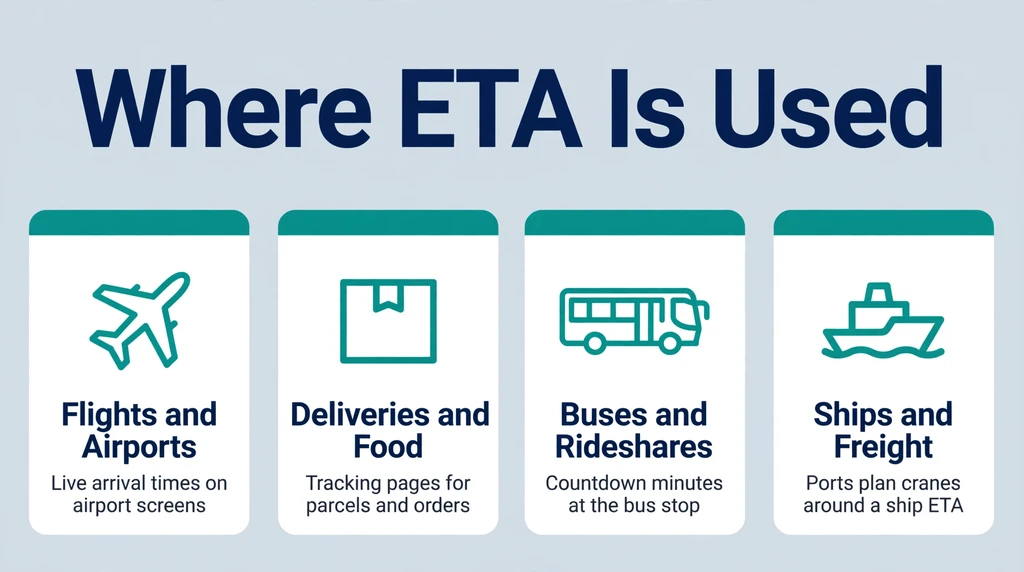
ETA started life in professional transport, and it still runs the schedules of ships, planes, and freight. Over the last two decades it has also slipped into everyday phone language. Today you meet it in several familiar places.
Flights and Airports
Airlines publish an ETA for every flight, and airport screens update it throughout the journey. A plane that leaves late usually lands late, so its ETA slides later too. Conversely, a strong tailwind can pull the ETA earlier than the timetable promised. Passengers watching the board are really watching a forecast, not a fixed appointment.
Your boarding pass also shows a scheduled arrival time, which comes from the timetable. The live ETA is different, because it reacts to the actual flight. During delays, staff quote the ETA far more often than the schedule, since it reflects reality.
Deliveries and Food Orders
Online shops and food apps have made ETA a household phrase. When you track a parcel, the page shows an estimated date, and later an estimated time window. Couriers work from the same idea, because their routes are planned around predicted arrival times. If the van falls behind, your window updates on the screen.
This is also where the metaphorical use appears. Project software, download bars, and repair tickets all borrow ETA to mean “when this will be done.” Nothing physical travels, yet everyone understands the estimate instantly.
Buses, Trains and Rideshares
Public transport systems generate ETAs from timetables or from live vehicle positions. A bus stop display may count down the minutes until the next bus. Similarly, a rideshare app shows your driver’s ETA shrinking as the car approaches your street. Both numbers are estimates built from real movement, so they feel more trustworthy than a printed schedule.
Shipping and Logistics
In freight, ETA is a working tool rather than a casual phrase. Ports plan cranes, warehouses plan staff, and buyers plan payments around a ship’s ETA. Because money depends on it, shipping documents define ETA and its partner terms very precisely. You will meet those partner terms in the comparison section below.
Beyond Travel: Work, Downloads and Deadlines
The metaphorical use deserves its own moment, because it is now everywhere. A file download shows an ETA. So does a software update. Meanwhile, a manager asks a team for an ETA on a report, and the team answers with a date. Nothing moves across a map in any of these cases, yet the meaning survives intact: the best current estimate of a finish time.
This borrowed sense works because journeys and tasks share a shape. Both have a start, a remaining distance of work, and a rate of progress. So the travel word slid naturally into offices and onto screens. Just remember that a work ETA is usually rougher than a flight ETA, since nobody has live traffic data for a spreadsheet.
How Your ETA Is Calculated
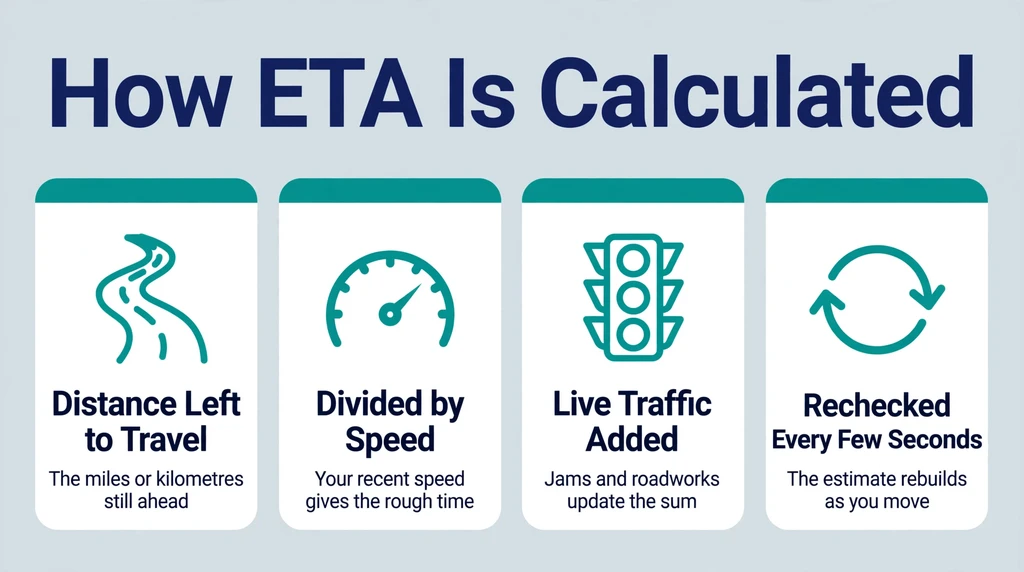
Every ETA, from a ship’s forecast to your phone’s map, rests on a simple idea. You take the distance still to travel and divide it by the speed of travel. Wikipedia describes exactly this basic method: the remaining distance is divided by the speed measured so far, which roughly gives the arrival time.
Modern systems add layers on top of that simple sum. Your phone knows your live position and the road ahead. It also knows current traffic speeds on each street, gathered from other drivers and sensors. Then it rebuilds the estimate every few seconds, so a new jam changes your ETA almost immediately.
Transport companies blend two sources instead. Some ETAs come straight from the published timetable when nothing has gone wrong. Others come from live measurements, such as an aircraft’s position or a train’s last station. The second kind is usually more accurate, because it reacts to the real day rather than the planned one.
A Worked Example in Plain Numbers
Picture a delivery van that is 30 miles from your house. So far it has averaged 30 miles per hour across its route. Divide 30 miles by 30 miles per hour and you get one hour, so the rough ETA is one hour from now. That is the whole engine of the calculation, before traffic data refines it.
Now imagine the van hits a queue and its recent speed drops to 15 miles per hour. The same sum now gives two hours, and your tracking page quietly updates. Nothing about the destination changed. Only the speed in the middle of the sum changed, and the estimate followed it honestly.
Why Your ETA Keeps Changing
An ETA changes because the world changes underneath it. A road closes, a storm slows a flight, or a delivery van gains three extra stops. Each event stretches or shortens the remaining journey.
Think of the estimate as a weather forecast for one trip. A good forecast updates as conditions change, and a good ETA does the same. A number that never moved would actually be less useful, because it would be ignoring fresh information.
ETA in Texting and Chat
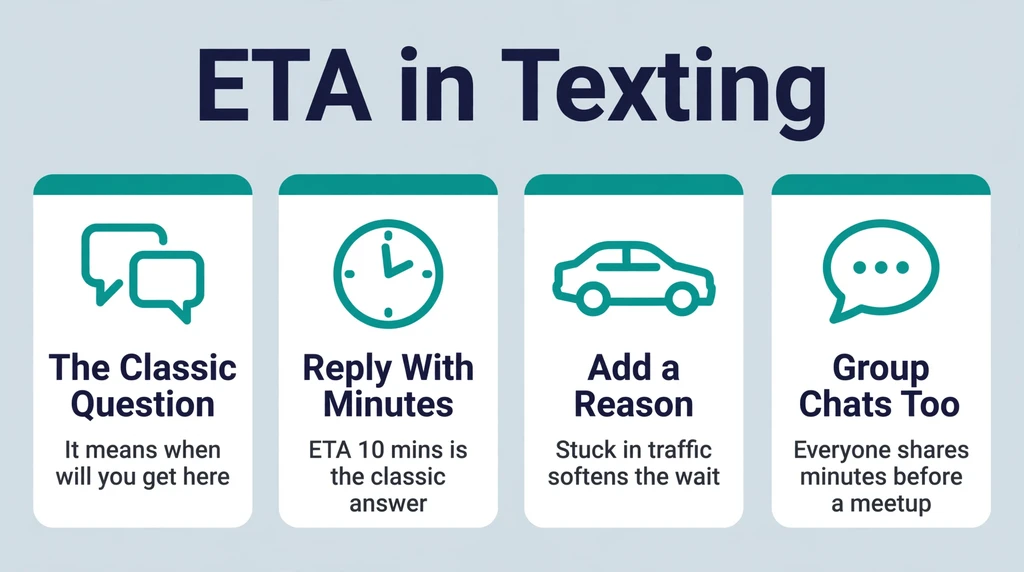
In casual messages, “What’s your ETA?” simply means “when will you get here?” Friends ask it before dinners, lifts, meetings, and nights out. It is short, friendly, and slightly more precise than asking “where are you?”
The standard reply is a duration, a clock time, or both. “ETA 10 mins” is the classic answer. “Almost there, ETA 7:45” works just as well. Some people add a reason, such as “ETA 25, stuck in traffic,” which softens the wait for the other side.
The tone stays light because the question itself is light. Asking for an ETA signals that you are planning around someone, not checking up on them. Hosts use it to time food, and drivers use it to warn about delays. Even a bare “ETA?” with no other words is understood in an ongoing chat.
ETA in Group Chats and Location Sharing
Group chats have made the question even shorter. Before a meetup, one person asks for everyone’s ETA, and the replies stack up as minutes. Organisers then judge whether to order food, hold a table, or start without the latecomers. The number acts like a tiny status report from each traveller.
Live location sharing has automated the habit entirely. Many chat apps let you share your journey, and your friends watch your arrival time update in real time. The app is effectively answering “what’s your ETA?” every few seconds. Even so, people still type the question, because a typed answer lets the driver add context like “parking is a nightmare here.”
How to Reply to “What’s Your ETA?”
First, glance at your map app, since it already shows the number. Then send the duration in plain words or figures, like “about 15 minutes.” If your arrival has slipped badly, add the new clock time as well. Finally, update again if the estimate jumps, because one honest update beats three optimistic ones.
If you are the one asking, accept the first answer gracefully. A follow up every five minutes will not move the traffic, and it only makes the driver reach for the phone more often.
How to Use ETA in a Sentence
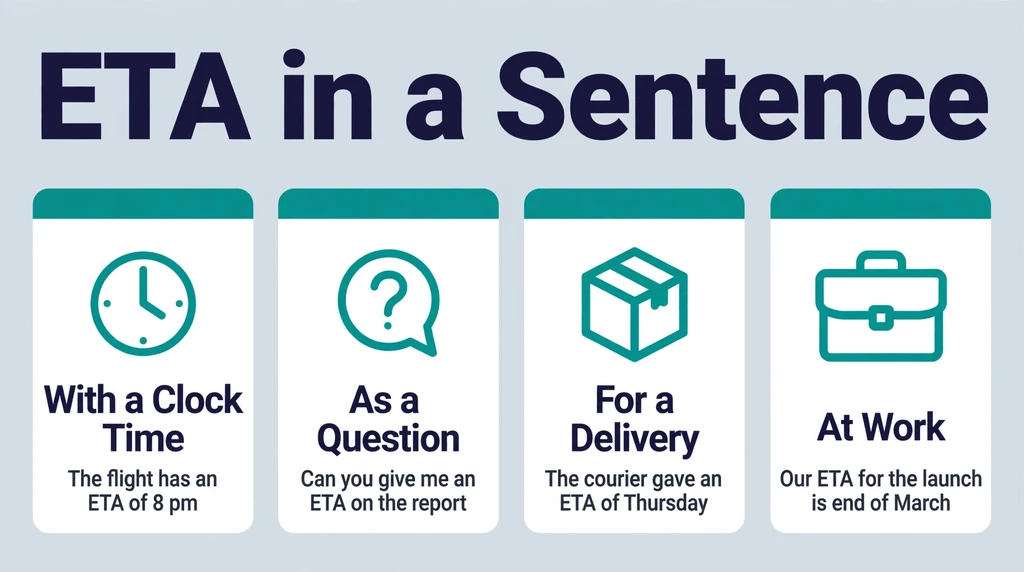
ETA works as a noun, and it usually sits comfortably in short, practical sentences. It often appears with a time after it, such as “an ETA of 6 pm.” It can also stand alone when the time is understood from context. Here are the main patterns, with fresh examples for each.
Everyday and Travel Sentences
- “The pilot announced an ETA of 8:20, so we should land before the rain.”
- “Our train has an ETA of noon, but the conductor warned about delays.”
- “The courier gave us an ETA of Thursday for the parcel.”
- “Her flight’s ETA moved from 5 pm to 6:15 pm after the late departure.”
- “The ferry reached the harbour twenty minutes after its ETA.”
Notice how each sentence pairs ETA with a concrete time or date. That pairing is the heart of the word’s grammar. Without a time, an ETA says very little, so writers nearly always supply one.
Text Message Examples
- “Running late. ETA 20 minutes, sorry!”
- “What’s your ETA? Dinner is almost ready.”
- “ETA 6:30 if the bridge traffic clears.”
- “Just left work, ETA half an hour.”
- “Send me your ETA and I will put the kettle on.”
These short forms copy real phone habits. People drop articles, skip verbs, and let the number carry the meaning. In formal writing, though, you would spell the sentences out fully and only use ETA once you have introduced the full phrase.
Work and Project Sentences
- “The repair team quoted an ETA of Friday for the fixed laptop.”
- “Can you give me an ETA on the sales report?”
- “The download shows an ETA of four minutes.”
- “Our ETA for the website launch is the end of March.”
Here ETA has stretched beyond travel into general deadline language. It still keeps its core sense of a best current estimate. However, careful writers remember that it sounds informal in business settings, so reports often prefer “expected completion date” instead.
Polite Ways to Ask for an ETA
The bare question “What’s your ETA?” suits friends, but workplaces prefer softer frames. “Could you share your ETA for the draft?” keeps the same meaning with better manners. “Do you have an ETA on the delivery yet?” works when you ask a supplier. Adding “rough” or “ballpark” in front signals that you accept an estimate rather than a commitment.
Notice that each polite version still asks for a time, not a yes or no. That is the grammar of the word at work. ETA always points at a moment on the clock or the calendar, so a helpful answer must contain one.
ETA vs ETD, ATD and ATA
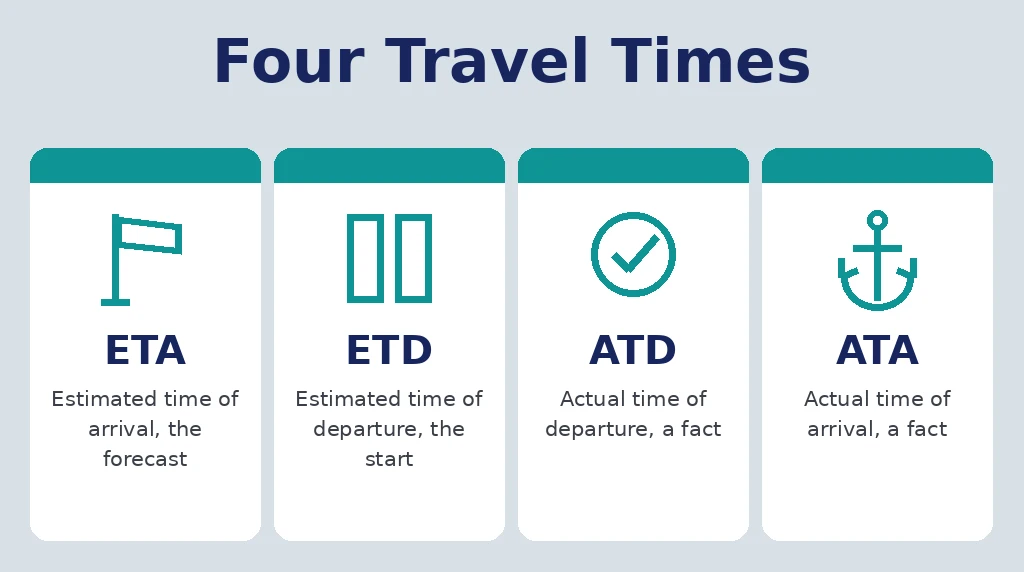
Transport workers use a small family of lookalike abbreviations. Each one marks a different moment in a journey, and mixing them up causes real confusion. ETA is the one the public sees most, but its three partners appear on shipping documents, flight systems, and freight tracking pages.
ETA, estimated time of arrival, is the predicted moment of reaching the destination. It can move earlier or later as the journey develops. Think of it as the forecast.
ETD, estimated time of departure, is the predicted moment of leaving the starting point. It is ETA’s natural partner, and the two often appear side by side on schedules. A delayed ETD usually pushes the ETA later as well.
ATD, actual time of departure, records when the vehicle really left. Unlike the estimates, this number never changes once it is logged. It marks history, not a forecast.
ATA, actual time of arrival, records when the vehicle or shipment truly arrived. Comparing ATA with ETA shows whether the journey ran on time. Logistics teams study that gap to improve future estimates.
A Simple Way to Remember Them
Read the middle letter first in your head. In ETD and ETA, the E means estimated, so both are predictions. In ATD and ATA, the A means actual, so both are facts. Then the last letter tells you the event: D for departure, A for arrival. With that one trick, all four terms stay straight forever.
Reading a Real Tracking Line
Imagine a freight update that reads: “ETD Tuesday 08:00, ATD Tuesday 09:40, ETA Friday 14:00, ATA Friday 13:35.” You can now decode the whole story of the voyage. The ship was estimated to leave at eight on Tuesday but actually left at twenty to ten, so it started late. It was then estimated to arrive at two on Friday, yet it actually docked at twenty five past one. Despite the late start, it arrived early.
Freight customers read these four figures the way fans read a score line. The gap between ETD and ATD shows how the journey began. The gap between ETA and ATA shows how well the forecast performed. Together they explain a delivery better than any single number could.
Which of the Four Do You Actually Need?
For daily life, ETA alone covers almost everything. You need it when you wait for a person, a plane, or a parcel. ETD joins it when you plan the start of a journey, such as catching a connection or meeting a departing ship. ATD and ATA matter mainly if you work in transport, claim for a delay, or study why a service ran late.
That division is worth remembering before you panic at a tracking page. The estimates tell you what to expect next. The actuals tell you what already happened and cannot change. Most questions from passengers and customers are answered by the estimates alone.
Eta the Greek Letter
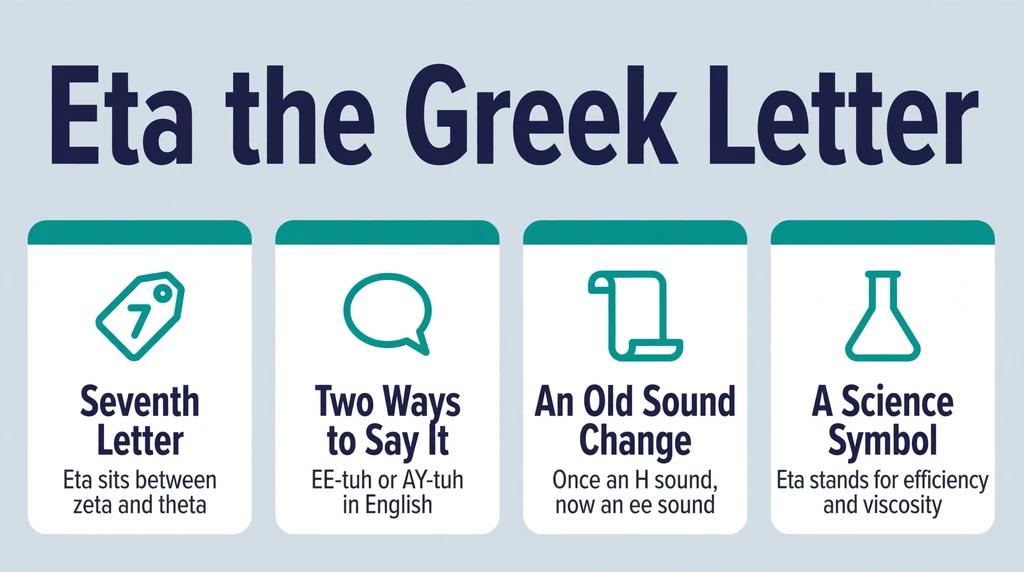
The second meaning of eta has nothing to do with journeys. Eta is the seventh letter of the Greek alphabet, written Η in uppercase and η in lowercase. Cambridge Dictionary lists it simply as “the seventh letter of the Greek alphabet,” with the symbols H and η. It sits between zeta and theta in the alphabet’s order.
How to Pronounce Eta
English speakers say the letter’s name in two accepted ways: EE-tuh or AY-tuh. Dictionaries record both, so neither one marks you as wrong. As a rough guide, Cambridge lists EE-tuh for British English and AY-tuh for American English, although real speakers mix them freely. In Greek itself, the letter’s modern name sounds like “ita,” roughly ee-tah. That difference is a small fossil of a long sound change, explained below.
A Sound That Changed Over Time
Eta has not always sounded the way it does today. In the earliest Greek dialects, the H shape stood for the consonant H, the sound at the start of “hat.” Later, classical Athens used the letter for a long vowel, roughly the sound in “air,” as Britannica’s alphabet table shows. Finally, over the Hellenistic centuries, that vowel rose until it matched the modern “ee” sound. Scholars call this raising process iotacism, or itacism.
The letter itself came from the Phoenician letter heth. Its family then travelled widely, because the Latin letter H and the Cyrillic letter И both descend from eta. So the H in this sentence is, in a real sense, eta’s grandchild. In the Greek counting system, eta also carried the number value 8.
Eta in Science and Maths
Scientists borrowed the lowercase η as a handy symbol in many fields. In thermodynamics, η stands for the efficiency of an ideal heat engine. In rheology, the study of how materials flow, η represents viscosity, the thickness of a fluid. Economists use η for elasticity, and astronomers use eta in star names, since Bayer labels the seventh star of a constellation with it. Mathematicians meet eta in the Dirichlet eta function, and the capital Η represents entropy in information theory.
You do not need to memorise this list. The useful lesson is simpler: when η appears inside a formula or a textbook, it is a symbol with a local job. Its job changes by subject, and the surrounding text always defines it.
Eta in Names and Daily Life
Most English speakers meet eta outside science in a few ordinary places. Students of Greek, classics, or the New Testament learn the alphabet early, and eta arrives in the first lessons. Many North American fraternities and sororities build their names from Greek letters, and eta appears in chapter names across campuses. Readers of older English texts also meet eta in transliterated Greek words, where it is usually written as a long e.
The storm story in the next section gave the letter one more public role. For a few weeks in 2020, millions of people who had never studied Greek were suddenly reading the name eta in headlines. Few everyday words get that kind of second life.
Eta and the 2020 Hurricane
The Greek letter also had one famous season in the weather news. Atlantic storms are named from rotating lists of ordinary names. When a season produces more storms than the list holds, forecasters once turned to Greek letters as a backup. That happened in 2005, and then again in the record breaking 2020 season.
Hurricane Eta formed on 31 October 2020 and struck Central America soon after. It was one of nine Greek named storms that season, in a run that stretched from Alpha to Iota. The season also exposed a practical flaw in the system: names like Zeta, Eta, and Theta sound alike, and similar sounding storms sometimes existed at the same time, which made warnings harder to communicate. Because the storm was so destructive, the World Meteorological Organization retired the name Eta in March 2021. At the same meeting, officials dropped the Greek letter backup system altogether. Future overflow storms now receive ordinary names from a supplemental list instead.
ETA, the Basque Group
One historical sense remains, and it belongs in a different world entirely. ETA was also the acronym of Euskadi Ta Askatasuna, a Basque phrase meaning “Basque Homeland and Liberty.” It named a separatist organisation in northern Spain that campaigned, often violently, for an independent Basque state.
The group was founded in 1959, when younger members broke away from the Basque Nationalist Party during Francisco Franco’s dictatorship. Decades later, it declared a permanent end to its armed activity in 2011. It then handed over its weapons in 2017 and announced its complete dissolution in May 2018.
This ETA shares only its letters with “estimated time of arrival.” When you meet ETA in history books or older European news, this is the sense intended. When you meet it on a phone screen, it never is.
Common Mistakes and Mix-Ups
Most ETA confusion comes from a handful of habits. Here are the mix-ups that appear most often, plus the quick fix for each one.
Treating an ETA as a promise. The whole point of the word “estimated” is that the time can move. If you plan a tight connection around an ETA, build in spare time. Couriers, airlines, and apps all treat the figure as a forecast.
Answering with your departure instead of your arrival. When someone asks for your ETA, they want the moment you walk in, not the moment you set off. Replying “leaving at six” leaves them doing the maths themselves. Give the arrival time and everyone relaxes.
Mixing Up ETA and eta
Confusing ETA with ETD. These two sit side by side on schedules, which invites errors. Remember that the A in ETA stands for arrival, while the D in ETD stands for departure. One ends the journey, and the other starts it.
Mixing up ETA and eta. Capital ETA is the travel abbreviation, said letter by letter. Lowercase “eta” is the Greek letter, said as one word. A sentence about “eta in physics” is about the symbol η, not about anyone’s journey home.
Adding “time of arrival” twice. People sometimes write “ETA time,” which repeats the T that already means time. It is a small redundancy rather than a serious error, and you will still be understood. Careful writers simply say “the ETA.”
Quoting the journey length instead of the arrival moment. A trip that lasts two hours does not have “an ETA of two hours from home” in most readers’ minds; they picture the clock time at the end. In texts, durations are perfectly normal because everyone shares the same “now.” In written reports, though, give the clock time or the date, so readers in other time zones are not left guessing.
Frequently Asked Questions
What does ETA stand for?
ETA stands for estimated time of arrival. It is the time a person, vehicle, aircraft, or delivery is expected to reach its destination. Some shipping documents use the variant “expected time of arrival” for the same idea.
What does ETA mean in a text message?
In a text, ETA carries the same meaning in friendlier clothing. “What’s your ETA?” asks when you expect to get here, and the usual reply is a number of minutes. It is everyday shorthand, not technical slang.
How do I reply when someone asks for my ETA?
Check your map app and send the duration it shows, such as “ETA 15 minutes.” Add the clock time too if the delay is long. Then send a fresh update if traffic or a delay changes the estimate a lot.
Is an ETA a guaranteed arrival time?
No. An ETA is an estimate built from current information, so it can move earlier or later. Flight boards, delivery pages, and map apps all update it as conditions change. Treat it as the best available forecast, not a promise.
What is the difference between ETA and ETD?
ETA predicts the arrival, while ETD predicts the departure. ETD means estimated time of departure, the moment a journey is expected to begin. The two are partners on schedules, and a late ETD usually pushes the ETA later.
What is eta in the Greek alphabet?
Eta is the seventh letter of the Greek alphabet, written Η in uppercase and η in lowercase. English speakers pronounce its name EE-tuh or AY-tuh. In modern Greek it makes the “ee” sound, although in classical Greek it was a longer vowel.
Why does my ETA keep changing?
Because the estimate reacts to new information in real time. Traffic builds, flights board slowly, and routes gain extra stops. Each change feeds into the remaining distance and speed, so the arrival time moves with it.
Is ETA used outside travel?
Yes. People borrow it for any expected finish time, from downloads to repair jobs to project deadlines. The travel sense stays underneath, since the task is “arriving” at completion. In formal documents, writers often prefer a spelled out phrase instead.
Final Thoughts
Three letters, one clear job: ETA tells you when something is expected to arrive. In texts it keeps friends patient, in airports it keeps travellers informed, and in shipping it keeps whole supply chains moving. Read it as a living estimate, not a promise, and it will rarely mislead you. That single habit separates relaxed travellers from frustrated ones, because the number was never the problem; the expectation was.
The Greek letter eta leads a separate, older life in alphabets, equations, and one famous hurricane season. The Basque ETA belongs to history books now. Context tells you which sense you are reading within a second or two. For a reference summary of that historical organisation, see the Encyclopaedia Britannica entry on ETA.
So next time your phone asks the question, you know exactly what it wants. Check the map, send the number, and arrive when the estimate said you would, give or take a traffic jam.