You have probably heard it in a song, a drama series, or from a friend with a big smile. Someone leans in and says one warm word: “Habibi.” It sounds affectionate, but what does it actually mean?
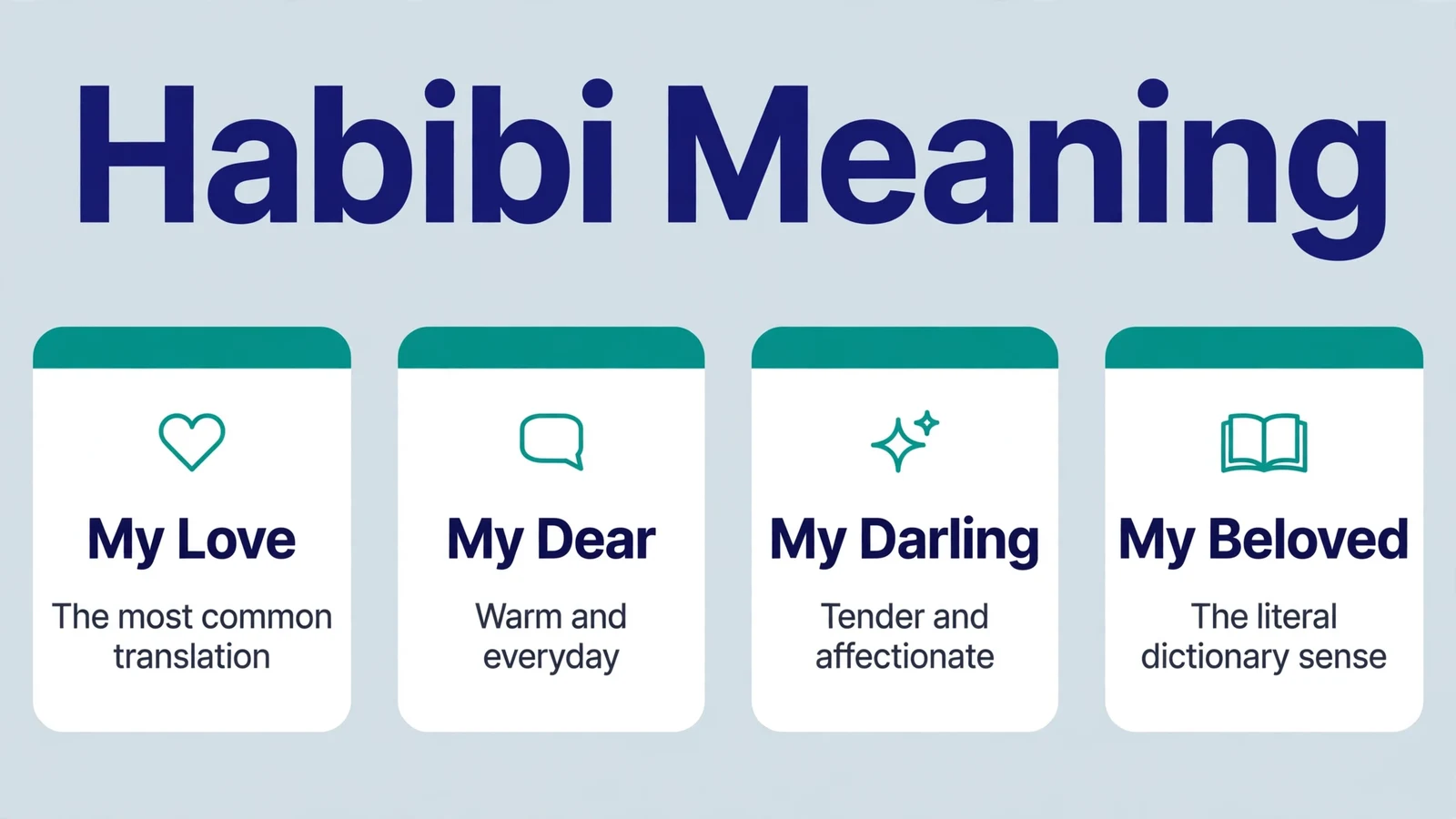
Habibi is an Arabic term of endearment that means “my love” or “my beloved.” People use it when speaking to a man or a boy. For a woman or a girl, the matching form is habibti, and it carries the same meaning.
Still, the word reaches far beyond romance. Across the Arab world, friends, parents, grandparents, and even shopkeepers say habibi every single day. It can sound romantic, fatherly, playful, or simply kind. The relationship and the tone decide which version you hear.
In this guide, you will learn the literal breakdown of the word and how to pronounce it correctly. You will also learn when each form fits, and how to reply with confidence when someone calls you habibi.
What Does Habibi Mean?
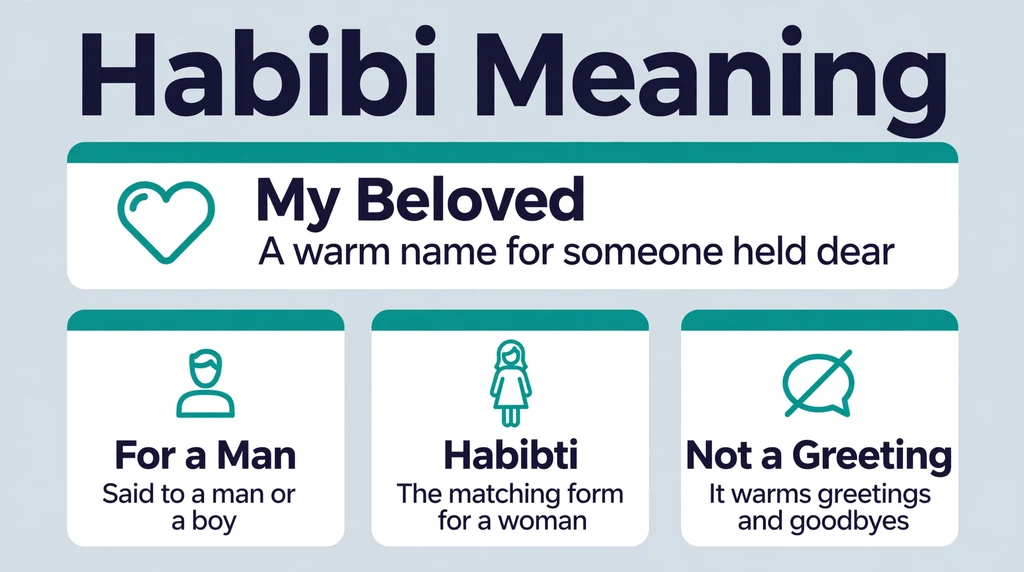
Habibi (حبيبي) is one of the most loved words in the Arabic language. Its core meaning is simple and tender. It calls the person in front of you “my beloved.”
Dictionaries translate it in a few slightly different ways. Dictionary.com gives “my love” as the literal meaning. Other reference works prefer “my dear,” “my darling,” or “beloved.”
Each translation catches one shade of the word. “My love” fits a partner. “My dear” fits a parent or an older relative. “Beloved” fits poetry and songs.
A name you call someone, not a greeting
Grammatically, habibi is a noun that works as a term of address. You use it the way English uses “sweetheart” or “honey.” It names the person you are speaking to.
Because of that, habibi does not mean “hello” or “goodbye” by itself. Instead, it attaches itself to greetings and makes them warmer. “Hello, habibi” simply sounds kinder than a plain hello.
Likewise, it can soften a request or an apology. “Sorry, habibi” carries a small hug inside the words. The word adds affection to whatever sentence surrounds it.
Why tone matters so much
Collins Dictionary describes habibi as a term of endearment used casually between friends, much like “buddy.” Collins also notes that lovers use it, and that tone gives away the real intent.
That single observation explains most confusion around the word. The dictionary meaning never changes. However, the feeling behind it shifts with the speaker, the moment, and the voice.
So a grandfather and a boyfriend can say the identical word. One means “my dear boy.” The other means “my love.” Both are using habibi correctly.
How habibi compares with English endearments
English speakers often ask which English word matches habibi best. The honest answer is that no single word covers it. Habibi behaves like several English endearments blended into one.
With a partner, it lands like “my love” or “darling.” With a child, it feels like “sweetheart” or “dear.” With a close friend, it relaxes into “buddy,” only with more heart in it.
That blend is exactly why the word confuses learners. English sorts affection into separate boxes. Arabic lets one beloved word walk between all of them.
Context does the sorting instead. Once you know who is speaking, the right English translation picks itself. Until then, “my dear” is the safest all-purpose rendering.
The Origin of Habibi: Root Word and Literal Breakdown
Arabic words grow from short roots, usually three letters long. Habibi grows from one of the most beautiful roots in the language. Understanding that root makes the word easy to remember.
The root letters that carry love
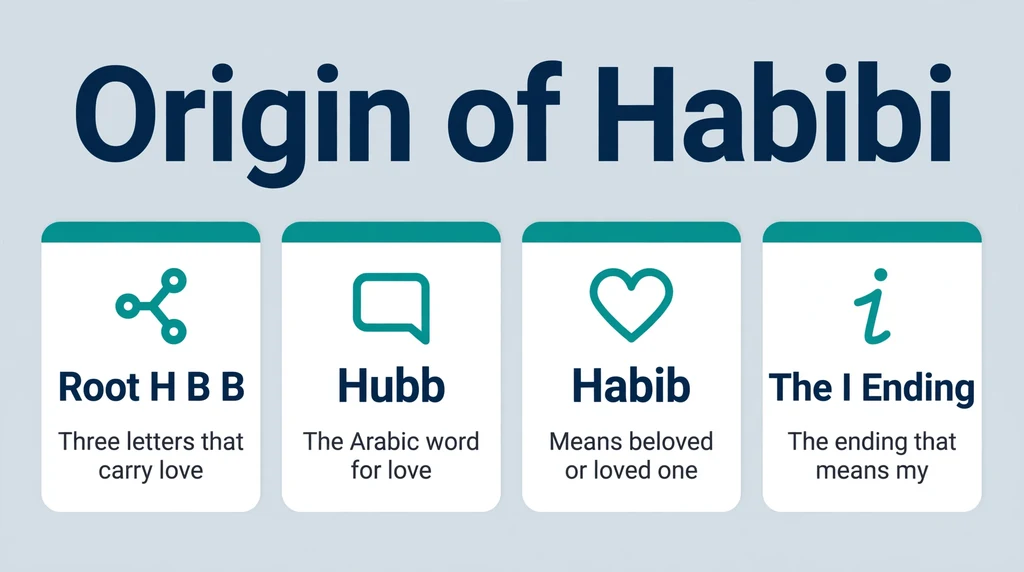
The root behind habibi is written ḥ-b-b. This root carries the idea of love and deep affection. From it comes the noun hubb (حب), which simply means “love.”
Many Arabic words for affection branch out from this same root. Once you hear the root, the whole family starts to sound familiar. Love sits at the center of every branch.
From that root comes habib (حبيب), which means “beloved” or “loved one.” A habib is a person who is held dear. The word can describe a sweetheart, a close friend, or a treasured family member.
One small suffix that makes it personal
The final letter sound, the long “ee,” does important work. In Arabic, that ending is a possessive suffix. It means “my.”
So the word builds itself in two steps. First, habib gives you “beloved.” Then the suffix turns it into “my beloved.”
This is why translations say “my love” instead of just “love.” The word already contains the relationship. The speaker claims the bond inside a single breath.
A word with a respected history
The same root appears in a famous religious title. In Islamic tradition, the Prophet Muhammad is honored as Habib Allah. That phrase means “Beloved of God.”
You do not need any religious knowledge to use habibi well. Still, the title shows how deeply the root is woven into Arabic culture. Love, respect, and devotion all grow from the same three letters.
The same word inside everyday names
The word family also lives inside personal names. Habib is also a common male first name across many countries. Habiba is the matching female name.
Both names appear across Arabic, Persian, Urdu, and Turkish settings. Families choose them because the meaning is built right in. Every introduction quietly repeats the word “beloved.”
Habibi even appears as a family name in some communities. So you may meet the word on a doorbell before you ever hear it in conversation. Few vocabulary words enjoy that kind of reach.
How to Pronounce Habibi
Good pronunciation makes the word land warmly. Luckily, habibi is not hard to say. It has three clear syllables and a friendly rhythm.
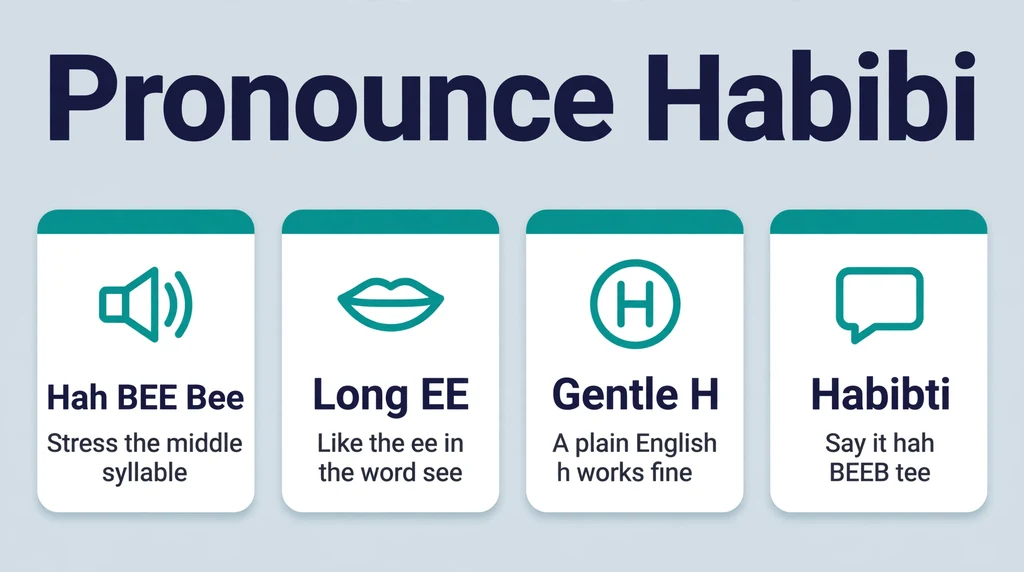
Say it like this: hah-BEE-bee. The middle syllable carries the stress. The long “ee” sounds stretch a little, like the “ee” in “see.”
In phonetic writing, the word appears as /ħaˈbiːbiː/. The symbols look technical, but the spoken word is simple. English speakers usually manage it on the first try.
The one sound English does not have
The first letter is the only tricky part. Arabic has a breathy “h” that comes from deeper in the throat. Scholars write it with a dot, like this: ḥ.
Native speakers hear the difference clearly. However, a normal English “h” still works fine. People will understand you, and most will simply appreciate the effort.
So do not let that one sound stop you. Say the word with a smile, and the meaning will travel.
Pronouncing habibti
The feminine form adds one small beat. Say it like this: hah-BEEB-tee. The ending changes from “bee” to “btee.”
Phonetically, habibti appears as /ħaˈbiːbtiː/. The “t” sound is the part that marks the word as feminine. Once you hear both forms side by side, the difference becomes easy.
Practice the pair a few times out loud. Habibi for him, habibti for her. After a few rounds, your ear will catch the pattern naturally.
Why spellings sometimes carry dots and lines
In books and language courses, you may see the word written ḥabībī. Those dots and lines are scholarly marks. They show the deep throat “h” and the long vowels precisely.
Everyday writing drops the marks for speed. On shop signs, in messages, and across social media, plain “habibi” rules. Both spellings point to the exact same word.
Habibti shows up in slightly different spellings too, since people type Arabic sounds with English letters in their own way. The spoken word stays identical. Only the typing changes with the writer’s habits.
Habibi vs Habibti: For Men and Women
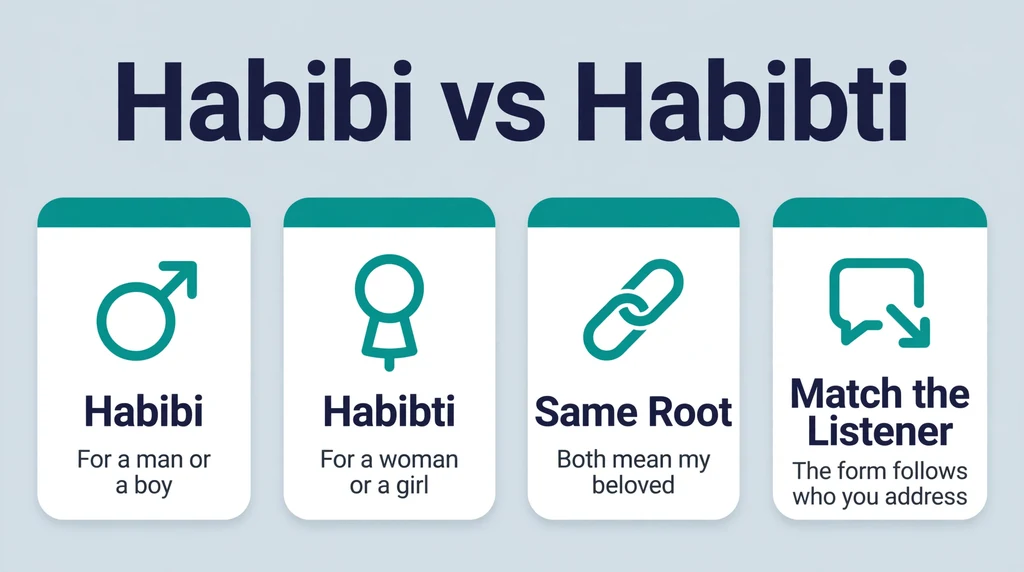
This pair causes more confusion than any other part of the word. The good news is that the rule is short. Arabic changes the ending based on who you are talking to.
Habibi is the masculine form. You say it to a man or a boy. Habibti (حبيبتي) is the feminine form. You say it to a woman or a girl.
The rule follows the listener, not the speaker
Here is the part that surprises many learners. The correct form depends on the gender of the person being addressed. It does not depend on your own gender.
So a woman speaking to her husband says habibi. A man speaking to his wife says habibti. A father calls his son habibi and his daughter habibti.
Two friends follow the same pattern. A man greets his male friend with habibi. A woman greets her female friend with habibti. The word simply matches the listener.
Think of it like a small act of respect. Choosing the right form shows that you see the person clearly. Native speakers notice, and they usually appreciate the care.
Can you say habibi to a woman?
In careful, standard usage, the answer is no. Habibti is the correct form for a woman. Most teachers and dictionaries will tell you to keep the pair separate.
Real life, however, is a little more relaxed. In some dialects and casual settings, people use habibi for almost everyone. Mothers in Egypt, for example, sometimes call their daughters habibi without thinking twice.
Casual speech online bends the rule even further. Many young speakers treat habibi as a general word for “my dear.” Nobody corrects them, because everyone understands the intention.
As a learner, though, the safe path is clear. Use habibi for men and habibti for women. That habit will always sound correct, polite, and natural.
What about speaking to a group?
Arabic even offers a way to address several people at once. You may hear habaybi used for a group of loved ones or friends. It works like saying “my dears” to the whole room.
This form shows up mostly in warm, informal speech. Learners rarely need it on day one. Still, recognizing it helps when a happy host greets a full table of guests.
It also explains a pattern you will notice in songs and films. A singer addressing a whole audience of loved ones needs one word for everyone. Group forms and the general friendly use of habibi both grow from that same welcoming instinct.
How Habibi Is Used in Everyday Life
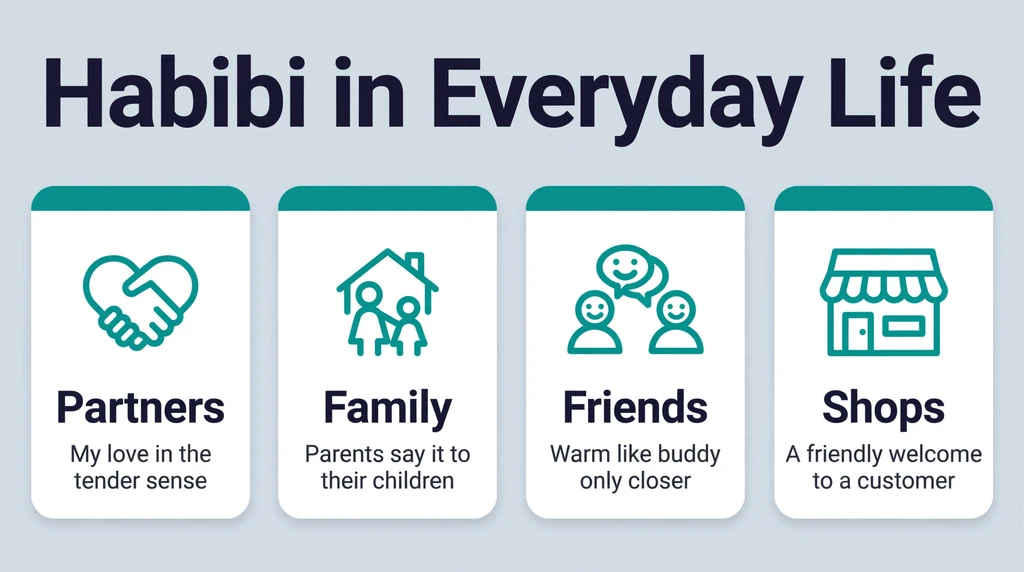
Dictionaries give you the translation, but daily life gives you the truth. Habibi shows up in kitchens, taxis, markets, songs, and text messages. Here is where you will actually hear it.
Between romantic partners
Between couples, habibi carries its full dictionary weight. It means “my love” in the tender, romantic sense. Partners use it in greetings, goodbyes, and quiet everyday moments.
A husband might text, “Good morning, habibti,” before she has even woken up. She answers later with a simple “Morning, habibi.” The pair of words becomes a small daily ritual.
In this setting, the word works like “my love” or “darling” in English. It signals closeness, commitment, and warmth. Tone here is soft, and the meaning is unmistakable.
Between parents and children
Parents use habibi constantly, and romance has nothing to do with it. A mother calls her young son to the table with “Come here, habibi.” A father uses it while comforting a child after a fall.
Grandparents may use it even more freely. For them, the word is pure tenderness. It wraps a grandchild in affection inside a single word.
Interestingly, this family use explains much of the word’s warmth. Many Arabs first hear habibi from their parents. So the word carries childhood comfort for the rest of their lives.
Between close friends
Male friends across the Arab world call each other habibi all day long. It works the way “buddy,” “bro,” or “my friend” works in English, only warmer. A typical greeting sounds like, “Habibi, how are you?”
Female friends use habibti with each other in the same spirit. The word marks trust and history between people. It says, without ceremony, “you matter to me.”
Notice that nobody in these exchanges is confused. Context makes the friendly meaning obvious. The word simply adjusts to the bond it lands on.
With strangers, waiters, and shopkeepers
Perhaps the biggest surprise for visitors is the friendly stranger. A shopkeeper may greet a customer with habibi. A waiter might use it while taking an order.
This use is pure social warmth. It says, “you are welcome here, and I mean you well.” No romance hides inside it at all.
Travelers in Egypt, Lebanon, Jordan, or the Gulf hear this daily. At first it can feel surprisingly intimate. Very soon, it starts to feel like the natural music of the street.
Habibi in Texting and Online Chat
These days, many people meet habibi on a screen before they hear it aloud. The word thrives in text messages, comments, and captions. Its short length and warm tone suit chat perfectly.
How it looks in a message thread
Friends drop habibi into chats the way they drop it into speech. A typical thread reads, “Habibi, are we still on for tonight?” Nothing about it feels heavy or dramatic.
Romantic partners use it even more freely in writing. A single “goodnight habibti” can close an entire evening of conversation. The word carries the affection so the sentence can stay short.
You will also see it under photos and videos. Commenters write it to praise a friend’s new baby, new car, or new haircut. There, it works like a written smile.
Reading tone without a voice
Text removes the clues that faces and voices provide. That loss creates the one real risk of written habibi. A friendly message can occasionally be misread as flirting.
Relationship history fills the gap that tone leaves behind. If an old friend writes it, read friendship. If a new admirer writes it at midnight, the meaning may lean romantic.
When you write it yourself, context is your safety net. Pair the word with a clear, ordinary message. Nobody misreads warmth when the sentence around it is plainly friendly.
Emojis and voice notes also help restore tone online. Many people send habibi inside a voice message for exactly this reason. Hearing the smile settles every doubt.
Is Habibi Always Romantic?
No, and this is the single most important thing to understand. Habibi is romantic only when the situation makes it romantic. Most daily uses carry no romantic charge at all.
Consider how English handles the word “dear.” A wife calls her husband “dear” with love. A grandmother calls a child “dear” with tenderness. A frustrated clerk might even say it with an edge.
Habibi behaves in exactly the same flexible way. The relationship supplies the meaning. The word itself only supplies the warmth.
When the tone turns playful or sarcastic
Tone can bend habibi even further. Friends tease each other with an exaggerated “ya habibi” when someone tells a tall story. The phrase then means something like “oh, my dear friend, really?”
With a sharper edge, the word can sound impatient. “Habibi, you need to read the instructions first” is not a love note. It is a gentle scolding wearing a friendly mask.
These playful uses are common among people who know each other well. They rely on shared history and facial expressions. As a visitor, enjoy them, but copy them carefully.
How to tell which meaning you are hearing
Three clues will guide you almost every time. First, look at the relationship between the speakers. Second, listen to the voice and watch the face. Third, notice the setting.
A soft voice between partners means romance. A loud laugh between old friends means affection and fun. From a shopkeeper, a polite smile simply means welcome.
When you read the clues together, confusion disappears. Habibi is less like a fixed label and more like a warm gesture. Gestures always take their meaning from the moment.
Habibi Across the Arab World
One reason habibi became so famous is its reach. Few words travel this well. You can use it in Morocco, Egypt, Lebanon, Jordan, Saudi Arabia, or Iraq, and everyone understands you instantly.
The word works in Modern Standard Arabic, the formal shared language. It also works in every major spoken dialect. Few everyday words enjoy that double passport.
Pronunciation shifts slightly from place to place. The rhythm may speed up or soften at the edges. Still, the heart of the word stays the same everywhere.
This wide reach also explains the name pattern mentioned earlier. Habib and Habiba appear as personal names across Arabic, Persian, Urdu, and Turkish settings. Wherever the names traveled, the idea of “beloved” traveled with them.
For learners, this reach is a gift. You learn one short word, and it opens friendly doors in more than twenty countries. Very few vocabulary items pay you back so quickly.
One word, many accents
Travelers notice small musical differences as they move. In Egypt, the word often rolls out relaxed and frequent. In the Levant, it threads through conversation at a lively pace.
In the Gulf, you may hear it in shops and majlis gatherings alike. In North Africa, French sometimes shares the sentence, yet habibi still holds its place. The melody changes, but the welcome does not.
These are impressions of rhythm rather than rules of grammar. The spelling, the root, and the meaning stay constant. Only the music of the word adjusts to its hometown.
Habibi in Music and Pop Culture
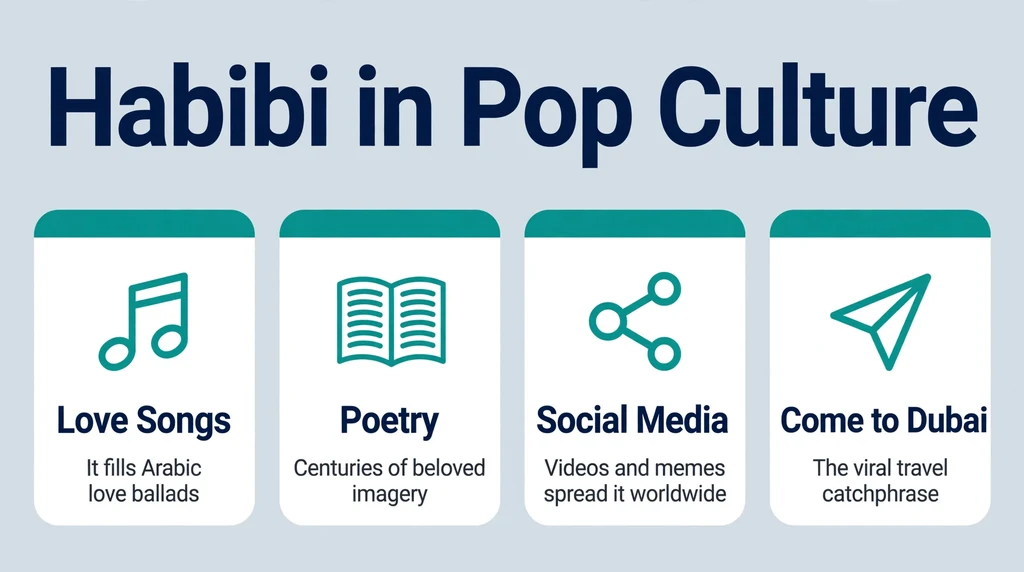
If the word feels familiar, music is probably the reason. Arabic love songs lean on habibi the way English songs lean on “baby.” Open almost any classic Arabic love ballad, and the word appears within the first lines.
Poets reached for it long before recording studios existed. Arabic poetry has used the language of the beloved for centuries. Habibi and its root run through that tradition like a thread.
Songs then carried the word across borders. Listeners who knew no Arabic still learned this one word by heart. Melodies taught the world a small lesson in affection.
The word goes global online
Social media gave the word a second, louder life. Short videos, memes, and travel clips spread habibi far beyond Arabic speakers. Today, people use it playfully on every major platform.
One catchphrase shows this spread perfectly. “Habibi, come to Dubai” went viral across TikTok, Instagram, and YouTube. Influencers used it as a glossy invitation to the city’s luxury lifestyle.
The joke worked because the word already sounded warm and welcoming. Millions of viewers absorbed the term without a single Arabic lesson. Pop culture quietly became a vocabulary teacher.
Meanwhile, diaspora communities had been using the word at home all along. For their children, habibi is kitchen-table language. The internet simply turned the volume up on something already loved.
The soundtrack of celebrations
The word also owns a permanent seat at Arab celebrations. Songs played at weddings and family parties return to habibi again and again. It is the easiest word for a whole room to sing together.
That is partly a matter of sound. The three syllables sit comfortably inside a melody and a chant. Crowds can hold the long “ee” the way English crowds hold the end of a chorus.
So for many people abroad, the word first arrives as music. Only later do they learn it also belongs to grandmothers, taxi drivers, and best friends. The song simply opened the door.
A Small Habibi Phrasebook
Single words open doors, but short phrases make conversations. These combinations appear constantly in Arabic daily life. Each one is built from simple, friendly pieces.
| Phrase | Sounds like | What it means |
|---|---|---|
| Ya habibi | yah hah-BEE-bee | Oh my dear (calling out warmly) |
| Ahlan, habibi | AH-lan hah-BEE-bee | Hello, my dear |
| Sabah al-khayr, habibi | sah-BAH al-KHAIR hah-BEE-bee | Good morning, my dear |
| Shukran, habibi | SHOO-kran hah-BEE-bee | Thank you, my dear |
| Yalla, habibi | YAH-lah hah-BEE-bee | Come on, my dear (let’s go) |
| Ma’a salama, habibi | mah-ah sah-LAH-mah hah-BEE-bee | Goodbye, my dear |
How to use these phrases naturally
Start with the greeting and let habibi ride along. “Ahlan, habibi” is the friendliest first step for a learner. It works in shops, taxis, and homes alike.
“Yalla, habibi” adds gentle energy. Friends say it when a group needs to move, eat, or finally leave. It hurries people without a drop of harshness.
Endings matter just as much as openings. “Ma’a salama, habibi” closes a meeting with warmth. People remember a kind goodbye long after the conversation fades.
Notice the pattern across all six phrases. The greeting or verb does the practical work. Habibi simply adds the human warmth on top.
Similar Arabic Terms of Endearment
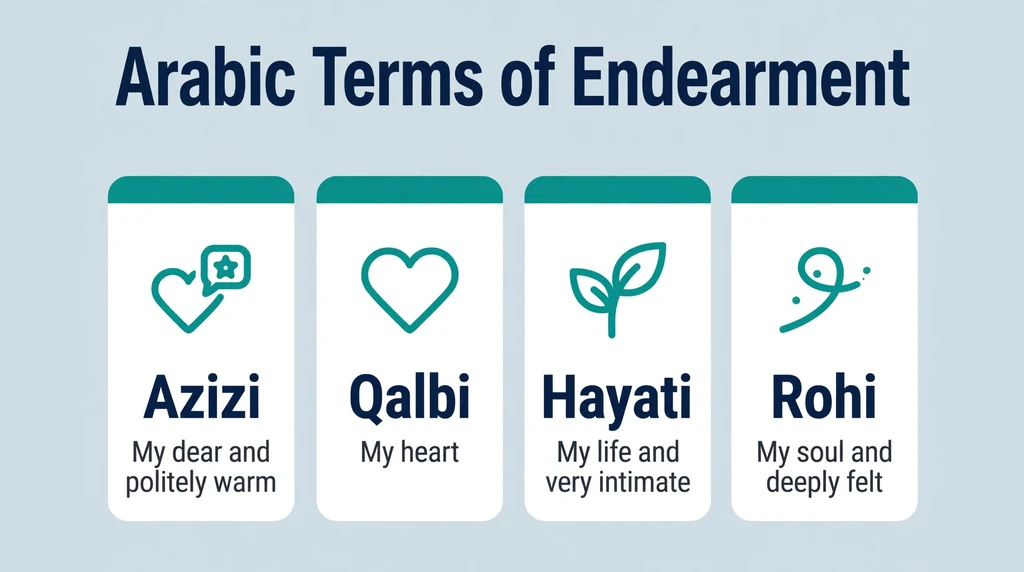
Habibi is famous, but it is not alone. Arabic owns a whole shelf of affectionate words, and each one carries a slightly different flavor. Learning a few of them deepens your feel for the language.
| Term | Pronunciation | Meaning | Best used for |
|---|---|---|---|
| Habibti | hah-BEEB-tee | My love (to a woman) | Partner, family, female friends |
| Azizi | ah-ZEE-zee | My dear | Friends, letters, polite warmth |
| Qalbi | KAHL-bee | My heart | Deep affection, romance |
| Hayati | hah-YAH-tee | My life | Very close partners |
| Rohi | ROO-hee | My soul | Deep emotional bonds |
| Omri | OM-ree | My lifetime | Poetic, devoted love |
Azizi, the polite cousin
Azizi (عزيزي) means “my dear” or “my cherished one.” It sounds a little more formal than habibi. People even open letters and emails with it.
Because of that polish, azizi suits friendly respect. You can use it where habibi might feel too casual. It is affection with its collar straightened.
Choosing between habibi and azizi
Learners often wonder which of the two words to reach for first. The difference is mostly temperature and setting. Habibi is warmer, closer, and more casual.
Azizi keeps a little more distance. It suits new acquaintances, polite letters, and elders you respect but do not know well. Think of it as affection wearing good manners.
When in doubt with a close friend, choose habibi. When in doubt with a respected stranger, azizi is safer. Both will be received kindly when your tone is kind.
Qalbi, hayati, and the deeper words
Qalbi (قلبي) means “my heart,” and you may also hear it softened as albi. Hayati (حياتي) means “my life.” Rohi (روحي) means “my soul,” and omri (عمري) means “my lifetime.”
These words climb a ladder of intensity. Habibi is the friendly everyday step. Qalbi and hayati sit higher, closer to deep romance and family devotion.
That ladder is exactly why habibi stays so popular. It gives warmth without climbing too high. You can offer it freely, and it still feels like a gift.
How to Reply When Someone Calls You Habibi
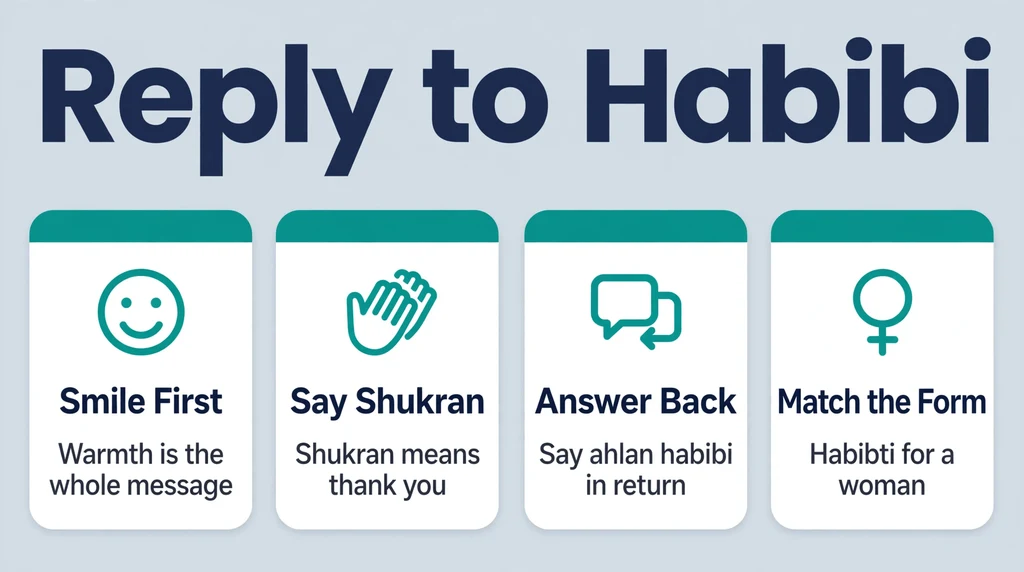
Sooner or later, someone will aim this word at you. The moment can feel sweet and slightly confusing at once. The good news is that easy, natural replies exist.
First, relax and smile. The word almost always signals warmth, welcome, or affection. Your face is half of the reply already.
Simple replies that always work
The easiest response is a warm thank you. You can say “shukran,” which means “thank you,” and keep it simple. Adding the person’s name makes it personal.
You can also return the word itself. If a man called you habibi, answering “ahlan, habibi” works beautifully. Ahlan means hello, so the phrase becomes a friendly hello back.
Between close friends, mirroring is the most natural move of all. They say habibi, you say habibi. The exchange takes two seconds and says everything.
Matching the form when you reply
If you reply to a woman, switch to habibti. If you reply to a man, habibi is right. This small detail shows real attentiveness.
Do not worry about perfection, though. A slightly wrong ending, said kindly, still lands kindly. Native speakers forgive learners generously, especially when the effort is genuine.
What matters most is energy, not grammar. Match their warmth, keep your tone light, and move on with the conversation. The word has done its job once everyone is smiling.
What if you do not speak Arabic?
You can still answer beautifully without any Arabic at all. A genuine smile and a warm “thank you” in your own language work everywhere. People respond to sincerity faster than to vocabulary.
If the moment feels right, adding their name helps. “Thank you, Ahmed” tells the speaker you received the kindness personally. Names and smiles translate perfectly in every country.
Over time, these small exchanges teach you more than drills do. Each reply builds a tiny bridge of trust. That, in the end, is exactly what the word was built for.
Common Mistakes to Avoid
Learners usually stumble in the same few places. Each mistake below is easy to fix once you see it coming.
Using habibi for a woman in careful settings. Among close friends, nobody minds much. In polite or formal company, though, habibti is the respectful choice for a woman.
Assuming every habibi is flirting. A taxi driver, a grandmother, and a coworker may all use the word innocently. Reading romance into every use leads to awkward misunderstandings.
Using it in formal business settings. Habibi is an informal, affectionate word. In a job interview or an official meeting, it sounds out of place. Save it for friendly ground.
Dropping the middle stress. Saying HA-bi-bi flattens the word and marks you as a beginner. Keep the beat in the middle: hah-BEE-bee.
Overusing it with strangers you have just met. Outside the Arab world’s friendly street culture, constant use can feel forced. Let the other person set the level of warmth first.
Confusing it with a greeting. Habibi does not mean hello. Pair it with a real greeting, and it will shine in its proper role.
Translating it too strongly for English speakers. If you repeat the word to English-speaking friends as “my love,” it may land heavier than you intend. Among English speakers, “my dear” or a simple friendly tone usually matches the original feeling better.
Frequently Asked Questions
What does habibi mean in English?
Habibi means “my love” or “my beloved” in English. Depending on who says it, “my dear” or “my darling” may fit better. Between friends, it comes close to “buddy” or “my friend,” only warmer.
Is habibi only for men?
Habibi is the masculine form, so it is used for a man or a boy. The feminine form is habibti, used for a woman or a girl. In relaxed everyday speech, though, some people use habibi for everyone.
Does habibi mean friend?
Not exactly, but it often points at one. The word itself means “my beloved” or “my dear.” Because close friends use it so often, many learners first hear it as a friendship word.
Can a girl say habibi to a guy?
Yes, absolutely. The form depends on the person being addressed, not on the speaker. A woman speaking to her husband, brother, or male friend correctly uses habibi.
What does ya habibi mean?
The word “ya” is a calling word, like “oh” in older English. So ya habibi means “oh my beloved” or “oh my dear.” People use it to call out warmly, to greet someone, or to add emotion.
Is habibi a romantic word or a friendly word?
It can be both, and context decides. Between partners, it is clearly romantic. Between friends, parents, and shopkeepers, it is simply warm and friendly. Tone and relationship always tell you which meaning is active.
Is Habibi also a name?
Habib is a common male first name, and Habiba is a common female first name. Both come from the same root meaning love. You will meet people with these names across the Middle East and beyond.
How do I reply when someone calls me habibi?
Smile and keep it simple. Say thank you, or return the warmth with “ahlan, habibi” to a man or “ahlan, habibti” to a woman. Matching their friendly energy matters far more than perfect grammar.
Final Thoughts
Habibi looks like a tiny word, but it carries a whole culture of warmth inside it. At its heart, it simply says “my beloved.” Everything else, the friendship, the teasing, the welcome, grows out of that core.
Now you know the full picture. You know the root, the pronunciation, and the difference between habibi and habibti. You also know how to hear the tone and how to reply without freezing.
So the next time someone greets you with habibi, enjoy the moment. Answer warmly, and let the word do what it has done for centuries. Few words make strangers feel like friends this quickly.
If you want to keep exploring the word’s background, the Dictionary.com entry on habibi offers a neat summary of its meaning and history.