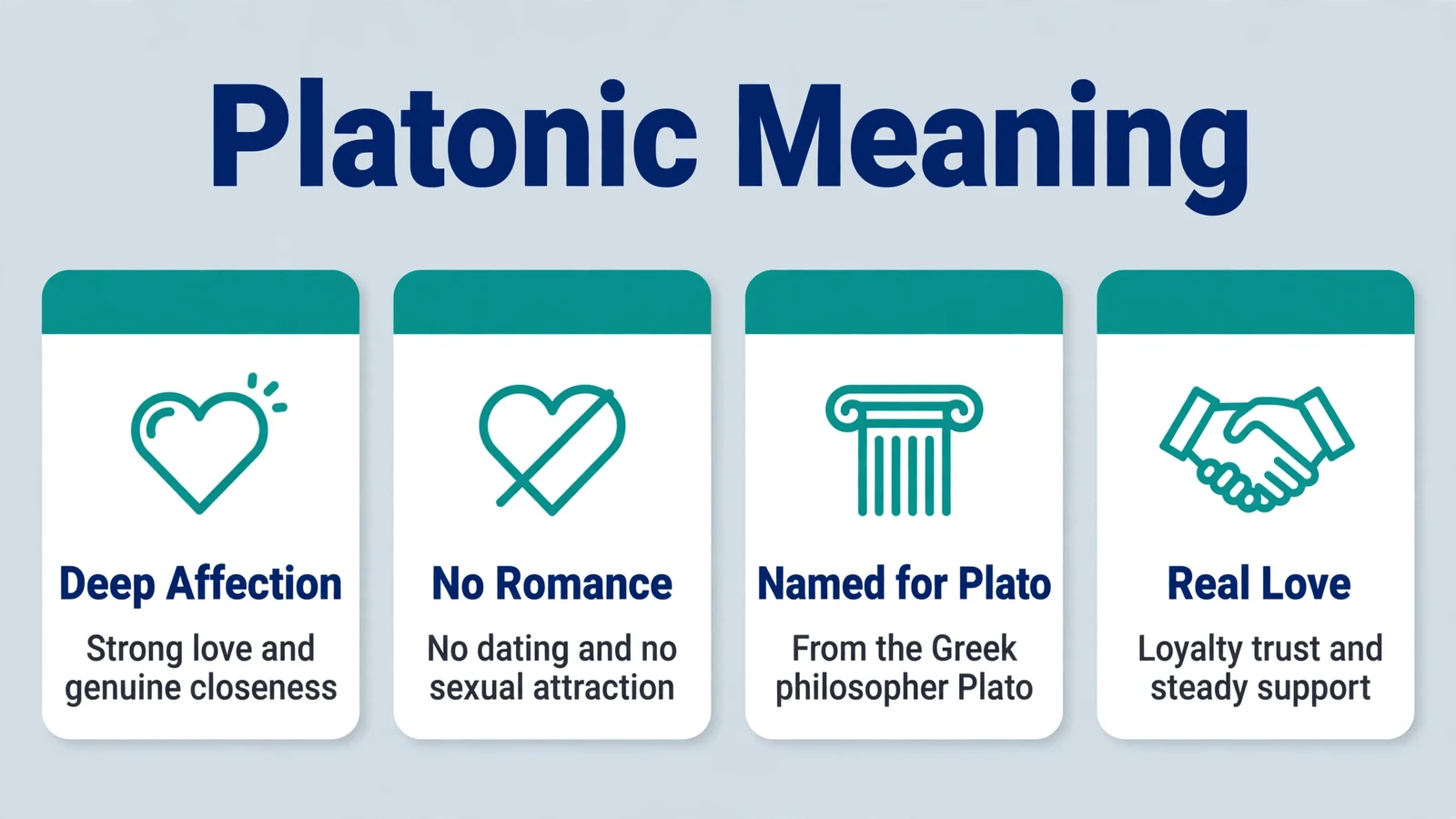
Two coworkers eat dinner together every Friday night. They text daily, share desserts, and finish each other’s jokes with ease. Everyone around them keeps asking the same question: are they dating? The honest answer is no. Their bond is platonic, which means it rests on affection and closeness without romance or sexual attraction.
That short answer covers most everyday uses of the word. Still, platonic carries a long history that begins with the Greek philosopher Plato. Along the way, it gathered ideas about spiritual love, ideal beauty, and friendship that lifts both people higher. Words this old tend to collect myths, and platonic has collected several.
This guide explains the platonic meaning in plain language. You will learn where the word came from and what Plato actually described. You will also see how platonic love differs from romantic love, with real examples. Finally, you will find sentence examples, usage notes, and answers to common questions.
What Does Platonic Mean?
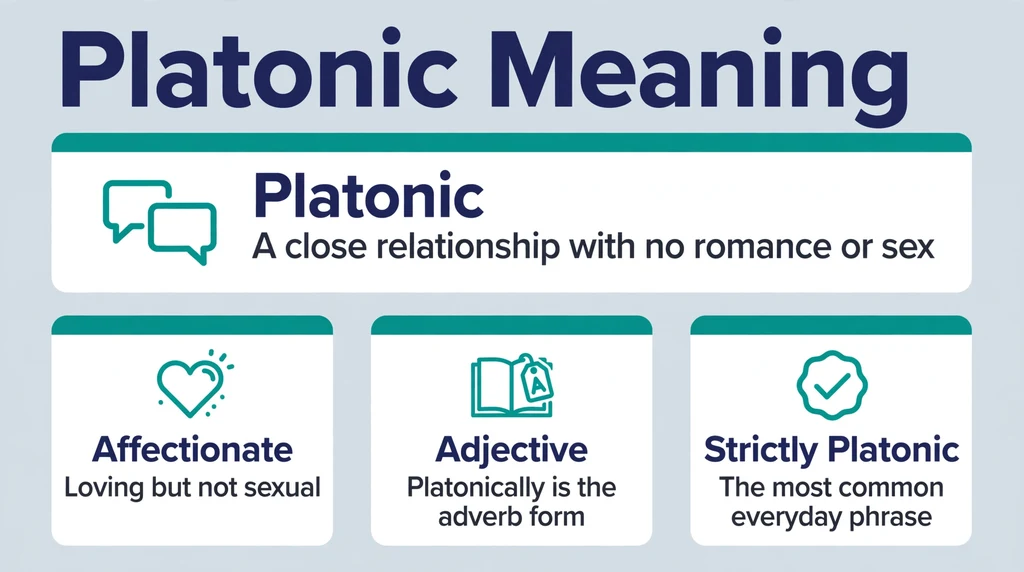
Platonic is an adjective that describes love, feelings, or a close relationship with no romance and no sex involved. Merriam-Webster defines this sense as “of, relating to, or being a relationship marked by the absence of romance or sex.” Cambridge puts it slightly warmer: a platonic relationship or emotion is “loving but not sexual.” Both dictionaries point to the same core idea.
The word is pronounced pluh-TAH-nik, and its adverb form is platonically. People most often use it for close friendships. However, it can also describe feelings, admiration, or love that stays purely spiritual. A teacher’s devotion to a mentor, for example, can be platonic.
You will meet the word in everyday talk, in novels, and in advice columns alike. It usually appears when someone needs to rule romance out quickly and kindly. Roommates, coworkers, and ex-partners reach for it whenever outsiders start guessing wrongly. Few single adjectives can clear the air that fast.
The Core Meaning in Simple Words
In simple words, platonic means “deep affection, minus the romance.” The closeness is real, and the loyalty is real. What is missing is romantic or sexual interest. Nothing about the word suggests coldness or distance.
Think of it as love with a clear boundary. Both people value the connection for its own sake. Neither person is pursuing a date, a partner, or a physical relationship. That is why the word so often appears in the phrase “strictly platonic.”
The Two Dictionary Senses
Dictionaries actually list two different senses for this word. The first sense points back to the philosopher himself. Capitalized, Platonic means “of, relating to, or characteristic of Plato or Platonism.” The second sense covers relationships and feelings. It grew out of the first one over many centuries.
Keeping the two senses apart removes most confusion. A course on Platonic philosophy belongs to sense one. A friendship between two close coworkers belongs to sense two. The rest of this article focuses mainly on the second sense, since that is what most searchers want.
Platonic Feelings and Platonic Attraction
Modern speakers also talk about platonic feelings and platonic attraction. These phrases name the pull toward closeness, trust, and time together, without any romantic aim. You might feel it toward a new coworker who instantly feels like an old friend. The wish is for friendship itself, not for dating.
This newer wording helps people describe bonds that older vocabulary missed. It separates “I want to know this person deeply” from “I want to date this person.” Both wishes are normal, and they often get confused. Having a clean word for the first one prevents awkward misunderstandings.
Where the Word Platonic Comes From
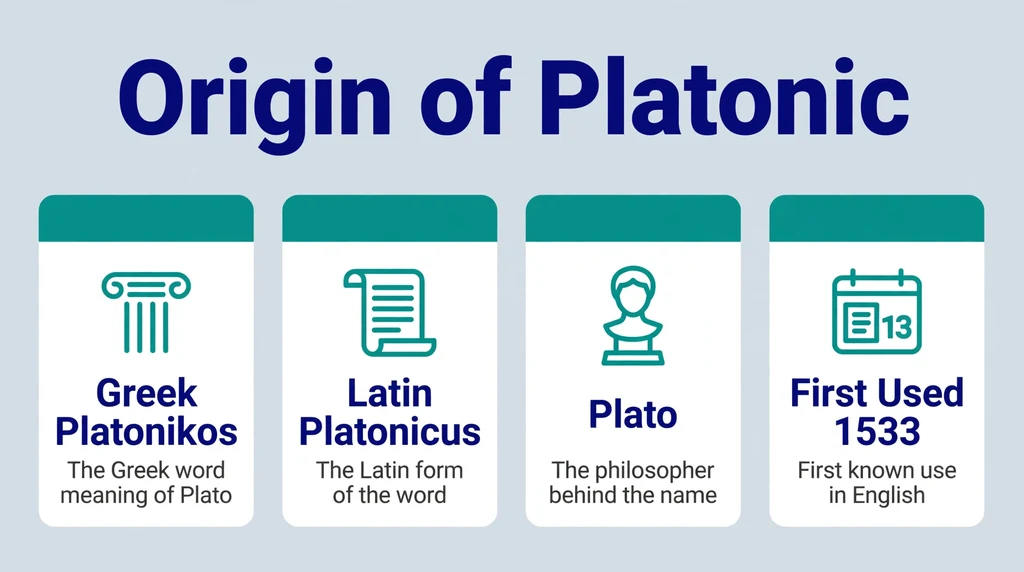
Like many English words, platonic traveled through older languages first. It comes from the Latin word platonicus, which comes from the Greek platōnikos. Both forms simply mean “of Plato.” Merriam-Webster records the first known use of platonic in English in 1533, in the sense about Plato and his philosophy.
The relationship sense arrived much later, though. To understand it, you first need to meet Plato himself. His writings on love planted the seed, even if he never used our modern phrase.
There is a reason the word wears Latin clothing. Renaissance readers across Europe met Plato mainly in Latin translation, not in Greek. Ficino’s Latin Plato, printed in 1484, carried the ideas into every major library. When English writers borrowed the term soon after, they borrowed its Latin shape as well.
Plato and the Symposium
Plato was an ancient Greek philosopher who lived roughly 2,400 years ago. In his dialogue the Symposium, a group of friends at a drinking party take turns praising Eros, the god of love. Each speech offers a different view of what love is. The most famous speech comes from Socrates, who retells what a wise woman named Diotima taught him.
Diotima describes love as a longing for beauty and goodness. Physical attraction, in her account, is only the lowest step. True love keeps climbing toward something higher and more lasting. That climbing image became the heart of the whole idea.
Diotima’s Ladder of Love
Diotima’s teaching is often called the ladder of love. The lover starts with love for one beautiful body. Next, the lover notices that beauty appears in all bodies, not just one. The climb then moves to beautiful souls, where character matters more than looks.
After that come beautiful laws, customs, and forms of knowledge. At the very top stands Beauty itself, an eternal and unchanging ideal. Merriam-Webster sums up this first sense of platonic love as love “ascending from passion for the individual to contemplation of the universal and ideal.” Modern platonic love is a distant, simplified cousin of this ladder.
The Phaedrus and the Alcibiades Story
The Symposium is not Plato’s only dialogue about love. In the Phaedrus, Socrates again discusses eros, this time as a kind of divine madness that can lift the soul. Both dialogues treat love as a force that can educate desire, not merely satisfy it. That theme runs through everything later called platonic.
The Symposium also ends with a famous living example. The general Alcibiades arrives drunk and praises Socrates in front of everyone. He admits that he once tried to seduce the philosopher and failed completely. Socrates, he says, stayed unmoved and spent the night in complete restraint. Readers have retold that scene for centuries as platonic devotion in action.
Ficino Coins “Platonic Love”
The actual phrase “platonic love” appeared in the 15th century, long after Plato died. The Italian philosopher Marsilio Ficino translated Plato’s complete works into Latin. His translation appeared in print in 1484, and it restarted European interest in Plato. In 1469, Ficino also wrote a commentary on the Symposium, known as De amore.
In that commentary, Ficino described love as a spiritual bond between souls. He read Plato through his own Christian faith, so his version stressed purity and the soul’s love of God. Scholars credit Ficino with coining the term Platonic love, from the Latin amor platonicus. Britannica notes that his theory of spiritual, or Platonic, love dominated European poetry and literature during the 16th century.
Later, the phrase reached England and became a court fashion. Merriam-Webster gives 1631 as the first known use of “platonic love” in English. A few years later, William Davenant’s 1636 play The Platonick Lovers gently mocked the trend. From there, the meaning slowly softened into today’s simple idea: love without romance or sex.
Platonic Love Explained
Platonic love is the strong affection behind every platonic relationship. Merriam-Webster’s second sense of platonic love describes “a close relationship between two persons in which sexual desire is nonexistent or has been suppressed or sublimated.” That wording matters. The love itself can be powerful, even life changing. Only the sexual element is absent, set aside, or transformed into something else.
In daily speech, people use platonic love much more loosely. They mean the love between close friends who would do anything for each other. College roommates, childhood friends, and longtime coworkers all use the phrase this way. The feeling is warm, loyal, and completely non-romantic.
Notice how far the phrase has drifted from Ficino’s version. He imagined a rare, disciplined love aimed at God and ideal beauty. Modern speakers mean something warmer and simpler: the friend who feels like family. The shared core across the centuries is love that does not seek physical possession.
What Platonic Love Includes
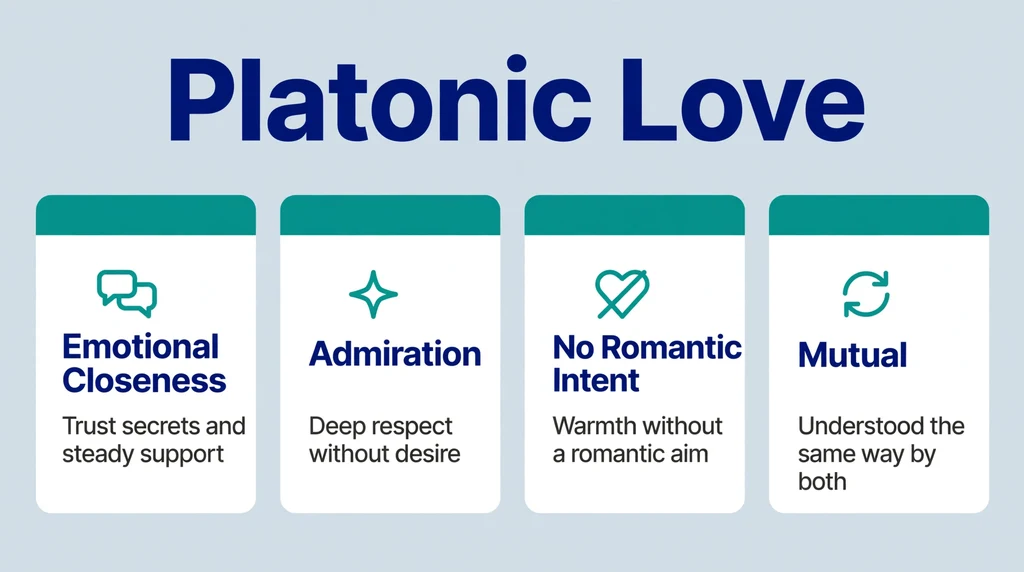
Platonic love includes emotional closeness, trust, and steady support. Friends share secrets, celebrate wins, and show up during hard weeks. It also includes admiration, because you can deeply respect someone without desiring them. Intellectual connection belongs here too, since many platonic bonds grow around shared ideas.
Physical affection can still appear in small, ordinary ways. A hug at the airport or a pat on the back does not change the label. What defines the bond is the absence of romantic intent, not the absence of warmth.
Platonic love also tends to be patient. It does not demand constant contact or dramatic proof. Old friends can meet after five silent years and resume mid-sentence. That durability is one reason psychologists and poets alike keep praising it.
What Platonic Love Is Not
Platonic love is not a failed romance or a consolation prize. It is also not a one-sided crush that someone hides and hopes will change. When one person secretly wants more, most people would call that unrequited love instead. Platonic love, used honestly, describes a connection both sides understand the same way.
It is not limited to any gender pairing either. Two women, two men, or a mixed group of friends can all share it. The word describes the nature of the bond, never the genders involved.
Platonic Love or Friendship: Is There a Difference?
Readers sometimes wonder whether platonic love is just a grand name for friendship. In everyday speech, the two overlap heavily. Most platonic love lives inside close friendships, so the words often swap places without confusion.
A slight difference in tone still exists. “Friendship” names the relationship, while “platonic love” names the feeling inside it. The second phrase also suits bonds that are not quite friendships, like devotion to a mentor. When you want to stress depth and loyalty, platonic love is the stronger choice.
Platonic vs Romantic Love
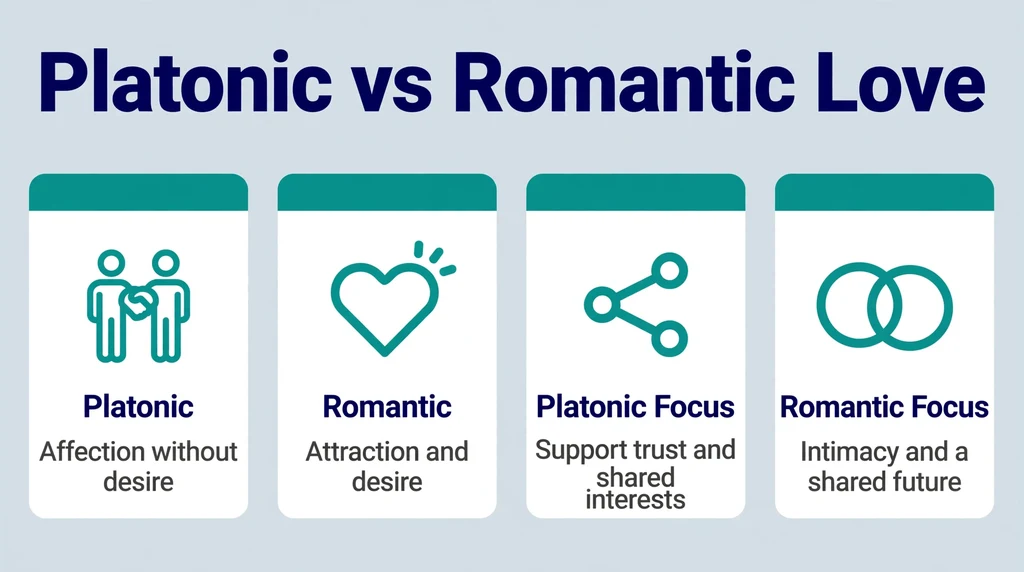
Platonic and romantic love can feel equally strong, yet they point in different directions. Romantic love usually involves attraction, desire, and some hope of partnership. Platonic love offers devotion and closeness while skipping attraction entirely. Understanding the contrast helps you label your own relationships with more honesty.
| Aspect | Platonic Love | Romantic Love |
|---|---|---|
| Attraction | Affection and admiration | Affection plus romantic or sexual attraction |
| Physical element | Little or none, and never the goal | Often central to the bond |
| Typical bond | Friendship, mentorship, chosen family | Dating, partnership, marriage |
| Exclusivity | Rarely expected | Commonly expected |
| Main focus | Support, trust, shared interests | Intimacy, desire, shared future |
The Key Differences
The clearest difference is desire. Romantic partners usually want physical closeness and an exclusive claim on each other. Platonic friends want time, honesty, and mutual care instead. Neither list is better; they simply describe different kinds of attachment.
Expectations differ as well. Romance often moves toward defined milestones, like dating, moving in, or marriage. Platonic love has no such script. It can stay steady for decades without needing a new label.
Can a Relationship Change From One to the Other?
Yes, feelings sometimes shift in either direction. Some couples begin as platonic friends and later fall in love. Other couples split up and rebuild a genuine platonic friendship afterward. Change is common because emotions are not fixed settings.
Honesty matters most during any shift. If your feelings change, the kind thing is to say so calmly. The other person can then decide what they want too. A clear conversation protects the friendship far better than silent hoping.
Why the Distinction Matters
Labels will not run a relationship for you, but they do prevent pain. When both people share one definition, nobody waits for a romance that is not coming. Nobody feels tricked, and nobody has to guess at hidden meanings. That shared clarity is the practical gift of the word platonic.
The distinction also protects existing couples. A partner who hears “she is a platonic friend” gets a clear, checkable claim. Trust grows when the label matches the behavior. Whenever the two agree, the word has done its job well.
Types of Platonic Relationships
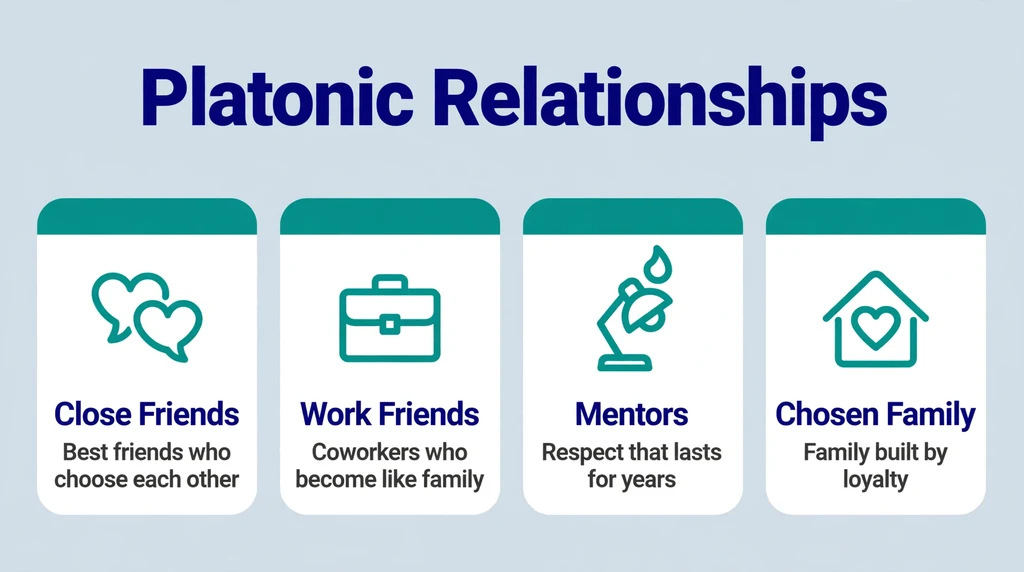
Platonic relationships appear in nearly every stage of life. Some last a school year, while others last sixty years. The examples below show how varied these bonds can be. Notice that none of them need romance to feel deep or important.
Close Friendships
The classic example is the best friendship. Two people choose each other again and again, through moves, jobs, and family changes. They may call each other brother, sister, or soulmate in a friendly sense. Their love is obvious to everyone, yet nobody mistakes it for dating for long.
Work Friends and Mentors
Offices create strong platonic bonds too. A trusted coworker who covers your shift and hears your worries becomes real family over time. Mentors and their former students often share this pattern as well. The respect runs deep, and the connection can last long after the job ends.
Roommates and Chosen Family
Roommates who cook together, split chores, and look after each other form another clear example. For many adults, friends like these become a chosen family. They spend holidays together and list each other as emergency contacts. Family, in this sense, is built by loyalty rather than by blood.
Long-Distance and Online Friendships
Distance does not weaken the label at all. Many platonic bonds now live in message threads, voice calls, and shared games. Two friends on different continents can stay closer than neighbors do. The bond still rests on conversation, humor, and loyalty, and none of those need a shared address.
Platonic Soulmates
A popular modern phrase calls such a person a “platonic soulmate.” It describes a friend who feels destined, irreplaceable, and deeply understood. The phrase borrows the drama of romantic language on purpose. It announces that friendship, not romance, holds the deepest seat in that person’s life.
Platonic Relationships at School and University
Campuses are factories for platonic bonds. Study partners, lab teammates, and dorm neighbors spend intense months side by side. Shared deadlines and cheap shared meals weld people together quickly. Many graduates say these friendships, not the lectures, shaped them most. Because romance is common on campus too, the word platonic gets heavy use there. It sorts the study group from the dating pool in one syllable-heavy adjective.
Signs a Relationship Is Platonic
A few signs usually point to a platonic bond. Neither person flirts, angles for dates, or feels jealous of the other’s partner. Both people relax fully around each other, like siblings do. Finally, each person can describe the relationship the same way without hesitation. When both definitions match, the label fits.
How to Use Platonic in a Sentence
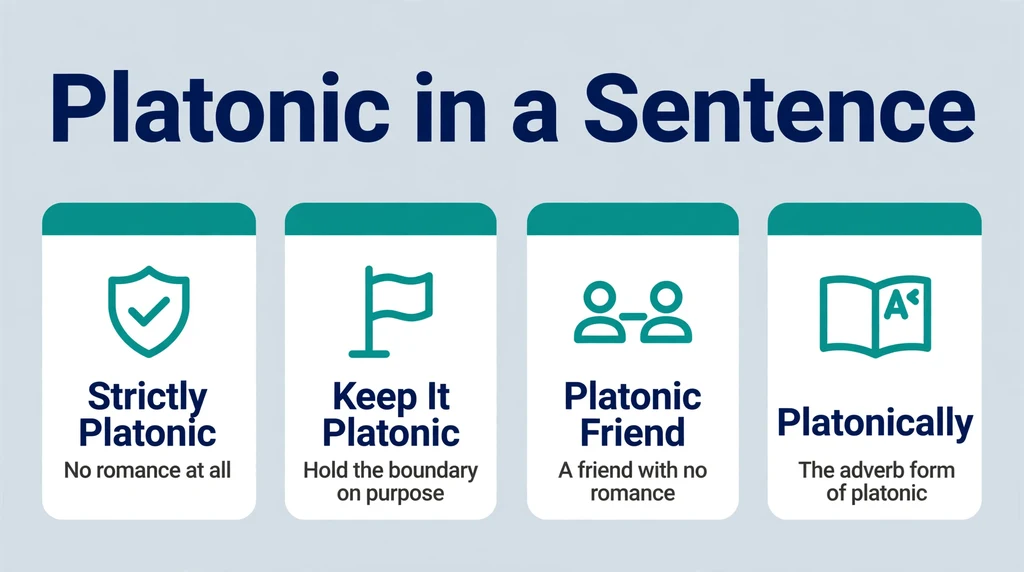
Seeing the word inside real sentences makes its meaning stick. The examples below are all natural, everyday uses. Pay attention to how often platonic sits right before the words love, relationship, or friendship.
- They dated briefly in college, but today their relationship is completely platonic.
- She loves her best friend dearly, though the feeling is entirely platonic.
- He assured his girlfriend that his friendship with his coworker was strictly platonic.
- The two actors share a warm platonic chemistry that audiences adore.
- Their platonic love survived three moves, two weddings, and thirty years.
- We share an apartment, but I promise you, it is purely platonic.
- He feels only platonic affection for her, like a sister.
- The letter expressed a deep platonic admiration for her mentor’s work.
- After the breakup, they stayed close and built an easy, platonic friendship.
- He joined the hiking group hoping for platonic company, not dates.
- Everyone teased them about dating, but they insisted it was platonic.
- She describes her bond with her co-founder as intense yet wholly platonic.
Common Phrases With Platonic
A handful of set phrases appear again and again. “Strictly platonic” stresses that no romance exists at all. “Keep it platonic” asks someone to hold that boundary on purpose. “Platonic friend” and “platonic best friend” name the person, not just the feeling.
You will also hear the adverb in lines like “I love him platonically.” That single word replaces a whole explanation. It tells the listener: affection yes, romance no.
Grammar Notes
Platonic works as an adjective, so it stands before a noun or after a linking verb. “A platonic relationship” and “the relationship is platonic” are both correct. It has no comparative form in normal use, so avoid “more platonic.” Writers usually choose “completely,” “strictly,” or “purely” to strengthen it instead.
Platonic in Formal and Academic Writing
Formal prose uses the word with the same core meaning, only tidier. Historians describe the devotion between certain monks, scholars, or soldiers as platonic. Biographers reach for it when two famous minds shared a famous friendship. In essays, the phrase “a platonic bond” signals that the writer has considered romance and ruled it out. That precision is exactly why the word survives in serious writing.
Platonic Synonyms and Antonyms
A thesaurus view helps the meaning settle. Platonic sits in a family of words about affection without desire. Its opposites, meanwhile, all point toward romance or physical attraction instead.
Words With a Similar Meaning
Non-romantic is the most direct substitute, and nonsexual covers the physical side. Affectionate and friendly describe the warm half of the meaning, though both are broader than platonic. Older books use chaste for this sense, and formal writing sometimes chooses purely spiritual. For the love itself, companionate appears in psychology writing, where it names steady, friendly devotion.
None of these matches platonic perfectly. Each one drops either the depth, the history, or the clear boundary. That is exactly why the old Greek borrowing survives: it packs all three into one word.
Words With the Opposite Meaning
The clearest opposites are romantic and sexual. Amorous and passionate describe feelings aimed at a lover, while erotic points squarely at physical desire. A relationship described with any of these words is, by definition, not platonic. Writers often set the pairs side by side for contrast, as in “their bond turned from platonic to romantic.”
Platonic With a Capital P: Usage Notes
New writers often ask whether platonic needs a capital letter. The answer depends on which sense you mean. Merriam-Webster notes that the sense about Plato or his philosophy “will always be capitalized.” So you write Platonic philosophy, Platonic forms, and Platonic solids with a capital P.
The relationship sense behaves differently. Most style guides treat it as an ordinary adjective and lowercase it. You will see “a platonic friendship” in most modern books and articles. Some writers still capitalize it out of respect for Plato, and readers will not mark it wrong. Consistency inside one document matters more than the choice itself.
Geometry borrowed the name as well, in the five Platonic solids. Mathematics and philosophy both keep the capital, since both point straight back to Plato. Whenever the word names his ideas, his school, or his legacy, the capital letter is the safe choice.
The “Platonic Ideal” Sense
One more phrase deserves a quick note. A “platonic ideal” means the perfect example of something. Journalists write about “the platonic ideal of a hotel bar” or of a summer day. This use borrows Plato’s theory of perfect forms, so it takes the capital P. It has nothing to do with relationships, which surprises many readers.
Style magazines reach for the phrase whenever they praise a flawless specimen. One famous example calls a chair design “the platonic ideal of the chair.” If a sentence praises a thing as the purest version of its kind, this is the sense at work. Context always separates it from the friendship sense.
Common Misconceptions About Platonic
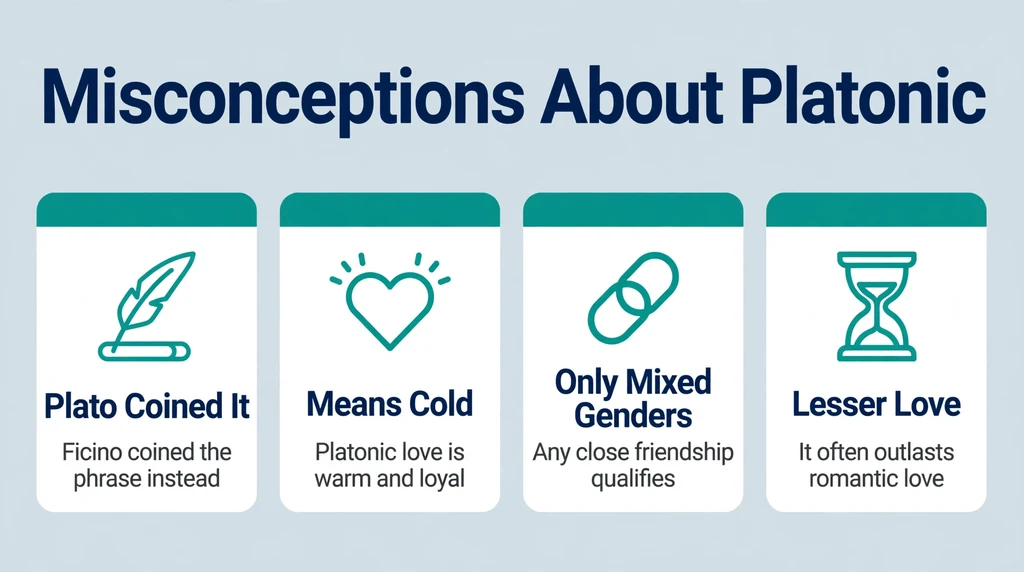
Few relationship words carry as many myths as this one. Some myths come from its long history, while others come from movies. Clearing them up makes the word far more useful.
Myth 1: Plato Invented the Phrase
Plato never wrote the words “platonic love” anywhere. He explored love deeply in the Symposium and the Phaedrus, yet the label came much later. Ficino coined it in the 15th century, over 1,800 years after Plato lived. The idea is Platonic; the phrase is Renaissance.
Myth 2: Platonic Means Cold or Distant
Many people hear “platonic” and picture something dry or emotionless. Real platonic love is often the opposite. It can involve fierce loyalty, daily affection, and profound grief at loss. The word removes romance from the picture, not feeling.
Myth 3: It Only Applies Between Men and Women
Old definitions sometimes framed platonic love as an opposite-sex arrangement. Modern usage is far wider than that. Any close friendship can be platonic, whatever the genders involved. The word describes the bond’s nature, so it fits best friends of every kind.
Myth 4: Any Attraction Ruins It
Dictionary wording is more forgiving than the myth suggests. Recall that Merriam-Webster allows desire that is “suppressed or sublimated,” not only desire that never existed. A passing attraction that both people honestly set aside does not erase years of friendship. What matters is how the pair actually treats the bond.
Myth 5: Platonic Love Is Lesser Love
Romance gets the songs and the films, so platonic love can look second rate. In practice, platonic bonds often outlast romantic ones. They raise children, staff hospitals, and hold whole communities together. A love does not need desire in it to be among the strongest forces in a life.
Myth 6: Saying “Platonic” Settles Everything
Some people treat the word like a magic shield that ends all questions. Sadly, a label alone cannot manage a relationship. Jealousy, mixed signals, and hurt feelings can still appear on either side. The word works only when both people mean it and act on it. Honest check-ins keep a platonic bond as clean as its name promises.
Platonic in Modern Life and Dating Culture

The word works harder today than it did a generation ago. Dating apps ask users what they are looking for, and “something platonic” is now a normal answer. It signals friendship, conversation, and shared activities without romantic pressure. On social media, people describe study partners, gaming friends, and travel buddies the same way.
You may also hear “keep it platonic” at work or in class group chats. There it acts as a polite boundary marker. It keeps collaboration friendly while ruling romance out early. Used kindly, it prevents weeks of mixed signals.
Pop culture has noticed the trend as well. The Apple TV+ comedy series Platonic, which premiered in 2023, follows two former best friends who reconnect in middle age. Seth Rogen and Rose Byrne play the pair, and the title itself tells you the premise. Their bond is intense, funny, and entirely non-romantic.
One nearby term deserves a warning, though. “Friend zone” is not a synonym for platonic. The friend zone implies one person wanted romance and feels stuck. Platonic, by contrast, describes a mutual and contented arrangement. Using the right word keeps the tone respectful.
Platonic on Dating Apps
Dating platforms have quietly given the word a second career. Many profiles now state “here for platonic connections” or “platonic only, please.” The phrase works as an honest filter before a single message is sent. It attracts people seeking conversation, hobbies, and local friends, and it politely discourages everyone else.
The same wording appears in community groups and event listings. Book clubs, running crews, and language exchanges all borrow it. Wherever strangers meet, platonic has become the fastest way to promise a romance-free space.
How People Keep a Friendship Platonic
Healthy platonic bonds usually run on a few simple habits. Both people speak plainly about the nature of the relationship. They respect each other’s partners and include them naturally in plans. They also avoid the gray zones, like flirty late-night messaging, that blur intentions.
When feelings shift on one side, they say so early. A short, kind conversation now prevents a long, painful misunderstanding later. The word platonic opens that conversation; honesty is what finishes it.
Frequently Asked Questions
What does platonic mean in simple words?
Platonic means loving or liking someone deeply without romance or sex. It describes close friendships and affection that stay non-romantic on purpose. If you would call someone your best friend and nothing more, the bond is platonic.
What is an example of a platonic relationship?
Two best friends who support each other for years without dating form a classic example. A mentor and a former student who stay close also qualify. Roommates who act like siblings are another everyday case. The shared pattern is love and loyalty with no romantic element.
Can a platonic relationship turn romantic?
Yes, it can, and it happens fairly often. Feelings sometimes grow after years of friendship, and some couples start exactly this way. The reverse also happens when former partners rebuild a friendship. Honest conversation helps both people adjust to the change. If only one person’s feelings change, respect for the other’s answer decides whether the friendship survives in a new form.
Is platonic love real love?
Most people who live it answer yes without hesitation. Platonic love includes devotion, sacrifice, joy, and grief, which are hallmarks of love itself. It simply directs those feelings toward friendship rather than partnership. Philosophers since Ficino have treated it as one of love’s highest forms. Modern life agrees in practice, since close friends often provide the steadiest love a person ever receives.
What is the difference between platonic and romantic love?
Romantic love involves attraction, desire, and usually an exclusive partnership. Platonic love involves affection, trust, and support with no desire involved. Both can be deep and lasting. They differ in aim, not in value.
Why is it called platonic?
The word honors the Greek philosopher Plato, who explored love’s higher forms in the Symposium. His account of love climbing from bodies to Beauty itself inspired later thinkers. Ficino turned that inspiration into the phrase “platonic love” in the 1400s. The adjective itself entered English in 1533.
Should platonic be capitalized?
Capitalize it when you mean Plato or his philosophy, as in Platonic solids. Lowercase it for the relationship sense, as in a platonic friendship. Merriam-Webster states that the Plato sense is always capitalized. When in doubt, lowercase the friendship sense and stay consistent.
What does “strictly platonic” mean?
“Strictly platonic” means the relationship has no romantic or sexual element at all, without exception. People say it to remove doubt, often when others assume a couple. The word “strictly” adds firmness to the boundary. It is the most common way the adjective appears in everyday speech.
Final Thoughts
Platonic is a small word with an unusual journey. It began with a Greek philosopher’s banquet conversation about love and beauty. Renaissance thinkers then turned it into a banner for spiritual, non-physical love. Today it simply names the close, loyal bonds that carry most of us through life.
Used well, the word brings clarity and comfort. It tells the world that a relationship can be loving, devoted, and complete without romance. It also honors an insight older than the word itself: desire is only one of love’s many dialects. Friendship, admiration, loyalty, and shared wonder speak the others fluently. If you want the dictionary’s own wording before you use it, Merriam-Webster’s entry for platonic lays out both senses side by side. Keep the term in your vocabulary, and use it proudly for the friends who feel like family.