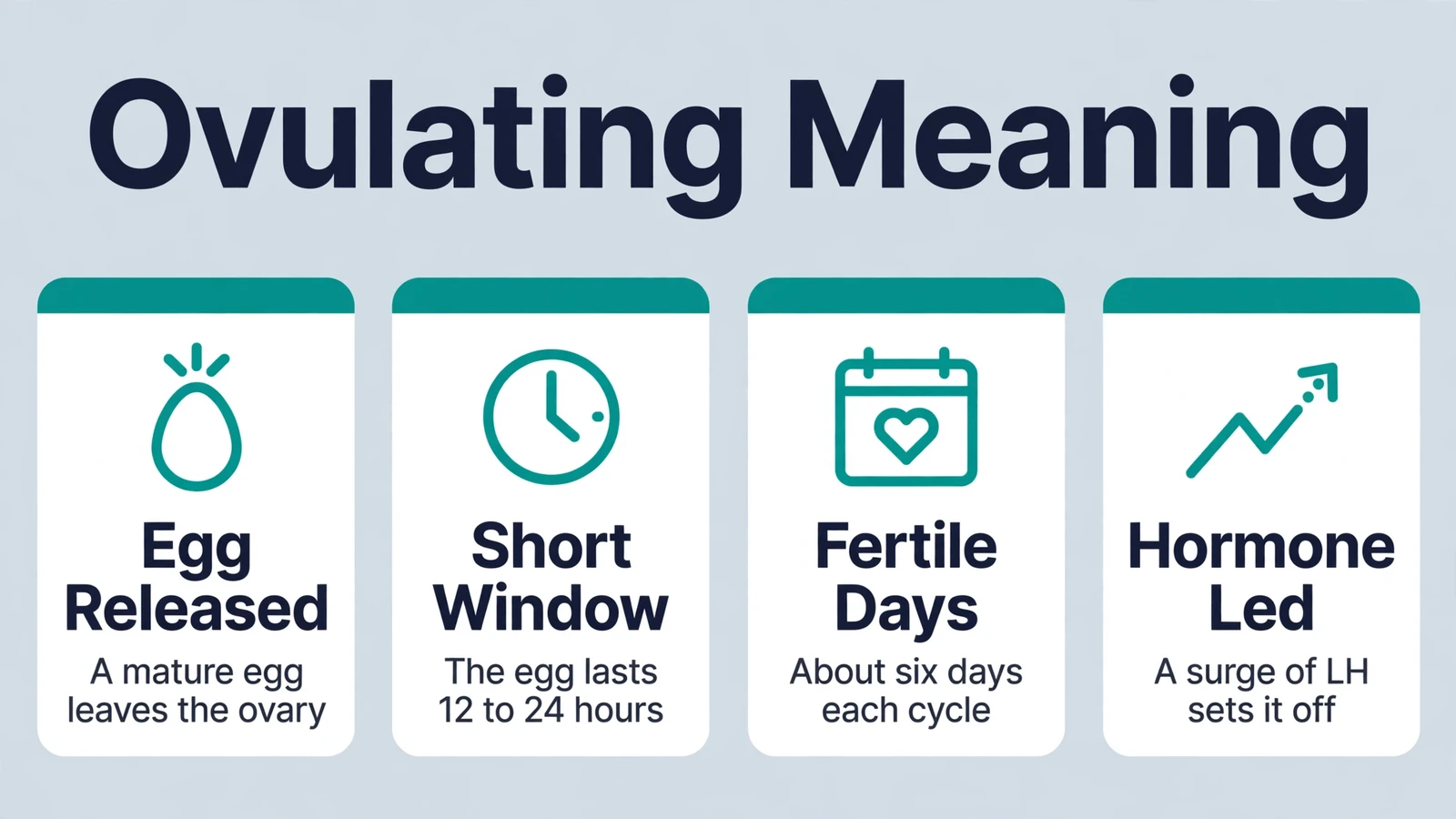
Ovulating means your body is releasing a mature egg from one of your ovaries. It is the one point in each menstrual cycle when pregnancy can begin. Once released, the egg travels into a fallopian tube and waits there for sperm, but only for a short time.
Most people meet this word while tracking a period app, planning a pregnancy, or trying to avoid one. Yet the details often stay fuzzy, and the famous day 14 rule misleads many readers. Major clinics such as Mayo Clinic and the NHS describe ovulation as a hormone driven event, and its timing shifts from person to person.
This guide explains the meaning in plain words first. After that, it covers the signs your body gives, the fertile window, home tests, and the myths worth dropping.
What Does Ovulating Mean?
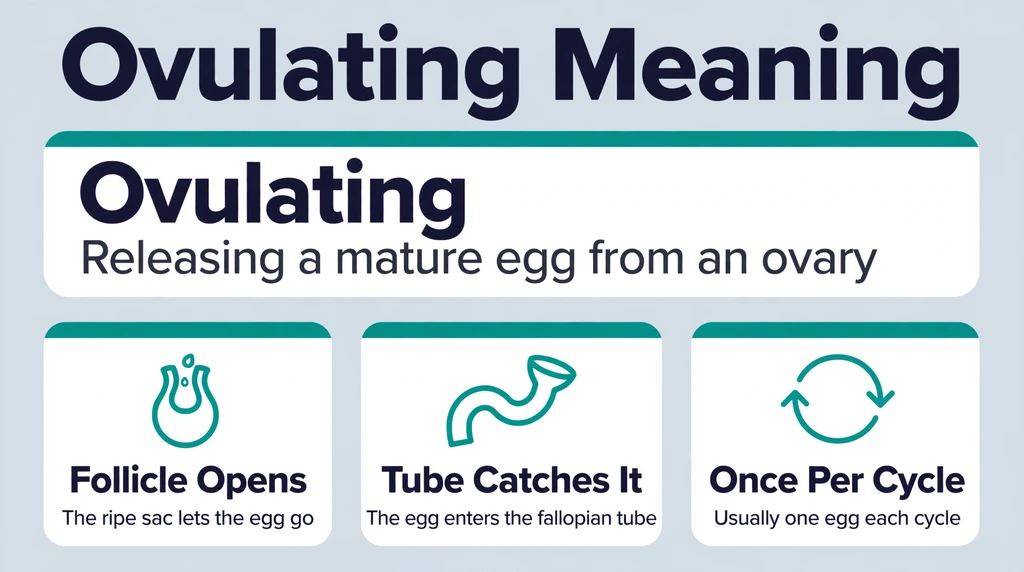
In plain language, ovulating means an ovary is letting go of a ripe egg. That egg has grown inside a small fluid filled sac called a follicle. When the follicle opens, the egg leaves the ovary and enters the nearby fallopian tube.
So when someone says “I am ovulating,” they mean this release is happening now, or is very close. The word points to a brief event, not a long phase of the cycle. In most cycles, the event takes place once, and one egg is released.
Occasionally, the ovaries release two eggs during the same event. The NHS notes that if both eggs are fertilized, the result can be a multiple pregnancy, such as twins. Even then, it still counts as one ovulation, just with an extra egg.
Ovulating also carries a fertility meaning that everyday speech often skips. Around this release sits the only stretch of the cycle when sperm can meet a living egg. That is why the word shows up so often in pregnancy planning, fertility tracking, and birth control discussions.
Think of it as a monthly handover. The ovary hands one mature egg to the fallopian tube. From that moment, a short countdown begins, and the rest of this guide explains how that countdown works.
Ovulating vs Being Fertile
People often treat ovulating and being fertile as the same thing. They are close, but they are not identical. Ovulating names a single event: the release of the egg on one day.
Being fertile describes a window of several days around that event. Sperm can survive for days while they wait, so fertility starts before the release itself. In everyday speech, “my fertile days” and “when I ovulate” point to the same season, but the calendar treats them differently.
This distinction matters when you read test results or app predictions. An app may shade six fertile days, yet only one of them is ovulation day. The other five are fertile because sperm, not the egg, can wait.
Core Meaning of Ovulation
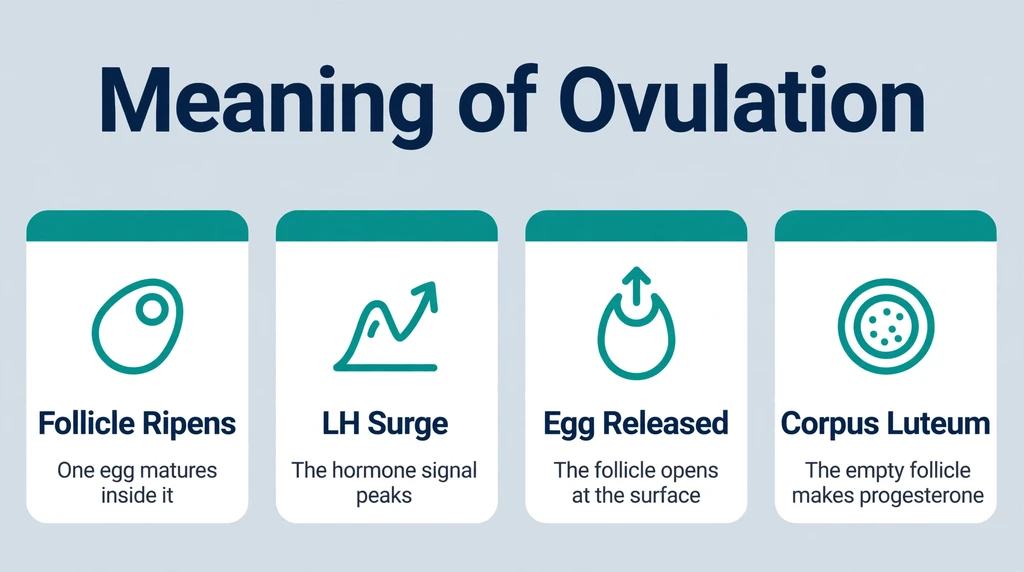
The dictionary style meaning is simple: ovulation is the release of an egg from an ovary. Still, the core meaning grows clearer when you see the two steps behind it. One step builds the egg. The next step sets it free.
The Follicle and the Egg
Each cycle, a group of follicles starts to grow in the ovaries. Over the first half of the cycle, one follicle usually pulls ahead of the rest. Inside it, a single egg matures while the other follicles fade back.
Meanwhile, rising estrogen thickens the lining of the uterus. This lining would support a pregnancy if the egg is fertilized later. So the body prepares two things at once: the egg itself, and a place for it to land.
When the lead follicle is fully ripe, it bulges at the surface of the ovary. It then ruptures and releases the egg. Tiny finger like fringes at the end of the fallopian tube sweep the egg inside, and the journey toward the uterus begins.
The Hormone Signal
Hormones run the whole sequence like a set of timed signals. Estrogen rises first, as the follicle grows. When estrogen peaks, it triggers a sharp surge of luteinizing hormone, usually called LH.
This LH surge is the starting gun for ovulation. Roughly a day to a day and a half later, the follicle releases its egg. Because tests can detect the surge in urine, those kits give advance warning, which later sections explain in detail.
After the egg leaves, the empty follicle changes into a small gland called the corpus luteum. It produces progesterone, a hormone that steadies the uterine lining. Together, these signals explain why ovulation sits at the center of the cycle, not at its edge.
Ovulating vs Ovulation
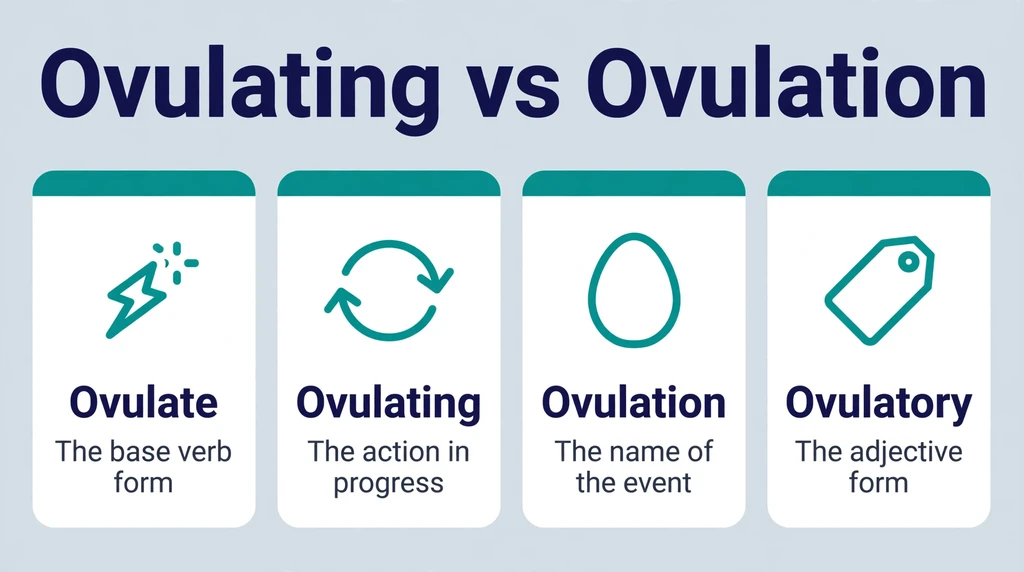
These three word forms cause quiet confusion, so it helps to separate them. All three come from the same root, the Latin word ovum, which means egg. Each form simply does a different job in a sentence.
Ovulate is the base verb. You can say, “Most women ovulate once per cycle.” Its other forms are ovulates, ovulated, and ovulating.
Ovulating is the present participle, the ing form. It describes the action while it is in progress. For example, “She is ovulating today, so her chances of conceiving are higher.”
Ovulation is the noun, the name of the event itself. For example, “Ovulation usually happens about two weeks before a period.” A related adjective, ovulatory, describes things connected with the event, as in “an ovulatory cycle.”
In short, you ovulate, you are ovulating during the release, and ovulation is the event you track on a calendar. Keeping the forms straight makes health articles, test instructions, and app notifications much easier to read.
Ovulating in Everyday Sentences
You will meet the word most often in health and family contexts. A tracking app might say, “You are ovulating this week,” meaning your fertile window is open now. A clinician might ask, “Do you know when you usually ovulate?”
Friends use it casually too: “My ovulation test was positive, so I am probably ovulating tomorrow.” Notice how speakers mix the forms freely in real talk. The noun names the event, while the ing form keeps the focus on the person and the present moment.
Ovulation Timing in Your Cycle
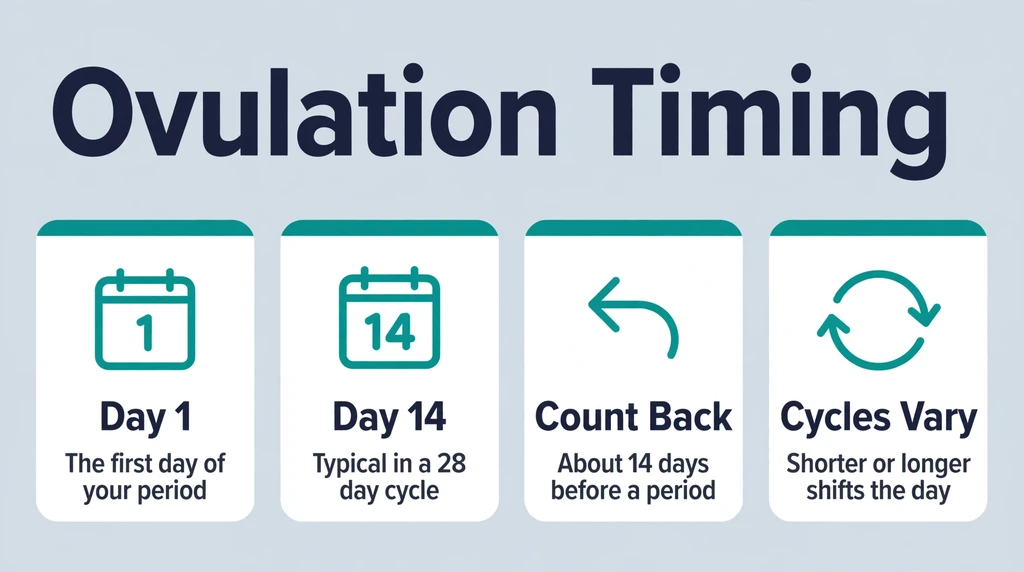
Timing is where most of the confusion lives. A menstrual cycle starts on day 1, which the NHS defines as the first day of your period. From there, you count forward until the day before your next period begins.
Here is the key point that surprises many readers. Ovulation is better counted backward than forward. Mayo Clinic explains that in an average 28 day cycle, ovulation typically occurs about 14 days before the start of the next period.
So in a textbook 28 day cycle, ovulation lands near day 14. That neat match is exactly why the day 14 rule became famous. However, the rule only fits cycles that actually last 28 days, and many do not.
Shorter and Longer Cycles
Apply the same backward count to other cycle lengths, and the picture changes. In a 24 day cycle, ovulation would fall near day 10. In a 35 day cycle, it would fall near day 21, a full week later than the famous rule suggests.
The NHS gives a wider frame for the same idea. It says ovulation happens around 10 to 16 days before the next period in most women. That range reflects the luteal phase, the stretch between ovulation and the next period, which stays fairly steady.
For a rough personal estimate, track your cycle length for a few months first. Then subtract about 14 days from your usual length. Cleveland Clinic suggests averaging three cycles, because one unusual month can skew the math.
Why Timing Shifts
Even with regular cycles, the exact day can move. The first half of the cycle, when the follicle grows, is the flexible half. Stress, illness, travel, poor sleep, and weight change can all stretch or shrink it.
The second half behaves more steadily, since the corpus luteum runs on a tighter schedule. As a result, a late period usually means ovulation happened later, not that the second half stretched. This is why apps sometimes miss the day, even for careful trackers.
Recent changes can move the day as well. Stopping hormonal birth control, recovering from illness, or crossing time zones can all shift one cycle. Most people settle back into their usual pattern within a month or two.
Signs You Are Ovulating
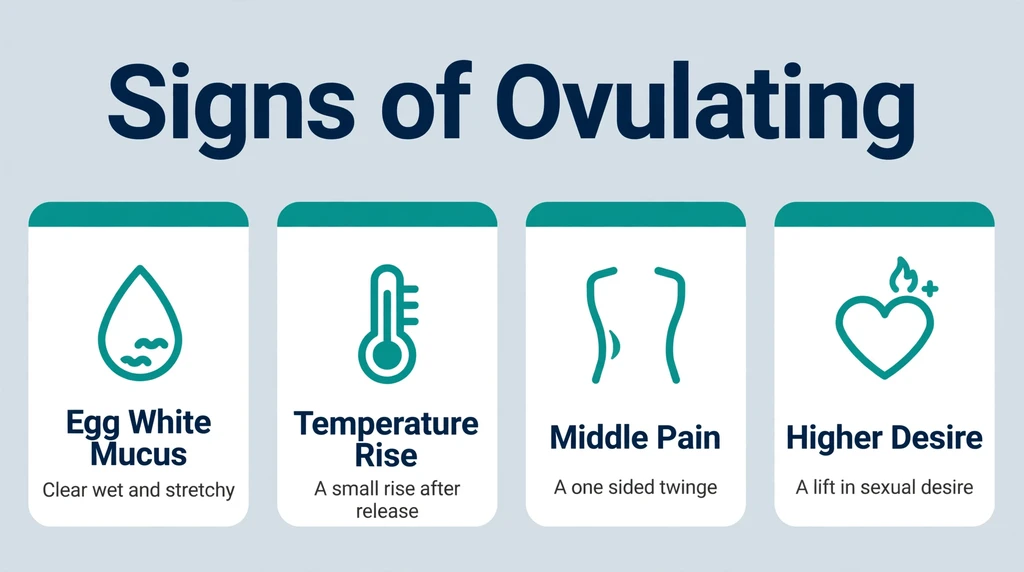
Your body sends several signals around ovulation, and some are more dependable than others. No single sign proves the egg has left, though. Instead, treat the signs as a pattern that builds over a few days.
Cervical Mucus Changes
Cervical mucus is the discharge your cervix produces, and it changes across the cycle. For most of the month it stays thick, sticky, or barely noticeable. As ovulation approaches, rising estrogen changes it in a clear direction.
Just before ovulation, Mayo Clinic notes, the mucus becomes clear, wet, and stretchy. Many guides compare it to raw egg white, because it can stretch between your fingers without breaking. This slippery texture helps sperm swim and survive longer.
After ovulation, the pattern flips again. The mucus turns thicker, cloudier, and much less noticeable. Watching this shift over two or three cycles teaches you your own fertile pattern better than any single day of checking.
Checking is simple and takes a moment. With clean hands, note what you see on toilet tissue or clean underwear. Then stretch a little mucus between two fingers. Fertile mucus stretches an inch or more without breaking, while non fertile mucus snaps right away.
Basal Body Temperature Rise
Your basal body temperature is your resting temperature, taken the moment you wake up. Before ovulation, it stays in a lower, fairly steady range. After the egg is released, progesterone pushes it upward.
Cleveland Clinic puts the rise at about 0.4 to 1.0 degrees Fahrenheit. The higher readings then hold until your next period starts. A simple chart of these mornings can show the shift clearly within one cycle.
Still, temperature has one big limit. It confirms ovulation only after the event has passed. ACOG makes the same point about temperature based tracking. So use the chart to learn your pattern for future cycles, not to catch the current day.
A basal thermometer helps, because it shows two decimal places. Cleveland Clinic recommends one that displays decimal points, since the shift is small. Ordinary fever thermometers can blur exactly the difference you are trying to see.
Mittelschmerz: The Mid-Cycle Twinge
Some people feel ovulation as a mild ache low in the belly. The ache usually sits on one side, matching the ovary that released the egg. It may last a few minutes or linger for a day or two.
Doctors call this mittelschmerz, a German word that means middle pain. The name fits, because the twinge falls near the middle of the cycle. For some trackers, it is a handy backup signal beside mucus and temperature.
However, pain is a soft sign, not a measurement. Cleveland Clinic guidance notes that its presence or absence says little about how fertile a cycle is. Many people never feel it at all, and they ovulate perfectly well.
Other Signs to Notice
A few softer signals can support the main three. Many people notice a lift in sexual desire around their fertile days. Breast tenderness, light bloating, and mild cramps also appear for some.
A small number notice light spotting near ovulation. These signs vary widely, though, and mood or appetite shifts can come from many causes. Treat them as supporting clues only, never as proof on their own.
Equally important, feeling nothing is normal too. Plenty of healthy cycles pass without pain, obvious mucus, or any clear signal. If you need certainty, the tests and tracking methods below give firmer answers than body watching alone.
A short daily note helps you sort real signs from noise. Write down mucus, pain, desire, and mood in one line each evening. After two cycles, your personal pattern usually stands out, including which signs you can trust and which ones never show up for you.
The Fertile Window Explained
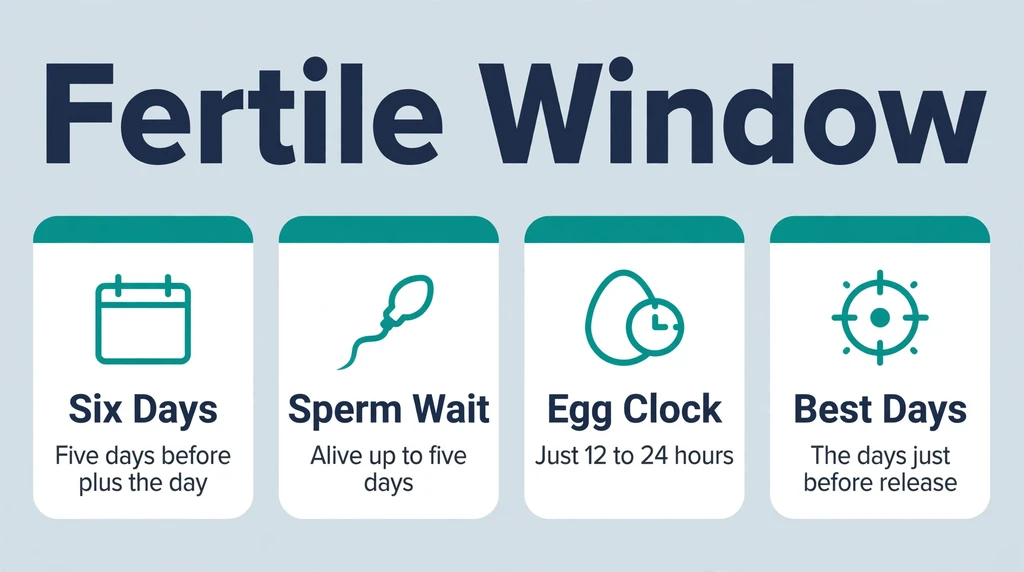
The fertile window is the short stretch of each cycle when pregnancy is possible. It lasts about six days: the five days before ovulation, plus ovulation day itself. Two very different lifespans create that window.
Sperm are the patient half of the pair. Mayo Clinic notes that sperm can live inside the female reproductive tract for as long as five days. So sperm from Monday can still be waiting when an egg arrives on Friday.
The egg, by contrast, is in a hurry. Once released, it can be fertilized for only about 12 to 24 hours. After that window closes, the egg breaks down, and the chance for that cycle ends.
This mismatch explains the practical advice clinics repeat. Mayo Clinic suggests having sex regularly from three to four days before ovulation until one day after it. The strongest days usually sit just before the release, when sperm are already in place and waiting.
It also explains a common surprise. The day of ovulation is not the only fertile day, and it may not even be the best one. Sex two days before the release often beats sex after it, simply because the egg’s clock runs out so fast.
A Worked Example
Picture a regular 30 day cycle, starting with a period on day 1. Counting back about 14 days from the next expected period puts ovulation near day 16. The fertile window then runs from about day 11 through day 16.
Now picture the same person in a stressful month that stretches the cycle to 34 days. Ovulation slides to about day 20, and the window slides with it. Anyone who trusted day 14 that month would have aimed almost a week too early.
That sliding is normal biology, not a tracking failure. It is also why body signs and tests add so much value. They respond to the cycle you are in, while the calendar only remembers the cycles you have finished.
What Happens After Ovulation
Once the egg leaves, the cycle enters its second half, called the luteal phase. The empty follicle, now the corpus luteum, produces progesterone. Under this hormone, the uterine lining stays thick, soft, and ready.
If sperm meet the egg in the fallopian tube, fertilization can occur. The fertilized egg then travels toward the uterus over several days, dividing as it goes. When it arrives, it can implant in the prepared lining, and pregnancy begins.
If no sperm meet the egg, the egg simply breaks down within about a day. The corpus luteum fades, progesterone falls, and the lining sheds as your next period. The NHS puts the gap between ovulation and that period at around 10 to 16 days.
This second half also explains many premenstrual feelings. Breast tenderness, bloating, and mood changes often belong to these luteal days, not to ovulation itself. Knowing which half you are in makes those monthly patterns far easier to read.
The corpus luteum has a built in lifespan of roughly two weeks. If pregnancy begins, signals from the early embryo keep it working and producing progesterone. If no signal arrives, it winds down on schedule, and that hormone drop is what allows the next period to start.
Progesterone also explains two things you met earlier in this guide. It drives the small temperature rise that chart keepers watch for each morning. And it can slow digestion slightly, which is why bloating so often belongs to the days after ovulation rather than the day itself.
Ovulation Through Your Lifetime
Ovulation does not run at the same rhythm from puberty to menopause. It starts unevenly, settles into a steadier pattern, and grows uneven again near the end. Knowing this arc stops normal changes from looking like problems.
The NHS points out that a woman is born with all her eggs already stored in the ovaries. Each cycle recruits a small group of those eggs toward maturity. Almost every month, only one of them completes the journey and is released.
The Early Years
In the first years after periods begin, cycles often run long and irregular. Anovulatory cycles are common during this stage, because the hormone conversation between brain and ovaries is still maturing. Many teens skip ovulation in some cycles without anything being wrong.
By the twenties, most people settle into their personal pattern. Cycle length becomes more predictable, and ovulation usually arrives on a steadier schedule. This is the stage when tracking methods work at their best.
Parents sometimes worry about the uneven teenage start. In most cases, though, it settles on its own within a few years. Only pain, very heavy bleeding, or periods that vanish for months at a time call for a checkup during these years.
Pregnancy, Postpartum and Menopause
Pregnancy pauses ovulation for its full length. After birth, the return of ovulation varies widely, and breastfeeding can delay it further. Importantly, the first postpartum ovulation can arrive before the first period, which surprises many new parents.
In the years before menopause, called perimenopause, the pattern loosens again. Cycles may shorten, lengthen, or skip ovulation entirely in some months. Once periods stop for good at menopause, ovulation ends as well.
That quiet return of fertility after birth catches many people off guard. Anyone who wants to avoid pregnancy needs a plan in place before the first postpartum period appears. Waiting for the period as a warning sign simply does not work.
Ovulating While on Birth Control
Hormonal birth control changes the ovulation story completely. The NHS explains that methods such as the combined pill, the patch, and the injection work partly by stopping ovulation. No egg is released, so there is nothing for sperm to meet.
Because of this, bleeding on hormonal methods is not proof of ovulation. The bleed follows the hormone schedule of the method, not a natural cycle. People sometimes track signs while on the pill and feel confused when nothing lines up.
Non hormonal methods work differently. Copper devices and barrier methods do not stop ovulation, so your natural cycle, signs, and fertile window continue as usual. If you stop a hormonal method, ovulation usually returns, though the first cycle or two can run long while your pattern resets.
This is also why missed pills matter. If the hormone level dips low enough for long enough, the ovaries can wake up and release an egg after all. That small gap in protection is exactly what pill instructions warn about when they describe what to do after a missed dose.
Ovulation Tests and the LH Surge
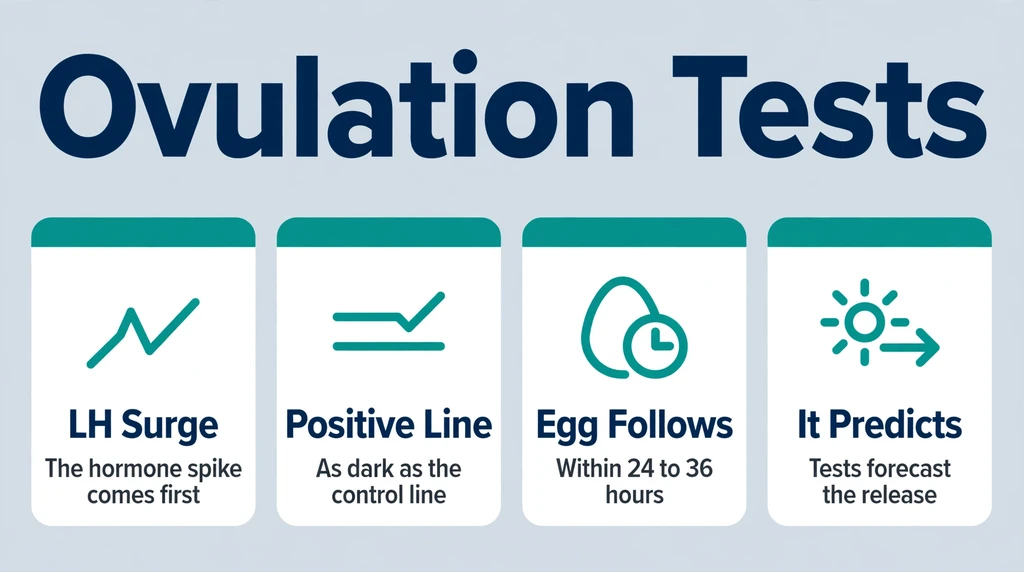
Home ovulation tests, often sold as ovulation predictor kits, offer a firmer signal than body signs. They do not detect the egg itself. Instead, they detect the LH surge that triggers the release.
You use a kit much like a pregnancy test. A strip or stick samples your urine, and it reacts to rising luteinizing hormone. Most kits turn positive about 24 to 36 hours before ovulation, giving you a useful head start.
Timing the tests matters. Start testing a few days before your expected surge, based on your usual cycle length. Test at the same time each day, and read the result window as the instructions direct.
A positive result usually shows a test line as dark as, or darker than, the control line. That darkness means the surge has arrived. Ovulation should follow within about a day or so, so those next two days matter most for conception.
Keep each used strip beside its date while it dries, or photograph it with your phone. Across several days, you can watch the line deepen as the surge builds. That simple record turns one confusing test into a clear trend, and it helps you learn how fast your own surge rises.
Kits have limits worth knowing. They predict ovulation; they do not confirm that an egg actually left. A surge can occasionally rise without a release. If your results look confusing month after month, a clinician can check ovulation directly with blood tests or ultrasound.
Strips, Digital Tests and Monitors
Basic strip tests are the cheapest option. You dip the strip, wait, and compare the test line with the control line yourself. They work well once you learn what your positive looks like.
Digital tests remove the guesswork by showing a clear symbol instead of lines. They cost more per cycle, but many people find them calmer to read. Fertility monitors go further and track hormone patterns across the whole cycle, building a wider picture for a higher price.
How to Track Ovulation at Home
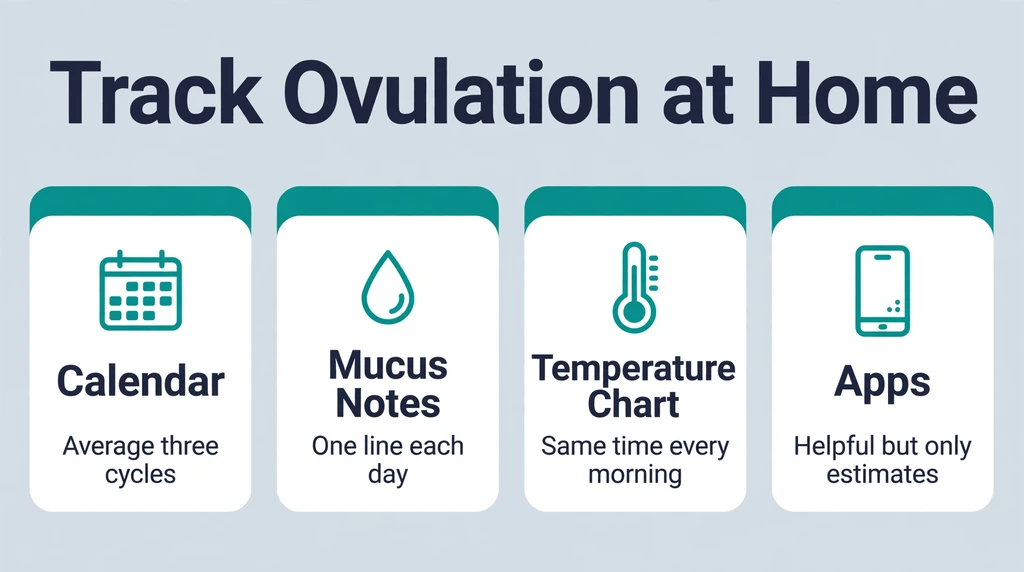
Tracking works best when you combine two or three simple methods. Each method covers a weakness in the others. Together, they build a picture of your personal pattern within a few cycles.
The Calendar Method
Start with the simplest tool: your period dates. Mark day 1 of each period, count each cycle’s length, and find your average. Cleveland Clinic suggests averaging three cycles for a steadier estimate.
Then count backward about 14 days from your expected next period. That gives a rough ovulation day and a fertile window around it. Remember, though, that calendar math gives an estimate, never a guarantee.
Add one habit to make the calendar smarter. Beside each period date, note anything unusual that month, such as illness, travel, or heavy stress. Later, odd cycles explain themselves, and your average stops hiding the story behind the numbers.
Charting Mucus and Temperature
Daily notes sharpen the calendar quickly. A one line note on mucus each day shows your fertile pattern forming in real time. Meanwhile, a temperature chart confirms, after the fact, that ovulation likely happened.
Take your temperature before getting out of bed, at the same time daily. Small disruptions, like illness or a late night, can bend a single reading. So judge the chart by its overall shift, not by one odd morning.
If charting feels fiddly at first, you are not alone. Clinicians often note that fertility awareness methods work best when someone teaches the basics in person. One short lesson can fix months of small recording mistakes.
Apps and Their Limits
Period apps bundle these records neatly and predict future windows automatically. They help many people stay consistent, which is half the battle in tracking. Still, most apps predict from past dates alone, and past dates cannot see this month’s stress or illness.
Use app predictions as a starting range, then check them against your mucus, tests, or temperature. When the body signs and the app disagree, trust the body signs. They describe the cycle you are actually in.
Common Myths About Ovulation
Short, confident claims about ovulation spread easily online. Unfortunately, several of the most repeated ones are wrong, and they can quietly wreck good tracking. Here are four myths worth retiring.
Myth 1: Everyone Ovulates on Day 14
Day 14 only matches a 28 day cycle. Shorter cycles ovulate earlier, and longer cycles ovulate later. Your own count backward from the next period tells the real story.
Myth 2: A Period Proves You Ovulated
Bleeding usually follows ovulation, but not always. Cleveland Clinic notes that some cycles release no egg, yet still end with bleeding. That bleeding comes from hormone shifts, not from a true post ovulation phase.
Myth 3: Ovulation Pain Means Peak Fertility
Mittelschmerz can appear before, during, or just after the release, and many people feel nothing. Pain alone cannot time the fertile window. Mucus changes and LH tests give far steadier signals for timing.
Myth 4: Pregnancy Is Possible on Any Day
The egg survives about a day, and sperm survive up to about five days. Outside that combined window, conception cannot occur. Still, cycles shift, so never treat calendar counting alone as reliable birth control.
Myth 5: Your Period Week Is Always Safe
This one fails at the edges of the cycle. With a short cycle, ovulation can arrive soon after bleeding ends. Sperm from the final days of a period can then survive long enough to meet that early egg, as the NHS cautions.
Myth 6: An Ovulation Test Works Like a Pregnancy Test
The two tests look alike but hunt different hormones. Ovulation kits detect LH, the surge that comes before the release. Pregnancy tests detect hCG, which appears only after implantation. A positive ovulation test cannot tell you that you are pregnant.
Irregular or Absent Ovulation
Sometimes the ovaries skip a release altogether. Doctors call such a cycle anovulatory, meaning no egg left the ovary that month. A single skipped cycle happens to many people and often means little on its own.
Patterns matter more than one odd month. Repeatedly irregular, very long, or missing periods can point to an underlying cause. Cleveland Clinic lists polycystic ovary syndrome, or PCOS, among the most common causes of absent ovulation.
Thyroid problems can also disrupt the hormone signals that release an egg. High stress, very low or very high body weight, and intense exercise can do the same. Even hormonal birth control works partly by design here, since the NHS notes that methods like the combined pill stop ovulation.
Because these causes overlap, guessing at home rarely settles the question. Simple blood tests can check the main hormone signals, including thyroid and prolactin levels. That is another reason a persistent pattern deserves a clinic visit rather than more months of wondering.
When to See a Clinician
Book a visit if your periods stay irregular, vanish for several months, or bring severe pelvic pain. The same advice applies if ovulation tests never turn positive across several cycles. A clinician can review your cycle history and run simple blood tests.
Also seek help if you have been trying to conceive for a year without success. Many clinics suggest coming sooner, after six months of trying, if you are over 35. This article offers general education only, and personal concerns always deserve personal medical advice.
Frequently Asked Questions
What does ovulating mean in simple words?
It means one of your ovaries is releasing a mature egg. That egg enters a fallopian tube, where sperm can fertilize it for about 12 to 24 hours. It is the key fertility event of each menstrual cycle.
How long does ovulation last?
The release itself is brief, and the egg stays usable for about 12 to 24 hours. However, your fertile window lasts about six days. That is because sperm can survive inside the body for up to five days before the egg arrives.
Can you get pregnant before ovulation day?
Yes. Sperm can wait in the fallopian tubes for several days, ready for the egg. In fact, the few days before ovulation are often the strongest days for conception. The day of release matters, but the days leading up to it matter just as much.
How do you know ovulation has finished?
Two signs point backward clearly. Your cervical mucus turns thicker and less noticeable, and your basal temperature rises and stays higher. Together, they suggest the egg’s short window has closed for this cycle.
Can you ovulate twice in one cycle?
The ovaries can release two eggs during a single ovulation event, which is how fraternal twins can begin. A second, separate ovulation later in the same cycle is not the normal pattern. The hormone changes after ovulation prevent another release that cycle.
Do ovulation tests confirm that you ovulated?
Not exactly. A positive test shows the LH surge, which predicts that ovulation is likely within about 24 to 36 hours. It cannot prove the egg actually left. Temperature charting, blood tests, or an ultrasound can confirm it more directly.
Is it normal to notice no ovulation signs?
Yes, completely. Many people ovulate monthly without pain, obvious mucus changes, or any clear signal. Regular cycles are reasonable evidence that ovulation is happening. If you want confirmation, home tests or a clinician’s blood test can provide it.
Can stress delay ovulation?
Yes. Stress works on the brain signals that start the cycle, so a hard month can push ovulation later. The egg still comes about two weeks before the next period, which is why the whole cycle runs long. Illness, travel, and sudden weight change can cause the same delay.
Final Thoughts
Ovulating simply means your ovary is releasing an egg, the brief event at the heart of the menstrual cycle. Once you know that, the rest falls into place: the backward count from your next period, the six day fertile window, and the body signs that mark it.
Track patterns over a few cycles rather than chasing one perfect day. Then match the method to your goal, whether that is planning a pregnancy or understanding your body better. If you remember one number, make it six: the days in each cycle when the whole story comes together. For a deeper clinical overview of the signs, Mayo Clinic’s guide to ovulation signs is a solid next read.
Above all, treat this information as general education, not personal medical advice. If your cycles worry you, a clinician who knows your history is the right next step.