A friend sends a screenshot to the group chat. It was meant for someone else. The whole chat goes quiet, and then one reply lands: “oop.” Another friend adds, “and i oop.” If those three letters left you staring, you are not behind. You just missed one of the internet’s favorite reactions.
In a text, OOP is a small word with a big facial expression. It means you are surprised, embarrassed, or watching something awkward happen. People type it when tea gets spilled. They type it when they send something to the wrong person. They type it when a story takes a turn nobody expected.
This guide is based on how OOP is actually used across TikTok, X, Instagram, and everyday chats. Every meaning was checked against documented sources, including Dictionary.com and Know Your Meme’s record of the original meme. Below, you will find the meanings, real examples, tone tips, and replies you can copy. You will also learn where “and I oop” actually came from.
OOP Meaning in Text at a Glance
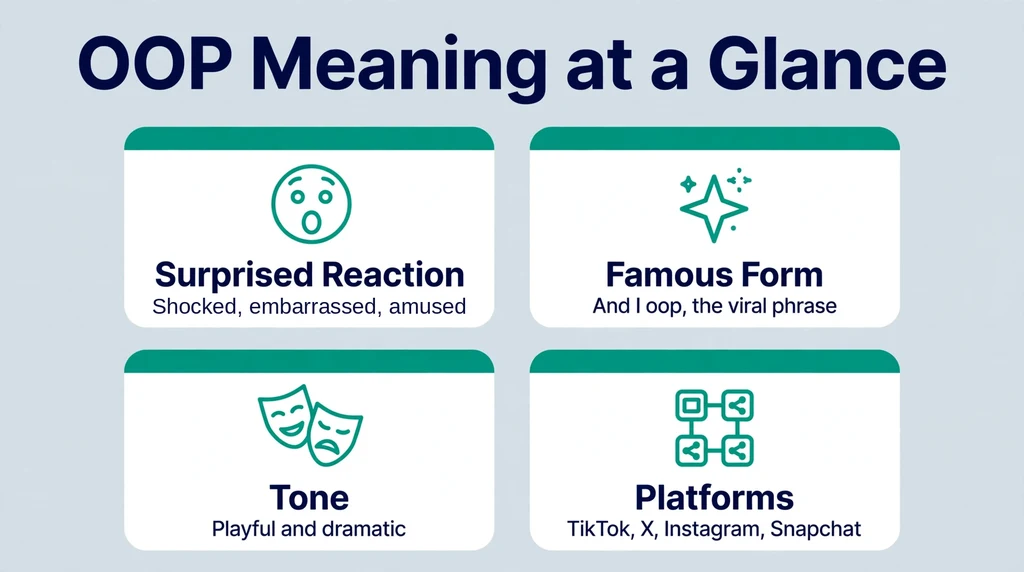
Short on time? Here is the fast version. In a text or comment section, “oop” is a quick reaction word that lands between “oops,” “oh no,” and a gasp. People reach for it when something is surprising, awkward, embarrassing, or just plain messy. Its famous full form is “and I oop,” the viral phrase that turns the reaction into a whole performance. OOP is playful slang for casual chats, not polite or professional messages.
| Detail | Explanation |
|---|---|
| Most Common Meaning | A surprised, awkward, or embarrassed reaction |
| Famous Form | “And I oop,” the viral mid-sentence cutoff |
| Tone | Playful, dramatic, lightly embarrassed |
| Common Platforms | TikTok, X, Instagram, Snapchat, text messages |
| Formal or Informal | Informal only |
What OOP Really Means in a Text
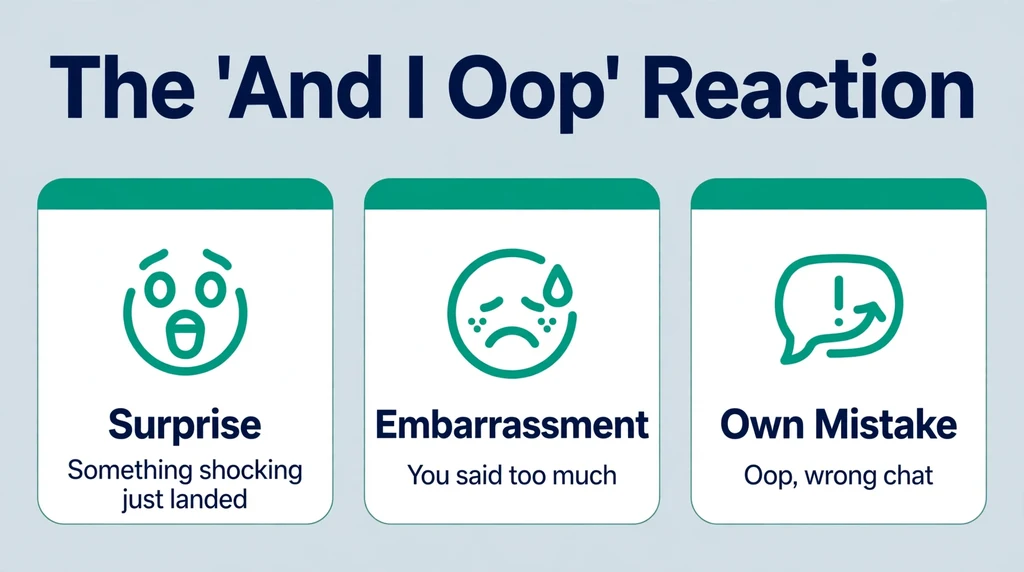
The first thing to know is that slang OOP is not an abbreviation you decode letter by letter. It is a sound typed out, a tiny gasp that escapes before you can stop it. That is why it works in so many moments. A secret slips out mid conversation. A photo lands in the wrong chat. Someone posts a story that exposes a little too much. The natural response to all three is the same short noise, spelled “oop” online.
Most of the time, OOP reacts to someone else’s moment: a bold confession, a wild celebrity post, a video ending nobody saw coming. Dropping “oop” underneath says: I saw that, I am shocked, and I am a little bit delighted. It carries surprise and amusement at once, which is why it spread so fast. A plain “wow” sounds flat next to it. OOP has drama built in.
The “And I Oop” Version
The full phrase is “and I oop,” and it adds one specific twist: it copies the feeling of stopping mid sentence because something just hit you. The speaker was talking, the shock arrived, and the sentence never finished. People type it when a revelation interrupts the moment: a plot twist, a screenshot that changes everything, a confession from nowhere. “And I oop” is bigger and more theatrical than plain “oop.” The plain version is a quick flinch. The full version is a hand over the mouth, eyes wide, whole pause.
People stretch it for comedy too, writing “and I oop-” with a dash, as if the shock cut the word off itself. The spelling stays casual, almost always lowercase in texts and comments.
OOP for Your Own Mistakes
OOP does double duty. It also works as a tiny confession when you are the one who slipped. Sent right after your own message, “oop” means “that was me, my bad.” You typed the name of the person you were talking about. You sent the meme to the group chat it was making fun of. You liked a photo from three years ago while scrolling too deep. A fast “oop, wrong chat” smooths it over, admitting the mistake and laughing at it in the same breath.
Other Meanings of OOP You Might See
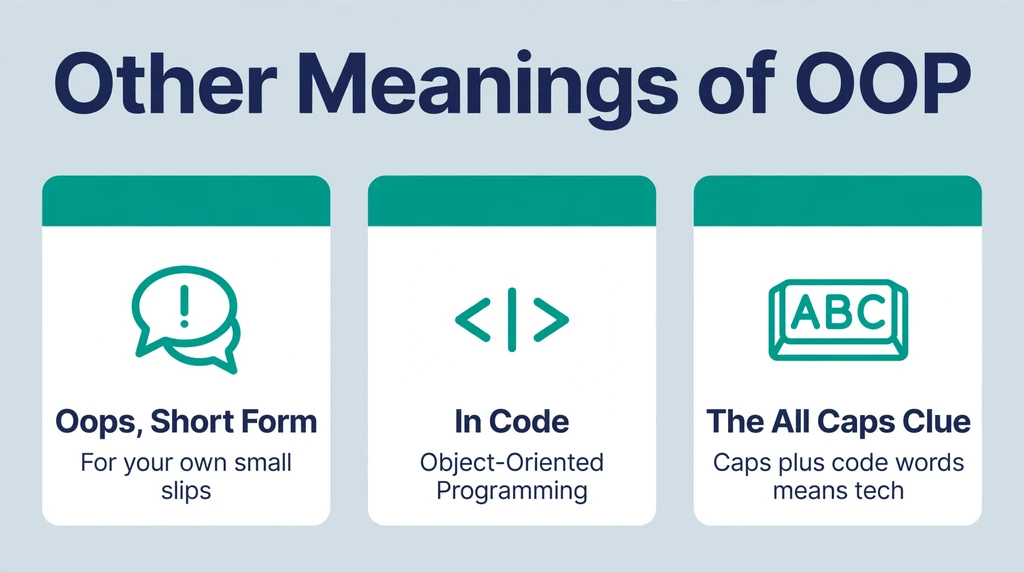
OOP has a couple of other lives outside the reaction word, and context tells you which one you are looking at.
| Meaning | Context | Tone | Example |
|---|---|---|---|
| Oops (short form) | Casual texts after your own slip | Light, apologetic | “oop, sent that to the wrong chat” |
| Object-Oriented Programming | Developer chats, coding forums, tech jobs | Neutral, technical | “The course covers OOP in Java.” |
The programming meaning confuses people in search results, so here is the short version. In tech, OOP stands for Object-Oriented Programming, a way of building software around objects and classes. It lives in course descriptions, job posts, and developer forums, usually in all caps, and it has nothing to do with texting. Beside words like Java or classes, it is the programming term. Beside a laughing emoji under a messy story, it is the reaction.
How Context Changes the Meaning
Four quick signals help you read OOP right. First, look at who slipped: if the sender made the mistake, “oop” is a confession; if someone else did, it is a reaction. Second, check the form: the full “and I oop” is nearly always the dramatic version. Third, read the capitalization. All caps beside code words points to programming, while lowercase beside emojis is pure slang. Fourth, watch the punctuation. A 😳 or 😭 keeps OOP comedic, while a bare “oop.” under serious news can read colder than meant.
Watch how the same three letters shift across these short exchanges:
- “oop, that screenshot was for my sister” means “oops,” and the sender is confessing their own slip.
- “and i oop” under a wild confession post means the reader is shocked and amused.
- “This role needs strong OOP skills” in a job post is about programming, not a reaction.
- “oop 😳” after a friend’s messy story means “well, that just happened,” said with a grin.
OOP on TikTok, Snapchat, and in Regular Texts
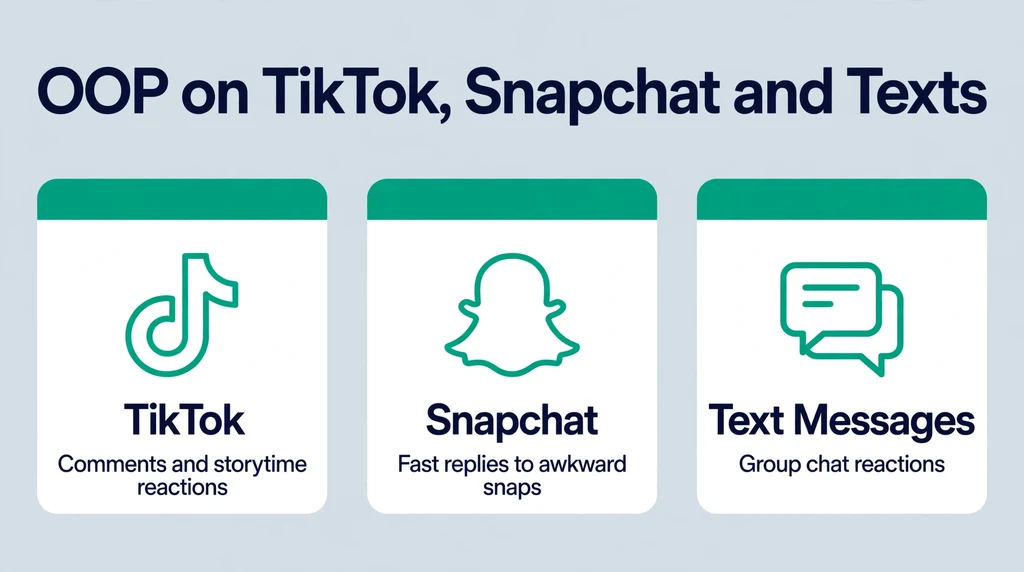
TikTok is where OOP feels most at home now. It fills comment sections under storytime videos, awkward moments, and dramatic reveals. Creators also say it out loud in videos, copying the mid sentence cutoff, and viewers answer in kind. Plenty of people use it with a wink now, because the phrase is old enough to feel retro, and that irony is part of the joke.
The retro flavor comes from 2019, the year “and I oop” peaked as a signature line of the VSCO girl aesthetic, alongside “sksksk,” scrunchies, and Hydro Flask jokes. It tipped into parody, and now it survives as a knowing throwback. Typing it today can mean genuine shock, playful nostalgia, or both.
Snapchat and regular texts use the plainer version more. A quick “oop” answers an awkward snap or surprising update without a whole sentence. In group chats it works like a reaction button: fast, funny, and easy to stack with everyone else’s replies.
Real Conversation Examples
Person A: “I just liked my crush’s photo from 2021 while stalking his profile”
Person B: “and i oop 😭”
Meaning: Person B is shocked and laughing. A deep-scroll like is exactly the awkward moment the full phrase was made for.
Person A: “oop, that voice note was meant for my mom, ignore it”
Person B: “lol too late, already played it twice”
Meaning: Person A is confessing their own slip. Here OOP is a quick, light “oops” that laughs at the mistake instead of over apologizing.
Person A: “She announced her engagement in the group chat and her ex is in there”
Person B: “oop”
Meaning: Person B is reacting to the awkwardness. One small word carries the whole “this is messy and I cannot look away” feeling.
Is OOP Rude?
OOP is not a rude word, but it can land wrong in the wrong moment. Usually it reads as playful shock, the text version of covering your mouth and laughing. Nobody is insulted by an “oop” under a funny fail or a dramatic story. It carries no profanity and no target.
The risky case is real bad news. If someone shares something genuinely painful, a bare “oop” can sound like you are entertained by it. The gap between “this is awkward” and “this is sad” is where OOP stumbles. When the moment is heavy, a real sentence beats a reaction word. When it is light and the sender is laughing at themselves, OOP is perfectly kind.
How to Reply When Someone Sends OOP
The best reply matches what the “oop” was doing. Laugh along when it is a reaction, reassure when it is a confession, and ask when you cannot tell which one it was.
Playful Replies
- “no because why did that actually happen 😭”
- “the way my jaw just dropped too”
- “and i oop is right, that was wild”
- “not the plot twist nobody asked for”
Supportive Replies
- “lol do not worry, we have all sent worse”
- “quick, delete it before they see”
- “it is fine, that could happen to anyone”
- “your secret is safe in this chat”
Replies When You Are Confused
- “wait, shocked oop or you messed up oop?”
- “what just happened, catch me up”
- “oop at what, I missed the story”
When to Use OOP
OOP fits casual texts with friends, TikTok and Instagram comment sections, group chats, and any chat where reaction slang is already the local language. It works best on small, funny, awkward moments: a spilled secret, a wild screenshot, a story with a twist. One word carries the whole reaction in fast moving chats. Use the full “and I oop” for the dramatic version, and plain “oop” for a quick flinch or light confession.
When to Avoid OOP
Skip OOP in work chats, school emails, and messages to anyone unlikely to know the reference, because an unexplained “oop” just looks like a typo. Avoid it under serious news and real apologies, since a reaction word can sound like mockery there. If the mistake is real and someone is affected, write the full apology instead. Clear beats cute whenever the message has weight.
Common Mistakes People Make With OOP
Reading every OOP as the programming term. In a casual chat, OOP is a reaction, not a résumé skill. The programming meaning lives in tech spaces and almost always arrives in all caps with code words around it. Check the company it keeps before you decode it.
Dropping it under genuinely bad news. OOP sounds entertained. Under a funny fail that is perfect, but under real sadness it can look like you are laughing at someone’s pain. Match the weight of the moment, not just the awkwardness of it.
Thinking it is still peak slang. “And I oop” peaked in 2019, and today it is often used as an ironic throwback. That is fine when your friends share the joke, but it can fall flat with people who never lived through the meme, or in chats expecting a more current reaction.
Slang That Shows Up Next to OOP
OOP travels with a small family of reaction words, and knowing the neighbors helps you read comment sections at speed.
| Term | Meaning | Main Difference |
|---|---|---|
| Oops | Admitting your own mistake | More sincere, less dramatic than oop |
| Oof | A wince of sympathy or pain | Reacts to something unfortunate, like a verbal flinch |
| Yikes | Strong cringe or disapproval | Bigger and more judgmental than oop |
| Sksksk | Keyboard-smash laughter from the VSCO era | Pure laughter typing, carries no shock by itself |
Where OOP Came From
The phrase “and I oop” comes from a single unscripted moment. On October 28, 2015, drag queen Jasmine Masters, a RuPaul’s Drag Race contestant, uploaded a YouTube video called “Jasmine Masters handle your liquor.” In it, she rants about friends who cannot handle their drink. Mid sentence, she interrupts herself with “And I, oop,” then explains, after a pause, that she had just hit a sensitive spot. The pain was real, the cutoff was an accident, and the clip mostly lived with Drag Race fans for years.
The explosion came in 2019. A clip of the moment spread as a reaction on Twitter in March, and by summer “and I oop” was the internet’s favorite way to say “I am shocked and I have no words.” It fused with VSCO girl culture, paired with “sksksk” in endless jokes, and GIPHY later named Masters’ clip its most used GIF of 2019. The roots matter too: the “oop,” “oops,” and “ope” interjection family has long lived in Black queer and drag culture, and the meme carried that expressive style to a mainstream audience.
Quick Recap
- In most texts, OOP is a playful reaction for surprise, embarrassment, or an awkward moment unfolding.
- “And I oop” is the full viral form, a mid sentence cutoff for moments that leave you speechless.
- After your own message, “oop” flips into a light confession: a quicker, funnier “oops.”
- In tech spaces, all caps OOP means Object-Oriented Programming, not a texting reaction.
- Keep OOP casual, and swap it for a real sentence when the news is genuinely serious.
Frequently Asked Questions
What does OOP mean in text?
OOP in text is a playful reaction meaning you are surprised, embarrassed, or watching something awkward unfold.
What does “and I oop” mean?
And I oop is the full viral phrase, used when something shocks you mid thought or mid sentence.
Is OOP the same as oops?
OOP works like a shorter, more dramatic oops, typed when a small mistake or awkward moment happens.
Where did “and I oop” come from?
Drag queen Jasmine Masters blurted it in a 2015 YouTube video, and the clip went viral in 2019.
Is OOP rude?
OOP is rarely rude, but dropping it under genuinely bad news can sound like you are mocking someone.
Final Thoughts
OOP looks like a typo and behaves like a facial expression, which is exactly why it survived its own meme cycle. Read it as a gasp: surprise, embarrassment, and amusement packed into three letters. Use the full “and I oop” when the moment deserves drama, the plain “oop” when you just slipped, and a real sentence when things turn serious. If you want the original 2015 clip and the full spread of the meme, Know Your Meme’s And I Oop page documents where it all started.
Related slang guides: OOF meaning in text, FOMO meaning in text, and TS meaning in text.