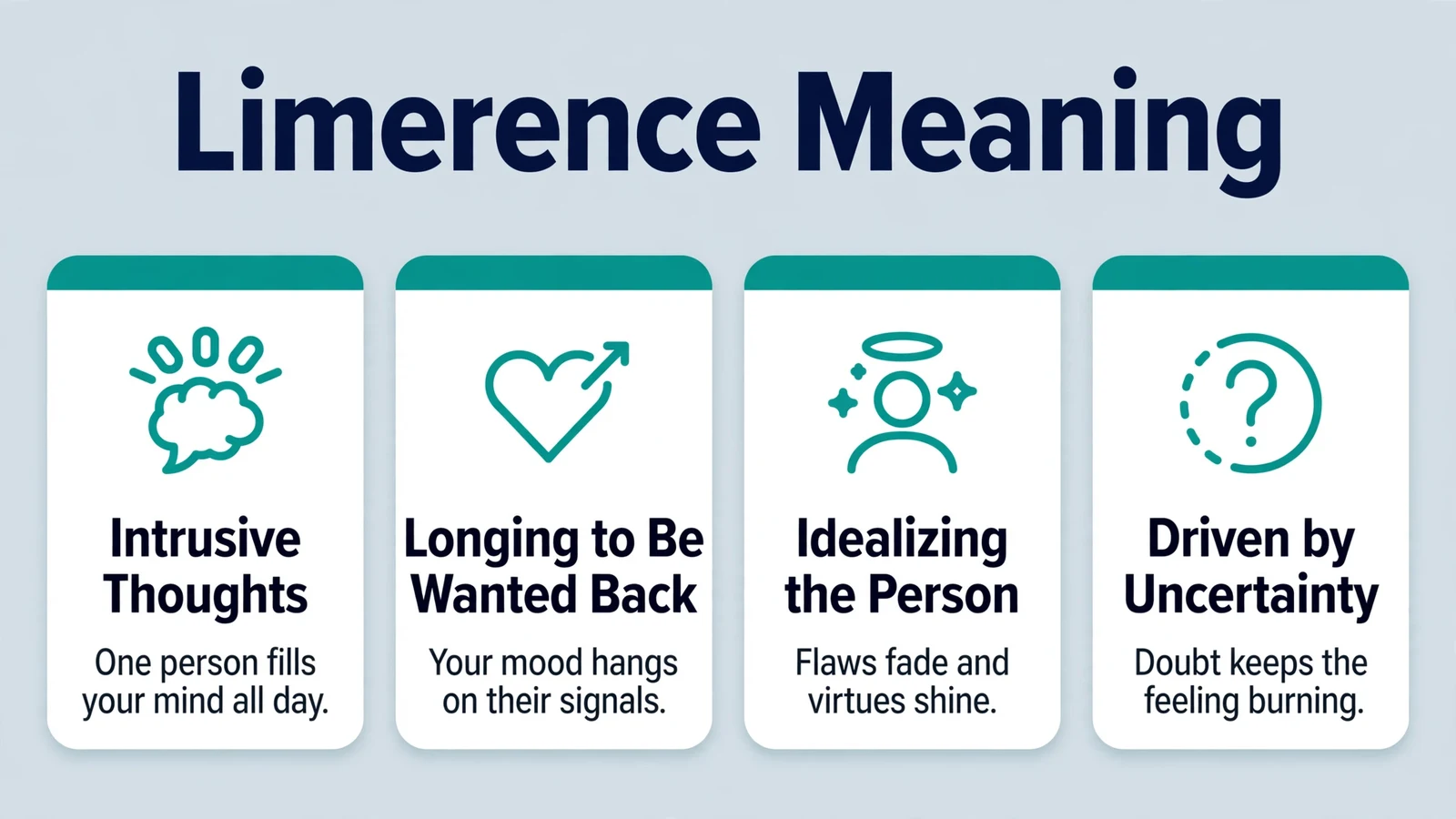
You think about one person from the moment you wake up. A short text from them lifts your whole day, and silence from them ruins it. If that sounds familiar, you may already know the limerence meaning from the inside.
Limerence is an involuntary state of intense infatuation with one person. It combines obsessive, intrusive thoughts about them with a powerful longing for your feelings to be returned. Psychologist Dorothy Tennov coined the word in 1979, after years of interviewing people about being in love. Her research gave this overwhelming state a name of its own.
This guide explains what limerence means, how it feels, and how it unfolds. You will also learn how it differs from love, how long it lasts, and what helps it fade.
What Does Limerence Mean?
A plain definition
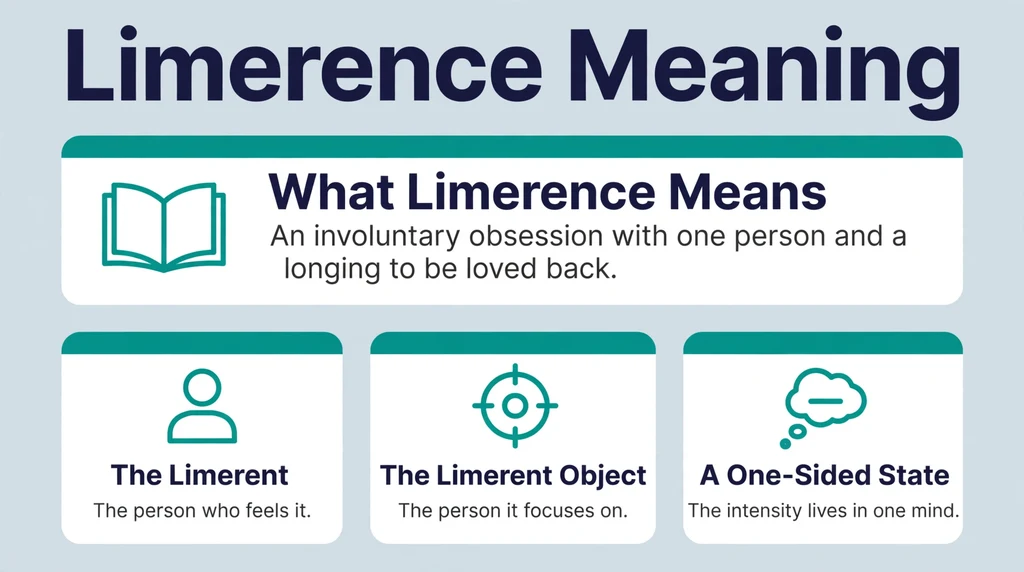
Limerence means being intensely, involuntarily preoccupied with one specific person. The feelings go far beyond ordinary attraction. You do not simply enjoy the person’s company or admire how they look. Instead, your emotional state hangs on one question: do they feel the same way about me?
Because of that, limerence is often described as a form of romantic obsession. The longing is aimed at reciprocation, not just at the person. You crave emotional union with them, and you crave proof that they want it too.
The two people in every limerence story
Tennov gave names to both sides of the experience. The person who feels limerence is called the limerent. Whoever the feelings focus on is the limerent object, usually shortened to LO.
This vocabulary matters more than it first seems. It highlights that limerence is a one-person state, even though it feels like a two-person bond. The LO may be a partner, a coworker, a friend, or someone barely aware of your feelings. Meanwhile, the intensity lives entirely inside the limerent’s mind.
How the word is used today
The word is pronounced LIM-er-ence, and it functions as a noun. Someone in the state is a limerent, and the adjective form is also limerent, as in a limerent episode or limerent feelings. There is no tidy verb form, so writers say someone is experiencing limerence or is in limerence.
For decades, the term lived mostly in psychology books and love research. In recent years, however, it has spread widely through articles, forums, and social media. Many people meet the word while searching for their own symptoms at 2 a.m. Recognizing their exact experience in a definition brings real relief. The state suddenly looks shared and studied, rather than private and shameful.
That popularity has a downside worth noting. Online, the word sometimes gets used for any strong crush at all. Specialists keep the narrower meaning: involuntary obsession, intrusive thought, and a life reorganized around one person’s signals.
Core Meaning of Limerence
It runs on longing for reciprocation
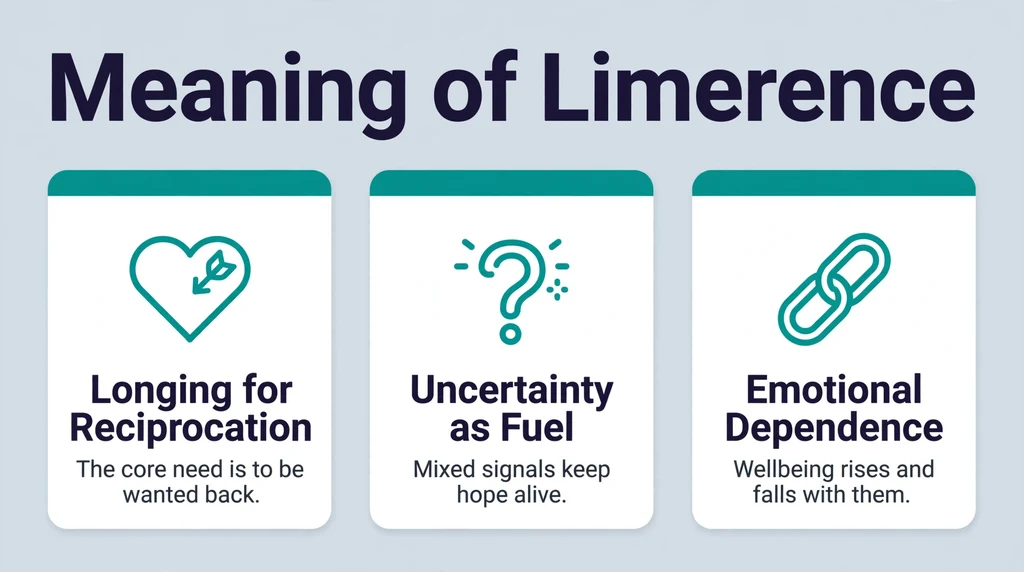
At the center of limerence sits one urgent need: the need to be wanted back. Compliments, attention, and small kindnesses from the LO feel like oxygen. In contrast, a cool reply or a missed call can feel like a verdict.
Tennov noticed that limerents do not only want a relationship. They want certainty that the LO returns their feelings. Until that certainty arrives, the mind keeps working overtime. It replays conversations, studies body language, and hunts for hidden meaning in ordinary words.
Uncertainty is the fuel
Paradoxically, limerence needs doubt to survive. If the LO clearly and consistently returns the feelings, the state usually settles into calmer affection. If the LO clearly rejects you, the state often begins to starve. Between those two poles, however, uncertainty keeps hope flickering.
Mixed signals are therefore powerful fuel. So are barriers, such as distance, another relationship, or a workplace rule. Each obstacle gives the imagination more work to do. As a result, limerence often burns hottest exactly where a relationship is hardest to build.
Emotional dependence on one person
As the state deepens, the limerent’s wellbeing quietly moves into the LO’s hands. A good day becomes a day when the LO was warm. A bad day becomes a day when the LO seemed distant. Self-esteem rises and falls on evidence that may not even be real.
Tennov described this as a general intensity that leaves other concerns in the background. Work targets blur. Friendships get postponed. Hobbies that once mattered wait untouched. The person is not being lazy or dramatic. Their attention has been reassigned, and almost everything else now queues behind one relationship question.
Origin of the Word Limerence
Dorothy Tennov and the 1979 book
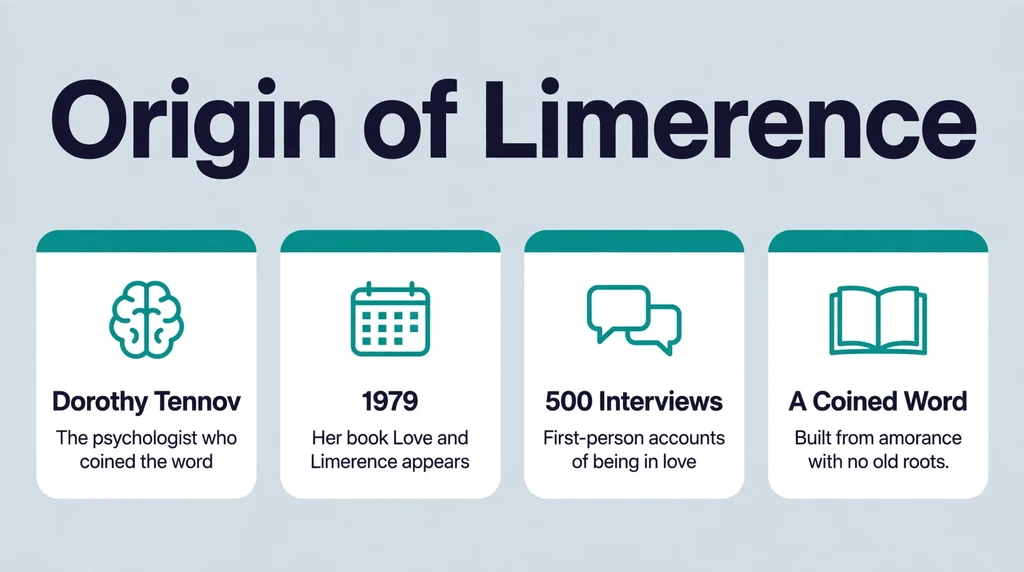
The word first appeared in *Love and Limerence: The Experience of Being in Love*, published in 1979. Its author, Dorothy Tennov, was a psychologist who had spent years studying how people fall in love. During the 1960s, she gathered interviews and questionnaires from more than 500 people about their experiences of being in love.
Again and again, her participants described the same pattern. Their thoughts circled one person without permission. Their moods rose and crashed on tiny signals. Existing words like love and infatuation did not capture that pattern cleanly, so Tennov built a new one.
Her method mattered as much as her conclusion. Instead of theorizing from an armchair, she collected first-person accounts in depth. People described dropping classes, losing sleep, and reorganizing whole days around a hoped-for meeting. Read together, the accounts showed a consistent syndrome hiding inside ordinary love stories. Tennov simply named what her interviewees had been living.
A word invented on purpose
Tennov formed “limerence” as an alteration of the older word “amorance.” She deliberately avoided roots from Latin or Greek. A made-up word, she reasoned, would arrive without baggage. Nobody could confuse it with everyday love talk.
Her caution was deliberate in another way too. She found that some people never experience this state at all. She called them nonlimerent, while stressing that there is no fixed nonlimerent personality. Almost anyone, she argued, could become limerent under the right conditions.
She also wanted to protect the word love itself. In her writing, she pointed out that dictionaries list dozens of meanings for love, covering acts, feelings, and relationships. One overloaded word could not do precise work. Limerence would name only the involuntary state, leaving love free to mean the chosen, caring bond.
Signs of Limerence
Intrusive thoughts and constant replaying
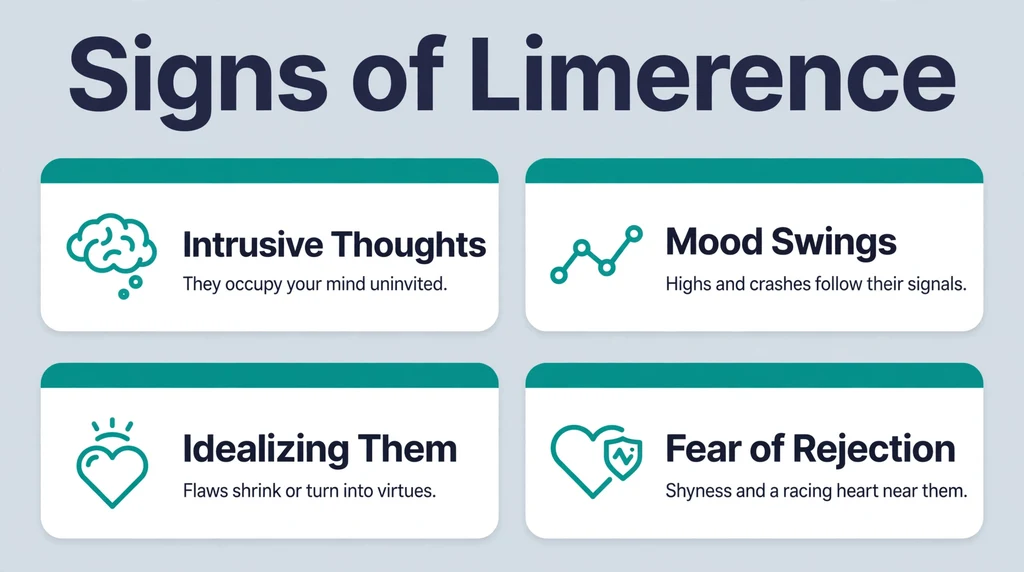
The clearest sign is a mind that will not switch off. Thoughts of the LO arrive uninvited during work, meals, and conversations with other people. You replay your last meeting in detail, then rehearse the next one. Drafting messages, deleting them, and drafting them again becomes a daily ritual.
These thoughts are not a choice, and that is the point. Tennov described limerence as first and foremost a condition of cognitive obsession. The person is not daydreaming for pleasure. The mind has locked onto one target and keeps returning to it, wanted or not.
Picture a normal workday. You open a spreadsheet, and within minutes you are rereading the LO’s last message instead. A quick check shows whether they are online. Then comes the calculation of when you might pass their desk. Hours can disappear this way, and the lost time often becomes a source of shame.
Mood swings tied to one person
In limerence, your emotional weather depends on the LO’s behavior, or on your reading of it. A warm smile can produce hours of energy and lightness. Tennov called this buoyancy, a feeling of walking on air. Meanwhile, a short reply or a distracted glance can drop you into anxiety and gloom.
Under strong uncertainty, many limerents report a physical ache in the center of the chest. Hope and despair alternate quickly, sometimes within a single day. Ordinary life continues, but it runs in the background of this emotional foreground.
Friends often notice the pattern before the limerent does. Every conversation bends back to one person and their latest signal. A single emoji gets analyzed like evidence in a trial. Meanwhile, genuinely good news, such as a promotion, barely registers unless the LO hears about it.
Idealizing the limerent object
Tennov borrowed a vivid term from the French writer Stendhal: crystallization. In this process, the LO’s real qualities get polished into something dazzling. Virtues look larger than they are. Flaws shrink, disappear, or even turn into charming quirks.
Importantly, limerents are not simply blind. Tennov found that people often see the flaws quite clearly. They just refuse to dwell on them, or they reinterpret each flaw as another hidden virtue. The admired image stays intact because the feeling needs it intact.
So a distant manner becomes depth. Unreliability becomes a busy, important life. Even rudeness can be recast as honesty. This mental editing is not lying, exactly. It is the imagination defending its central project, which is keeping hope alive at almost any cost.
Fear, shyness, and physical reactions
Around the LO, confidence often deserts the limerent. Tennov listed fear of rejection and an unsettling shyness among the core features, especially early on. The person who talks easily with everyone else may stumble, blush, or go quiet near the one person who matters most to them.
Physical reactions can join in as well. A racing heart, trembling hands, and flushing are commonly reported. Some people lose sleep or appetite during intense phases. The body, in short, responds as if something enormous is at stake.
Tennov also noted the strange relief of fantasy. Imagining a scene in which the LO finally declares love can calm the ache for a while. The relief is real but brief. Soon the uncertainty returns, and the mind goes back to scanning, hoping, and rehearsing.
Changing yourself to win approval
Another common sign is quiet self-editing. You adjust your opinions, clothes, schedule, and even your friendships to seem more appealing to the LO. Therapists who treat limerence flag this behavior often. The limerent is no longer simply expressing interest. They are auditioning, and every interaction feels like a test they might fail.
Small sacrifices then start to accumulate. You skip events the LO will not attend. You answer messages instantly, at any hour, from anywhere. Your own plans bend around their possible presence. Looking back, people often say the clearest sign was not the longing itself. It was how much of themselves they had quietly set aside.
The Stages of Limerence
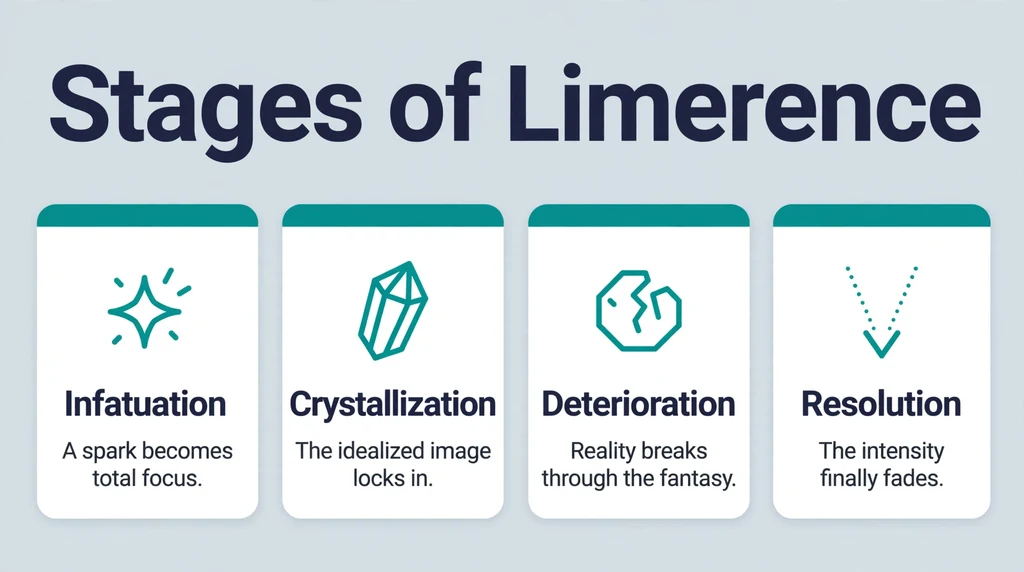
Tennov did not publish a formal stage model herself. Later writers and clinicians, building on her work, often describe limerence as unfolding in four stages. The labels vary a little between sources, yet the overall arc stays consistent. People do not always move through the stages in a tidy line, either. Many cycle between hope and deterioration several times before the state finally resolves.
Stage one: infatuation
Everything starts with a spark. After surprisingly little contact, the person captures your attention completely. Attraction intensifies within days or weeks. You think about them constantly, replay interactions, and feel a rush at every small exchange. At this point, the experience can still feel like an exciting crush, only stronger.
Stage two: crystallization
Next, the idealized image locks into place. The LO now seems to glow with exactly the qualities you value most. Obsessive thinking peaks in this stage. You analyze their words for hidden meaning, build fantasies about a shared future, and watch for any sign of returned feeling. Emotional dependence deepens here too, because your mood now answers to their signals.
Stage three: deterioration
Eventually, reality starts pushing through the fantasy. The LO’s responses may prove too thin to sustain the need. Rejection may become clear, or flaws may grow too large to polish away. This stage often brings the sharpest distress, along with desperate efforts to revive the connection. Sleep, work, and friendships frequently suffer most during deterioration.
Stage four: resolution
Finally, the intensity fades. Resolution arrives in one of three classic ways, which the next sections explore. Feelings may die out, turn into a real and calmer bond, or transfer onto someone new. The grip loosens, and ordinary priorities return to the foreground.
Limerence vs Love
What love does differently
Love, in the fuller sense, is grounded in the real person. It grows through shared experience, honest knowledge, and mutual care. A loving partner wants the other person’s wellbeing, whether or not every need of their own gets met. Love also tends to feel steady rather than frantic.
Therapists who explain this contrast make a similar point. Love involves respect, commitment, and a bond both people actively build. It does not require you to erase your own needs. Nor does it force you to perform for someone’s approval day after day.
Love also tolerates ordinary knowledge. A loving partner has seen the bad moods, the boring habits, and the failures. The bond survives that knowledge, and often deepens because of it. In love, the person’s flaws are neither polished nor hidden. They are simply part of someone you choose, with open eyes.
What limerence does differently
Limerence focuses on a question, not a person. The burning issue is whether the LO reciprocates, and the LO’s idealized image matters more than their real character. The state is also involuntary. People in love choose acts of care. People in limerence endure a condition they did not choose.
Another difference is direction. Love looks outward, toward the other person’s good. Limerence looks inward, toward relief from longing and doubt. That is why limerence can persist for someone unsuitable, distant, or even unkind. The feeling feeds on uncertainty, not on the person’s actual worth.
A practical test follows from this. Ask what you want most on your hardest day. If the honest answer is their happiness, love may be present. If the answer is proof that they want you, limerence is probably driving. The question sounds simple, yet limerents often find it painfully clarifying.
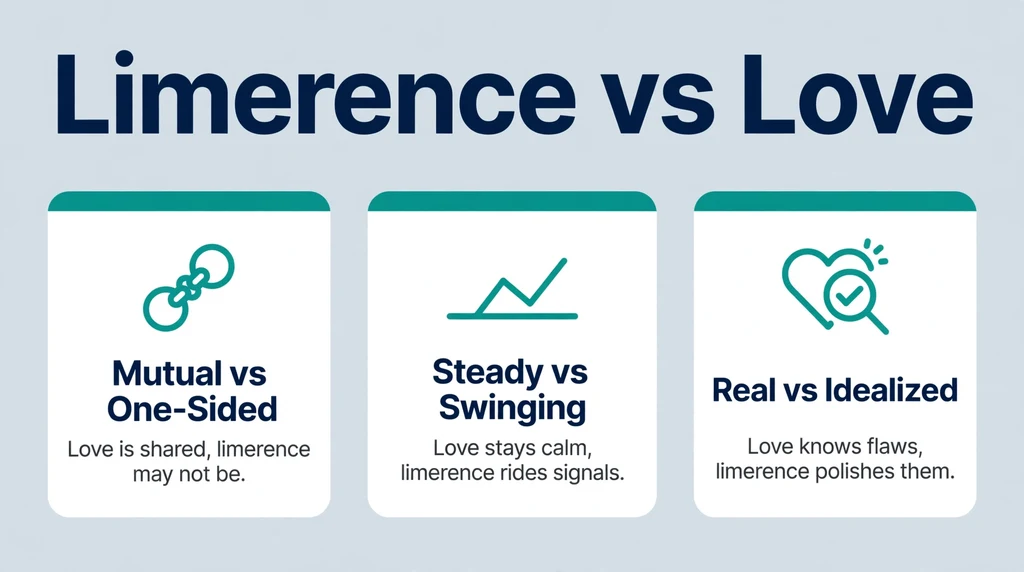
Put side by side, the pattern is consistent. Love is mutual, while limerence can be entirely one-sided. It is steady, too, where limerence swings with every signal. Real people stand at its center, flaws included, while limerence protects an idealized figure. And love leaves room for the rest of your life, while limerence keeps pushing that life to the margins.
Can limerence become love?
Yes, sometimes it can. Tennov herself noted that limerence can transform into affectionate bonding. When feelings are returned and two people build real knowledge of each other, the obsession may cool into attachment. The fantasy gives way to a relationship with an actual person.
However, the transformation is not automatic. If the bond was mostly fantasy, reality can disappoint both sides. Many limerent episodes end when the imagined person and the real person no longer match. What survives that meeting with reality has a chance to become love.
Time helps the sorting process. As the obsession cools, partners either discover genuine compatibility or discover the fantasy was the whole relationship. Neither outcome is a failure of character. Both are information, and honest couples use it.
Limerence vs Infatuation and a Crush
People often use infatuation, crush, and limerence as if they were synonyms. They overlap, yet psychologists draw useful lines between them. The biggest differences involve intensity, duration, and how much of your life the feeling takes over.
A crush is usually lighter and more playful. You enjoy thinking about the person, but your focus, sleep, and work stay largely intact. A common summary puts it neatly: limerence is what happens when a crush takes over your life.
Infatuation sits closer to limerence, and everyday speech blurs them constantly. Tennov, though, disliked the word infatuation. She felt it carried a dismissive, pejorative tone, as if the feelings were silly by definition. Limerence was her neutral term for the serious state underneath. In practice, writers often treat infatuation as the shallower, shorter cousin, and limerence as the deeper, more consuming condition.
Why do the labels matter at all? Because advice changes with the diagnosis you give yourself. A crush needs patience and perspective. Full limerence may need distance, boundaries, and support. Calling everything a crush can leave a suffering person underestimating their own state. Calling every crush limerence, on the other hand, pathologizes a normal pleasure. The distinctions protect both directions.
How Long Does Limerence Last?
The typical range
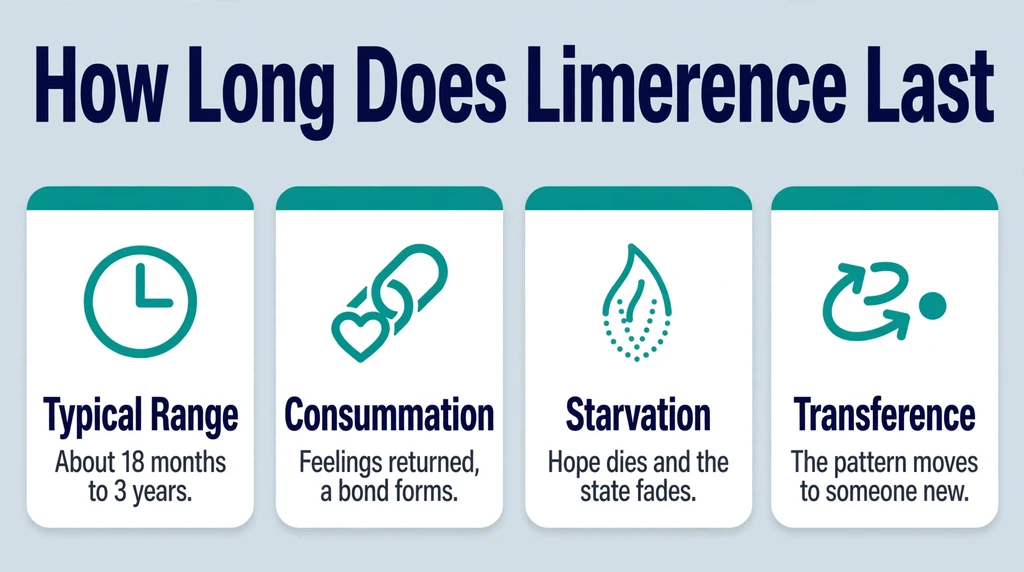
Tennov concluded that a typical episode lasts between 18 months and 3 years. That range surprises people who expect a crush to fade in weeks. It also reassures others, because it confirms that the state has a natural shelf life. Limerence feels permanent from inside, yet it is not.
What stretches or shortens an episode
Individual episodes vary, of course. Strong barriers and occasional contact can stretch an episode out. Every rare, warm encounter refills the hope that keeps the loop running. Clear answers tend to shorten it, one way or the other. A firm yes builds a relationship instead. A firm no, however painful, starts the starvation process.
Daily proximity matters as well. Seeing the LO at work every day feeds the cycle with fresh material. Distance, by contrast, gives the imagination less to work with. This is one reason episodes involving coworkers and classmates so often outlast episodes involving strangers.
The three ways limerence ends
In the end, Tennov described three classic exits. Consummation means the feelings are returned and the state settles into a relationship. Starvation means hope is finally extinguished, usually by clear rejection or long absence. Transference means the whole pattern lifts and lands on a new limerent object.
Each exit feels different. Consummation brings relief and reorganization. Starvation brings grief, then slow freedom. Transference, notably, restarts the cycle rather than ending the pattern. Recognizing which exit you are near can help you respond with clearer eyes.
What Causes Limerence?
Uncertainty and mixed signals
No single cause explains every case. Still, researchers and clinicians point to a consistent set of ingredients. Uncertainty about the other person’s feelings is the most important one. Without doubt, the obsessive loop has little to feed on.
Intermittent reinforcement adds power to that doubt. Occasional warmth, arriving unpredictably, keeps hope alive far longer than steady warmth would. A friendly text after days of silence can restart weeks of longing. Writers on love have compared this pattern to the pull of a slot machine, and the comparison is often repeated because it fits.
Vulnerability and life circumstances
Personal vulnerability plays a role as well. Periods of loneliness, low self-esteem, stress, or major life change can make a person readier to fixate. Some clinicians also link limerence with anxious attachment patterns, though that link is a clinical observation, not a settled diagnosis.
Unmet emotional needs can act as dry grass. A person who feels unseen in daily life may experience one person’s attention as rescue. The LO then carries far more than attraction. They seem to hold the key to being valued at all, which raises the stakes of every signal.
What brain research suggests
Finally, research on early intense romantic love finds brain reward activity resembling addiction. The comparison appears in studies of passionate love, where craving, focus, and relapse-like returns all show up. That resemblance may help explain the craving quality of limerence, even though experts still debate how far the addiction comparison should go. The honest summary is simple: the state has psychological triggers, and biology likely amplifies them.
Limerence in Everyday Life
Limerence for a coworker or friend
Modern limerence often starts in ordinary places. A coworker laughs at your jokes in meetings. A friend becomes the one person you text about everything. Daily contact supplies a steady stream of signals, and the imagination does the rest.
Workplace cases carry special risks. Professional boundaries limit what you can say or do, and that very barrier feeds the uncertainty. Meanwhile, your reputation and livelihood sit inside the same building as your obsession. Many people describe this as the hardest setting of all, because escape routes stay narrow.
Limerence inside a relationship or marriage
Limerence can also strike people who are already partnered. Someone married or committed may fixate on a colleague, an old flame, or a person met online. The state does not ask permission from existing vows. It arrives as chemistry plus uncertainty, and it can arrive at any age.
This situation creates a double strain. Guilt joins the obsession, because the limerent knows the fixation threatens a real bond. Relationship counselors treat such cases seriously for that reason. The fantasy promises rescue, yet acting on it usually trades a stable life for an imagined one.
Limerence for celebrities and people online
A newer setting involves people never met at all. Actors, musicians, streamers, and influencers can all become limerent objects. Social media supplies a feeling of access: stories, replies, and livestreams simulate closeness. The LO, however, does not know the limerent exists.
Tennov’s framework still fits. One-sidedness is no obstacle to limerence; in some ways it helps, because the real person can never contradict the fantasy. Distance keeps the crystal polished. Recognizing that mechanism often loosens its hold.
Common Misconceptions About Limerence
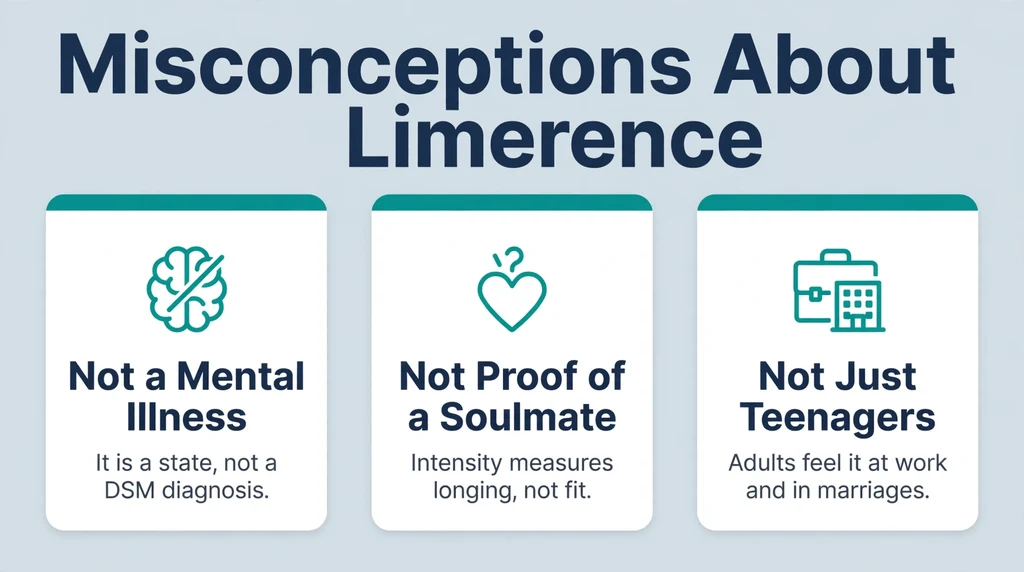
“It is a mental illness”
This is the most stubborn myth. Limerence is a descriptive concept, not a diagnosis. It does not appear in the DSM, the manual clinicians use to classify mental disorders. Tennov herself insisted that limerence is not a mental illness, and she described it as a normal, if illogical, human experience.
That said, normal does not always mean harmless. An intense episode can disrupt work, sleep, friendships, and existing relationships. If a state is painful and disruptive, it deserves support, whatever label it carries.
“It proves this person is your soulmate”
Intensity feels like evidence, but it is not. Limerence measures the strength of your longing and uncertainty, not the quality of a match. The LO may be kind or careless, compatible or completely wrong for you. The feeling grows either way, because it is powered by doubt rather than by knowledge.
In fact, Tennov’s research points the other way. The less you truly know the person, the more room the imagination has to build. A mysterious stranger can host a grander fantasy than a familiar partner ever could.
“It is just love with a fancier name”
The two states overlap, and one can grow out of the other. Even so, they are not identical. Love can exist quietly, without obsession, jealousy, or intrusive thought. Limerence, by definition, includes those consuming features. Tennov coined the word precisely because everyday language kept smearing the two together.
Consider a long marriage on an ordinary Tuesday. Nobody is scanning anybody’s tone for hidden signals. Care shows up as soup, lifts to appointments, and patience. That quiet pattern is love in action. Limerence, with its fevers and verdicts, belongs to a different register entirely.
“It only happens to teenagers”
Adults fall into limerence at work, in friendships, and inside marriages. The LO can be a colleague, an old friend, a celebrity, or someone met online. Dante’s lifelong fixation on Beatrice and Stendhal’s unrequited love for Mathilde are classic literary examples. This state belongs to no single age group.
Adult limerence often hides better than the teenage kind. It wears a suit, meets deadlines, and says nothing at dinner. Underneath, the same machinery runs: scanning, hoping, aching, and replaying. Age brings responsibilities, not immunity.
“The person must feel the same way”
Another myth says limerence requires encouragement from the LO. In truth, the state needs only hope, and hope can survive on almost nothing. A polite smile or a remembered kindness can sustain months of longing. Many limerent objects never offered any encouragement at all. Some never learned that the feelings existed. The engine runs on interpretation, not on invitation.
How to Get Over Limerence
There is no instant cure, but episodes do respond to clear steps. The strategies below appear again and again in guidance from therapists and counselors. They work by removing fuel: uncertainty, contact, and fantasy.
Starve the loop of signals
First, reduce contact where you honestly can. Distance starves the loop of fresh signals to analyze. For many people this means no casual texting, no late-night profile checking, and no engineered run-ins. Full no contact is not always possible with a coworker, yet firmer boundaries still help.
Second, challenge the fantasy on paper. Write down what you actually know about the person, including the flaws crystallization polished away. Reread the list when a wave hits. The goal is not to hate the LO. The goal is to see a person instead of a mirage.
Some people also seek a clear answer directly. Asking honestly, and accepting the reply, can end the uncertainty that feeds the state. The answer may hurt sharply and briefly, rather than slowly for years. Not every situation allows this step, of course. Where it is safe and appropriate, though, clarity is often kinder than hope.
Rebuild your own ground
Third, redirect the energy the state was consuming. Rebuild routines around friends, work, exercise, and projects that return visible results. Limerence often grows in empty emotional space, so a fuller life leaves it less room.
Expect the process to feel uneven. Good weeks may collapse after one accidental meeting or one old photograph. That collapse is not proof that nothing worked. Episodes fade in waves, and each wave usually returns weaker than the last. Patience is a strategy here, not just a virtue.
Finally, consider talking to a therapist if the episode will not loosen. Persistent obsession, deep low mood, or damage to an existing relationship are all good reasons to seek help. Support is not an overreaction. It is maintenance for a mind under real strain.
Frequently Asked Questions
What is the simple meaning of limerence?
Limerence is an intense, involuntary infatuation with one person. It involves constant intrusive thoughts about them and a strong longing for them to return your feelings. The state thrives on uncertainty about whether they care.
Is limerence a mental disorder?
No. Limerence is a descriptive term for an emotional state, not a clinical diagnosis. It does not appear in the DSM. Dorothy Tennov, who coined the word, explicitly argued that it is not a mental illness.
How long does limerence usually last?
According to Tennov’s research, a typical episode lasts between 18 months and 3 years. Some episodes end sooner, especially after a clear rejection. Ongoing mixed signals and occasional contact can stretch an episode longer. Tennov drew the range from the many first-person accounts she collected, not from a laboratory measure.
What is the difference between limerence and love?
Love is mutual, steady, and based on knowing the real person. Limerence is one-sided, unstable, and based on an idealized image plus uncertainty. Love centers on the other person’s wellbeing, while limerence centers on getting feelings returned.
Can limerence turn into real love?
Yes, it can. If the feelings are reciprocated and both people build genuine knowledge of each other, the obsession may settle into affectionate bonding. If the connection was mostly fantasy, it more often fades instead.
Who was Dorothy Tennov?
Dorothy Tennov was a psychologist who studied romantic love in the 1960s and 1970s. She interviewed more than 500 people about being in love. In 1979 she published *Love and Limerence*, the book that introduced the term limerence.
Can you feel limerence for a friend or coworker?
Yes. The limerent object can be almost anyone: a friend, a colleague, an ex, or even a public figure. The state depends on your longing and uncertainty, not on the type of relationship you have with the person.
How do you stop limerence?
Common strategies include limiting contact, avoiding signals like social media profiles, and writing down the person’s real flaws. Filling your schedule and talking with a therapist also help. The state fades fastest when hope and contact both run out.
Final Thoughts
Limerence meaning comes down to one sentence: it is the state of being involuntarily obsessed with someone whose feelings for you remain uncertain. Tennov’s word gave millions of people a cleaner way to describe an experience that love talk had blurred for centuries.
Knowing the name does not end an episode overnight. Still, it replaces shame with understanding, and it points toward the exits. You can stop asking what is wrong with you, and start asking what the state needs in order to fade. Usually the answer is less uncertainty, less contact, and more life of your own. For a clinical walk-through of how limerence differs from love, the Cleveland Clinic’s guide to limerence vs. love is a solid next read. Whatever you feel right now, remember that limerence is a state, and states pass.