A friend asks if you are still coming tonight. You want to say yes, fast and with feeling. So you type three small letters: ofc.
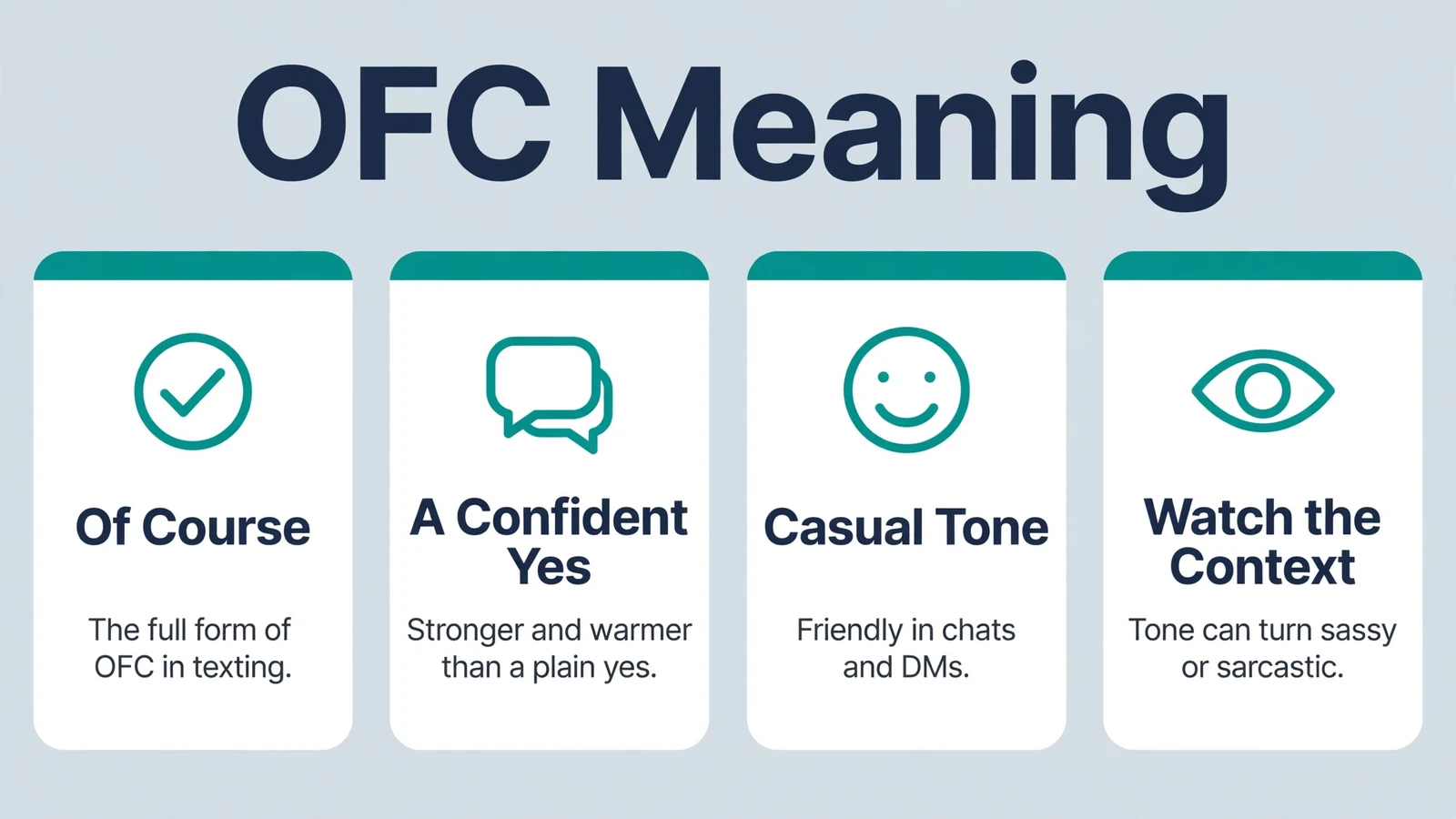
OFC means of course. It is the texting shortcut for the full phrase, and it works like a confident, friendly yes. People use it to agree, to confirm plans, and to reassure someone that a favor is no problem at all.
Still, three letters can carry more tone than you might expect. Depending on where OFC sits in a sentence, it can sound warm, playful, or a little sassy. This guide breaks down the meaning, the tone, real chat examples, and the best ways to reply. It also covers the other meanings you may meet in fandom spaces.
What Does OFC Mean in Text?
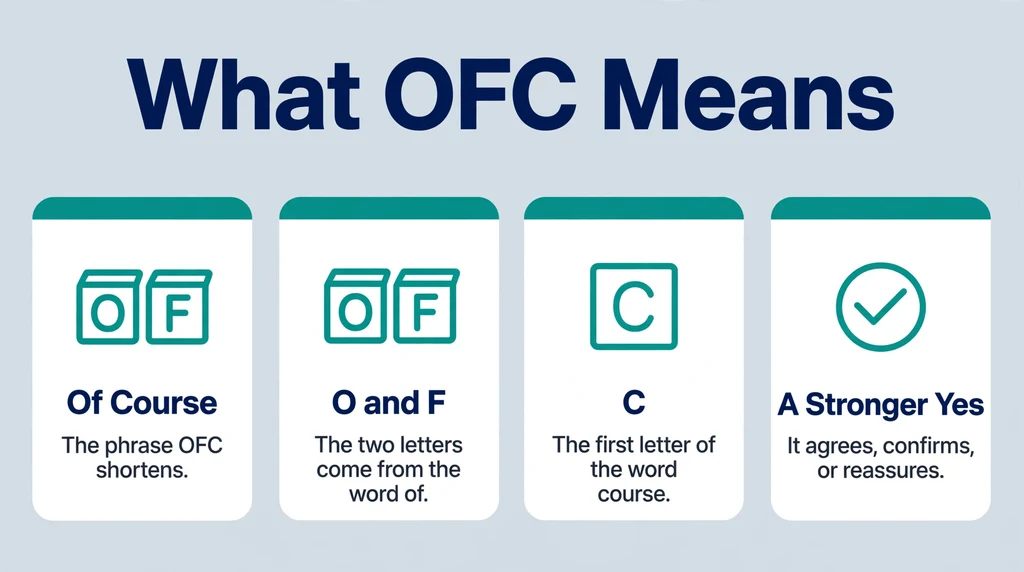
OFC is an initialism, which means it is built from the key letters of a longer phrase. The O and the F come from the word “of.” The C comes from the word “course.” Put them together and you get a three-letter shortcut for “of course.”
Dictionaries treat it as standard internet slang now. Dictionary.com lists OFC as a slang abbreviation for “of course.” Wiktionary does the same and labels it internet slang and text messaging shorthand. So this is not a niche code. It is one of the most common short replies in everyday chats.
In practice, OFC works as a stronger and warmer version of “yes.” A plain yes can feel flat or even reluctant on a screen. OFC adds energy. It tells the other person that the answer was never in doubt.
What OFC tells the other person
When someone sends OFC, they usually send one of three signals. First, they agree with what you said. Second, they confirm that a plan is on. Third, they reassure you that a request is easy and welcome.
For example, suppose you ask a friend to bring snacks to a movie night. A reply of “ofc” does more than approve the plan. It says the favor is small and the friend is happy to help. That extra warmth is exactly why people pick OFC over a bare yes.
OFC, Ofc, or ofc: does capitalization matter?
The meaning stays the same in every form. Most people type it in lowercase, as “ofc,” because lowercase feels calm and casual in chat. Sentence-start “Ofc” is just normal capitalization.
All caps, “OFC,” reads louder. It often signals excitement or strong emphasis, much like typing any word in caps. None of these forms is more correct than the others. The choice only adjusts the volume, not the message.
OFC as a complete reply on its own
Often, OFC needs no sentence around it at all. A single “ofc” can answer a whole question by itself. Chats are full of these one-word replies, and nobody finds them strange.
This works because the question carries the context. When a friend asks, “You are bringing the speaker, right?” the reply “ofc” fills in everything. It means yes, I remember, and I have it handled. Few shortcuts pack that much into three letters.
The Tone of OFC: Warm, Sassy, or Sarcastic?
OFC is short, so readers judge its tone from context. Word position, punctuation, and your relationship with the sender all matter. The same three letters can feel kind in one chat and cheeky in the next.
Luckily, the patterns are easy to learn. Once you see them, you can read almost any OFC correctly. You can also control the tone of your own messages with more care.
When OFC sounds warm
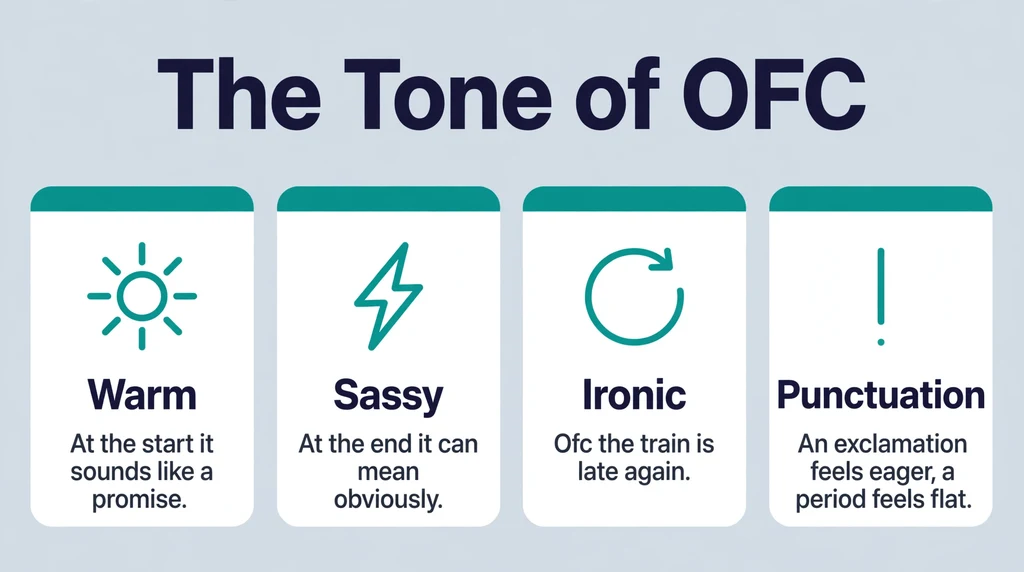
At the start of a sentence, OFC usually works as positive assurance. How-To Geek notes this pattern in its guide to the term. A message like “Ofc I will be there” promises attendance with confidence.
Warmth also grows when OFC answers a favor. If you ask, “Can you send me the notes?” an “ofc” reply says the task is no burden. In short, a leading OFC usually sounds generous and upbeat.
When OFC sounds sassy or snarky
At the end of a sentence, OFC often flips toward “obviously.” How-To Geek points out this snarkier use as well. Imagine asking a film fan if they have seen a famous trailer. A reply of “Yeah, ofc” hints that the question barely needed asking.
ProWritingAid describes the plain reading as the sassy “of course.” That label fits many real chats. The reply is still friendly, yet it carries a small teasing edge. Friends use this tone with each other all the time.
The ironic starter: “ofc this happens”
OFC can also open a sentence about something annoyingly predictable. In that spot it means “naturally” or “typical.” A classic example is “ofc the train is late again.”
Here the writer is not agreeing with anyone. Instead, they joke that bad luck was guaranteed. The humor comes from fake surprise. Most readers spot this use at once, because the sentence reports an unwelcome event.
Punctuation changes the feeling
An exclamation mark makes OFC sound cheerful and eager. “Ofc!” is a bright, happy yes. A period does the opposite. “Ofc.” can look flat, tired, or faintly annoyed.
No punctuation at all is the neutral default in fast chats. So if tone matters, choose your ending mark with care. One small character can change how the whole reply lands.
Why OFC gets misread so often
Text strips away voice, face, and timing. Those cues normally tell you whether “of course” is warm or annoyed. Without them, readers fill the gap with their own mood.
How-To Geek gives simple advice for this problem. Before you assume a sender is being snarky, ask them first. That habit prevents most OFC misunderstandings. A two-second check beats a day of guessing at someone’s mood.
How to Use OFC in Chats
Using OFC well is mostly about picking the right moment. It shines in fast, friendly exchanges where a full sentence would slow things down. It also works best when the answer is clearly positive.
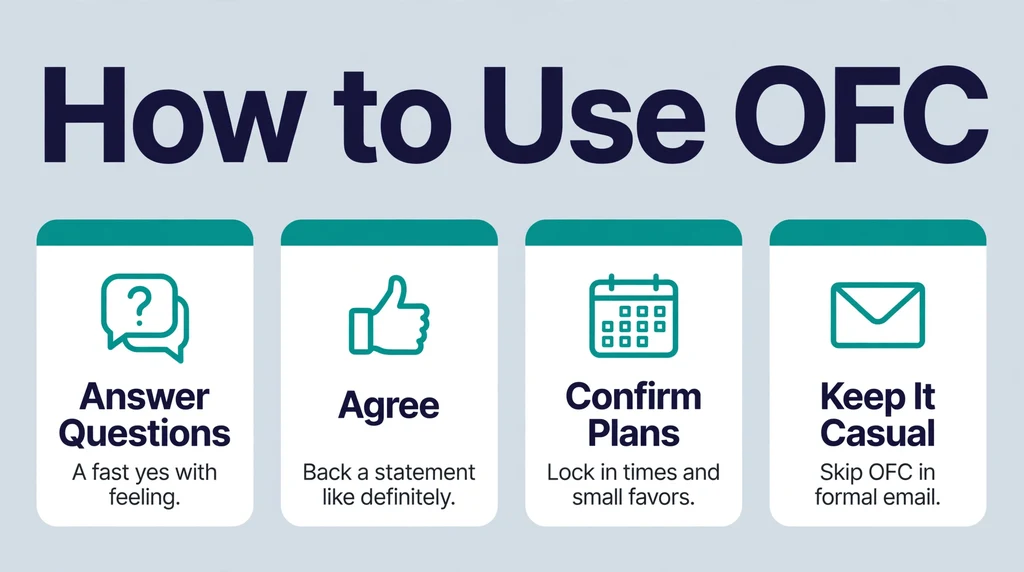
Below are the four jobs OFC does most often. Each one comes with the kind of message it answers. Match your reply to the job, and your OFC will land exactly as intended.
Answering a yes or no question
OFC is a natural reply when someone asks a question with an obvious yes. For instance, a friend might ask, “Are you coming to my birthday dinner?” You can answer, “Ofc, I would not miss it.”
Notice how OFC opens the reply and sets the tone at once. The short follow-up then adds detail. This pattern is the most common use of the abbreviation online.
Agreeing with a statement
OFC also works as a fast agreement marker. When a friend writes, “That exam was way too hard,” you might reply, “Ofc it was.” The reply says you share the opinion fully.
In this role, OFC behaves like “definitely” or “absolutely.” It adds weight to the agreement. As a result, the conversation feels lively instead of flat.
Confirming plans and giving permission
Plans need quick, clear confirmations, and OFC delivers them. A reply like “ofc, see you at seven” locks in both the yes and the time. Permission works the same way. “Can I borrow your charger?” “Ofc, it is in my bag.”
In both cases, OFC removes doubt in three letters. The other person can act on the answer right away. That speed is a big reason the shortcut survives in everyday chat.
Pairing OFC with emojis and reactions
Many chatters soften or boost OFC with a small extra signal. A thumbs-up or a smiling face pushes the reply firmly into warm territory. A laughing face marks the sassy reading as a joke.
These additions act like training wheels for tone. They cost almost nothing and prevent most misreadings. If you like using OFC with new contacts, one friendly emoji makes your intent much clearer.
Where OFC does not belong
OFC is casual, so keep it out of formal writing. Avoid it in job applications, formal emails, reports, and school essays. In those settings, write “of course” in full or use a plain yes.
Relaxed team chats sit in a gray area. Many coworkers use OFC on Slack or Teams with people they know well. Even there, read the room first. If the thread is serious, the full phrase is the safer choice.
Start of the reply or end of the reply
Placement gives you a simple tone dial. OFC at the start of your message sounds like a promise. “Ofc I will send it tonight” puts the commitment first and reads as reliable.
OFC at the end sounds like a verdict. “You knew that, ofc” judges the statement instead of answering a person. So when you want warmth, lead with OFC. Save the closing position for jokes among close friends who know your style.
OFC Examples in Real Conversations
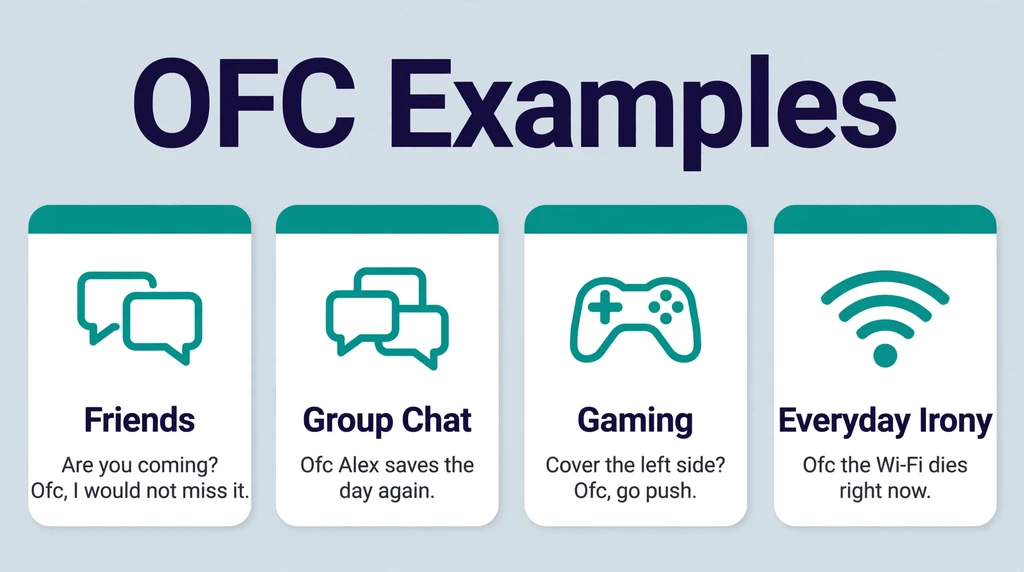
Reading real exchanges is the fastest way to learn tone. The dialogues below are original, but they mirror chats that happen every day. Watch where OFC sits in each reply, and notice how the feeling changes.
Some examples sound warm. Others carry the sassy edge described above. A few show the ironic starter at work.
Between friends
Sara: Are you still picking me up at six? Mina: Ofc. I am leaving in ten minutes. Sara: You are the best.
Here, OFC gives instant reassurance. Mina then adds a useful detail, which keeps the reply warm and practical.
Dan: Did you watch the final episode yet? Leo: Yeah, ofc. Twice. Dan: Twice? No spoilers, please.
In this exchange, OFC leans sassy. Leo treats the answer as obvious, and the added “twice” pushes the teasing tone further.
In a group chat
Group chat: Who is bringing drinks on Saturday? Alex: I can grab them. Priya: Ofc Alex saves the day again. Alex: Lol, someone has to.
Priya uses OFC with light irony here. She means “naturally, it is Alex again,” and the group reads it as a joke. Context and friendship make the meaning clear to everyone.
While gaming
Teammate: Can you cover the left side this round? You: Ofc, go push the objective. Teammate: Copy that.
Game chats reward speed, so short confirmations rule. OFC tells your teammate the job is handled. Nobody has to stop and type a full sentence mid-match.
The ironic everyday example
You: Ofc the Wi-Fi dies right before my presentation. Friend: Every single time. You: I swear it waits for me.
This time OFC opens a complaint, not an answer. It means “of course this would happen to me.” The friend reads the irony instantly, because the event is clearly unwelcome.
In a casual team chat at work
Manager (team chat): Can someone cover the Friday summary post? You: Ofc, I will draft it today. Coworker: Legend. I will add the charts. You: Perfect, send them by three.
Notice that OFC stays inside a relaxed internal thread. The same reply would be too casual for a client email. Audience, not the word itself, decides whether it fits.
Between partners and family
Mom: Will you call your grandmother this weekend? You: Ofc, Sunday morning like always. Mom: She will love that.
Family chats show the warm reading at its clearest. OFC promises the call and signals that no reminder was needed. A plain yes would work too, but it would carry less affection.
How to Reply When Someone Sends OFC
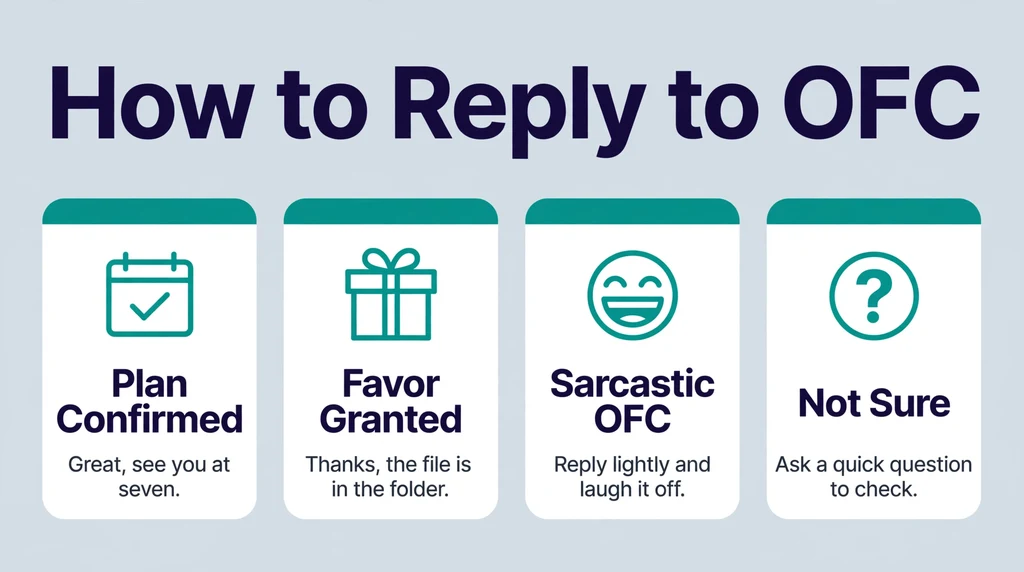
An OFC reply usually means the conversation can move forward. Your job is to keep it moving. Most of the time, a short and friendly response is all you need.
The right reply depends on what OFC was answering. A confirmed plan, a granted favor, and a sarcastic aside each call for something slightly different. The patterns below cover the main cases.
If OFC confirms your plan
When OFC locks in a plan, confirm the details and close the loop. Replies like “Great, see you at seven” work well. Adding the time or place again prevents mix-ups.
You can also add a small thank you. It takes two seconds and keeps the tone warm. After that, no long discussion is needed. The plan is set, and both sides know it.
If OFC answers your request
When someone grants your request with OFC, thank them and share any detail they need. For example, “Thanks! The file is in the shared folder.” This tells them exactly where to start.
If the favor has a deadline, state it kindly and once. Clear details save a follow-up chat later. Then let the person get on with it.
If OFC sounds sarcastic
Sometimes OFC arrives with a teasing or annoyed edge. The safest reply is a light one. A laughing emoji, a “fair enough,” or a playful comeback keeps things friendly.
Try not to take a sassy OFC personally. Among friends, that tone is usually a joke, not an attack. If the edge feels real, though, a calm question clears the air fast. Ask, “All good?” and let them explain.
If you are not sure what they meant
Occasionally, OFC lands in a chat where two readings are possible. Maybe the topic is plans, but the thread is in a fandom server. In that case, a quick check costs nothing.
Ask a short question, such as “You mean yes, right?” Most senders will clarify in seconds. Guessing wrong, by contrast, can stall a plan or start a needless argument. A tiny question is always cheaper than a misunderstanding.
Reply mistakes to avoid
Three habits cause most OFC friction. The first is answering a warm OFC with a cold one-word reply like “k.” That mismatch can make a kind exchange feel tense for no reason.
The second mistake is over-explaining after someone already agreed. OFC means the matter is settled, so trust it and move on. The third is replying to a sarcastic OFC with real anger. Check the tone first, laugh if you can, and save serious talks for serious messages.
OFC in Gaming and Online Communities

OFC thrives anywhere people type fast and talk faster. Gaming lobbies, Discord servers, and livestream chats are its natural home. In those spaces, a three-letter yes keeps the action moving.
Social platforms run on the same fuel. Comments and DMs reward replies that are quick, clear, and full of tone. OFC delivers all three at once.
In game chat and on Discord
Players use OFC to accept roles, confirm strategies, and answer callouts. A support player might type “ofc” when asked to guard a point. The team hears yes instantly and adjusts around it.
Discord works much the same way. Server chats move quickly, and long replies get buried. A short OFC confirms you read the plan and agree with it. It also pairs well with reaction emojis for extra speed.
On TikTok, Snapchat, and Instagram
On social apps, OFC appears in comments, captions, and direct messages. Fans reply “ofc” to creators as a cheerful yes. Friends use it in DMs to confirm plans or agree with a take.
The ironic starter is popular here too. Posts like “ofc my phone dies at 2 percent” use OFC to mean “typical.” That shared joke format travels well, because almost everyone has lived some version of it.
OFC across generations
OFC started in younger chat spaces, but it no longer belongs to one age group. Parents meet it in family group chats, and coworkers meet it in team channels. Most people decode it quickly once they see it used twice.
If you are teaching someone older, give them the expansion and one example. “Ofc, I will bring it Sunday” teaches both the meaning and the warm tone at once. After that, most new readers handle the sassy uses on their own.
Why speed made OFC stick
Fast spaces punish slow typing. By the time you write “of course” in full, the match or thread has moved on. OFC keeps your answer inside the moment where it matters.
Tone is the second reason. A bare “yes” can look bored or annoyed on a screen. OFC adds a small spark of confidence and goodwill. Together, speed and tone explain why this little shortcut is still everywhere.
OFC in comment sections
Public comments use OFC a little differently from private chats. Under videos and posts, “ofc” often answers a rhetorical question. A comment like “Did the sequel flop? ofc” performs agreement for the whole audience.
Creators see this pattern daily. Fans drop OFC to confirm they watched, agree with a ranking, or back a hot take. The word works as a tiny show of loyalty. It says the answer was never in doubt, and the community was always on the same side.
Other Meanings of OFC
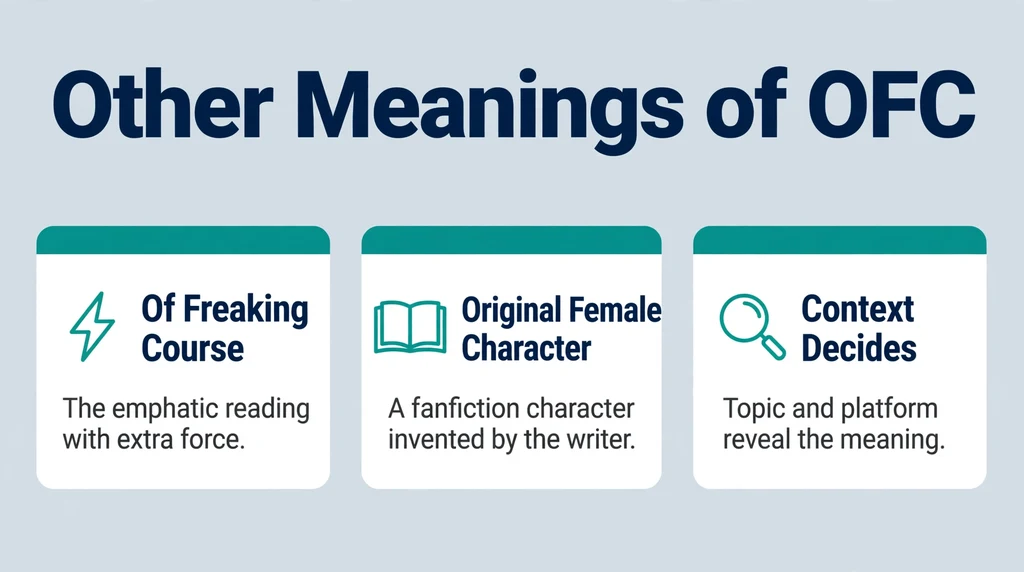
Most of the time, OFC means “of course,” and nothing else is going on. Still, the same three letters carry two other sourced meanings. Knowing them stops confusion when you meet OFC outside a normal chat.
Context separates the senses almost every time. A request for a favor points to “of course.” A fanfiction tag points somewhere else entirely.
Of freaking course: the emphatic reading
Some writers pack extra force into OFC. Read with more heat, the letters can stand for “of freaking course” or its ruder cousin with a full swear word. How-To Geek and ProWritingAid both note this emphatic reading.
The stronger version usually appears when someone is annoyed or amazed. The question feels so obvious that a plain yes seems too weak. Close friends swap this version as a joke, while strangers may read it as rude. When in doubt, assume the mild “of course” reading first.
Original Female Character in fanfiction
In fanfiction and fandom spaces, OFC means something completely different. There, it stands for “Original Female Character.” Dictionary.com defines it as a female character in a fanwork who does not exist in the source material. The fan writer invents her and places her among the canon cast.
An OFC is one kind of OC, or original character. The male counterpart is called an OMC, short for original male character. Writers list OFCs in story tags and summaries, so readers know a new face is joining the story.
Dictionary.com dates this fandom use to at least the early 2000s. Wiktionary even quotes Usenet fiction groups using OFC in 1999. The label has some baggage, though. Dictionary.com notes that some readers dismiss any OFC as a “Mary Sue,” an unrealistically perfect character. That label traces back to Paula Smith’s 1973 Star Trek fan story, “A Trekkie’s Tale,” which parodied idealized fan characters. Dictionary.com also notes that some writers see the quick dismissal of OFCs as rooted in sexism, since invented male characters rarely face the same criticism.
How to tell which meaning is meant
Three quick checks will sort almost every case. First, look at the topic. A favor, plan, or opinion points to “of course,” while a story tag points to fanfiction. Second, look at the platform. Text messages and game chats almost always use “of course.”
Third, look at the heat of the exchange. A calm chat means the plain reading. A fired-up reply to an obvious question may carry the emphatic reading. With those checks, OFC rarely stays a mystery for long.
OFC vs Similar Abbreviations
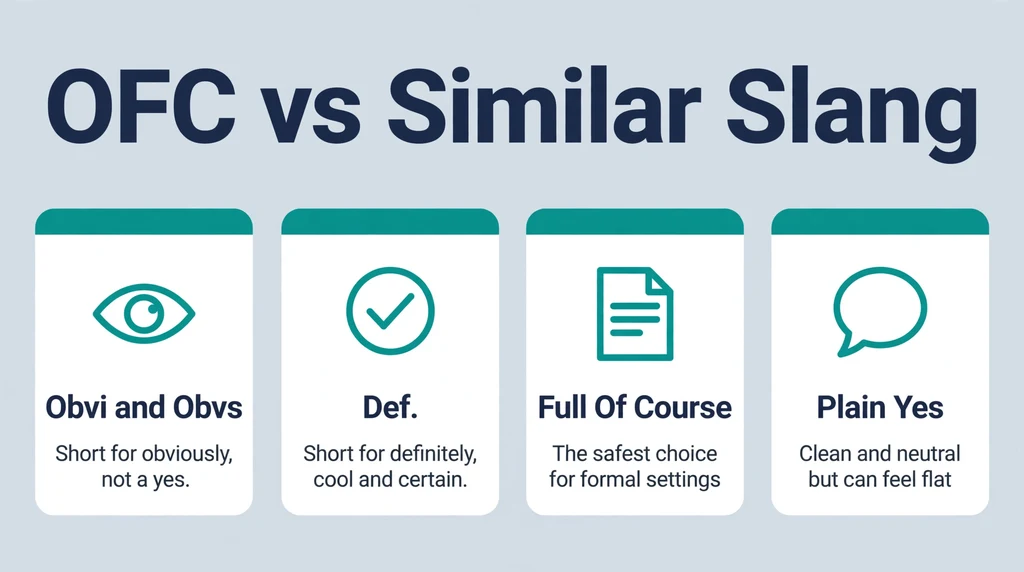
OFC belongs to a small family of casual affirmations. Each member says yes in a slightly different way. Picking the right one sharpens your tone, and reading them well prevents mix-ups.
The closest neighbours are “obvi,” “def,” and the full phrase itself. Here is how they divide the work.
OFC vs obvi and obvs
“Obvi” and “obvs” both shorten “obviously.” They claim that something is plain to see. OFC, by contrast, grants or agrees. That is the core difference between them.
Use OFC when you accept a request or back a statement. Reach for obvi when you point out that a fact is clear. Swapping them changes the message, so the choice is worth a second of thought.
OFC vs def
“Def” shortens “definitely.” It stresses certainty about a fact or a plan. For example, “I will def be there” locks in attendance with zero doubt.
OFC sounds warmer and more cooperative than def. It often carries a hint of “happy to help.” Def sounds cooler and more matter-of-fact. Both are friendly, yet OFC is the better pick when someone just asked you a favor.
OFC vs writing “of course” in full
The full phrase never causes doubt. It also suits any audience, including teachers, managers, and new acquaintances. When the relationship is unclear, those extra letters buy you safety.
OFC wins on speed and casual charm. It belongs with friends, teammates, and close contacts. So the rule is simple. Type OFC when the chat is casual and the tone is clear. Write the full phrase whenever doubt, formality, or a new audience enters the picture.
OFC vs a plain yes
A plain “yes” answers the question and nothing more. It is clean, neutral, and safe everywhere. However, on a screen it can read as tired or unwilling, especially as a lone reply.
OFC adds an attitude to the same answer. It says yes, and also says the yes was easy. Choose the plain yes for formal threads and serious news. Choose OFC when the chat is friendly and you want your willingness to show.
How OFC Spread: A Short Background
People often ask who invented OFC and when. The honest answer is that nobody knows, and no reliable source names a person or a year. That gap is normal for slang, and it is worth stating plainly.
What sources do agree on is the environment that produced it. OFC grew inside texting and online chat culture, alongside hundreds of similar shortcuts. The pressures of that world explain the word far better than any single origin story could.
Built for small screens and slow typing
Early chat rooms, forums, and text messages rewarded brevity. Typing on tiny keypads was slow, and some messaging systems limited characters. Short forms saved real effort, not just style points.
OFC fits that world perfectly. It cuts a nine-letter phrase down to three letters. Writers kept the shortcuts that felt natural, and OFC clearly did. Once a form spreads through friend groups and platforms, it no longer needs an inventor to survive.
No inventor and no launch date
Some websites state exact years for the birth of OFC as “of course.” Those claims do not come with evidence, so this guide does not repeat them. Dictionaries record what the word means, not the day someone first typed it.
The fanfiction sense is the exception, because fandom communities document their terms well. That is why sources can date OFC as Original Female Character to around the early 2000s, with a 1999 Usenet quote, while the texting sense has no such paper trail. Treat any precise coinage story for the texting sense with healthy doubt.
Common Mistakes When Using OFC
Most OFC problems come from setting, not spelling. The word itself is harmless and widely understood. Trouble starts when the audience, the moment, or the punctuation fights against your intent.
Watch for the three mistakes below. Each one is easy to make in a hurry. Each one is just as easy to avoid once you know it exists.
Using OFC in formal settings
The biggest mistake is dropping OFC into formal writing. A cover letter, a client email, or an exam answer needs the full phrase. Slang in those places looks careless, even when your intent is friendly.
The fix costs two seconds. Write “of course” in full, or restructure the sentence around a plain yes. Formal readers judge polish, and full words are part of that polish.
Assuming every OFC is rude
The second mistake happens on the reading side. Many people meet one sarcastic OFC and start hearing attitude in all of them. In reality, most OFC replies are warm or neutral.
Relationship is your best guide here. Friends who joke with you daily are probably still joking. A short check-in question settles any real doubt. Generous reading keeps chats healthier than suspicious reading does.
Using OFC for every single answer
The third mistake is repetition. If every reply you send is “ofc,” the word loses its spark. Worse, it can start to sound lazy, as if you are answering on autopilot.
Mix your affirmatives instead. Rotate between “yes,” “definitely,” “sure thing,” and the full “of course.” Variety keeps your tone human, and each OFC lands with its full warmth when you save it for the right moment.
Frequently Asked Questions
What does OFC mean in text?
OFC means “of course” in texting and online chat. People use it as a quick, confident yes. It can agree with a statement, confirm a plan, or reassure someone that a favor is fine. You will see it in texts, DMs, comments, and game chats, usually in lowercase as “ofc.”
Is OFC rude?
Usually, no. OFC is friendly in most chats, especially at the start of a reply. It can sound sassy when it ends a sentence about something obvious. A very heated reply may also carry the emphatic “of freaking course” reading. Context and your relationship with the sender decide the tone.
What does OFC mean on Snapchat and TikTok?
It means the same thing there: “of course.” On Snapchat and TikTok, people use OFC in DMs and comments to agree or confirm. You will also see the ironic starter form, like “ofc this happens to me,” which means “naturally” or “typical.”
How do you reply to OFC?
Match the job OFC just did. If it confirmed a plan, repeat the time or place and say thanks. If it granted a favor, share the details the person needs. If it sounded sarcastic, answer lightly and do not take the teasing personally. Short, warm replies keep the chat flowing, which is the whole point of the shortcut.
What does OFC mean in fanfiction?
In fanfiction, OFC stands for “Original Female Character.” It means a female character the fan writer invented who is not part of the original work. Writers flag OFCs in tags and summaries so readers know what to expect.
Is OFC the same as “obviously”?
Not quite. OFC mainly agrees, confirms, or grants. “Obviously” claims that something is plain to see. The two overlap only in the sassy use of OFC at the end of a sentence, where it can feel close to “well, obviously.”
Can I use OFC in a work email?
It is better not to. OFC is informal slang, so formal email deserves the full phrase “of course.” In a relaxed team chat with close coworkers, OFC is common and harmless. When the audience is senior or new, write the words out in full.
What is the full form of OFC?
The full form is “of course.” The O and F come from “of,” and the C comes from “course.” In fandom writing only, the same letters form a different full form: “Original Female Character.”
Final Thoughts
OFC is a tiny shortcut with a clear job. It says “of course” in three letters, and it brings warmth, speed, and confidence along with it. Position and punctuation tune its tone, from a generous yes to a teasing “obviously.”
Read the context before you judge any OFC you receive. Most senders mean the friendly version, and a quick question fixes the rare unclear case. For a deeper look at the term and its uses, the How-To Geek guide to OFC is a solid next read.
Now you can use OFC with confidence. Keep it casual, keep it kind, and save the full phrase for formal ground. Three letters are enough to carry a warm and certain yes, as long as you send them to the right audience at the right moment.